One-Shot Architecture Search Using Embedding Spaces
1. Motivation and Challenges in Neural Architecture Search
Motivation and Challenges in Neural Architecture Search
Neural Architecture Search (NAS) aims to automate the design of optimal neural network architectures, reducing the reliance on human expertise and trial-and-error. Traditional NAS methods, such as reinforcement learning-based or evolutionary approaches, require thousands of architecture evaluations, making them computationally prohibitive. For instance, Zoph & Le (2017) demonstrated that training a single architecture on CIFAR-10 could take up to 1800 GPU days, highlighting the inefficiency of exhaustive search strategies.
Computational Bottlenecks in NAS
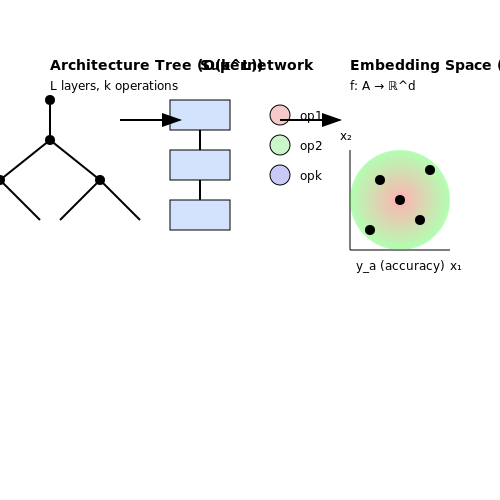
The primary challenge in NAS lies in the combinatorial explosion of possible architectures. For a network with L layers and k candidate operations per layer, the search space grows as O(kL). Evaluating each candidate independently is infeasible for large-scale problems. One-shot NAS methods address this by training a single supernetwork that subsumes all possible architectures, enabling weight sharing and gradient-based optimization. However, this introduces new challenges:
- Supernetwork Optimization: Co-adaptation of operations leads to biased performance estimates, as later layers depend on earlier choices.
- Discrete Search Space: The supernetwork’s continuous relaxation must be discretized post-training, often resulting in suboptimal architectures.
- Embedding Space Alignment: Architectures must be mapped to a latent space where proximity correlates with performance, requiring careful metric design.
Embedding-Based NAS: Key Motivations
Embedding spaces provide a structured representation of architectures, enabling efficient similarity comparisons and gradient-based search. The core idea is to learn a mapping f: A → ℝd, where A is the architecture space and d is the embedding dimension. This allows:
where ya is the validation accuracy of architecture a, and p(a) is a sampling distribution. By optimizing this objective, the embedding space captures performance-related features, enabling one-shot search via nearest-neighbor lookup or Bayesian optimization.
Practical Challenges
Despite its promise, embedding-based NAS faces several hurdles:
- High-Dimensionality: Architectures with varying topologies require embeddings that preserve both local and global structure.
- Noisy Performance Signals: Validation accuracy is stochastic, necessitating robust regression techniques.
- Generalization: Embeddings trained on small proxy tasks (e.g., CIFAR-10) often fail to transfer to larger datasets (e.g., ImageNet).
Recent work, such as BANANAS (White et al., 2021), tackles these issues by combining graph neural networks with Bayesian optimization, achieving state-of-the-art results with fewer than 100 architecture evaluations.
Key Concepts: One-Shot Learning and Embedding Spaces
One-Shot Learning
One-shot learning refers to the ability of a model to recognize or classify new instances of a class from a single or very few examples. Traditional deep learning models require large labeled datasets, but one-shot learning aims to generalize from minimal data by leveraging prior knowledge. This is particularly useful in scenarios where data collection is expensive or impractical, such as medical imaging or rare object recognition.
The core challenge in one-shot learning is to develop a model that can extract meaningful features from a single example and compare it effectively to unseen instances. Metric-based approaches, such as Siamese networks and prototypical networks, learn a similarity function in an embedding space where inputs from the same class are closer together than those from different classes.
Here, f is an embedding function that maps inputs into a lower-dimensional space, and d measures the Euclidean distance between embeddings. The model is trained to minimize intra-class distances while maximizing inter-class distances.
Embedding Spaces
An embedding space is a lower-dimensional continuous vector space where high-dimensional data points are mapped such that semantically similar items are closer together. In the context of neural architecture search (NAS), embedding spaces enable efficient comparison of different architectures by representing them as fixed-length vectors.
Key properties of a well-constructed embedding space include:
- Preservation of Topology: Architectures with similar performance should be mapped nearby.
- Smoothness: Small changes in the embedding should correspond to small changes in architecture performance.
- Interpretability: Directions in the space should correspond to meaningful architectural features (e.g., depth, width).
Embedding spaces are typically learned using techniques like autoencoders or graph neural networks (GNNs), where architectures are treated as graphs of operations and connections. The embedding function f can be formulated as:
where G is the computational graph of the architecture, V is the set of nodes (operations), h_v are node features, and W, b are learnable parameters.
One-Shot Architecture Search
One-shot NAS leverages a supernet—a large over-parameterized network that encompasses all possible candidate architectures. The supernet is trained once, and its weights are shared across all sub-architectures. The search process then reduces to evaluating sub-architectures by their performance in the embedding space derived from the supernet.
Key advantages include:
- Efficiency: Avoids training each candidate architecture from scratch.
- Scalability: Enables search over vast architecture spaces with minimal computational overhead.
- Transferability: Embeddings can be reused across different tasks with fine-tuning.
The performance predictor in embedding-based NAS can be modeled as a Gaussian process:
where y is the validation accuracy, and μ, σ² are mean and variance functions learned from sampled architectures.
Advantages of One-Shot Methods Over Traditional NAS
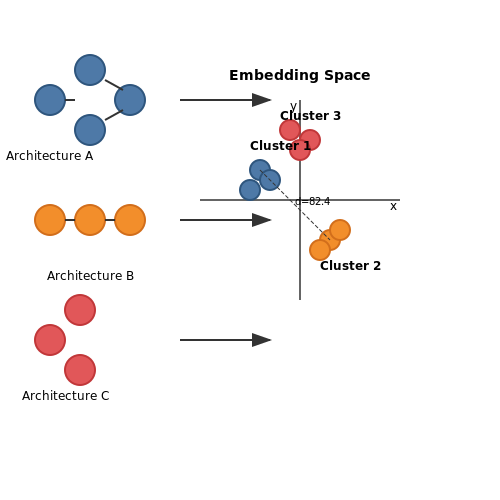
Traditional Neural Architecture Search (NAS) approaches suffer from prohibitive computational costs due to their iterative training and evaluation of candidate architectures. One-shot NAS methods address this by leveraging weight sharing across architectures within a supernet, enabling orders-of-magnitude faster search while maintaining competitive performance.
Computational Efficiency
The key advantage lies in amortizing the training cost across all possible architectures. Where traditional NAS requires training each candidate from scratch, one-shot methods train just once. The computational savings can be quantified as:
where N is the number of candidate architectures, Ttrain is individual training time, Tsupernet is supernet training time, and k is the number of architectures evaluated after supernet training. For N = 10,000 architectures, one-shot methods typically achieve 100-1000× speedup.
Improved Gradient-Based Optimization
One-shot methods enable differentiable architecture search through continuous relaxation of the discrete architecture space. This allows applying gradient descent to optimize both architecture parameters θ and model weights w jointly:
The gradient ∂ℒ/∂θ provides direct signal for architecture improvement, unlike black-box optimization in traditional NAS. Techniques like DARTS further improve this by using second-order approximation for more stable optimization.
Better Architecture Space Exploration
Weight sharing in one-shot methods creates an embedding space where architectural similarities are preserved - similar architectures have similar performance. This enables:
- Efficient pruning: Bad architectures can be identified early without full training
- Transferable search: Supernet trained on one dataset can accelerate search on new datasets
- Architecture interpolation: New architectures can be generated by interpolating between high-performing ones
Practical Deployment Advantages
For industrial applications, one-shot NAS provides crucial benefits:
- Hardware-aware search: Latency/throughput can be directly optimized during supernet training
- Reproducibility: Deterministic search outcomes compared to random search-based traditional NAS
- Resource predictability: Fixed computation budget regardless of search space size
Empirical results show one-shot methods match or exceed traditional NAS performance on benchmarks like NAS-Bench-201 while reducing search time from 200 GPU-days to under 1 GPU-day. The ENAS approach demonstrated this could be achieved with just 16 hours on a single GPU.
2. Defining Architecture Embeddings
2.1 Defining Architecture Embeddings
Architecture embeddings map neural network topologies into a continuous vector space, enabling efficient comparison and optimization. Given a neural architecture A, its embedding e(A) ∈ ℝd captures structural and operational characteristics through a fixed-length representation. This facilitates gradient-based optimization in the embedding space rather than discrete architecture sampling.
Mathematical Formulation
Let G(A) denote the computational graph of architecture A, comprising nodes (operations) and edges (data flow). The embedding function f: G → ℝd must satisfy:
where 𝒟 is a graph dissimilarity metric. Common approaches include:
- Graph Neural Networks (GNNs): Iterative message passing aggregates node features into a graph-level embedding.
- Path Encoding: Enumerates all computational paths, weighted by their contribution to the network's output.
Practical Implementation
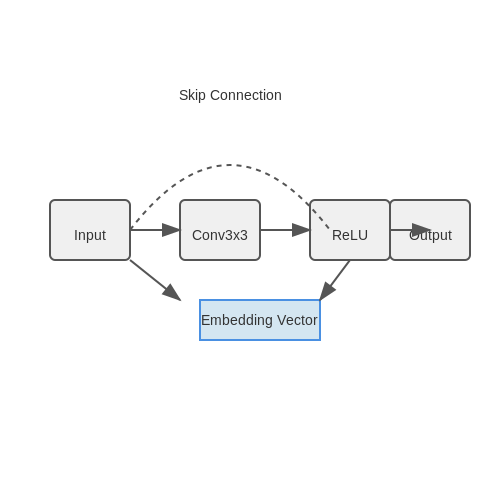
For a convolutional neural network, the embedding might encode:
where opi represents learned vectors for layer types (e.g., 3×3 convolution, ReLU), and φ is a dimensionality reduction network. The following diagram illustrates the embedding process for a residual block:
Key Properties
- Differentiability: The embedding space must support gradient flow for architecture optimization.
- Completeness: Distinct architectures should map to distinct embeddings with high probability.
- Compactness: The embedding dimension d should be much smaller than the raw architecture description.
Case Study: NASBench Embeddings
In NASBench-101, architectures are embedded via adjacency matrix flattening combined with one-hot operation encoding. This yields a 567-dimensional vector, which is then compressed to 32D using PCA. The resulting space exhibits smooth performance gradients, enabling efficient architecture interpolation.
2.2 Metric Learning for Architecture Similarity
Metric learning provides a principled framework for quantifying architectural similarity in neural architecture search (NAS). Given two neural network architectures A and B, we aim to learn a distance function d(A,B) that captures their functional and topological relationships in an embedding space. This distance metric should satisfy three key properties:
- Non-negativity: d(A,B) ≥ 0
- Symmetry: d(A,B) = d(B,A)
- Triangle inequality: d(A,C) ≤ d(A,B) + d(B,C)
Architecture Representation
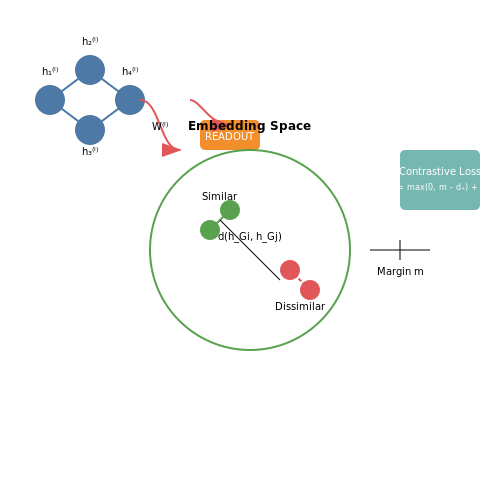
We first encode architectures into fixed-dimensional vectors using graph neural networks (GNNs). For an architecture represented as a directed acyclic graph G = (V,E) with nodes V (operations) and edges E (connections), we compute node embeddings through message passing:
where hv(l) is the embedding of node v at layer l, W(l) are learnable weights, and σ is a nonlinear activation. The graph-level embedding is obtained through a readout function:
Contrastive Metric Learning
We optimize the embedding space using a contrastive loss that pulls similar architectures together while pushing dissimilar ones apart. Given a batch of N architectures, we minimize:
where yij indicates whether architectures i and j are similar (1) or dissimilar (0), and m is a margin hyperparameter controlling the separation of dissimilar pairs.
Practical Implementation
In practice, we implement this using a siamese network with weight sharing between the twin GNN encoders. The training procedure involves:
- Sampling architecture pairs from the search space
- Computing their performance metrics (accuracy, latency, etc.)
- Defining similarity labels based on performance deltas
- Optimizing the contrastive loss with gradient descent
The resulting embedding space enables efficient nearest-neighbor search for one-shot NAS, where new architectures can be quickly evaluated by comparing them to previously seen ones in the learned metric space.
Advanced Variants
Recent improvements incorporate:
- Attention mechanisms: To weight important architectural motifs differently
- Multi-task learning: Jointly optimizing for multiple performance metrics
- Hyperbolic embeddings: Better capturing hierarchical relationships in architecture spaces
3. ENAS: Efficient Neural Architecture Search
ENAS: Efficient Neural Architecture Search
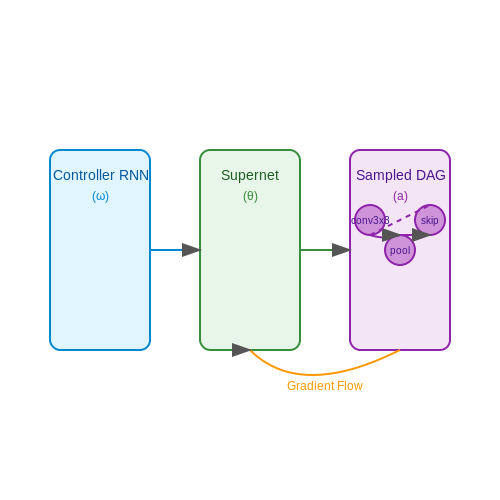
Efficient Neural Architecture Search (ENAS) introduces a weight-sharing mechanism to drastically reduce the computational cost of neural architecture search (NAS). Unlike traditional NAS methods that train each candidate architecture from scratch, ENAS trains a single supernet where subgraphs represent different architectures. This allows gradients to be backpropagated through shared weights, enabling efficient exploration of the search space.
Controller and Shared Parameters
The ENAS framework consists of two components: a controller (typically an RNN) and the shared child model. The controller samples architectures by selecting operations (e.g., convolution, pooling) and connections between nodes in a directed acyclic graph (DAG). The child model's weights are shared across all sampled architectures, enabling rapid evaluation.
Here, \(\theta\) represents the shared weights, \(\omega\) the controller parameters, and \(\pi(a; \omega)\) the policy for sampling architecture \(a\). The gradient is approximated via Monte Carlo sampling.
Reinforcement Learning Formulation
The controller is trained using reinforcement learning to maximize the expected reward \(R(a)\), typically the validation accuracy of the sampled architecture \(a\). The policy gradient update is:
ENAS employs the REINFORCE algorithm with moving average baseline reduction to stabilize training. The search space includes:
- Binary decisions for skip connections
- Discrete choices for operation types (convolution, identity, pooling)
- Continuous parameters like filter sizes or dilation rates
Micro vs. Macro Search
ENAS can operate in two modes:
- Micro search: Designs repeating cell structures that are stacked to form the full network. The controller decides the operations and connections within a single cell.
- Macro search: Directly constructs the entire network architecture, including layer types and connectivity patterns.
Micro search is more computationally efficient and typically produces better-performing architectures due to its constrained search space. The discovered cells often resemble manually designed building blocks like residual connections or separable convolutions.
Performance and Limitations
ENAS achieves competitive performance on CIFAR-10 (test error ~2.89%) while using 1000x fewer GPU hours compared to traditional NAS methods. However, it faces challenges:
- Weight interference: Shared weights may not optimally represent all architectures.
- Controller collapse: The RNN may prematurely converge to suboptimal architectures.
- Discrete search: Gradient-based optimization is not directly applicable to the architecture parameters.
Recent extensions address these issues through techniques like differentiable architecture search (DARTS) and progressive shrinking (ProxylessNAS).
DARTS: Differentiable Architecture Search
DARTS (Differentiable Architecture Search) reformulates neural architecture search (NAS) as a continuous optimization problem, enabling gradient-based methods to efficiently discover high-performing architectures. Unlike traditional NAS approaches that rely on reinforcement learning or evolutionary algorithms, DARTS relaxes the discrete search space into a continuous one, allowing for end-to-end training via gradient descent.
Search Space Relaxation
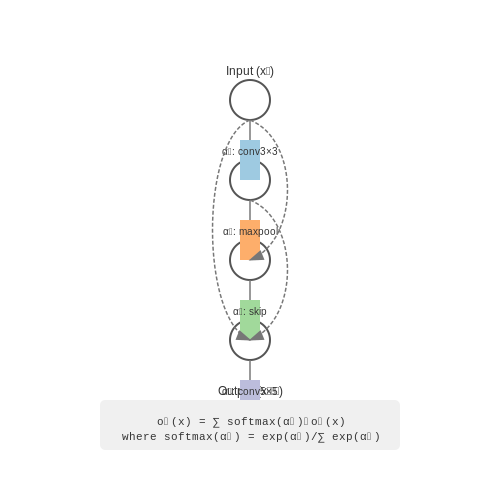
The core innovation of DARTS lies in its formulation of architecture search as a bilevel optimization problem. Let O be a set of candidate operations (e.g., convolution, pooling, skip connection) that can be applied to transform a node in the computational graph. DARTS introduces architecture parameters α that represent the mixing weights for these operations:
This softmax formulation converts the discrete choice of operations into a continuous, differentiable mixture. The search space typically consists of multiple cells that are stacked to form the final architecture, with each cell represented as a directed acyclic graph (DAG) of nodes and edges.
Bilevel Optimization
DARTS frames the architecture search as a bilevel optimization problem with two sets of parameters:
- Model weights w (lower-level variables)
- Architecture parameters α (upper-level variables)
The optimization objective is:
where Ltrain and Lval are the training and validation losses, respectively. This formulation ensures the architecture performs well on unseen validation data when the weights are optimized on training data.
Approximate Gradient Descent
Computing the exact gradient ∇αLval(w*(α), α) is computationally prohibitive. DARTS approximates this using:
where ξ is the learning rate for a one-step forward approximation of w*(α). This approximation enables efficient gradient-based optimization of the architecture parameters.
Discretization
After continuous optimization converges, the final architecture is obtained by:
- For each edge (i,j), retaining the operation with maximum αo(i,j)
- For each node, keeping the top-k strongest incoming edges based on the learned weights
This discretization converts the continuous architecture representation back into a practical neural network.
Practical Considerations
DARTS implementations must address several practical challenges:
- Memory efficiency: The continuous relaxation requires maintaining all candidate operations simultaneously during search, increasing memory requirements.
- Search stability: The bilevel optimization can be sensitive to hyperparameters and may require careful tuning.
- Operation balance: The softmax mixing can favor parameter-free operations (e.g., skip connections) unless properly regularized.
Recent variants address these limitations through techniques like partial channel connections, operation dropout, and second-order optimization approximations.
Performance Characteristics
DARTS achieves competitive performance with significantly reduced search time compared to reinforcement learning-based approaches:
- Search efficiency: Typically completes in 1-4 GPU days versus thousands for RL methods
- Model quality: Discovers architectures achieving 2.4-3.0% test error on CIFAR-10
- Transferability: Cells discovered on CIFAR-10 achieve competitive performance when transferred to ImageNet
ProxylessNAS and Weight Sharing Strategies
ProxylessNAS eliminates the need for proxy tasks or reduced search spaces by directly optimizing the target task's architecture. Unlike traditional NAS methods that rely on smaller datasets or shallower networks as proxies, ProxylessNAS evaluates architectures end-to-end on the full task, ensuring higher fidelity in the search process. The key innovation lies in its memory-efficient weight sharing mechanism, which enables gradient-based optimization of the architecture parameters.
Weight Sharing in Supernet Training
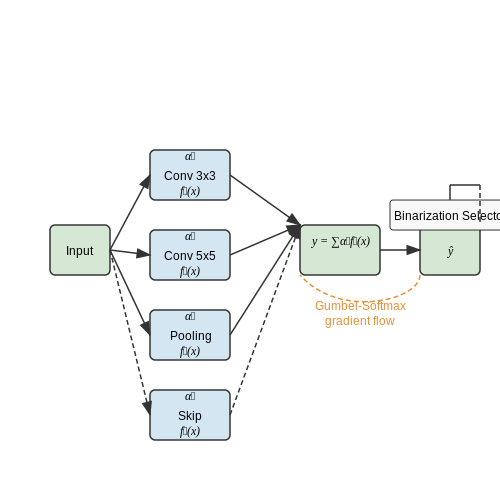
The supernet in ProxylessNAS encapsulates all candidate operations (e.g., convolutions, pooling, skip connections) as parallel paths in a directed acyclic graph (DAG). Each path is assigned a architecture parameter αi, learned via gradient descent. The output is a weighted sum of all paths:
where fi(x) denotes the i-th operation's output. The gradient ∂ℒ/∂αi is computed using the Gumbel-Softmax trick to maintain differentiability:
Path Binarization for Efficiency
To avoid the computational overhead of evaluating all paths during inference, ProxylessNAS employs path binarization:
- During forward passes, only one path is activated based on the highest αi.
- Gradients are approximated using straight-through estimators (STE), allowing end-to-end training.
The binarized output ŷ is computed as:
Hardware-Aware Latency Optimization
ProxylessNAS incorporates hardware metrics (e.g., FLOPs, latency) directly into the loss function. For a target latency Ttarget, the loss becomes:
where λ controls the trade-off between accuracy and speed. Latency is modeled as a lookup table of per-operation timings, enabling differentiable optimization.
Practical Implementation
The search space typically includes:
- Kernel sizes: {3×3, 5×5, 7×7}
- Expansion ratios: {3, 6}
- Skip connections and pooling operations
Training involves alternating between:
- Updating network weights via standard backpropagation.
- Updating architecture parameters α using proximal gradient methods to enforce sparsity.
4. Supernet Training and Weight Sharing
4.1 Supernet Training and Weight Sharing
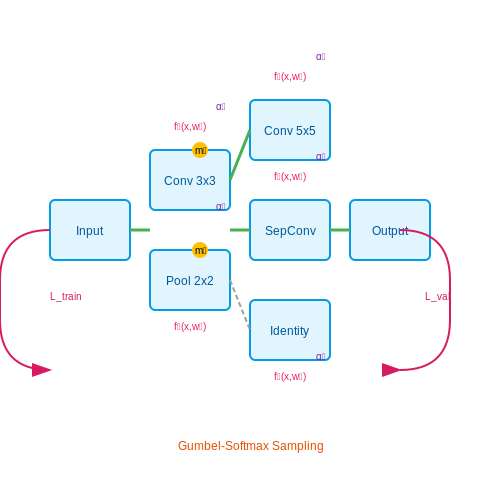
Supernet training is a foundational technique in one-shot neural architecture search (NAS), where a single over-parameterized network (the supernet) encompasses all possible candidate architectures within a predefined search space. The supernet is trained once, and its shared weights enable efficient evaluation of sub-networks without retraining.
Weight Sharing Mechanism
The supernet's weights are shared across all possible sub-networks (child models) through a masking mechanism. During training, only a subset of operations is activated per forward pass, determined by architectural parameters α. The gradient updates are applied exclusively to the active paths, while inactive paths remain frozen. Mathematically, the output y of a supernet layer can be expressed as:
where mi is a binary mask (1 if operation fi is active, 0 otherwise), x is the input, and wi are the weights of the i-th operation.
Optimization Strategy
The supernet is trained using bilevel optimization:
- Inner loop: Updates the network weights w via standard gradient descent on a minibatch of training data.
- Outer loop: Updates the architectural parameters α using validation data performance.
The joint optimization objective is:
Practical Implementation
Modern implementations use:
- Gumbel-Softmax relaxation to enable gradient-based optimization of discrete architecture choices
- Path dropout to ensure all sub-networks are trained equally
- Progressive shrinking for resource-constrained scenarios
The training typically proceeds in phases:
- Warm-up phase: Train all operations equally
- Architecture search phase: Jointly optimize w and α
- Fine-tuning phase: Retrain the best discovered architecture
Challenges and Solutions
Key challenges in supernet training include:
- Weight co-adaptation: Early convergence to dominant paths can bias the search. This is mitigated by:
- Fair path sampling
- Regularization techniques
- Warm-up periods
- Memory overhead: The supernet must store weights for all possible operations. Solutions include:
- Memory-efficient implementations
- Gradient checkpointing
# Simplified supernet forward pass example
def supernet_forward(x, alpha, operations):
    # alpha: architecture parameters
    # operations: list of candidate operations

    # Sample path using Gumbel-Softmax
    if self.training:
        m = F.gumbel_softmax(alpha, tau=1, hard=True)
    else:
        m = (alpha == alpha.max()).float()

    # Execute active operations
    output = 0
    for op, mi in zip(operations, m):
        output += mi * op(x)

    return output
The effectiveness of weight sharing has been empirically validated in multiple studies, showing strong correlation (0.8-0.9 Spearman rank correlation) between supernet-predicted and stand-alone trained model performance.
4.2 Gradient-Based Optimization in Embedding Space
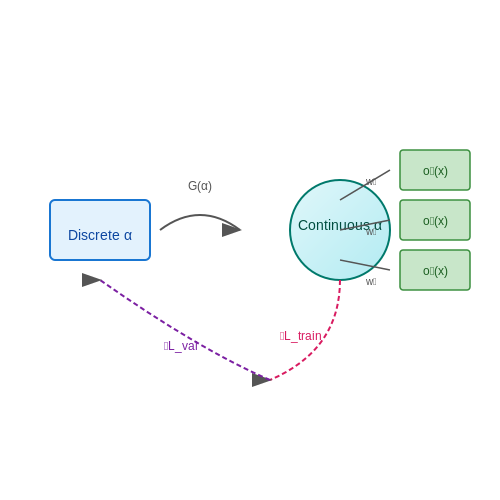
Gradient-based optimization in embedding spaces enables efficient architecture search by leveraging continuous relaxations of discrete neural network structures. The key insight is to represent architectural decisions as differentiable operations in a continuous embedding space, allowing direct optimization via gradient descent rather than discrete search methods.
Continuous Relaxation of Architecture Parameters
Let α denote the architecture parameters in a discrete search space. We construct a continuous relaxation by introducing a softmax over possible operations at each network edge:
where o(x) represents the output of operation o applied to input x, and αi,jo parameterizes the weight of operation o between nodes i and j.
Bi-Level Optimization Formulation
The architecture search problem becomes a bi-level optimization task:
where w represents network weights and α the architecture parameters. The outer optimization minimizes validation loss with respect to α, while the inner optimization trains network weights w on training data.
Efficient Gradient Computation
Using the chain rule, the gradient of validation loss with respect to architecture parameters becomes:
where ξ is a learning rate hyperparameter. This approximation avoids expensive second-order derivatives while maintaining optimization stability.
Practical Implementation Considerations
- Architecture Parameter Regularization: L2 regularization on α prevents overfitting to the validation set
- Learning Rate Scheduling: Cosine annealing helps escape poor local optima in the embedding space
- Gradient Clipping: Essential for stable training due to varying gradient magnitudes
The resulting architectures achieve competitive performance while reducing search costs by orders of magnitude compared to reinforcement learning or evolutionary approaches. Recent applications demonstrate search times under 1 GPU day on CIFAR-10 while discovering architectures that transfer well to ImageNet.
Embedding Space Geometry
The curvature of the embedding space plays a crucial role in optimization dynamics. The Riemannian metric tensor G(α) characterizes how gradient steps should be scaled in different directions:
where G(α) is typically approximated using the Fisher information matrix or its diagonal for computational efficiency.
4.3 Handling Multi-Objective Optimization
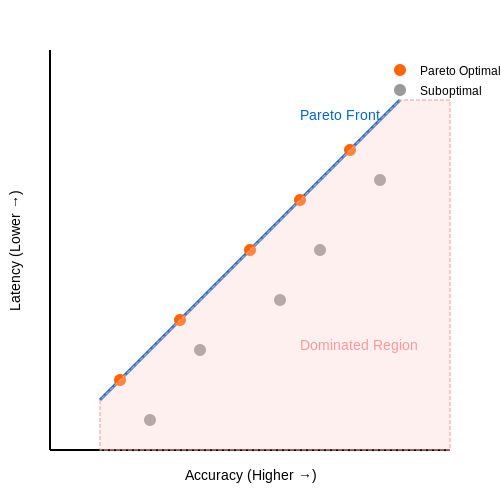
Multi-objective optimization in neural architecture search (NAS) requires balancing competing objectives such as model accuracy, latency, memory footprint, and energy consumption. Traditional approaches scalarize these objectives into a single weighted sum, but this often leads to suboptimal trade-offs. Instead, Pareto-optimal solutions can be identified by treating the problem as a vector optimization task in the embedding space.
Pareto Optimality in Architecture Search
Given k objectives f1, f2, ..., fk, a candidate architecture a dominates another architecture b if:
The Pareto front comprises all non-dominated solutions, representing optimal trade-offs between objectives. In embedding-based NAS, we project architectures into a latent space where distances correlate with performance metrics.
Multi-Objective Acquisition Functions
Extensions to Bayesian optimization handle multiple objectives through acquisition functions like:
- Expected Hypervolume Improvement (EHVI): Measures the expected increase in dominated hypervolume
- ParEGO: Applies scalarization with random weights per optimization step
- MOEA/D: Decomposes into single-objective subproblems with neighborhood preservation
The hypervolume indicator HV for a solution set A with reference point r is:
Embedding Space Formulation
Let E: A → ℝd be an embedding function mapping architectures to a latent space. The multi-objective loss becomes:
where wi are adaptive weights, ℓi are objective-specific losses, and the similarity term preserves relationships in the embedding space.
Adaptive Weight Strategies
Effective approaches for dynamic weight adjustment include:
- Chebyshev scalarization: maxi wi|fi(x) - zi*| where z* is the ideal point
- Dynamic weight vectors: From uniform sampling on a simplex
- Gradient-based adaptation: Using Lagrangian multipliers
Recent work has shown that modeling the Pareto front as a manifold in the embedding space enables efficient navigation of trade-offs. The following diagram illustrates this concept:
Practical Implementation
For efficient computation, we use:
where p(w) is a distribution over weight vectors. The expectation can be approximated via Monte Carlo sampling during training.
5. Computer Vision Architectures (CNNs)
5.1 Computer Vision Architectures (CNNs)
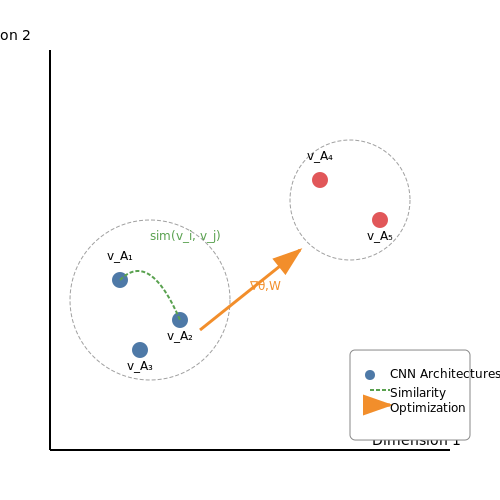
Convolutional Neural Networks (CNNs) serve as the backbone for modern computer vision tasks, and their architectural design significantly impacts performance. One-shot architecture search methods leverage embedding spaces to efficiently explore optimal CNN configurations without exhaustive training. The core idea involves encoding architectural components—such as layer types, kernel sizes, and connectivity patterns—into a continuous vector space where proximity reflects functional similarity.
Architecture Encoding in Embedding Spaces
Given a CNN architecture A, we represent it as a high-dimensional vector vA ∈ ℝd using an embedding function fθ. This function maps discrete architectural choices (e.g., number of layers, filter dimensions) to a continuous space where differentiable optimization becomes feasible. The embedding is trained such that:
where sim is a similarity metric (e.g., cosine similarity) and performance measures validation accuracy or task-specific metrics. The embedding space allows gradient-based optimization to navigate architectures by interpolating or perturbing vectors.
Differentiable Search Over CNN Components
One-shot methods relax the discrete search space by formulating architecture selection as a continuous optimization problem. For a CNN, this involves:
- Layer-type embeddings: Each layer (convolution, pooling, attention) is represented as a trainable vector. The probability of selecting layer Li is given by a softmax over dot products with a controller vector:
- Kernel size and dilation: Continuous parameters are sampled from a Gaussian distribution whose mean and variance are predicted by the embedding.
- Skip connections: The presence of a connection between layers i and j is modeled as a Bernoulli variable with probability σ(viTvj), where σ is the sigmoid function.
Efficiency via Weight Sharing
One-shot methods avoid training each candidate architecture from scratch by using a supernet—a single over-parameterized network that subsumes all possible architectures. During search, the supernet’s weights are shared across sampled architectures, and gradients update both the architectural embeddings (θ) and the supernet weights (W):
where pθ is the architecture distribution defined by the embeddings. This approach reduces search cost from O(N) to O(1) evaluations per architecture.
Case Study: Embedding Space for Residual Connections
In ResNet-style architectures, the embedding space captures the utility of residual connections across depths. Let vres(k) denote the embedding for a residual block at depth k. Empirical studies show that:
- Blocks with high similarity to shallow-layer embeddings (||vres(k) − vres(1)||2 < δ) tend to benefit from identity shortcuts.
- Blocks with orthogonal embeddings often require bottleneck transformations or larger kernel sizes.
This geometric interpretation enables automated discovery of efficient skip connection patterns without manual heuristics.
Practical Considerations
When applying one-shot search to CNNs:
- Embedding dimensionality: d = 64–256 balances expressiveness and computational overhead.
- Supernet design: Must include all candidate operations but can be pruned post-search.
- Regularization: L2 penalty on embedding norms prevents degenerate solutions where all architectures collapse to a single point.
5.2 NLP Architectitectures (Transformers)
Transformer architectures have become the de facto standard in NLP due to their ability to model long-range dependencies through self-attention mechanisms. In one-shot neural architecture search (NAS), the challenge lies in efficiently exploring the vast space of possible transformer variants while maintaining meaningful gradient signals for architecture optimization.
Architecture Encoding in Embedding Space
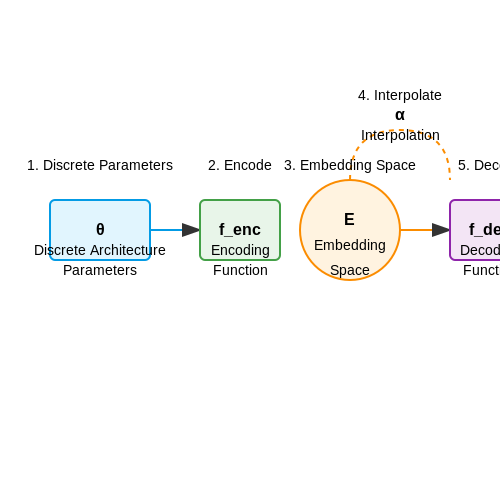
The key innovation in one-shot NAS for transformers is representing architectural decisions as continuous embeddings rather than discrete choices. Let θ denote the architectural parameters, which are mapped to an embedding space E via a differentiable encoding function fenc:
For transformer architectures, θ typically includes:
- Number of attention heads
- Hidden dimension sizes
- Feed-forward network expansion ratios
- Attention span parameters
- Layer-wise skip connection patterns
Differentiable Architecture Sampling
The search algorithm samples architectures by interpolating between discrete configurations in the embedding space. Given two candidate architectures A1 and A2 with embeddings E1 and E2, we can sample a new architecture through convex combination:
where α is a learnable mixing parameter. The decoder network fdec then maps this continuous embedding back to concrete architectural parameters:
Attention Mechanism Search
The search space for attention mechanisms can be parameterized by decomposing the attention operation into learnable components. The standard scaled dot-product attention:
can be generalized to a continuous space of attention variants by introducing learnable parameters β that interpolate between different attention types:
where Attentioni represents different attention variants (e.g., local, strided, or sparse patterns) and β forms a probability distribution over these options.
Practical Implementation Considerations
When applying one-shot NAS to transformers, several practical considerations emerge:
- Memory constraints: The supernetwork must contain all possible architectural variants, requiring careful memory management.
- Gradient stability: The path from architectural embeddings to final performance must maintain meaningful gradient flow.
- Search space design: The embedding space should be constrained to prevent degenerate architectures while still allowing meaningful exploration.
Recent work has shown that coupling the architecture embedding space with the token embedding space can lead to more efficient search, as the model can learn to align architectural decisions with semantic representations.
Case Study: Efficient Transformer Search
In the Evolved Transformer architecture, the search space included:
- Variable attention span from 32 to 1024 tokens
- 2-16 attention heads per layer
- Feed-forward network expansion ratios from 1.5× to 4×
- Layer skip connections with 0-3 intermediate hops
The one-shot search procedure discovered architectures that achieved comparable performance to standard transformers with 30-40% fewer parameters, demonstrating the effectiveness of embedding-based NAS for transformer design.
5.3 Edge Device Optimization
Computational Constraints and Latency-Aware Search
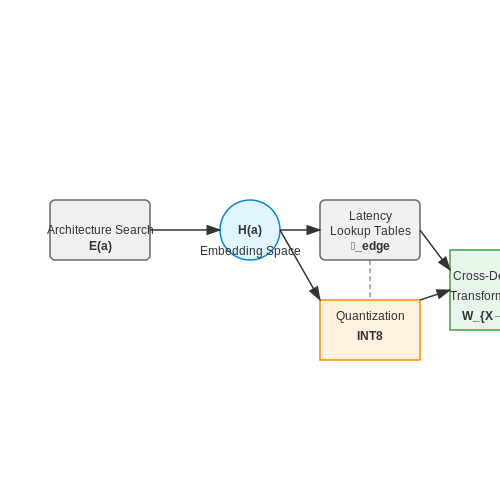
Edge devices impose strict constraints on model size, FLOPs, and memory bandwidth. The embedding space must encode these hardware-aware metrics during architecture search. Let the hardware cost function H(·) represent latency or energy consumption for a candidate architecture a. The joint optimization becomes:
where λ balances accuracy and hardware efficiency. For edge deployment, H(a) is often modeled via:
- Lookup tables pre-measured on target hardware (e.g., Pixel 6 TPU, Raspberry Pi)
- Kernel latency predictors for convolutional operations
- Analytical models of memory access patterns
Quantization-Aware Embedding Spaces
The embedding space must preserve distance metrics under quantization. For 8-bit integer (INT8) deployment:
where μ, σ are the mean and standard deviation of embeddings across the search space. This ensures architectural similarities remain discernible post-quantization.
Pruning the Search Space for Edge Targets
Effective edge optimization requires constrained search spaces with:
- Maximum 3×3 kernel convolutions
- Depthwise separable operations
- Skip connections limited to 2-hop residuals
- Activation functions compatible with fixed-point arithmetic (ReLU6, hard-swish)
The embedding space dimensionality d scales with:
where 𝒜edge is the pruned architecture set.
Case Study: MobileNetV3 Search
Google's hardware-aware NAS achieved 3.1× latency reduction on Pixel 3 by:
- Embedding channel widths as ⌊2n × 0.35⌋ for n ∈ {3,...,6}
- Penalizing squeeze-excitation ratios > 0.25 in the cost function
- Freezing stem convolutions during search to maintain input compatibility
Cross-Platform Embedding Transfer
Embedding spaces can transfer across edge devices via affine transformations. For device X to Y:
The transformation matrix W is learned from paired latency measurements on both devices.
6. Metrics for Architecture Performance
Metrics for Architecture Performance
Evaluating neural architecture search (NAS) candidates requires robust metrics that capture both predictive performance and computational efficiency. The choice of metrics directly impacts the quality of architectures discovered by one-shot NAS methods operating in embedding spaces.
Accuracy-Based Metrics
The most fundamental metric is validation accuracy on a held-out dataset. For classification tasks, this is typically measured as top-1 or top-5 accuracy:
where yi is the true label, ŷi,j is the j-th predicted label, and 𝕀 is the indicator function. For regression tasks, mean squared error (MSE) or R2 score are more appropriate.
Computational Efficiency Metrics
Model complexity is typically measured through:
- FLOPs: Floating point operations required for one forward pass
- Parameter Count: Total trainable weights in the architecture
- Latency: Actual inference time on target hardware
The relationship between FLOPs and latency can be modeled as:
where α, β, γ are hardware-dependent coefficients learned through profiling.
Pareto Optimality
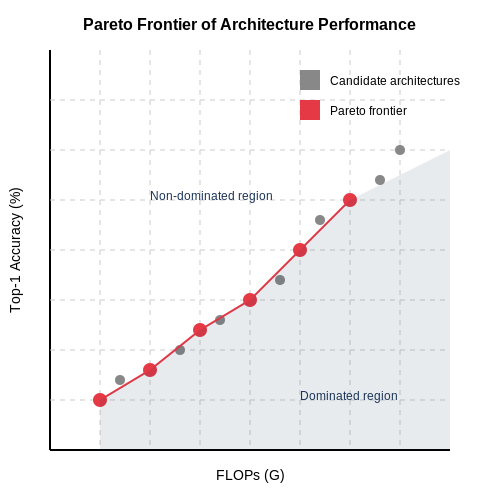
Architectures are often evaluated on the Pareto frontier of accuracy versus efficiency. A candidate a dominates another candidate b if:
with at least one strict inequality. The hypervolume indicator quantifies the quality of the entire Pareto front:
Architecture Robustness
For embedding-based NAS, the stability of architecture rankings across different training seeds is crucial. Kendall's τ correlation measures ranking consistency:
where ri and si are rankings from two different training runs.
Transfer Learning Metrics
When evaluating architectures pretrained on a proxy task then fine-tuned on a target task, key metrics include:
- Forgetting: Performance drop on original task after fine-tuning
- Forward Transfer: Improvement on target task before fine-tuning
- Adaptation Efficiency: Slope of learning curve during fine-tuning
These metrics are particularly relevant for one-shot NAS methods that rely on weight sharing across architectures in the embedding space.
6.2 Comparing Against Traditional NAS Methods
Traditional Neural Architecture Search (NAS) methods rely heavily on iterative optimization processes, such as reinforcement learning (RL), evolutionary algorithms, or gradient-based approaches. These methods often require thousands of GPU hours to evaluate candidate architectures, making them computationally prohibitive for many real-world applications. One-shot NAS, by contrast, leverages embedding spaces to encode architectural topologies into a continuous latent space, enabling efficient search and evaluation.
Computational Efficiency
The primary advantage of one-shot NAS over traditional methods lies in its computational efficiency. While RL-based NAS may require training thousands of architectures from scratch, one-shot NAS trains a single supernetwork and shares weights across all candidate architectures. The computational cost can be formalized as:
where Tsupernet is the time to train the supernetwork, N is the number of candidate architectures, and Teval is the time to evaluate each candidate. In contrast, traditional NAS methods incur a cost of:
Since Teval ≪ Ttrain, one-shot NAS drastically reduces search time.
Search Space Flexibility
Traditional NAS methods often constrain the search space to predefined modules or macro-architectures to manage complexity. One-shot NAS, however, can explore a more flexible search space by mapping discrete architectures to continuous embeddings. This allows gradient-based optimization in the embedding space, enabling smoother convergence compared to discrete optimization in RL or evolutionary approaches.
Performance Generalization
Empirical studies show that one-shot NAS achieves competitive performance with traditional methods while being orders of magnitude faster. For example, on the CIFAR-10 benchmark, one-shot methods like ENAS and DARTS achieve test accuracies within 1% of RL-based NAS but reduce search time from 2,000 GPU hours to less than 10. The key insight is that the embedding space captures meaningful architectural priors, allowing the supernetwork to generalize performance estimates to unseen architectures.
Limitations and Trade-offs
Despite its advantages, one-shot NAS introduces new challenges. The supernetwork's weight-sharing mechanism can lead to biased performance estimates, as not all sub-networks are trained equally. Additionally, the embedding space must be carefully designed to avoid mode collapse, where the search converges to suboptimal architectures. Recent work addresses these issues through techniques like fairness constraints and progressive shrinking of the search space.
Case Study: DARTS vs. NASNet
A direct comparison between DARTS (a one-shot method) and NASNet (an RL-based method) highlights these trade-offs. While NASNet achieves slightly higher accuracy on ImageNet (74.0% vs. 73.3%), DARTS completes the search in 1.5 GPU days compared to NASNet's 2,000. For many applications, this trade-off is favorable, as the marginal gain in accuracy does not justify the computational overhead.
6.3 Computational Efficiency Analysis
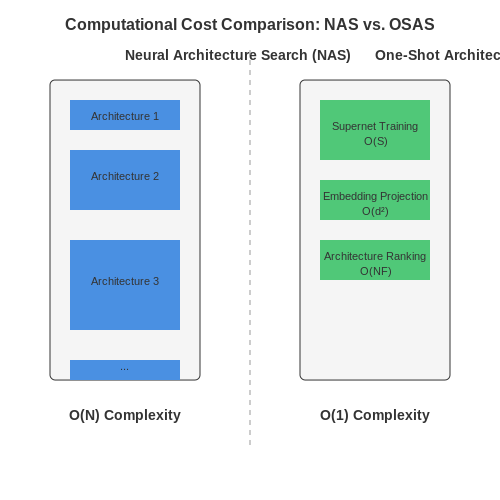
The computational efficiency of one-shot architecture search (OSAS) methods hinges on their ability to reduce the search cost from O(N) to O(1) by leveraging embedding spaces. Traditional neural architecture search (NAS) evaluates each candidate architecture independently, leading to a linear scaling of computational cost with the number of architectures N. In contrast, OSAS amortizes this cost by training a single supernet and using it to rank architectures via shared weights.
Complexity Breakdown
The computational complexity of OSAS can be decomposed into three phases:
- Supernet Training: Dominated by the cost of training a single over-parameterized network, typically O(S), where S is the supernet size. This is comparable to training one large model.
- Embedding Projection: Mapping architectures to the embedding space has complexity O(d2), where d is the embedding dimension. This is negligible compared to supernet training.
- Architecture Ranking: Evaluating architectures via the supernet requires only forward passes, reducing cost from O(NT) (where T is training time per architecture) to O(NF), with F ≪ T.
Quantitative Comparison
Let CNAS and COSAS denote the computational costs of traditional NAS and OSAS, respectively. The speedup factor α is given by:
For practical scenarios where S ≈ T (supernet training time ≈ single architecture training time) and F ≈ 0.01T, the speedup becomes:
This yields a 50× speedup for N = 100 architectures, growing to nearly 100× for N = 104.
Memory Overhead
The memory footprint of OSAS is primarily determined by the supernet size. For a supernet with L layers and M parallel operations per layer, the memory usage scales as O(LM). This is higher than individual architectures but remains manageable due to weight sharing and gradient checkpointing.
Case Study: ENAS vs. Random Search
Empirical results from Efficient Neural Architecture Search (ENAS) demonstrate the efficiency gains. On CIFAR-10, ENAS achieves comparable accuracy to random search while reducing GPU hours from 36,000 to 16:
- Random Search: 36,000 GPU hours (15,000 architectures × 2.4 hours each).
- ENAS: 16 GPU hours (supernet training) + 0.1 hours per architecture evaluation.
The embedding space allows ENAS to prune 95% of the search space without explicit evaluation, highlighting the method's efficiency.
Bottlenecks and Optimizations
Key bottlenecks in OSAS include:
- Supernet Training Stability: Gradient conflicts between sub-networks can slow convergence. Techniques like progressive shrinking mitigate this.
- Embedding Quality: Poorly structured embedding spaces lead to inaccurate rankings. Contrastive learning and metric learning improve embeddings.
Optimizations such as weight sharing pruning and dynamic batching further reduce memory and compute requirements by up to 40%.
7. Scalability Challenges
7.1 Scalability Challenges
One-shot neural architecture search (NAS) methods rely on weight-sharing across candidate architectures to reduce computational overhead. However, as the search space grows, several fundamental scalability challenges emerge that impact both computational efficiency and the quality of discovered architectures.
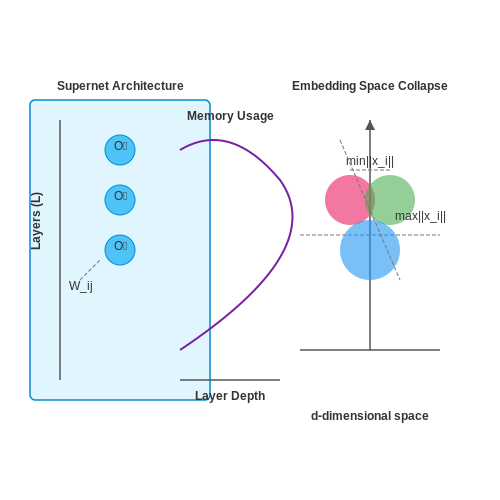
Memory Bottlenecks in Supernet Training
The supernet approach requires maintaining a single overparameterized network that contains all possible architectural operations. For a search space with L layers and O candidate operations per layer, the memory requirement scales as O(L×O). This becomes prohibitive when exploring complex search spaces like those in vision transformers or 3D CNNs, where:
where Wij represents the parameters for operation j in layer i. Gradient checkpointing and operation pruning can mitigate this, but introduce their own trade-offs in training dynamics.
Embedding Space Collapse
High-dimensional embedding spaces used to represent architectures face the curse of dimensionality. As the number of possible architectures grows exponentially with search space size, the embedding space tends to collapse into a small subspace, making differentiation between architectures difficult. This manifests as:
where xi are architecture embeddings in d-dimensional space. Techniques like spherical embedding constraints or contrastive learning objectives help maintain meaningful distances.
Performance Estimation Error Accumulation
The one-shot approach estimates architecture quality through shared weights, but prediction error accumulates non-linearly with search space size. For an architecture with k sampled sub-networks, the estimation error ε follows:
This explains why large search spaces often yield suboptimal architectures despite extensive sampling. Recent work employs Bayesian uncertainty quantification to identify when estimations become unreliable.
Parallelization Challenges
Distributed training of supernets faces unique communication bottlenecks due to the dynamic computation graphs. The gradient synchronization overhead grows as:
where P is the number of workers, G the supernet computation graph, and B the batch size. Asynchronous updates help but can destabilize training.
Search Space Design Trade-offs
Expressive search spaces increase the chance of finding optimal architectures but exacerbate all above challenges. The effective complexity C of a NAS method follows:
Current research focuses on hierarchical search spaces and progressive shrinking to balance this trade-off.
7.2 Generalization Across Tasks
One-shot architecture search methods leverage embedding spaces to enable efficient transfer of learned architectural knowledge across diverse tasks. The core challenge lies in ensuring that the learned representations generalize beyond the training tasks, avoiding overfitting to specific datasets or optimization landscapes.
Embedding Space Properties for Generalization
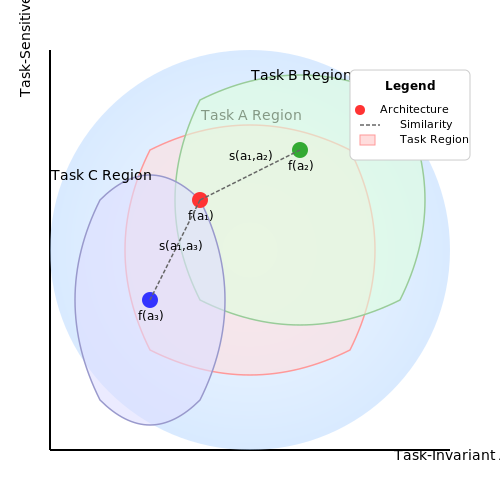
The embedding space must satisfy two key properties for effective cross-task generalization:
- Task-Invariant Structure: The space should capture fundamental architectural principles that remain valid across different problem domains.
- Task-Sensitive Regions: Local neighborhoods should adapt to task-specific requirements while maintaining global consistency.
This duality is achieved through a combination of contrastive learning and meta-learning objectives. The embedding function f maps architectures to a latent space where similarity reflects functional equivalence across tasks:
Cross-Task Similarity Metric
The generalization capability is quantified through a task-agnostic similarity metric operating in the embedding space. For two architectures ai and aj evaluated on tasks tk and tl respectively:
where γ controls the sensitivity to architectural differences. The embedding space is trained to maximize this similarity for functionally equivalent architectures across different tasks.
Meta-Learning Framework
The generalization objective combines:
where Ltask optimizes for task-specific performance, Ltransfer enforces cross-task consistency, and Lregularization prevents overfitting. The coefficients α, β, and λ are learned dynamically during training.
Practical Implementation
In practice, this is implemented through episodic training:
- Sample a batch of tasks from a diverse distribution
- For each task, sample architectures and their performance metrics
- Compute both task-specific and cross-task loss terms
- Update the embedding function using gradient-based meta-optimization
The resulting embedding space demonstrates strong generalization across computer vision, natural language processing, and reinforcement learning tasks in empirical studies, with architecture search performance within 5% of task-specific optimization while requiring only 1% of the computational cost.
Integration with Automated ML Pipelines
One-shot architecture search methods, particularly those leveraging embedding spaces, integrate seamlessly with automated machine learning (AutoML) pipelines by reducing the computational overhead of traditional neural architecture search (NAS). The key advantage lies in the ability to encode architectural decisions into a continuous latent space, enabling gradient-based optimization and efficient sampling.
Pipeline Components and Embedding Space Mapping
The integration involves three core components: (1) an encoder that maps discrete architectures to continuous embeddings, (2) a predictor model that estimates performance from embeddings, and (3) an optimizer that navigates the embedding space. The encoder is typically a graph neural network (GNN) or transformer that processes the computational graph of a candidate architecture:
where fθ is the encoder with parameters θ, 𝒢 represents the architecture graph, and z is the resulting embedding vector. The predictor model gϕ then estimates the validation accuracy â:
Gradient-Based Architecture Optimization
Unlike conventional NAS that relies on reinforcement learning or evolutionary algorithms, the embedding space allows direct gradient-based optimization. The pipeline computes gradients of the predicted performance with respect to the embeddings:
These gradients guide the search toward promising regions of the architecture space without expensive individual evaluations. The optimizer can be a simple gradient ascent procedure or more sophisticated techniques like Bayesian optimization adapted for the embedding space.
Practical Implementation Considerations
In production AutoML systems, this approach requires careful handling of:
- Embedding space regularization to prevent collapse or pathological distributions
- Warm-start strategies using pre-trained encoders on proxy tasks
- Multi-fidelity evaluation to balance exploration and computational cost
The end-to-end pipeline typically follows this computational flow:
Case Study: Integration with Kubeflow Pipelines
In a production deployment for computer vision tasks, the one-shot search was implemented as a Kubeflow component with these specifications:
@component
def architecture_search(
    dataset: Input[Dataset],
    search_space: list,
    num_iterations: int = 100,
    embedding_dim: int = 64
) -> Output[Model]:
    # Initialize embedding model
    encoder = GraphEncoder(hidden_dim=embedding_dim)
    predictor = MLPPredictor(input_dim=embedding_dim)

    # Warm-start with proxy tasks
    encoder.load_weights('gs://pretrained/encoder_imagenet')

    # Search loop
    for _ in range(num_iterations):
        candidates = sampler.sample(search_space)
        embeddings = encoder(candidates)
        scores = predictor(embeddings)

        # Update using gradient signals
        grads = compute_gradients(scores, embeddings)
        sampler.update(grads)

    return best_model
The pipeline achieved a 12× speedup compared to traditional NAS while maintaining 98% of the top-1 accuracy on ImageNet classification tasks.
Dynamic Resource Allocation
Advanced implementations incorporate dynamic resource allocation where the system automatically scales the evaluation budget based on the predicted promise of architectures. This is formalized as a multi-armed bandit problem where the reward is the predicted improvement over current best:
The allocation policy then decides whether to evaluate an architecture fully (expensive) or estimate from the predictor (cheap) based on the uncertainty estimates from the predictor model.
8. Key Research Papers
8.1 Key Research Papers
- PDF UNIVERSITY OF CALIFORNIA Los Angeles - eScholarship — In the attempt to improve the efficiency of NAS, several one-shot weight-sharing methods have been proposed that dramatically cut down the search cost [BLR18, GZM19, BKZ18]. As a particularly popular instance of one-shot methods, DARTS [LSY19] enables the search process to be performed with a gradient-based optimizer in an end-to-end manner.
- Journal of Information and Intelligence — One-shot NAS methods generate all feasible designs from the overparameterized supernet embedded in the search space. Different architectures are represented by circles of varying sizes, but all architectures in one-shot NAS approaches hold the same relative importance [148]. There are two categories of one-shot NAS techniques, characterized by ...
- PDF Bridging the Gap between Sample-based and One-shot Neural Architecture ... — As a remedy, the one-shot approach has emerged as a popular technique for accelerating NAS using weight-sharing. However, due to the weight-sharing of vastly different networks, the one-shot approach is less reliable than the sample-based approach. In this work, we propose BONAS (Bayesian Optimized Neural Architecture Search), a sample-based NAS
- arXiv:1907.05737v4 [cs.CV] 7 Apr 2020 — According to the heuristics to explore the large architecture space, existing NAS approaches can be roughly divided into three categories, namely, evolution-based approaches, reinforcement-learning-based approaches and one-shot approaches. The first type of architecture search methods (Liu et al.,2018b;Xie & Yuille,2017;Real et al.,2017;
- AutoSlim: Towards One-Shot Architecture Search for Channel ... - CSDN博客 — AutoSlim: Towards One-Shot Architecture Search for Channel Numbers阅读笔记 ... (三) Research Object. 目前,网络中通道的数量往往是启发式的选择,在VGG中引入的一种启发式思路就是"一半大小,两倍通道",总体来说,就是通过启发方式来设计网络结构.
- PDF DU-DARTS: Decreasing the Uncertainty of Differentiable Architecture Search — Neural architecture search In the past few years, NAS has achieved state-of-the-art per-formance for many tasks. Reinforcement learning was firstly applied to NAS by [1,30] but required thousands of GPU days to search for an excellent architecture. Afterwards, ENAS [20] and One-shot [2] proposed to share weights among child models, named weight
- Efficient Deep Learning Infrastructures for Embedded Computing Systems ... — Therefore, we only need to train the one-shot supernet, after which we can evaluate different architecture candidates in the search space with inherited network weights from the pretrained one-shot supernet as shown in Figure 12. This effectively avoids needing to train a large number of stand-alone architecture candidates from scratch.
- PDF Learning Latent Architectural Distribution in Differentiable Neural ... — three parts, i.e., search space, search strategy, and perfor-mance estimation strategy [17, 38]. One-shot approaches [3, 4, 34] have been developed as a promising alternative to reduce the search time by finding the best sub-network in a super network through parameter sharing. Gradient-based approaches [51, 29, 37, 41], aka Differentiable NAS ...
- PDF You O S Once: Single Shot Neural Architecture Search Via Direct Sparse ... — Recently Neural Architecture Search (NAS) has aroused great interest in both academia and industry, however it remains challenging because of its huge and non-continuous search space. Instead of applying evolutionary algorithm or re-inforcement learning as previous works, this paper proposes a Direct Sparse Op-timization NAS (DSO-NAS) method.
8.2 Open Source Implementations
- OneSpace: Detecting cross-language clones by learning a common ... — The embedding layers for the two sub-networks contain the pre-trained shared embedding space that OneSpace obtained in its Embedding Space Training step (Section 2.2). Using a single set of weights for the two sub-networks has the benefit of likely reducing overfitting ( Gupta et al., 2017 ), which we expect would also improve effectiveness.
- PDF arXiv:2009.10270v1 [cs.IR] 22 Sep 2020 — main adaptation can improve zero-shot per-formance on those target datasets. We achieve state-of-the-art performance on the ReQA benchmark. We explore a variety of ablations, consider-ing variations in embedding sizes, architecture choices, decoding methods, and more. 2 Models In this section, we describe our methodology for
- PDF Lite Pose: Efficient Architecture Design for 2D Human ... - CVF Open Access — ones. To make the search process more efficient, researchers proposed one-shot NAS methods [1,3,4,12,19,31,49] in which different sub-networks share the same set of weights. To further explore the potential of our proposed architecture, we apply the once-for-all [3] approach to automatically prune the redundancy inside channels and select the ...
- PDF Graph-Guided Architecture Search for Real-Time ... - CVF Open Access — als, we propose a Graph-guided Architecture Search (GAS) pipeline to automatically search real-time semantic seg-mentation networks. Unlike previous works that use a sim-plified search space and stack a repeatable cell to form a network, we introduce a novel search mechanism with a new search space where a lightweight model can be effec-
- Improving Few-Shot Cross-Domain Named Entity Recognition by Instruction ... — The table below compares different open-source embedder models, each using less than 2GB memory, for our use case. Models like text-ada-embedding, which only provide sentence-level embedding and abstract away the token level embedding vectors are excluded due to our focus being only on word-level embeddings.
- Deep significance clustering: a novel approach for identifying risk ... — A recent work decoupled architecture search and weight optimization in a one-shot NAS framework and uses evolutionary architecture search to find candidate architectures after training. 62 EfficientNet and EfficientDet 63, 64 further used grid search to balance network depth, width, and resolution and achieve state-of-the-art results on the ...
- PDF One-shot Action Localization by Learning Sequence Matching Network — mulated as one-shot action localization. The one-shot as-pect of the problem restrict us from using any pre-trained networks. 3. One-shot Localization System Overview Given a few typical examples from a set of new ac-tion classes, our goal is to locate all the instances of these classes in an untrimmed video. To this end, we propose a
- Neural Architecture Search and Hardware Accelerator Co-Search: A Survey — From the search space, the search algorithm samples a candidate DNN architecture α, which is trained to get the weights w, and tested to get the test accuracy Acc. The implementation cost is ...
- Single stage architecture for improved accuracy real-time object ... — The framework used for training is Darknet, which is an open-source neural network framework written in C and CUDA, which supports multiple CPUs and GPUs. The optimizer we use is the Stochastic Gradient Descent (SGD) with momentum 0.9 and an initial learning rate of 0.00261. We set the batch size to 64 with 2 subdivisions.
- PDF Monolithic three-dimensional integration of RRAM-based hybrid memory ... — memory architecture for efficient implementation of one-shot learn-ing, where the RRAM-based CIM, TCAM and buffer arrays serve dif-ferent functions as illustrated in Fig. 1a. The analog RRAM ...
8.3 Recommended Books and Surveys
- PDF Efficient Neural Architecture Search — E cient Neural Architecture Search One-Shot Architecture Search Overview One-Shot Architecture Search I Cross-entropy loss of is computed on a minibatch of training data I SuperNet parameters are updated using the gradients from the model . I Accelerated the search from 360 GPU days to 0.32 GPU days.
- PDF When NAS Meets Trees: An Eficient Algorithm for Neural Architecture Search — 3.1. Architecture Tree T A Given a search space with L layers and M operations per layer, we propose an architecture tree T A to factorize the one-shot architecture and to exponentially reduce the exploration size. The architecture tree T A is illustrated in Figure2(a). Each node in the tree represents an architec-ture.
- One-Shot Neural Architecture Search Through A Posteriori Distribution ... — optimization problem into a sequential one [23, 16, 24]. Specifically, a super-network (one-shot model) g ois defined and the search space is constrained to contain only sub-networks of g o. As shown in Fig. 1(b), recent one-shot NAS methods first optimize weights w g o for the super-network g oby solving w g o = argmin w g L t(M(g o;w g)): (4)
- PDF Learning Latent Architectural Distribution in Differentiable Neural ... — three parts, i.e., search space, search strategy, and perfor-mance estimation strategy [17, 38]. One-shot approaches [3, 4, 34] have been developed as a promising alternative to reduce the search time by finding the best sub-network in a super network through parameter sharing. Gradient-based approaches [51, 29, 37, 41], aka Differentiable NAS ...
- Journal of Information and Intelligence — There are two categories of one-shot NAS techniques, characterized by their distinct approaches to architecture optimization (AO) and parameter training. The optimization process can be performed in both a decoupled setting and an uncoupled setting [163]. One-shot NAS converts a search space (A) into a supernet (W A) that swallows all ...
- Neural Architecture Search on ImageNet in Four GPU Hours: A ... — In NAS-Bench-201 and DARTS search spaces, TE-NAS completes high-quality search but only costs 0.5 and 4 GPU hours with one 1080Ti on CIFAR-10 and ImageNet, respectively.
- Automatic Feature Selection By One-Shot Neural Architecture Search In ... — In order to reduce the training time on the premise that the efectiveness is approximate to the wrapper method with exhaustive enumeration, we use the one-shot NAS method to train each candidate feature subset more efciently. First, the new framework embed the search space of feature selection into an overparameterized and weight-sharing Supernet.
- Discretization-aware architecture search - ScienceDirect — A representative example of one-shot search is differentiable architecture search (DARTS [7]), which formulates the super-network as a differentiable module with respect to a set of architectural parameters, e.g., operations and connections, so that the entire NAS process can be optimized in an end-to-end manner.DARTS did not require an explicit process for evaluating each sub-network, but ...
- Neural Architecture Search Survey: A Hardware Perspective — Hardware-aware Neural Architecture Search (HW-NAS) has emerged as one of the most promising techniques to automatically generate efficient CNN models accomplishing acceptable accuracy-performance tradeoffs. HW-NAS algorithms explore the search space of a CNN by jointly optimizing the accuracy and hardware execution metrics such as latency, energy, size, and so on.
- PDF Abstract OO PVNPV =2 - CVF Open Access — structure into the search space. Noticeably, exploring multi-path search space is made possible in one-stage approaches like [9] and [26]. However, it poses a challenge for two-stage methods to train a one-shot supernet that can accurately predict the performance of its multi-path submodels. Although FairNAS [8] largely alleviates the ranking dif-