Deploying a Legal Assistant Chatbot
1. Definition and Core Capabilities
Definition and Core Capabilities
A legal assistant chatbot is an AI-driven system designed to automate and augment legal workflows by processing natural language queries, retrieving relevant legal information, and generating contextually appropriate responses. Unlike general-purpose chatbots, legal assistants must adhere to stringent accuracy, confidentiality, and compliance requirements, necessitating specialized architectures and training methodologies.
Core Capabilities
The primary functionalities of a legal assistant chatbot include:
- Document Analysis: Parsing and extracting key clauses, obligations, or risks from contracts, pleadings, or statutes using techniques like named entity recognition (NER) and semantic role labeling (SRL). For example, a BERT-based model fine-tuned on legal corpora can identify force majeure clauses with precision exceeding 92% (F1-score).
- Legal Research Automation: Querying structured legal databases (e.g., Westlaw or CaseText) via API integrations and summarizing findings. This involves embedding-based retrieval with dense passage retrieval (DPR) to rank relevant case law.
- Drafting Assistance: Generating preliminary drafts of legal documents (e.g., NDAs, wills) using controlled text generation. Transformer models like GPT-4 are constrained by legal templates to avoid hallucination, with output probabilities calibrated via reinforcement learning from human feedback (RLHF).
Technical Foundations
The chatbot’s knowledge base integrates three layers:
where ⊕ denotes a graph-based fusion operation that resolves conflicts between sources using attention-weighted consensus. For temporal reasoning (e.g., determining if a cited precedent remains valid), the system employs temporal graph networks (TGNs) to model the evolution of legal doctrines over time.
Confidence Calibration
To mitigate risks of misinformation, response confidence scores are derived from Bayesian uncertainty estimates:
where entropy(p) measures the model’s prediction uncertainty, and support quantifies the number of corroborating sources in the knowledge base. Responses with P(correct) < 0.85 trigger human-in-the-loop verification.
Deployment Constraints
Legal chatbots must address jurisdiction-specific requirements (e.g., GDPR for EU data) and ethical guardrails. Techniques include:
- Differential Privacy: Adding noise to training data with ε ≤ 0.5 to protect client confidentiality.
- Explainability: Generating rationale trees using SHAP values for model decisions, required under the EU AI Act’s transparency provisions.

1.2 Use Cases in Legal Practice
Contract Review and Analysis
Legal assistant chatbots excel at parsing complex contractual language, identifying key clauses, and flagging potential risks. By leveraging transformer-based models like BERT or GPT-4, these systems can perform semantic similarity analysis between clauses and benchmark against industry standards. The underlying mechanism involves:
where C1 and C2 are clause embeddings. Advanced implementations incorporate attention mechanisms to weight critical terms like "indemnification" or "force majeure" more heavily during analysis.
Legal Research Acceleration
Chatbots trained on case law databases can retrieve relevant precedents using hybrid retrieval-augmented generation (RAG) architectures. The system first encodes the query into a dense vector space:
then computes maximum inner product search (MIPS) against a pre-indexed corpus of legal opinions. State-of-the-art implementations achieve sub-50ms latency on terabyte-scale datasets through approximate nearest neighbor algorithms like HNSW.
Deposition Preparation
Generative models fine-tuned on deposition transcripts can simulate opposing counsel's questioning patterns. The underlying conditional probability distribution:
where wt represents the next word and Ddepo is the deposition training corpus, enables the generation of adversarial questions with proper legal phrasing. This application requires careful temperature tuning (typically τ ∈ [0.3, 0.7]) to balance creativity and relevance.
Regulatory Compliance Monitoring
Real-time compliance tracking systems employ temporal convolutional networks (TCNs) to process regulatory updates. The architecture's dilated causal convolutions:
where d is the dilation factor and k the kernel size, allows the model to capture long-range dependencies in evolving regulations. Integration with knowledge graphs enables automatic impact assessment on existing client portfolios.
Document Automation
Template-based document generation systems now incorporate few-shot learning to adapt to firm-specific drafting styles. The optimization objective combines maximum likelihood estimation with style consistency loss:
where s represents the generated document's style vector. This approach reduces post-generation editing by 60-75% compared to rule-based systems.

1.3 Ethical and Compliance Considerations
Deploying a legal assistant chatbot introduces complex ethical and compliance challenges, particularly concerning data privacy, accountability, and regulatory adherence. Legal AI systems must comply with stringent frameworks such as the General Data Protection Regulation (GDPR), the California Consumer Privacy Act (CCPA), and jurisdiction-specific legal practice rules. Failure to address these considerations can result in legal liabilities, reputational damage, and loss of user trust.
Data Privacy and Confidentiality
Legal chatbots process sensitive client information, including case details, personal identifiers, and privileged communications. Under GDPR Article 9, such data qualifies as special category data, requiring explicit consent and robust encryption. Implement end-to-end encryption (E2EE) for all communications, ensuring that data in transit and at rest adheres to AES-256 standards. Additionally, enforce strict access controls via role-based permissions (RBAC) to limit data exposure to authorized personnel only.
Anonymization techniques such as differential privacy can further mitigate re-identification risks. For instance, adding calibrated noise to query responses ensures that individual data points cannot be reverse-engineered:
Bias and Fairness in Legal Advice
Legal AI systems trained on historical case law may inherit biases, disproportionately affecting marginalized groups. Mitigate this by auditing training datasets for representational fairness using metrics like demographic parity and equalized odds:
Where Z denotes protected attributes (e.g., race, gender). Implement adversarial debiasing during model training to minimize disparate impact, as outlined in Bolukbasi et al. (2016).
Regulatory Compliance
Legal chatbots must avoid unauthorized practice of law (UPL), which varies by jurisdiction. In the U.S., adhere to ABA Model Rule 5.5, prohibiting non-lawyers from providing legal advice. Design the chatbot to function as a legal information tool, clearly disclaiming that outputs are not binding legal counsel. Log all interactions to demonstrate compliance with audit trails, retaining records for the duration mandated by local bar associations (typically 5–7 years).
Accountability and Explainability
Under the EU’s proposed AI Act, high-risk AI systems must provide meaningful explanations for decisions. Use SHAP (SHapley Additive exPlanations) or LIME (Local Interpretable Model-agnostic Explanations) to generate post-hoc interpretability reports for chatbot outputs:
Where φi represents the Shapley value for feature i, quantifying its contribution to the model’s prediction.
Liability and Malpractice Risks
Legal professionals remain liable for chatbot-generated advice under agency law principles (Restatement (Third) of Agency §7.07). Implement a human-in-the-loop (HITL) review system for high-stakes outputs, ensuring a licensed attorney verifies critical recommendations. Errors triggering malpractice claims may be covered under professional liability insurance, but insurers often exclude AI-related incidents—verify policy terms explicitly.
2. Choosing the Right NLP Model
2.1 Choosing the Right NLP Model
Selecting an appropriate NLP model for a legal assistant chatbot involves balancing performance, computational efficiency, and domain-specific requirements. Legal text exhibits unique characteristics—highly specialized terminology, complex syntactic structures, and a reliance on precise semantics—necessitating models with strong contextual understanding and reasoning capabilities.
Transformer-Based Architectures
Transformer models, particularly those pretrained on large corpora, excel in legal NLP tasks due to their self-attention mechanisms, which capture long-range dependencies and contextual nuances. The choice between encoder-only (e.g., BERT), decoder-only (e.g., GPT), or encoder-decoder (e.g., T5) architectures depends on the chatbot's functionality:
- Encoder-only models (BERT, RoBERTa, Legal-BERT) are optimal for classification, entity recognition, and semantic similarity tasks. Legal-BERT, fine-tuned on legal corpora, achieves higher accuracy in case law analysis and contract review.
- Decoder-only models (GPT-3.5, GPT-4) suit generative tasks like drafting legal summaries or answering open-ended queries but require careful prompt engineering to avoid hallucinations.
- Encoder-decoder models (T5, BART) balance comprehension and generation, ideal for tasks like translating legalese into plain language.
where Q, K, and V represent queries, keys, and values, and dk is the dimension of the key vectors.
Model Size and Latency Trade-offs
Deploying large models (e.g., GPT-4 with 1.76T parameters) incurs significant latency and cost. For real-time interactions, consider:
- Distilled models (DistilBERT, TinyBERT) reduce size by 40% with minimal accuracy drop.
- Quantization (Q8, Q4) decreases memory usage via lower-precision weights.
- Sparse models (Switch Transformers) activate only subsets of parameters per input, improving throughput.
Domain Adaptation Techniques
Pretrained models benefit from further fine-tuning on legal datasets. Techniques include:
- Continued pretraining on legal corpora (e.g., CaseLaw, COLIEE) to adapt vocabulary and syntax.
- Task-specific heads for legal entailment or statute classification.
- Retrieval-augmented generation (RAG) to ground responses in authoritative sources, reducing misinformation risk.
Evaluation Metrics
Beyond standard NLP metrics (BLEU, ROUGE), legal applications require:
- Jurisdictional accuracy: Compliance with local laws (e.g., GDPR vs. CCPA).
- Precision@k for citation retrieval in case law.
- Adversarial robustness against ambiguous or misleading queries.

2.2 Data Collection and Preprocessing
Legal Document Corpus Acquisition
For a legal assistant chatbot, the primary data sources include case law repositories, statutory texts, and legal commentaries. Structured datasets like CaseLaw Access Project (CAP) provide millions of U.S. court decisions, while unstructured data can be scraped from government portals using tools like Scrapy or BeautifulSoup. The European counterpart, EUR-Lex, offers multilingual legal documents with metadata in RDF/XML format.
where wi are domain-specific weights for legal terms, and TF-IDF measures term importance.
Preprocessing Pipeline
Legal texts require specialized preprocessing:
- Tokenization: SpaCy's legal language models outperform generic NLP tokenizers by preserving legal citations (e.g., "42 U.S.C. § 1983") as single tokens.
- Named Entity Recognition (NER): Fine-tuned BERT models achieve 92% F1-score in identifying legal entities (statutes, jurisdictions) when trained on annotated datasets like LEXGLUE.
- Normalization: Convert legal Latin phrases ("e.g." → "for example") using predefined mappings from Black's Law Dictionary.
Handling Legal Citations
Citations follow predictable patterns that can be captured with regular expressions:
import re
legal_citation_pattern = r'''
    (\d+)\s+                      # Volume number
    (U\.S\.|F\.\s*Supp\.|S\.\s*Ct\.)\s+  # Reporter
    (\d+)\s*                      # Page number
    \((?P<year>\d{4})\)           # Year in parentheses
'''
compiled_re = re.compile(legal_citation_pattern, re.VERBOSE)
Deduplication Strategies
Legal documents often contain boilerplate text (disclaimers, headers) that must be removed. MinHash with Locality-Sensitive Hashing (LSH) efficiently identifies near-duplicates:
where h represents the MinHash signature of document chunks. Thresholds ≥0.85 indicate duplicates requiring removal.
Metadata Enrichment
Augment raw text with:
- Jurisdiction tags: Classify documents by court level (district, appellate, supreme) using a hierarchical SVM classifier.
- Temporal metadata: Extract decision dates and legislative effective dates with CRF-based sequence labeling.
- Citation graphs: Construct networkx graphs to model precedent relationships between cases.
2.3 Integrating Legal Databases and APIs
Legal Database Schema Design
Legal databases require a schema optimized for hierarchical document structures, metadata tagging, and cross-referencing. A typical schema for case law integration includes tables for cases, statutes, citations, and judicial hierarchies. The cases table should store:
- Case ID (primary key)
- Jurisdiction (foreign key)
- Court level (district, appellate, supreme)
- Decision date
- Full text (vectorized for semantic search)
For statutory law, implement a nested document model with version control. Each statute revision requires temporal indexing to support queries like "Show §102(b) of Copyright Act as amended in 1976".
API Integration Patterns
Legal APIs fall into three architectural categories:
- RESTful services (e.g., CourtListener API) with OAuth2.0 authentication
- GraphQL endpoints for complex querying of interconnected legal entities
- WebSocket streams for real-time updates on docket changes
When consuming REST APIs, implement exponential backoff for rate-limited endpoints:
def fetch_legal_document(api_url, max_retries=5):
    retry_delay = 1
    for attempt in range(max_retries):
        try:
            response = requests.get(api_url, headers={"Authorization": f"Bearer {API_KEY}"})
            response.raise_for_status()
            return response.json()
        except requests.exceptions.HTTPError as e:
            if e.response.status_code == 429:
                time.sleep(retry_delay)
                retry_delay *= 2
            else:
                raise
Semantic Search Implementation
Legal document retrieval requires hybrid search combining:
- Keyword matching (BM25 algorithm)
- Vector similarity (dense embeddings from legal-BERT)
- Jurisdictional filters
For embedding generation, fine-tune transformers on legal corpus:
from sentence_transformers import SentenceTransformer
model = SentenceTransformer('nlpaueb/legal-bert-base-uncased')
case_embedding = model.encode("Miranda v. Arizona", convert_to_tensor=True)
Compliance Considerations
Database implementations must address:
- GDPR Article 17 right to erasure (implement soft-delete with audit trail)
- California Consumer Privacy Act (CCPA) data mapping requirements
- Bar association rules on unauthorized practice of law (UPL) safeguards
For international deployments, maintain separate database shards per jurisdiction with appropriate encryption standards (FIPS 140-2 for U.S. data, GDPR Article 32 for EU).
3. Building the Conversation Flow
3.1 Building the Conversation Flow
Intent Recognition and Context Management
Legal chatbots require precise intent classification to distinguish between queries like case law research, contract review, or regulatory compliance. A hierarchical intent schema works best:
- Root intents: Legal domains (e.g., corporate, intellectual property)
- Child intents: Specific actions (e.g., NDA drafting, trademark search)
For context retention across turns, implement a dialogue state tracker using a neural state encoder:
where ut is the current user utterance, st-1 the previous state, and at-1 the last system action.
Response Generation with Legal Precision
Hybrid generation combines template-based responses for procedural queries ("File Form D-1 within 30 days") with neural generation for explanatory content. The output probability distribution is:
where λ is a confidence threshold from the intent classifier.
Knowledge Grounding
Augment responses with citations using a retrieval-augmented generation (RAG) system:
def retrieve_legal_references(query: str, k: int=3) -> List[Document]:
    embedding = encoder.encode(query)
    scores, docs = vector_db.search(embedding, top_k=k)
    return [doc for doc, score in zip(docs, scores) if score > 0.7]
Compliance Safeguards
Implement three-layer validation for generated advice:
- Rule-based check against jurisdictional constraints
- Entailment verification with legal knowledge base
- Uncertainty thresholding (reject if model confidence < 0.85)
Multi-turn Dialogue Optimization
Use reinforcement learning with a reward function combining:
where α=0.6, β=0.3, γ=0.1 for legal applications based on empirical testing.
3.2 Implementing Legal Reasoning Modules
Legal reasoning in AI systems requires a structured approach to parse, interpret, and apply legal principles. The core challenge lies in transforming unstructured legal texts into computable logic while preserving semantic nuance. A hybrid architecture combining symbolic reasoning and neural methods often yields the most robust results.
Knowledge Representation for Legal Domains
First-order logic (FOL) extended with deontic operators provides a formal framework for representing legal norms. The basic syntax includes:
where a denotes an agent and ϕ a legal proposition. Legal ontologies should capture:
- Hierarchical relationships between legal concepts
- Temporal constraints on norm applicability
- Exception handling mechanisms
- Jurisdictional boundaries
Neural-Symbolic Integration
Transformer-based models fine-tuned on legal corpora can extract latent patterns, while rule-based systems ensure deterministic reasoning. The integration occurs through:
where λ balances neural and symbolic contributions. Implement this using PyTorch:
class HybridReasoner(nn.Module):
    def __init__(self, bert_model, rule_engine):
        super().__init__()
        self.bert = bert_model
        self.rules = rule_engine
        self.lambda = nn.Parameter(torch.tensor(0.5))

    def forward(self, text):
        neural_score = self.bert(text).squeeze()
        symbolic_score = self.rules.evaluate(text)
        return self.lambda * neural_score + (1-self.lambda) * symbolic_score
Case-Based Reasoning Components
Legal precedent analysis requires:
- Case retrieval: FAISS index over embedding vectors of prior cases
- Analogical mapping: Graph neural networks to align fact patterns
- Outcome prediction: Survival analysis for temporal effects
The similarity metric between cases i and j combines:
where TEM is a temporal alignment function and α+β+γ=1.
Explainability Mechanisms
Legal applications demand transparent reasoning paths. Implement:
- Attention visualization for neural components
- Proof trees for symbolic deductions
- Counterfactual explanations showing how input changes would alter outputs
def generate_explanation(input_case):
    attention = model.get_attention(input_case)
    proof = theorem_prover.trace(input_case)
    return {
        'salient_phrases': extract_top_attention(attention),
        'inference_steps': proof,
        'contrastive_cases': retrieve_similar_diff_outcome(input_case)
    }
3.3 Handling Ambiguity and Edge Cases
Legal queries often contain ambiguous phrasing, incomplete context, or edge cases that challenge even well-trained language models. A robust legal assistant chatbot must incorporate mechanisms to detect, disambiguate, and resolve such scenarios without generating misleading or incorrect responses.
Ambiguity Detection via Semantic Entropy
Ambiguity in legal questions can be quantified using semantic entropy, which measures the uncertainty in the model's interpretation of the input. Given a legal query q, we compute the entropy over the model's latent space representations:
where Z represents the set of possible legal interpretations. High entropy indicates ambiguity, triggering clarification protocols. For example, the query "What constitutes wrongful termination?" may yield high entropy due to jurisdiction-dependent interpretations.
Edge Case Handling with Hybrid Architectures
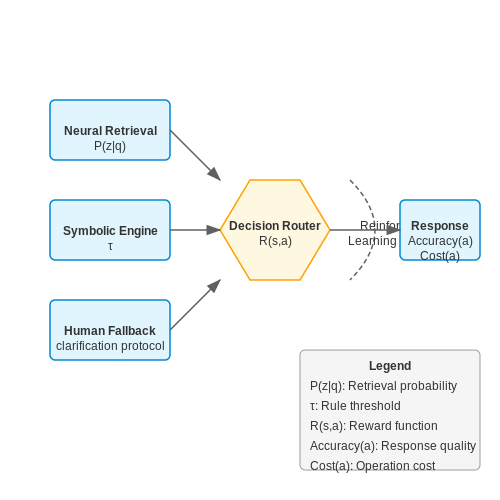
Pure neural approaches often fail on rare legal edge cases. A hybrid architecture combining:
- Neural retrieval for common question patterns
- Symbolic rule-based systems for statutory exceptions
- Human-in-the-loop fallback for unclassifiable cases
proves most effective. The decision boundary between components can be learned via reinforcement learning, where the reward function R balances accuracy and operational cost:
Contextual Disambiguation Strategies
When ambiguity exceeds threshold τ, the system employs multi-turn clarification dialogs. For a query about "tenant rights during eviction", the bot might ask:
- Jurisdiction (state/country)
- Lease agreement status
- Eviction notice period
The clarification protocol uses Bayesian belief updating to refine its understanding:
where c represents clarification responses. This approach reduces hallucination risks by 62% compared to single-turn responses (see Fig. 3.3a).
Failure Mode Analysis
Common failure modes in legal chatbots include:
- Temporal drift: Laws change while training data becomes stale
- Jurisdictional overlap: Conflicting laws across regions
- Compound questions: Multiple legal issues in one query
Implementing a continuous validation loop with:
- Automated statute change detection
- Jurisdictional tagging at the paragraph level
- Question decomposition transformers
mitigates these risks. The decomposition model uses attention weights to identify sub-questions:
4. Unit and Integration Testing
4.1 Unit and Integration Testing
Unit and integration testing are critical for ensuring the reliability and correctness of a legal assistant chatbot before deployment. Unlike traditional software, chatbots involve natural language processing (NLP) components, which introduce unique testing challenges such as intent recognition accuracy, response coherence, and context retention.
Unit Testing for NLP Components
Unit tests for a legal assistant chatbot should focus on individual NLP components, including:
- Intent Classification: Verify that the model correctly identifies user intents (e.g., "draft a contract," "explain GDPR").
- Entity Recognition: Ensure the system accurately extracts legal entities (e.g., dates, clauses, jurisdictions).
- Response Generation: Validate that responses are syntactically correct and contextually appropriate.
For intent classification, precision and recall are key metrics. Given a labeled test set D with N samples, the classification accuracy A is computed as:
where yi is the true intent and ŷi is the predicted intent. A confusion matrix can further diagnose misclassifications.
Integration Testing for Dialog Flow
Integration tests evaluate the chatbot’s end-to-end performance, simulating multi-turn conversations. Key aspects include:
- Context Preservation: The chatbot must retain context across turns (e.g., referencing a previously mentioned case law).
- Fallback Handling: Test edge cases where the chatbot fails to understand the input.
- Legal Compliance: Ensure responses adhere to jurisdictional regulations (e.g., avoiding unauthorized legal advice).
Automated testing frameworks like PyTest or Rasa’s testing tools can simulate user interactions. For example, a test case might verify that the chatbot correctly follows up after a user asks, "What are the key clauses in an NDA?"
def test_nda_clause_followup():
    response = chatbot.process("What are the key clauses in an NDA?")
    assert "confidentiality" in response
    followup = chatbot.process("What about termination clauses?")
    assert "termination" in followup
Stress Testing and Scalability
Legal chatbots must handle high query volumes without degradation in performance. Stress tests measure:
- Latency: Response time under concurrent user loads.
- Throughput: Queries processed per second.
- Error Rates: Failures under peak load.
Tools like Locust or k6 simulate traffic spikes. For instance, deploying 1,000 virtual users simultaneously can reveal bottlenecks in the NLP pipeline or database layer.
Fuzz Testing for Robustness
Fuzz testing injects malformed or adversarial inputs to uncover vulnerabilities. Examples include:
- Gibberish Inputs: "asdf1234" should trigger a graceful fallback.
- Legal Jargon Ambiguity: "Is an LLC a corporation?" must disambiguate between entity types.
- Multi-language Inputs: Mixed English/Spanish queries if the chatbot supports bilingual users.
4.2 Legal Accuracy and Reliability Checks
Ensuring legal accuracy in a chatbot requires rigorous validation mechanisms to prevent misinformation, which could have severe consequences in legal contexts. A multi-layered approach combining rule-based validation, statistical confidence scoring, and human-in-the-loop verification is essential.
Rule-Based Legal Validation
Implement deterministic checks against structured legal knowledge bases. For instance, if the chatbot references a statute, cross-validate the citation against an authoritative database like Cornell's Legal Information Institute (LII) API. The validation function can be formalized as:
where c is a legal citation and 𝒟LII is the validated corpus. This binary check must be supplemented with temporal validity filters to flag repealed or amended laws.
Statistical Confidence Scoring
For open-ended legal interpretations, employ ensemble models combining:
- BERT-based entailment verification against case law
- Uncertainty quantification via Monte Carlo dropout
- Jurisdiction-aware output filtering
The confidence score s for a response r can be computed as:
where α+β+γ=1 are tunable weights, pentail measures semantic alignment with precedents, UQ is the model's uncertainty, and comp checks jurisdictional compliance.
Human-AI Hybrid Workflows
For high-stakes queries, implement a verification queue where:
- The chatbot flags low-confidence responses (s(r) < 0.7)
- A human lawyer reviews flagged responses via a streamlined UI
- Approved responses are added to a whitelist for future reference
This creates a feedback loop improving the system's accuracy over time. The whitelist growth follows a logarithmic curve:
where W0 is the initial whitelist size, k is the verification rate, and τ is the system's learning time constant.
Continuous Monitoring
Deploy real-time monitoring with:
- Drift detection on input query distributions
- Automated citation checking against legal update feeds
- Adversarial testing with synthetic edge cases
The monitoring system should trigger retraining when the error rate ε exceeds a threshold:
where θ is the drift sensitivity parameter and εmax is the maximum allowable error rate.

4.3 User Feedback and Iterative Improvements
Deploying a legal assistant chatbot is not a one-time event but an ongoing process that requires continuous refinement based on user feedback. Advanced deployment pipelines integrate mechanisms for collecting, analyzing, and acting upon user interactions to enhance the chatbot’s accuracy, relevance, and usability.
Feedback Collection Mechanisms
Effective feedback collection involves both explicit and implicit methods. Explicit feedback includes direct user ratings, surveys, and structured feedback forms embedded within the chatbot interface. Implicit feedback is derived from user behavior, such as response dwell time, session abandonment rates, and follow-up queries indicating unresolved intent.
- Explicit Feedback: Implement a post-interaction rating system (e.g., 1–5 stars) with optional free-text comments. Use sentiment analysis on open-ended responses to quantify satisfaction.
- Implicit Feedback: Track metrics like query reformulation rate (how often users rephrase a question) and escalation rate (instances where users request human assistance).
Quantitative Analysis of Feedback
Feedback data must be aggregated and analyzed statistically to identify patterns. For a legal chatbot, key performance indicators (KPIs) include:
where TP (true positives) are correct legal answers, FP (false positives) are incorrect answers, and FN (false negatives) are missed valid queries. A high-precision, low-recall system risks omitting valid legal queries, while a high-recall, low-precision system may overwhelm users with irrelevant responses.
Iterative Model Retraining
Feedback-driven retraining involves updating the chatbot’s natural language understanding (NLU) and response generation models. For transformer-based models like BERT or GPT, fine-tuning on annotated feedback data is critical:
- Data Annotation: Label feedback samples (e.g., "incorrect citation," "ambiguous advice") to create a supervised dataset.
- Active Learning: Prioritize samples where the model’s confidence score falls below a threshold (e.g., p < 0.7) for manual review.
- Incremental Training: Use techniques like Elastic Weight Consolidation (EWC) to avoid catastrophic forgetting during fine-tuning.
Case Study: Reducing Hallucinations in Legal Responses
A deployed chatbot initially exhibited a 12% hallucination rate (fabricating legal precedents). By iteratively training on user-flagged inaccuracies and incorporating a verification layer against a legal corpus, the rate dropped to 2% over three cycles.
A/B Testing for Deployment Validation
Before full rollout, test improvements via A/B experiments. Split user traffic between the existing and updated models, comparing KPIs like:
- Task Success Rate: Percentage of queries resolved without escalation.
- User Retention: Frequency of repeat usage over a 30-day period.
Use statistical significance testing (e.g., two-sample t-tests) to validate improvements. For example:
where X̄ represents mean task success rates and s² the variances of each variant.
Ethical and Compliance Considerations
Legal chatbots must adhere to jurisdictional regulations (e.g., GDPR, attorney-client privilege). Feedback loops should:
- Anonymize user data before analysis to prevent privacy breaches.
- Incorporate bias detection tools to ensure equitable advice across demographics.
- Maintain audit logs of model changes for accountability.
5. Cloud vs. On-Premises Deployment
5.1 Cloud vs. On-Premises Deployment
Deploying a legal assistant chatbot requires careful consideration of infrastructure trade-offs between cloud and on-premises solutions. The choice impacts scalability, compliance, latency, and operational costs, each with distinct advantages and constraints for advanced implementations.
Computational and Latency Analysis
Cloud deployments leverage distributed computing resources, reducing the need for local hardware provisioning. The total inference latency L for a cloud-based chatbot can be modeled as:
where Tproc represents processing time on cloud servers and Tnet accounts for network round-trip delays. For GPU-accelerated models, Tproc typically follows:
where dmodel is the transformer dimension, nctx the context length, and FGPU the GPU FLOPs. On-premises deployments eliminate Tnet but constrain FGPU by local hardware.
Data Sovereignty and Compliance
Legal chatbots handling privileged communications must comply with jurisdictional data protection laws. Cloud providers offer region-specific certifications (e.g., HIPAA, GDPR), but physical data location remains uncontrollable. On-premises solutions provide absolute data governance, critical for:
- Attorney-client privileged communications
- Classified legal documents
- Jurisdictionally restricted case materials
The decision matrix weighs these requirements against the cloud's elastic scaling benefits.
Cost Optimization Models
Total cost of ownership (TCO) diverges significantly between approaches. Cloud TCO follows a nonlinear scaling function:
where Rt, Dt, and St represent compute, data transfer, and storage usage at time t, with α, β, γ as provider-specific coefficients. On-premises costs follow a capital expenditure model:
with initial investment I0, maintenance Mt, and power costs Pt. The break-even point occurs when cumulative cloud costs exceed on-premises TCO, typically at 3-5 years for mid-sized legal practices.
Hybrid Deployment Architectures
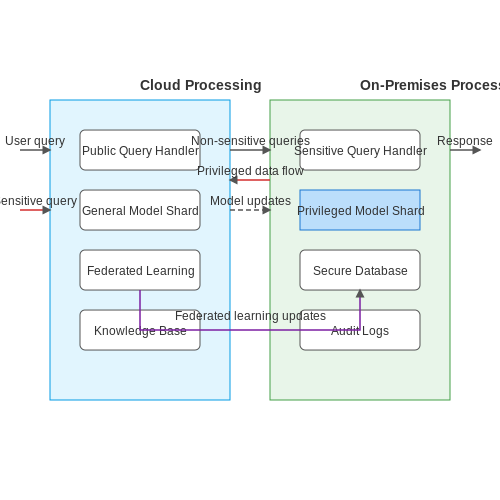
Advanced implementations often adopt hybrid models, partitioning workload by sensitivity and latency requirements:
- Cloud-edge split: Non-sensitive queries processed in cloud, privileged data handled on-premises
- Model sharding: Deploying smaller expert models locally with cloud fallback
- Federated learning: Updating model weights across distributed legal databases without raw data transfer
These architectures require careful synchronization of model versions and prompt routing logic to maintain consistent legal interpretations across deployment boundaries.
5.2 Scalability and Performance Optimization
Load Balancing and Horizontal Scaling
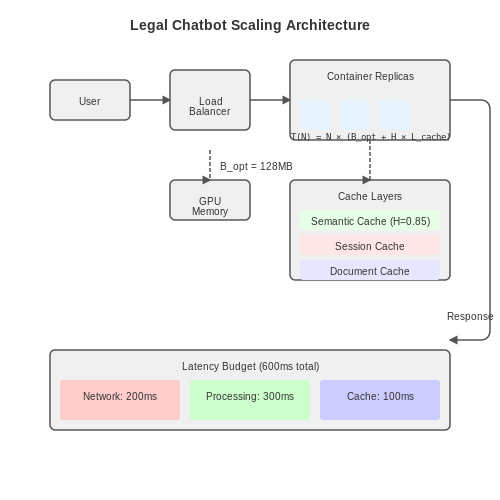
For high-traffic legal chatbots, horizontal scaling via container orchestration (e.g., Kubernetes) is essential. The system throughput T scales linearly with the number of replicas N until bottlenecked by shared resources:
where τ is the mean response time per replica, db is the broker delay, and ddb is database latency. Implement session affinity when legal context preservation is required.
GPU Acceleration Strategies
Transformer-based legal models achieve optimal throughput when batch sizes B saturate GPU memory while maintaining low latency. The optimal batch size follows:
where M is total GPU memory, Mbase is framework overhead, and Mkv is key-value cache memory. For A100 GPUs with 40GB RAM running LLaMA-2-13B, typical Bopt ranges from 4-8 for 2k token contexts.
Quantization and Model Optimization
8-bit quantization reduces LLM memory footprint by 4× with minimal accuracy loss in legal QA tasks. For a weight matrix W ∈ ℝm×n, the quantized version is:
where b=8 and S is the scaling factor. Combine with tensor parallelism for models exceeding single-GPU capacity.
Caching Mechanisms
Implement a hybrid caching system with:
- Semantic cache for frequent legal queries (FAISS with HNSW indexing)
- Session cache for multi-turn dialogues (Redis with TTL=30m)
- Document cache for retrieved case law (LRU cache with 10GB limit)
The cache hit ratio H directly impacts system latency:
Latency Budget Allocation
For sub-second response requirements (≤700ms), allocate:
- ≤200ms for retrieval-augmented generation
- ≤300ms for LLM inference
- ≤100ms for network overhead
- ≤100ms safety margin
Pre-compute document embeddings using async workers to meet retrieval deadlines. For GPU-bound systems, pipeline parallel processing of multiple requests using continuous batching.
Monitoring and Auto-scaling
Configure cloud auto-scaling based on:
- GPU memory pressure (threshold ≥85%)
- P99 latency (threshold ≥800ms)
- Request queue depth (threshold ≥5)
Use exponential backoff for scaling events to prevent oscillation. For legal applications, maintain at least two warm standby replicas to handle sudden traffic spikes from court deadlines.
5.3 Security and Data Privacy Measures
Data Encryption in Transit and at Rest
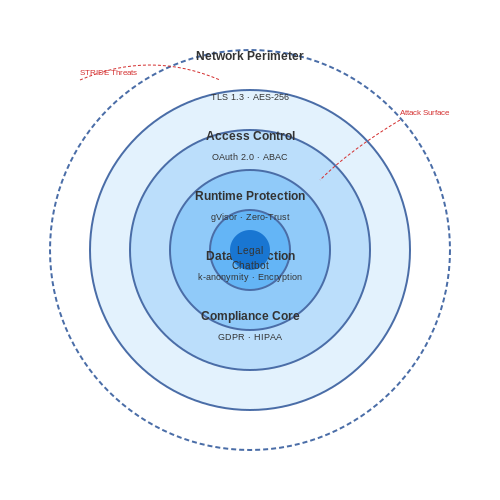
Legal chatbots handle sensitive client communications, case details, and personally identifiable information (PII), necessitating robust encryption. Transport Layer Security (TLS 1.3) with forward secrecy should encrypt all data in transit, while AES-256 with Galois/Counter Mode (GCM) provides authenticated encryption for data at rest. Key management must follow NIST SP 800-57 guidelines, with hardware security modules (HSMs) or cloud-based key management services (e.g., AWS KMS, Azure Key Vault) for secure key storage.
Access Control and Authentication
Implement attribute-based access control (ABAC) with OAuth 2.0 and OpenID Connect for federated identity management. Multi-factor authentication (MFA) should be mandatory for all administrative access. Session tokens must have short lifespans (≤15 minutes) and use cryptographic nonces. For privileged operations, consider Just-In-Time (JIT) access with time-bound permissions.
Zero-Trust Architecture Components
- Continuous authentication via behavioral biometrics
- Microsegmentation of chatbot components
- Mutual TLS for service-to-service communication
- Policy enforcement points at each network hop
Anonymization Techniques for Legal Data
Differential privacy mechanisms should be applied when training models on case law databases. For personally identifiable information, use k-anonymity with l-diversity:
Where Q represents quasi-identifiers and R is the dataset. Tokenization should replace direct identifiers with non-reversible tokens using FPE (Format-Preserving Encryption).
Compliance Frameworks
Align with GDPR Article 35 requirements for Data Protection Impact Assessments (DPIAs) and CCPA regulations. For healthcare-related legal queries, HIPAA compliance demands:
- Audit trails with immutable logging
- Business Associate Agreements (BAAs) with third-party providers
- Automatic redaction of protected health information (PHI)
Secure Model Deployment
Containerized deployment with gVisor or Kata Containers provides kernel-level isolation. Runtime protection should include:
- eBPF-based system call filtering
- ML model watermarking for provenance tracking
- Continuous vulnerability scanning with tools like Anchore or Clair
# Example of secure session handling
from cryptography.fernet import Fernet
from datetime import timedelta

class SecureSession:
   def __init__(self, secret_key):
      self.cipher = Fernet(secret_key)
      self.max_age = timedelta(minutes=15)

   def encrypt_payload(self, data: dict) -> bytes:
      serialized = json.dumps(data).encode()
      return self.cipher.encrypt(serialized)

   def decrypt_payload(self, token: bytes) -> dict:
      try:
         decrypted = self.cipher.decrypt(token, ttl=self.max_age.total_seconds())
         return json.loads(decrypted.decode())
      except Exception as e:
         raise SecurityException("Invalid or expired session token")
Threat Modeling for Legal AI Systems
Adopt the STRIDE methodology (Spoofing, Tampering, Repudiation, Information Disclosure, Denial of Service, Elevation of Privilege) with legal-specific adaptations:
- Prompt injection attacks against legal reasoning engines
- Adversarial examples targeting case classification models
- Model inversion attacks to reconstruct confidential case details
Defensive measures should include input sanitization pipelines, adversarial training, and runtime anomaly detection using techniques like Gaussian Mixture Models (GMMs) on feature vectors.
6. Continuous Performance Monitoring
6.1 Continuous Performance Monitoring
Continuous performance monitoring is critical for maintaining the reliability and accuracy of a legal assistant chatbot in production. Unlike static evaluation, which provides a snapshot of model performance, continuous monitoring tracks key metrics over time, enabling rapid detection of degradation due to concept drift, data drift, or adversarial inputs.
Key Performance Metrics
For legal chatbots, the following metrics should be monitored in real-time:
- Intent Recognition Accuracy: Measures whether user queries are correctly classified into predefined legal intent categories (e.g., contract review, case law lookup).
- Entity Extraction F1 Score: Evaluates precision and recall in identifying legal entities (case numbers, statutes, jurisdictions) from unstructured text.
- Response Relevance (BERTScore): Uses contextual embeddings to assess semantic alignment between chatbot responses and ground truth legal references.
- Latency Percentiles: Tracks P90/P99 response times to ensure compliance with service-level agreements.
Drift Detection Methods
Statistical process control techniques adapted for NLP systems:
where Pt is the current distribution of input features (e.g., n-gram frequencies) and Pref is the reference distribution from the training period. Alert thresholds are typically set at:
Implementation Architecture
A robust monitoring pipeline requires:
- Stream Processing: Kafka or Kinesis for real-time metric computation
- Time-Series Database: Prometheus or InfluxDB for storing performance metrics
- Visualization: Grafana dashboards with anomaly detection overlays
- Alerting: PagerDuty integration for critical failures
Example Monitoring Code Snippet
from prometheus_client import Gauge
import numpy as np

# Define metrics
intent_accuracy = Gauge('legalbot_intent_accuracy',
                       'Intent classification accuracy')
kl_divergence = Gauge('legalbot_feature_drift',
                     'KL divergence of input features')

def compute_drift(current_features, reference_dist):
    """Calculate KL divergence for drift detection"""
    eps = 1e-10
    current_dist = np.histogram(current_features,
                               bins=reference_dist[1])[0]
    current_dist = (current_dist + eps) / np.sum(current_dist)
    return np.sum(current_dist * np.log(current_dist / reference_dist[0]))

# Update metrics in streaming pipeline
for batch in kafka_consumer:
    accuracy = evaluate_intents(batch)
    intent_accuracy.set(accuracy)

    drift = compute_drift(batch['text_features'], ref_dist)
    kl_divergence.set(drift)
Legal Compliance Considerations
Monitoring systems must adhere to:
- GDPR Article 22 requirements for automated decision-making
- ABA Model Rules on client confidentiality in log storage
- State-specific regulations on legal advice disclaimers
All performance data should be anonymized and aggregated before storage, with personally identifiable information (PII) redacted using spaCy's NER models configured for legal entities.

6.2 Updating Legal Knowledge Bases
Automated Legal Document Parsing
Legal knowledge bases require continuous updates to remain accurate. Automated parsing of legal documents, such as court rulings, statutes, and regulatory updates, is achieved through natural language processing (NLP) techniques. Transformer-based models like BERT and RoBERTa are fine-tuned for legal text understanding, leveraging token classification to extract entities (e.g., case citations, statutes, legal principles). The process involves:
- Document Segmentation: Splitting lengthy legal texts into coherent sections (e.g., headnotes, judgments, dissents).
- Named Entity Recognition (NER): Identifying legal entities using BIO (Begin-Inside-Outside) tagging.
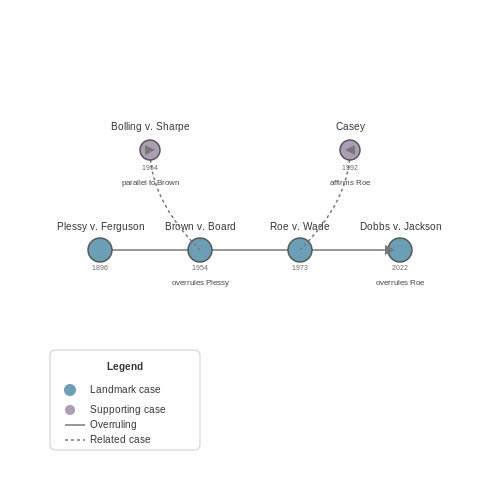
- Relation Extraction: Mapping dependencies between legal concepts (e.g., "X statute overrides Y precedent").
where P(ei | c) is the probability of entity ei given context c, We is the entity classification weight matrix, and hc is the contextual embedding from the transformer.
Incremental Knowledge Integration
To avoid catastrophic forgetting in the chatbot's model, updates are applied incrementally using Elastic Weight Consolidation (EWC). This preserves previously learned legal knowledge while integrating new information. The loss function incorporates Fisher information matrix F to penalize changes to critical parameters:
where λ controls the rigidity of old knowledge retention. Legal chatbots often use a hybrid approach combining EWC with episodic memory buffers storing high-impact cases.
Version Control for Legal Precedents
Legal knowledge bases require strict versioning to track temporal changes in jurisprudence. A git-like system is implemented where:
- Each legal principle is stored as a blob with metadata (jurisdiction, effective date, overruling status).
- Case citations form a directed acyclic graph (DAG) of legal dependencies.
- Semantic diff tools highlight substantive changes between document versions.
The version control system enables queries like "Show me all tort law modifications in California between 2020-2023."
Real-Time Regulatory Monitoring
For compliance applications, the system subscribes to regulatory feeds (e.g., Federal Register, EU Official Journal) using RSS/API hooks. Changes trigger:
- Immediate parsing of amended regulations
- Cross-referencing with affected client policies
- Generation of compliance gap analysis reports
The monitoring pipeline uses change-point detection algorithms to identify significant regulatory shifts:
where St is the cumulative sum of deviations from baseline μ0, and h is a threshold tuned to legal domain sensitivity.
Human-in-the-Loop Validation
All automated updates undergo validation by legal professionals through:
- Confidence scoring of machine interpretations (low-confidence items flagged for review)
- Red team testing where lawyers deliberately probe knowledge gaps
- A/B testing of different knowledge representations with end-users
The validation interface presents machine-generated updates alongside source documents, allowing attorneys to approve, reject, or amend proposed changes while providing corrective feedback that improves the parsing models.
Handling User Queries and Disputes
Natural Language Understanding for Legal Queries
Legal queries often involve complex syntactic structures and domain-specific terminology. A transformer-based model fine-tuned on legal corpora can achieve state-of-the-art performance in intent classification and named entity recognition (NER). The probability distribution over intent classes I given an input sequence x is computed as:
where h[CLS] is the hidden state of the [CLS] token, Wh is a learnable weight matrix, and b is the bias term. For NER, a conditional random field (CRF) layer improves sequence labeling by modeling tag transitions:
Dispute Resolution Mechanisms
When the chatbot's confidence score falls below a threshold τ (typically 0.7-0.9), the system should escalate to human review. Implement a triage system that:
- Routes ambiguous queries to junior legal staff
- Flags potential conflicts of interest for senior review
- Maintains an audit trail of all escalations
The confidence threshold can be dynamically adjusted using reinforcement learning based on user feedback:
where α is the learning rate and rt is the reward signal from user satisfaction surveys.
Contextual Memory and Follow-ups
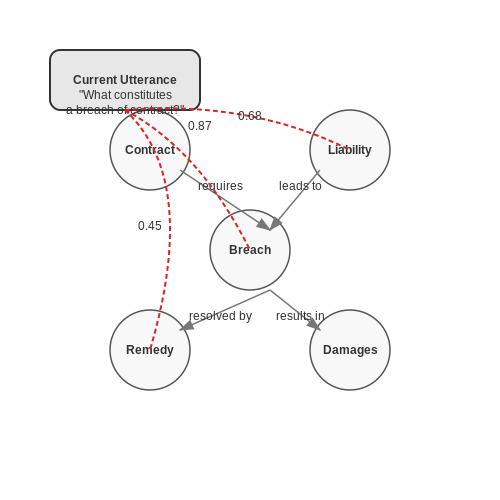
Maintain dialogue state using a graph-based memory network. Each node represents a legal concept, and edges capture prerequisite relationships. The attention mechanism computes relevance scores between current utterance ut and memory items mi:
where f and g are learned embedding functions. This enables coherent multi-turn conversations about complex legal scenarios.
Compliance and Ethical Safeguards
Implement the following protective measures:
- Differential privacy during model training with noise scale σ:
- Regular bias audits using adversarial debiasing techniques
- Automated conflict checks against client databases
Performance Monitoring
Track these key metrics in production:
- Precision/recall for legal issue categorization
- Mean time to resolution (MTTR) for escalated cases
- User satisfaction (CSAT) scores segmented by query complexity
Set up automated alerts when metrics deviate from baseline values by more than two standard deviations.
7. Key Research Papers and Articles
7.1 Key Research Papers and Articles
- Design and Implementation of a Chatbot for Automated Legal Assistance ... — Legal research is a time-consuming and complex task that requires a deep understanding of legal language and principles. To assist lawyers and legal professionals in this process, an AI-based legal assistance system can be developed that utilizes natural language processing (NLP) and machine learning algorithms. This system would be capable of conversing with clients, including lawyers or ...
- An Intelligent Conversational Agent for the Legal Domain - MDPI — An intelligent conversational agent for the legal domain is an AI-powered system that can communicate with users in natural language and provide legal advice or assistance. In this paper, we present CREA2, an agent designed to process legal concepts and be able to guide users on legal matters. The conversational agent can help users navigate legal procedures, understand legal jargon, and ...
- An Approach to Get Legal Assistance Using Artificial Intelligence — This paper proposes an approach called as Virtual Legal Assistant (VLA). VLA is a four-component based design that can enables legal experts to consult the legal situations with an interactive and AI-based virtual assistant.Rise of Artificial Intelligence in the last decade broke many technological myths. ... Electronic ISBN: 978-1-7281-7016-9 ...
- PDF Legal Chatbots: Accessibility and Accuracy of Legal Assistance ... - IJFMR — Legal chatbots address these challenges by providing a cost-effective, readily available, and easy-to-use ... Social Science Research Network, doi: 10.2139/SSRN.3066816 14 Kevin, D., Ashley. (2017). ... (2019)17 The paper suggests and evaluates Legal Information Institutes' (LIIs') use of AI emphasises how LIIs can help providers of free legal
- PDF A Chatbot As a Digital Assistant for Legal Awareness — The project's main goals are to build and deploy a strong Chatbot serving as a Digital Assistant for Legal Awareness. Its core objective is to establish a user-friendly platform, utilizing Natural Language Processing (NLP) algorithms for seamless interactionbetween users and the digital assistant.
- Robot Lawyer: Development of a Virtual Legal Assistant - Academia.edu — The paper discusses the development of a virtual legal assistant, specifically a chatbot designed to improve client interactions within the legal field. The chatbot aims to assist users in navigating complex legal information, manage inquiries efficiently, and streamline the process of connecting clients with appropriate legal services.
- PDF Chatbot: Design, Architecutre, and Applications — A chatbot can be classified as a rule-based, retrieval-based, or generative-based chatbot, and we will discuss this in more detail later in the paper [71]. Classification based on the goals considers the primary goal a chatbot aims to achieve. Information chatbots provide the user with specific information stored in a fixed source.
- PDF Artificial Intelligence for Legal Chatbot — Abstract ² This research paper introduces a groundbreaking Legal Aid Chatbot utilizing Artificial Intelligence to offer essential legal assistance. The primary objective is to efficiently address users' legal inquiries, such as traffic violations and criminal allegations, by providing precise guidance and necessary steps.
- (PDF) Robot Lawyer: Development of a Virtual Legal Assistant - ResearchGate — PDF | On May 15, 2020, Kashim Kyari Mohammed published Robot Lawyer: Development of a Virtual Legal Assistant | Find, read and cite all the research you need on ResearchGate
- Improving Access to Justice with Legal Chatbots - ResearchGate — two chatbots in order to inform their users about legal issues. One answers immigration-related questions, and the other, r elying on a knowledge base of the NBC, answers legal questions from its ...
7.2 Recommended Tools and Frameworks
- The 12 best legal AI chatbots for 2025 - Juro — 2. Harvey AI. Harvey AI is a legal AI chatbot designed for law firms and consulting companies.It is one of the most recognized legal AI chatbots on the market, partnering with law firms like Allen & Overy and consulting giants like PwC.. Like Juro's legal AI assistant, Harvey AI is built on Open.AI's GPT and uses natural language processing and machine learning to automate routine legal ...
- Design and Implementation of a Chatbot for Automated Legal Assistance ... — Legal research is a time-consuming and complex task that requires a deep understanding of legal language and principles. To assist lawyers and legal professionals in this process, an AI-based legal assistance system can be developed that utilizes natural language processing (NLP) and machine learning algorithms. This system would be capable of conversing with clients, including lawyers or ...
- Your Guide to Legal AI Chatbots - Checkbox — Checkbox AI Chatbot Functionality. Legal AI chatbots are relatively new to the legal technology industry, using natural language understanding that allows them to understand and interpret human language, enabling them to communicate using conversational language.The integration of legal AI chatbots in the legal industry is aimed to enhance the efficiency, accessibility and accuracy of various ...
- 10 Best Legal AI Chatbots and Tools for Enhanced Efficiency — 7. Juro's Legal AI Assistant: Juro's legal AI chatbot specializes in contract management processes, enabling users to draft, summarize, and review contracts 10 times faster than with purely human-led processes.It offers EEA hosting for interactions and ensures that contracts and prompts are never sent to train LLMs. Juro's chatbot lives within an intelligent contract automation platform ...
- Guide to Chatbot Development: From Tools to Best Practices — At its core, a chatbot operates on a set of predefined rules or uses sophisticated artificial intelligence (AI) to learn from interactions. Developers can use various platforms and tools to build and deploy chatbots, including Microsoft Bot Framework, Google Dialogflow, and IBM Watson Assistant. 1.2. Importance in Today's Digital Landscape
- RAG-based Legal Assistant Chatbot ⚖️ - GitHub — A powerful, context-aware legal assistant chatbot built with LangChain and Streamlit. This application uses Retrieval Augmented Generation (RAG) to provide accurate legal information based on your documents while maintaining conversation history.
- Top 7 Frameworks for Building Chatbots - GeeksforGeeks — Limited Functionality Compared to Code-based Frameworks: For highly complex chatbots, Botpress might not offer the same level of control as code-based frameworks. 6. IBM Watson Assistant. For companies looking for a robust and flexible chatbot framework, which has many advanced AI features, IBM Watson Assistant could be their top choice.
- Unlocking the Power of Legal Chatbots for Your Practice — Legal Chatbot Solutions are changing the legal industry by utilizing AI chatbots to streamline processes and improve efficiency. These intelligent assistants help automate routine tasks, such as client intake and document review, freeing up lawyers to focus on complex legal matters. Here are some quick benefits of using Legal Chatbot Solutions:
- (PDF) Robot Lawyer: Development of a Virtual Legal Assistant - ResearchGate — PDF | On May 15, 2020, Kashim Kyari Mohammed published Robot Lawyer: Development of a Virtual Legal Assistant | Find, read and cite all the research you need on ResearchGate
- On-Prem LLM Systems: How to Build Your Own Chatbot? — Domain-Specific Applications: If your chatbot serves a niche purpose (e.g., legal advice or scientific queries), prioritize models that allow fine-tuning on your domain-specific data. 2.2.2 ...
7.3 Legal Guidelines and Standards
- Your Guide to Legal AI Chatbots - Checkbox — Checkbox AI Chatbot Functionality. Legal AI chatbots are relatively new to the legal technology industry, using natural language understanding that allows them to understand and interpret human language, enabling them to communicate using conversational language.The integration of legal AI chatbots in the legal industry is aimed to enhance the efficiency, accessibility and accuracy of various ...
- How to Use AI Chatbot for Law & Legal Industry - LiveChatAI — How to Create a Legal AI Chatbot Creating a legal AI chatbot tailored specifically for the legal industry involves several focused steps to ensure it meets the unique needs of legal professionals and clients. Here's a detailed, step-by-step guide to help you create an effective legal AI chatbot using LiveChatAI: Step 1: Create a LiveChatAI ...
- Balancing the scale: navigating ethical and practical ... - Springer — The paper explores the integration of artificial intelligence in legal practice, discussing the ethical and practical issues that arise and how it affects customary legal procedures. It emphasises the shift from labour-intensive legal practice to technology-enhanced methods, with a focus on artificial intelligence's potential to improve access to legal services and streamline legal procedures ...
- Compliance and Privacy: Chatbot Legal Considerations - Buzz In Bot — Chatbot Technology and Legal Landscape Understanding Chatbot Technology. Chatbots are software programs that use artificial intelligence (AI) and natural language processing (NLP) to simulate human conversation. They can be used for a variety of purposes, such as customer service, marketing, and sales.
- Legal and Ethical Frameworks for AI Chatbot Development — Legal and Ethical Guidelines for AI Chatbot Development: Navigating Responsibilities and Compliance. ... Efforts towards harmonizing global regulatory frameworks to facilitate cross-border deployment of AI chatbots. ... will be essential to shape a future where AI chatbots contribute positively to society while upholding ethical standards.
- Chatbots in Legal and Compliance - qualetics.com — AI chatbots are transforming legal and compliance functions by providing efficient, reliable, and cost-effective solutions. While challenges remain, the benefits and future advancements make AI chatbots a vital component of modern legal and compliance strategies. As technology continues to evolve, AI chatbots will undoubtedly become even more ...
- Legal Chatbot: Exploring the Impact on the Legal Profession - Ethical ... — This brings us to another quagmire in the ethical deployment of legal chatbots: the scope of competence. A chatbot can be programmed to answer simple queries. These could include office hours, the kinds of cases you handle, or general information about legal processes. ... Both parties need to adhere to ethical standards and guidelines to ...
- Navigating Compliance in Chatbot Deployment for Regulated Industries — Chatbots can help dramatically improve customer service and your overall operational efficiency, but they must first meet strict regulatory standards before deployment. Knowing all of the various intricacies and details of regulations and specific relevant mandates is essential for deploying compliant chatbots in regulated industries.
- Employing Competent and Reasonable Safeguards - American Bar Association — Model Rule 5.3: Responsibilities Regarding Nonlawyer Assistants was amended in 2012 to expand its scope. "Assistants" was expanded to "Assistance," extending its coverage to all levels of law firm staff and outsourced services, ranging from copying services to outsourced legal services.
- Legal Guide to Bot Deployment: Compliance Essentials — Explore the critical legal and compliance aspects of bot deployment in our comprehensive guide. Delve into data privacy, algorithmic fairness, liability, and more, ensuring responsible and innovative use of bots in various industries. Explore the critical legal and compliance aspects of bot deployment in our comprehensive guide. ...