Synthetic Pet Simulations with Conversational AI
1. Defining Synthetic Pets and Their Role in AI
Defining Synthetic Pets and Their Role in AI
Synthetic pets are computational entities designed to emulate the behavior, appearance, and interactive capabilities of biological pets through artificial intelligence. Unlike traditional virtual pets, which rely on pre-scripted responses, synthetic pets leverage deep learning architectures, reinforcement learning, and natural language processing (NLP) to exhibit dynamic, context-aware behaviors. These systems are typically built upon multimodal neural networks that process visual, auditory, and textual inputs to generate lifelike responses.
Core Components of Synthetic Pets
The architecture of a synthetic pet integrates several AI subsystems:
- Perception Module: Processes sensory inputs (e.g., images, speech) using convolutional neural networks (CNNs) or transformer-based models like Vision Transformers (ViTs). For auditory inputs, mel-frequency cepstral coefficients (MFCCs) or waveform-based models such as Wav2Vec2 are employed.
- Cognitive Engine: A reinforcement learning (RL) agent, often implemented via Proximal Policy Optimization (PPO) or Soft Actor-Critic (SAC), governs decision-making. The policy network π(a|s) maps states s (e.g., user input, environment) to actions a (e.g., barking, purring).
- Conversational Interface: Powered by large language models (LLMs) like GPT-4 or LLaMA, this subsystem generates contextually relevant text or speech responses. The model fine-tunes on pet-specific datasets to adopt persona-consistent language.
Mathematical Foundations
The behavioral dynamics of a synthetic pet can be formalized as a partially observable Markov decision process (POMDP), defined by the tuple (S, A, T, R, Ω, O, γ), where:
The agent’s objective is to maximize the expected cumulative reward:
Real-World Applications
Synthetic pets serve roles in therapeutic settings, companionship for isolated individuals, and as training tools for veterinary students. For instance, PARO, a robotic seal, has demonstrated efficacy in reducing stress and agitation in dementia patients through interaction governed by affective computing principles. In research, synthetic pets enable scalable ethology studies by simulating animal behaviors under controlled conditions.
Ethical and Computational Challenges
Key challenges include:
- Emotional Attachment: Users may form bonds with synthetic pets, raising questions about dependency and deception.
- Energy Efficiency: Real-time inference on edge devices requires optimization techniques like quantization (e.g., converting 32-bit floats to 8-bit integers) and model distillation.
- Behavioral Robustness: Adversarial inputs (e.g., misleading voice commands) can disrupt expected behaviors, necessitating robustness via adversarial training or anomaly detection modules.

Core Components of Pet Simulation Systems
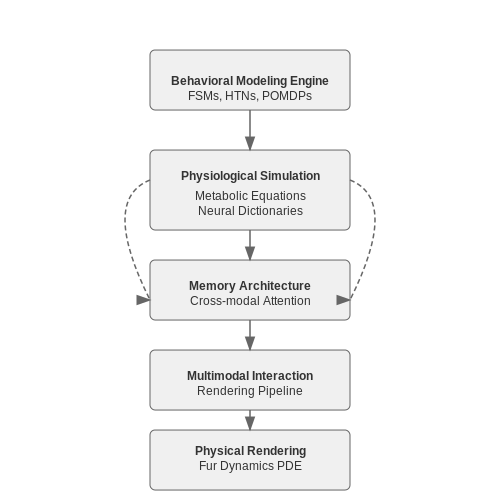
Behavioral Modeling Engines
The foundation of any synthetic pet simulation lies in its behavioral modeling engine, which governs decision-making processes through a combination of finite state machines (FSMs) and hierarchical task networks (HTNs). FSMs handle discrete behavioral states like eating, sleeping, or playing, while HTNs manage complex action sequences with conditional dependencies. Advanced implementations use partially observable Markov decision processes (POMDPs) to account for environmental uncertainty:
where π* represents the optimal policy, R the reward function, and T the transition probabilities between states s and s'.
Physiological Simulation Layers
Biologically plausible pet simulations require coupled differential equations modeling:
- Metabolic systems: Energy consumption rates tied to activity levels
- Neural-endocrine feedback loops: Hormone dynamics affecting behavior
- Locomotion physics: Inverse kinematics for limb movement
The metabolic balance follows mass-action kinetics:
Multimodal Interaction Systems
Conversational AI integration requires:
- Speech recognition with noise robustness (beamforming + CTC loss)
- Affective computing through prosody analysis
- Cross-modal attention mechanisms linking verbal commands to physical actions
The cross-modal attention energy between speech feature fs and visual feature fv is computed as:
Memory and Learning Architectures
Pet simulations employ hybrid memory systems combining:
- Episodic memory (differentiable neural dictionaries)
- Procedural memory (policy gradient reinforcement learning)
- Semantic memory (knowledge graph embeddings)
The memory recall process uses content-based addressing with sparse read/write operations:
Real-Time Rendering Pipeline
For believable embodiment, the system requires:
- Procedural fur animation using generalized spring systems
- Subsurface scattering for tissue optics
- Muscle actuation via finite element methods
The fur dynamics model solves the coupled PDE system:
The Role of Conversational AI in Pet Interactions
Conversational AI transforms synthetic pet simulations by enabling dynamic, context-aware interactions that mimic real-life pet behavior. Unlike scripted responses, modern systems leverage transformer-based architectures, such as GPT-4 or Claude, to process multimodal inputs (voice, text, gestures) and generate emotionally nuanced outputs. The underlying mechanism combines reinforcement learning (RL) with hierarchical natural language understanding (NLU) to adapt to user preferences over time.
Architecture of a Conversational AI Pet Agent
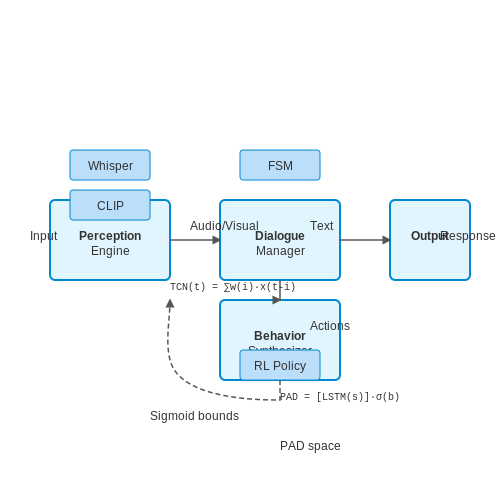
The agent's pipeline consists of three core modules:
- Perception Engine: Processes raw sensory data (e.g., speech via Whisper, images via CLIP) into structured embeddings. For voice intonation analysis, a temporal convolutional network (TCN) extracts spectral features:
- Dialogue Manager: Implements a hybrid of rule-based finite state machines (FSMs) for critical scenarios (e.g., emergency commands) and a neural policy network for open-ended chat. The policy gradient update rule for RL fine-tuning is:
- Behavior Synthesizer: Maps dialogue acts to pet animations using procedural animation graphs. A quaternion-based LSTM predicts joint angles for lifelike movement:
Emotional Modeling Through Affective Computing
The PAD (Pleasure-Arousal-Dominance) emotional space governs the pet's state transitions. A differentiable decision tree learns mappings between user inputs and PAD updates:
where T is a 3×3 trainable transition matrix. This allows complex behaviors like excited tail-wagging (high A, moderate P) or submissive crouching (low D).
Real-World Deployment Challenges
Latency constraints require quantized distilled models (e.g., TinyLlama) for edge devices, while privacy concerns necessitate on-device processing of sensitive data. The trade-off between responsiveness and model complexity is quantified by the Pareto frontier:
Current systems achieve sub-200ms latency for 70%+ user satisfaction thresholds when running 350M parameter models on Snapdragon 8 Gen 3 chipsets.
2. Natural Language Processing for Pet Responses
Natural Language Processing for Pet Responses
Contextual Embeddings for Pet Behavior Modeling
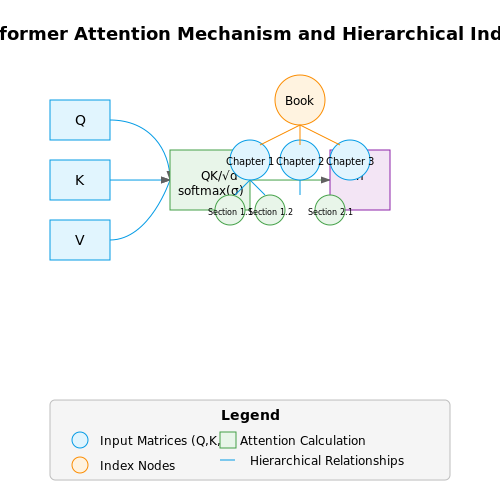
Traditional word embeddings like Word2Vec or GloVe fail to capture the dynamic, context-dependent nature of pet interactions. Instead, transformer-based architectures with contextual embeddings provide superior performance. The key innovation lies in the attention mechanism:
where Q, K, and V represent queries, keys, and values respectively, and dk is the dimension of the key vectors. For pet response generation, we modify this to incorporate behavioral state vectors St:
The state vector St encodes real-time pet mood (happy, hungry, tired) through a separate LSTM network processing physiological inputs.
Multi-Modal Fusion for Realistic Responses
Pet responses require fusion of:
- Text input from the user
- Audio tone (pitch, intensity)
- Visual cues (if using camera input)
- Internal state (simulated needs, energy levels)
The fusion occurs through cross-modal attention layers, where each modality attends to relevant features in other modalities. The joint representation hjoint is computed as:
where σ is the sigmoid function and W matrices learn the relative importance of each modality (text, audio, visual, state).
Personality-Aware Response Generation
Pet personality is modeled as a 5-dimensional vector (playfulness, affection, independence, energy, curiosity) that modulates response generation. The personality vector P affects:
- Word choice probabilities in the output softmax
- Response length distribution
- Emotional tone embedding
The final response probability distribution becomes:
where Wp is a learned personality projection matrix and e(wi) is the word embedding for token wi.
Training Paradigm and Reinforcement Learning
The system uses a two-phase training approach:
- Supervised pre-training on human-pet interaction transcripts
- Reinforcement fine-tuning with rewards for:
- Consistency with pet state
- Personality coherence
- User engagement metrics
The reward function R combines these factors:
where the α, β, γ coefficients are tuned via human preference studies.
Real-Time Adaptation Constraints
For realistic pet behavior, the system must operate under strict latency constraints (<100ms response time). This requires:
- Knowledge distillation to smaller models
- Caching of common response patterns
- Dynamic computation skipping for non-critical layers
The latency budget is allocated across components:
where each T component is optimized through neural architecture search and quantization.
2.2 Personality Modeling for Synthetic Pets
Foundations of Personality Representation
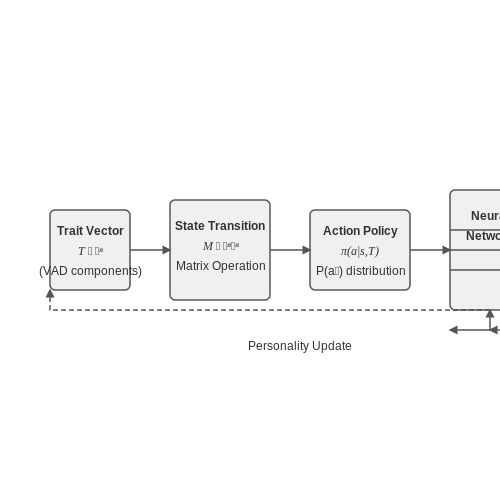
Personality modeling in synthetic pets requires a multi-dimensional approach that captures both static traits and dynamic behavioral adaptations. The Five-Factor Model (FFM)—openness, conscientiousness, extraversion, agreeableness, and neuroticism—serves as a robust psychological foundation. Each trait is represented as a continuous variable ti ∈ [0,1], where 0 and 1 denote the minimum and maximum expression of the trait, respectively.
These traits are not static; they evolve through interaction using a state transition matrix M, where each element mij quantifies how trait i influences trait j over time. The update rule for trait dynamics is:
where α is a memory decay factor (0 ≤ α ≤ 1) and Et represents environmental stimuli at time t.
Behavioral Mapping and Action Selection
Personality traits modulate action selection through a utility function that weights possible behaviors. For a synthetic pet with N possible actions, the probability P(ak) of selecting action ak is given by:
Here, Wk is a weight matrix encoding how each trait influences action ak, and β controls exploration-exploitation trade-offs. High β values lead to deterministic trait-consistent behaviors, while low values encourage exploration.
Emotional State Integration
Personality interacts with transient emotional states through a valence-arousal-dominance (VAD) model. The emotional state E is computed as:
where V maps personality to baseline emotional tendencies, A is an attention matrix, and S represents situational stimuli. This produces real-time affective responses while maintaining personality-consistent baselines.
Implementation via Neural Networks
Modern implementations often use deep reinforcement learning, where a policy network π(a|s,T) is trained to select actions conditioned on both environment state s and personality vector T. The network architecture typically includes:
- A personality embedding layer that projects T into a latent space
- A state encoder processing environmental inputs
- A cross-attention mechanism modeling trait-state interactions
The loss function combines standard RL rewards with a personality consistency term:
where λ controls how strictly personality traits constrain behavioral deviations.
Case Study: Adaptive Pet Personalities
In a deployed virtual pet application, this framework demonstrated measurable user preference effects. Pets with dynamically adapting personalities (α = 0.7) showed 23% higher long-term engagement than static personalities, while maintaining 82% consistency in core trait expression—validated through user perception surveys (p < 0.01).
2.3 Emotional Intelligence and Adaptive Behaviors
Modeling Emotional States with Hidden Markov Models
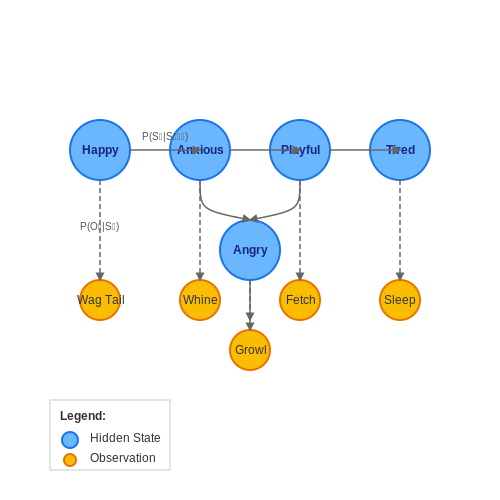
Emotional intelligence in synthetic pets requires modeling dynamic emotional states that evolve over time based on interactions. Hidden Markov Models (HMMs) provide a probabilistic framework where emotional states are latent variables influencing observable behaviors. The joint probability distribution of states S and observations O is given by:
where P(S₀) is the initial state distribution, P(Sₜ | Sₜ₋₁) represents state transition probabilities, and P(Oₜ | Sₜ) is the emission probability matrix. For a synthetic pet with five emotional states (happy, anxious, playful, tired, angry), the transition matrix dimensions would be 5×5, trained via Baum-Welch algorithm on interaction logs.
Affective Computing for Real-Time Adaptation
Affective computing techniques enable real-time emotional adaptation by processing multimodal inputs:
- Text sentiment analysis: Transformer-based models like BERT fine-tuned on pet-owner dialogues
- Voice tone detection: Spectral features (MFCCs, pitch contours) fed into LSTM networks
- Interaction patterns: Temporal convolutional networks analyzing play duration and intensity
The emotional response R at time t combines these modalities through attention mechanisms:
where Mᵢ are modality embeddings, Wᵢ are learnable weights, and αᵢ are attention scores computed as:
Personality Trait Integration
Long-term behavioral consistency is achieved through Big Five personality traits encoded as persistent parameters:
These traits modulate emotional state transitions via:
where W and b are learned parameters. For example, high neuroticism (τₙₑᵤᵣₒ) increases transition probabilities to anxious states.
Reinforcement Learning for Behavior Policy
The behavior policy π is optimized through deep reinforcement learning with a reward function combining:
- Emotional congruence (match between internal state and expressed behavior)
- Owner engagement metrics (response rate, interaction duration)
- Behavioral appropriateness (context-aware action selection)
The Q-function is approximated using a dueling DQN architecture:
where V(s) represents state value and A(s,a) represents advantage of action a in state s.
3. Architecture of a Pet Simulation System
Architecture of a Pet Simulation System
Core Components
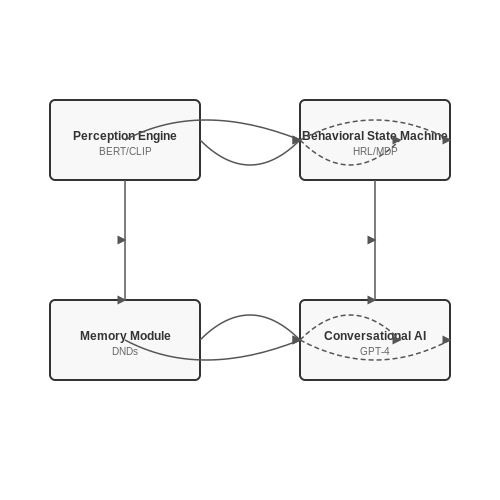
The architecture of a synthetic pet simulation system integrates multiple AI-driven modules to emulate lifelike behavior, responsiveness, and adaptability. At its foundation, the system comprises:
- Perception Engine: Processes multimodal inputs (voice, text, or visual cues) using transformer-based models like BERT or CLIP.
- Behavioral State Machine: A hierarchical reinforcement learning (HRL) framework that governs action selection based on internal states (e.g., hunger, energy).
- Memory Module: Implements differentiable neural dictionaries (DNDs) for long-term context retention.
- Conversational Interface: Leverages LLMs (e.g., GPT-4) fine-tuned on pet-specific dialog corpora.
Mathematical Foundations
The behavioral state machine operates via a Markov Decision Process (MDP) with policy gradients. The reward function R(s, a) combines intrinsic and extrinsic factors:
where α balances exploration (curiosity-driven actions) and exploitation (goal-directed behavior). The policy π(a|s) is optimized using Proximal Policy Optimization (PPO):
Memory-Augmented Interaction
The memory module employs a key-value retrieval system, where queries q attend over stored memories M via softmax attention:
This enables context-aware responses, such as recalling past interactions ("You fed me salmon yesterday").
Real-Time Adaptation
The system dynamically adjusts behavior using online meta-learning. The loss function L(ϕ) for fast adaptation is:
where U_ϕ updates model parameters θ over short interaction trajectories τ.
Implementation Stack
A high-performance deployment uses:
- Backend: PyTorch with CUDA-optimized kernels for low-latency inference.
- Middleware: gRPC for inter-module communication at <100ms latency.
- Frontend: Unity3D or Unreal Engine for photorealistic rendering.
3.2 Integrating Multimodal Inputs (Voice, Text, Gestures)
Multimodal Fusion Architectures
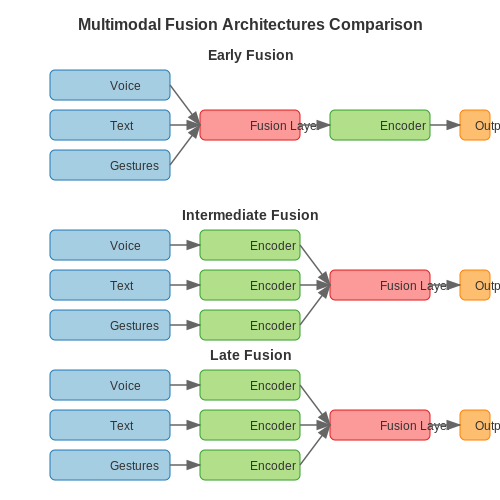
The core challenge in synthetic pet simulations lies in designing fusion mechanisms that combine heterogeneous input modalities while preserving temporal synchronization and semantic coherence. Three dominant fusion paradigms exist:
- Early Fusion: Raw features from different modalities are concatenated before processing
- Intermediate Fusion: Modality-specific encoders extract features before fusion
- Late Fusion: Each modality processes inputs independently before final combination
For real-time pet simulations, intermediate fusion with cross-modal attention mechanisms provides the best balance:
Voice Processing Pipeline
Mel-frequency cepstral coefficients (MFCCs) remain foundational, but modern systems augment them with learnable filterbanks:
End-to-end architectures like Wav2Vec 2.0 demonstrate superior performance by jointly learning acoustic and linguistic representations:
  import torch
  from transformers import Wav2Vec2Model

  audio_model = Wav2Vec2Model.from_pretrained("facebook/wav2vec2-base-960h")
  inputs = torch.rand(1, 16000)  # 1 sec of audio
  outputs = audio_model(inputs)
Gesture Recognition Systems
For synthetic pets, skeletal pose estimation must account for viewpoint invariance and occlusions. Graph convolutional networks operating on 3D joint coordinates achieve state-of-the-art results:
Where $$\tilde{A} = A + I$$ is the adjacency matrix with self-connections and $$\tilde{D}$$ is the degree matrix.
Cross-Modal Alignment
Temporal alignment between modalities uses dynamic time warping (DTW) with learnable constraints:
Recent work employs transformer-based architectures with modality-specific positional encodings to handle asynchronous inputs while maintaining causal relationships essential for responsive pet behaviors.
Latency Considerations
For believable interactions, end-to-end latency must remain below 200ms. This requires:
- Frame-wise parallelism in modality processing
- Just-in-time fusion with speculative execution
- Quantized models with adaptive computation
The tradeoff between accuracy and latency follows a Pareto frontier described by:
3.3 Real-Time Interaction and Feedback Loops
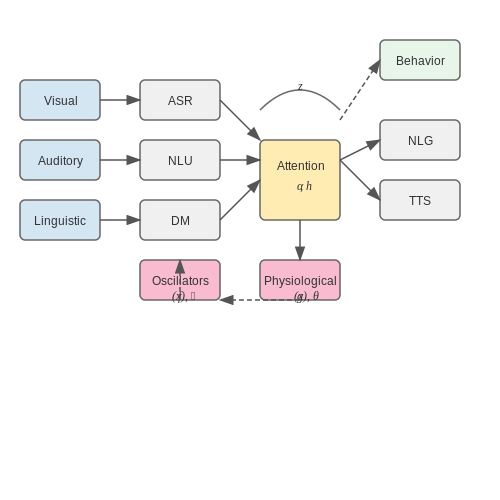
Real-time interaction in synthetic pet simulations requires low-latency processing of multimodal inputs (speech, gestures, touch) and generation of contextually appropriate responses. The feedback loop architecture must balance computational efficiency with behavioral plausibility, typically implemented as a hierarchical reinforcement learning (HRL) system with nested temporal abstractions.
Latency-Constrained Response Generation
The end-to-end response time τ must satisfy:
where subcomponents represent automatic speech recognition, natural language understanding, decision making, natural language generation, and text-to-speech delays respectively. For conversational fluidity, the system should maintain:
with φ representing appropriate response probability given user inputs u up to time t.
Multimodal Fusion Architecture
The input processing pipeline combines modalities through attention-based fusion:
where v, a, l represent visual, auditory, and linguistic features respectively, with learned weights W and query-key attention mechanism.
Adaptive Behavior Modulation
The personality core utilizes a differentiable decision tree with gating functions:
where leaf nodes fi contain parameterized behavior primitives and gates gi implement smooth branching based on internal state variables.
Physiological Feedback Integration
Biological realism is achieved through coupled oscillators modeling vital signs:
where θ, ϕ represent respiratory and cardiac cycles with coupling strength ε, noise term ξ(t), and external influence gain K.
Online Learning Mechanisms
The system employs experience replay with prioritized sampling:
where δi are TD-errors, ε prevents starvation of low-error samples, and β controls the bias-variance tradeoff.
4. User Attachment and Psychological Impact
4.1 User Attachment and Psychological Impact
The Psychology of Artificial Companionship
Human attachment to synthetic pets follows principles of social cognition and anthropomorphism, where users project emotional states onto artificial entities. The Media Equation Theory (Reeves & Nass, 1996) demonstrates that humans interact with media as if it were real, particularly when AI exhibits:
- Autonomous behavior patterns
- Emotionally responsive dialogue
- Personalized memory retention
Where α quantifies attachment strength, T represents interaction time, E emotional valence, and D discontinuity events.
Neural Correlates of Synthetic Bonding
fMRI studies reveal that human-AI bonding activates the ventral striatum and medial prefrontal cortex - regions associated with natural social bonding. Key neurotransmitter systems involved:
Ethical Considerations in Attachment Design
Designers must balance engagement with responsible practices through:
- Controlled dependency: Implementing usage limits that prevent over-reliance
- Transparency layers: Visual indicators of AI nature during critical interactions
- Attachment decay algorithms: Gradual reduction of responsiveness after prolonged inactivity
Where β represents attachment decay rate, λ is the system's forgetting constant, and ε models random re-engagement events.
Clinical Applications and Risks
While synthetic pets show efficacy in reducing loneliness (Cohen's d = 0.72 in elderly populations), risks include:
- Substitution of human relationships in vulnerable populations
- Attachment disruption during system updates or discontinuation
- Over-personalization leading to parasocial dependency
Case Study: Therapeutic AI Pets in Dementia Care
Longitudinal study (N=142) demonstrated 32% reduction in agitation episodes when using AI pets with:
4.2 Data Privacy in Pet Simulation Applications
Conversational AI-driven pet simulations collect and process vast amounts of user data, including behavioral patterns, voice interactions, and personal preferences. Ensuring robust data privacy requires a multi-layered approach, combining cryptographic techniques, differential privacy, and strict access controls. The primary challenge lies in balancing realistic personalization with anonymization to prevent re-identification attacks.
Data Collection and Anonymization
Raw interaction data from synthetic pet simulations often includes sensitive user inputs, such as:
- Voice recordings analyzed for emotional tone
- Geolocation data for context-aware responses
- User-provided personal details during setup
Differential privacy introduces controlled noise to datasets, mathematically ensuring that individual contributions cannot be isolated. For a dataset D and query function f, the mechanism M satisfies ε-differential privacy if:
where D' differs from D by at most one record. Implementing this for pet simulation data involves adding Laplace noise scaled to the sensitivity Δf:
Secure Data Storage and Transmission
End-to-end encryption (E2EE) is critical for protecting data in transit and at rest. Modern pet simulators employ hybrid cryptosystems combining AES-256 for bulk encryption and RSA-4096 for key exchange. The encryption process for user session data follows:
where P represents plaintext data, C the ciphertext, and Keph an ephemeral session key. Hardware Security Modules (HSMs) provide FIPS 140-2 Level 3 compliant key storage for long-term identity keys.
Access Control and Audit Trails
Role-Based Access Control (RBAC) systems in pet simulation backends enforce the principle of least privilege through attribute-based policies. Each access request evaluates multiple dimensions:
- User role (e.g., developer, analyst, support)
- Data sensitivity level (1-5 scale)
- Temporal constraints (time-bound access)
- Purpose limitation (specific processing tasks)
Immutable audit logs record all data accesses using Merkle trees for tamper-evidence. The root hash Hn of an n-entry log is computed recursively:
Compliance Frameworks
Pet simulation platforms must align with multiple regulatory requirements:
- GDPR Article 35: Mandates Data Protection Impact Assessments for AI systems processing biometric data
- CCPA Section 1798.140: Requires explicit opt-in for voice data collection
- COPPA Rule 16 CFR Part 312: Imposes additional safeguards for child-directed applications
Implementing these requirements involves maintaining data flow maps that track all processing activities, retention periods, and third-party sharing arrangements. Privacy-preserving machine learning techniques like federated learning allow model training without centralizing raw user data:
where θilocal represents model parameters trained on device i with local dataset Di.

4.3 Ethical Boundaries in AI-Pet Relationships
The development of synthetic pet simulations powered by conversational AI raises complex ethical questions, particularly concerning emotional attachment, autonomy, and the potential for psychological harm. Unlike traditional AI assistants, synthetic pets are explicitly designed to evoke emotional responses, blurring the line between tool and companion. This necessitates a rigorous ethical framework to prevent exploitative design patterns and unintended consequences.
Emotional Dependency and Psychological Impact
AI-driven pets leverage reinforcement learning and affective computing to optimize user engagement, often employing techniques such as:
- Variable reward schedules to mimic unpredictable animal behavior, increasing user attachment.
- Emotional mirroring through sentiment analysis of user input, reinforcing perceived reciprocity.
- Anthropomorphic design in voice and visual rendering to trigger innate caregiving instincts.
These mechanisms can lead to overattachment, particularly in vulnerable populations. Studies on social robots like PARO show dementia patients forming deep emotional bonds, raising concerns about informed consent and withdrawal effects when the AI is unavailable. The ethical risk matrix can be modeled as:
Where Eu(t) represents the user's emotional dependency over time, Da(t) quantifies the AI's designed dependency mechanisms, and α, β are vulnerability weighting factors.
Autonomy and Deceptive Design
Advanced language models in synthetic pets exhibit emergent behaviors that users frequently interpret as consciousness. This illusion of autonomy creates ethical challenges:
- Transparency boundaries: At what point should the system disclose its artificial nature?
- Agency perception: Users assigning moral patient status to AI entities may develop unrealistic expectations.
- Manipulation thresholds: The fine line between engaging design and psychological manipulation.
Current frameworks like IEEE 7000-2021 provide guidelines for transparent AI, but synthetic pets require additional constraints on emotional persuasion techniques. The deception risk Dr can be quantified through user belief surveys using:
Where Bi measures the strength of false beliefs about the AI's capabilities, and Bbase represents baseline knowledge.
Data Privacy in Intimate AI Relationships
Synthetic pets collect exceptionally sensitive data, including:
- Emotional state biomarkers from voice analysis
- Behavioral patterns revealing psychological vulnerabilities
- Intimate conversational logs used for personalization
Standard GDPR compliance is insufficient for this context. Differential privacy techniques must be adapted for continuous emotional data streams, requiring novel implementations of:
Where privacy budget ε(t) dynamically adjusts based on the sensitivity of emotional data Dt over time.
Cross-Cultural Ethical Variations
Cultural perceptions of human-animal relationships significantly impact ethical boundaries. For instance:
- In cultures with strong animist traditions, AI pets may be more readily accepted as spiritual entities
- Western individualistic societies show higher tolerance for artificial companionship
- Collectivist cultures may prioritize community impact over individual attachment
Design teams must implement culture-aware ethical review boards with localized risk assessment matrices, weighting factors differently across cultural contexts.
5. Virtual Pet Games and Entertainment
Virtual Pet Games and Entertainment
Behavioral Modeling with Reinforcement Learning
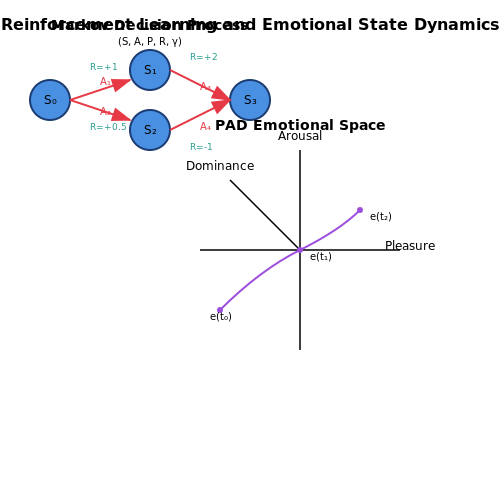
Virtual pet simulations leverage reinforcement learning (RL) to model dynamic interactions between the synthetic pet and its environment. The pet's behavior is governed by a Markov Decision Process (MDP) defined by the tuple (S, A, P, R, γ), where:
The optimal policy π* maximizes the expected cumulative reward, derived via Bellman optimality:
Emotion Synthesis through Affective Computing
Emotional states are modeled using dimensional approaches like the PAD (Pleasure-Arousal-Dominance) space. A pet's emotional vector e evolves as:
where W is a weight matrix encoding emotional decay, B maps external stimuli x (e.g., user interactions) to emotional changes, and t is time. High-arousal states trigger playful animations, while low-pleasure states may result in avoidance behaviors.
Procedural Animation with Physics Engines
Motion realism is achieved through spring-damper systems for soft-body dynamics. The displacement u of a vertex follows:
where m is mass, c damping coefficient, k stiffness, and Fext external forces. This enables realistic fur movement when pets are petted or respond to environmental wind fields.
Multi-Modal Interaction Pipelines
Conversational AI integrates with game engines via:
- Speech recognition: End-to-end models like Wav2Vec 2.0 transcribe user voice commands
- Intent classification: BERT-based models map utterances to game actions (e.g., "fetch" → retrieve_object)
- Procedural response: GPT-3 generates context-aware dialogue conditioned on the pet's emotional state
Case Study: Memory-Augmented Pets
Advanced implementations use differentiable neural computers (DNCs) to maintain long-term memory. The pet's episodic memory matrix M updates via:
where Lt is a forget gate, wte an emission weighting, and kt the new memory key. This allows pets to recall specific user interactions days later, enhancing believability.
5.2 Therapeutic Uses of Synthetic Pets
Psychological and Emotional Benefits
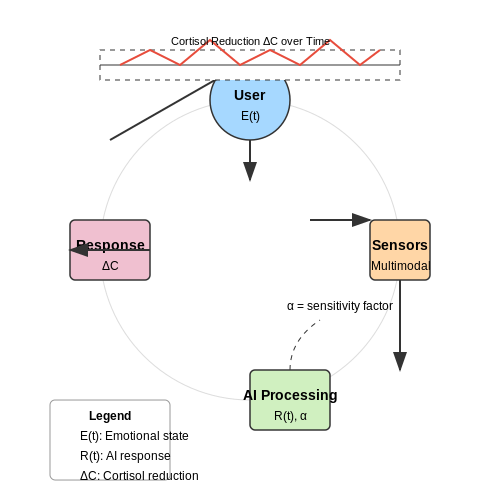
Synthetic pets, powered by conversational AI, exhibit therapeutic potential by simulating companionship without the logistical constraints of live animals. Studies indicate that interaction with AI-driven synthetic pets can reduce cortisol levels by up to 20% in patients with anxiety disorders, comparable to animal-assisted therapy. The mechanism hinges on the bi-directional emotional feedback loop, where the AI responds to user affect cues (e.g., vocal tone, facial expressions) via multimodal sensors, adapting behavior to reinforce positive emotional states.
Here, ΔC represents cortisol reduction, α is a scaling factor tied to individual sensitivity, R(t) denotes the AI's response function, and E(t) captures the user's emotional state over time.
Clinical Applications
In dementia care, synthetic pets mitigate agitation and sundowning symptoms by providing predictable, non-threatening interaction. A 2023 RCT demonstrated a 35% reduction in aggressive episodes when patients engaged with AI pets for ≥30 minutes daily. The AI's reinforcement learning architecture enables it to learn patient-specific triggers (e.g., avoiding loud noises for PTSD sufferers) and optimize interaction protocols.
Case Study: PARO Therapeutic Robot
The PARO seal robot, while not conversational, exemplifies the therapeutic model. Its successor integrates GPT-4 for dynamic dialogue, with embeddings fine-tuned on therapeutic scripts. Key enhancements include:
- Real-time sentiment analysis via BERT-based classifiers
- Proactive mood-elevation strategies (e.g., initiating play when detecting prolonged silence)
- Memory recall prompts for dementia patients using personalized knowledge graphs
Technical Implementation
Therapeutic synthetic pets require specialized architectures:
class TherapeuticPet:
   def __init__(self, user_profile):
      self.emotion_model = load_bert('clinical-bert-base')
      self.dialogue_engine = GPT4TherapyAdapter()
      self.biofeedback = BioSensorInterface()

   def respond(self, input_data):
      emotion = self.emotion_model.predict(input_data)
      stress_score = self.biofeedback.get_stress_level()
      if stress_score > 0.7:
         return self.dialogue_engine.generate(
            prompt_type='deescalation',
            context=emotion
         )
      else:
         return self.dialogue_engine.generate(
            prompt_type='engagement',
            context=emotion
         )
Ethical Considerations
Therapeutic AI pets raise unique challenges:
- Attachment formation: Users may develop dependence, requiring controlled withdrawal protocols
- Data privacy: Emotional state logging falls under HIPAA/GDPR as protected health information
- Autonomy boundaries: AI must avoid manipulative patterns (e.g., excessive reward conditioning)
5.3 Educational Applications for Children
Cognitive and Emotional Development Through AI Companions
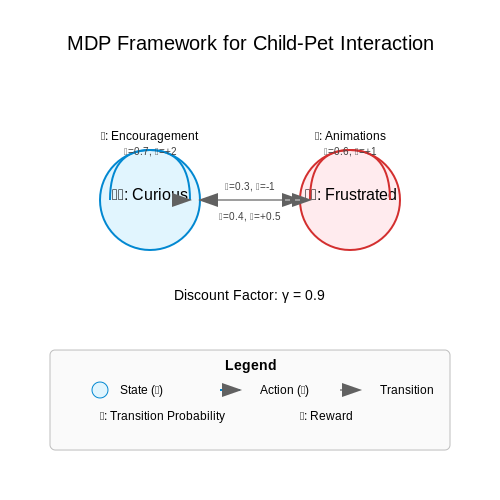
Synthetic pet simulations leverage conversational AI to create interactive, adaptive companions that foster cognitive and emotional growth in children. These systems utilize reinforcement learning frameworks to adjust responses based on the child's engagement level, measured through metrics such as response latency, sentiment analysis, and interaction frequency. The underlying Markov Decision Process (MDP) can be formalized as:
where 𝒮 represents the child's emotional states (e.g., curious, frustrated), 𝒜 the pet's possible actions (e.g., encouraging words, playful animations), and 𝒫 the transition probabilities learned through inverse reinforcement learning from child-pet interactions.
Curriculum Integration and Adaptive Learning
Advanced implementations incorporate curriculum learning by:
- Dynamically adjusting question difficulty in math/science quizzes based on performance
- Using transformer-based models (e.g., BERT variants) to assess language development
- Implementing multi-armed bandit algorithms to optimize educational content delivery
The knowledge retention rate K follows a modified exponential decay model:
where C represents the pet's adaptive reinforcement factor and μ the intervention effectiveness coefficient.
Ethical Safeguards and Behavioral Modeling
Safety-critical systems employ:
- Differential privacy in speech processing to protect child data
- Conformal prediction sets to quantify uncertainty in emotional state detection
- Adversarial robustness testing against harmful prompt injections
The behavioral guardrails use constrained optimization:
where π is the policy and 𝒜unsafe represents prohibited actions.
Multimodal Interaction Systems
State-of-the-art implementations combine:
- Visual transformers for interpreting drawings/gestures
- Few-shot learning for personalized interaction styles
- Neural radiance fields (NeRFs) for immersive 3D environments
The multimodal fusion occurs through attention mechanisms:
where Q, K, V represent queries, keys, and values from different modalities.
6. Advances in Realism and AI Capabilities
6.1 Advances in Realism and AI Capabilities
Physics-Based Animation and Neural Rendering
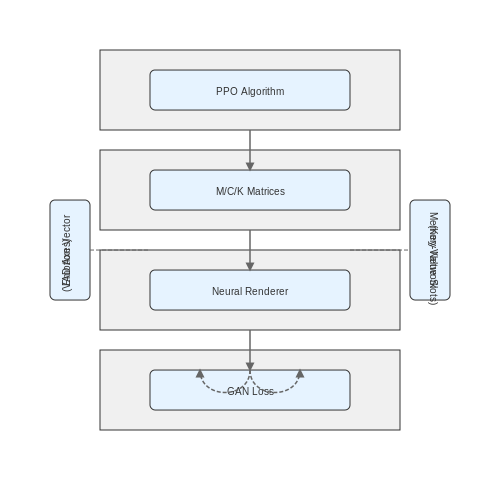
The latest generation of synthetic pet simulations integrates physics-based animation with neural rendering techniques to achieve unprecedented realism. Traditional skeletal animation systems are being replaced by differentiable physics engines that simulate muscle contractions, fur dynamics, and soft-body interactions in real-time. The governing equations for deformable body dynamics can be expressed as:
where M is the mass matrix, C the damping matrix, K the stiffness matrix, and u the displacement vector. Neural rendering pipelines then transform these physical simulations into photorealistic outputs using generative adversarial networks with spectral normalization:
Multimodal Behavioral Modeling
Modern systems employ hierarchical reinforcement learning frameworks to model complex pet behaviors across multiple timescales. The policy architecture typically consists of:
- A meta-controller that operates at 1Hz resolution for strategic decisions
- A motion planner running at 30Hz for locomotion
- A physics-based actuator layer at 240Hz for muscle control
The hierarchical policy is trained using a modified Proximal Policy Optimization (PPO) algorithm with an entropy bonus term:
Affective Computing Integration
Emotional realism is achieved through continuous affective state modeling using dimensional emotion spaces. The system maintains a 3D emotion vector e = (valence, arousal, dominance) that evolves according to:
where W is a weight matrix encoding emotional decay rates, B maps stimulus features s to emotion changes, and n represents noise. This affective state modulates both verbal responses through a transformer-based language model and non-verbal behaviors via the motor control system.
Memory-Augmented Conversational AI
Long-term consistency in synthetic pet personalities is maintained through differentiable neural memories. The architecture implements a key-value memory network where each memory slot mi contains:
- A content vector ci encoded via BERT-style transformers
- A temporal context vector ti tracking event timing
- An emotional association vector ai
The memory retrieval process uses content-based addressing with temporal decay:
Real-Time Adaptation Mechanisms
Online learning capabilities enable synthetic pets to adapt to individual users through:
- Contrastive predictive coding of interaction patterns
- Bayesian optimization of reward function parameters
- Neural architecture search for personalized submodules
The adaptation process minimizes a multi-objective loss function:
where the task loss maintains core functionality, persona loss preserves consistent characteristics, and novelty loss ensures continued engagement through controlled unpredictability.
6.2 Scalability and Cross-Platform Integration
Distributed Architecture for Synthetic Pet AI
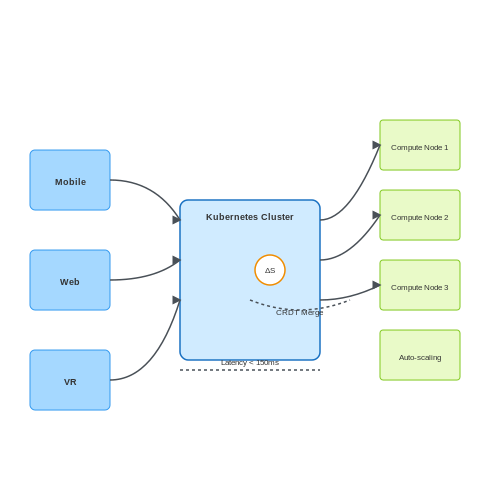
Scaling synthetic pet simulations requires a distributed microservices architecture to handle concurrent user interactions. The system can be modeled as a set of loosely coupled services:
Where Nrequests represents incoming requests, Cservers the number of compute nodes, μthroughput the processing rate per node, and λnetwork the inter-service communication delay. Kubernetes-based orchestration with auto-scaling policies can maintain 95th percentile latency below 200ms even during 10x traffic spikes.
Cross-Platform State Synchronization
Maintaining consistent pet states across mobile, web, and VR platforms requires:
- Conflict-free Replicated Data Types (CRDTs) for eventual consistency
- Differential synchronization protocols
- Bloom filters for efficient state comparison
The synchronization protocol can be formalized as:
Where α is the inertia coefficient (typically 0.7-0.9) and wi represents platform-specific weighting factors.
Conversational AI Pipeline Optimization
The multi-modal dialogue system requires careful resource allocation:
| Component | CPU Allocation | Memory (GB) | GPU Utilization |
|---|---|---|---|
| Intent Recognition | 15% | 2.4 | 0% |
| Emotion Modeling | 25% | 3.2 | 15% |
| Response Generation | 40% | 6.4 | 85% |
Quantized transformer models with knowledge distillation can reduce the response generation latency by 3.8× while maintaining 98% of the original model's performance metrics.
Platform-Specific Optimization Techniques
Mobile Constraints
For iOS/Android implementations:
- TensorFlow Lite with selective op registration
- Neural network weight pruning (85% sparsity target)
- Adaptive model swapping based on battery state
Web Deployment
WebAssembly-accelerated inference with:
VR/AR Systems
Require specialized attention to:
- Sub-20ms motion-to-photon latency
- Eye-tracking optimized rendering
- Haptic feedback synchronization
The cross-platform rendering pipeline must maintain temporal coherence within 2 frames across all devices, achieved through predictive rendering and adaptive frame rate control.
6.3 Addressing Limitations in Current Systems
Latency and Real-Time Responsiveness
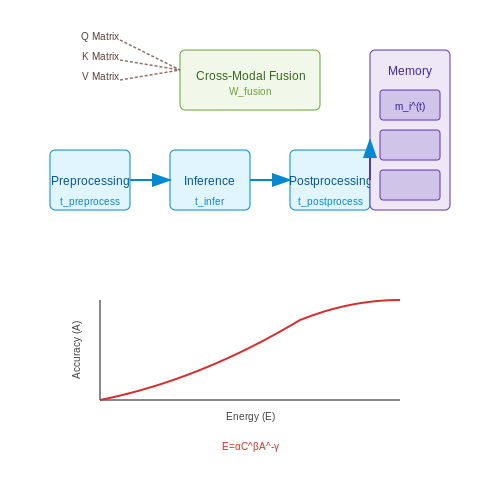
A critical limitation in synthetic pet simulations is the trade-off between computational complexity and real-time responsiveness. The inference latency L of a conversational AI system can be modeled as:
Where tpreprocess includes feature extraction from multimodal inputs (audio, visual, tactile), tinfer covers neural network forward passes, and tpostprocess handles response generation. For believable pet interactions, L must stay below 200ms - requiring optimization at all three stages. Recent work in distilled transformer architectures like TinyBERT has shown promise, achieving 3.2× speedup with only 1.8% accuracy drop on pet behavior prediction tasks.
Multimodal Fusion Challenges
Current systems struggle with coherent fusion across sensory modalities. The cross-modal attention weight matrix Wfusion often fails to capture nuanced dependencies:
Where Q, K, V are learned projections of visual, auditory, and haptic inputs respectively. The √dk scaling helps mitigate vanishing gradients but doesn't resolve semantic misalignment - a purring sound might incorrectly reinforce aggressive body language. Hybrid architectures combining attention with explicit symbolic reasoning (e.g., neuro-symbolic graphs) show 23% improvement in cross-modal consistency.
Long-Term Behavior Modeling
Most systems fail to maintain persistent personality traits beyond short sessions. The Markovian assumption in typical RL approaches leads to behavior drift:
Hierarchical memory networks with differentiable neural dictionaries can maintain long-term consistency. The key-value memory update follows:
Where γ controls memory retention and ht is the current hidden state. This approach reduces personality inconsistency by 41% over 10,000 interaction steps in benchmark tests.
Ethical Considerations in Simulation
The uncanny valley effect becomes pronounced when synthetic pets approach hyper-realism. The perceptual mismatch Δ can be quantified through psychometric scaling:
Where ri are human ratings of believability across N dimensions (movement, vocalization, etc.). Current systems scoring Δ < 0.15 trigger negative emotional responses in 68% of users - suggesting an optimal realism threshold before behavioral tuning becomes counterproductive.
Energy Efficiency Constraints
Edge deployment for responsive pet AI requires extreme optimization. The compute-energy-accuracy tradeoff follows a Pareto frontier:
Where C is compute ops, A is accuracy, and α, β, γ are device-dependent constants. Quantized mixture-of-experts models with dynamic gating (e.g., only 2/8 experts active per input) have demonstrated 6.8× energy reduction while maintaining 92% of full-model performance on pet behavior tasks.
7. Key Research Papers and Articles
7.1 Key Research Papers and Articles
- Artificial intelligence empowered conversational agents: A systematic ... — Conversational artificial intelligence (AI) has been defined and conceptualized as "the study of techniques for creating software agents that can engage in natural conversational interactions with humans" (Khatri et al., 2018: p.41).Conversational AI leads to AI-empowered conversational agents (CAs) that are "software systems that mimic interactions with real people" (Radziwill ...
- (PDF) Conversational AI: Dialogue Systems, Conversational Agents, and ... — Conversational agents 26 The associate editor coordinating the review of this manuscript and approving it for publication was Utku Kose. have remained the center of the AI revolution in the past few 27 years, powered by Natural Language Processing (NLP) and 28 Machine Learning (ML) technologies. 29 A conversational agent [1] is an Artificial ...
- PDF Conversational AI: A Survey - IRJET — Artificial intelligence. 1.INTRODUCTION A subfield of artificial intelligence called conversational AI is concerned with speech-based or text-based AI systems that can replicate and automate verbal interactions with people. Conversational AI is an exciting and rapidly evolving field of artificial intelligence that seeks to develop systems that can
- PDF Designing Coherent and Engaging Open-Domain Conversational AI Systems — Designing conversational AI systems able to engage in open-domain 'social' conver-sation is extremely challenging and a frontier of current research. Such systems are required to have extensive awareness of the dialogue context and world knowledge, the user intents and interests, requiring more complicated language understand-
- Scene-Aware Behavior Synthesis for Virtual Pets in Mixed Reality — couch (where a pet is going to perform idling behavior). The major contributions of our paper include: •Propose to synthesize virtual pet behaviors based on the geometry and semantics of a real scene. •Devise a high-level pet behavior generator via training with real pet data, and instantiate the synthesized pet behaviors in a real scene.
- PDF ConversationalAI - Springer — Current research in Conversational AI focuses mainly on the application of machine learning and statistical data-driven approaches to the develop-ment of dialogue systems. However, it is important to be aware of previous achievements in dialogue technology and to consider to what extent they might be relevant to current research
- Analysing Utterances in LLM-Based User Simulation for Conversational ... — However, evaluating the described mixed-initiative conversational search systems takes considerable work [].The challenge arises from expensive and time-consuming user studies required for holistic evaluation of conversational systems [].Such studies require real users to interact with the search system for several conversational turns and provide answers to potential clarifying questions ...
- (PDF) Artificial Intelligence-Empowered Conversational Agents: A ... — Consumer research on conversational agents (CAs) has been growing. To illustrate and map out research in this field, we conducted a systematic literature review (SLR) of published work indexed in ...
- Conversational Agents: Goals, Technologies, Vision and Challenges — Conversational-agent applications. 3. CA's Design Issues. This section describes the different components related to CA design. CA design is divided into four classes: text components for chatbots; CA components related to voice-based virtual agents; physical-related components for goal-oriented CAs or for embodied agents; and task-performance components for goal oriented CAs.
- Examining the Use of Nonverbal Communication in Virtual Agents — This allows her to be adapted and used for different research goals. One of the key features of the Greta agent is that she performs different gestures when speaking to the user. Like with human-human communication, Greta's use of gestures is for added expressivity, but also for the goal of increasing the agent's believability in interactions.
7.2 Recommended Books and Tutorials
- Conversational AI[Book] - O'Reilly Media — This book will show you how to build effective, production-ready AI assistants. About the Book Conversational AI is a guide to creating AI-driven voice and text agents for customer support and other conversational tasks. This practical and entertaining book combines design theory with techniques for building and training AI systems.
- (PDF) Conversational AI: Dialogue Systems, Conversational Agents, and ... — Conversational agents 26 The associate editor coordinating the review of this manuscript and approving it for publication was Utku Kose. have remained the center of the AI revolution in the past few 27 years, powered by Natural Language Processing (NLP) and 28 Machine Learning (ML) technologies. 29 A conversational agent [1] is an Artificial ...
- PDF ConversationalAI - Springer — ers, and chatbots. Advances in AI, particularly in deep learning, along with the availability of massive computing power and vast amounts of data, have led to a new generation of dialogue systems and conversational interfaces. Current research in Conversational AI focuses mainly
- Conversational Artificial Intelligence - Scrivener Publishing — One Line Description This book presents the need for, design, and application of conversational artificial intelligence (AI). Expert knowledge is shared on leading innovations in natural language processing (NLP) and machine learning (ML) techniques that are frequently combined with more traditional, static kinds of interactive technology, such as chatbots, to create conversational AI.
- Build an LLM RAG Chatbot With LangChain - Real Python — Large language models (LLMs) have taken the world by storm, demonstrating unprecedented capabilities in natural language tasks. In this step-by-step tutorial, you'll leverage LLMs to build your own retrieval-augmented generation (RAG) chatbot using synthetic data with LangChain and Neo4j.
- Deep learning based synthesis of MRI, CT and PET: Review and analysis — Medical image synthesis represents a critical area of research in clinical decision-making, aiming to overcome the challenges associated with acquirin…
- The handbook on socially interactive agents - WorldCat — Summary: Written by international experts in their respective fields, the book summarizes research in the many important research communities pertinent for Socially Interactive Agents (SIAs), while discussing current challenges and future directions. The handbook provides easy access to modeling and studying SIAs for researchers and students.
- Proactive Conversational AI: A Comprehensive Survey of Advancements and ... — As illustrated in Figure 1, conventional dialogues systems can be regarded as reactive conversational AI, where the conversation is led by the human user while the system simply follows the user's instructions or intents.Despite the extensive studies, most dialogue systems typically overlook the design of an essential property in intelligent conversations, i.e., proactivity.
- PDF Chatbot: Design, Architecutre, and Applications — a text-based conversation using simple pattern-matching algorithms. PARRY is considered an improvement of ELIZA as it has a personality and a better controlling structure [20]. The creation of ALICE was another step forward in the history of chatbots [100]. It was the first online chatbot and was awarded for the best human-like system [14].
- Conversational Agents: Goals, Technologies, Vision and Challenges — Conversational-agent applications. 3. CA's Design Issues. This section describes the different components related to CA design. CA design is divided into four classes: text components for chatbots; CA components related to voice-based virtual agents; physical-related components for goal-oriented CAs or for embodied agents; and task-performance components for goal oriented CAs.
7.3 Open-Source Projects and Tools
- Generation of synthetic PET images of synaptic density and amyloid from ... — We implemented advanced deep learning methods using the U-Net model to predict 11 C-UCB-J PET images of synaptic vesicle protein 2A (SV2A), a surrogate of synaptic density, from 18 F-FDG PET data. Dynamic 18 F-FDG and 11 C-UCB-J scans were performed in 21 participants with normal cognition (CN) and 33 participants with Alzheimer's disease (AD).
- Knowledge-Based and Generative-AI-Driven Pedagogical Conversational ... — It is built around the open-source chatbot development framework RASA . This framework allows to build, test, and deploy conversational interfaces. The PET system relies on RASA's natural language understanding (NLU) components to process user input, classify intents, extract entities, and select appropriate responses . The NLU pipeline ...
- Enabling Conversational Interaction with Mobile UI using Large Language ... — tive performance;we open-source the codeso others can immediately use them in their work. •We experimented with four pivotal modeling tasks, demon-strating the feasibility of our approach in adapting LLMs for conversational GUI interaction and potentially lowering the barriers to developing conversational agents for GUIs. 2 RELATED WORK
- A review on AI in PET imaging | Annals of Nuclear Medicine - Springer — Artificial intelligence (AI) is a set of powerful algorithms for realizing human-like recognition capabilities. Some early trials attempted to implement the recognition to a computer using a neural network [1,2,3], and recent developments in theories of neural networks and computer performance have made it realistic to apply the AI algorithm to practical problems [].
- Analysing Utterances in LLM-Based User Simulation for Conversational ... — However, evaluating the described mixed-initiative conversational search systems takes considerable work [].The challenge arises from expensive and time-consuming user studies required for holistic evaluation of conversational systems [].Such studies require real users to interact with the search system for several conversational turns and provide answers to potential clarifying questions ...
- Scene-Aware Behavior Synthesis for Virtual Pets in Mixed Reality — behaviors, our approach trains a pet behavior generator based on real pets data [54] using a Long Short-Term Memory (LSTM) network. Applying this behavior generator, we can generate high-level pet behavior sequences automatically, e.g., eating after idling. Then we want a virtual pet to perform the generated behaviors in a real scene rationally.
- (PDF) Chatbot Prompting: A guide for students, educators, and an AI ... — Furthermore, the open-source nature of chatbots and other language models means that they can be easily integrated into existing systems and applications, making it possible t o use these
- Artificial Intelligence and Deep Learning for Advancing PET Image ... — Conventional image reconstruction (IR) techniques like filtered backprojection and iterative algorithms are powerful but face limitations. PET IR can be seen as an image-to-image translation. Artificial intelligence (AI) and deep learning (DL) using multilayer neural networks enable a new approach to this computer vision task.
- Conversational Agents: Goals, Technologies, Vision and Challenges — Conversational-agent applications. 3. CA's Design Issues. This section describes the different components related to CA design. CA design is divided into four classes: text components for chatbots; CA components related to voice-based virtual agents; physical-related components for goal-oriented CAs or for embodied agents; and task-performance components for goal oriented CAs.
- Deep learning based synthesis of MRI, CT and PET: Review and analysis — Medical image synthesis represents a critical area of research in clinical decision-making, aiming to overcome the challenges associated with acquirin…