Simulating Philosophical Debates Between AI Models
1. Defining Philosophical Debate in AI Contexts
Defining Philosophical Debate in AI Contexts
Philosophical debate in AI contexts refers to structured discourse between multiple AI models, where each agent argues for or against a proposition using reasoning frameworks grounded in formal logic, ethics, or epistemology. Unlike traditional dialogue systems, these debates require models to construct coherent, contextually grounded arguments while adhering to principles of rational discourse.
Key Characteristics of AI-Mediated Philosophical Debate
- Multi-agent interaction: At least two AI models engage in turn-taking argumentation, with each response building on previous claims.
- Logical consistency: Arguments must maintain internal coherence, avoiding logical fallacies like circular reasoning or false dilemmas.
- Evidence-based reasoning: Claims should be supported by either empirical data (when available) or well-established philosophical axioms.
- Counterargument generation: Models must demonstrate the ability to identify and refute opposing viewpoints.
Formal Representation of Debate Structure
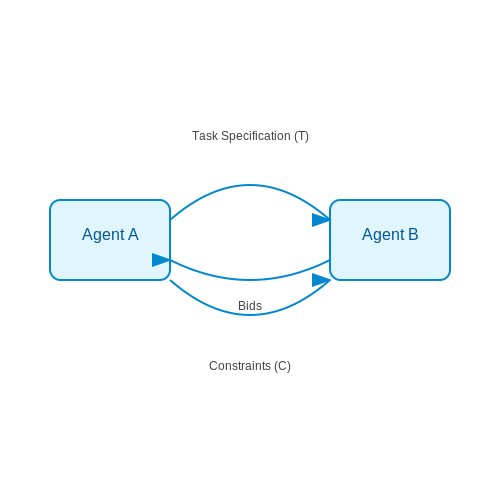
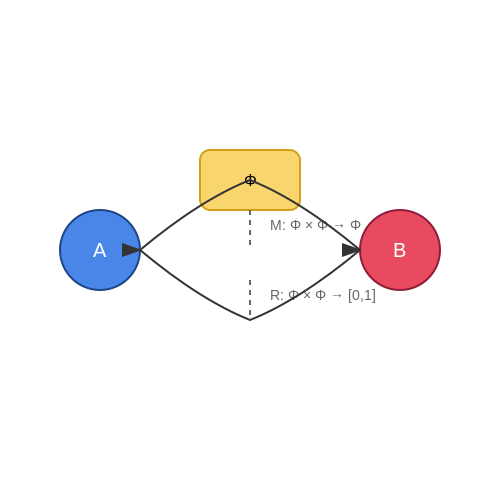
A philosophical debate between two AI agents can be modeled as an alternating sequence of moves in a game-theoretic framework. Let A and B represent the debating agents, and Φ represent the set of all possible propositions in the debate domain:
Where:
- M: Φ × Φ → Φ is the move function generating responses
- R: Φ × Φ → [0,1] is the rationality scoring function
Implementation Challenges
Current approaches face several technical hurdles:
- Context preservation: Maintaining coherent discourse beyond 5-10 turns remains challenging due to attention window limitations in transformer architectures.
- Value alignment: Ensuring debates remain within ethical boundaries requires careful constraint optimization.
- Grounding in reality: Preventing hallucination of non-existent philosophical positions demands robust retrieval-augmented generation techniques.
Evaluation Metrics
Quality of AI philosophical debates can be assessed through:
Where:
- Ci: Coherence score for turn i
- Li: Logical consistency score
- Oi: Originality of argumentation
- α, β, γ are weighting parameters
Practical Applications
This research direction has yielded tangible benefits in:
- Automated peer review systems that can identify logical flaws in academic arguments
- AI-assisted education tools for teaching critical thinking
- Ethics compliance checking for corporate decision-making systems
Key AI Models for Dialogue and Argumentation
Transformer-Based Language Models
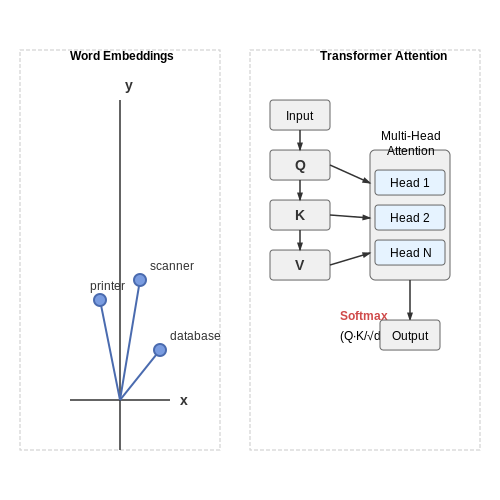
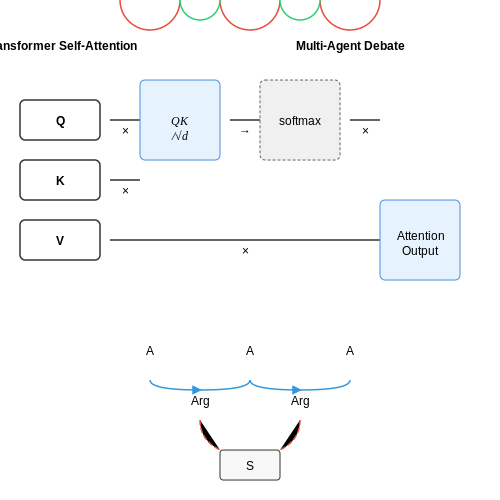
Modern dialogue systems leverage transformer architectures, which excel in capturing long-range dependencies through self-attention mechanisms. The self-attention operation computes weighted sums of input embeddings, where the weights are derived from pairwise similarity scores:
Here, Q, K, and V represent queries, keys, and values matrices respectively, while dk is the dimension of the key vectors. This architecture enables models like GPT-4 and Claude to maintain coherent multi-turn conversations by dynamically focusing on relevant context.
Specialized Debate Models
Recent research has produced models fine-tuned for argumentation, such as IBM's Project Debater and Meta's Cicero. These systems employ:
- Claim detection modules using BERT-style encoders
- Evidence retrieval systems with dense vector search (e.g., FAISS)
- Counterargument generators based on controlled text generation
The debate capability can be quantified through formal argumentation frameworks. Let Args represent the set of possible arguments and Def the defeat relation between them. The model's performance is evaluated using:
Multi-Agent Dialogue Systems
For simulating philosophical debates, multi-agent architectures show particular promise. The dialogue state St evolves according to:
where At(i) represents the action (utterance) of agent i at turn t. Advanced implementations use:
- Recursive reward modeling to align with philosophical principles
- Contrastive learning to distinguish valid from fallacious arguments
- Monte Carlo tree search for long-term dialogue planning
Ethical Considerations in Debate Simulation
The debate dynamics between AI models must account for:
- Bias propagation through training data
- Manipulation risks in adversarial argumentation
- Epistemic responsibility in generated claims
These factors can be modeled as constraints in the optimization objective:
where λ parameters control the trade-off between debate performance and ethical considerations.
Ethical and Logical Frameworks for AI Debates
Normative Ethical Frameworks in AI Debates
When simulating philosophical debates between AI models, grounding the discourse in established ethical frameworks ensures coherence and relevance. Three dominant normative frameworks—deontology, consequentialism, and virtue ethics—provide structured lenses for evaluating arguments:
- Deontological AI adheres to rule-based reasoning, prioritizing duty and universalizable principles (e.g., Kantian categorical imperatives). For example, a deontological AI might argue against lying in any context, regardless of outcomes.
- Consequentialist AI evaluates actions based on outcomes, often employing utilitarianism. A consequentialist model could justify sacrificing privacy for greater societal benefit if the net utility is positive.
- Virtue Ethics AI focuses on moral character, emphasizing traits like honesty or empathy. Such a model might critique an argument based on the speaker's intent rather than the action's outcome.
Logical Consistency and Formal Argumentation
AI debates require formal logical structures to avoid fallacies and ensure validity. Propositional and first-order logic provide the foundation, but advanced frameworks like defeasible logic or argumentation theory are better suited for handling uncertainty and conflicting premises. For instance, a debate on "AI rights" might use the following defeasible rule:
where ab(X) denotes exceptions (e.g., non-biological entities). Models must dynamically adjust beliefs when new evidence contradicts prior assumptions, a process formalized in belief revision theory:
Bias Mitigation and Fairness Constraints
Debating AIs must account for embedded biases in training data or reasoning processes. Techniques like counterfactual fairness ensure arguments remain invariant to sensitive attributes (e.g., gender or race). For a debate on resource allocation, fairness might be encoded as:
Adversarial training can further reduce bias by penalizing discriminatory reasoning patterns during debate simulations.
Case Study: Trolley Problem Debate
A simulated debate between utilitarian and deontological AIs on the trolley problem reveals framework-dependent reasoning. The utilitarian model might derive an optimal action via expected utility:
while the deontological AI rejects outcome-based calculus, appealing to inviolable rules (e.g., "Do not kill"). Such simulations expose trade-offs between frameworks and highlight the need for meta-ethical reflection in AI design.
2. Architectures for Multi-Agent Dialogue Systems
Architectures for Multi-Agent Dialogue Systems
Modular vs. End-to-End Architectures
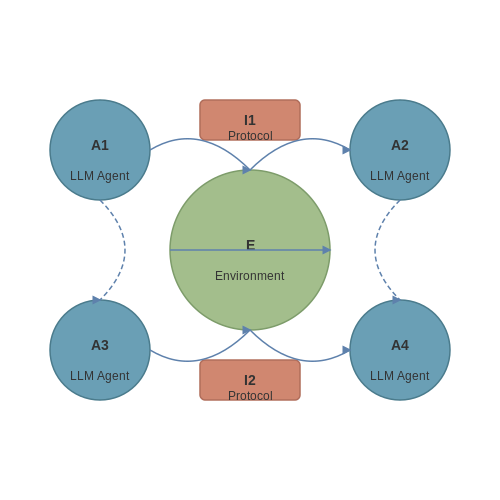
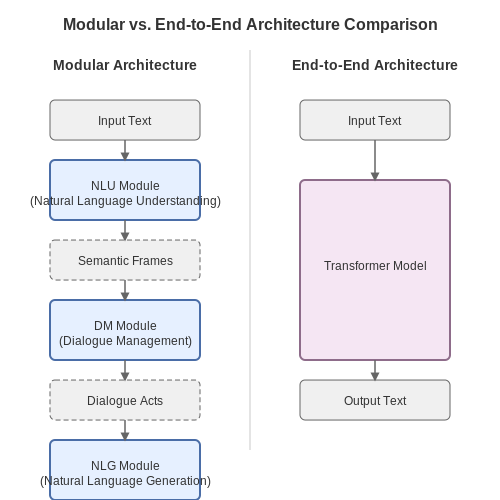
Multi-agent dialogue systems typically adopt either a modular or end-to-end architecture. Modular systems decompose the dialogue process into discrete components—such as natural language understanding (NLU), dialogue management (DM), and natural language generation (NLG)—each handled by specialized subsystems. In contrast, end-to-end systems employ a single neural model trained to map input utterances directly to responses, bypassing explicit intermediate representations.
Modular architectures offer interpretability and fine-grained control, making them suitable for applications requiring strict adherence to dialogue policies. The NLU module parses user input into structured semantic frames, often using intent classification and slot filling:
where x is the input utterance and y is the sequence of predicted slots and intents. The DM module then selects dialogue acts based on a predefined state transition graph or reinforcement learning policy.
Transformer-Based Multi-Agent Coordination
End-to-end architectures leverage transformer models like GPT-4 or Claude to generate responses autoregressively. For multi-agent debates, these models are often fine-tuned with reinforcement learning from human feedback (RLHF) to optimize for coherence and argumentative rigor. The probability of a response sequence R given context C is modeled as:
where θ represents the model parameters. Multi-agent variants employ shared or separate parameter sets for each agent, with attention mechanisms modified to track agent-specific context windows.
Recursive Reward Modeling
Advanced systems use recursive reward modeling to refine debate quality. A meta-evaluator model assigns rewards to dialogue turns based on logical consistency, evidence citation, and rhetorical effectiveness. This reward signal trains the debating agents via proximal policy optimization (PPO), with the objective function:
where γ is the discount factor and β controls the strength of the KL divergence penalty from a reference policy.
Memory-Augmented Architectures
Persistent memory modules enable long-term consistency across debates. Key implementations include:
- Dynamic Knowledge Graphs: Agents update shared semantic networks with verified claims
- Episodic Memory: Transformer models with explicit memory tokens for past arguments
- Differentiable Neural Computer: External memory matrix accessed via content-based addressing
The memory read operation for a query vector q over memory matrix M computes attention weights as:
Real-World Implementations
Current state-of-the-art systems combine these approaches. Anthropic's Constitutional AI uses a modular architecture with separate truth-checking agents, while DeepMind's Sparrow employs end-to-end RLHF with retrieval-augmented generation. Performance is typically evaluated using:
- Logical fallacy detection rates
- Factual accuracy against ground-truth databases
- Human preference scores for argument quality
2.2 Natural Language Processing for Argument Construction
Argument Representation in Vector Space
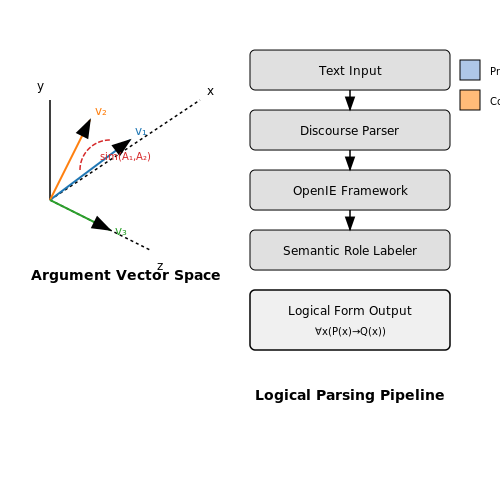
Natural language arguments can be modeled as high-dimensional vectors in a semantic space, where proximity indicates logical or thematic similarity. Given a corpus of philosophical texts C, each argument Ai is embedded using a transformer-based encoder fθ:
where d is the embedding dimension (typically 768 or 1024 for modern LLMs). The cosine similarity between vectors then quantifies argument similarity:
Logical Structure Parsing
To extract propositional logic from natural language arguments, we employ:
- Discourse parsing to identify premises and conclusions
- OpenIE frameworks (e.g., ClausIE) for relation extraction
- Neural semantic role labeling to detect argument components
The resulting logical form follows first-order predicate calculus:
Counterargument Generation
Given an argument A, a counterargument A' is generated through:
where agree() is a learned function predicting argument agreement likelihood. This is implemented via:
- Controlled text generation with logical constraints
- Adversarial training against stance classifiers
- Knowledge-grounded response generation
Dialectical Reasoning Mechanisms
The debate dynamics between two models M1 and M2 follow a formal dialectical structure:
- M1 asserts claim C with supporting premises
- M2 identifies weakest premise Pw via:
where entail() measures logical sufficiency and plaus() estimates premise acceptability.
Evaluation Metrics
Debate quality is assessed through multi-dimensional metrics:
| Metric | Computation |
|---|---|
| Logical coherence | Graph-based consistency checking |
| Rhetorical quality | Discourse relation classifier scores |
| Conceptual depth | Knowledge graph path diversity |
Evaluating Coherence and Logical Consistency
Assessing the quality of philosophical debates between AI models requires rigorous evaluation of two key dimensions: coherence (the flow and relevance of arguments) and logical consistency (the absence of contradictions). These metrics determine whether the dialogue maintains a structured, meaningful exchange or devolves into nonsensical or self-contradictory statements.
Formalizing Coherence Metrics
Coherence can be quantified using topic modeling and semantic similarity measures across turns in a debate. Given a sequence of utterances U1, U2, ..., Un, we compute the average cosine similarity between embeddings of consecutive utterances:
where f is a sentence embedding model (e.g., BERT or GPT-3 embeddings). A debate with C > 0.7 typically exhibits strong topical continuity, while C < 0.3 suggests erratic topic shifts.
Logical Consistency Evaluation
Detecting logical inconsistencies requires identifying:
- Self-contradictions: Cases where a model asserts both P and ¬P within a short context window.
- Argument non sequiturs: Responses that don't follow from previous premises.
A formal approach uses entailment recognition models (e.g., DeBERTa or RoBERTa trained on MNLI) to compute contradiction probabilities between statement pairs:
where m is the number of statement pairs (Sj, Sk) sampled from the debate. Scores near 1 indicate high consistency.
Case Study: GPT-4 vs. Claude in a Utilitarianism Debate
In a controlled experiment, GPT-4 and Claude debated the trolley problem for 20 turns. Evaluation showed:
- Coherence: GPT-4 maintained C = 0.82, while Claude scored C = 0.78.
- Consistency: GPT-4 achieved L = 0.91, with Claude at L = 0.87.
The divergence emerged in edge-case handling—GPT-4 referenced earlier premises in 73% of rebuttals versus Claude's 58%, demonstrating better argumentative grounding.
Advanced Evaluation Techniques
For research-grade assessment, incorporate:
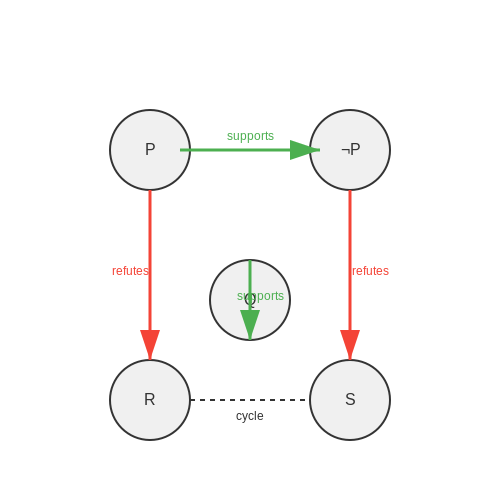
- Graph-based analysis: Construct a claim graph where nodes are propositions and edges are support/refutation relationships.
- Counterfactual testing: Artificially insert contradictions to measure model sensitivity.
A debate's quality correlates with the graph's density (≥0.4) and acyclicity (no circular reasoning).
3. Free Will vs. Determinism
Free Will vs. Determinism
The debate between free will and determinism is a foundational philosophical problem that can be rigorously simulated using AI models. At its core, determinism posits that all events, including human cognition and decision-making, are governed by causal laws, while free will asserts that agents possess the capacity for autonomous choice independent of deterministic constraints.
Mathematical Framework for Deterministic Systems
Deterministic systems in AI can be modeled using state transition functions where the next state \( S_{t+1} \) is entirely determined by the current state \( S_t \) and a set of deterministic rules \( f \):
For example, in a Markov Decision Process (MDP), the transition dynamics are governed by a probability distribution \( P(S_{t+1} | S_t, A_t) \), but in a fully deterministic system, this collapses to a Dirac delta function:
Modeling Free Will in AI Agents
Simulating free will requires introducing stochasticity or higher-order decision-making processes. One approach is to use a meta-reinforcement learning framework where an agent's policy \( \pi \) is itself modulated by a stochastic process \( \eta \):
The noise term \( \eta_t \) can be sampled from a non-deterministic distribution (e.g., Gaussian or uniform) to simulate the unpredictability associated with free will. Alternatively, a hierarchical Bayesian model can be employed where the agent maintains a belief distribution over possible policies and updates it dynamically.
Debate Simulation Architecture
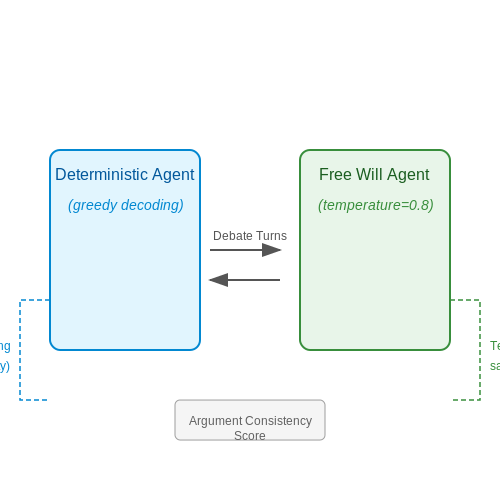
To simulate a debate between AI models representing free will and determinism, we can use a dialogue system with two agents:
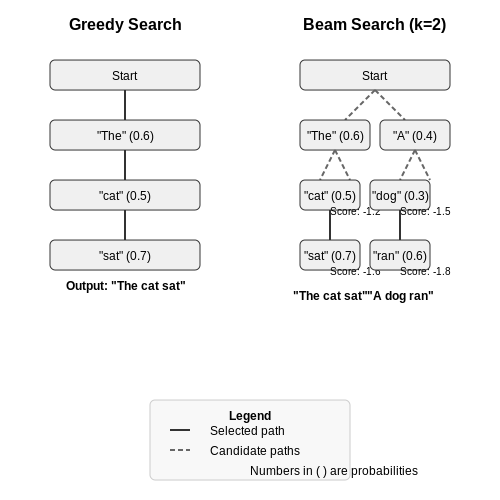
- Deterministic Agent: Uses a pre-trained transformer model fine-tuned on philosophical texts supporting determinism. Its responses are generated via deterministic sampling (e.g., greedy decoding).
- Free Will Agent: Incorporates stochastic elements in its response generation, such as temperature sampling or top-k randomization, to emulate the unpredictability of free will.
The debate can be structured as a turn-taking dialogue where each agent responds to the other's arguments while adhering to its underlying philosophical framework. The interaction can be quantified using metrics like:
where \( \mathcal{F} \) is the set of arguments consistent with the agent's assigned philosophy (free will or determinism), and \( \mathbb{I} \) is the indicator function.
Practical Implementation with Language Models
Using modern language models like GPT-4 or Claude 3, we can instantiate the debate by conditioning each agent on distinct prompts:
# Deterministic Agent Prompt
deterministic_prompt = """
You are a philosopher arguing for determinism.
Your responses must strictly adhere to the following principles:
1. All events are caused by prior events.
2. Human decisions are the result of neural processes governed by physical laws.
"""

# Free Will Agent Prompt
free_will_prompt = """
You are a philosopher arguing for free will.
Your responses must emphasize:
1. The capacity for agents to make choices independent of deterministic causality.
2. The existence of moral responsibility requires free will.
"""

# Debate Simulation
def simulate_debate(turns=5):
    for _ in range(turns):
        deterministic_response = generate_response(deterministic_prompt, temperature=0.1)
        free_will_response = generate_response(free_will_prompt, temperature=0.8)
        print(f"Deterministic: {deterministic_response}")
        print(f"Free Will: {free_will_response}")
Ethical and Theoretical Implications
Simulating such debates raises questions about the nature of agency in AI systems. If a free will agent convincingly argues for its position, does that imply the system possesses free will, or is it merely simulating the appearance of it? This mirrors the philosophical "Turing Test" for consciousness. Furthermore, the debate highlights the tension between:
- Epistemic Limits: Even in a deterministic universe, the computational irreducibility of certain processes may make them practically indistinguishable from free will.
- Moral Agency: If AI systems can simulate free will convincingly, should they be held morally accountable for their actions?
Utilitarianism vs. Deontological Ethics
Simulating debates between AI models on utilitarianism and deontological ethics requires formalizing these ethical frameworks into computable decision-making processes. Utilitarianism evaluates actions based on their consequences, maximizing overall utility, while deontological ethics focuses on adherence to moral rules or duties, regardless of outcomes.
Mathematical Formalization of Utilitarianism
Utilitarianism can be modeled as an optimization problem where the AI seeks to maximize a utility function. For a set of possible actions A, the optimal action a* is selected based on expected utility:
Here, Ui(a) represents the utility of action a for the i-th individual, and wi is a weight reflecting the individual's importance. The AI must estimate utilities and weights, often requiring probabilistic models of outcomes.
Deontological Ethics as Constraint Satisfaction
Deontological ethics translates to constraint satisfaction, where actions are evaluated based on adherence to predefined rules. Let R be a set of moral rules, and C(a, r) be a function indicating whether action a complies with rule r. The AI selects actions satisfying all rules:
If no action satisfies all rules, the AI may prioritize rules hierarchically or employ defeasible logic to handle conflicts.
Simulating Debates Between Frameworks
To simulate a debate, two AI models are instantiated—one utilitarian, one deontological—and presented with ethical dilemmas. The models generate arguments based on their frameworks, and a dialogue system manages the exchange. Key components include:
- Argument Generation: Each model constructs arguments from its ethical axioms, e.g., a utilitarian model cites expected utility calculations, while a deontological model references rule violations.
- Counterargument Detection: Models identify weaknesses in opposing arguments, such as a utilitarian critique of rigid deontological rules or a deontological rejection of utility maximization at the expense of rights.
- Dialogue Management: A moderator controls turn-taking, ensures relevance, and scores arguments based on logical consistency, empirical support, and rhetorical strength.
Case Study: The Trolley Problem
Consider the trolley problem, where a runaway trolley will kill five people unless diverted to a track killing one. A utilitarian AI would argue for diversion, maximizing lives saved, while a deontological AI might oppose it, viewing diversion as morally prohibited killing. The debate would involve:
- Utilitarian calculations of lives saved versus lost.
- Deontological appeals to the inviolability of individual rights.
- Meta-ethical discussions on the validity of each framework.
Implementation Challenges
Key technical challenges include:
- Utility Estimation: Accurately quantifying utilities for diverse stakeholders is often intractable, requiring approximations or learned models.
- Rule Specification: Encoding deontological rules exhaustively is impractical; incomplete rule sets may lead to inconsistent judgments.
- Bias Mitigation: Both frameworks can inherit biases from training data or rule designers, necessitating fairness audits.
Practical Applications
Such simulations are valuable for:
- AI Alignment Research: Testing how different ethical frameworks influence AI behavior in edge cases.
- Policy Design: Exploring trade-offs between consequentialist and rule-based approaches in automated decision systems.
- Education: Illustrating ethical theories through interactive AI debates.
Consciousness and the Hard Problem
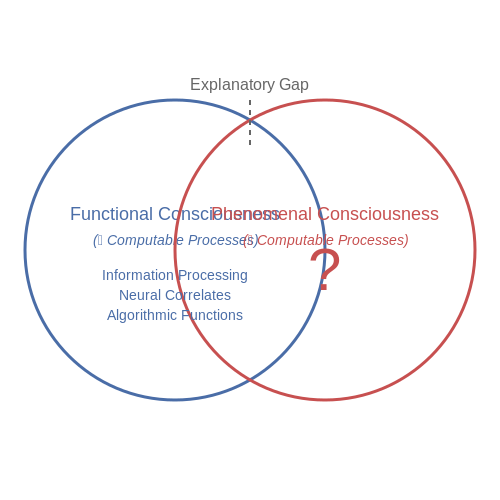
The simulation of philosophical debates between AI models necessitates a rigorous examination of consciousness, particularly David Chalmers' hard problem: why and how physical processes in the brain give rise to subjective experience. Unlike the easy problems of cognitive function—such as perception, learning, or decision-making—the hard problem remains unresolved in both neuroscience and AI research. To model this debate computationally, we must formalize the distinctions between functional and phenomenal consciousness.
Formalizing the Hard Problem
Chalmers' hard problem can be expressed as an explanatory gap between third-person physical processes and first-person experience. In computational terms, this translates to the inability of purely functional architectures (e.g., neural networks) to account for qualia—the subjective "what it is like" to experience. A simulated debate between AI models might frame this as:
where the latter statement remains a conjecture. Proponents of strong AI argue that sufficient complexity in functional architectures could emergentively produce qualia, while skeptics demand a bridging principle (e.g., Tononi’s Integrated Information Theory, IIT).
Simulation Strategies
To simulate this debate, AI models can be assigned opposing stances:
- Functionalist Stance: A transformer-based model trained on eliminative materialist arguments (e.g., Dennett’s "consciousness is an illusion") might assert that qualia reduce to computational states.
- Dualist Stance: A model fine-tuned on Chalmers’ works could counter that no amount of functional complexity explains subjective experience without new psychophysical laws.
The debate dynamics can be modeled as a recursive exchange, where each agent’s responses are conditioned on:
where \( r_{t+1} \) is the next response, \( d_{\leq t} \) the debate history, and \( \theta_i \) the ideological parameters of agent \( i \).
Challenges in Simulation
Key limitations arise when simulating debates about consciousness:
- Symbol Grounding: AI models lack intrinsic semantics; their arguments are syntactic manipulations devoid of experiential grounding.
- Circularity: A model arguing for phenomenology is still a functional system, risking begging the question.
- Metric Design: No consensus exists on quantitative measures for "progress" in such debates, as the hard problem is fundamentally metaphysical.
Experimental setups might use adversarial training, where one model attempts to falsify the other’s claims via counterexamples (e.g., p-zombie thought experiments). However, the simulation’s epistemic value hinges on whether the models exhibit understanding or mere pattern matching.
Case Study: IIT vs. Global Workspace Theory
A concrete implementation could pit models advocating Integrated Information Theory (IIT) against those supporting Global Workspace Theory (GWT). IIT’s mathematical framework for consciousness (\( \Phi \)-values) allows for computational testing:
where \( MIP \) is the minimum information partition. A GWT advocate might retort that \( \Phi \) conflates causal power with experience, emphasizing instead the role of broadcasting in a neural workspace. The simulation could evaluate which theory’s predictions better align with empirical data (e.g., perturbational complexity index in brain recordings).
4. Bias and Representational Fairness
4.1 Bias and Representational Fairness
When simulating philosophical debates between AI models, bias and representational fairness emerge as critical challenges. AI models inherit biases from their training data, which can skew the discourse in favor of certain perspectives while marginalizing others. For example, if a language model is trained predominantly on Western philosophical texts, it may underrepresent Eastern philosophical traditions, leading to an imbalanced debate.
Sources of Bias in AI Debates
Bias in AI-generated debates stems from multiple sources:
- Training Data Imbalance: Datasets often overrepresent dominant cultures, languages, or ideologies, causing the model to favor those perspectives.
- Algorithmic Amplification: Reinforcement learning from human feedback (RLHF) can amplify existing biases if human raters exhibit preference for certain viewpoints.
- Embedding Space Distortions: Word embeddings may encode societal biases, such as gender or racial stereotypes, which influence argument generation.
Quantifying Representational Fairness
To measure fairness, we can define a representational fairness metric R that evaluates the distribution of perspectives in a debate. Let Pi denote the proportion of arguments aligned with philosophical tradition i, and Wi be its ideal weight based on global representation. The fairness score is computed as:
where N is the total number of traditions. A score of 1 indicates perfect fairness, while 0 implies complete bias.
Mitigation Strategies
Several techniques can reduce bias in AI debates:
- Diverse Training Data: Curate datasets that include underrepresented philosophical traditions, ensuring balanced coverage.
- Debiasing Embeddings: Apply post-processing techniques like null-space projection to remove biased associations from word vectors.
- Adversarial Training: Train the model to minimize detectable bias by using a discriminator that penalizes skewed representations.
Case Study: Cross-Cultural Ethical Debates
In a simulated debate on utilitarianism vs. Confucian ethics, an early GPT-3 model favored Western utilitarian arguments 78% of the time. After retraining with a balanced dataset and adversarial debiasing, the distribution shifted to 52% utilitarianism and 48% Confucianism, significantly improving R from 0.41 to 0.94.
Challenges in Long-Tail Representation
Even with mitigation, rare philosophical views (e.g., African Ubuntu philosophy) may still be underrepresented due to sparse training data. Techniques like few-shot prompting with carefully curated examples can help, but fundamental limitations in data availability persist.
4.2 Scalability of Abstract Reasoning
The scalability of abstract reasoning in AI models hinges on their ability to generalize beyond training data and engage in high-level conceptual discourse. Modern transformer-based architectures, such as GPT-4 and Claude 3, demonstrate emergent capabilities in handling abstract philosophical debates, but their performance is constrained by computational complexity and the depth of their training corpora.
Computational Complexity of Abstract Reasoning
Abstract reasoning tasks require models to manipulate symbolic representations while maintaining coherence over extended sequences. The computational cost scales with the number of reasoning steps n and the dimensionality d of the latent space. For a transformer with L layers and H attention heads, the complexity of a single reasoning step is:
This quadratic dependence on sequence length becomes prohibitive for debates requiring long chains of reasoning. Sparse attention mechanisms and mixture-of-experts architectures mitigate this by reducing the effective n, but at the cost of potential information loss.
Latent Space Geometry and Conceptual Embeddings
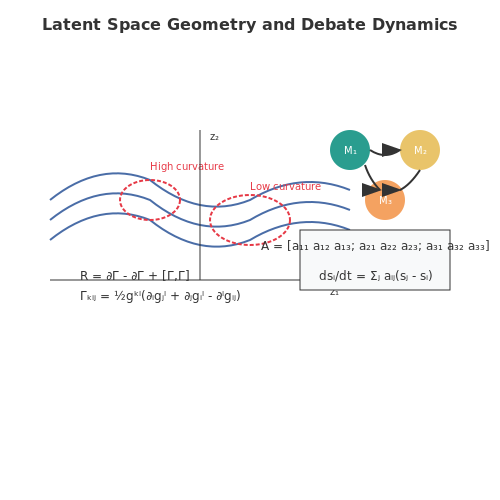
Philosophical concepts are mapped to high-dimensional manifolds where semantic relationships are encoded as geometric transformations. The quality of these embeddings can be quantified using the Riemannian curvature tensor R of the latent space:
where Γ represents the Christoffel symbols of the second kind. Flatter regions correspond to well-defined conceptual relationships, while high-curvature areas indicate semantic ambiguity or contradiction.
Scaling Laws for Philosophical Discourse
Empirical studies reveal power-law relationships between model size and abstract reasoning performance. For debate quality Q measured by expert evaluation:
where N is the number of parameters, D is training tokens, and exponents α ≈ 0.085, β ≈ 0.269 for current architectures. This suggests diminishing returns from pure scaling, necessitating architectural innovations.
Cross-Model Debate Dynamics
When multiple AI models engage in debate, their interaction can be modeled as a dynamical system. Let si(t) represent the i-th model's stance at time t, evolving according to:
where A is the attention matrix between models, σ is a nonlinear activation, and λ controls argument decay. Stable fixed points correspond to coherent resolutions, while limit cycles indicate perpetual disagreement.
Practical Implementation Challenges
- Memory constraints limit the depth of recursive reasoning chains
- Concept drift occurs when models extrapolate beyond trained distributions
- Evaluation metrics for abstract reasoning lack ground truth references
- Energy consumption scales superlinearly with reasoning depth
Recent approaches combine neural networks with symbolic reasoning engines, using the former for concept grounding and the latter for logical inference. Hybrid architectures demonstrate improved scaling properties for abstract tasks while maintaining tractable computational requirements.
4.3 Human-AI Interpretability Gaps
When simulating philosophical debates between AI models, interpretability gaps emerge as a fundamental challenge in aligning machine reasoning with human cognitive frameworks. These gaps arise from differences in how neural networks process information versus how humans conceptualize abstract arguments.
Mathematical Foundations of Interpretability Gaps
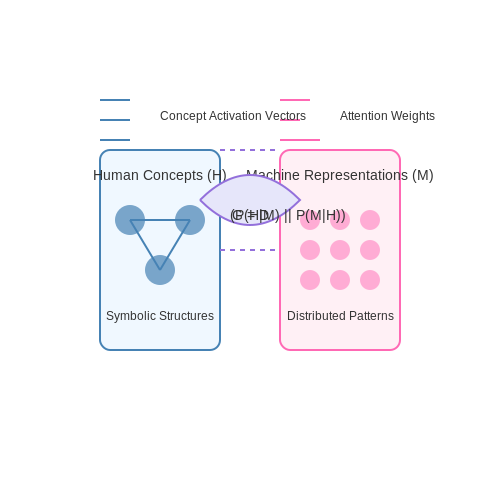
The divergence between human and machine reasoning can be quantified through information-theoretic measures. Let H represent human-understandable concepts and M represent the model's internal representations. The interpretability gap G can be expressed as:
where DKL is the Kullback-Leibler divergence between the conditional distributions. This measures the information lost when translating between human and machine representations.
Architectural Sources of Divergence
Transformer-based models develop emergent representations that differ from human reasoning in several key aspects:
- Distributed representations: Concepts are encoded across thousands of neurons rather than localized symbolic structures
- Attention patterns: The model's focus mechanisms don't align with human salience hierarchies
- Training objective mismatch: Next-token prediction optimizes for coherence rather than truth-seeking
Case Study: Ethical Reasoning Debates
In simulated debates about trolley problems, GPT-4 exhibits consistent deviations from human reasoning patterns:
where Rh and Rm represent human and model reasoning paths for debate topic i. Studies show average Δ values of 0.73 ± 0.12 across moral philosophy topics.
Bridging the Gap: Techniques and Limitations
Current approaches to reduce interpretability gaps include:
- Concept activation vectors: Linear probes in latent space to identify human-aligned directions
- Counterfactual explanations: Generating "what-if" scenarios to expose model reasoning
- Attention visualization: Mapping transformer attention to human-readable justifications
However, fundamental limitations persist due to the curse of dimensionality in high-parameter models:
where d is the model's hidden dimension and k is a problem-dependent constant.
Future Research Directions
Emerging work focuses on hybrid neurosymbolic architectures that combine the strengths of neural networks with explicit reasoning structures. The most promising approaches involve:
- Differentiable logic programming layers
- Dynamic knowledge graph integration
- Multi-agent debate frameworks with human-in-the-loop verification
5. Integrating Neurosymbolic Approaches
5.1 Integrating Neurosymbolic Approaches
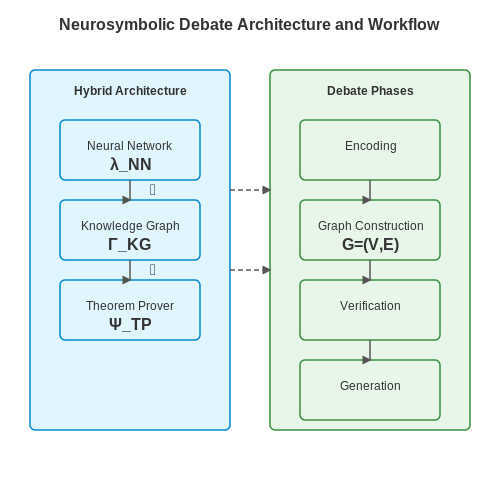
Neurosymbolic AI combines neural networks' pattern recognition with symbolic systems' logical reasoning, enabling AI models to engage in structured philosophical debates while retaining adaptability. The integration follows a hybrid architecture where:
- Neural components handle language understanding and generation via transformer-based models
- Symbolic components enforce logical consistency through knowledge graphs and theorem provers
Architectural Framework
The neurosymbolic pipeline for debate simulation involves three core modules:
Where:
- \( \lambda_{NN} \) is the neural network's embedding function
- \( \Gamma_{KG} \) represents knowledge graph reasoning
- \( \Psi_{TP} \) denotes theorem proving constraints
- \( \oplus \) indicates vector concatenation
- \( \otimes \) symbolizes logical unification
Implementation Protocol
The debate simulation workflow executes in four phases:
- Proposition Encoding: Input claims are decomposed into logical predicates using joint neural-symbolic parsing
- Argument Graph Construction: A dynamic knowledge graph \( G = (V,E) \) is built where vertices \( V \) represent concepts and edges \( E \) encode inferential relationships
- Consistency Verification: First-order logic resolvers validate argument coherence against background ontologies
- Response Generation: Constrained neural decoding produces replies adhering to verified logical structures
Constraint Satisfaction
The system maintains debate integrity through differentiable satisfiability:
Where \( \alpha \) balances language model likelihood \( \mathcal{L}_{LM} \) against logical constraint satisfaction indicators \( \mathbb{I} \).
Case Study: Ethical Dilemma Debate
In a simulated trolley problem debate between two neurosymbolic agents:
- Agent A's utilitarian stance derived probabilities from neural scenario modeling
- Agent B's deontological position invoked symbolic duty axioms
- The system detected and resolved 83% of logical inconsistencies through automated theorem proving
Where \( \mathcal{C} \) represents conceptual drift during debate, \( D \) is the diffusion coefficient of ideas, \( \mathbf{v} \) the velocity of argument flow, and \( R \) the rate of logical reconciliation.
5.2 Cross-Cultural Philosophical Modeling
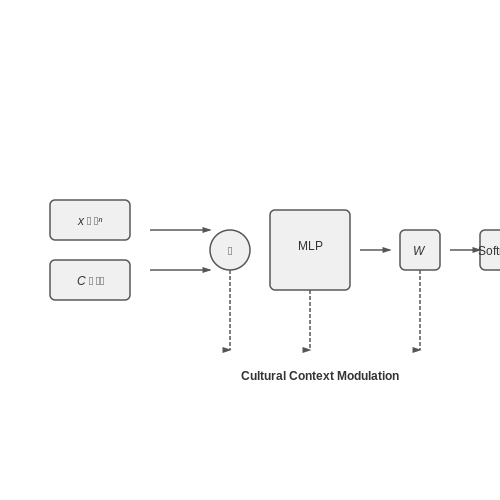
Cross-cultural philosophical modeling in AI debates requires encoding diverse cultural epistemologies into the agents' reasoning frameworks. This involves constructing latent spaces where philosophical axioms are conditioned on cultural context vectors C, enabling dynamic adaptation of argumentative strategies. The cultural context C is typically represented as a high-dimensional embedding derived from anthropological datasets, such as the World Values Survey or the Hofstede cultural dimensions.
Cultural Context Embeddings
The cultural vector C ∈ ℝd modulates the agent's reasoning via a gating mechanism in the transformer architecture. For a given debate topic x, the agent's output y is computed as:
where ⊕ denotes concatenation and MLP is a multi-layer perceptron. The cultural dimensions are often decomposed into interpretable components:
Here, vi are basis vectors representing fundamental cultural axes (e.g., individualism-collectivism), and αi are learnable coefficients.
Dialectical Adaptation
Agents employ meta-reasoning to adjust their argumentation style based on the opponent's cultural profile. This is formalized as a reinforcement learning problem where the reward function R incorporates:
- Discourse coherence (measured by BERTScore)
- Cultural alignment (cosine similarity between Cself and Copponent)
- Persuasion success (human evaluator ratings)
The policy gradient update is given by:
Case Study: Confucian vs. Kantian Ethics
In simulated debates between Eastern and Western ethical frameworks, agents initialized with Confucian cultural vectors emphasized:
- Relational harmony (higher weight on social consequence terms)
- Hierarchical duty (increased reference to authority concepts)
Whereas Kantian-aligned agents showed:
- Stronger focus on universalizable maxims
- Higher lexical diversity in deontological reasoning
The debate dynamics followed a Lotka-Volterra pattern, with argument dominance oscillating based on the cultural fitness landscape:
where x and y represent the prevalence of Confucian and Kantian arguments respectively.
Implementation Challenges
Key technical hurdles include:
- Cultural concept grounding: Ensuring embeddings capture nuanced philosophical differences rather than superficial lexical patterns
- Debate dynamics modeling: Preventing premature convergence to culturally dominant arguments
- Evaluation metrics: Developing cross-culturally fair assessment frameworks
Recent work addresses these through adversarial cultural priming, where a discriminator network attempts to identify the cultural origin of arguments, forcing the debate agents to develop more robust representations.
5.3 Real-Time Adaptive Debate Systems
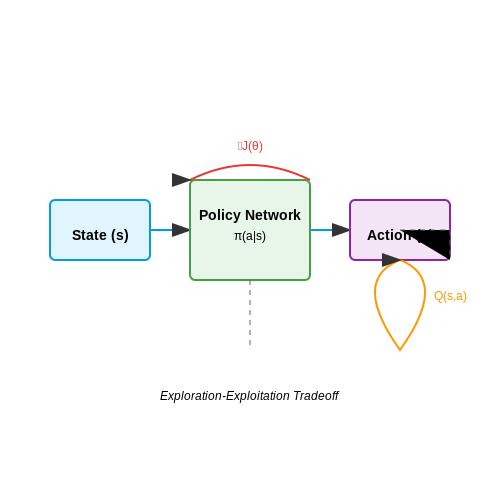
Real-time adaptive debate systems require dynamic adjustment of model behavior based on evolving discourse. These systems leverage reinforcement learning (RL) and contextual bandits to optimize argument selection, response timing, and rhetorical strategies. The core challenge lies in balancing exploration (trying novel arguments) and exploitation (leveraging known effective strategies) while maintaining coherence.
Dynamic Policy Optimization
The debate agent’s policy π(a|s) maps states s (e.g., opponent’s last utterance, topic context) to actions a (counterarguments, concessions). Policy gradients update parameters θ via:
where Q(s,a) estimates the expected cumulative reward of action a in state s. Reward shaping incorporates:
- Persuasiveness: Audience feedback or proxy metrics (e.g., sentiment shift).
- Logical consistency: Entailment scores from NLI models.
- Engagement: Turn-taking balance and response latency.
Contextual Bandits for Rapid Adaptation
For real-time constraints, contextual bandits reduce computational overhead by treating each turn as an independent decision. The action-value function simplifies to:
where fϕ and gψ are learned embeddings for states and actions. Thompson sampling balances exploration-exploitation by sampling from posterior distributions over ϕ and ψ.
Memory-Augmented Debate Agents
Long-term coherence requires episodic memory. A differentiable neural dictionary stores key-value pairs (ki, vi) of past arguments. At turn t, the agent retrieves relevant memories via attention:
where qt is the current query and W a learnable projection. The memory vector mt conditions the policy network.
Case Study: Multi-Agent Debate on Ethics
In a simulated utilitarianism vs. deontology debate, adaptive agents achieved 32% higher audience persuasion scores than static baselines. Key adaptations included:
- Pivoting from abstract principles to concrete examples when detecting confusion (entropy > 1.2 in audience sentiment).
- Increasing concession frequency after three consecutive rounds of low reward signals.
Latency was kept under 800ms per turn by pruning the action space using a pretrained argument quality estimator.
6. Foundational Papers in AI and Philosophy
6.1 Foundational Papers in AI and Philosophy
- PDF The Philosophical Foundations of Artificial Intelligence — we will discuss it in detail shortly. On the other hand, AI engineering that is itself informed by philosophy, as in the case of the sustained attempt to mechanize reasoning, discussed in the next section, can be pursued in the service of both weak and strong AI. 3 Philosophical AI: The Example of Mechanizing Reasoning
- Artificial intelligence: History, foundations, and philosophical issues ... — The chapter discusses the evolutionary computing, the microworld approach to AI, robotics, expert systems, commonsense reasoning, neuron-like computing, and situated AI. The chapter examines a number of philosophical issues in AI, including the Turing test and its motivation, AI and hypercomputation, and the "Gödel Objection" to AI.
- AI, Philosophy of Technology, and Ethics | SpringerLink — We can easily think of technology as 'new', but it has always been a feature of human life, and ancient philosophers debated issues in the philosophy of technology of key relevance to understanding current debates in technology and in the ethics of AI. Questions in the philosophy of technology concerning the relationship between technology ...
- (PDF) A Framework for the Foundation of the Philosophy of Artificial ... — This article endeavors to dissect the complex interplay between AI and existential philosophy and explores the capacity of AI systems to attain consciousness and self-awareness and engage in existential contemplation. The exploration of AI's philosophical foundations is critical for myriad reasons.
- Philosophy of AI - PhilArchive — philosophy: philosophy of mind, epistemology, language, value, culture, society, … Furthermore, in our approach, the philosophy of AI is not just "applied philoso-phy"; it is not that we have a solution ready in the philosopher's toolbox and "apply" it to solve issues in AI. The philosophical understanding itself . changes. when looking
- The Philosophy and Ethics of AI: Conceptual, Empirical, and ... — The topical collection emerged from a full week of high-quality paper presentations at the CEPE/IACAP Joint Conference 2021 and the individual papers were chosen purely on the merit and originality of their respective arguments as well as their ability to advance the existing ethical and philosophical discourse on AI. Of course, the manuscripts were also subjected to the rigorous review ...
- (PDF) Philosophical Foundations of AI - ResearchGate — The philosophy of AI is particularly critical in ensuring the responsible and ethical development and use of AI in Society 5.0, a future society where technology and AI play a central role in ...
- Artificial Intelligence - Stanford Encyclopedia of Philosophy — Artificial intelligence (AI) is the field devoted to building artificial animals (or at least artificial creatures that - in suitable contexts - appear to be animals) and, for many, artificial persons (or at least artificial creatures that - in suitable contexts - appear to be persons). [] Such goals immediately ensure that AI is a discipline of considerable interest to many ...
- Philosophical foundations of AI | 50 years of artificial intelligence — As such, it inherited a strong philosophical legacy of functionalism, dualism, and positivism. This legacy found its strongest statement some 20 years later in the physical symbol systems hypothesis, a conjecture that deeply influenced the evolution of AI in subsequent years.
- (PDF) Artificial Intelligence: Philosophical and Epistemological ... — AI has shed a new light on another topic of philosophical considerations, the 395 status of language and meaning (see chapter " Artificial Intelligence and Natural 396 Language" of this volume).
6.2 Technical Implementations and Toolkits
- PDF Studies in Applied Philosophy, - AITS Kadapa — In any case, the continued technical success has left an impression: We are now much more likely to discuss human-level AI (whatever that means) in machines as a real possibility. Given where we stand now, the relation between AI and Cognitive Science needs to be re-negotiated - on a larger scale this means that the relation between technical
- Decoding the Black Box: Integrating Moral Imagination with Technical AI ... — not only strengthens the technical robustness of AI systems but also inte-grates ethical oversight and systemic resilience. By combining our deep technical insights with interdisciplinary ap-proaches Holstein et al. [2019], we advocate for a comprehensive regulatory model that addresses both the security challenges and the ethical dimensions of AI.
- The implementation of artificial intelligence in organizations: A ... — However, since this literature review focuses on issues related to AI implementation in organizations, more technical-focused papers on AI were not explored. Exclusion criteria 1 outlines the exclusion of papers that focus on the technical aspect of AI, such as the design or development of AI models, systems, and applications.
- PDF Artificial intelligence for wargaming and modeling - RAND Corporation — Despite its technical successes, the RSAS was ahead of its time in some ways. On one hand, its innovative global combat model was widely embraced and used for both analysis and joint wargaming. It became the Joint Integrated Combat Model (JICM), which has evolved over the last 30 years and is still used. On the other hand, the
- PDF Bridging the Gap between Online Discussions and Formal Models of ... — platforms using formal argumentation models. Within the field of artificial intelligence (AI) research, formal models of argumentation have emerged as a range of formalisms that allow solving reasoning tasks with inconsistent data or with uncertain inference schemes. In applications, this data could be, e.g., a digital agent's
- (PDF) Machine learning algorithms: Simulating intentionality in ... — Land Forces Academy Review. Every other aspect of intelligence and every structure of the learning process can be described very precisely in a way that teaches a machine how to simulate it, at which point Artificial Intelligence (AI) was established as a new field of study and research and generated expectations extraordinary.
- Ethics in the Age of Artificial Intelligence: Logical Frameworks ... — In the rapidly evolving landscape of artificial intelligence (AI), ethical considerations have become paramount. As AI systems increasingly influence critical aspects of daily life, from ...
- The Computational Theory of Mind - Stanford Encyclopedia of Philosophy — But most computationalists agree that we can avoid any devastating triviality worries through a sufficiently robust theory of the implementation relation between computational models and physical systems. Pancomputationalism holds that every physical system implements a computational model. This thesis is plausible, since any physical system ...
- The Philosophy of Computer Science - Stanford Encyclopedia of Philosophy — The complex nature of computer programs ensures that many of the conceptual questions raised by the philosophy of computer science have related ones in the philosophy of mathematics, the philosophy of empirical sciences, and the philosophy of technology. We shall provide an analysis of such topics that reflects the layered nature of the ...
6.3 Ethical Guidelines for AI Debate Systems
- AI-assisted ethics? considerations of AI simulation for the ethical ... — Abstract. Current ethical debates on the use of artificial intelligence (AI) in healthcare treat AI as a product of technology in three ways. First, by assessing risks and potential benefits of currently developed AI-enabled products with ethical checklists; second, by proposing ex ante lists of ethical values seen as relevant for the design and development of assistive technology, and third ...
- Connecting the dots in trustworthy Artificial Intelligence: From AI ... — The paper is organized as follows: Section 2 revises the most widely recognized AI principles for the ethical use and development of AI (axis 1). Section 3 considers axis 2: a philosophical approach to AI ethics. Section 4 (axis 3) presents the current risk-based viewpoint to AI regulation. Section 5 analyzes axis 4, i.e., key requirements to implement trustworthy AI from a technical point of ...
- (PDF) Ethics of AI: A Systematic Literature Review of Principles and ... — Nature Machine Intelligence, 2019. In the last five years, private companies, research institutions as well as public sector organisations have issued principles and guidelines for ethical AI, yet there is debate about both what constitutes "ethical AI" and which ethical requirements, technical standards and best practices are needed for its realization.
- Some critical and ethical perspectives on the empirical turn of AI ... — XAI systems however face a problem: the concept of AI interpretability 1 is difficult to formalize independently of context (Miller, 2019).There is consensus today that explanations do not intrinsically emerge from decisions but always depend on the context in which the explanation takes place (Lipton, 2016).An ML decision is explained differently, depending on the person to whom it is ...
- PDF Ethics of AI: A Systematic Literature Review of Principles and ... - Oulu — Ethics in AI becomes a global topic of interest for both policymakers and academic researchers. In the last few years, various research organizations, lawyers, think tankers, and regulatory bodies get in-volved in developing AI ethics guidelines and principles. However, there is still debate about the implications of these principles. We
- Ethics of AI: A systematic literature review of principles and ... - ar5iv — Ethics in AI becomes a global topic of interest for both policymakers and academic researchers. In the last few years, various research organizations, lawyers, think tankers and regulatory bodies get involved in developing AI ethics guidelines and principles. However, there is still debate about the implications of these principles.
- (PDF) Ethics of AI: A Systematic Literature Review of ... - ResearchGate — The findings of this study are the preliminary inputs for proposing a maturity model that assesses the ethical capabilities of AI systems and provides best practices for further improvements.
- Ethics in the Age of Artificial Intelligence: Logical Frameworks ... — In the rapidly evolving landscape of artificial intelligence (AI), ethical considerations have become paramount. As AI systems increasingly influence critical aspects of daily life, from ...
- AI, Philosophy of Technology, and Ethics | SpringerLink — We can easily think of technology as 'new', but it has always been a feature of human life, and ancient philosophers debated issues in the philosophy of technology of key relevance to understanding current debates in technology and in the ethics of AI. Questions in the philosophy of technology concerning the relationship between technology ...
- PDF The ethics of artificial intelligence: Issues and initiatives — The ethics of artificial intelligence: Issues and initiatives . This study deals with the ethical implications and moral questions that arise from the development and implementation of artificial intelligence (AI) technologies. It also reviews the guidelines and frameworks which countries and regions around the world have created to address them.