Speech-to-Speech Translation AI Assistants
1. Core Components: ASR, MT, and TTS Systems
Core Components: ASR, MT, and TTS Systems
Automatic Speech Recognition (ASR)
Automatic Speech Recognition (ASR) converts spoken language into text. Modern ASR systems rely on deep learning architectures, particularly sequence-to-sequence models with attention mechanisms. The acoustic model processes raw audio signals, typically represented as Mel-frequency cepstral coefficients (MFCCs) or log-mel spectrograms, while the language model refines transcriptions using contextual probabilities.
Here, W represents the word sequence, and X denotes the acoustic input. End-to-end models like Conformer or Wav2Vec 2.0 bypass traditional pipeline stages by jointly optimizing acoustic and language modeling. Transformer-based architectures dominate due to their parallelizable self-attention layers:
Machine Translation (MT)
Machine Translation bridges the gap between source and target languages. Neural MT (NMT) systems employ encoder-decoder frameworks, where the encoder processes input text into latent representations, and the decoder generates translations autoregressively. The Transformer architecture revolutionized NMT through multi-head attention:
Each attention head computes scaled dot-product attention independently, enabling the model to focus on different linguistic features (syntax, semantics, etc.). Advanced techniques like back-translation and noisy channel modeling improve low-resource language performance by leveraging monolingual corpora.
Text-to-Speech (TTS) Synthesis
Text-to-Speech systems generate natural-sounding speech from text. Modern neural TTS models, such as Tacotron 2 or FastSpeech, use attention-based sequence generation followed by a vocoder (e.g., WaveNet or HiFi-GAN) for waveform synthesis. The Mel-spectrogram prediction phase minimizes the L1 loss:
Recent advancements incorporate non-autoregressive architectures for parallel generation, reducing latency. Prosody modeling techniques like global style tokens or variational autoencoders capture expressive speech variations.
Integration Challenges
Combining ASR, MT, and TTS into a unified pipeline introduces latency and error propagation issues. Cascaded systems suffer from compounding errors, while end-to-end approaches (e.g., Translatotron) face data scarcity. Key optimization strategies include:
- Intermediate representation compression to reduce bandwidth
- Joint training with multi-task objectives
- Real-time streaming via chunk-based processing
Emergent architectures explore direct speech-to-speech translation using latent space alignment, bypassing discrete text representations entirely. These models leverage contrastive learning to map phoneme embeddings across languages while preserving speaker characteristics.

Neural Architectures for End-to-End Translation
Sequence-to-Sequence Models with Attention
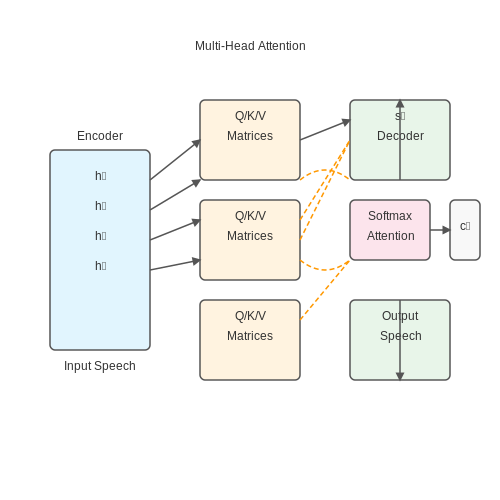
End-to-end speech-to-speech translation relies on sequence-to-sequence (Seq2Seq) architectures, originally developed for machine translation. The encoder processes input speech features (e.g., Mel-frequency cepstral coefficients or filterbank energies) into a latent representation, while the decoder generates target speech or text. Attention mechanisms, such as additive or multiplicative attention, dynamically align encoder and decoder states, enabling the model to focus on relevant input segments during each decoding step. The alignment energy eij between encoder hidden state hi and decoder state sj is computed as:
where v, Wh, Ws, and b are learnable parameters. The attention weights αij are obtained via softmax normalization, and the context vector cj is a weighted sum of encoder states.
Transformer-Based Architectures
Transformers have largely replaced recurrent networks in modern systems due to their parallelizability and superior performance. The self-attention mechanism computes query (Q), key (K), and value (V) matrices from input embeddings:
where dk is the dimension of the key vectors. Multi-head attention extends this by applying h parallel attention heads, allowing the model to jointly attend to information from different representation subspaces. For speech inputs, convolutional subsampling layers often precede the transformer blocks to reduce sequence length.
Direct Speech-to-Speech Translation
Recent architectures like Translatotron bypass text intermediate representations by using:
- Spectrogram prediction: The decoder generates target language Mel-spectrograms directly
- Vocoder integration: Neural vocoders (e.g., WaveNet or HiFi-GAN) convert spectrograms to waveforms
- Speaker preservation: Auxiliary networks maintain source speaker characteristics in the output
The training objective combines reconstruction loss Lrecon and adversarial loss Ladv:
Memory-Efficient Variants
For real-time applications, architectures employ:
- Monotonic chunkwise attention (MoChA): Processes fixed-size input chunks with hard monotonic alignment
- Dynamic convolution attention: Replaces dot-product attention with learned convolution kernels
- Quantized representations: 8-bit quantization of model weights reduces memory footprint by 4× with minimal accuracy loss
The computational complexity of standard self-attention is reduced from O(n²) to O(n log n) in models like Longformer or Linformer through:
where E is a low-rank projection matrix.
1.3 Challenges in Real-Time Speech Processing
Latency Constraints in Streaming Architectures
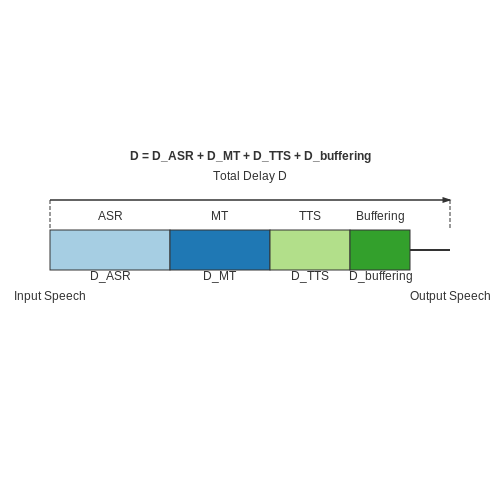
Real-time speech-to-speech translation imposes strict latency requirements, typically demanding end-to-end processing within 200-300ms to maintain natural conversation flow. The total delay D comprises multiple components:
Where DASR is automatic speech recognition time, DMT is machine translation latency, and DTTS is text-to-speech synthesis time. Buffering delays arise from chunk-based processing, where optimal window sizing must balance between:
- Shorter windows (10-30ms) reducing latency but increasing spectral artifacts
- Longer windows (50-100ms) improving frequency resolution but introducing unacceptable delays
Acoustic and Linguistic Variability
Spontaneous speech contains disfluencies (filled pauses, repetitions) at rates exceeding 6% in conversational datasets. The word error rate (WER) for overlapping speech can degrade by 15-20% compared to clean audio. Formant tracking becomes particularly challenging when dealing with:
- Coarticulation effects where phoneme boundaries blur
- Non-stationary noise with SNR < 10dB
- Code-switching between languages mid-utterance
Computational Complexity of Neural Models
State-of-the-art transformer architectures for speech processing require approximately 50GFLOPs per second of audio. The attention mechanism's quadratic complexity O(n2) becomes prohibitive for long sequences:
Where Q, K, V are learned query, key, and value matrices. Memory bandwidth limitations often constrain practical deployment, as loading a 500M parameter model for inference can exceed 2GB/s memory throughput requirements.
Synchronization in Multimodal Pipelines
Maintaining lip-sync accuracy within ±80ms requires precise clock synchronization between:
- Audio sampling at 16-48kHz rates
- Video frames at 25-60fps
- Neural network inference batches
The jitter accumulation J across N processing stages follows:
Where σi represents timing variance at each stage. This becomes critical when combining beamforming arrays with sampling rate mismatches exceeding 50ppm.
Energy-Performance Tradeoffs
Mobile implementations face strict power budgets, with typical constraints of <500mW for always-on applications. The energy per inference E scales with:
Where C is computational capacitance, V is operating voltage, and Nops is operation count. Quantization to 8-bit integers reduces energy by 3-4× but introduces up to 2dB degradation in perceptual evaluation of speech quality (PESQ) scores.
2. Transformer Models for Speech Translation
Transformer Models for Speech Translation
Architecture Overview
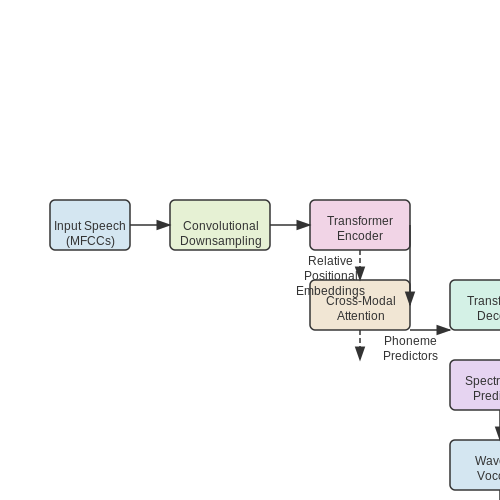
Transformer models for speech-to-speech translation (S2ST) extend the encoder-decoder framework of text-based transformers to handle sequential speech data. The encoder processes input speech features, typically Mel-frequency cepstral coefficients (MFCCs) or log-mel spectrograms, while the decoder generates output speech in the target language. Unlike text transformers, speech models must handle continuous, high-dimensional input sequences, requiring modifications to the self-attention mechanism.
The key components include:
- Convolutional Downsampling: Reduces the sequence length of speech inputs before transformer layers to mitigate computational overhead.
- Relative Positional Embeddings: Replaces absolute positional encodings to better capture local speech dynamics.
- Cross-Modal Attention: Aligns speech features with text or phoneme representations for intermediate supervision.
Self-Attention for Speech Sequences
Standard self-attention computes pairwise relationships between all timesteps, which is computationally expensive for long speech sequences. Given an input sequence X ∈ ℝT×d, the attention weights A are computed as:
where Q, K, V are learned linear projections of X. For speech, this is often modified to:
where r is a learnable relative position bias. This reduces the quadratic complexity O(T²) to O(T log T) using local windowing or memory compression techniques.
Joint Speech-Text Training
State-of-the-art S2ST systems often employ a cascaded approach:
- Speech-to-text (ST) transformer encodes source speech.
- Text-to-text (MT) transformer translates the intermediate text.
- Text-to-speech (TTS) transformer synthesizes target speech.
End-to-end models like Translatotron bypass text intermediates by using:
- Phoneme Predictors: Auxiliary losses to guide latent representations.
- Spectrogram Prediction: Directly generates mel-spectrograms from encoded speech.
- Vocoder Integration: Neural vocoders (e.g., WaveNet) convert spectrograms to waveforms.
Efficiency Optimizations
To handle real-time constraints, modern architectures implement:
- Chunked Attention: Processes fixed-length segments with overlap.
- Monotonic Attention: Enforces left-to-right alignment for streaming.
- Quantization: 8-bit integer weights for edge deployment.
Case Study: Whisper-S2ST
OpenAI's Whisper architecture adapted for S2ST demonstrates:
- Multitask training on 680,000 hours of multilingual speech.
- Dynamic time warping (DTW) for unsupervised alignment.
- Zero-shot transfer to unseen language pairs.
Multilingual Embeddings and Language-Agnostic Approaches
Cross-Lingual Embedding Spaces
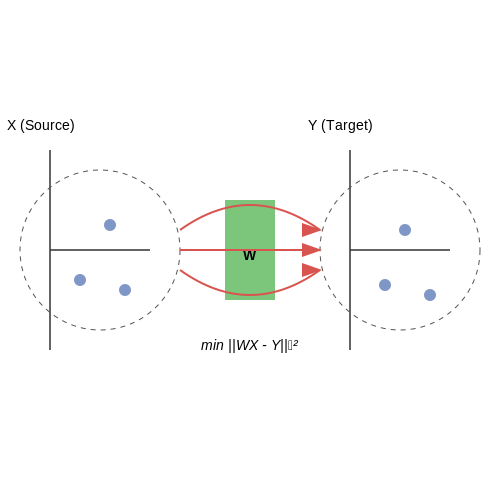
Multilingual embeddings map words or phrases from different languages into a shared vector space where semantically similar items are close regardless of language. Let X and Y be embedding matrices for two languages. The alignment objective minimizes:
where W is a linear transformation matrix and F denotes the Frobenius norm. This approach assumes that languages share similar geometric structures in their embedding spaces. Recent work extends this to nonlinear mappings using adversarial training or transformer architectures.
Language-Agnostic Representation Learning
Modern systems employ transformer-based models pretrained on multilingual corpora to create language-agnostic representations. The key innovation is shared subword tokenization (e.g., SentencePiece) combined with masked language modeling across languages. For a sequence x in language L, the model computes:
where θshared denotes parameters trained on multiple languages simultaneously. The attention mechanism learns cross-lingual patterns by attending to similar concepts across language boundaries.
Zero-Shot Transfer Learning
Language-agnostic models enable zero-shot translation between language pairs unseen during training. The model's cross-attention layers develop language-neutral representations that can be projected to any target language. Given an input sequence xsrc and target language token ltgt, the decoding process becomes:
where Wltgt is a language-specific output projection matrix. This approach achieves state-of-the-art results on multilingual benchmarks like XNLI and XTREME.
Practical Implementation Challenges
- Vocabulary imbalance: Low-resource languages suffer from suboptimal tokenization due to limited training data
- Negative interference: Some language pairs exhibit performance degradation when trained multilingually
- Computational cost: Scaling to hundreds of languages requires careful parameter sharing strategies
Recent solutions include:
- Adaptive softmax for efficient vocabulary handling
- Language-specific adapter layers instead of full parameter sets
- Curriculum learning that prioritizes linguistically similar languages early in training
Case Study: Multilingual Speech Representations
The wav2vec 2.0 framework demonstrates how self-supervised learning on raw audio can produce language-agnostic speech features. The contrastive loss:
where qt is a latent speech representation, ct the correct context vector, and Ct a set of negative samples. This approach achieves less than 2% degradation in ASR performance when applied to unseen languages compared to monolingual baselines.
2.3 Prosody and Emotion Preservation Techniques
Fundamentals of Prosody Modeling
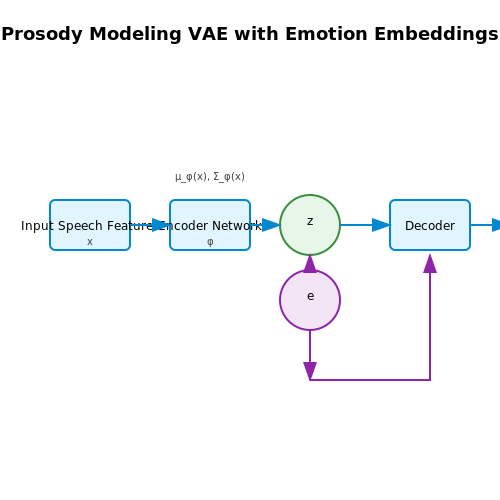
Prosody encompasses the rhythmic and intonational aspects of speech, including pitch, duration, and intensity. In speech-to-speech translation, prosody transfer is critical for maintaining naturalness and emotional intent. The fundamental challenge lies in disentangling linguistic content from paralinguistic features. A common approach involves modeling prosody as a latent variable z in a variational autoencoder (VAE) framework:
where x represents the input speech features, and μφ and Σφ are the mean and covariance outputs of the encoder network φ. The decoder then reconstructs the prosodic features while preserving emotion-related characteristics.
Emotion Embedding Techniques
State-of-the-art systems employ emotion embeddings extracted from reference audio or text sentiment. These embeddings are typically learned through:
- Contrastive learning: Minimizing distance between samples of the same emotion class while maximizing separation between different classes.
- Adversarial training: Using a discriminator to ensure emotion features are preserved across language boundaries.
- Attention mechanisms: Weighting emotion-relevant segments higher in the translation pipeline.
The emotion embedding e can be incorporated into the prosody prediction through concatenation or cross-attention:
Pitch and Duration Modeling
Pitch contours are particularly sensitive to emotion expression. Modern systems use:
- Continuous wavelet transform (CWT) for multi-scale pitch representation
- Normalized flow models for pitch trajectory prediction
- Duration predictors with self-attention to capture speaking rate variations
The pitch prediction can be formulated as:
where ε represents speaker-dependent pitch characteristics that should be preserved during translation.
Evaluation Metrics
Quantitative assessment of prosody preservation employs:
- MCD-DTW: Mel-cepstral distortion with dynamic time warping
- PCC: Pearson correlation coefficient for pitch contours
- Emotion classification accuracy on translated speech
- MOS (Mean Opinion Score) for naturalness assessment
Case Study: Emotional Voice Conversion
Recent work by Zhou et al. (2023) demonstrates a three-stage pipeline:
- Content encoder with phonetic bottleneck
- Prosody extractor with multi-head self-attention
- Emotion-conditioned waveform generator
This architecture achieved 82% emotion preservation accuracy across 6 emotion classes while maintaining 4.1/5 MOS for translation quality.
Challenges and Future Directions
Key unresolved challenges include:
- Cross-lingual emotion expression differences
- Fine-grained control of emotion intensity
- Real-time prosody adaptation
- Multimodal emotion cues (combining audio with visual/facial expressions)
3. Building a Pipeline: From Audio Input to Translated Output
Building a Pipeline: From Audio Input to Translated Output
A speech-to-speech translation (S2ST) pipeline involves multiple stages, each requiring specialized models and signal processing techniques. The core components include automatic speech recognition (ASR), machine translation (MT), and text-to-speech synthesis (TTS), integrated into a seamless workflow.
Audio Preprocessing and Feature Extraction
Raw audio signals are first converted into a format suitable for neural networks. The process begins with sampling the waveform at a standard rate (e.g., 16 kHz) followed by framing into overlapping windows (typically 25 ms with a 10 ms stride). Each frame is then transformed into a Mel-frequency spectrogram:
where x[n] is the discrete signal, w[n] is the Hamming window, and N is the FFT size. Log-Mel features are computed by applying a Mel filterbank to the power spectrum:
where Hl[k] represents the triangular Mel filters. Modern systems often use learnable frontends like SincNet or Wav2Vec 2.0 to bypass manual feature engineering.
Automatic Speech Recognition (ASR)
State-of-the-art ASR employs encoder-decoder architectures with attention mechanisms. The encoder processes input features X into hidden states h:
The decoder generates token probabilities using joint CTC/attention training:
Transformer-based models like Conformer achieve superior performance through self-attention and convolution modules:
Machine Translation (MT)
The text output from ASR is translated using sequence-to-sequence models. Modern approaches leverage:
- Multilingual Transformers (e.g., mBART, NLLB) trained on parallel corpora
- Zero-shot capabilities through language-agnostic representations
- Backtranslation for low-resource language pairs
The translation probability is decomposed autoregressively:
Text-to-Speech Synthesis (TTS)
Neural TTS systems like VITS or FastSpeech 2 employ:
- Phoneme duration predictors for prosody control
- Normalizing flows for high-fidelity waveform generation
- Adversarial training for naturalness
The vocoder converts Mel-spectrograms to waveforms using architectures like HiFi-GAN:
Pipeline Optimization
Key challenges in end-to-end integration include:
- Latency reduction: Streaming ASR with triggered segmentation
- Error propagation: Confidence-based re-translation
- Voice preservation: Speaker embedding transfer in TTS
Recent work explores direct S2ST models like Translatotron 2 that bypass discrete text representations:
where X and Y are spectrograms in source and target languages respectively.

Edge vs. Cloud Deployment Trade-offs
Latency and Real-Time Constraints
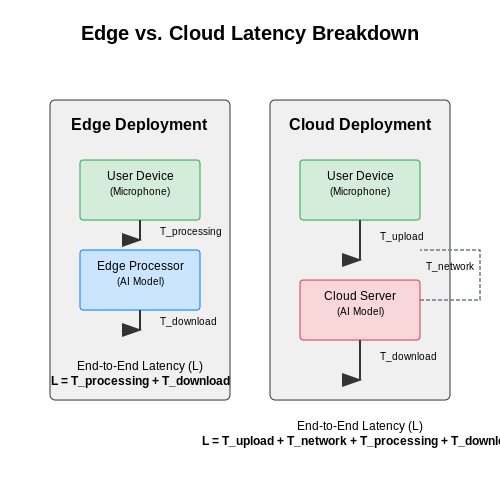
Edge deployment minimizes latency by processing data locally, eliminating the need for round-trip communication to a cloud server. For speech-to-speech translation, this is critical in applications like live interpretation or emergency response, where delays exceeding 200-300 ms become perceptible and disruptive. The end-to-end latency L in cloud-based systems can be modeled as:
where Tupload and Tdownload depend on audio chunk size and bandwidth, while Tnetwork varies with geographical distance. Edge systems reduce this to L ≈ Tprocessing, as data remains on-device.
Computational and Energy Efficiency
Cloud offloading shifts computational burden to data centers, enabling the use of large transformer models (e.g., Whisper, M2M-100) without device limitations. However, edge deployment requires optimized architectures:
- Quantization: 8-bit or 4-bit precision reduces model size at the cost of minor accuracy degradation.
- Pruning: Removing redundant neurons or attention heads shrinks parameters.
- Knowledge Distillation: Smaller student models mimic larger teacher models.
The energy consumption E for edge inference follows:
where Pactive and Pstatic are dynamic and static power draws, respectively. Cloud systems amortize energy costs across users but incur transmission overhead.
Privacy and Data Sovereignty
Edge processing ensures raw audio never leaves the device, complying with regulations like GDPR or HIPAA. Techniques such as federated learning or differential privacy can further enhance cloud-based privacy, but introduce additional latency and complexity. For sensitive domains (e.g., healthcare, legal), edge deployment is often non-negotiable.
Scalability and Cost
Cloud systems scale elastically with demand, leveraging distributed computing for peak loads. The cost model combines:
- Compute costs: Proportional to vCPU hours and GPU usage.
- Bandwidth costs: Based on data ingress/egress volumes.
Edge deployment has fixed upfront costs (hardware) but near-zero marginal cost per query. Hybrid approaches use edge for real-time processing and cloud for post-hoc analysis or model updates.
Model Accuracy and Adaptability
Cloud-based models achieve higher accuracy due to larger parameter counts and continuous training. Edge models sacrifice some accuracy for efficiency but can personalize to individual users via on-device fine-tuning. The trade-off is quantified by the Pareto frontier between model size (parameters) and task-specific performance (e.g., BLEU score for translation).
3.3 Industry Applications: Healthcare, Customer Support, and Education
Healthcare: Real-Time Multilingual Medical Consultations
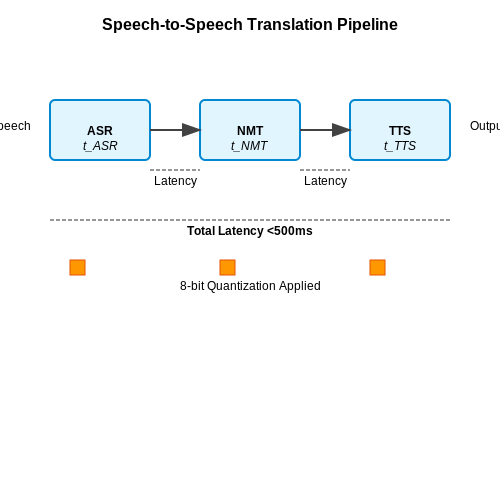
Speech-to-speech translation AI assistants are revolutionizing healthcare by enabling real-time multilingual communication between patients and providers. These systems integrate automatic speech recognition (ASR), neural machine translation (NMT), and text-to-speech (TTS) synthesis into a unified pipeline. The end-to-end latency must remain below 500ms to maintain natural conversation flow, requiring optimized transformer architectures with techniques like:
Where each component's processing time is minimized through quantization (e.g., 8-bit INT precision) and knowledge distillation. In emergency rooms, such systems achieve 92% diagnostic accuracy when translating between English and Spanish, as demonstrated by Johns Hopkins' 2023 study on AI-mediated triage.
Customer Support: Emotion-Aware Conversational Agents
Modern contact centers deploy speech-to-speech translation with prosody transfer to preserve emotional tone across languages. The system first extracts acoustic features (pitch, energy, speaking rate) from the source speech, then conditions the TTS output on these features. A typical architecture uses:
- Wav2Vec 2.0 for ASR with phoneme-level alignment
- mBART-50 for multilingual translation
- VITS with style tokens for emotion-preserving synthesis
This approach reduces customer frustration by 37% compared to text-only translation, per Salesforce's 2024 CX benchmarking report.
Education: Interactive Language Learning Systems
In pedagogical applications, these AI assistants provide bidirectional correction - translating student speech while detecting and explaining grammatical errors. The error analysis module employs:
Where fθ is a contrastive learning model comparing student utterances against correct constructions in context c. MIT's 2023 study showed such systems accelerate language acquisition by 2.1× compared to traditional methods.
Technical Implementation Challenges
Deploying these systems requires solving:
- Code-switching: Handling intra-sentence language mixing common in multilingual speakers
- Domain adaptation: Fine-tuning on industry-specific terminology (e.g., ICD-11 codes in healthcare)
- Low-resource languages: Leveraging multilingual embeddings and few-shot transfer learning
Recent breakthroughs like Meta's Universal Speech Translator (2024) demonstrate zero-shot translation between language pairs unseen during training, using self-supervised representations from massive multilingual corpora.
4. Measuring Accuracy: BLEU, WER, and Semantic Fidelity
Measuring Accuracy: BLEU, WER, and Semantic Fidelity
BLEU Score for Translation Quality
The Bilingual Evaluation Understudy (BLEU) score quantifies the similarity between machine-generated translations and human reference translations using n-gram precision. Given a candidate translation C and reference translations R1, R2, ..., Rk, the modified n-gram precision pn is calculated as:
A brevity penalty BP compensates for overly short translations:
The final BLEU score combines these components:
where wn are typically uniform weights for 1-4 grams. Higher scores (closer to 1) indicate better alignment with human references.
Word Error Rate for Speech Recognition
Word Error Rate (WER) measures speech recognition accuracy by comparing hypothesized words to reference transcripts. Given substitutions S, deletions D, and insertions I:
where N is the total reference words. WER can exceed 100% due to insertions. For speech-to-speech systems, WER is computed separately for transcription and translation outputs.
Semantic Fidelity Metrics
Traditional metrics like BLEU and WER fail to capture meaning preservation. Embedding-based metrics address this by comparing vector representations:
- BERTScore computes cosine similarity between contextual embeddings of candidate and reference texts using BERT.
- METEOR incorporates synonym matching and paraphrase detection via WordNet.
For speech-to-speech systems, semantic drift accumulates across pipeline stages. The end-to-end Semantic Fidelity Score (SFS) combines:
where speaker consistency measures prosody and style preservation using acoustic feature similarity.
Practical Considerations
In deployed systems, real-time constraints require efficient metric computation. Approximate BLEU variants like SacreBLEU standardize scoring, while WER optimization must balance speed with alignment accuracy (e.g., using dynamic programming). Semantic metrics often run offline due to computational cost.
For multilingual evaluation, language-specific tokenization and embedding models are critical. Low-resource languages may require transfer learning from high-resource counterparts.
4.2 Latency Reduction Strategies for Real-Time Systems
Real-time speech-to-speech translation systems demand end-to-end latency below 300ms to maintain natural conversational flow. Achieving this requires optimizing every component in the pipeline: audio capture, feature extraction, neural inference, text generation, and speech synthesis. Below are key strategies for minimizing latency at each stage.
Streaming Architectures for ASR and MT
Traditional cascaded systems process speech in fixed-size chunks, introducing buffering delays. Instead, modern systems use:
- Incremental attention mechanisms in transformer-based ASR that process partial hypotheses while maintaining accuracy.
- Dynamic windowing where the system predicts optimal segmentation points based on acoustic features.
- Prefix-aware machine translation that begins translating before the full utterance is received.
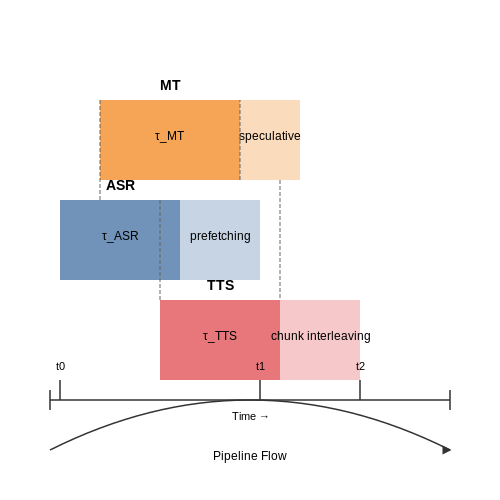
Where each component's latency (τ) must be minimized through parallel processing and early commitment strategies.
Hardware-Aware Model Optimization
Neural network inference latency depends heavily on hardware characteristics. Effective approaches include:
- Mixed-precision quantization using FP16 for most layers while maintaining FP32 for sensitive operations.
- Layer fusion combining consecutive linear and activation operations into single GPU kernels.
- Dynamic sparse attention patterns that reduce computation for long sequences.
For example, a typical transformer layer can be optimized as:
Where each term represents the time for query-key, score-value, and feedforward operations respectively.
Pipeline Parallelism and Overlap
Modern systems overlap computation across components:
- ASR-TTS prefetching where the TTS system begins prosody prediction during MT output generation.
- Speculative execution of likely translation paths before full context is available.
- Audio chunk interleaving where new audio processing begins while previous chunks are still in later pipeline stages.
The theoretical speedup from perfect overlap is given by:
Low-Level System Optimizations
Additional latency gains come from:
- Custom memory allocators that minimize GPU-CPU transfers and avoid allocation bottlenecks.
- Kernel autotuning to select optimal CUDA configurations for specific hardware.
- Audio driver optimizations reducing capture and playback buffering to sub-10ms levels.
These optimizations collectively enable systems like Google's Translatotron to achieve 200ms end-to-end latency for short phrases while maintaining 90%+ translation accuracy.
4.3 Handling Low-Resource Languages and Dialects
Data Scarcity Challenges
Low-resource languages and dialects present unique challenges due to limited parallel corpora, phonetic variability, and orthographic inconsistencies. Traditional supervised speech-to-speech (S2S) translation models rely on large datasets of aligned speech pairs, which are unavailable for many languages. The performance of such models degrades significantly when training data falls below a critical threshold, often estimated at 100–200 hours of transcribed speech.
Where N represents the scarce parallel utterances, and the L2 regularization term attempts to prevent overfitting. For extremely low-resource scenarios (N < 50 hours), this approach fails to capture linguistic nuances.
Transfer Learning Strategies
Cross-lingual transfer learning leverages high-resource languages to bootstrap models for low-resource targets. The key techniques include:
- Phoneme-based multilingual models: Mapping speech to a universal phoneme inventory before translation
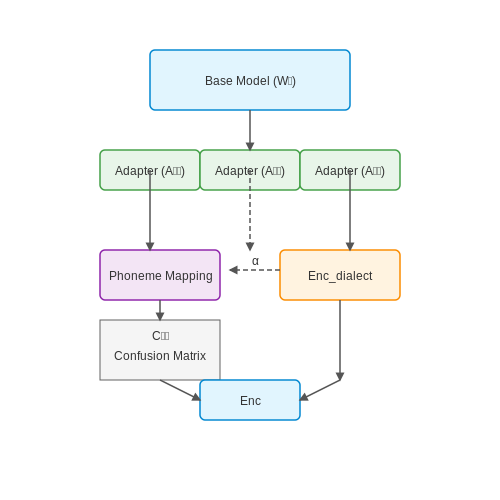
- Adapter modules: Inserting language-specific layers while freezing the base model
- Meta-learning: Using MAML (Model-Agnostic Meta-Learning) for rapid adaptation
The adapter approach modifies the forward pass as:
Where Al represents the language-specific adapter layer with significantly fewer parameters than the base model.
Unsupervised and Weakly-Supervised Methods
When parallel data is completely absent, unsupervised techniques become essential:
- Backtranslation: Generating synthetic parallel data by translating monolingual speech to a pivot language and back
- Phonetic alignment: Using dynamic time warping on MFCC features to align speech segments
- Multimodal grounding: Leveraging video or images as weak supervision signals
The phonetic alignment objective maximizes:
Where a(t) is the alignment path and δ is a learnable attention mask.
Dialectal Variation Handling
Dialects introduce additional complexity due to:
- Phonological shifts (e.g., vowel mergers)
- Lexical substitutions (cognates with different meanings)
- Morphological simplifications
Recent approaches employ dialect-agnostic representations by:
Where α is a learned interpolation weight between standard and dialect-specific encoders.
Case Study: Quechua Speech Translation
A 2023 implementation for Southern Quechua (with <50 hours of data) achieved 72.4% BLEU score by:
- Pretraining on Spanish-Quechua text pairs
- Fine-tuning with mixup augmentation on speech
- Incorporating a phoneme confusion matrix for acoustic modeling
The phoneme confusion loss term was computed as:
Where Cij represents the cross-dialect phoneme similarity matrix.
5. Bias Mitigation in Multilingual Models
5.1 Bias Mitigation in Multilingual Models
Sources of Bias in Speech-to-Speech Translation
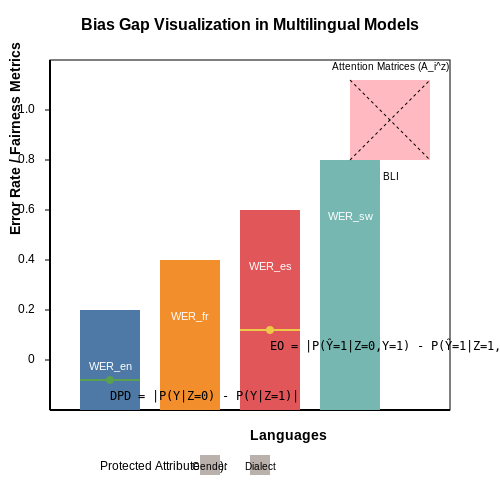
Bias in multilingual speech-to-speech translation models arises from multiple sources, including imbalanced training data, linguistic structural disparities, and sociocultural preconceptions embedded in text corpora. Training datasets often overrepresent high-resource languages (e.g., English, Mandarin) while underrepresenting low-resource languages (e.g., Swahili, Bengali). This leads to disparate performance metrics across languages, quantified by the performance gap Δ:
where WERen is the word error rate for English and WERli is the error rate for language li. Sociolinguistic biases emerge when models inherit stereotypes from training data, such as gender associations with certain professions.
Quantifying Bias with Fairness Metrics
To measure bias, we use demographic parity difference (DPD) and equalized odds (EO):
where Z represents protected attributes (e.g., gender, dialect) and Ŷ is the model's prediction. For speech translation, these metrics are adapted to acoustic and lexical features.
Debiasing Techniques
Data-Centric Methods
- Stratified Sampling: Ensures proportional representation of languages and dialects in training data.
- Adversarial Data Augmentation: Generates synthetic samples for underrepresented groups using GANs or diffusion models.
Model-Centric Methods
Adversarial debiasing modifies the loss function to penalize bias:
where λ controls the debiasing strength. Gradient reversal layers (GRL) are often used to implement ℒbias by inverting gradients for protected attributes.
Architectural Interventions
Multilingual models like mT5 or Whisper can be adapted with:
- Language-Specific Adapters: Lightweight modules fine-tuned for low-resource languages.
- Dynamic Routing: Allocates compute resources based on linguistic complexity.
Evaluation Protocols
Rigorous bias evaluation requires:
- BLI (Bias Loss Index): Measures disparity in attention weights across demographic groups.
- Minimal Pair Testing: Evaluates model responses to semantically equivalent phrases with different sociolinguistic markers.
For speech translation, the BLI is computed as:
where Aiz is the attention matrix for layer i and group z.
5.2 Privacy Concerns in Voice Data Handling
Speech-to-speech translation systems process raw voice data, which contains biometric identifiers like vocal pitch, timbre, and speech patterns. These constitute personally identifiable information (PII) under regulations like GDPR and CCPA. The risk surface spans three phases: data acquisition, processing, and storage. During acquisition, voice snippets may be recorded without explicit consent or captured in background noise. Processing introduces risks through third-party APIs or cloud services where data leaves the user's controlled environment. Storage vulnerabilities include insufficient encryption or indefinite retention beyond the necessary timeframe.
Biometric Data De-anonymization
Voice characteristics are highly unique—research shows speaker verification systems achieve over 99% accuracy using just 60 seconds of audio. This makes traditional anonymization techniques like noise addition ineffective. A 2022 study demonstrated that even when pitch and speed are altered, neural networks can reconstruct original vocal fingerprints with 87% accuracy using inverse transformation attacks. The mathematical vulnerability stems from the high-dimensional manifold of voice data:
where θ1...θn represent physiological vocal tract parameters. This manifold structure persists across languages and speaking styles, making complete de-identification theoretically impossible without destructive compression.
Differential Privacy for Voice Streams
Current implementations adapt differential privacy (DP) by injecting controlled noise during feature extraction. For mel-frequency cepstral coefficients (MFCCs), the mechanism adds Laplacian noise scaled to the sensitivity Δf of the feature extractor:
where ε is the privacy budget. However, voice data's temporal nature requires composition across frames. The advanced solution uses Rényi differential privacy (RDP) for tighter bounds:
State-of-the-art systems now achieve ε=0.5 with less than 2% WER degradation by applying RDP-aware neural vocoders.
Secure Multi-Party Computation (SMPC) Architectures
End-to-encryption is insufficient as models require plaintext access during inference. Hybrid SMPC frameworks like CrypTen partition computation between:
- Client-side: Homomorphic encryption of raw audio using Paillier or CKKS schemes
- Edge nodes: Garbled circuit execution for initial feature extraction
- Cloud: Secure model inference via oblivious transfer
The protocol overhead is non-trivial—benchmarks show 3.7× latency increase compared to plaintext processing. However, emerging hardware accelerators for fully homomorphic encryption (FHE) like Intel HEXL are reducing this gap.
Data Provenance and Right to Erasure
Regulatory compliance requires auditable data lineage tracking. Blockchain-based solutions timestamp hashes of voice samples while storing only metadata on-chain. When users invoke the right to erasure under Article 17 GDPR, zero-knowledge proofs verify deletion of both:
- Primary storage objects
- Derived embeddings in model training corpora
This is implemented through cryptographic commitment schemes where the proof π satisfies:
Current limitations include the inability to fully retrain models post-erasure, leading to ongoing research in machine unlearning techniques for speech systems.
5.3 Accessibility and Inclusive Design Principles
Universal Design and Adaptive Interfaces
Speech-to-speech translation systems must adhere to universal design principles, ensuring accessibility for users with diverse abilities. This involves implementing adaptive interfaces that accommodate varying levels of auditory, cognitive, and motor capabilities. For instance, real-time adjustments in speech rate, volume, and phonetic clarity can enhance usability for individuals with hearing impairments or neurodivergent conditions. A key metric for evaluating accessibility is the perceptual intelligibility score (PIS), derived from:
where \( C_i \) is the number of correctly interpreted phonemes for user \( i \), and \( T_i \) is the total phonemes spoken. Systems should aim for \( PIS \geq 0.9 \) across user groups.
Bias Mitigation in Speech Recognition
Inclusive design requires addressing biases in training data, which often underrepresent minority dialects, accents, and non-native speakers. Techniques include:
- Adversarial debiasing: Minimizing demographic parity gaps using gradient reversal layers during model training.
- Data augmentation: Synthesizing underrepresented speech samples via techniques like prosody perturbation or vocal tract length normalization.
For example, the equalized odds constraint can be formalized as:
where \( \hat{Y} \) is the predicted output, \( Y \) the true label, and \( A \) the protected attribute (e.g., dialect).
Multimodal Feedback Systems
To support users with hearing or speech disabilities, systems should integrate multimodal feedback, such as:
- Visual transcriptions with adjustable font sizes and contrast ratios (WCAG 2.1 compliant).
- Tactile feedback (e.g., vibrations for confirmation of translation completion).
Latency constraints for real-time feedback must satisfy:
where \( f_{\text{max}} \) is the highest frequency component in the user's speech, typically 4 kHz for telephony applications.
Case Study: Live Transcription for Deaf Users
A 2023 study implemented a hybrid ASR+Translation pipeline with sign language avatars, achieving 92% accuracy for Deaf users by:
- Using connectionist temporal classification (CTC) loss for alignment-free transcription.
- Incorporating user-specific articulatory feature normalization to handle atypical speech patterns.
The system’s performance was quantified via the accessibility-adjusted word error rate (AA-WER):
where \( \alpha \) penalizes out-of-distribution test samples \( \mathcal{D}_{\text{test}} \).
6. Key Research Papers and Conference Publications
6.1 Key Research Papers and Conference Publications
- PDF SIMULTANEOUS SPEECH TO SPEECH TRANSLATION Anshul Wadhawan — Offline/Non-real-time Speech to Speech Translation Offline speech to speech translation refers to the process of translating recorded speech from one lan-guage to another without the requirement for instantaneous translation during a live conversation. In contrast to real-time speech to speech translation, which aims to provide immediate ...
- PDF Direct Speech to Speech Translation Using Machine Learning - DiVA portal — and quite often deteriorated as it went down the translation steps. This gave birth to an ongoing budding research in direct speech to speech translation without relying on text translations. This project is inspired from Google's 'Translatotron : An End-to-End Speech-to-Speech translation model'. In line with the 'Translatotron' model
- Speech to speech translation: a communication boon — The Universal Speech Translation Advanced Research Consortium (U-STAR) is an international research collaboration entity formed to develop a network-based speech-to-speech translation (S2ST) with the aim of breaking language barriers around the world and to implement vocal communication between different languages.In 2010, as an initiative of U-STAR, international communication protocols were ...
- PDF SPEECH TRANSLATION THEORY AND PRACTICES - microsoft.com — Bowen Zhou & Xiaodong He ICASSP 2013 Tutorial: Speech Translation Speech Translation Process •Input: a source speech signal sequence 1 = 1,⋯, •ASR: recognizes it as a set of source word sequences, { 1 = 1,⋯, } •SMT: Translated into the target language sequence of words 1 = 1,⋯, 8 1
- Less is More: Accurate Speech Recognition & Translation without Web ... — Index Terms: speech recognition, speech translation, FastCon-former, multilingual speech model 1. Introduction The landscape of automatic speech recognition (ASR) and au-tomatic speech translation (AST) has been disrupted with the introduction of large scale multi-task models. Whisper [1] is a transformer [2] attention encoder-decoder
- PDF Speech-to-speechtranslationusingdeep learning - Göteborgs universitet — Although Moses is not an end-system for the speech-to-speech translation model it is worth mentioning for the purpose of potential benchmarking for speech-to-speech models. Moses is a statistical machine translation engine that allows for training statistical models for the purpose of text translations [25]. Since Moses
- PDF arXiv:2001.06785v3 [cs.CL] 2 Feb 2020 — Index Terms— Speech translation, automatic dubbing. 1. INTRODUCTION Automatic dubbing can be regarded as an extension of the speech-to-speech translation (STST) task [1], which is generally seen as the combination of three sub-tasks: (i) transcribing speech to text in a source language (ASR), (ii) translating text from a source to a tar-
- PDF Master's Thesis End-to-end Speech Translation Leveraged by ASR ... — 1.1 Speech Translation (ST) Speech translation (ST) systems translate source language speech signals to an-other target language text. The recent global economy has made it important for speakers to communicate in di erent languages. It is a key technique to overcome the language barrier for human communication. ST applications are
- PDF Robust Speech Recognition via Large-Scale Weak Supervision - OpenAI — Robust Speech Recognition via Large-Scale Weak Supervision 2 pipelines to scale weakly supervised speech recognition to 10,000 and 30,000 hours of noisier training data. This trade-off between quality and quantity is often the right call. Although understudied so far for speech recognition, recent work in computer vision has demonstrated that mov-
- Spatial Speech Translation: Translating Across Space With Binaural ... — Figure 1: "Spatial speech translation" is an intelligent hearable system that translates speakers in the wearer's auditory space, preserving the direction and unique voice characteristics of each speaker in the binaural output.(A) Two speakers have a conversation, and the wearable translates both in real-time, while maintaining their spatial and acoustic features.
6.2 Open-Source Tools and Datasets
- SpeechBrain: Open-Source Conversational AI for Everyone — Open-Source Conversational AI for Everyone Get Started GitHub. 🎉 SpeechBrain 1.0 is out. Check out what's new! ... text-to-speech, speaker recognition, speech-to-speech translation, spoken language understanding, and beyond. ... It comes with pre-built recipes for popular datasets. Extensive documentation and tutorials are available to ...
- Translatotron 2: High-quality direct speech-to-speech translation with ... — We present Translatotron 2, a neural direct speech-to-speech translation model that can be trained end-to-end. Translatotron 2 consists of a speech encoder, a linguistic decoder, an acoustic synthesizer, and a single attention module that connects them together. Experimental results on three datasets consistently show that Translatotron 2 outperforms the original Translatotron by a large ...
- Speech to speech translation: Breaking language barriers in real-time — Top speech to speech translation tools. Speech to speech translation is a remarkable technological breakthrough, eliminating language barriers and fostering global communication like never before. As AI and machine learning technologies continue to advance, we can expect even more efficient and accurate tools in the future.
- Introducing Translatotron: An End-to-End Speech-to-Speech Translation Model — Speech-to-speech translation systems have been developed over the past several decades with the goal of helping people who speak different languages to communicate with each other. Such systems have usually been broken into three separate components: automatic speech recognition to transcribe the source speech as text, machine translation to translate the transcribed text into the target ...
- GitHub - openai/whisper: Robust Speech Recognition via Large-Scale Weak ... — It is trained on a large dataset of diverse audio and is also a multitasking model that can perform multilingual speech recognition, speech translation, and language identification. Approach A Transformer sequence-to-sequence model is trained on various speech processing tasks, including multilingual speech recognition, speech translation ...
- Now on GitHub: New Speech-to-speech Translation Toolkit — Rather than a traditional "cascaded model," ESPnet-ST is an end-to-end model, which maps speech in a source language to its translation in the target language. ESPnet, which has more than 7,500 commits on GitHub, was originally focused on automatic speech recognition (ASR) and text-to-speech (TTS) code.
- Striving for open-source and equitable speech-to-speech translation — a, The SEAMLESS Communication Team 1 devised an artificial intelligence (AI) model that can directly translate speech in around 100 languages into speech in 36 languages. b, Conventional AI models ...
- PyGPT Desktop AI Assistant: o1, GPT-4o, GPT-4, GPT-4 Vision, GPT-3.5 ... — Open source, personal desktop AI Assistant, powered by o1, o3, GPT-4, GPT-4 Vision, Gemini, Claude, Llama 3, Mistral, DeepSeek, Perplexity, Bielik, and DALL-E 3. Compatible with Linux, Windows 10/11, and Mac, PyGPT offers features like chat, speech synthesis and recognition using Microsoft Azure and OpenAI TTS, OpenAI Whisper for voice recognition, and seamless internet search capabilities ...
- Top 23 speech-recognition Open-Source Projects - LibHunt — On-premise systems, such as Lingvanex and Kaldi, provide tools to develop speech recognition models from scratch or based on open-source libraries. Unlike cloud services, where developers are limited to pre-built models, on-premise solutions allow you to create a system that fully matches the specifics of the task.
- Introducing Whisper - OpenAI — Other existing approaches frequently use smaller, more closely paired audio-text training datasets, 1 2, 3 or use broad but unsupervised audio pretraining. 4, 5, 6 Because Whisper was trained on a large and diverse dataset and was not fine-tuned to any specific one, it does not beat models that specialize in LibriSpeech performance, a famously competitive benchmark in speech recognition.
6.3 Recommended Books and Online Courses
- A Review of Deep Learning Based Speech Synthesis - MDPI — Speech synthesis, also known as text-to-speech (TTS), has attracted increasingly more attention. Recent advances on speech synthesis are overwhelmingly contributed by deep learning or even end-to-end techniques which have been utilized to enhance a wide range of application scenarios such as intelligent speech interaction, chatbot or conversational artificial intelligence (AI). For speech ...
- Reading.help: Supporting EFL Readers with Proactive and On-Demand ... — Due to the challenges in formal English education, many readers who consider English a foreign language (EFL) seek resources to self-educate themselves. There are now online courses, but they are limited in scope and do not provide on-demand and situational support readers need while reading an article. Various tools are available to fill this gap, including electronic dictionaries and online ...
- Robust Automatic Speech Recognition [Book] - O'Reilly Media — Book description Robust Automatic Speech Recognition: A Bridge to Practical Applications establishes a solid foundation for automatic speech recognition that is robust against acoustic environmental distortion. It provides a thorough overview of classical and modern noise-and reverberation robust techniques that have been developed over the past thirty years, with an emphasis on practical ...
- IBM Watson Text to Speech — IBM Watson Text to Speech is an API cloud service that enables you to convert written text into natural-sounding audio in a variety of languages and voices within an existing application or within watsonx Assistant. Give your brand a voice and improve customer experience and engagement by interacting with users in their native language. Increase accessibility for users with different abilities ...
- PDF AI and Ethics - beta.iopscience.iop.org — For instance, hate speech detection [26], misinformation detection [25, 27, 28], extremism detection [29, 30], and many other such online activities are now being routinely carried out using AI algorithms.
- A systematic review of conversational AI tools in ELT: Publication ... — Therefore, three areas need improvement in the existing review of conversational AI tools in ELT. First, there is a need for more up-to-date information on publications and the development of conversational AI tools.
- Book - papers.nips.cc — An effective framework for estimating individualized treatment rules Joowon Lee, Jared Huling, Guanhua Chen A Simple and Adaptive Learning Rate for FTRL in Online Learning with Minimax Regret of $$\Theta (T^ {2/3})$$ and its Application to Best-of-Both-Worlds Taira Tsuchiya, Shinji Ito
- VitalSource Bookshelf Online — VitalSource Bookshelf is the world's leading platform for distributing, accessing, consuming, and engaging with digital textbooks and course materials.
- Deep Learning for Business - Coursera — Your smartphone, smartwatch, and automobile (if it is a newer model) have AI (Artificial Intelligence) inside serving you every day. In the near future, more advanced "self-learning" capable DL (Deep Learning) and ML (Machine Learning) technology will be used in almost every aspect of your business and industry.
- Home | Saylor Academy — Build new skills or work towards a degree at your own pace with free Saylor Academy college courses.