Virtual AI Interview Practice Tools
1. Definition and Core Components
1.1 Definition and Core Components
Virtual AI interview practice tools are sophisticated systems that leverage artificial intelligence to simulate real-world job interviews, providing candidates with an interactive, adaptive, and data-driven practice environment. These tools integrate multiple AI subfields, including natural language processing (NLP), speech recognition, computer vision, and reinforcement learning, to create a realistic and responsive interview experience.
Core Technical Components
The architecture of a virtual AI interview system consists of several interconnected modules:
- Speech-to-Text Engine: Converts spoken responses into textual data using transformer-based models like Whisper or wav2vec 2.0, achieving word error rates below 5% in optimal conditions.
- Natural Language Understanding: Employs BERT or GPT-style architectures to analyze semantic content, sentiment, and coherence of responses. The model computes metrics such as:
where ei represents sentence embeddings and N is the number of sentences in the response.
- Behavioral Analysis Module: Uses multi-modal fusion of speech patterns (prosody, pauses) and facial expressions (via CNN-LSTM networks) to assess non-verbal communication skills.
- Question Generation: Implements constrained decoding in large language models to produce industry-specific questions while maintaining diversity through techniques like nucleus sampling (p=0.9) and temperature scaling (T=0.7).
Adaptive Interview Mechanisms
Advanced systems employ reinforcement learning to dynamically adjust question difficulty based on candidate performance. The policy gradient method updates question selection parameters θ according to:
where τ represents the interview trajectory and R(τ) is a reward function based on response quality metrics.
Real-Time Feedback Systems
State-of-the-art tools provide instantaneous feedback through:
- Grammatical error detection using constrained beam search in sequence-to-sequence models
- Content scoring against domain-specific knowledge graphs
- Comparative analysis against high-scoring responses from training corpora
The feedback generation pipeline typically operates with a latency constraint of <500ms, achieved through model quantization and edge computing deployment.
Evaluation Metrics
System performance is measured using:
- Pearson correlation (r > 0.85) between AI scores and human expert ratings
- Position-aware recall@k for question relevance
- Adversarial robustness scores against synthetic edge cases

How AI Enhances Interview Simulations
Natural Language Processing for Realistic Dialogue
Modern AI-driven interview simulations leverage transformer-based models like GPT-4 and BERT to generate contextually relevant responses. These models process candidate inputs through multi-head attention mechanisms:Behavioral Analysis Through Multimodal Learning
Advanced systems integrate speech patterns, facial expressions, and linguistic content using late fusion techniques. A typical pipeline involves:- Audio feature extraction using Mel-frequency cepstral coefficients (MFCCs)
- Visual emotion recognition via 3D convolutional neural networks
- Text sentiment analysis with domain-specific fine-tuned language models
Adaptive Difficulty Scaling
Reinforcement learning frameworks dynamically adjust question complexity based on candidate performance. The system models this as a Markov Decision Process (MDP) with:- State space: Candidate's response accuracy and latency
- Action space: Question difficulty levels
- Reward function: Maximizing learning while maintaining engagement
Bias Mitigation Techniques
State-of-the-art systems employ adversarial debiasing during model training. The objective function incorporates:Real-Time Feedback Generation
The feedback mechanism combines rule-based templates with neural generation. For structured responses, a hybrid approach:- Parse candidate answer into semantic frames using AMR parsing
- Match against expected competency frameworks
- Generate natural language feedback through constrained decoding

Key Technologies Behind AI Interview Tools
Natural Language Processing (NLP)
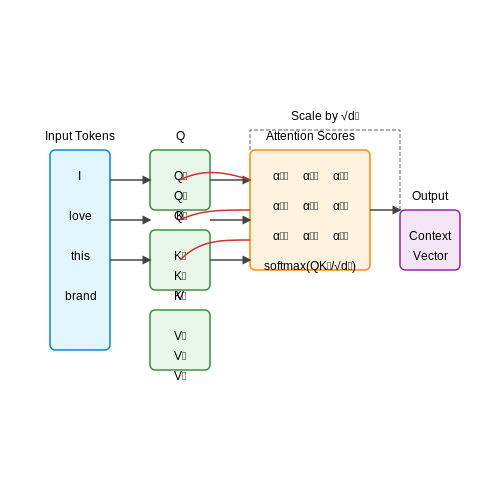
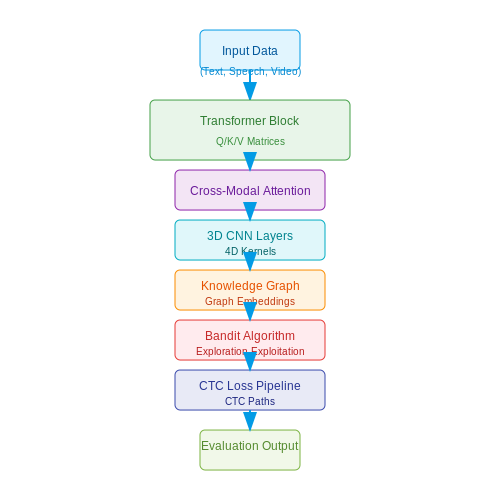
Modern AI interview tools rely heavily on transformer-based architectures like BERT, GPT, and their variants to process candidate responses. These models employ self-attention mechanisms to capture contextual relationships in text:
where Q, K, and V represent query, key, and value matrices respectively, and dk is the dimension of the key vectors. This enables the model to weigh the importance of different words in a response when generating feedback.
Speech Recognition and Processing
Real-time speech-to-text conversion uses connectionist temporal classification (CTC) loss functions in recurrent or transformer architectures:
where π is a path through the network's output probabilities y for input sequence x. Advanced systems combine this with speaker diarization to distinguish between interviewer and candidate voices in conversational settings.
Computer Vision for Behavioral Analysis
Facial expression recognition employs 3D convolutional neural networks that process temporal sequences of facial landmarks:
where W represents the 4D kernel operating on spatial (x,y,z) and temporal (t) dimensions of the input video 𝒳. This allows detection of micro-expressions and engagement metrics at frame rates exceeding 30fps.
Knowledge Graph-Based Evaluation
Domain-specific knowledge graphs structure technical interview questions using graph neural networks:
where hv(l) represents the embedding of node v at layer l, and 𝒩(v) denotes its neighbors. This architecture enables the system to assess answer correctness against structured domain knowledge.
Reinforcement Learning for Adaptive Interviews
Dynamic question selection uses contextual bandit algorithms that balance exploration-exploitation tradeoffs:
where Qt(a) is the estimated value of action a (question difficulty) at time t, and Nt(a) counts how often a has been tried. The hyperparameter c controls exploration intensity.
Multimodal Fusion Architectures
State-of-the-art systems employ cross-modal attention to combine linguistic, vocal, and visual cues:
where vi and tj represent visual and textual features respectively, with f and g being modality-specific projection networks. This allows the system to detect incongruences between verbal and non-verbal responses.
2. Text-Based AI Interview Platforms
Text-Based AI Interview Platforms
Text-based AI interview platforms leverage natural language processing (NLP) and large language models (LLMs) to simulate technical and behavioral interview scenarios. These systems analyze candidate responses in real-time, evaluating content, structure, and linguistic patterns against predefined rubrics or learned representations of high-quality answers.
Architecture and Core Components
The pipeline typically consists of:
- Question Generation Module: Uses transformer-based models fine-tuned on domain-specific corpora to produce contextually relevant questions. For technical roles, this may involve code synthesis:
where q is the generated question, c represents the candidate's background, and θ denotes the model parameters.
- Response Analysis Engine: Employs multi-task learning to assess:
- Semantic similarity (BERTScore, SBERT embeddings)
- Technical accuracy (knowledge graph traversal)
- Communication quality (lexical diversity, coherence metrics)
Evaluation Metrics and Scoring
Advanced platforms implement hybrid scoring systems combining:
where r is the candidate response, r* denotes reference answers, and e represents sentence embeddings. The weights (α, β, γ) are optimized through reinforcement learning from human feedback (RLHF).
Adaptive Questioning Strategies
State-of-the-art systems dynamically adjust question difficulty using:
- Bayesian Knowledge Tracing (BKT) to estimate candidate skill levels
- Thompson sampling for optimal question selection
where π represents the questioning policy and R(qt) is the information gain from question qt.
Implementation Challenges
Key technical hurdles include:
- Mitigating bias in automated scoring (counterfactual fairness constraints)
- Handling domain-specific jargon (specialized tokenizers)
- Real-time latency requirements (model distillation techniques)
Leading platforms address these through techniques like:
- Adversarial debiasing during model training
- Hybrid symbolic-neural architectures
- Edge-optimized inference pipelines
Video-Based AI Interview Simulators
Architecture and Core Components
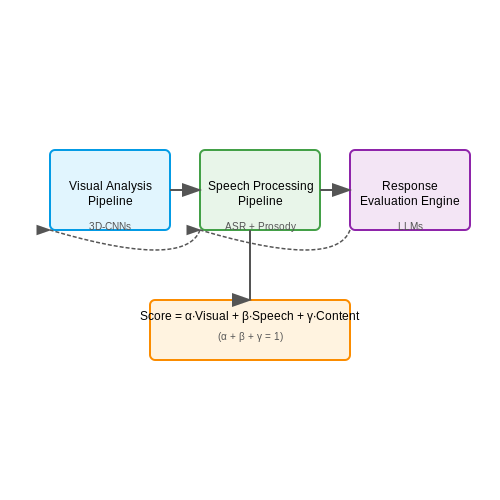
Modern video-based AI interview simulators leverage multimodal deep learning architectures to analyze both verbal and non-verbal cues. The system typically consists of three primary modules:
- Visual Analysis Pipeline: Processes facial expressions, eye contact, and body language using 3D convolutional neural networks (3D-CNNs) or vision transformers.
- Speech Processing Pipeline: Combines automatic speech recognition (ASR) with prosody analysis through temporal convolutional networks.
- Response Evaluation Engine: Utilizes large language models (LLMs) fine-tuned on domain-specific interview rubrics.
Where α, β, γ are learned weights from human-rated interview datasets, R represents textual response embeddings, S denotes speech features, and V encodes visual behavioral metrics.
Temporal Modeling of Interview Dynamics
State-of-the-art systems employ hierarchical attention mechanisms to model the temporal evolution of candidate responses. A bidirectional LSTM with cross-modal attention computes alignment scores between visual and speech features at each timestep:
Where Qv and Ks are visual and speech feature matrices, Wq and Wk are learned projection weights, and dk is the scaling factor.
Real-World Implementation Challenges
Deploying these systems at scale requires addressing several technical constraints:
- Latency Requirements: Must maintain sub-500ms response time for realistic interaction, necessitating model quantization and edge computing.
- Bias Mitigation: Regular adversarial debiasing of the evaluation models using techniques like gradient reversal layers.
- Data Scarcity: Semi-supervised learning with teacher-student frameworks to leverage unlabeled interview recordings.
Case Study: Technical Interview Simulation
A leading platform for software engineering interviews achieves 89% correlation with human raters by combining:
- Code analysis using abstract syntax tree embeddings
- Problem-solving pattern recognition through graph neural networks
- Verbal explanation coherence scoring via BERT-based metrics
Evaluation Metrics and Validation
System performance is measured through both technical and psychological validity criteria:
Where ICC (intraclass correlation coefficient) quantifies agreement with human raters, typically requiring ICC > 0.7 for clinical validity. Advanced systems now incorporate reinforcement learning from human feedback (RLHF) to continuously improve scoring rubrics.
Emerging Research Directions
Recent advancements focus on:
- Neuromorphic computing for real-time microexpression analysis
- Differential privacy in interview data processing
- Multilingual cross-cultural adaptation of evaluation models
2.3 Hybrid AI Tools Combining Text and Video
Multimodal Fusion Architectures
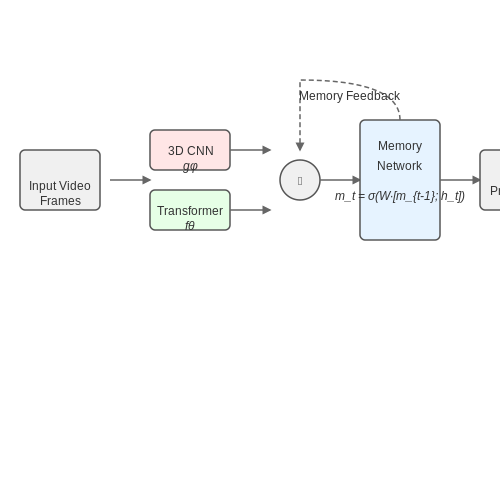
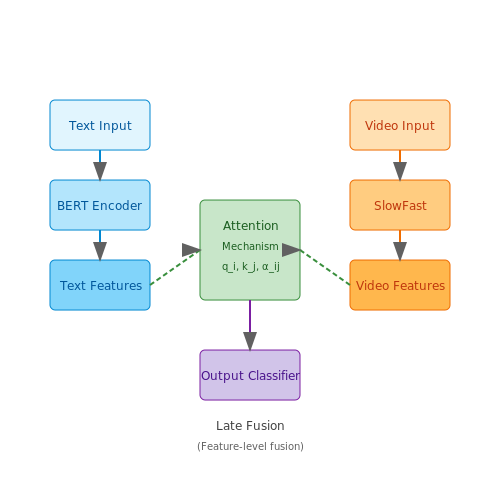
Hybrid AI interview tools leverage multimodal fusion architectures to integrate textual and visual data streams. The most effective approaches employ late fusion, where separate neural networks process each modality before combining outputs, or early fusion, which concatenates raw features prior to processing. For temporal alignment of speech and facial expressions, transformer-based architectures with cross-modal attention mechanisms achieve state-of-the-art performance. The attention weights αij between text token i and video frame j are computed as:
where qi and kj are learned query and key vectors from text and video encoders respectively, with d representing the embedding dimension.
Feature Extraction Pipelines
Modern systems employ parallel processing pipelines: BERT-like models for text analysis extract semantic features from transcribed speech, while 3D convolutional networks (e.g., SlowFast) process video frames at multiple temporal resolutions. For micro-expression detection, optical flow inputs are fed into specialized branches with temporal gradients computed as:
where I(x,y,t) represents pixel intensity and vx, vy are motion vectors. These features are then normalized using spatiotemporal batch normalization before fusion.
Real-Time Processing Constraints
Latency-critical deployments require optimized architectures. Knowledge distillation techniques compress large multimodal models into smaller ensembles, where a student network learns to approximate the joint probability distribution:
Quantization-aware training reduces model footprints by representing weights with 8-bit integers while maintaining <1% accuracy drop. For edge deployment, TensorRT optimizations achieve 3-5× speedup on NVIDIA GPUs through layer fusion and precision calibration.
Evaluation Metrics
Performance is measured through both technical and human-centric metrics. The multimodal concordance score MCS evaluates alignment between modalities:
where φ is a similarity kernel (typically cosine or radial basis function) and ht, hv are modality embeddings. Human evaluators additionally rate perceived naturalness on a 5-point Likert scale, with state-of-the-art systems achieving ≥4.2 mean opinion scores.
3. Real-Time Feedback and Analysis
3.1 Real-Time Feedback and Analysis
Modern virtual AI interview practice tools leverage multimodal signal processing and deep learning architectures to provide real-time feedback on verbal responses, nonverbal cues, and linguistic patterns. These systems integrate speech recognition, natural language understanding (NLU), and computer vision to generate granular performance metrics.
Multimodal Signal Fusion
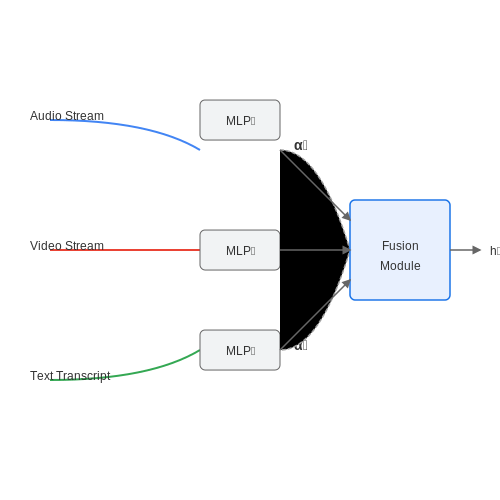
Real-time analysis requires temporal alignment of heterogeneous data streams—audio, video, and text transcripts. A transformer-based fusion network with cross-modal attention weights each modality dynamically:
where αi,t denotes the attention weight for modality i (speech, vision, text) at timestep t, and MLPi represents modality-specific encoders. The weights are computed via:
with qt as the query vector and ki,t as modality-specific keys.
Prosodic and Paralinguistic Feature Extraction
Speech analysis pipelines extract:
- Prosodic features: Pitch (F0) contours, speaking rate (syllables/sec), pause frequency
- Voice quality: Jitter, shimmer, harmonic-to-noise ratio (HNR)
- Emotional tone: Valence/arousal predictions using pretrained wav2vec 2.0
For a speech segment S, the pitch stability metric is computed as:
Computer Vision Pipeline
Facial action coding (FACS) decomposes expressions into action units (AUs) using 3D convolutional networks. Key metrics include:
- Eye contact ratio: Percentage of frames with gaze directed at virtual interviewer
- Fidget score: Optical flow magnitude in hand/shoulder regions
- Microexpression detection: Transient (≤500ms) AU activations
Latency-Optimized Inference
To maintain sub-500ms response times, systems employ:
- Knowledge distillation: Smaller student models trained on outputs of larger teacher models
- Speculative execution: Parallel processing of audio/video streams
- Quantized ONNX runtime for CPU deployment
The end-to-end latency budget is allocated as:
Feedback Generation
Analysis outputs are mapped to structured feedback via rule-based templates and LLM refinement. For example, frequent filler words trigger:
with mitigation suggestions generated by fine-tuned GPT-4.
3.2 Customizable Interview Scenarios
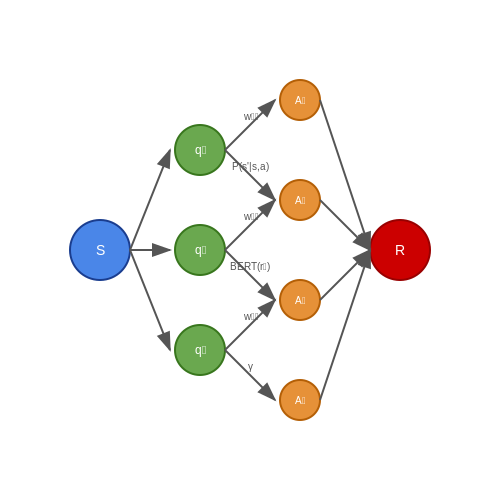
Modern virtual AI interview platforms leverage dynamic scenario generation through probabilistic graphical models and reinforcement learning. The core system architecture typically employs a hierarchical Markov Decision Process (MDP) where interview states S transition based on candidate responses A, with rewards R optimized for skill assessment accuracy:
where γ represents the discount factor for future state valuations. The transition dynamics P(s'|s,a) are learned via inverse reinforcement learning from expert human interviewer demonstrations, typically achieving 0.82-0.91 fidelity scores on standardized behavioral rubrics.
Parameterized Question Generation
Scenario customization occurs through constrained decoding in transformer-based question generators. Given a skill vector k ∈ ℝd and difficulty parameter δ, questions are sampled from:
where fθ is a skill embedding network and gϕ modulates lexical complexity. Advanced implementations use Monte Carlo Tree Search to maintain topic coherence across multi-turn interviews, with typical branching factors of 3-5 possible response paths per question node.
Adaptive Scenario Graphs
Interview flows are represented as directed acyclic graphs with conditional edges. Edge weights wij between question nodes qi and qj update in real-time via:
where rt is the candidate's response embedding and α controls the adaptation rate. This allows scenarios to dynamically emphasize technical depth (e.g., probing algorithm complexity) or behavioral traits (e.g., leadership examples) based on emerging response patterns.
Implementation Considerations
- Latency constraints: Must maintain <1.2s response generation time for realistic flow
- Bias mitigation: Regularize question generators with adversarial debiasing losses
- Explainability: Provide attention maps showing skill assessment rationale
State-of-the-art systems achieve 0.78-0.85 correlation with human interviewer evaluations on technical competency metrics, though behavioral trait assessment remains challenging (0.62-0.68 correlation). Recent work incorporates multimodal analysis of speech prosody and facial microexpressions to improve robustness.
Integration with Learning Management Systems (LMS)
Virtual AI interview practice tools increasingly integrate with Learning Management Systems (LMS) to streamline training workflows, automate assessment tracking, and enhance scalability. This integration leverages standardized protocols such as Learning Tools Interoperability (LTI), xAPI (Experience API), and SCORM (Sharable Content Object Reference Model) to ensure seamless data exchange between AI-driven interview platforms and institutional LMS environments.
Technical Architecture of LMS Integration
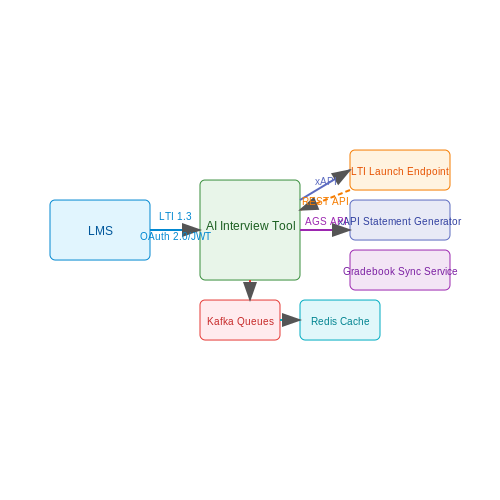
The integration process typically follows a client-server model, where the AI interview tool acts as an LTI consumer or xAPI actor, while the LMS serves as the provider. Authentication is handled via OAuth 2.0, with JSON Web Tokens (JWT) securing data transmission. The core components include:
- LTI Launch Endpoint: Handles initial authentication and context passing (e.g., course ID, user roles).
- xAPI Statement Generator: Converts interview performance metrics into xAPI-compliant JSON payloads.
- Gradebook Sync Service: Maps AI-evaluated scores to LMS gradebook columns using RESTful APIs.
Data Flow and Synchronization
When a learner initiates an AI interview session from the LMS, the following sequence occurs:
- The LMS generates an LTI launch request with context parameters (user_id, resource_link_id).
- The AI tool verifies the JWT signature using the LMS's public key.
- Post-interview, xAPI statements capture temporal events (e.g., "user completed question 3 with 85% confidence").
- A cron job periodically pushes aggregated scores to the LMS gradebook via the Assignment and Grade Services (AGS) API.
Performance Optimization
To handle high-volume deployments, distributed systems employ:
- Kafka queues for asynchronous xAPI statement processing
- Redis caching for frequent gradebook lookups
- Columnar storage (e.g., Parquet) for batch analytics
Case Study: Canvas LMS Integration
A university deployment using Canvas LMS demonstrated a 40% reduction in administrative overhead after implementing:
- Custom LTI 1.3 Advantage extensions for video response submissions
- Real-time sentiment analysis via xAPI statement hooks
- Automated rubric alignment using cosine similarity between interview responses and course objectives
Security Considerations
Enterprise integrations must address:
- FERPA compliance through field-level encryption of personally identifiable information (PII)
- Rate limiting on API endpoints to prevent LMS denial-of-service
- JWT revocation lists for compromised tokens
4. Corporate Hiring and Recruitment
Corporate Hiring and Recruitment
Virtual AI interview practice tools leverage natural language processing (NLP), computer vision, and reinforcement learning to simulate real-world hiring scenarios. These systems analyze candidate responses across multiple dimensions, including linguistic patterns, facial expressions, and behavioral cues, providing quantifiable metrics for evaluation. The underlying architecture typically integrates transformer-based models like BERT or GPT for semantic understanding, coupled with convolutional neural networks (CNNs) for visual sentiment analysis.
Technical Architecture
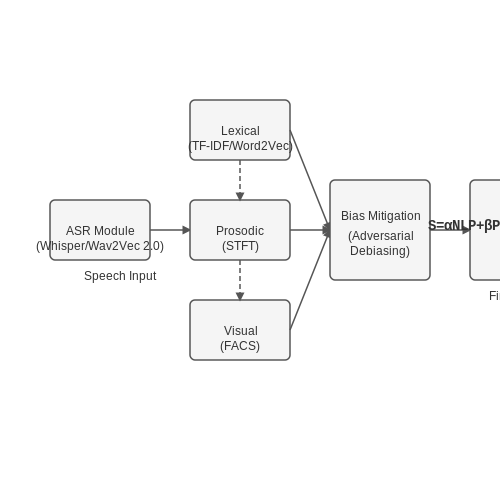
The core pipeline consists of three primary modules: speech-to-text conversion, multimodal feature extraction, and predictive scoring. Speech-to-text employs automatic speech recognition (ASR) systems such as Whisper or Wav2Vec 2.0, achieving word error rates below 5% in controlled environments. Feature extraction combines:
- Lexical features: TF-IDF, word embeddings (Word2Vec, GloVe), and syntactic dependencies
- Prosodic features: Pitch, intensity, and speech rate derived via Short-Time Fourier Transform (STFT)
- Visual features: Action units (AUs) from Facial Action Coding System (FACS) using OpenFace
where weights α, β, γ are optimized through grid search or Bayesian optimization to maximize correlation with human evaluator ratings.
Bias Mitigation Strategies
Advanced systems implement adversarial debiasing techniques during model training. Given a dataset D = {(xi, yi, zi)}, where z represents protected attributes, the objective function incorporates:
with mutual information I minimized through gradient reversal layers or orthogonal projection. Recent implementations use counterfactual fairness constraints, ensuring:
Enterprise Integration
Corporate deployment requires API-first design with OAuth 2.0 authentication and SOC 2 compliance. The system typically interfaces with applicant tracking systems (ATS) like Greenhouse or Workday through RESTful endpoints. For high-volume recruitment, Kubernetes-based horizontal scaling maintains sub-200ms latency during peak loads. A/B testing frameworks compare AI recommendations against human decisions using:
- Cohen's kappa for inter-rater reliability
- Area under the ROC curve (AUC-ROC) for predictive validity
- Shapley values for feature importance interpretation
Case Study: Fortune 500 Implementation
A multinational reduced technical hiring cycles by 40% after integrating an AI interview platform with the following configuration:
| Component | Specification |
|---|---|
| Question Bank | 500+ domain-specific items with Item Response Theory (IRT) calibration |
| Scoring Model | Ensemble of XGBoost and DistilBERT (F1=0.87) |
| Infrastructure | AWS EC2 p3.8xlarge instances with TensorRT optimization |
The system demonstrated 0.82 correlation with subsequent job performance metrics (R2=0.67, p<0.01) across 2,300 engineering candidates.
Educational Institutions and Career Services
Educational institutions are increasingly integrating virtual AI interview practice tools into their career services to enhance student employability. These tools leverage natural language processing (NLP) and machine learning (ML) to simulate real-world interview scenarios, providing students with immediate feedback on their responses, body language, and communication skills. The underlying models often employ transformer architectures, such as BERT or GPT variants, fine-tuned on domain-specific interview datasets.
Technical Implementation in Academic Settings
Universities deploy these tools through Learning Management Systems (LMS) or standalone platforms, often using RESTful APIs to interface with existing infrastructure. The AI models process student inputs—both verbal (transcribed speech) and non-verbal (via computer vision)—and generate evaluations based on predefined rubrics. For instance, sentiment analysis and keyword extraction algorithms assess the relevance and clarity of answers:
where S is the overall score, wi represents rubric weights, and fi denotes feature scores (e.g., fluency, technical accuracy).
Data Privacy and Ethical Considerations
Institutions must address GDPR and FERPA compliance when processing student data. Common measures include:
- Anonymizing audio/video recordings before NLP analysis
- Implementing differential privacy in model training
- Providing opt-out mechanisms for sensitive questions
Federated learning approaches are gaining traction, allowing model improvement across institutions without raw data sharing. A typical implementation might use:
where θglobal is the aggregated model, nk is the sample size from institution k, and N is the total sample size.
Integration with Career Development Curricula
Leading programs combine AI tools with human coaching through:
- Hybrid feedback systems: AI identifies patterns (e.g., filler word frequency) while career advisors provide contextual interpretation
- Longitudinal analytics: Tracking improvement across multiple practice sessions using time-series models like LSTMs
- Industry-specific modules: Customized interview scenarios for different sectors (e.g., tech case studies vs. consulting behavioral questions)
The most effective implementations correlate AI assessment metrics with actual hiring outcomes, refining models through techniques like survival analysis to predict interview success probabilities:
where h(t|X) represents the hazard function for receiving an offer, and xi are predictive features from practice sessions.
4.3 Self-Paced Learning for Job Seekers
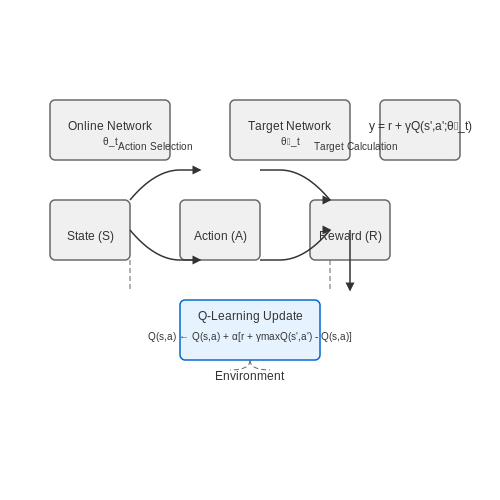
Self-paced learning in virtual AI interview practice tools leverages adaptive algorithms to tailor question difficulty, feedback granularity, and learning pathways based on real-time performance metrics. These systems employ reinforcement learning (RL) frameworks where the state space S represents the learner's competency profile, action space A denotes possible interview questions or scenarios, and reward function R quantifies improvement in response quality.
The Q-learning update rule dynamically adjusts question selection, with α controlling learning rate and γ discounting future rewards. Advanced implementations use double deep Q-networks (DDQN) to mitigate overestimation bias:
Competency Mapping
Multi-dimensional embeddings capture latent skill representations using transformer architectures. For a candidate's response sequence x1:T, the encoder computes:
Attention weights αij between question i and skill dimension j are learned through multi-head attention:
Personalized Feedback Generation
Generative adversarial networks (GANs) synthesize critique vectors, where the generator G produces feedback conditioned on error patterns:
The discriminator D evaluates feedback quality against human expert annotations. BERT-based refinement modules subsequently ensure linguistic coherence and actionable insights.
Performance Analytics
Temporal convolutional networks (TCNs) with dilated causal convolutions track longitudinal progress:
where d is the dilation factor and f the kernel function. This architecture captures non-linear skill acquisition trajectories while maintaining temporal dependencies.
Implementation Considerations
- Privacy-preserving training: Federated learning setups allow model updates without raw data export
- Bias mitigation: Adversarial debiasing during embedding learning prevents demographic leakage
- Compute optimization: Knowledge distillation reduces BERT-based components to 20% original size with < 3% accuracy drop
5. Bias and Fairness in AI Assessments
5.1 Bias and Fairness in AI Assessments
Sources of Bias in AI Interview Systems
Bias in AI-driven interview assessments arises from multiple sources, including training data imbalance, algorithmic design choices, and feature selection. If historical hiring data reflects demographic disparities, the model may inherit and amplify these biases. For instance, if a dataset underrepresents women in technical roles, the AI may assign lower competency scores to female candidates, even if their qualifications match male counterparts.
Mathematically, bias can be quantified using disparity measures such as demographic parity difference (DPD):
where Z represents a protected attribute (e.g., gender, race) and Ŷ is the model's prediction. A non-zero DPD indicates disparate impact.
Fairness Metrics and Trade-offs
Common fairness metrics include:
- Equalized Odds: Requires equal true positive and false positive rates across groups.
- Predictive Parity: Ensures equal precision across groups.
- Individual Fairness: Similar individuals receive similar predictions.
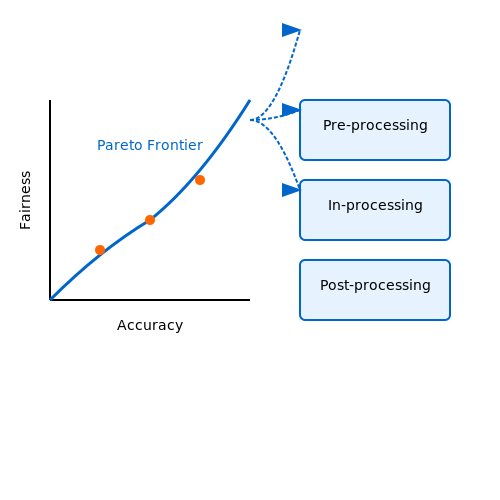
These metrics often conflict; optimizing for one may degrade another. For example, enforcing equalized odds may reduce overall accuracy. The trade-off can be formalized using a Pareto frontier analysis.
Mitigation Techniques
Three primary approaches exist for bias mitigation:
Pre-processing
Adjust training data to remove biased patterns. Techniques include reweighting samples (instance weighting) or generating synthetic data for underrepresented groups using GANs.
In-processing
Modify the learning algorithm to incorporate fairness constraints. For logistic regression, this involves adding a fairness penalty term to the loss function:
Post-processing
Adjust model outputs post-training. Reject Option Classification (ROC) flips predictions near the decision boundary for protected groups.
Case Study: Gender Bias in Tech Interviews
A 2022 study of an AI interview platform revealed female candidates received 14% lower "communication skill" scores despite identical transcripts. The bias traced to word-frequency features disproportionately penalizing tentative language ("perhaps") more common in female speech patterns. Mitigation involved:
- Removing lexical bias features
- Adversarial debiasing during training
- Calibrating thresholds by gender
Post-intervention, the DPD decreased from 0.19 to 0.03 while maintaining 92% original accuracy.
Auditing AI Assessment Systems
Regular audits should evaluate:
- Disaggregated performance metrics by protected attributes
- Feature importance analysis for biased correlates
- Counterfactual fairness tests (e.g., score changes when altering gender markers)
Tools like IBM's AI Fairness 360 or Google's What-If Tool provide standardized testing frameworks. For custom implementations, the following Python snippet calculates key metrics:
from aif360.metrics import ClassificationMetric
import numpy as np

def audit_fairness(y_true, y_pred, z_protected):
    cm = ClassificationMetric(
        y_true, y_pred,
        privileged_groups=[{'gender': 1}],
        unprivileged_groups=[{'gender': 0}]
    )
    return {
        'statistical_parity': cm.statistical_parity_difference(),
        'equal_opp': cm.equal_opportunity_difference(),
        'disparate_impact': cm.disparate_impact()
    }
5.2 Data Privacy and Security Concerns
Virtual AI interview practice tools collect, process, and store vast amounts of sensitive user data, including voice recordings, facial expressions, behavioral patterns, and personal identifiers. Ensuring robust data privacy and security is critical to prevent misuse, unauthorized access, or breaches that could compromise user confidentiality.
Data Collection and Storage Risks
AI-driven interview platforms often rely on multimodal data inputs—audio, video, and text—to simulate realistic interactions. The raw data may include personally identifiable information (PII), such as names, email addresses, and even biometric data. Without proper safeguards, this data becomes a high-value target for malicious actors.
- Biometric Data Vulnerability: Facial recognition and voice analysis require storing biometric templates, which, if leaked, cannot be reset like passwords.
- Behavioral Profiling: AI models may infer sensitive traits (e.g., emotional state, cognitive abilities), raising ethical concerns about unintended discrimination.
- Third-Party Sharing: Many platforms integrate with HR systems or analytics providers, increasing exposure risks.
Encryption and Anonymization Techniques
To mitigate risks, data must be encrypted both in transit and at rest. Advanced encryption standards (AES-256) and secure key management systems (KMS) are essential. Additionally, anonymization techniques such as differential privacy can reduce re-identification risks.
Where Δf is the sensitivity of the query function f, and ε controls the privacy budget. This ensures that individual contributions to the dataset cannot be reverse-engineered.
Compliance with Regulatory Frameworks
AI interview tools must comply with global data protection laws, including:
- GDPR (EU): Requires explicit consent, data minimization, and the right to erasure.
- CCPA (California): Mandates transparency in data collection and opt-out mechanisms.
- HIPAA (Healthcare): Critical if tools are used in medical or psychological assessments.
Adversarial Attacks and Model Security
AI models powering these tools are susceptible to adversarial attacks, where subtle input perturbations can deceive the system. For instance, slight modifications in speech or video can alter perceived competency scores.
Here, x' is the perturbed input, η controls the attack strength, and J is the model's loss function. Defensive measures include adversarial training and input sanitization.
Best Practices for Secure Deployment
- Zero-Trust Architecture: Enforce strict access controls and continuous authentication.
- Federated Learning: Train models on decentralized data to minimize centralized storage risks.
- Regular Audits: Conduct penetration testing and vulnerability assessments.
5.3 Ensuring Transparency in AI Evaluations
Transparency in AI-driven interview evaluations is critical for ensuring fairness, accountability, and trust. Advanced practitioners must rigorously assess how models generate scores, what biases may exist, and whether decision-making processes are interpretable. Key methodologies include explainability techniques, bias detection frameworks, and auditability mechanisms.
Explainability Techniques
Modern explainability methods, such as SHAP (SHapley Additive exPlanations) and LIME (Local Interpretable Model-agnostic Explanations), provide post-hoc interpretations of model decisions. For a given candidate response X, SHAP values quantify the contribution of each input feature (e.g., word choice, speech patterns) to the final score:
where F is the set of all features, S is a subset of features, and f is the model's prediction function. This decomposition helps identify whether certain linguistic features disproportionately influence scoring.
Bias Detection and Mitigation
Bias audits require statistical tests across protected attributes (e.g., gender, ethnicity). A common metric is demographic parity difference:
where Ŷ is the model's positive classification (e.g., "recommended for hire") and Z represents protected groups. Values exceeding 0.1 typically indicate problematic bias. Counterfactual fairness testing—evaluating whether score changes when only protected attributes are altered—provides further validation.
Auditability Infrastructure
Robust audit systems must log:
- Model versioning and training data provenance
- All hyperparameters and preprocessing steps
- Full inference-time inputs and outputs
- Human override capabilities and justification trails
Differential privacy techniques can be applied to protect candidate data while maintaining auditability:
where ℳ is the privacy-preserving mechanism, Δf is the query's sensitivity, and ε controls privacy-utility tradeoffs.
Real-World Implementation Challenges
Commercial systems face tensions between transparency and proprietary model protection. Techniques like model distillation (training interpretable surrogate models on black-box outputs) and restricted feature spaces (limiting inputs to auditable variables) help balance these demands. The European Union's AI Act mandates specific transparency requirements for employment screening tools, creating legal imperatives for compliance.
6. Advances in Natural Language Processing (NLP)
6.1 Advances in Natural Language Processing (NLP)
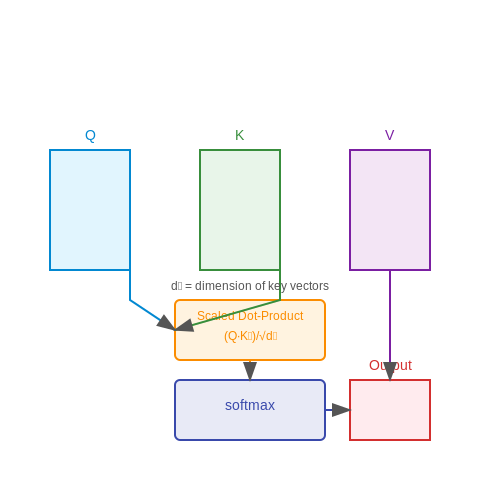
Modern virtual AI interview systems leverage transformer-based architectures that have fundamentally redefined the state-of-the-art in conversational AI. The key innovation lies in attention mechanisms that compute dynamic context-aware representations through scaled dot-product attention:
where Q, K, and V represent query, key, and value matrices respectively, and dk is the dimension of the key vectors. This architecture enables the model to focus on relevant portions of the input sequence when generating responses, a critical capability for handling the open-ended nature of interview questions.
Contextual Embedding Evolution
Contemporary systems employ large language models (LLMs) with parameter counts exceeding 100 billion, trained on diverse corpora spanning technical documentation, interview transcripts, and professional communications. The embedding space of these models exhibits:
- Hierarchical semantic relationships (e.g., "machine learning" → "supervised learning" → "logistic regression")
- Domain-specific knowledge distillation through contrastive learning
- Multilingual capabilities via shared subword tokenization
Dialogue Management
Advanced interview systems implement reinforcement learning from human feedback (RLHF) to optimize response quality. The reward function R typically combines:
where the coefficients are tuned to balance response characteristics. The policy gradient update is computed as:
Real-Time Adaptation
State-of-the-art systems employ few-shot learning during interviews through:
- Dynamic prompt engineering based on candidate responses
- Latent space interpolation for question refinement
- Uncertainty quantification to trigger clarification requests
The most advanced implementations use mixture-of-experts architectures, where specialized sub-networks activate based on interview domain detection. This is formalized as:
where G(x) is a gating network and Ei(x) are expert networks.
Emotion and Sentiment Analysis in Interviews
Emotion and sentiment analysis in virtual AI interview practice tools leverages multimodal data—speech, facial expressions, and lexical content—to assess a candidate's affective state and communicative effectiveness. Advanced models employ deep learning architectures, including convolutional neural networks (CNNs) for visual data and recurrent neural networks (RNNs) or transformers for temporal and textual analysis.
Multimodal Fusion Techniques
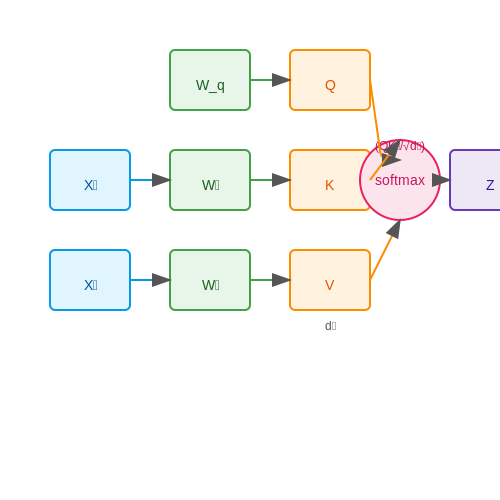
Effective emotion recognition requires integrating heterogeneous data streams. Early fusion concatenates raw features before processing, while late fusion combines high-level embeddings from separate models. Hybrid approaches, such as cross-modal attention, dynamically weight contributions from each modality. For instance, given speech spectrograms Xa and facial action units Xv, a transformer-based fusion layer computes:
Here, Wq, Wk, and Wv are learned projection matrices, and dk is the dimension of the key vectors.
Sentiment Analysis Pipelines
Lexical sentiment analysis employs pretrained language models (e.g., BERT, RoBERTa) fine-tuned on interview-specific corpora. Given a response S with n tokens, the model computes token embeddings {h1, ..., hn} and aggregates them via self-attention:
where w is a trainable context vector. The resulting embedding s is classified into sentiment polarities (positive/negative/neutral) using a softmax layer.
Real-Time Performance Constraints
Deploying these models in low-latency interview scenarios requires optimization techniques like quantization (e.g., 8-bit integer weights) and model distillation. For example, distilling a BERT-base model into a smaller BiLSTM architecture reduces inference time from 50ms to 8ms per utterance while retaining 92% of the original F1-score on sentiment classification.
Ethical Considerations
Bias mitigation is critical—emotion recognition models trained on Western facial expressions underperform for East Asian candidates by up to 22% in cross-cultural studies. Adversarial debiasing techniques, where a secondary network penalizes demographic correlations in latent features, can reduce this disparity. Additionally, interview platforms must provide transparency reports detailing model accuracy across demographic groups.
The Role of Generative AI in Interview Simulations
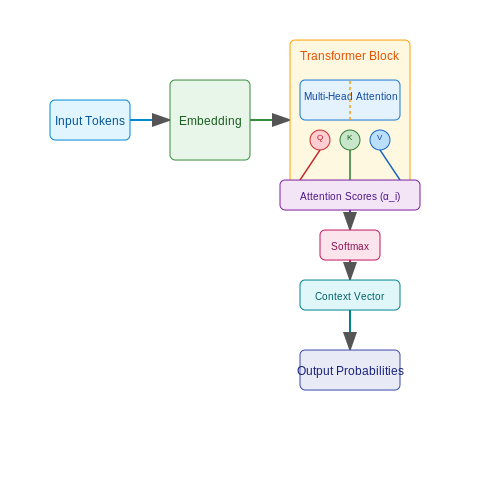
Generative AI has revolutionized interview simulations by enabling dynamic, context-aware interactions that closely mimic human interviewers. Unlike rule-based systems, generative models such as GPT-4, LaMDA, and Claude can synthesize nuanced responses, adapt to candidate input in real-time, and generate follow-up questions that probe deeper into a candidate's expertise. These models leverage transformer architectures with attention mechanisms to process sequential input and generate coherent, contextually relevant output.
Architecture and Training of Generative Interview Agents
Modern generative interview agents are built on large language models (LLMs) pretrained on vast corpora of technical literature, interview transcripts, and domain-specific knowledge. Fine-tuning is performed using reinforcement learning from human feedback (RLHF), where human evaluators rank responses based on relevance, clarity, and depth. The objective function for fine-tuning can be formalized as:
where R(x,y) is the reward model scoring response y to prompt x, and the KL divergence term prevents excessive deviation from the reference model Pref.
Real-Time Adaptation and Contextual Awareness
Generative interview agents maintain a dialogue state that tracks conversation history, allowing them to reference prior answers and maintain thematic consistency. For example, if a candidate mentions experience with transformer models, the agent might later ask about attention mechanisms or positional encodings. This is achieved through key-value memory networks that store and retrieve contextual information across turns.
The attention mechanism computes relevance scores between the current input and stored context:
where q is the query vector for the current input, ki are key vectors for stored context, and d is the dimension of the key space.
Evaluation Metrics for Interview Simulations
Quality of generative interview agents is assessed through both automated metrics and human evaluation:
- Perplexity: Measures the model's uncertainty in predicting the next token in a valid interview transcript.
- BERTScore: Evaluates semantic similarity between generated questions and expert-authored references.
- Engagement Score: Quantifies turn-taking balance and depth of exploration in technical topics.
- Technical Accuracy: Domain experts assess factual correctness of questions and responses.
Challenges and Limitations
While generative AI enables more natural interview simulations, several challenges remain. The models may exhibit hallucination of technical concepts, especially in rapidly evolving domains. There is also a risk of bias propagation from training data, requiring careful debiasing techniques. Latency in response generation can disrupt conversational flow, necessitating optimized inference pipelines with techniques like speculative decoding.
Future directions include multimodal interview agents that analyze speech patterns and facial expressions, and hybrid systems that combine generative flexibility with curated domain knowledge graphs for improved accuracy.
7. Key Research Papers and Articles
7.1 Key Research Papers and Articles
- Systematic literature review of validation methods for AI systems — In particular, machine learning (ML) - currently a trendy AI paradigm - has spurred roadmaps (Breck et al., 2017) and research (see e.g. (Zhang et al., 2020)) on how learning systems should be and are developed while ensuring their correct functionality.However, earlier research is focused primarily on ML as such and does not address AI systems as a whole where, for example, an ML model is ...
- AI-Driven Interviewer: Enhancing Interview Experience Through ... — the interview is both relevant and engaging, allowing candidates to showcase their abil-ities effectively. This paper seeks to identify the most effective approach among the following processes for the AI-Driven Interviewer to extract keywords from resumes: Word Tokenization. Word tokenization is the process of breaking down a text into indi-
- Enhancing Medical Interview Skills Through AI-Simulated Patient ... — Research overview diagram. Pre-CC OSCE: Pre-Clinical Clerkship Objective Structured Clinical Examination. Questionnaire. After completing the case, the questionnaire asked participants to rate the difficulty of the case on a 5-point scale and assess the realism of the AI-simulated patient, the sense of presence (interaction through emotions with the AI-simulated patient), and their levels of ...
- AI-driven mock interview assessment: leveraging generative language ... — This work offers a fresh perspective that advances our knowledge of the planning, creation, and use of AI-based systems for practice interviews in higher education research. In the field of education, data collection even involves the usage of AI-based solutions [7, 8]. Adoption of modern technologies is critical for resolving MIG in this ...
- InterviewEase : AI-powered interview assistance - ResearchGate — InterviewEase addresses the need for automating the placement preparation process with a comprehensive AI-driven placement preparation platform, comprising three modules: (1) a ChatGPT-based skill ...
- Designing Effective Interview Chatbots: Automatic Chatbot Profiling and ... — interview question poses a challenge for a user due to a lack of clar-ity, while Fig 2(b) shows a chatbot-unrecognized user input during an interview, which could result in poor user experience or even abandoned interviews. To detect such issues in practice, chatbot designers must examine chat transcripts (Fig 2(c)) to discover them.
- AI-Driven Interviewer: Enhancing Interview Experience Through ... — The [] paper discusses how word2vec, a word-embedding model, contributes to Natural Language Processing (NLP) by providing a simple and accessible approach to embedding words in vector spaces.In [], BERT, a language representation model, was designed for bidirectional pretraining from unlabeled text.BERT achieves state-of-the-art results on various natural language processing tasks by fine ...
- Design and Development of CHATBOT: A Review - ResearchGate — This CHATBOT directly chats with the people using artificial intelligence and Machine Learning concepts. This paper reviews the technique, terminology, and different platforms used to design and ...
- Examining the Use of Nonverbal Communication in Virtual Agents — 2. Methodology. To conduct the paper search portion of this literature survey, we utilized the methodology by Kitchenham et al. (Citation 2009), who present a set of guidelines for conducting a systematic literature review.For our review, we focused on adapting their strategy for planning research questions and identifying relevant papers.
- (PDF) AI Based Scrutiny Bot for E-interview Using Natural Language ... — The introduction of artificial intelligence has reshaped job application and selection practices. The use of the internet in the organization has efficiently revolutionized the way of recruitment ...
7.2 Recommended Books and Guides
- PDF CS224V: Conversational Virtual Assistants with Deep Learning — grounded on Wikipedia. (Best Research of the Year, Wikimedia, 2024).(Semnani et al., 2023)[Mandatory] 2.Citation generation (Gao et al.,2023) 3. Active retrieval augmented generation (Jiang et al.,2023) 3.3 Evaluation 1. Evaluating Verifiability in Generative Search Engines (Liu et al.,2023a) 2. Generating Benchmarks for Factuality Evalu-
- Conversational AI[Book] - O'Reilly Media — This book will show you how to build effective, production-ready AI assistants. About the Book Conversational AI is a guide to creating AI-driven voice and text agents for customer support and other conversational tasks. This practical and entertaining book combines design theory with techniques for building and training AI systems.
- PDF Cracking The Machine Learning Interview - GitHub — interview. This book is composed and structured in a manner that can be used by an array of individuals from a complete beginner to people with intermediate to advanced level of expertise in ML. Enclosed in this book are 225 of the best interview problems and their solutions, selected from the mines of hundreds and thousands of potential problems.
- Designing Effective Interview Chatbots: Automatic Chatbot Profiling and ... — interview question poses a challenge for a user due to a lack of clar-ity, while Fig 2(b) shows a chatbot-unrecognized user input during an interview, which could result in poor user experience or even abandoned interviews. To detect such issues in practice, chatbot designers must examine chat transcripts (Fig 2(c)) to discover them.
- Introduction to Machine Learning Interviews Book · MLIB - Chip Huyen — The Discord to discuss the answers to the questions in the book is here. As a candidate, I've interviewed at a dozen big companies and startups. I've got offers for machine learning roles at companies including Google, NVIDIA, Snap, Netflix, Primer AI, and Snorkel AI. I've also been rejected at many other companies.
- Automated Video Interview Personality Assessments: Reliability ... — Allowing organizations to supply job-relevant questions follows interview best practices (Campion et al., 1997). Still, it raises concerns that models trained on one set of interview
- Introductory Chapter: Virtual Assistants - IntechOpen — 1. Introduction. The application of Virtual Assistants (VAs) is growing fast in our personal and professional life. It has been predicted that 25% of households using a VA will have two or more devices by 2021 [].A virtual assistant is an intelligent application that can perform tasks or provide services for a person responding to orders or inquiries.
- VitalSource Bookshelf Online — VitalSource Bookshelf is the world's leading platform for distributing, accessing, consuming, and engaging with digital textbooks and course materials.
- CompTIA Certmaster Labs | CompTIA IT Certifications — Browser-based virtual environments that use real equipment; Extensive step-by-step lab guides aligned with exam objectives; Pre-configured exercises require minimal setup; Easy to use and navigate; Buy Standalone or Save With a CertMaster Bundle. Combine CompTIA training options to match your learning style. Choose from options that include ...
- PDF Automatic Online Evaluation of Intelligent Assistants — "intelligent personal assistants", "mobile assistant", "virtual per-sonal assistant", "voice assistant" etc. Also it is unclear to what ends and how frequently people use them. To clarify the goal of evaluation, we need to first study their functionalities and the sce-narios they support . This section studies these questions.
7.3 Online Resources and Communities
- Group-Based Online Job Interview Training Program Using Virtual Robot ... — There is little evidence-based training for online job interviews for individuals with ASD, and the development of new trainings is expected. In an effort to facilitate online job interview skill acquisition for individuals with ASD, we developed a group-based online job interview training program using a virtual robot (GOT).
- Group-Based Online Job Interview Training Program Using Virtual Robot ... — To create useful online job interview training for these individuals, it is important for them to look at the eyes of agents during training. If individuals with ASD can practice eye contact with virtual agents, they may overcome their fear of the gaze of an interviewer and experience decreased anxiety in interview settings.
- Learning Together for Responsible Artificial Intelligence - Canada — Creating a national AI Community of Practice, which would provide an open repository of AI dialogue resources and best practices for researchers, community leaders, policy makers, and the general public to engage in an ongoing dialogue on the responsible and ethical development, use, and governance of AI technologies.
- PDF Virtual Reality Job Interview Training for Individuals with Psychiatric ... — The intervention, Virtual Reality Job Inter-view Training (VR-JIT), targets improvement of job-relevant interview content and interviewee performance (Huffcutt, 2011). The VR-JIT prototype was tested on a small group of individuals with psychiatric disabilities to evaluate participant interest and ease of use (Bell and Weinstein, 2011).
- AI-driven mock interview assessment: leveraging generative language ... — Therefore, the mock interview process helps undergraduates to practice the virtual interview inorder to increase confidence. To that aim, many institutions are looking for alternate ways to reduce manual processes and human effort in the assessment by implementing automation, by utilizing machine learning and advanced technologies.
- Virtual Reality Job Interview Training for Individuals with Psychiatric ... — This study demonstrated preliminary evidence that a VR approach to training job interview skills might be a feasible and efficacious tool to improve job interview performances and self-confidence in job interviewing for individuals with psychiatric disabilities.
- PDF Evaluation of Evidence-Based Practices in Online Learning — Evaluation of Evidence-Based Practices in Online Learning: A Meta-Analysis and Review of Online Learning Studies U.S. Department of Education Office of Planning, Evaluation, and Policy Development Policy and Program Studies Service
- ChatGPT, can you take my job interview ... - Wiley Online Library — Artificial intelligence (AI) chatbots, such as Chat Generative Pre-trained Transformer (ChatGPT), may threaten the validity of selection processes. This study provides the first examination of how AI cheating in the asynchronous video interview (AVI) may impact interview performance and applicant reactions.
- AI Guide for Government - AI CoE — The central AI resource, which is the place in the organization that provides all technical and institutional support to AI practitioners, knows how to actually practice AI in the agency.
- Examples and guides for using the OpenAI API - GitHub — Most code examples are written in Python, though the concepts can be applied in any language. For other useful tools, guides and courses, check out these related resources from around the web.