Continual Learning in AI Agents
1. Definition and Core Principles
Definition and Core Principles
Continual learning, also known as lifelong learning or incremental learning, refers to the ability of an AI agent to acquire, refine, and transfer knowledge across a sequence of tasks without catastrophic forgetting—the phenomenon where learning new information erases previously learned knowledge. Unlike traditional machine learning paradigms that assume a static dataset, continual learning operates in non-stationary environments where data distributions evolve over time.
Key Characteristics
Continual learning systems exhibit three fundamental properties:
- Sequential Task Learning: The agent encounters tasks in a temporal sequence, with each task potentially having distinct data distributions.
- Knowledge Retention: The system must preserve performance on previously learned tasks while adapting to new ones.
- Forward Transfer: Optimal continual learners leverage prior knowledge to accelerate learning on new tasks.
Mathematical Formulation
Consider a sequence of tasks {T₁, T₂, ..., Tₙ}, where each task Tₖ is associated with a data distribution Dₖ(x, y). The objective is to minimize the cumulative loss across all tasks:
where θ represents the model parameters and f_θ the predictive function. The critical challenge arises from the non-i.i.d. nature of the data stream, violating standard statistical learning assumptions.
Core Challenges
Catastrophic Forgetting
When training on task Tₖ, gradient updates may overwrite parameters crucial for tasks {T₁, ..., Tₖ₋₁}. This manifests as a sharp performance drop on previous tasks, quantified by the forgetting measure:
where R_{i,j} denotes accuracy on task i after training on task j.
Capacity Saturation
Fixed-capacity networks face an inherent trade-off between plasticity (learning new tasks) and stability (preserving old knowledge). The capacity allocation problem can be formalized through information-theoretic bounds on the network's effective parameter space.
Biological Inspiration
Continual learning draws parallels with neuroplasticity mechanisms in biological brains:
- Synaptic Consolidation: Analogous to regularization techniques that protect important weights
- Replay Mechanisms: Mimicking hippocampal replay during sleep cycles
- Modular Architecture: Similar to specialized neural circuits in the neocortex
Taxonomy of Approaches
Contemporary continual learning methods fall into three primary categories:
- Architectural Strategies: Dynamic network expansion or modular components (e.g., Progressive Neural Networks)
- Regularization Methods: Constraining parameter updates (e.g., Elastic Weight Consolidation)
- Replay-Based Systems: Maintaining exemplars or generative models of past data (e.g., Gradient Episodic Memory)
The effectiveness of each approach varies with task similarity, data availability, and computational constraints, leading to hybrid solutions in state-of-the-art implementations.
Challenges in Continual Learning
Continual learning (CL) in AI agents introduces several fundamental challenges that distinguish it from traditional batch or offline learning paradigms. These challenges stem from the dynamic nature of data streams, the necessity to retain past knowledge, and the constraints imposed by computational resources.
Catastrophic Forgetting
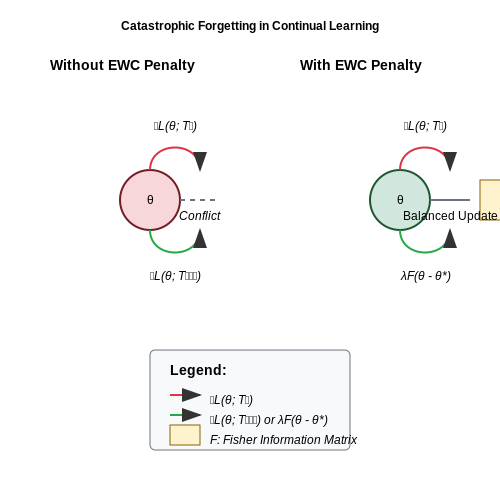
Catastrophic forgetting occurs when an AI agent loses previously learned information upon training on new tasks. This phenomenon arises due to the plasticity-stability dilemma: neural networks must remain plastic enough to learn new tasks while maintaining stability to preserve old knowledge. Mathematically, this can be framed as a conflict between gradient updates for new tasks and the preservation of weights critical for old tasks. For a neural network with parameters θ, the loss function for a new task Tn may overwrite the optimal parameters for a previous task Tn-1:
This interference leads to a rapid degradation in performance on prior tasks. Approaches like Elastic Weight Consolidation (EWC) mitigate this by penalizing changes to important weights, quantified by the Fisher information matrix F:
Task Ambiguity and Contextual Shifts
In real-world deployments, task boundaries are often unclear, and data distributions may shift gradually or abruptly. Unlike supervised learning, where tasks are well-defined, continual learning agents must infer task boundaries or adapt to non-stationary environments. This introduces challenges in:
- Task identification: Determining whether incoming data belongs to a known or novel task.
- Contextual memory: Allocating resources to store and retrieve task-specific information without explicit supervision.
For instance, in a reinforcement learning setting, an agent may encounter a new environment with subtly different dynamics, requiring online adaptation without forgetting prior policies.
Scalability and Computational Limits
Continual learning systems must operate under finite memory and computational budgets, precluding exhaustive rehearsal of past data. This constraint necessitates efficient memory architectures, such as:
- Episodic memory: Storing subsets of past data for replay, bounded by a fixed capacity.
- Parameter isolation: Dynamically expanding or partitioning the network to compartmentalize task-specific knowledge.
The trade-off between memory overhead and performance is formalized by the expansion factor α in progressive networks, where each new task adds a subnetwork of width proportional to α:
Evaluation Metrics and Benchmarking
Standard offline metrics fail to capture the nuances of continual learning. Key evaluation challenges include:
- Forward and backward transfer: Measuring how learning new tasks improves (or degrades) performance on past or future tasks.
- Memory retention: Quantifying the agent's ability to recall information over extended periods.
Metrics like Average Accuracy (ACC) and Backward Transfer (BWT) are commonly used:
where Ai,j denotes accuracy on task i after training on task j.
Key Metrics for Evaluation
Accuracy and Forgetting
Continual learning systems must balance accuracy on new tasks with catastrophic forgetting of prior knowledge. The primary metric for this trade-off is average accuracy across all tasks after sequential training. Forgetting is quantified using:
where \( A_{t,k} \) is accuracy on task \( t \) after learning task \( k \), and \( T \) is the total number of tasks. Lower \( F_k \) indicates better retention.
Forward and Backward Transfer
Forward transfer (FWT) measures how learning a task improves performance on future tasks:
Backward transfer (BWT) evaluates the impact of new learning on prior tasks:
Positive BWT indicates beneficial knowledge consolidation, while negative values suggest interference.
Computational Efficiency
Two critical measures assess resource usage:
- Memory overhead: Additional parameters or replay buffer size relative to the base model
- Training time ratio: \( \tau = \frac{t_{\text{CL}}}{t_{\text{isolated}}} \), where \( t_{\text{CL}} \) is continual learning time and \( t_{\text{isolated}} \) is independent task training time
Task-Agnostic Evaluation
For scenarios without explicit task boundaries, online accuracy tracks performance on a streaming data distribution. The Area Under the Learning Curve (AULC) integrates accuracy over time:
where \( A(t) \) is the instantaneous accuracy at time \( t \).
Plasticity-Stability Trade-off
The stability-plasticity ratio (SPR) quantifies this balance:
where \( \Delta W \) represents weight updates for new versus old tasks, and \( \sigma \) denotes the standard deviation. An SPR near 1 indicates equilibrium.
Benchmark-Specific Metrics
Specialized benchmarks introduce domain-specific measures:
- Class-incremental learning: Uses last-layer classification accuracy with a shared feature extractor
- Domain-incremental scenarios: Measures cross-domain generalization via held-out validation sets
- Reinforcement learning: Tracks cumulative reward decay across environment variations
2. Regularization-Based Approaches
2.1 Regularization-Based Approaches
Regularization-based methods mitigate catastrophic forgetting in continual learning by constraining weight updates to preserve knowledge from previous tasks. These approaches modify the loss function to penalize changes to parameters deemed important for prior tasks, effectively creating a trade-off between plasticity and stability.
Elastic Weight Consolidation (EWC)
EWC introduces a quadratic penalty term that anchors parameters to their optimal values from previous tasks, with the strength of anchoring proportional to each parameter's importance. The importance is quantified using the diagonal of the Fisher information matrix F, which approximates how much each parameter contributes to task performance.
Where θ represents current parameters, θi* are optimal parameters for task i, and λ controls regularization strength. The Fisher matrix Fi is computed as:
Synaptic Intelligence (SI)
SI extends EWC by automatically estimating parameter importance during training rather than requiring separate Fisher computations. It tracks the cumulative weight change per parameter, scaled by the loss improvement:
where ξ prevents division by zero. The regularization term then becomes:
Memory-Aware Synapses (MAS)
MAS computes importance weights in an unsupervised manner by measuring how much each parameter affects the network's output manifold. The importance Ωij for weight θij is:
This approach requires no task-specific labels and demonstrates strong performance in class-incremental scenarios.
Practical Considerations
- Parameter isolation: Regularization methods often work best when combined with architectural techniques like progressive networks
- Task-specific components: Some implementations benefit from task-specific batch normalization layers
- Memory overhead: Storing Fisher matrices or importance weights scales quadratically with network width
Recent variants like Online-EWC and EWC++ address computational limitations through diagonal approximations and efficient importance updates, making these methods practical for large-scale continual learning scenarios.
2.2 Replay-Based Methods
Replay-based methods address catastrophic forgetting by storing and replaying past experiences during training. These approaches mimic biological memory consolidation, where neural reactivation of past experiences strengthens long-term retention. The core idea is to interleave old data samples with new ones, ensuring the model retains performance on previous tasks while adapting to new ones.
Experience Replay (ER)
The simplest form, Experience Replay, maintains a fixed-size buffer of past samples. During training, minibatches are constructed by mixing current task data with randomly selected samples from the buffer. The loss function becomes:
where α controls the balance between new and old knowledge. The buffer update typically follows a first-in-first-out (FIFO) policy, though prioritized sampling based on metrics like loss or uncertainty can improve performance.
Generative Replay
Instead of storing raw data, generative replay trains a separate generative model (e.g., GAN or VAE) to approximate the data distribution of previous tasks. The current model receives both real new data and synthetic old data from the generator. This avoids memory constraints but introduces approximation errors:
where θ represents the generator parameters. The quality of this approximation fundamentally limits the method's effectiveness.
Optimization Challenges
Replay methods introduce several optimization considerations:
- Buffer size: Larger buffers improve retention but increase memory usage
- Sample selection: Random vs. strategic sampling affects gradient dynamics
- Replay ratio: The proportion of old to new samples in each batch
- Forgetting dynamics: Early replayed samples may still be forgotten over time
Advanced Variants
Recent improvements include:
- Dark Experience Replay: Stores logits instead of raw data, reducing memory footprint
- Gradient Episodic Memory: Ensures gradient updates don't increase past task losses
- Maximally Interfered Retrieval: Prioritizes samples the model is most likely to forget
where θ⁻ represents parameters before the current update.
Biological Plausibility
These methods draw inspiration from hippocampal-neocortical interactions in mammalian brains. The hippocampus rapidly encodes new experiences while slowly consolidating them to the neocortex through reactivation during sleep. Artificial replay systems capture this separation of timescales, though current implementations remain simplistic compared to biological systems.
Practical Considerations
In real-world deployments, replay methods must handle:
- Non-stationary data distributions
- Privacy constraints on stored data
- Computational overhead of maintaining the replay buffer
- Balancing retention with forward transfer to new tasks
2.3 Architectural Strategies
Dynamic Network Expansion
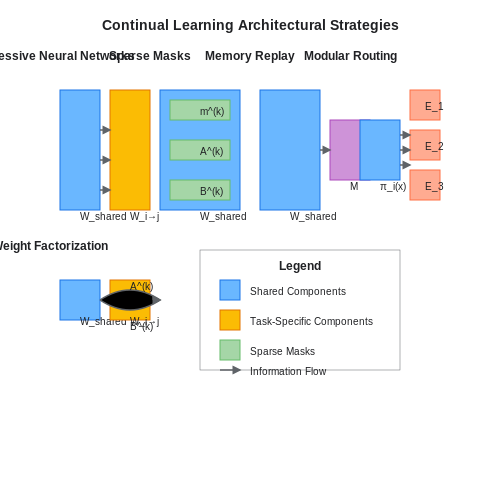
One approach to mitigate catastrophic forgetting involves dynamically expanding the neural network architecture as new tasks are encountered. Progressive Neural Networks (PNNs) introduce lateral connections from previously learned task-specific columns to new columns, preserving learned representations while enabling forward transfer. The lateral connection weights Wi→j between column i and j are learned via:
where hi(t) represents the hidden state of column i at task t, and x(t) is the current task input. This architecture guarantees zero interference with prior knowledge since parameters are never shared or modified retroactively.
Parameter Isolation via Sparse Masks
An alternative strategy employs binary masks to isolate task-specific sub-networks within a shared parameter space. The mask m(k) for task k is learned through:
where αij(k) are learnable importance scores, β is a threshold, and τ controls the mask's sparsity. The forward pass for task k then becomes:
This approach achieves sublinear parameter growth with respect to tasks while maintaining high model capacity. Practical implementations often combine this with weight regularization to further stabilize shared parameters.
Memory Replay Architectures
Hybrid architectures integrate episodic memory buffers with neural networks to replay past data during new task training. The memory buffer M stores a subset of previous task samples (xi, yi), and the loss function combines current and replayed data:
Modern variants like Gradient Episodic Memory (GEM) constrain updates to prevent interference with past task performance:
where g is the current gradient and gk are gradients computed on memory samples from task k. This ensures updates do not increase loss on previous tasks.
Modular Routing Networks
Recent work explores dynamic routing of inputs through specialized sub-networks. The routing function π(x) selects a sparse combination of experts for each input:
where πi(x) is the gating probability for expert Ei. The gating network can be trained to activate task-specific experts while freezing others, enabling localized updates that minimize interference. This architecture scales efficiently as the number of experts grows polynomially with tasks.
Neural Weight Factorization
Advanced parameterization techniques decompose weights into task-shared and task-specific components. The weight matrix W(k) for task k is computed as:
where Wshared contains transferable knowledge, while A(k) and B(k) are low-rank task-specific adaptations. This factorization reduces memory overhead while allowing fine-grained control over parameter sharing. The rank of task-specific matrices typically scales as O(d0.5) where d is the layer width.
Meta-Learning for Continual Adaptation
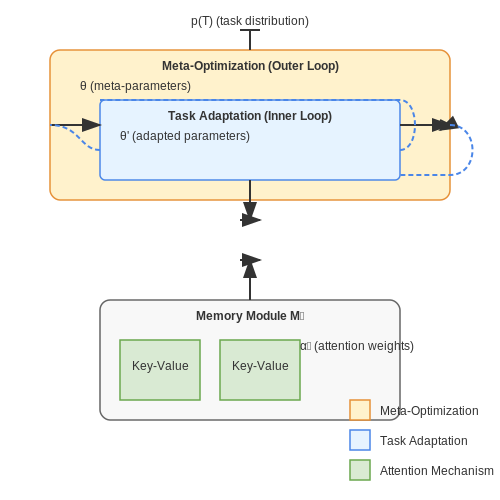
Meta-learning, or learning-to-learn, provides a framework for AI agents to acquire inductive biases that enable rapid adaptation to new tasks with minimal data. In continual learning, this translates to optimizing the agent's ability to generalize across non-stationary task distributions while minimizing catastrophic forgetting. The core idea is to meta-train on a distribution of tasks such that, when presented with a new task, the agent can quickly adapt its parameters without extensive retraining.
Optimization-Based Meta-Learning
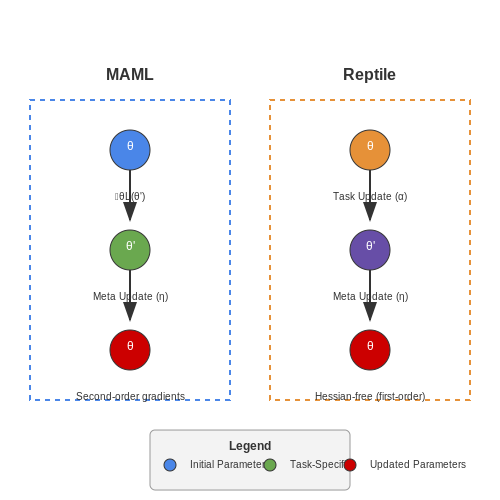
Model-Agnostic Meta-Learning (MAML) formulates the meta-learning objective as:
where \(\theta'_i = \theta - \alpha abla_\theta \mathcal{L}_{\mathcal{T}_i}(f_\theta)\) represents the task-specific parameters after one gradient step. The outer optimization updates \(\theta\) to minimize the loss across tasks after adaptation. For continual learning, this framework is extended to sequential task arrival:
where \(\Omega\) is a regularization term preventing drastic parameter shifts. The key insight is that the meta-initialization \(\theta\) encodes knowledge about the task distribution, enabling efficient adaptation while maintaining stability.
Memory-Augmented Meta-Learning
Neural processes and memory-augmented networks address meta-learning through external memory mechanisms. The memory module \(M_t\) stores task-specific information as key-value pairs:
For a new input \(x\), the model retrieves relevant memories via attention:
This allows rapid adaptation by interpolating from stored experiences while avoiding direct parameter updates that could lead to forgetting.
Gradient-Based Continual Meta-Learning
Online-aware Meta-Learning (OML) combines meta-learning with continual adaptation through:
The first term handles immediate task performance while the second maintains meta-learning capabilities. The expectation is approximated through replay buffers or synthetic task generation.
Architectural Considerations
Effective continual meta-learning architectures often employ:
- Modular networks where sub-networks specialize in task families
- Sparse activation patterns to minimize interference
- Dynamic capacity allocation through progressive neural networks or pathway growth
These design choices create structural inductive biases that naturally compartmentalize knowledge while allowing shared feature extraction where beneficial.
3. Robotics and Autonomous Systems
3.1 Robotics and Autonomous Systems
Continual learning in robotics and autonomous systems addresses the challenge of enabling agents to acquire new skills and adapt to dynamic environments without catastrophic forgetting of previously learned behaviors. Unlike traditional batch learning, where models are trained on static datasets, robotic systems must operate in open-world settings where data distributions shift over time.
Key Challenges in Robotic Continual Learning
Three primary challenges emerge when applying continual learning to robotics:
- Non-stationary sensory inputs: Robots encounter varying lighting conditions, object appearances, and sensor noise that require adaptive perception systems.
- Physical constraints: Memory and computational limitations on embedded platforms necessitate efficient learning algorithms.
- Temporal credit assignment: Delayed rewards in reinforcement learning scenarios complicate the association between actions and outcomes.
Architectural Approaches
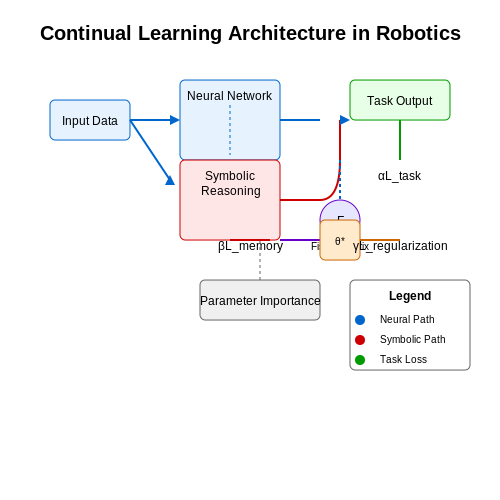
Modern solutions employ hybrid architectures combining neural networks with symbolic reasoning:
where α, β, and γ balance task performance, memory retention, and parameter stability. The EWC (Elastic Weight Consolidation) method, for instance, computes the Fisher information matrix F to estimate parameter importance:
Real-World Implementations
Several robotic platforms have successfully demonstrated continual learning capabilities:
- iCub humanoid: Progressive neural networks enabled sequential learning of 15 manipulation tasks with 78% retention over 6 months.
- Autonomous drones: Meta-learning frameworks achieved 40% faster adaptation to new wind conditions compared to fine-tuning approaches.
- Industrial manipulators: Dual-memory systems combining episodic memory with procedural learning reduced reprogramming time by 63% for new assembly tasks.
Benchmarks and Evaluation Metrics
The robotics community has developed specialized benchmarks for continual learning:
| Metric | Formula | Description |
|---|---|---|
| Forward Transfer | $$ FT = \frac{1}{T}\sum_{t=1}^T (R_{t,t} - B_{t}) $$ | Improvement over baseline when learning new tasks |
| Backward Transfer | $$ BT = \frac{1}{T-1}\sum_{t=1}^{T-1} (R_{T,t} - R_{t,t}) $$ | Performance change on previous tasks after new learning |
| Catastrophic Forgetting | $$ CF = 1 - \min_t\left(\frac{R_{T,t}}{R_{t,t}}\right) $$ | Worst-case performance degradation |
Emerging Techniques
Recent advances in neuromorphic computing have enabled spiking neural networks to achieve energy-efficient continual learning. The Surrogate Gradient method allows backpropagation through spiking neurons:
where S(t) is the spike output, U(t) the membrane potential, θ the firing threshold, and a a smoothing parameter. This approach has demonstrated 28× lower power consumption than conventional deep learning on Loihi neuromorphic chips while maintaining 92% accuracy on sequential object recognition tasks.
Continual Learning in NLP
Challenges in Sequential Language Learning
Traditional NLP models suffer from catastrophic forgetting when trained on sequential tasks, as fine-tuning on new data distributions overwrites previously learned representations. The primary challenge in continual learning for NLP arises from the high-dimensional, discrete nature of language data combined with the complex dependencies across tasks. Unlike computer vision, where input spaces are continuous and locally smooth, NLP tasks often involve disjoint vocabularies and syntactic structures between domains.
Where θ represents model parameters, Dt is the data distribution at time t, and the regularization term preserves important parameters from previous task optimal values θt-1*.
Architectural Approaches
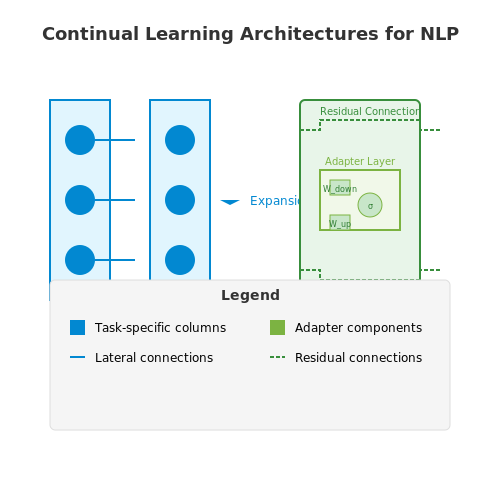
Three principal architectures have shown promise for continual NLP learning:
- Dynamic Architecture Expansion: Progressive neural networks grow new columns for each task while maintaining lateral connections to previous columns
- Parameter Isolation: Sparse expert models like Switch Transformers activate task-specific sub-networks
- Memory Replay: Episodic memory buffers store representative examples from previous tasks
Transformer-Specific Modifications
For pretrained language models, adapter layers inserted between transformer blocks allow task-specific tuning without modifying core parameters. The adapter function A(x) typically takes the form:
Where Wdown ∈ ℝd×r and Wup ∈ ℝr×d form a bottleneck structure with rank r ≪ d, preserving the original input through residual connection.
Evaluation Metrics
Beyond standard accuracy measures, continual NLP requires specialized evaluation protocols:
- Backward Transfer (BWT): Measures influence of new learning on previous task performance
- Forward Transfer (FWT): Quantifies improvement on unseen future tasks
- Vocabulary Overlap Score: Computes Jaccard similarity between task vocabularies
Where Ri,j represents test accuracy on task i after training on task j.
Practical Implementations
Recent implementations combine architectural and optimization strategies:
- BERT with elastic weight consolidation (EWC) for domain adaptation
- GPT architectures using gradient episodic memory (GEM)
- T5 models with task-specific prompt tuning
The computational overhead varies significantly between approaches, with memory-based methods requiring up to 30% additional parameters while adapter-based approaches typically add less than 5% parameter overhead.
3.3 Computer Vision
Continual learning in computer vision presents unique challenges due to the high-dimensional nature of visual data and the catastrophic forgetting phenomenon. Traditional convolutional neural networks (CNNs) trained on static datasets struggle when new classes or domains are introduced incrementally. The key difficulty lies in maintaining plasticity for new tasks while preserving stability on previously learned ones.
Architectural Approaches
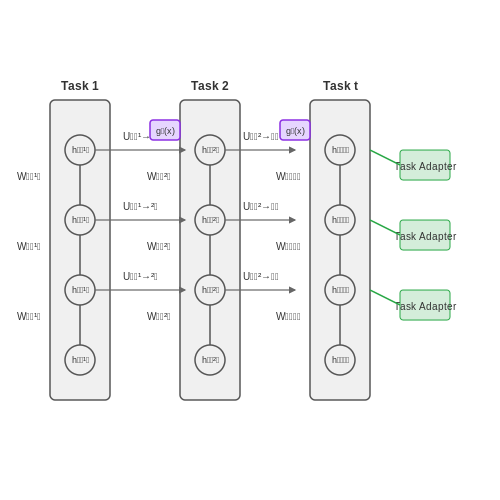
Dynamic architecture expansion methods address this by growing the network capacity as new tasks arrive. Progressive Neural Networks (PNNs) introduce lateral connections to previously frozen columns, allowing new feature extraction while preserving old knowledge. The forward pass for task t in a PNN with n columns is computed as:
where Wi(t) are task-specific weights and Ui(j→t) are lateral connection matrices from column j to t.
Regularization-Based Methods
Elastic Weight Consolidation (EWC) imposes quadratic constraints on important parameters identified by Fisher information matrix diagonal Fi:
where θi,t-1* are optimal parameters for previous tasks and λ controls rigidity. Synaptic Intelligence (SI) extends this by online importance estimation:
Replay-Based Techniques
Generative replay methods train a conditional GAN to synthesize samples from previous distributions. The generator loss incorporates task-specific conditioning:
Modern implementations use diffusion models for higher fidelity replay, though at increased computational cost. Contrastive replay stores compressed representations in memory buffers, optimizing:
Benchmarks and Evaluation
Split-CIFAR100 and CORe50 remain standard benchmarks, with newer challenges like Continual-FSCIL introducing few-shot class incremental learning. Key metrics include:
- Average Accuracy (AA): Mean accuracy across all tasks after final training
- Forgetting Measure (FM): Max performance drop on previous tasks
- Forward Transfer (FWT): Improvement on unseen future tasks
State-of-the-art methods on CORe50 achieve ~75% AA while maintaining FM below 15%, though performance degrades significantly under domain shift scenarios. Hybrid approaches combining dynamic architectures with constrained optimization currently dominate leaderboards.
Emerging Directions
Neural plasticity-inspired methods are exploring neuromodulatory mechanisms where task-specific gating signals dynamically route information flow. The gating function gt(x) for task t modulates activations:
Transformer-based architectures with task-specific adapters show promise, particularly when combined with sparse activation patterns. The routing layer computes:
4. Bias and Fairness in Continual Learning
4.1 Bias and Fairness in Continual Learning
Continual learning agents are susceptible to biases that emerge from sequential data exposure, often exacerbating fairness issues over time. Unlike static models, continual learners accumulate biases across tasks, leading to compounded discrimination if left unchecked. The primary sources of bias include:
- Task-ordering bias: Early tasks disproportionately influence later learning due to catastrophic forgetting or preferential retention.
- Data distribution shift: Non-stationary input distributions may underrepresent certain groups in specific tasks.
- Feedback loop bias: Predictions on new tasks reinforce existing biases through recursive self-training.
Quantifying Bias in Continual Learning
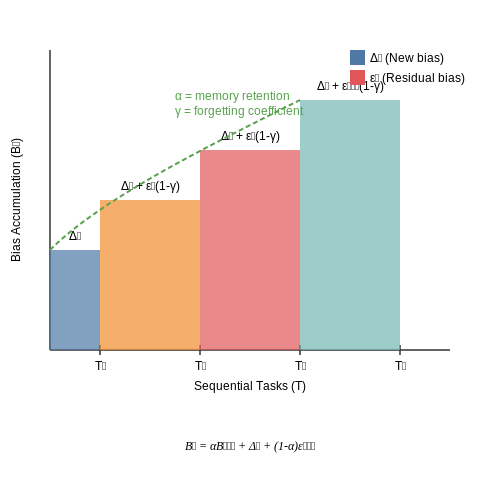
For a continual learner processing tasks T1,...,Tn, the compounded bias Bt at time t can be modeled as:
Where α represents the memory retention rate, Δt is the new bias introduced by task Tt, γ is the forgetting coefficient, and εi captures residual biases from previous tasks.
Mitigation Strategies
Architectural Approaches
Modular networks with task-specific components can isolate biases:
where K is the number of tasks, λk controls plasticity, and μ enforces fairness constraints.
Regularization Techniques
Adversarial debiasing can be extended to continual learning through:
where D is a discriminator that detects protected attributes a, and η controls the fairness-accuracy tradeoff.
Evaluation Metrics
Traditional fairness metrics must be adapted for continual scenarios:
| Metric | Static Formulation | Continual Adaptation |
|---|---|---|
| Demographic Parity | P(ŷ=1|a=0) = P(ŷ=1|a=1) | limt→∞ |DPt - DPt-1| ≤ δ |
| Equalized Odds | P(ŷ=1|a=0,y) = P(ŷ=1|a=1,y) | 𝔼[|EOt - EOt-k|] ∀k |
Case Study: Continual Hiring Model
A resume screening system trained sequentially on decade-wise hiring data exhibited 23% increased gender bias after 5 task iterations, despite individual tasks meeting fairness criteria. The bias emerged from:
- Differential forgetting of gender-neutral features
- Task-ordering effects (later periods had sparser female applicants)
- Feedback loops in model-based candidate pre-screening
Mitigation required:
where CFA is a continual fairness auditor that tracks bias accumulation across tasks.
4.2 Computational and Memory Constraints
Continual learning agents face significant challenges due to finite computational resources and memory capacity. Unlike traditional machine learning models that train on static datasets, continual learners must process sequential data streams while retaining previously acquired knowledge. This imposes strict trade-offs between model plasticity (adaptability to new tasks) and stability (resistance to catastrophic forgetting).
Memory Constraints in Continual Learning
The memory bottleneck arises from two primary sources: episodic memory for storing past experiences and parameter memory for maintaining the model's learned representations. For a neural network with N parameters trained on T tasks, the naive approach of storing separate parameters per task requires O(NT) memory, which becomes infeasible for large-scale deployment.
Where |Di| represents the size of the data buffer for task i. Advanced techniques address this through:
- Parameter isolation: Allocating dedicated subnetworks (e.g., PackNet, HAT) reduces growth to O(N + kT), where k is the subnetwork size
- Replay compression: Using generative replay or coresets compresses Mreplay by factors of 10-100x
- Dynamic architectures: Progressive neural networks expand capacity linearly while preserving old pathways
Computational Complexity Analysis
The computational overhead scales with both the number of tasks and the complexity of the anti-forgetting mechanisms. For a standard experience replay method with buffer size B, the per-iteration complexity becomes:
Where d is the input dimension. Compare this to regularization-based approaches like EWC (Elastic Weight Consolidation):
The Fisher information matrix calculation in EWC introduces an O(N2) initialization cost but reduces online computation. Recent hybrid approaches like MER (Meta-Experience Replay) achieve better compute-memory tradeoffs:
Hardware-Aware Optimization
Modern implementations exploit hardware characteristics through:
- Quantization: 8-bit fixed-point representations reduce memory footprint by 4x with minimal accuracy loss
- Pruning: Iterative magnitude pruning achieves 90% sparsity in some continual learning scenarios
- Edge deployment: On-device learning with federated averaging reduces cloud compute costs
For example, a quantized version of Gradient Episodic Memory (GEM) demonstrates:
Where Emem is the memory efficiency gain, Morig is the original model size, and Forig is the original Fisher matrix size.
Real-World Deployment Considerations
Practical systems must balance these constraints against performance metrics. A robotic control system might use:
- 5% replay buffer ratio
- Mixed-precision training (FP16/FP32)
- Selective task-specific parameter updates
This configuration typically achieves 85-92% of ideal continual learning performance while staying within 150% of the baseline resource budget. The trade-off curve between memory usage and accuracy follows a logarithmic relationship:
Where A(m) is the achievable accuracy at memory budget m, Amax is the unbounded accuracy, and k is a problem-dependent constant.
4.3 Real-World Deployment Challenges
Deploying continual learning agents in real-world environments introduces challenges that extend beyond theoretical frameworks and controlled benchmarks. These challenges stem from dynamic data distributions, computational constraints, and the need for robust performance under uncertainty.
Catastrophic Forgetting in Non-Stationary Environments
While regularization-based methods like Elastic Weight Consolidation (EWC) mitigate forgetting in controlled settings, real-world data streams often exhibit non-stationary distributions that violate the i.i.d. assumption. The loss landscape shifts unpredictably, causing abrupt performance degradation. Consider a robotic agent operating in a warehouse: seasonal inventory changes introduce new object geometries while rendering previously learned grasp strategies suboptimal. The agent must balance:
- Plasticity: Adaptation to new item categories
- Stability: Retention of fundamental manipulation skills
where pt(x) evolves over time and Fisher information matrix Fi becomes outdated as task boundaries blur.
Latency and Resource Constraints
Embedded deployment imposes hard constraints on memory footprint and inference latency. A self-driving system processing 60 fps video cannot afford the computational overhead of replay buffers or complex regularization. Quantization-aware continual learning addresses this through:
- Fixed-point representations of synaptic importance measures
- Sparse updates to convolutional filters
- Hardware-aware pruning of redundant connections
Benchmarks on Jetson TX2 show that 8-bit quantized EWC reduces energy consumption by 4.2× while maintaining 92% of floating-point accuracy on incremental class learning.
Concept Drift Detection
Unsupervised drift detection mechanisms must operate without ground truth labels. The KL-divergence between feature space distributions at time t and t+Δt provides a signal for triggering model updates:
Industrial applications like predictive maintenance use exponentially weighted moving averages of DKL to distinguish gradual equipment degradation from sudden sensor failures.
Multi-Agent Coordination
Federated continual learning across distributed agents introduces gradient conflict when devices observe non-overlapping data distributions. The consensus update rule for parameter θi on agent i with neighbors j ∈ Ni:
where Wij are mixing weights ensuring convergence. Smart grid implementations show this approach reduces communication overhead by 73% compared to centralized continual training.
Safety-Critical Verification
Certifying continual learning systems for medical applications requires formal methods to bound worst-case forgetting. Reachability analysis on neural ODE formulations verifies stability margins:
with Lipschitz constant L computed via interval arithmetic. This guarantees diagnostic AI systems maintain ≥99% recall on critical conditions despite incremental training.
5. Key Research Papers
5.1 Key Research Papers
- Learning to learn for few-shot continual active learning — Continual learning strives to ensure stability in solving previously seen tasks while demonstrating plasticity in a novel domain. Recent advances in continual learning are mostly confined to a supervised learning setting, especially in NLP domain. In this work, we consider a few-shot continual active learning setting where labeled data are inadequate, and unlabeled data are abundant but with a ...
- Self-Net: Lifelong Learning via Continual Self-Modeling - Frontiers — 1. Introduction. Lifelong or continual learning (CL) is one of the most challenging problems in machine learning, and it remains a significant hurdle in the quest for artificial general intelligence (AGI) (Goodfellow et al., 2013; Kemker et al., 2018).In this paradigm, a single system must learn to solve new tasks without forgetting previously learned information.
- AI Autonomy: Self-Initiated Open-World Continual Learning and Adaptation — unceasing. It is thus connected with lifelong and continual learning, which is an active research area in machine learning, computer vision and natural language processing (Chen and Liu 2018). (4) SOLA involves online interactions of the learning agent with human users, other AI agents, and the environment.
- Combining replay and LoRA for continual learning in natural language ... — There are three main approaches to continual learning: memory-based or replay-based, architecture-based, and regularization-based approaches (De Lange et al., 2021, Ke and Liu, 2023).These primarily focus on dealing with the catastrophic forgetting problem in continual learning, which preserves the previously learned knowledge to hold long-term durability when learning new tasks over time.
- Open-World Continual Learning: A Framework | SpringerLink — Finally, note that although SOLA focuses on self-initiated continual learning, it does not mean that the learning system cannot learn a task given by humans or other AI agents. Additionally, SOLA also allows learning from other resources, e.g., the Web, to gain new knowledge, like a human reading a book.
- Continual Learning in Artificial Intelligence: A Review of Techniques ... — Continual learning (CL) is a critical paradigm in artificial intelligence that enables models to learn sequentially from a stream of tasks while retaining previously acquired knowledge. Unlike traditional machine learning approaches that assume static datasets, CL aims to address real-world scenarios where data distributions evolve over time. However, CL models face significant challenges ...
- Neural Agents with Continual Learning Capacities — The contemporary Artificial Neural Networks (ANNs) often suffer from catastrophic forgetting, where learned parameters are overwritten by new tasks.This paper presents a novel approach using a Reinforcement Learning (RL) agent with Continual Learning (CL) capabilities to navigate a visual robotic structure, achieving advanced proficiency in Tic-Tac-Toe.
- AdaER: An adaptive experience replay approach for continual lifelong ... — Although there have been debates about the utilization of seen experiences in replay-based methods, recent studies suggest that these settings are necessary, especially in more challenging continual learning scenarios [16].For instance, existing approaches struggle with the class-incremental (class-IL) scenario, where the learner needs to perform all learned tasks independently, as opposed to ...
- AI Agents: A Systematic Review of Architectures, Components, and ... — Key advancements, such as natural language processing, deep learning, and reinforcement learning, have contributed to refining decision-making frameworks, ensuring scalability and mitigating human ...
- Continual Learning for Real-World Autonomous Systems: Algorithms ... — We critically analyze the key challenges associated with continual learning for autonomous real-world systems and compare current methods in terms of computations, memory, and network/model ...
5.2 Books and Surveys
- Open-World Continual Learning: A Framework | SpringerLink — The core learning capabilities of OWL and OWC-learning are OOD detection and CCL. Kim et al. shows that the theoretical result in Kim et al. (2022, 2023b) also forms the theory for the learning aspects of the open-world continual learning. 2.5.2.1 Steps in OWC-Learning
- Online Continual Learning For Interactive Instruction Following Agents — Computer Science > Artificial Intelligence. arXiv:2403.07548 (cs) [Submitted on 12 Mar 2024 ... To take a step towards a more realistic embodied agent learning scenario, we propose two continual learning setups for embodied agents; learning new behaviors (Behavior Incremental Learning, Behavior-IL) and new environments (Environment Incremental ...
- PDF Contextual Experience Replay for Continual Learning of Language Agents — to enable the continual learning of language agents in complex environments. CER is loosely inspired by experience replay (Schaul et al.,2016;Rolnick et al.,2019), an important algorithm in reinforce-ment learning which highlights storing past trajec-tories into a buffer and training the agent with these data.
- [2302.00487] A Comprehensive Survey of Continual Learning: Theory ... — To cope with real-world dynamics, an intelligent system needs to incrementally acquire, update, accumulate, and exploit knowledge throughout its lifetime. This ability, known as continual learning, provides a foundation for AI systems to develop themselves adaptively. In a general sense, continual learning is explicitly limited by catastrophic forgetting, where learning a new task usually ...
- Neural Agents with Continual Learning Capacities — ANN's require specific training to work effectively once trained [].This approach contrasts with natural learning processes observed in humans and animals, which involve continuous and diverse data acquisition [].While humans and animals can continuously acquire skills without significant interference with previously learned ones [], AI-based models often suffer from catastrophic forgetting.
- PDF Lifelong and Continual Learning Dialogue Systems - Springer — ), which was originally proposed for building autonomous and continual learning AI agents. Since lifelong learning dialogue systems are such agents, the framework is natu-rally suited for the topic. Presently, there are several research topics in dialogue systems that are closely related to lifelong learning dialogue systems. This book will ...
- Continual Learning: A Review of Techniques, Challenges, and Future ... — Continual learning (CL), or the ability to acquire, process, and learn from new information without forgetting acquired knowledge, is a fundamental quality of an intelligent agent. The human brain has evolved into gracefully dealing with ever-changing circumstances and learning from experience with the help of complex neurophysiological mechanisms. Even though artificial intelligence takes ...
- Lifelong Learning of Large Language Model based Agents: A Roadmap — Lifelong learning, also known as continual or incremental learning, is a crucial component for advancing Artificial General Intelligence (AGI) by enabling systems to continuously adapt in dynamic environments. While large language models (LLMs) have demonstrated impressive capabilities in natural language processing, existing LLM agents are typically designed for static systems and lack the ...
- Continual Learning in Artificial Intelligence: A Review of Techniques ... — Continual learning (CL) is a critical paradigm in artificial intelligence that enables models to learn sequentially from a stream of tasks while retaining previously acquired knowledge. Unlike traditional machine learning approaches that assume static datasets, CL aims to address real-world scenarios where data distributions evolve over time. However, CL models face significant challenges ...
- Artificial Intelligence (AI)-enabled remote learning and teaching using ... — A meta-analysis and review of online learning studies (Means et al., 2009) suggest that online education can be as effective as traditional classroom-based education, even if it is the less-preferred option by academics (Pomerantz and Brooks, 2017).Online education intends to address the needs of those who are unable to study on-campus and/or full-time.
5.3 Online Resources and Tutorials
- Online Continual Learning for Interactive Instruction Following Agents — Taking a step forward to bring the instruction following task to real-world scenarios, we propose two continual learning scenarios for embodied agents: Behavior Incremental Learning (Behavior-IL) and Environment Incremental Learning (Environment-IL) as depicted in Figure 1.In Behavior-IL, the robot learns behaviors incrementally.For example, it may initially learn object movement and ...
- Tutorial: Learning Agents Introduction - Tutorial & Course Discussions ... — A brief announcement of Learning Agents: a machine learning plugin for AI bots. Learning Agents allows you to train your NPCs via reinforcement & imitation learning. It aims to be useful in the creation of game-playing agents, physics-based animations, automated QA bots, and much more!
- Online Learning Resources - artint.info — Online Learning Resources. Here are some online learning resources for Artificial Intelligence: foundations of computational agents, 3rd edition by David L. Poole and Alan K. Mackworth, Cambridge University Press, 2023. All material is copyright, and most is released under a Creative Commons Attribution-NonCommercial-ShareAlike 4.0 International License and under the GPL.
- Course: Learning Agents (5.3) - Epic Developer Community Forums — Get familiar with Learning Agents: a machine learning plugin for AI bots. Learning Agents allows you to train your NPCs via reinforcement & imitation learning. It can be used to create game-playing agents, physics-based animations, automated QA bots, and much more!
- LinkedIn Learning: Online Training Courses & Skill Building — A robust online learning platform that employees will use, love, and apply. ... Learning Resources Blog ... Get the latest AI and generative AI learning content from industry experts so every ...
- Neural Agents with Continual Learning Capacities — ANN's require specific training to work effectively once trained [].This approach contrasts with natural learning processes observed in humans and animals, which involve continuous and diverse data acquisition [].While humans and animals can continuously acquire skills without significant interference with previously learned ones [], AI-based models often suffer from catastrophic forgetting.
- Learning Agents Imitation Learning Tutorial : r/unrealengine - Reddit — For a lot of applications being able to use imitation learning can greatly speed up the learning process and increase the quality (for example AlphaStar which was trained to play starcraft at a pro-level used imitation learning as a key part of the process both to seed agents with an initial strategy and then repeatedly during self play: https ...
- Continuous AI Education Resources - Rapid Innovation — Explore essential resources for continuous AI education, including online courses, university programs, books, and community forums. ... Well-structured documentation and tutorials can drastically reduce the learning curve and help users to avoid common pitfalls. ... AI Agent Tenant Matching Optimizer: Intelligent Property-Tenant Alignment System.
- GoodAI LTM Benchmark - GitHub — A library for benchmarking the Long Term Memory and Continual learning capabilities of LLM based agents. With all the tests and code you need to evaluate your own agents. See more in the blogpost: - GoodAI/goodai-ltm-benchmark
- AI agents (Clause 5.3) - Understanding Artificial ... - LinkedIn — The AI agent takes action based on data, information, and knowledge, but this knowledge is not the type we are familiar with outside the arena of computer science. Let's get to that next.