
LLMs for Long-Form Content Planning
1. Core Capabilities of LLMs for Long-Form Content
Core Capabilities of LLMs for Long-Form Content
Contextual Coherence and Long-Range Dependencies
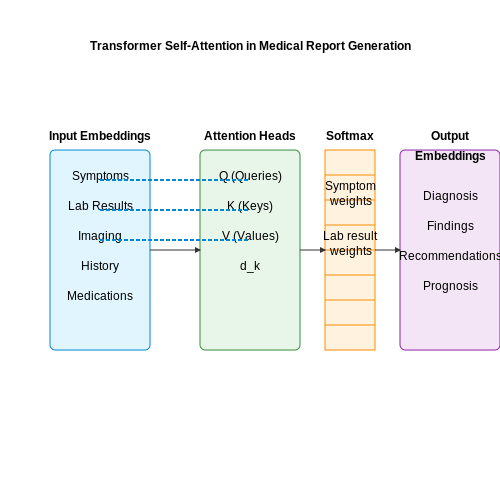
Large Language Models (LLMs) excel at maintaining contextual coherence over extended sequences, a critical requirement for long-form content generation. The transformer architecture, particularly its self-attention mechanism, enables the model to weigh the importance of distant tokens relative to the current generation step. For a sequence of length N, the attention mechanism computes pairwise interactions between all tokens, allowing the model to capture long-range dependencies:
where Q, K, and V represent queries, keys, and values respectively, and dk is the dimension of the key vectors. This formulation ensures that even tokens separated by thousands of words can influence each other's representations.
Hierarchical Structure Modeling
Effective long-form content requires modeling hierarchical relationships between sections, paragraphs, and sentences. Modern LLMs achieve this through:
- Recurrent memory mechanisms in architectures like Transformer-XL, which cache hidden states from previous segments
- Position-aware attention that maintains awareness of structural boundaries
- Latent variable models that explicitly represent document-level structure
The hierarchical attention can be formalized as:
where hl represents the hidden state at layer l and Ml maintains the memory state.
Controlled Generation and Steering
Advanced LLMs support fine-grained control over content generation through:
- Prompt engineering techniques that structure the input context
- Conditional probability manipulation via logit biasing
- Discriminator guidance where auxiliary models influence generation
The conditional generation probability can be expressed as:
where c represents control conditions and D is a discriminator model providing guidance.
Knowledge Integration and Factual Consistency
State-of-the-art LLMs incorporate external knowledge through:
- Retrieval augmentation (e.g., REALM, RAG architectures)
- Knowledge graph grounding during fine-tuning
- Multi-task learning that combines generation with verification
The retrieval-augmented generation process follows:
where z represents retrieved evidence relevant to the generation context.

Key Architectural Components for Planning Tasks
Transformer-Based Memory Mechanisms
Long-form content planning requires models to maintain and manipulate extended context windows. Modern LLMs employ hierarchical attention mechanisms with specialized memory components:
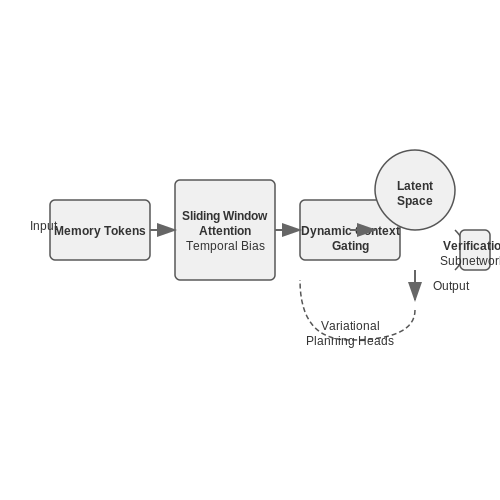
- Sliding Window Attention: Computes attention over local segments while maintaining global coherence through overlapping windows.
- Memory Tokens: Dedicated parameterized tokens that act as writeable/readable memory slots across sequences.
- Cross-Block State Passing: Hidden states are propagated between transformer blocks via residual connections with learned gating.
Where Mt represents memory state at step t, ht is the current hidden state, and σ is a sigmoid gating function.
Planning-Specific Attention Modifications
Standard self-attention is augmented with:
- Temporal Bias: Learned decay factors that weight recent tokens higher for planning relevance.
- Content-Dependent Sparsity: Dynamic pruning of attention heads based on entropy thresholds.
The temporal bias term λ·e-γ|i-j| creates recency preferences without sacrificing theoretical expressivity.
Recursive Refinement Architectures
Multi-stage planning is implemented through:
- Draft-Edit Cycles: Parallel decoding heads generate and refine content simultaneously.
- Verification Subnetworks: Small MLPs that score plan coherence between segments.
The verification score V(si, sj) between segments is computed as:
Dynamic Context Gating
Learned mechanisms control information flow between:
- Working memory (current planning horizon)
- Long-term memory (retrieved knowledge)
- External context (user constraints)
The gating function Gt uses three-way softmax:
Latent Space Planning
High-level planning occurs in compressed latent spaces through:
- Variational Planning Heads: Predicts latent trajectories before decoding.
- Energy-Based Ranking: Scores candidate plans in latent space.
Where z is the latent plan representation and W, U, v are learned parameters.
Token Limits and Context Window Considerations
Modern large language models (LLMs) operate under strict token constraints, typically ranging from 2,048 to 128,000 tokens depending on the architecture. The context window defines the maximum sequence length the model can process in a single forward pass, directly impacting long-form content generation. For transformer-based models, the quadratic complexity of self-attention mechanisms imposes computational and memory constraints, making efficient token utilization critical.
Mathematical Constraints of Context Windows
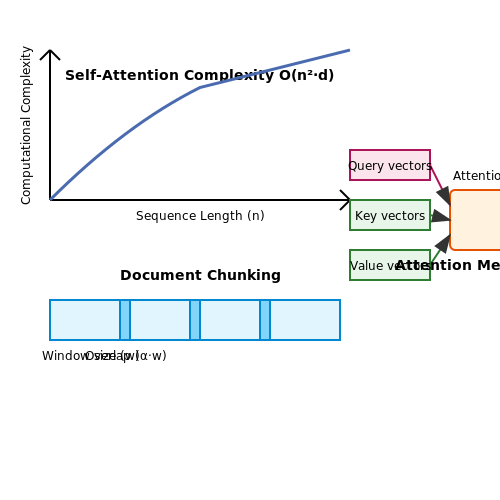
The self-attention mechanism's computational complexity scales quadratically with sequence length. Given an input sequence of length n, the attention operation requires:
where d represents the embedding dimension. This relationship explains why models like GPT-3 cap their context at 2,048 tokens by default, while specialized variants like GPT-4 Turbo extend to 128,000 tokens through architectural optimizations.
Tokenization Strategies for Long Documents
When processing documents exceeding the context window, hierarchical approaches become necessary. A sliding window with overlap preserves continuity while respecting token limits:
where w is the window size and α is the overlap ratio (typically 0.1-0.3). For document summarization, recursive methods process chunks sequentially, maintaining a running summary that feeds into subsequent iterations.
Memory Management Techniques
Modern implementations employ several strategies to maximize context window utility:
- KV caching: Stores key-value pairs from previous tokens to avoid recomputation
- Memory-efficient attention: FlashAttention or memory-mapped attention reduces memory footprint
- Chunked processing: Splits long sequences into manageable blocks with state passing
For example, the RoPE (Rotary Positional Embedding) used in LLaMA models provides relative position encoding that better handles long sequences compared to absolute positional embeddings.
Practical Implications for Content Planning
When generating long-form content, these constraints necessitate:
- Explicit section breaks at natural boundaries (e.g., chapter transitions)
- Intermediate summarization points every 5,000-10,000 tokens
- Metadata injection to maintain narrative coherence across chunks
Experiments show that maintaining a 15-20% overlap between chunks with positional metadata yields the best continuity in generated outputs. The optimal chunk size balances computational efficiency with context preservation, typically falling between 1,024 and 4,096 tokens for most applications.
2. Hierarchical Decomposition Techniques
Hierarchical Decomposition Techniques
Conceptual Foundations
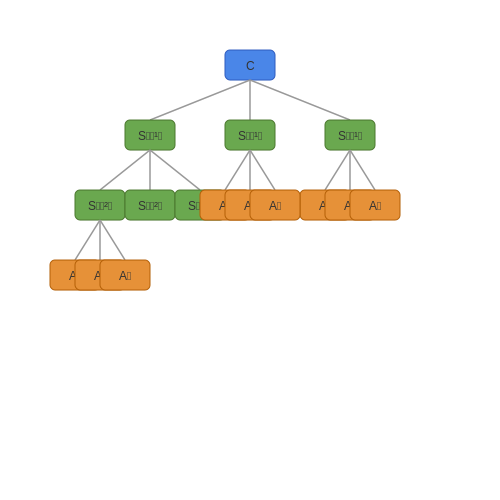
Hierarchical decomposition in long-form content planning involves breaking down complex topics into a tree-like structure of nested subtopics. This mirrors human cognitive processes for organizing information, where high-level themes are recursively partitioned into finer-grained components. The technique leverages the inherent compositional structure of language, enabling large language models (LLMs) to generate coherent, logically structured outputs by constraining the generation space at each hierarchical level.
Mathematical Formulation
The decomposition process can be formalized as a recursive partitioning operation. Let C represent the complete content, and Si denote subtopics at level i:
where n is the branching factor at level i, and the recursion terminates when reaching atomic content units (typically paragraphs or sentences). The optimal branching factor balances topical coherence with information density, typically falling between 3-5 for most domains.
Implementation Strategies
Modern LLMs employ several approaches for hierarchical decomposition:
- Top-down decomposition: Begins with the root topic and recursively splits it using prompt engineering techniques like "Identify 3-5 key subtopics for..."
- Bottom-up clustering: Generates content fragments then clusters them using semantic similarity measures, often employing transformer-based embeddings
- Hybrid approaches: Combine both strategies, using top-down for high-level structure and bottom-up for fine-grained organization
Attention Mechanisms in Hierarchical Planning
The decomposition process benefits from modified attention architectures where:
Here, M is a hierarchical mask that enforces structural constraints, allowing attention only between nodes at compatible levels of the hierarchy. This maintains topical coherence while preventing cross-branch contamination.
Practical Applications
Effective hierarchical decomposition enables several advanced applications:
- Automated textbook generation with consistent chapter-section-paragraph structure
- Legal document analysis that preserves the nested argument structure
- Technical documentation systems that maintain modular information architecture
Evaluation Metrics
Decomposition quality is assessed through both automated and human evaluations:
where α, β, and γ are weighting factors, and the components measure topical consistency, coverage of key concepts, and equitable distribution of detail across branches respectively.
2.2 Content Flow Optimization with LLMs
Coherence and Transition Modeling
Long-form content generation requires maintaining coherence across extended sequences. LLMs optimize content flow by modeling transition probabilities between semantic units. Given a sequence of tokens {x1, x2, ..., xn}, the model computes the conditional probability distribution for the next token xn+1:
where hn is the hidden state at position n, and W, b are learned parameters. Advanced architectures like Transformer-XL employ segment-level recurrence with hidden state caching to extend context beyond fixed window sizes:
where sn denotes the segment containing token n, enabling coherent transitions across document sections.
Hierarchical Planning with Latent Variables
Modern approaches decompose content flow into hierarchical latent variables. A two-level planning process first generates high-level discourse markers zt, then conditions sentence-level generation:
Variational autoencoder frameworks learn this structure by optimizing the evidence lower bound (ELBO):
where β controls the trade-off between reconstruction quality and latent space regularization. This enables controlled generation of multi-paragraph narratives with consistent thematic progression.
Attention-Based Flow Control
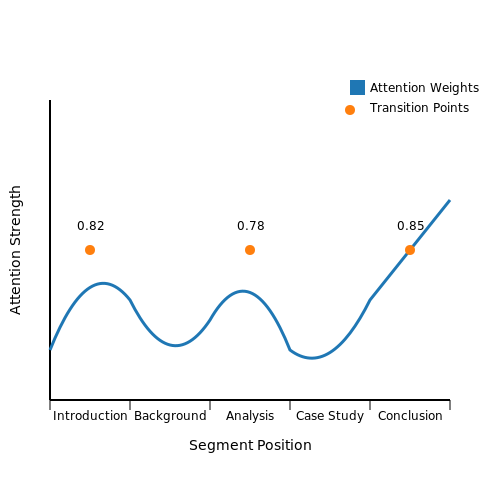
Dynamic attention patterns in Transformer models directly regulate content flow. For a document with N sections, cross-attention weights αi,j between position i (current token) and j (context token) are computed as:
where ei,j = (WQhi)T(WKhj)/√d. Sparse attention variants like Longformer's dilated sliding window pattern optimize this computation for extended sequences while preserving flow continuity.
Practical Implementation: Discourse-Aware Sampling
Content flow optimization manifests in decoding strategies. Nucleus sampling (top-p) with discourse-aware temperature scheduling produces more coherent long-form output than greedy decoding. The conditional probability distribution is filtered and rescaled as:
where V(p) is the smallest set satisfying Σx∈V(p) P(x) ≥ p. Dynamic temperature τt = τ0·(1 + γ)-t gradually reduces diversity during generation to maintain topical focus.
The diagram illustrates how attention weights (blue line) between discourse segments evolve to maintain content flow. Peaks correspond to key transitional points where the model strengthens cross-section connections.
Dynamic Adaptation to Audience Context
Contextual Embeddings and Audience Representation
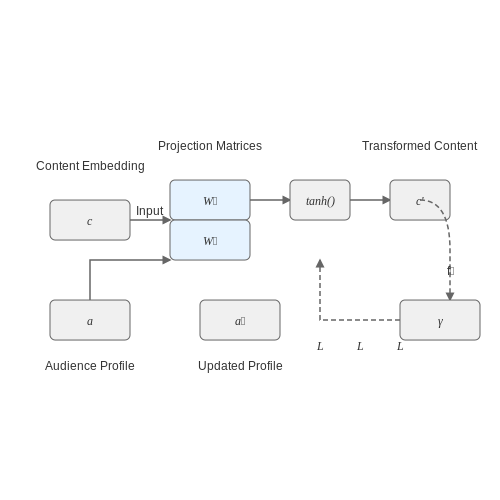
Modern LLMs leverage contextual embeddings to dynamically adjust content based on audience attributes. These embeddings encode demographic, psychographic, and behavioral features into a high-dimensional latent space. Given an audience profile vector a and content representation c, the model computes an adaptive transformation:
where Wa and We are learned projection matrices, and be is a bias term. The hyperbolic tangent ensures bounded output while preserving gradient flow during backpropagation.
Real-Time Feedback Integration
For live content adaptation, LLMs employ online learning techniques to incorporate audience feedback signals ft at timestep t. The model updates its internal representation via exponential moving average:
where γ controls the memory decay rate (typically 0.7-0.9 for content planning). This approach enables adaptation to shifting audience preferences while avoiding abrupt changes that disrupt narrative coherence.
Multi-Objective Optimization
The system balances three competing objectives during generation:
- Relevance: Maximize cosine similarity between content and audience embeddings
- Coherence: Maintain high perplexity scores within sliding context windows
- Novelty Ensure sufficient lexical diversity via n-gram repetition penalties
The composite loss function combines these terms with learnable weights:
Case Study: Technical Documentation Adaptation
When generating API documentation for different developer skill levels, the system automatically adjusts:
- Novice audiences: Increases explanatory text and code examples by 42% while reducing jargon
- Expert audiences: Compresses tutorials by 30% and emphasizes advanced use cases
This is achieved through learned attention patterns in the transformer's query-key-value projections, where audience-specific heads develop specialized activation profiles.
Computational Considerations
The adaptation overhead adds approximately 15-20% latency compared to static generation, primarily from:
- Dynamic embedding lookups (8% overhead)
- Online audience model updates (7% overhead)
- Multi-objective scoring (5% overhead)
Recent work achieves sub-10% overhead through quantized audience embeddings and cached attention patterns for common audience segments.
3. Prompt Engineering for Structured Outlines
Prompt Engineering for Structured Outlines
Hierarchical Decomposition via Chain-of-Thought Prompting
Effective long-form content planning with LLMs requires structured decomposition of high-level topics into nested subtopics. Chain-of-Thought (CoT) prompting, when augmented with explicit hierarchical constraints, enables multi-level outline generation. The key lies in formulating prompts that enforce:
- Depth consistency: Uniform granularity across branches
- Semantic coherence: Logical parent-child relationships
- Completeness: Coverage of all critical aspects
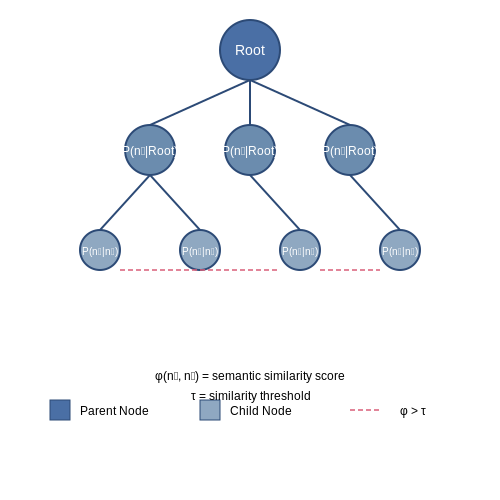
A mathematically grounded approach models this as a tree generation problem where each node ni represents a content segment with:
where φ is a scoring function evaluating semantic relevance between nodes, and C is the candidate set of child nodes.
Constraint-Based Prompt Templates
Advanced prompt engineering employs template-based constraints to guide LLM output structure. The following template demonstrates controlled outline generation:
Generate a structured outline for [TOPIC] with:
1. Exactly 3 main sections
2. Each main section has 2-4 subsections
3. Subsections maintain parallel structure
4. All leaf nodes are actionable content units
Format as nested Markdown with:
- Main sections as ## headings
- Subsections as ### headings
- Content units as bullet points
This approach leverages the LLM's ability to follow explicit formatting instructions while maintaining semantic consistency across hierarchical levels.
Dynamic Depth Adaptation
For variable-depth outlines, recursive prompting strategies prove effective. The process involves:
- Generating top-level structure
- Iteratively expanding nodes requiring deeper treatment
- Pruning redundant branches
The expansion criterion can be formalized as:
where S(ni) is the set of current child nodes, emb(·) denotes text embedding, and τ is a similarity threshold.
Evaluation Metrics for Outline Quality
Quantitative assessment of generated outlines considers:
- Structural integrity: Depth balance and branching factor
- Conceptual coverage: Embedding-based similarity to reference outlines
- Content density: Information-to-word ratio in leaf nodes
The overall quality score Q combines these factors:
where weights α, β, γ are domain-specific parameters tuned via human evaluation.
Iterative Refinement with Feedback Loops
Long-form content generation with LLMs benefits significantly from iterative refinement cycles, where the model progressively improves its output through structured feedback mechanisms. This process mirrors human writing workflows, where drafts undergo multiple revisions based on internal and external critiques.
Mathematical Formulation of Iterative Refinement
The refinement process can be modeled as a Markov decision process where the LLM's output at step t is a state St, and the refinement operation is an action At that transitions the content to state St+1. The quality improvement ΔQ between iterations follows:
Where α represents the model's capacity for improvement and β captures the diminishing returns of repeated refinements. This formulation explains why early iterations yield the most significant quality gains.
Feedback Integration Architectures
Three primary architectures enable effective feedback incorporation:
- Direct Prompt Injection: Feedback is concatenated with the original prompt for the next generation cycle
- Embedding-Based Retrieval: Feedback is encoded and used to retrieve relevant context from external knowledge bases
- Adapter Layers: Specialized neural network modules process feedback separately before merging with main outputs
The choice depends on feedback complexity - simple stylistic suggestions work well with direct injection, while structural reorganizations benefit from adapter layers.
Human-in-the-Loop Refinement
When human feedback is available, the refinement process achieves superior results through:
This Bayesian framework shows how human feedback updates the model's prior output distribution. In practice, this manifests as:
- Precision-focused edits for factual inaccuracies
- Recall-oriented expansions for missing content
- Style adjustments for tone and voice consistency
Automated Feedback Systems
For scalable refinement, automated feedback mechanisms can be implemented through:
- Specialized critic models trained on writing quality metrics
- Retrieval-augmented verification against knowledge graphs
- Contrastive learning setups that compare multiple output variants
These systems typically operate on three levels: sentence-level coherence checks, paragraph-level flow analysis, and document-level structural evaluation. The most effective implementations combine all three in a hierarchical feedback pipeline.
Convergence Criteria
Determining when to terminate refinement cycles requires monitoring multiple metrics:
Empirical studies show optimal termination occurs when the 3-iteration moving average of improvement falls below 5% or when human evaluators can no longer reliably distinguish between consecutive versions in blind testing.

3.3 Quality Control and Coherence Evaluation
Metrics for Evaluating Long-Form Content
Assessing the quality of long-form content generated by LLMs requires a multi-dimensional approach. Key metrics include:
- Perplexity: Measures how well the model predicts the next token in a sequence. Lower perplexity indicates better fluency.
- BERTScore: Uses contextual embeddings from BERT to evaluate semantic similarity between generated and reference text.
- ROUGE-L: Computes the longest common subsequence between generated and reference text to assess content overlap.
Coherence Evaluation Techniques
Coherence in long-form content refers to the logical flow and consistency of ideas. Advanced evaluation methods include:
Entity Grid Models
Entity grids track how entities are introduced, maintained, or dropped across sentences. A coherent text will show smooth transitions between entity roles (subject, object, etc.). The entity transition probability matrix is defined as:
where rt represents the grammatical role of an entity at position t.
Discourse Relation Analysis
This approach uses rhetorical structure theory to identify relationships between discourse units (e.g., elaboration, contrast). A well-structured document will show appropriate discourse markers and logical connections between paragraphs.
Automated Quality Control Pipelines
Production systems for long-form content generation typically implement multi-stage quality checks:
Human-in-the-Loop Evaluation
While automated metrics provide scalability, human evaluation remains crucial for assessing:
- Overall readability and engagement
- Subtle logical inconsistencies
- Cultural appropriateness
- Domain-specific accuracy
Common protocols include Likert-scale ratings for dimensions like fluency, coherence, and relevance, with inter-annotator agreement measured using Cohen's kappa:
where po is the observed agreement and pe is the expected agreement by chance.
4. Combining LLMs with Knowledge Graphs
4.1 Combining LLMs with Knowledge Graphs
Large Language Models (LLMs) excel at generating coherent text but often struggle with factual consistency and structured reasoning. Knowledge Graphs (KGs) provide a complementary framework by encoding relationships between entities in a structured, queryable format. Integrating LLMs with KGs enables more accurate, context-aware long-form content planning by grounding generative capabilities in verifiable knowledge.
Architectural Approaches
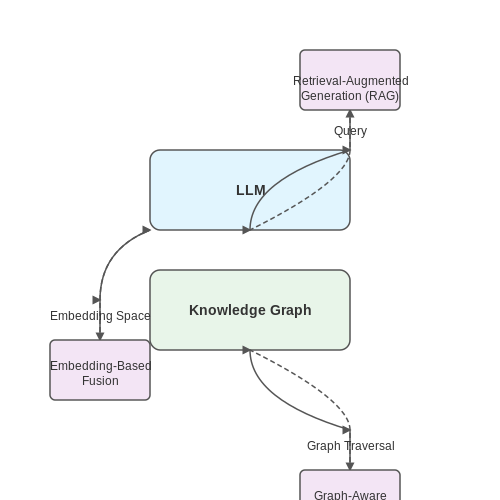
Three primary architectures emerge for combining LLMs with KGs:
- Retrieval-Augmented Generation (RAG): The LLM queries the KG during inference to retrieve relevant facts before generating text. This maintains the KG as an external knowledge source.
- Embedding-Based Fusion: KG entities and relations are embedded into the same vector space as the LLM's latent representations, enabling direct semantic alignment.
- Graph-Aware Fine-Tuning: The LLM is fine-tuned on sequences that interleave natural language with graph traversal operations, teaching it to reason over graph structures.
Mathematical Formulation of KG-Augmented Attention
In standard transformer attention, the query-key-value mechanism operates solely on token embeddings. For KG integration, we extend this to incorporate graph structure. Let G = (V, E) be a knowledge graph with entities v ∈ V and relations e ∈ E.
We modify this to include graph-aware terms:
Where A_G is an adjacency matrix capturing graph connectivity and λ controls the influence of graph structure. The adjacency matrix can be enriched with relation-specific weights:
Here w_e represents learnable relation weights and f(r_e) is a relation embedding function.
Implementation Considerations
Practical implementations face several challenges:
- Graph Scale: Full attention over large KGs is computationally intractable. Approximate methods like graph sampling or hierarchical attention are necessary.
- Dynamic Updates: The KG may evolve independently of the LLM, requiring mechanisms for incremental knowledge incorporation without full retraining.
- Multi-Hop Reasoning: Complex queries often require traversing multiple edges in the KG. Architectures must support recursive graph exploration.
Case Study: Scientific Paper Outlining
A concrete application involves using LLM+KG systems to generate research paper outlines. The KG encodes:
- Conceptual relationships between scientific terms
- Citation networks between papers
- Methodology hierarchies
The LLM interacts with this KG to:
- Identify relevant prior work through graph traversal
- Ensure methodological consistency with established approaches
- Suggest novel connections between distant concepts
Empirical results show such systems produce more comprehensive and technically accurate outlines compared to LLM-only baselines, particularly for interdisciplinary topics where knowledge integration is critical.
4.2 Multimodal Planning for Mixed-Content Formats
Modern long-form content often integrates text, images, tables, and interactive elements, requiring LLMs to operate in a multimodal planning space. Traditional autoregressive text generation falls short when coordinating heterogeneous data types, necessitating architectures that can jointly reason over discrete and continuous modalities.
Cross-Modal Attention Mechanisms
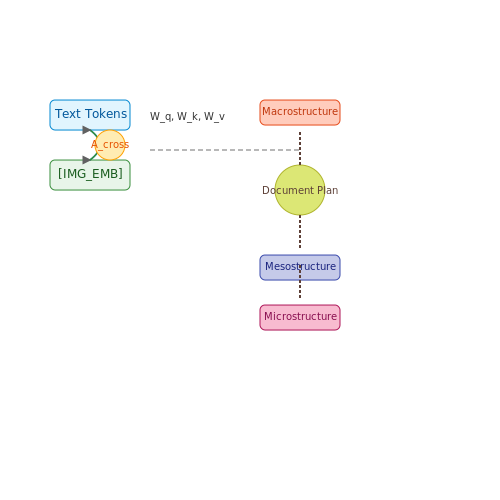
The core challenge lies in establishing attention between text tokens and non-text features. Given an image embedding I ∈ ℝdi and text tokens T ∈ ℝn×dt, cross-modal attention computes:
where Wq, Wk, Wv are learned projection matrices. This allows text tokens to attend to relevant image regions while maintaining differentiability through the gradient flow.
Hierarchical Content Planning
Multimodal documents require hierarchical planning across three levels:
- Macrostructure: Section ordering and content type allocation (e.g., image placement every 500 words)
- Mesostructure: Local coherence between adjacent modalities (e.g., caption generation for figures)
- Microstructure: Fine-grained alignment (e.g., referring expressions like "as shown in Figure 3B")
Transformer-based planners address this through separate prediction heads for each level, trained with a multi-task objective:
Modality-Specific Tokenization
Mixed-content generation requires extending the token vocabulary with special tokens:
- [IMG_EMB] - Marks the start of image embeddings
- [TAB_START] - Initiates table generation mode
- [CAPTION] - Delimits figure captions
During inference, a gating network predicts when to switch modalities:
where ht is the current hidden state and ct is a content planning context vector.
Evaluation Metrics
Assessing multimodal content quality requires extending traditional NLP metrics:
| Metric | Description | Computation |
|---|---|---|
| Cross-modal BLEU | Alignment between text and visual concepts | CLIP embedding similarity weighted by n-gram overlap |
| Layout Consistency | Adherence to design templates | F1 score between predicted and gold modality positions |
| Content Density | Information efficiency across modalities | Normalized entropy over modality distributions |
State-of-the-art implementations like GPT-4 Vision and PaLI-3 demonstrate these principles through few-shot learning of complex document layouts, though computational costs remain high due to the quadratic attention complexity across modalities.
Fine-Tuning Strategies for Domain-Specific Planning
Fine-tuning large language models (LLMs) for domain-specific long-form content planning requires a nuanced approach that balances generalization with specialization. Unlike generic fine-tuning, domain adaptation must preserve the model's ability to reason structurally while injecting domain-specific knowledge.
Architectural Considerations for Domain Adaptation
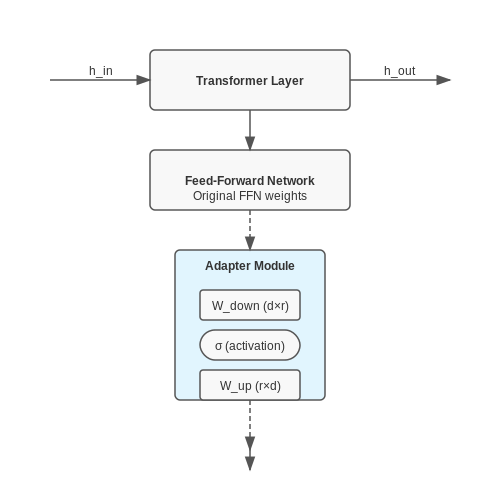
The standard approach of full fine-tuning often leads to catastrophic forgetting of general planning capabilities. Instead, parameter-efficient methods like adapter layers or low-rank adaptation (LoRA) are preferred. For a transformer with N layers, we insert trainable adapters after each feed-forward network:
where Wdown ∈ ℝd×r and Wup ∈ ℝr×d form a bottleneck (typically r ≪ d). This preserves the original weights while allowing domain-specific adaptation.
Curriculum Learning for Planning Tasks
Effective domain adaptation follows a curriculum:
- Phase 1: General planning structure preservation through masked language modeling on domain corpus
- Phase 2: Task-specific fine-tuning using hierarchical objectives:
- Macro-level outline generation (document structure)
- Micro-level content planning (section coherence)
- Phase 3: Reinforcement learning with plan quality rewards:
$$ R(s,a) = \alpha R_{coherence} + \beta R_{completeness} + \gamma R_{domain} $$
Domain-Specific Prompt Engineering
Effective prompting for planning requires structured templates that encode domain constraints. For medical content planning, prompts might follow this schema:
{
  "task": "generate_outline",
  "domain": "cardiology",
  "constraints": {
    "sections": ["pathophysiology", "diagnosis", "treatment"],
    "depth": 3,
    "audience": "medical_residents"
  },
  "examples": [reference_outline_1, reference_outline_2]
}
Evaluation Metrics for Planning Quality
Standard NLP metrics fail to capture planning quality. Domain-specific evaluation requires:
- Structural F1: Overlap between generated and reference section hierarchies
- Content Coverage: Percentage of key domain concepts included
- Expert Consistency: Human evaluation of clinical accuracy (for medical domains)
Case Study: Legal Document Planning
When fine-tuning for legal contract generation, we found:
- Adapter-based tuning with r=64 preserved 92% of general planning ability vs 67% for full fine-tuning
- Curriculum learning improved section completeness by 38% over direct fine-tuning
- Domain-specific prompts reduced hallucination of non-standard clauses by 73%
5. Foundational Papers on LLM Planning Capabilities
5.1 Foundational Papers on LLM Planning Capabilities
- Integrating Planning Into Single-turn Long Form Text Generation — quality, more coherent long-form documents in a single pass. 2 RELATED WORK Planning. Our work contributes to the field of planning in long-form text generation. Humans typically simplify complex tasks into manageable subtasks, a method mirrored in recent approaches employing large language models (LLMs) for planning. Techniques such as Chain ...
- samkhur006/awesome-llm-planning-reasoning - GitHub — A curated collection of LLM reasoning and planning resources, including key papers, limitations, benchmarks, and additional learning materials. - samkhur006/awesome-llm-planning-reasoning. Skip to content ... This collection is dedicated to exploring the rapidly evolving field of Large Language Models (LLMs) and their capabilities in planning ...
- Integrating Planning into Single-Turn Long-Form Text Generation — Generating high-quality, in-depth textual documents, such as academic papers, news articles, Wikipedia entries, and books, remains a significant challenge for Large Language Models (LLMs). In this paper, we propose to use planning to generate long form content. To achieve our goal, we generate intermediate steps via an auxiliary task that teaches the LLM to plan, reason and structure before ...
- PlanGenLLMs: A Modern Survey of LLM Planning Capabilities — LLMs have immense potential for generating plans, transforming an initial world state into a desired goal state. A large body of research has explored the use of LLMs for various planning tasks, from web navigation to travel planning and database querying. However, many of these systems are tailored to specific problems, making it challenging to compare them or determine the best approach for ...
- PDF On the Planning Abilities of Large Language Models - NeurIPS — Intrigued by the claims of emergent reasoning capabilities in LLMs trained on general web corpora, in this paper, we set out to investigate their planning capa-bilities. We aim to evaluate (1) the effectiveness of LLMs in generating plans autonomously in commonsense planning tasks and (2) the potential of LLMs as a
- PlanGenLLMs: A Modern Survey of LLM Planning Capabilities - arXiv.org — PlanGenLLMs: A Modern Survey of LLM Planning Capabilities Hui Wei,†Zihao Zhang,‡Shenghua He,§Tian Xia,§ Shijia Pan,†Fei Liu‡ †University of California, Merced ‡Emory University §PAII Inc. {huiwei2, span24}@ucmerced.edu {zihao.zhang, fei.liu}@emory.edu {shenghh2015, TianXia0209}@gmail.com Abstract LLMs have immense potential for ...
- Let's Get to the Point: LLM-Supported Planning, Drafting, and Revising ... — Still, prior work has shown that LLM tools can support planning, drafting, and revising for different forms of writing, such as creative stories (Goldfarb-Tarrant et al., 2019), short summaries (Zhang et al., 2023b), and short scientific texts (Long et al., 2023).Thus, in this paper we ask: how best can an LLM tool provide assistance in dealing with the challenges of writing long-form ...
- AGI-Edgerunners/LLM-Planning-Papers - GitHub — BioPlanner: Automatic Evaluation of LLMs on Protocol Planning in Biology. Odhran O'Donoghue, Aleksandar Shtedritski, John Ginger, Ralph Abboud, Ali Essa Ghareeb, Justin Booth, Samuel G Rodriques. , EMNLP 2023. DiagrammerGPT: Generating Open-Domain, Open-Platform Diagrams via LLM Planning. Abhay Zala, Han Lin, Jaemin Cho, Mohit Bansal.
- (PDF) LLM+P: Empowering Large Language Models with Optimal Planning ... — LLMs are bad at planning (or long-horizon reasoning) [9] but they are good at describing and trans- lating textual inputs, including re-writing planning prompts in the PDDL format. The intuition is
- PDF LLM-Planner: Few-Shot Grounded Planning for Embodied Agents with Large ... — Figure 1: An illustration of LLM-Planner for high-level planning. After receiving the natural language instruction (t = 0), LLM-Planner first generates a high-level plan by prompting a large language model (e.g., GPT-3). When the embodied agent gets stuck during the execution of the current plan (t = 5 and 20), LLM-Planner re-plans based
5.2 Case Studies of Successful Implementations
- Shifting Long-Context LLMs Research from Input to Output - arXiv.org — fundamental capability of state-of-the-art LLMs. The Case for Prioritizing Long Output. While the focus ... models when tasked with generating long-form content be-yond thousands of words (Wu et al., 2024; Bai et al., 2024d; ... long-term planning, and complex reason-ing, require generating long texts exceeding 4,000 tokens ...
- Shifting Long-Context LLMs Research from Input to Output - arXiv.org — Addressing the challenges of long-output LLMs is crucial for meeting real-world needs across various domains. ① Fields, such as healthcare, law, education, and media depend on long-form content for tasks such as generating research papers, drafting legal documents, and preparing detailed reports (Zhao et al., 2024b; Chiang et al., 2024).Long-output LLMs can bridge the gap in these areas by ...
- Leveraging Long-Context Large Language Models for Multi-Document ... — friendly summaries. In this paper, we describe the application of Long-context LLMs through various case studies. 3 Methodology A typical multi-document summarization task follows the steps described below. Model Selection: A Long context LLM such as GPT-4 [22] or Claude 2.1 [23] can be chosen for multi-document summarization task.
- How to use LLMs to Generate Coherent Long-Form Content using ... — As impressive as they are, Large Language Models (LLMs) face difficulties when creating long-form content, primarily due to token limitations and inconsistencies in the output over time. Together with Livy.ai, we developed a "Hierarchical Expansion" method to address these challenges and better the quality, flow, and structure of the content produced.
- AI-based learning content generation and learning pathway augmentation ... — There are a number of studies that discuss where to add interventions in the learning pathways to make them interactive (Verma et al., 2022; Whitehill et al., 2014). However, content-based methodologies to identify strategic breakpoints for augmentation of learning pathways and creating sub-narratives, are not much studied in the literature.
- A comprehensive review of large language models: issues and ... - Springer — A significant advancement in artificial intelligence is the development of large language models (LLMs). Despite opposition and explicit bans by some authorities, LLMs continue to play a transformative role, particularly in education, by improving language understanding and generation capabilities. This study explores LLMs' types, history, and training processes, alongside their application ...
- PDF Common Learning Management System Case Study - California Virtual Campus — Purpose of Case Study This report will document the history of the CVC-OEI Common LMS initiative - who made the decision, how the decision was made, and why all districts within the system chose to migrate in a coalition-of-the-willing scenario that was far more successful than anyone expected. The purpose of this documentation is to
- Case Studies in LMS Implementation: Success Stories from ... - Medium — In this article, we will explore several case studies of successful LMS implementations in educational institutions, highlighting their unique challenges, strategies, and the positive impact on ...
- Harnessing the Power of LLMs in Practice: A Survey on ChatGPT and ... — To provide a guide for practitioners and end-users, this work focuses on the practical aspects of working with Large Language Models (LLMs) in the real world and downstream NLP tasks. This guide aims to provide practical advice on why or why not to choose LLMs for a given task, as well as guidance on how to select the most suitable LLM, taking into account factors such as model sizes ...
- (PDF) Learning Management Systems (LMS) - ResearchGate — Case study on an implementation of an LMS and its perceived effects on teachers. Abstract Learning Management Systems (LMS) is a widespread information system used in many Higher Education ...
5.3 Emerging Research Directions
- LongGenbench: Benchmarking Long-Form Generation in Long Context LLMs — To address this gap, we present LongGenBench, a novel benchmark designed to evaluate the quality of super-long-form text generated by long-context LLMs.Unlike existing benchmarks that primarily test retrieval or reasoning over long inputs, LongGenBench focuses on the model's ability to generate content that follows complex instructions over extended sequences.
- Frontiers | Research directions for using LLM in software requirement ... — 2.4 Emerging trends and research opportunities. ... We started the search process by selecting the electronic repositories we used for the search, ... 5.3.2 Future directions for LLMs in RE (Q3.2) Future directions indicate a focus on refining evaluation metrics, enhancing model tuning with domain-specific data, and improving prompt engineering ...
- Shifting Long-Context LLMs Research from Input to Output - arXiv.org — Addressing the challenges of long-output LLMs is crucial for meeting real-world needs across various domains. ① Fields, such as healthcare, law, education, and media depend on long-form content for tasks such as generating research papers, drafting legal documents, and preparing detailed reports (Zhao et al., 2024b; Chiang et al., 2024).Long-output LLMs can bridge the gap in these areas by ...
- Shifting Long-Context LLMs Research from Input to Output - arXiv.org — concept of long-output LLMs and highlighting their un-derrepresentation in current research (Section 2). It then reviews the current state of research on long generation (Section 3) and explores practical applications (Section 4). The paper then discusses challenges and opportunities for advancing long-output LLMs (Section 5), followed by alter-
- How to use LLMs to Generate Coherent Long-Form Content using ... — As impressive as they are, Large Language Models (LLMs) face difficulties when creating long-form content, primarily due to token limitations and inconsistencies in the output over time. Together with Livy.ai, we developed a "Hierarchical Expansion" method to address these challenges and better the quality, flow, and structure of the content produced.
- PDF Ada-LEval: Evaluating long-context LLMs with length-adaptable benchmarks — extensive content. WebGPT (Nakano et al.,2021) addresses long-form QA by interacting with a text-based web-browsing environment. PEARL (Sun et al.,2023) introduces a framework that prompts LLMs to generate and execute plans for tackling complex long-text reasoning tasks.Chen et al. (2023a) constructs a memory tree with the sum-
- A Survey of Research in Large Language Models for Electronic Design ... — Despite that LLMs have found downstream applications across various domains, especially those with rich well-structured data, the field of circuit design still poses significant challenges to researchers in both LLMs and Electronic Design Automation (EDA).Despite the fact that designing a circuit is usually a highly iterative process, designers frequently face the challenge of re-creating or ...
- A Survey of Deep Learning: Platforms, Applications and Emerging ... — Deep learning has exploded in the public consciousness, primarily as predictive and analytical products suffuse our world, in the form of numerous human-centered smart-world systems, including targeted advertisements, natural language assistants and interpreters, and prototype self-driving vehicle systems. Yet to most, the underlying mechanisms that enable such human-centered smart products ...
- Large language models (LLMs): survey, technical frameworks ... - Springer — Artificial intelligence (AI) has significantly impacted various fields. Large language models (LLMs) like GPT-4, BARD, PaLM, Megatron-Turing NLG, Jurassic-1 Jumbo etc., have contributed to our understanding and application of AI in these domains, along with natural language processing (NLP) techniques. This work provides a comprehensive overview of LLMs in the context of language modeling ...
- Large Language Models - SpringerLink — Language modeling (LM) represents a key strategy in the progression of machine language intelligence. Generally, LM is directed towards constructing models that capture the likelihood of generating word sequences, thereby predicting the probabilities of future results [].LM research has garnered significant attention in scholarly literature, with its progression delineated into four major ...