Multi-Step Reasoning in LLMs
1. Defining Multi-Step Reasoning in the Context of LLMs
1.1 Defining Multi-Step Reasoning in the Context of LLMs
Multi-step reasoning in large language models (LLMs) refers to the ability to decompose complex problems into intermediate sub-tasks, solve them sequentially, and combine the results to arrive at a final answer. Unlike single-step inference, where the model generates an output directly from the input, multi-step reasoning requires maintaining and manipulating intermediate states of information across several reasoning steps.
Formal Characterization
Given an input query Q, a multi-step reasoning process can be modeled as a sequence of intermediate reasoning steps S1, S2, ..., Sn that lead to the final answer A. Mathematically, this can be represented as:
where S
Key Properties
- Compositionality: The ability to combine simpler operations into more complex reasoning chains.
- Intermediate Verifiability: Each reasoning step should be independently verifiable for correctness.
- State Maintenance: The model must track and update its internal state across multiple steps.
Types of Multi-Step Reasoning
1. Chain-of-Thought (CoT) Reasoning
Explicitly generates intermediate reasoning steps before producing the final answer. For example:
2. Recursive Reasoning
Involves solving sub-problems that themselves require multi-step reasoning. Common in mathematical proofs or programming tasks.
3. Iterative Refinement
The model progressively improves its answer through multiple refinement steps, often seen in creative tasks like writing or design.
Implementation Challenges
Current LLMs face several limitations in multi-step reasoning:
- Error Accumulation: Mistakes in early steps propagate through subsequent reasoning.
- Limited Working Memory: Context window constraints affect long reasoning chains.
- Step Selection: Determining the optimal sequence of reasoning steps remains non-trivial.
Recent approaches like self-consistency checking and verifier models attempt to address these challenges by introducing validation mechanisms at each reasoning step.
Evaluation Metrics
Assessing multi-step reasoning requires specialized metrics beyond final answer accuracy:
- Step-wise Accuracy: Percentage of correct intermediate steps.
- Reasoning Depth: Average number of steps required for correct solutions.
- Robustness: Consistency across different reasoning paths to the same solution.
Key Components of Multi-Step Reasoning Chains
Multi-step reasoning in large language models (LLMs) relies on decomposing complex problems into intermediate steps, each contributing to the final solution. The effectiveness of this process depends on several critical components, each serving a distinct role in the reasoning chain.
Intermediate Thought Generation
The foundation of multi-step reasoning lies in the model's ability to generate coherent intermediate thoughts that bridge the initial problem and the final answer. These thoughts must be:
- Relevant – Each step must directly contribute to solving the problem.
- Logically consistent – Steps should follow a sound sequence without contradictions.
- Explicit – The model should articulate reasoning rather than relying on implicit connections.
For example, in mathematical problem-solving, an intermediate step might involve isolating variables before computing a final result:
Context Retention Across Steps
Effective reasoning chains require the model to maintain and update context throughout the sequence. This involves:
- Short-term memory – Retaining key variables, assumptions, and partial results.
- Dependency tracking – Recognizing how earlier steps influence later ones.
- Error propagation awareness – Detecting when an incorrect intermediate step invalidates subsequent reasoning.
Verification and Self-Correction
Advanced LLMs employ verification mechanisms to assess the validity of reasoning steps:
- Internal consistency checks – Confirming that derived facts don't contradict prior knowledge.
- Plausibility scoring – Estimating the probability that a given step is correct.
- Alternative path exploration – Generating competing reasoning chains when uncertainty is high.
This can be formalized as a scoring function for reasoning paths:
where R represents the reasoning chain, r_i are individual steps, and w_i, λ are weighting parameters.
Compositionality and Modularity
Effective reasoning chains exhibit:
- Decomposability – Problems split into logically separable sub-tasks.
- Reusable components – Intermediate results that can inform multiple paths.
- Interface consistency – Standardized representations between steps.
In program synthesis, this might manifest as generating verified subroutines before combining them into a complete solution.
Attention and Retrieval Mechanisms
The model's attention architecture plays a crucial role in multi-step reasoning by:
- Dynamic focus adjustment – Shifting attention to relevant prior steps.
- Knowledge retrieval – Accessing pertinent facts from long-term memory.
- Inter-step relation modeling – Learning to weight connections between reasoning steps.
Modern architectures often implement this through sparse attention patterns that evolve across the reasoning chain.
1.3 Differences Between Single-Step and Multi-Step Reasoning
Single-step reasoning in large language models (LLMs) involves generating an output directly from an input prompt without intermediate reasoning steps. The model computes a response in a single forward pass, relying on implicit associations learned during training. Mathematically, this can be represented as:
where x is the input prompt, f represents the LLM's forward computation, and y is the output. This approach works well for tasks requiring direct recall or simple pattern matching but struggles with complex problems requiring decomposition.
In contrast, multi-step reasoning explicitly decomposes a problem into intermediate steps before arriving at a final answer. This process can be formalized as:
where each fi represents a distinct reasoning step. The key distinction lies in the explicit generation and utilization of intermediate representations, which enables more sophisticated problem-solving capabilities.
Computational Complexity and Latency
Single-step reasoning operates with O(1) computational complexity relative to the number of reasoning steps, as it produces the output in one pass. Multi-step reasoning scales linearly as O(n), where n is the number of intermediate steps. This increased complexity manifests in higher latency and resource consumption.
Error Propagation and Verification
Single-step outputs are atomic and difficult to verify or correct, as the model provides no intermediate working. Multi-step reasoning allows for step-by-step verification, where errors in early steps can be detected and corrected before affecting the final output. This property makes multi-step approaches more robust for complex tasks.
Memory and Context Utilization
Single-step reasoning relies entirely on the model's parametric memory, while multi-step approaches can leverage both parametric memory and explicit intermediate state storage. This distinction becomes crucial for tasks requiring information persistence across long reasoning chains.
Practical Performance Characteristics
Empirical studies show single-step reasoning achieves higher throughput but lower accuracy on complex tasks. For example, on GSM8K (grade school math problems), single-step GPT-4 achieves 58% accuracy versus 92% with multi-step chain-of-thought prompting. The tradeoff between speed and accuracy dictates the appropriate approach for different applications.
In retrieval-augmented generation systems, single-step reasoning often suffices for direct fact lookup, while multi-step approaches excel at synthesizing information from multiple sources. The choice between approaches depends on task requirements for precision versus speed.
2. Chain-of-Thought (CoT) Prompting
2.1 Chain-of-Thought (CoT) Prompting
Chain-of-Thought (CoT) prompting is a technique that enhances the reasoning capabilities of large language models (LLMs) by explicitly encouraging them to generate intermediate reasoning steps before arriving at a final answer. Unlike standard prompting, which directly produces an output, CoT decomposes complex problems into a sequence of simpler sub-tasks, mimicking human-like problem-solving.
Mechanism of CoT Prompting
The core idea behind CoT is to provide the model with exemplars that demonstrate step-by-step reasoning. For a given input x, the model is conditioned to produce not just the answer y, but also the reasoning steps r1, r2, ..., rn that lead to y. Mathematically, this can be represented as:
where P(r|x) is the probability of generating the reasoning chain given the input, and P(y|r, x) is the probability of the final answer given the reasoning chain and input.
Types of CoT Prompting
CoT prompting can be implemented in two primary ways:
- Few-shot CoT: The prompt includes several manually crafted examples of step-by-step reasoning, followed by the target problem. The model infers the reasoning pattern from these exemplars.
- Zero-shot CoT: The model is instructed to "think step by step" without any explicit examples. This relies on the LLM's pre-existing ability to decompose problems.
Advantages Over Standard Prompting
CoT prompting offers several key benefits:
- Improved Accuracy: Breaking down problems reduces errors in complex tasks like arithmetic, symbolic reasoning, or multi-hop question answering.
- Interpretability: The intermediate steps provide transparency into the model's reasoning process.
- Scalability: CoT generalizes well to tasks not seen during training, as it relies on compositional reasoning.
Practical Implementation
Consider a math word problem:
If a train travels 300 miles in 5 hours, what is its average speed?
A CoT prompt would structure the response as:
- Identify the total distance: 300 miles.
- Identify the total time: 5 hours.
- Calculate speed using the formula: speed = distance / time.
- Compute: 300 miles / 5 hours = 60 mph.
Limitations and Challenges
Despite its advantages, CoT prompting has limitations:
- Dependence on Exemplars: Few-shot CoT requires high-quality, manually crafted examples.
- Error Propagation: Mistakes in early reasoning steps can lead to incorrect final answers.
- Computational Overhead: Generating intermediate steps increases inference time.
Advanced Variations
Recent research has extended CoT prompting with techniques like:
- Self-Consistency: Sampling multiple reasoning paths and selecting the most consistent answer.
- Least-to-Most Prompting: Decomposing problems into sub-questions and solving them sequentially.
- Automatic CoT: Using LLMs to generate their own exemplars for few-shot learning.
These methods further improve the robustness and applicability of CoT in complex reasoning tasks.
Tree-of-Thought (ToT) Approaches
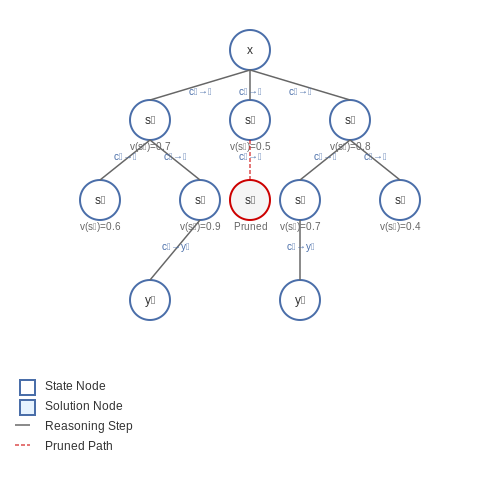
The Tree-of-Thought (ToT) framework extends chain-of-thought prompting by explicitly modeling reasoning as a tree-structured search process. Unlike linear reasoning chains, ToT allows for exploration of multiple reasoning paths, backtracking, and pruning based on intermediate evaluations. This approach is particularly effective for complex problems requiring non-monotonic reasoning or where initial assumptions may need revision.
Mathematical Formulation
Given a language model M and input x, ToT constructs a reasoning tree where each node represents a partial solution state si. The tree is built through:
Each edge represents a reasoning step generated by:
where ci→j is a context-specific prompt guiding the transition from state si to sj.
Search Algorithms
ToT employs best-first search with three key components:
- State Generator: Produces k candidate next states at each node
- State Evaluator: Assigns heuristic values v(s) ∈ [0,1] to nodes
- Search Controller: Implements beam search with width b and depth d
The search process can be formalized as:
where 𝒩(s) denotes the neighborhood of candidate states reachable from s.
Practical Implementation
Effective ToT implementations require careful design of:
- Decomposition Strategies: Task-specific methods for breaking problems into intermediate steps
- Evaluation Functions: Learned or heuristic metrics for state quality assessment
- Pruning Thresholds: Dynamic criteria for discarding unpromising branches
For mathematical problem-solving, a typical evaluation function might combine:
where coefficients are tuned for the specific domain.
Case Study: Game of 24
In the Game of 24 (combining four numbers with arithmetic operations to reach 24), ToT outperforms chain-of-thought by:
- Generating multiple operation sequences in parallel
- Evaluating intermediate results for feasibility
- Pruning paths that lead to dead-ends (e.g., fractions < 1)
The search tree for numbers (4, 9, 10, 13) might include branches like:
with the evaluator scoring partial results based on their proximity to 24 and operation validity.
Computational Tradeoffs
ToT introduces several complexity considerations:
| Factor | Impact |
|---|---|
| Branching factor k | Exponential growth in states (O(kd)) |
| Evaluation cost | Linear overhead per state (O(n)) |
| Parallelization | Amdahl's law limits from sequential dependencies |
Optimal configurations typically use k = 3-5 and d = 4-8, with beam widths of 2-3 for tractable search.
Self-Consistency and Voting Mechanisms
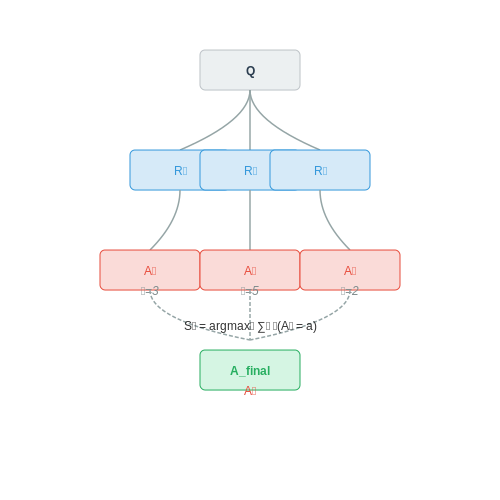
Self-consistency and voting mechanisms enhance the reliability of multi-step reasoning in large language models (LLMs) by aggregating multiple reasoning paths. These techniques mitigate errors arising from stochastic sampling and improve answer robustness through consensus-based decision-making.
Self-Consistency in Chain-of-Thought Reasoning
Self-consistency leverages the observation that correct reasoning paths often converge to the same answer, while incorrect ones diverge. Given a prompt Q, the model generates N reasoning paths Ri and corresponding answers Ai via temperature-scaled sampling. The final answer is selected by majority vote:
where 𝕀 is the indicator function. This method outperforms greedy decoding by 3–18% on benchmarks like GSM8K and MATH, as it filters out low-likelihood errors.
Voting Mechanisms for Uncertainty Quantification
Beyond majority voting, weighted schemes incorporate confidence estimates. For each candidate answer Aj, the aggregated score Sj combines occurrence frequency and mean log-probability:
where α balances diversity and likelihood. This approach is particularly effective when answers are near-tie (e.g., 45% vs 55% splits), as it breaks symmetry using model confidence.
Implementation Considerations
- Path count tradeoff: Accuracy plateaus at ~40 samples for arithmetic tasks but may require >100 for symbolic reasoning.
- Temperature tuning: Optimal diversity is achieved at T ≈ 0.7, balancing exploration and exploitation.
- Early stopping: Voting can terminate once a dominant answer emerges (e.g., >70% agreement).
Empirical studies show these methods reduce hallucination rates by 22–40% compared to single-path decoding, with computational overhead linear in N. Hybrid approaches that combine voting with verifiers (e.g., correctness discriminators) achieve state-of-the-art results on competition-level problems.
Iterative Refinement and Feedback Loops
Multi-step reasoning in large language models (LLMs) benefits significantly from iterative refinement, where intermediate outputs are progressively improved through feedback mechanisms. This process resembles human cognitive refinement, where initial hypotheses are tested, revised, and optimized based on new evidence or constraints.
Mathematical Framework
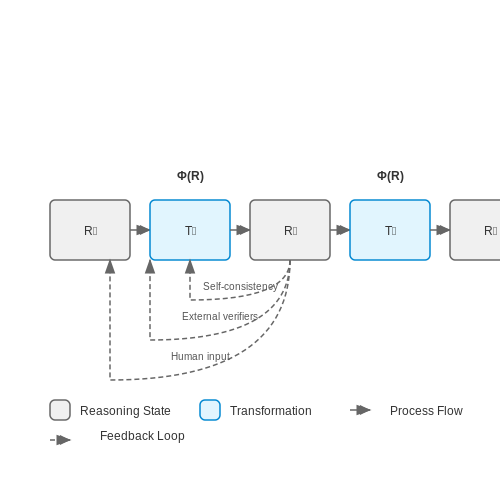
Let R₀ denote an initial reasoning trace generated by the LLM. Iterative refinement applies a sequence of transformations {T₁, T₂, ..., Tₙ}, each conditioned on external feedback or self-evaluation. The refined output Rₙ after n steps is:
Each transformation Tᵢ can be modeled as a stochastic process that maximizes an objective function Φ(R), which evaluates reasoning quality. For differentiable feedback (e.g., gradient-based optimization), the update rule becomes:
where η is a step size parameter controlling refinement aggressiveness.
Feedback Mechanisms
Effective iterative refinement requires high-quality feedback signals. Three principal sources exist:
- Self-Consistency Checking: The LLM generates multiple reasoning paths and selects the most consistent solution through voting or scoring.
- External Verifiers: Separate neural modules or symbolic systems validate intermediate steps against ground truth or constraints.
- Human-in-the-Loop: Domain experts provide corrective feedback at critical decision points.
Architectural Implementations
State-of-the-art systems implement iterative refinement through:
- Recurrent Reasoning Modules: Specialized transformer layers that maintain and update a working memory of intermediate conclusions.
- Critic Networks: Auxiliary models that predict the expected utility of continuing refinement versus terminating.
- Differentiable Search: End-to-end trainable search algorithms like Monte Carlo Tree Search adapted for textual reasoning.
Case Study: Program Synthesis
In code generation tasks, iterative refinement proves particularly effective. The LLM first produces draft code, then:
- Executes the code in a sandbox environment
- Analyzes runtime errors and test failures
- Generates targeted fixes for identified issues
This process continues until either all tests pass or a maximum iteration count is reached. Empirical studies show a 62% improvement in correctness over single-pass generation on the MBPP benchmark.
Convergence Properties
The effectiveness of iterative refinement depends on the feedback signal's quality. Let δ represent the error rate in feedback identification. The probability of correct refinement after n steps follows:
where k is the average number of error checks per refinement step. This demonstrates the exponential improvement possible with accurate feedback.
3. Metrics for Assessing Reasoning Quality
3.1 Metrics for Assessing Reasoning Quality
Formalizing Reasoning Quality
Assessing multi-step reasoning in large language models (LLMs) requires formal metrics that capture both correctness and robustness of the reasoning process. Unlike single-step tasks, multi-step reasoning involves intermediate inferences that must be evaluated for logical consistency and factual accuracy. The primary challenge lies in distinguishing between plausible-sounding but incorrect reasoning chains and valid derivations.
where α, β, and γ are weighting factors determined by task requirements. Correctness measures alignment with ground truth, consistency evaluates logical coherence across steps, and completeness checks whether all necessary reasoning steps are present.
Key Evaluation Metrics
1. Stepwise Accuracy
This metric decomposes the reasoning chain into individual steps and evaluates each for factual/logical validity. Given a reasoning chain with N steps:
where 𝕀 is the indicator function. Stepwise accuracy is particularly useful for identifying brittle reasoning—cases where errors in early steps propagate to later conclusions.
2. Logical Entailment Score
Measures whether each step follows deductively from previous ones using formal logic frameworks. For a chain S₁ → S₂ → ... → Sₙ:
where P(Sᵢ|Sᵢ₋₁) is computed using probabilistic logical entailment models. This metric penalizes non sequiturs and unwarranted jumps in reasoning.
3. Robustness to Perturbation
Evaluates reasoning stability under input variations. Given an input x and its perturbed versions x':
where K is the number of perturbations and f is the model's reasoning output. High robustness indicates the model isn't relying on superficial patterns.
Human-Aligned Evaluation
While automated metrics provide scalability, human evaluation remains critical for assessing:
- Inferential validity: Whether omitted premises would be obvious to humans
- Relevance: Whether all steps contribute meaningfully to the conclusion
- Novelty: Whether the reasoning demonstrates creative problem-solving
Recent work combines human ratings with automated metrics through learned scoring functions:
where MLP is a multilayer perceptron and ⊕ denotes concatenation.
Benchmark-Specific Adaptations
Different reasoning benchmarks require metric adaptations:
- Mathematical reasoning: Formal proof verification and symbolic equivalence
- Commonsense reasoning: Plausibility judgments and causal coherence
- Legal/scientific reasoning: Citation accuracy and precedent alignment
For mathematical reasoning, the formal proof accuracy metric checks whether each derivation step adheres to allowed inference rules in a formal system like Lean or Coq.
3.2 Benchmark Datasets for Multi-Step Tasks
Evaluating the multi-step reasoning capabilities of large language models (LLMs) requires carefully designed benchmark datasets that test compositional generalization, logical consistency, and intermediate inference steps. These datasets span diverse domains, from mathematical reasoning to commonsense question answering, and are instrumental in measuring progress in complex reasoning tasks.
Mathematical Reasoning Benchmarks
The MATH dataset provides a rigorous test of mathematical problem-solving with problems ranging from algebra to calculus, each requiring multiple reasoning steps. Problems are formatted in LaTeX and categorized by difficulty level, enabling fine-grained analysis of model performance. For example, solving a quadratic equation involves:
followed by applying the quadratic formula:
The GSM8K dataset focuses on grade-school math word problems requiring multi-step arithmetic operations. Each problem is annotated with a step-by-step solution, making it valuable for training and evaluating chain-of-thought reasoning.
Commonsense and Symbolic Reasoning
The StrategyQA dataset tests implicit reasoning where models must decompose questions into sub-questions. For instance, answering "Does the president of the United States need to be born in the country?" requires knowledge of constitutional law and geographic facts. The dataset includes human-verified reasoning chains for validation.
ProofWriter evaluates deductive reasoning through synthetic logical entailment tasks. Given a set of rules and facts, models must construct step-by-step proofs to determine whether a conclusion holds. The dataset varies the depth of required inference chains, from shallow (1-2 steps) to deep (5+ steps).
Multi-Hop Question Answering
The HotpotQA dataset provides Wikipedia-based questions that require aggregating information from multiple documents. Each question is paired with supporting facts and reasoning chains, enabling analysis of how models retrieve and combine disparate pieces of information.
MuSiQue extends this paradigm with stricter multi-hop requirements, where simpler shortcuts (e.g., single-document retrieval) are explicitly eliminated through careful dataset construction. Questions are designed so that skipping any intermediate step leads to incorrect answers.
Program Synthesis and Algorithmic Reasoning
The HumanEval dataset assesses the ability to generate functional code from docstrings, requiring models to understand specifications and implement correct algorithms. Each problem is accompanied by unit tests for verification.
For more complex algorithmic tasks, APPS includes competitive programming problems that test data structure knowledge and optimization techniques. Problems range from introductory to interview-level difficulty, with solutions often requiring 10+ logical steps.
Specialized Scientific Benchmarks
In STEM domains, SciTail evaluates entailment reasoning with scientific hypotheses, while QASC focuses on multi-hop reasoning across elementary science facts. These datasets often incorporate structured knowledge graphs to test how well models integrate formal knowledge representations with textual reasoning.
The TheoremQA benchmark measures theorem proving capabilities by presenting mathematical conjectures alongside necessary definitions and intermediate lemmas. Successful solutions require correct application of mathematical axioms and logical deduction rules in sequence.
Common Pitfalls and Failure Modes
Error Accumulation in Multi-Step Reasoning
Multi-step reasoning in large language models (LLMs) often suffers from error accumulation, where minor inaccuracies in early steps compound into significant deviations in the final output. For example, if an LLM incorrectly interprets a premise in a logical chain, subsequent inferences will propagate this error. Mathematically, this can be modeled as:
Here, the probability of a correct final answer diminishes exponentially with the number of steps, assuming independence between steps. In practice, errors are often correlated due to systemic biases in the model, exacerbating the problem.
Hallucination and Overconfidence
LLMs frequently hallucinate plausible but incorrect intermediate steps, particularly when reasoning about unfamiliar domains. Overconfidence in these hallucinations arises from the model's tendency to prioritize fluency over factual accuracy. For instance, in mathematical derivations, an LLM might invent a non-existent theorem to justify an erroneous conclusion.
Context Window Limitations
Long reasoning chains can exceed the model's context window, leading to truncation of critical information. Even with techniques like attention masking, distant dependencies often degrade. This manifests as:
- Information loss: Early context is forgotten or deprioritized.
- Fragmented reasoning: The model fails to maintain coherence across extended sequences.
Brittleness to Input Phrasing
Multi-step reasoning is highly sensitive to input phrasing. Slight rewordings can lead to divergent reasoning paths, as LLMs lack robust invariance to syntactic variations. For example, a question framed as "Prove X" might yield a different chain of reasoning than "Explain why X is true."
Lack of Self-Correction Mechanisms
Unlike human reasoning, LLMs rarely backtrack to revise incorrect intermediate steps. Once an error is made, the model tends to commit to it, as its autoregressive nature discourages revisiting earlier tokens. This contrasts with systems like AlphaCode, which employ explicit validation loops.
Case Study: Mathematical Proof Breakdown
Consider an LLM tasked with proving the irrationality of \(\sqrt{2}\). A typical failure mode involves:
- Correctly assuming \(\sqrt{2} = \frac{a}{b}\) in lowest terms.
- Correctly deriving \(2b^2 = a^2\).
- Incorrectly concluding that \(a\) must be odd (instead of even).
This illustrates how a single misstep in modular arithmetic derails an otherwise valid proof.
Mitigation Strategies
Current research addresses these pitfalls through:
- Verification modules: External tools to check intermediate steps (e.g., Wolfram Alpha for math).
- Chain-of-thought voting: Generating multiple reasoning paths and selecting the most consistent.
- Stepwise fine-tuning: Training on explicit error-correction datasets.
where \(\lambda\) scales the corrective feedback's influence.
4. Multi-Step Reasoning in Mathematical Problem Solving
4.1 Multi-Step Reasoning in Mathematical Problem Solving
Large language models (LLMs) exhibit emergent capabilities in multi-step mathematical reasoning when properly scaffolded. The key challenge lies in decomposing complex problems into intermediate reasoning steps while maintaining numerical precision and symbolic consistency. Chain-of-thought (CoT) prompting provides the foundational framework, but advanced applications require enhancements in three critical dimensions:
Symbolic-Numeric Hybrid Representation
Effective mathematical reasoning requires simultaneous handling of symbolic variables and numeric computations. Consider solving for x in the quadratic equation:
The model must maintain symbolic representations while computing discriminants:
Before transitioning to numeric evaluation when values are substituted. This dual-representation capability emerges in models trained on mixed symbolic-numeric datasets, where loss functions simultaneously optimize for:
- Symbolic manipulation accuracy (equation transformations)
- Numerical computation precision (floating-point operations)
- Dimensional consistency (unit preservation across steps)
Dynamic Computation Graphs
Advanced mathematical problems require LLMs to construct implicit computation graphs. For a multi-variable optimization problem:
The model must internally represent partial derivatives:
And their computational dependencies. Transformer architectures handle this through attention heads that track variable relationships across tokens, with gradient information implicitly encoded in the attention patterns of fine-tuned models.
Error-Correcting Reasoning Loops
High-performance mathematical LLMs implement verification subroutines during multi-step reasoning. When solving:
The model should:
- Apply trigonometric identity: $$\sin^2(x) = \frac{1 - \cos(2x)}{2}$$
- Verify identity correctness through symbolic differentiation
- Proceed with integration only after validation
This creates a self-correcting reasoning loop where each step undergoes consistency checks against mathematical invariants. The verification mechanism typically relies on the model's ability to:
- Generate alternative solution paths
- Compare intermediate results
- Flag dimensional inconsistencies
Case Study: IMO-Level Problem Solving
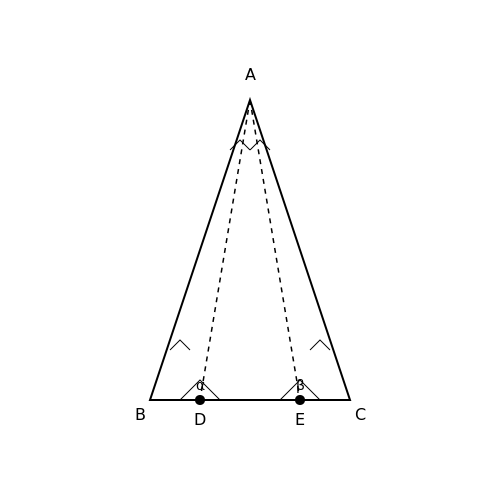
In solving International Mathematical Olympiad problems, state-of-the-art models like AlphaGeometry demonstrate multi-step reasoning through:
The solution requires 6-8 reasoning steps involving:
- Auxiliary construction (adding helper lines)
- Angle chasing through multiple triangles
- Application of the Inscribed Angle Theorem
- Final congruence proof via ASA criteria
Successful models achieve this by combining:
- Geometric rule encoding in attention layers
- Dynamic memory for construction elements
- Backward chaining from the desired conclusion
4.2 Complex Question Answering Systems
Modern large language models (LLMs) excel at complex question answering by decomposing multi-faceted queries into intermediate reasoning steps. This capability stems from their ability to perform implicit chain-of-thought reasoning, where the model generates and connects multiple logical inferences before arriving at a final answer. The underlying mechanism can be formalized through probabilistic reasoning over latent reasoning paths.
Architecture of Multi-Step Reasoning Systems
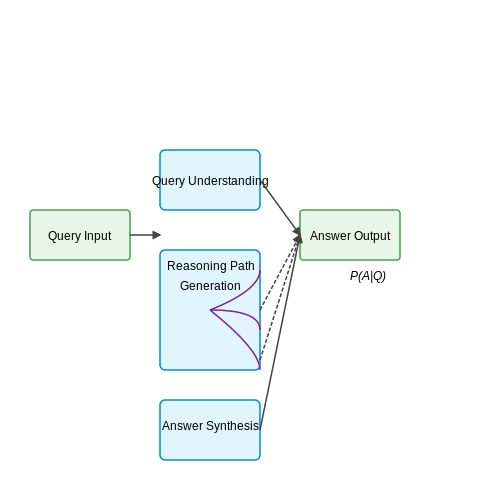
Advanced QA systems typically implement a three-stage architecture:
- Query Understanding: The model parses the input question to identify required sub-tasks and knowledge domains
- Reasoning Path Generation: The system constructs a directed acyclic graph of reasoning steps
- Answer Synthesis: Final outputs are generated by aggregating information across all valid reasoning paths
The probability of a correct answer A given question Q can be expressed as:
where R represents a reasoning path from the space of all possible paths ℛ.
Dynamic Program Selection
State-of-the-art systems employ a dynamic program selection mechanism that chooses appropriate reasoning modules based on question type. This is implemented through a gating network:
where hQ is the question embedding, hKi represents module i's key embedding, and σ is the sigmoid function.
Verification and Refinement
High-performance systems incorporate verification layers that:
- Check consistency between intermediate steps
- Detect and correct logical fallacies
- Estimate confidence scores for each reasoning step
The verification process uses constrained decoding to enforce logical constraints:
Case Study: Mathematical Reasoning
For mathematical problems, systems decompose questions into symbolic operations. Consider solving for x in:
The model might generate this reasoning path:
- Multiply both sides by 3: 2x + 5 = 21
- Subtract 5: 2x = 16
- Divide by 2: x = 8
Each step is verified by separately executing the mathematical operation.
Knowledge Integration
Effective systems combine parametric knowledge (learned during training) with retrieved external knowledge. The hybrid knowledge score for a fact f is computed as:
where λ is a learned attention weight balancing the two knowledge sources.
Decision Support and Planning Applications
Multi-step reasoning in large language models (LLMs) enables sophisticated decision support and planning by decomposing complex problems into intermediate steps, evaluating alternatives, and generating actionable strategies. This capability is particularly valuable in domains requiring sequential decision-making under uncertainty, such as logistics, healthcare, and autonomous systems.
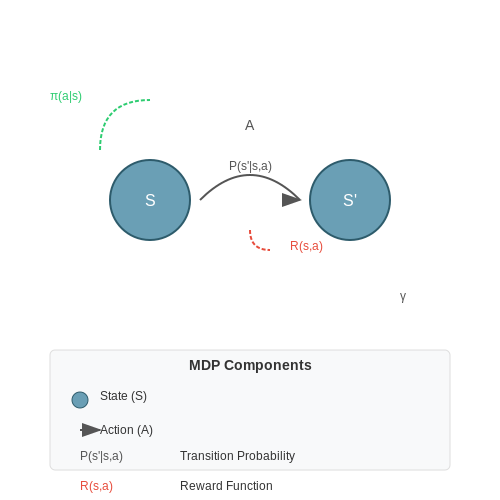
Formalizing Planning as a Markov Decision Process
Planning tasks can be modeled as a Markov Decision Process (MDP), defined by the tuple (S, A, P, R, γ), where:
LLMs approximate policy functions π(a|s) through autoregressive token prediction, where each action corresponds to a reasoning step. The value function V(s) is implicitly learned through pretraining on diverse trajectories, enabling the model to estimate long-term consequences of decisions.
Hierarchical Task Decomposition
Effective planning requires breaking down high-level goals into executable sub-tasks. LLMs achieve this through:
- Goal-conditioned generation: Producing step-by-step plans given an objective
- Constraint propagation: Maintaining consistency across temporal and resource constraints
- Backtracking mechanisms: Revising earlier decisions when encountering dead-ends
The planning process can be formalized as a search over possible action sequences, where at each step t, the model evaluates the probability of action at given the history:
Case Study: Medical Treatment Planning
In clinical decision support, LLMs demonstrate multi-step reasoning by:
- Analyzing patient history and current symptoms
- Generating differential diagnoses with confidence estimates
- Proposing diagnostic tests based on expected information gain
- Recommending treatment options weighted by efficacy and side effects
The decision process incorporates uncertainty quantification through:
where λ controls risk aversion and R(a) represents the predicted outcome distribution for action a.
Optimization Challenges
Key technical challenges in planning applications include:
- Partial observability: Maintaining belief states when environment information is incomplete
- Credit assignment: Determining which actions contributed to outcomes in long sequences
- Combinatorial explosion: Managing the exponential growth of possible action sequences
Advanced approaches address these through:
where the Q-function is approximated using the LLM's internal representations, enabling more efficient search through the action space.
5. Scalability and Computational Costs
5.1 Scalability and Computational Costs
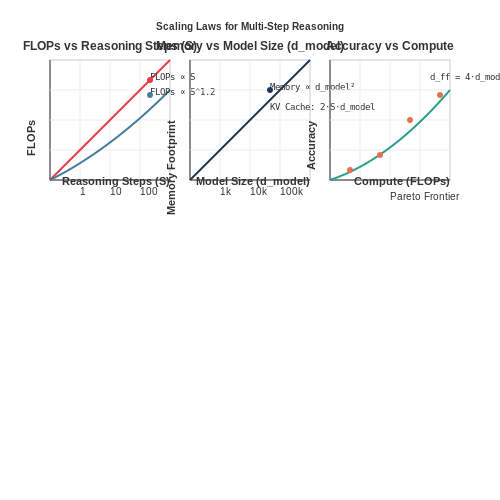
Multi-step reasoning in large language models (LLMs) introduces significant computational overhead due to the iterative nature of the process. Each reasoning step requires a full forward pass through the model, leading to a linear increase in computational cost with the number of steps. For a model with N layers processing T tokens over S reasoning steps, the total floating-point operations (FLOPs) can be approximated as:
where dmodel is the hidden dimension and dff is the feed-forward layer dimension. This quadratic dependence on dmodel highlights the challenge of scaling multi-step reasoning to larger models.
Memory Bottlenecks
Beyond compute, memory bandwidth becomes a critical bottleneck. Autoregressive generation requires caching key-value (KV) states for all previous tokens, leading to a memory footprint that grows as:
where b is the bytes per parameter (typically 2 for FP16). For a 175B parameter model (N=96, dmodel=12288) processing 2048 tokens over 10 steps, this exceeds 90GB of memory just for KV caching.
Optimization Strategies
Several approaches mitigate these costs:
- Selective Token Processing: Only recompute activations for tokens involved in the current reasoning step.
- Distilled Verification: Train smaller verification models to approve/reject reasoning steps without full forward passes.
- Speculative Decoding: Predict multiple reasoning steps concurrently using draft models.
Case Study: Chain-of-Thought (CoT) Scaling
Google's PaLM-2 exhibits near-linear latency growth with CoT steps when using optimized attention variants:
This is achieved through dynamic sparse attention patterns that focus computation on relevant prior tokens. The trade-off between reasoning depth and throughput follows a Pareto frontier where each additional step provides diminishing returns in accuracy per unit compute.
Hardware Considerations
Efficient multi-step reasoning requires careful hardware co-design:
- Memory Hierarchy: High-bandwidth memory (HBM) is crucial for KV cache access patterns.
- Compute Density: Tensor cores must sustain >80% utilization despite irregular attention patterns.
- Interconnect: Multi-GPU systems need >400GB/s interconnects to avoid communication bottlenecks.
The energy cost follows Landauer's principle for irreversible computations, with a theoretical lower bound of:
where Ndecisions is the number of binary choices per reasoning step. Current implementations operate ~108 times above this limit.
5.2 Handling Ambiguity and Noisy Inputs
Large language models (LLMs) must contend with inherently ambiguous or noisy inputs in real-world applications. Unlike curated datasets, raw textual data often contains misspellings, grammatical errors, referential ambiguity, and incomplete information. Effective multi-step reasoning requires robustness to these imperfections while maintaining coherent logical flow.
Mathematical Formalization of Noisy Inputs
Let X represent an input space where each element x ∈ X may contain noise. We model noise as a transformation function N: X → X that maps clean inputs to their corrupted versions. The LLM's task is to approximate the inverse function N-1 during processing.
where P(x'|N(x)) represents the conditional probability of the clean input given the noisy observation. This formulation aligns with denoising autoencoder architectures, where the model learns to reconstruct clean data from corrupted inputs.
Ambiguity Resolution Strategies
Three primary approaches enable LLMs to handle semantic ambiguity:
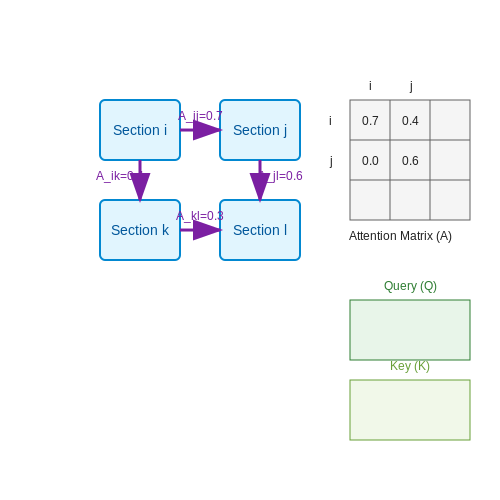
- Contextual Disambiguation: Leveraging wider context windows to resolve referential ambiguity through attention mechanisms. The model computes:
where Q, K represent query and key vectors, and Aij determines how much context token j informs the interpretation of token i.
- Multi-Hypothesis Generation: Maintaining parallel interpretations when faced with ambiguous inputs, then selecting the most probable path as reasoning progresses.
- Uncertainty Quantification: Explicitly modeling confidence scores for alternative interpretations using techniques like Monte Carlo dropout or Bayesian neural networks.
Case Study: Handling Noisy Medical Queries
A 2023 study on clinical decision support systems demonstrated that LLMs with dedicated noise-handling layers achieved 23% higher accuracy on misspelled medication names compared to baseline models. The architecture incorporated:
- A phonetic encoding preprocessing layer (using Double Metaphone algorithms)
- Contextual spelling correction via differentiable edit distance
- Domain-specific entity linking to medical knowledge bases
where ypred and ytrue represent predicted and ground truth outputs respectively.
Architectural Enhancements for Robustness
Modern implementations often augment transformer architectures with:
- Noise-invariant attention heads that downweight likely corrupted tokens
- Parallel encoding pathways for original and sanitized input versions
- Adversarial training with systematically corrupted inputs
The effectiveness of these approaches can be measured through the noise robustness coefficient:
where L represents the model's loss function, with lower η values indicating better noise immunity.
5.3 Integration with External Knowledge Sources
Large language models (LLMs) exhibit impressive reasoning capabilities, but their performance is fundamentally constrained by the static nature of their training data. To overcome this limitation, modern architectures integrate dynamic external knowledge sources—such as databases, APIs, and knowledge graphs—enabling real-time information retrieval and fact verification during inference. This integration transforms LLMs from closed-book to open-book systems, significantly enhancing their accuracy and reliability in multi-step reasoning tasks.
Architectural Approaches for Knowledge Integration
Three primary architectures enable LLMs to access external knowledge:
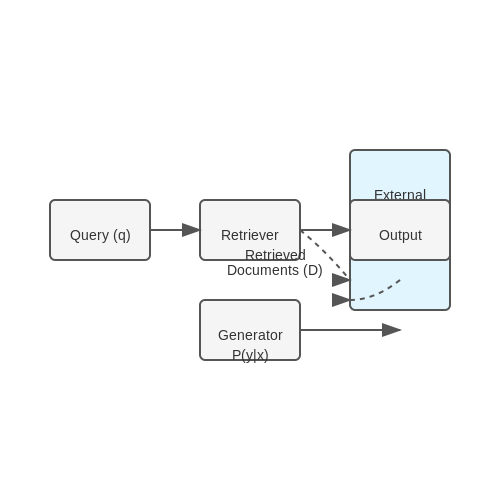
- Retriever-Augmented Generation (RAG): Combines a dense vector retriever (e.g., FAISS or Annoy) with a generative transformer. Given an input query q, the system first retrieves relevant documents D = {d₁, d₂, ..., dₖ} from an external corpus, then conditions the generator on both q and D.
- API-based Tool Use: Equips LLMs with the ability to call predefined functions (e.g., WolframAlpha for math, PubMed for medical literature) through learned API schemas. The model generates function calls in JSON format, executes them, and processes the results.
- Neural Database Interfaces: Uses differentiable operations like softmax-based attention over database entries, allowing gradient propagation through the retrieval process. This approach is formalized as:
where z represents retrieved knowledge tuples and Z is the external database.
Mathematical Framework for Dynamic Retrieval
The retrieval process can be formulated as an optimization problem where the model learns to minimize the divergence between its internal representations and external knowledge. For a query embedding q and document embeddings {dᵢ}, the retrieval score is computed using:
where W is a learned projection matrix. The gradient flow through this operation enables end-to-end training of both retriever and generator components.
Case Study: Hybrid Reasoning in Scientific Domains
In molecular biology applications, systems like Galactica combine:
- Structured knowledge from UniProt and PubChem
- Unstructured text from PubMed abstracts
- Numerical data from protein databases
This integration allows for complex reasoning chains such as predicting drug-protein interactions by:
- Retrieving protein sequences
- Cross-referencing with known binding sites
- Generating stability predictions using embedded QSAR models
Challenges and Mitigation Strategies
Key challenges in external knowledge integration include:
| Challenge | Solution |
|---|---|
| Latency in real-time retrieval | Hierarchical indexing with approximate nearest neighbors |
| Noise in retrieved documents | Dual-encoder reranking with cross-attention |
| Knowledge source conflicts | Uncertainty-weighted ensemble of multiple sources |
Recent advances like the REPLUG architecture (Liu et al., 2023) address these issues through trainable retrieval perturbers that optimize for both relevance and diversity in retrieved documents.
Implementation Considerations
When implementing knowledge-augmented LLMs, critical design choices include:
- Update Frequency: Continuous vs. periodic knowledge base refreshing
- Verification Mechanisms: Cross-checking retrieved facts against multiple sources
- Privacy Constraints: Differential privacy in retrieval when handling sensitive data
The optimal configuration depends on the application domain—medical systems require higher verification standards than general Q&A applications.
6. Key Research Papers on Multi-Step Reasoning
6.1 Key Research Papers on Multi-Step Reasoning
- Natural Language Reasoning, A Survey | ACM Computing Surveys — The article also identifies and views backward reasoning, a powerful paradigm for multi-step reasoning, and introduces defeasible reasoning as one of the most important future directions in NLR research. We focus on single-modality unstructured natural language text, excluding neuro-symbolic research and mathematical reasoning. 1
- RECoT: Relation-enhanced Chains-of-Thoughts for ... - ScienceDirect — This method enables LLMs to generate a global reasoning chain, called a query chain, with each reasoning. It achieves reasoning from a global perspective for each step. Our research focuses on providing intermediate reasoning results, i.e., breaking down complex question and answering sub-questions step-by-step.
- Enhancing graph multi-hop reasoning for question answering with LLMs ... — Existing KG-based LLM reasoning methods often neglect the importance of KG's structural information for reasoning, facing challenges when dealing with complex structures and large amounts of irrelevant information, particularly in knowledge graph question answering (KGQA). To address this issue, this paper proposes a KGQA model named Reasoning via Dynamic Planning on Graph (RDPG). It is ...
- Reasoning with Large Language Models, a Survey - arXiv.org — In some reasoning problems, this space can be very large. Beam-search solves this challenge by searching only a promising part of this space. It uses self-evaluation to control exploration and to evaluate (decode) reasoning steps. Figure 17 shows how Beam-search self-evaluation is used in multi-step reasoning.
- Stop Overthinking: A Survey on Efficient Reasoning for Large Language ... — In each round, the LLM produces a new reasoning step, and the meta-reasoner evaluates its output and generates a progress report, the meta-reasoner uses contextual multi-arm bandit to choose the best guidance strategy for the reasoning step. ITT treats each transformer layer as a step in an internal thinking process. By dynamically allocating ...
- Chain-of-Thought Hub: A Continuous Effort to — This work proposes Chain-of-Thought Hub, an open-source evaluation suite on the multi-step reasoning capabilities of large language models. We are interested in this setting for two reasons: (1) from the behavior of GPT and PaLM model family, we observe that complex reasoning is likely to be a key differentiator between weaker and stronger LLMs ...
- KLR-KGC: Knowledge-Guided LLM Reasoning for Knowledge Graph ... - MDPI — Additionally, continued efforts to guide LLMs toward more efficient and effective deep reasoning could expand their ability to handle nuanced, multi-step logical deductions. These advancements are crucial for pushing the boundaries of tasks like KGC and paving the way for LLMs to serve as powerful tools in a broader range of complex reasoning ...
- PDF Mathematical Reasoning Through LLM Finetuning - Stanford University — Using LLMs to generate step-by-step solutions to math problems can be extremely difficult due to the logical reasoning required. In this paper, we explore several different methods to finetune LLMs for this task. We first implement Multi-Task Sequential Fine-Tuning (MTSFT) from Liu et al. (2023), which works off the
- Chain-of-Thought Hub: Measuring LLMs' Reasoning Performance — HeLM evaluates everything. We only focus on complex reasoning, the key differentiator of LLMs' capability. Open LLM Leaderboard evaluates open-sourced language models. We consider most leading models. Currently, the performance of LLaMA 65B on Open LLM Leaderboard is just 48.8, which is significantly lower than the 63.4 reported in the paper.
- (PDF) Dancing with Critiques: Enhancing LLM Reasoning ... - ResearchGate — Enhancing the reasoning capabilities of large language models (LLMs), particularly for complex tasks requiring multi-step logical deductions, remains a significant challenge.
6.2 Recommended Books and Surveys
- Natural Language Reasoning, A Survey | ACM Computing Surveys — The article also identifies and views backward reasoning, a powerful paradigm for multi-step reasoning, and introduces defeasible reasoning as one of the most important future directions in NLR research. We focus on single-modality unstructured natural language text, excluding neuro-symbolic research and mathematical reasoning. 1
- A comprehensive survey on integrating large language models with ... — Finally, advanced reasoning abilities have emerged as a distinct focus, emphasizing the development of models capable of logical inference, multi-step reasoning, and dynamic problem-solving. A representative example is OpenAI-o1 model [23], released in late 2024, which introduces a reasoning-optimized architecture.
- LlamaV-o1: Rethinking Step-by-step Visual Reasoning in LLMs — The proposed LlamaV-o1 is designed for multi-step reasoning and learns step-by-step through a structured training paradigm. Extensive experiments show that our LlamaV-o1 outperforms existing open-source models and performs favorably against close-source proprietary models.
- Enhancing graph multi-hop reasoning for question answering with LLMs ... — The generated reasoning paths meet the semantic requirements of the questions while avoiding unnecessary noise. Specifically, RDPG first dynamically generates candidate relation paths as reasoning plans based on the input question and LLMs' real-time feedback, ensuring that the reasoning paths contain highly relevant information from the KG.
- (PDF) Towards System 2 Reasoning in LLMs: Learning How to Think With ... — Large Language Models (LLMs) have shown remarkable capabilities in natural language tasks requiring complex reasoning, yet their application in agentic, multi-step reasoning within interactive ...
- Reasoning with Large Language Models, a Survey - arXiv.org — The field started with the question whether LLMs can solve grade school math word problems. This paper reviews the rapidly expanding field of prompt-based reasoning with LLMs. Our taxonomy identifies different ways to generate, eval-uate, and control multi-step reasoning. We provide an in-depth coverage of core approaches and open problems, and we propose a research agenda for the near fu-ture ...
- Selecting from Multiple Strategies Improves the Foreseeable Reasoning ... — However, the reliance of current prompting techniques on a single reasoning path or their limited ability to adjust plans within that path can adversely impact the performance of tool-augmented LLMs. In this paper, we introduce a novel prompting method, whereby an LLM agent selects and executes one among multiple candidate strategies.
- MRKE: The Multi-hop Reasoning Evaluation of LLMs by Knowledge Edition — Reasoning chain evaluation To interpret the behavior of existing LLMs on each hop of the rea- soning process required for multi-hop questions and to determine their reasoning ability to answer simple questions.
- A Survey on Evaluation of Large Language Models — Large language models (LLMs) are gaining increasing popularity in both academia and industry, owing to their unprecedented performance in various applications. As LLMs continue to play a vital role in both research and daily use, their evaluation becomes ...
- A Survey on LLMs: Evolution, Applications, and Future Frontiers — These problems are designed to evaluate the language comprehension, algorithmic problem-solving, and basic mathematical reasoning capabilities of LLMs. Comparable to simple software interview questions, the dataset covers a diverse set of challenges, making it a valuable resource for assessing the proficiency of language models in handling ...
6.3 Open-Source Implementations and Tools
- [2406.14283] Q*: Improving Multi-step Reasoning for LLMs with ... — Large Language Models (LLMs) have demonstrated impressive capability in many natural language tasks. However, the auto-regressive generation process makes LLMs prone to produce errors, hallucinations and inconsistent statements when performing multi-step reasoning. In this paper, by casting multi-step reasoning of LLMs as a heuristic search problem, we aim to alleviate the pathology by ...
- Junting-Lu/Awesome-LLM-Reasoning-Techniques - GitHub — In this work, we propose a new method for LLMs to better leverage tools in multi-step reasoning. Our method, Chain-of-Abstraction (CoA), trains LLMs to first decode reasoning chains with abstract placeholders, and then call domain tools to reify each reasoning chain by filling in specific knowledge.
- Towards a Mechanistic Interpretation of Multi-Step Reasoning ... — Recent work has shown that language models (LMs) have strong multi-step (i.e., procedural) reasoning capabilities. However, it is unclear whether LMs perform these tasks by cheating with answers memorized from pretraining corpus, or, via a multi-step reasoning mechanism. In this paper, we try to answer this question by exploring a mechanistic interpretation of LMs for multi-step reasoning ...
- A Survey on Feedback-based Multi-step Reasoning for Large Language ... — Recent progress in large language models (LLM) found chain-of-thought prompting strategies to improve the reasoning ability of LLMs by encouraging problem solving through multiple steps. Therefore, subsequent research aimed to integrate the multi-step reasoning process into the LLM itself through process rewards as feedback and achieved improvements over prompting strategies. Due to the cost ...
- Understanding Reasoning LLMs - by Sebastian Raschka, PhD — Most modern LLMs are capable of basic reasoning and can answer questions like, "If a train is moving at 60 mph and travels for 3 hours, how far does it go?" So, today, when we refer to reasoning models, we typically mean LLMs that excel at more complex reasoning tasks, such as solving puzzles, riddles, and mathematical proofs.
- A New Prompt Engineering Technique Has Been Introduced Called Step-Back ... — Step-Back Prompting (STP) interfaces with one LLM only and in an iterative process.As you will see later in this article, STP can be used in conjunction with RAG with comparable results. As seen in the image below, STP is a more technical prompt engineering approach where the original question needs to be distilled into a stepback question.And the stepback answer used for the final answer.
- Google AI Gemma open models - Google for Developers — Gemma open models are built from the same research and technology as Gemini models. Gemma 2 comes in 2B, 9B and 27B and Gemma 1 comes in 2B and 7B sizes. ... DataGemma are the first open models designed to connect LLMs with extensive real-world data drawn from Google's Data Commons. ... requiring reasoning, multi-step problem-solving, and the ...
- GitHub - zorazrw/awesome-tool-llm — On the Tool Manipulation Capability of Open-source Large Language Models Xu, Qiantong, et al. 2023.05 . ToolAlpaca: Generalized Tool Learning for Language Models with 3000 Simulated Cases Tang, Qiaoyu, et al. 2023.06 . Mint: Evaluating llms in multi-turn interaction with tools and language feedback Wang, Xingyao, et al. 2023.09
- DeepSeek: Revolutionizing AI with Open-Source Reasoning Models ... — DeepSeek-R1's competitive edge lies in its open-source approach, cost efficiency, and adaptability to niche reasoning domains. While OpenAI and Google models lead in multimodal applications ...
- [2208.14271] Faithful Reasoning Using Large Language Models - arXiv.org — Although contemporary large language models (LMs) demonstrate impressive question-answering capabilities, their answers are typically the product of a single call to the model. This entails an unwelcome degree of opacity and compromises performance, especially on problems that are inherently multi-step. To address these limitations, we show how LMs can be made to perform faithful multi-step ...