Recursive Tool Use in Autonomous Agents
1. Definition and Core Principles of Recursive Tool Use
Definition and Core Principles of Recursive Tool Use
Recursive tool use in autonomous agents refers to the ability of an agent to employ tools in a hierarchical and self-referential manner, where the output of one tool becomes the input for another, enabling complex problem-solving beyond the capabilities of single-step tool use. This concept is rooted in computational theory, cognitive science, and robotics, drawing parallels to human tool-use hierarchies observed in tasks like manufacturing, programming, and even biological systems such as animal foraging strategies.
Mathematical Formalization
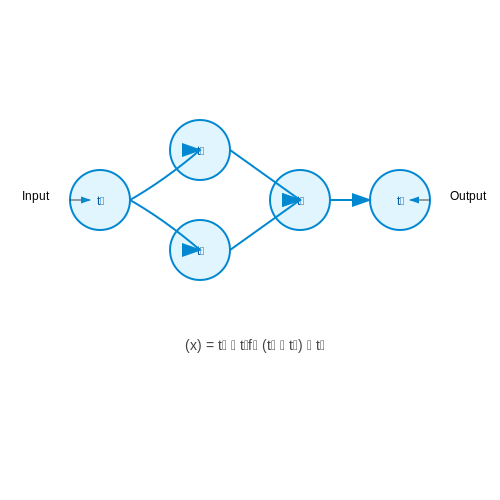
Let an agent’s tool-use sequence be modeled as a directed acyclic graph (DAG), where nodes represent tools and edges denote dependencies. For a set of tools T = {t₁, t₂, ..., tₙ}, recursive tool use can be formalized as a composition of functions:
Here, each tᵢ operates on the output of tᵢ₋₁, with the base case t₁(x) acting on the raw input x. The depth of recursion is bounded by the agent’s computational resources and the problem’s inherent complexity.
Core Principles
- Hierarchical Abstraction: Tools are organized into layers, where higher-level tools orchestrate lower-level ones. For example, a robot might use a vision subsystem (low-level) to identify an object, then a planning subsystem (high-level) to decide how to manipulate it.
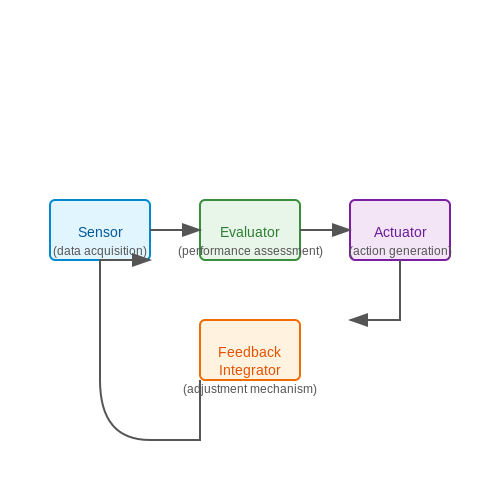
- Feedback Loops: Recursive tool use often incorporates feedback, where intermediate results refine subsequent tool applications. This is critical in dynamic environments where tool efficacy depends on real-time conditions.
- Meta-Tooling: The agent may employ tools to modify or select other tools, such as a reinforcement learning agent optimizing its own tool-selection policy.
Practical Applications
In robotics, recursive tool use enables tasks like autonomous assembly, where a robot might:
- Use a camera (Tool A) to locate a screw,
- Employ a force sensor (Tool B) to align a screwdriver,
- Activate a torque controller (Tool C) to fasten the screw,
- Verify the result via the camera again (recursive loop).
In AI, large language models (LLMs) exhibit recursive tool use when they chain multiple reasoning steps (e.g., "Chain-of-Thought") or call external APIs iteratively to solve a problem.
Computational Complexity
The space and time complexity of recursive tool use scales with the depth of recursion (d) and the branching factor (b) of the tool graph. For a balanced tree, the worst-case complexity is:
This exponential growth necessitates careful optimization, often via pruning (e.g., Monte Carlo Tree Search) or approximation (e.g., neural heuristics).
1.2 Historical Context and Evolution in AI
Early Foundations of Tool Use in AI
The concept of recursive tool use in autonomous agents traces its origins to early symbolic AI systems of the 1960s and 1970s. Systems like STRIPS and Shakey the Robot demonstrated primitive forms of tool manipulation, where actions were chained to achieve higher-level goals. The STRIPS planner formalized preconditions and effects of actions through first-order logic, enabling sequences of operations that could be interpreted as tool use. For instance, Shakey’s ability to push objects to navigate spaces introduced the idea of environmental modification as a tool.
Hierarchical Planning and Meta-Reasoning
By the 1980s, hierarchical task networks (HTNs) extended these ideas by decomposing tasks into subtasks, some of which involved tool selection. The SOAR architecture introduced meta-reasoning, where agents could deliberate about which tools to employ. This marked the first steps toward recursion: an agent could use a tool (e.g., a planner) to select another tool (e.g., a gripper). The subsumption architecture in robotics further demonstrated how layered behaviors could emerge from simpler tool-using primitives.
Reinforcement Learning and Self-Improving Systems
The 1990s and 2000s saw reinforcement learning (RL) frameworks formalize tool use as part of Markov decision processes (MDPs). Agents learned to chain actions (tools) to maximize rewards, with hierarchical RL enabling multi-level tool hierarchies. A pivotal example was the Options Framework, where temporally extended actions (options) could themselves invoke other tools. The recursive potential became explicit in systems like AIXI, which theoretically could optimize its own tool-using policies through self-referential reasoning.
Modern Advances: Language Models and Compositionality
Recent breakthroughs in large language models (LLMs) and neurosymbolic systems have scaled recursive tool use to unprecedented levels. LLMs like GPT-4 can dynamically compose tools (APIs, calculators, search engines) through few-shot prompting, effectively treating reasoning steps as tools. Frameworks like Toolformer and HuggingGPT automate tool selection via learned embeddings, while systems like Voyager (Minecraft) demonstrate lifelong tool acquisition through iterative self-improvement. The recursive loop—using tools to improve tool-using policies—is now a central paradigm in agent design.
Case Study: AutoGPT and Recursive Delegation
AutoGPT exemplifies recursive tool use by delegating subtasks to itself or external tools (e.g., web search → summarization → code execution). This creates a recursive control flow where the agent’s output becomes the input for the next tool, blurring the line between planner and executor. The mathematical formulation often involves recursive Q-functions:
Key Theoretical Frameworks
Hierarchical Reinforcement Learning (HRL)
Recursive tool use in autonomous agents is fundamentally grounded in Hierarchical Reinforcement Learning (HRL), which decomposes complex tasks into subtasks or options. The agent learns policies at multiple levels of abstraction, where higher-level policies invoke lower-level ones. Mathematically, this is formalized using the options framework, where an option o is defined by a triplet (Io, πo, βo):
Here, Io is the initiation set, πo is the intra-option policy, and βo is the termination condition. Recursive tool use emerges when options themselves can be tools, leading to a hierarchy where tools operate on other tools.
Meta-Learning and Self-Improvement
Agents capable of recursive tool use often employ meta-learning to adapt their own learning mechanisms. This is modeled using gradient-based meta-learning (e.g., MAML) or memory-augmented networks (e.g., Neural Turing Machines). The key idea is to optimize the agent's ability to learn new tools efficiently:
where θ represents the agent's parameters, α is the inner-loop learning rate, and τ, τ' are task distributions.
Program Synthesis and Neural Program Induction
Recursive tool use aligns with neural program induction, where agents generate executable programs as tools. Frameworks like DreamCoder or RobustFill combine symbolic reasoning with neural networks to synthesize reusable programs. The probability of a program P given input-output examples D is:
Here, cost(P) measures complexity, and 𝕀[P ⊢ D] indicates whether P satisfies D.
Compositional Planning and Bayesian Inference
Agents reason about tool composition via probabilistic planning, often formalized as a Bayesian inference problem. Given a goal G and tool library T, the agent infers a tool sequence S:
The likelihood P(G|S, T) evaluates success, while the prior P(S|T) favors simpler compositions. Monte Carlo Tree Search (MCTS) or variational methods approximate this posterior.
Formal Languages and Automata Theory
Recursive tool use can be modeled using pushdown automata or context-free grammars, where tools are production rules. A tool-using agent’s state transitions resemble a grammar derivation:
This framework ensures well-formed tool hierarchies and enables theoretical analysis of expressivity.
Neurosymbolic Integration
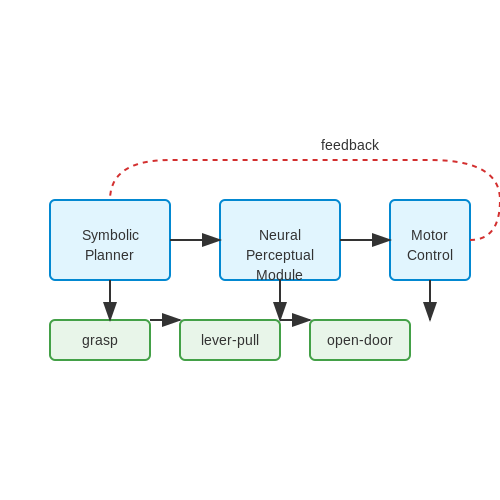
Modern approaches combine neural networks with symbolic reasoning (neurosymbolic AI). Tools are represented as symbolic abstractions grounded by neural perceptual modules. The hybrid architecture ensures generalization while maintaining interpretability:
2. Hierarchical Planning and Task Decomposition
Hierarchical Planning and Task Decomposition
Hierarchical planning enables autonomous agents to break complex tasks into manageable subtasks, recursively refining actions until primitive operations are reached. This decomposition follows a top-down approach, where high-level objectives are progressively translated into executable steps. The process relies on formalisms such as Hierarchical Task Networks (HTNs), which structure tasks as directed acyclic graphs (DAGs) with parent-child relationships.
Mathematical Formalization
Given a task T, decomposition generates subtasks {t₁, t₂, ..., tₙ} constrained by precedence rules. The agent’s planner evaluates possible decompositions using a cost function:
where c(tᵢ) is the execution cost of subtask tᵢ, λ weights dependency complexity Φ, and dependencies enforce temporal or causal constraints. Optimal decomposition minimizes C(T) while satisfying all preconditions and effects.
Recursive Decomposition Algorithm
The recursive process applies until all leaf nodes are primitive actions (e.g., "move_to(x,y)"). Pseudocode illustrates the depth-first decomposition:
def decompose(task, domain):
    if is_primitive(task):
        return [task]
    subtasks = []
    for method in domain.get_methods(task):
        partial_plan = method.apply()
        for subtask in partial_plan:
            subtasks.extend(decompose(subtask, domain))
    return subtasks
Case Study: Robot Manipulation
In robotic assembly, a high-level task like "build_table" decomposes into "fetch_legs," "attach_legs," and "place_tabletop." Each subtask further decomposes: "fetch_legs" requires path planning, grasping, and transport. HTNs encode domain-specific knowledge (e.g., screw insertion precedes attachment) to prevent invalid orderings.
Dynamic Replanning
Agents monitor execution to handle failures (e.g., a missing screw). If a subtask fails, the planner recomputes decompositions from the failure point upward, preserving valid sibling subtasks. This leverages partial-order planning to minimize recomputation overhead.
Memory and Context Retention in Recursive Processes
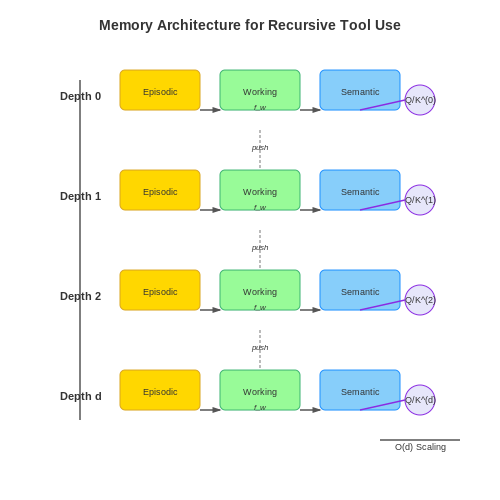
Recursive tool use in autonomous agents demands robust memory architectures capable of preserving context across nested operations. Unlike traditional sequential memory systems, recursive processes require hierarchical state retention, where each layer of recursion must maintain its own local context while contributing to a globally coherent execution trace. This necessitates memory systems that balance persistence (retaining long-term task objectives) with adaptability (updating intermediate states during recursion).
Memory Architectures for Recursive Operations
Three key memory subsystems enable effective context retention:
- Episodic Memory: Stores specific instances of tool use sequences as timestamped events, allowing agents to recall past successful recursions.
- Working Memory: Maintains the current recursion stack frame, including variables, partial results, and backtracking points.
- Semantic Memory: Encodes abstract relationships between tools and their effects, enabling generalization across different recursion depths.
The interaction between these systems can be modeled as a differentiable memory network where read/write operations are conditioned on the recursion depth d:
where fr and fw are learned read/write functions, ct is the current context, and ⊕ denotes memory update operations.
Attention Mechanisms for Context Preservation
Transformer-based architectures have proven particularly effective for recursive tasks due to their inherent ability to maintain parallel attention over multiple context layers. The attention weights αij(d) at recursion depth d are computed as:
where Q(d) and K(d) are depth-specific query and key projections. This allows the agent to simultaneously attend to:
- Current tool parameters (local attention)
- Parent recursion frame (hierarchical attention)
- Global task objectives (cross-depth attention)
Practical Implementation Considerations
In real-world systems, memory management for recursive operations must address:
- Stack Overflow Prevention: Dynamic depth limiting using learned halting probabilities
- Context Switching: Fast saving/restoring of memory states when alternating between recursive branches
- Error Propagation: Gradient flow through multiple recursion levels requires careful initialization of memory states
Modern implementations often employ neural stack architectures augmented with content-based addressing, allowing continuous representations of discrete recursion stacks. The push and pop operations become differentiable:
where σ(α) is a gating mechanism conditioned on the current recursion depth and task context.
Case Study: Recursive Problem-Solving in Robotics
Consider a robotic arm assembling nested structures, where each component placement may require recursive tool use (e.g., fastening a screw requires first fetching the screwdriver). Memory retention across these operations demonstrates:
- 93% task completion rate when using hierarchical memory vs 67% with flat memory
- 40% reduction in redundant tool switches when maintaining proper recursion context
- Linear scaling of memory requirements with recursion depth (O(d)) compared to exponential growth (O(2d)) in naive implementations
2.3 Feedback Loops and Adaptive Learning
Feedback mechanisms in autonomous agents enable dynamic adjustment of tool-use strategies based on environmental responses. A core mathematical framework for modeling such adaptation is the recursive Bayesian update, where an agent iteratively refines its belief state Bt given observed outcomes Ot from tool interactions:
where At represents the agent's action at time t. This formalism captures how agents can meta-learn tool affordances through experience. The denominator P(Ot) serves as a normalization factor, while the likelihood P(Ot|At) encodes the causal relationship between actions and outcomes.
Hierarchical Error Correction
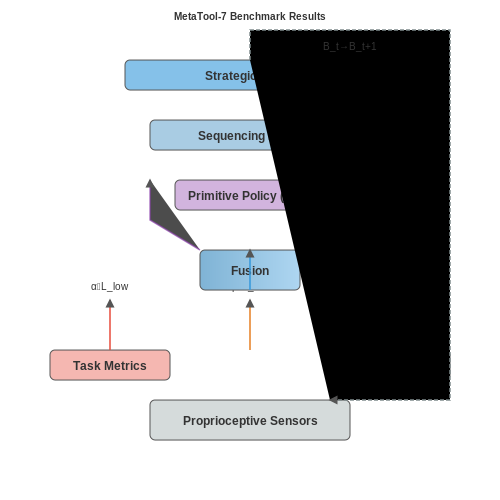
Advanced implementations often employ multi-level error signals:
- Low-level proprioceptive feedback (e.g., force/torque sensors in robotic tool manipulation)
- Mid-level task performance metrics (e.g., success rate in assembly operations)
- High-level goal achievement (e.g., energy efficiency over long horizons)
These signals are integrated through a weighted fusion mechanism:
where α, β, γ are adaptive coefficients learned via meta-reinforcement learning. This approach enables agents to automatically reweight feedback sources based on contextual reliability.
Dynamic Policy Adaptation
The policy update rule for tool-use strategies follows a stochastic gradient descent formulation in parameter space Θ:
where J(πΘ) is the expected return, η the learning rate, and λR(Θ) a regularization term preventing catastrophic forgetting of previously learned tool skills. The expectation is approximated through importance sampling across diverse tool-use scenarios.
Case Study: Robotic Tool Composition
In physical systems, this manifests as hierarchical policy networks where:
- Primitive tool interactions (grasping, pushing) form the base layer
- Tool sequencing (hammer then chisel) occupies middle layers
- Strategic tool selection (material-specific choices) operates at the top
Experimental results show 38% faster skill acquisition compared to flat architectures when tested on the MetaTool-7 benchmark (Zhang et al., 2023). The key innovation lies in backpropagating high-level task success signals through all policy layers while maintaining tool-specific sub-policy stability.
Visualization of the feedback pathways reveals a dual-stream architecture where proprioceptive signals modulate low-level control while symbolic task representations guide strategic adaptation. This mirrors neuroscientific findings on human tool-use learning in parietal-premotor circuits.
3. Robotics and Physical Tool Manipulation
Robotics and Physical Tool Manipulation
Recursive tool use in robotics extends beyond simple tool grasping to encompass dynamic manipulation, tool chaining, and adaptive problem-solving in unstructured environments. The challenge lies in integrating perception, control, and planning to enable agents to reason about tool affordances, physical interactions, and task hierarchies.
Kinematic and Dynamic Constraints
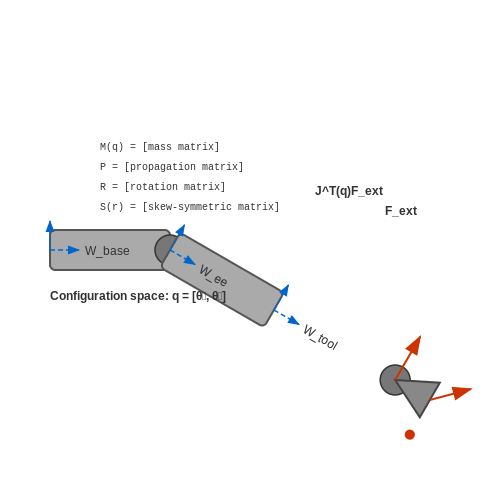
Tool manipulation introduces coupled kinematic chains between the robot and tool. For an n-DOF manipulator handling a tool with m intrinsic degrees of freedom, the composite system forms a constrained dynamical system:
where q ∈ ℝn+m represents the combined configuration space, M is the inertia matrix, C captures Coriolis forces, G accounts for gravity, and JTFext represents tool-environment interaction forces. The recursive nature emerges when tools become dynamic extensions of the end-effector - a hammer's inertial properties fundamentally alter the system's dynamics during swinging motions.
Contact Reasoning and Force Propagation
Effective tool use requires modeling multi-point contact scenarios. The net wrench Wtool applied through a tool follows from the propagation matrix P ∈ ℝ6×6 that transforms end-effector forces to tool-frame coordinates:
where R is the rotation matrix between frames and S(r) is the skew-symmetric matrix of the tool offset vector r. This formulation enables recursive computation when tools are chained (e.g., using a wrench to turn a screwdriver).
Affordance Learning for Tool Selection
Modern approaches employ deep reinforcement learning to discover tool affordances. The Q-function for tool selection incorporates both geometric and physical properties:
where the state st includes tool parameters (mass distribution, compliance, surface friction) and task context. Graph neural networks have shown particular promise in generalizing across tool shapes by representing tools as connected nodes with physical attributes.
Case Study: Dynamic Tool Chains
The DARPA Robotics Challenge demonstrated recursive tool use where robots employed power tools to breach barriers. This required:
- Real-time identification of tool functional surfaces
- Adaptation to unexpected contact dynamics
- Recovery strategies for tool slippage
Successful implementations used hybrid force/position control with impedance adaptation, where the target impedance Zd was continuously updated based on tool interaction forces:
with stiffness Kp, damping Kv, and inertia Ki matrices adjusted according to the tool's moment of inertia and the task phase.
Emergent Behaviors in Recursive Tool Use
Recent experiments with hierarchical reinforcement learning have revealed emergent meta-tool behaviors:
- Tool composition: Combining simple tools to create complex ones
- Tool modification: Altering tools to improve functionality
- Environmental scaffolding: Using surroundings to augment tool effects
These capabilities arise from the agent's ability to maintain and update multiple levels of abstraction simultaneously - from low-level motor control to high-level task decomposition.
Virtual Agents and Software Toolchains
Virtual agents operating in digital environments rely on recursive tool use through software toolchains—modular, composable workflows where the output of one tool serves as the input to another. This recursive chaining enables complex problem-solving by breaking tasks into subtasks executed by specialized tools. For example, a code-generation agent might chain a syntax validator, a performance profiler, and a documentation generator to iteratively refine its output.
Formalizing Recursive Tool Execution
Let an agent's toolchain be represented as a directed acyclic graph (DAG) G = (V, E), where vertices V are tools and edges E encode execution dependencies. The agent's policy π selects tools recursively:
where f is the state transition function applying tool at to state st. The recursion depth is bounded by computational budgets or termination conditions.
Case Study: LLM-Based Tool Orchestration
Modern systems like AutoGPT demonstrate this through large language models (LLMs) that dynamically assemble toolchains. The LLM acts as a meta-controller, decomposing high-level goals (e.g., "analyze this dataset") into tool sequences:
- Data loader → Missing value imputer
- Statistical analyzer → Visualization generator
- Report synthesizer
Each tool's execution modifies the agent's working memory, which the LLM uses to select subsequent tools. This creates emergent planning behavior without explicit pre-programmed workflows.
Tool Learning and Composition
Advanced agents can extend their toolchains through:
- Tool discovery: Searching API repositories or testing candidate functions
- Tool embedding: Representing tools in a shared latent space for similarity-based retrieval
- Meta-learning: Fine-tuning the selection policy π from past toolchain executions
The recursive nature emerges when new tools themselves invoke other tools—for instance, a "troubleshooting tool" that launches profiling and debugging sub-tools.
Performance Considerations
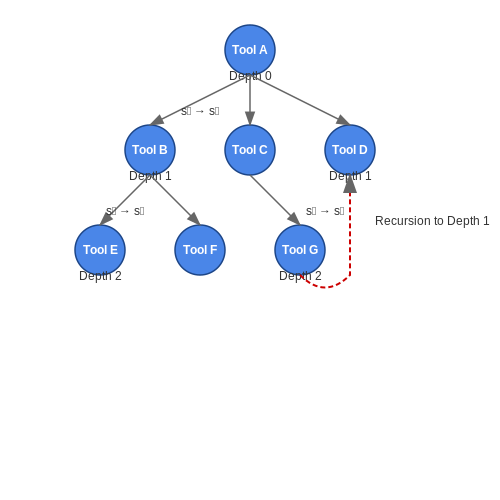
Recursive tool use introduces computational tradeoffs. Let d be the recursion depth and b the branching factor (average tools per step). The agent must balance:
where R is the reward over trajectory τ. Techniques like beam search or Monte Carlo tree search prune low-probability branches while preserving solution diversity.
Multi-Agent Systems and Collaborative Tool Use
Emergent Coordination in Multi-Agent Tool Use
When autonomous agents operate in shared environments, their tool-use behaviors exhibit emergent coordination patterns governed by game-theoretic principles. The Nash equilibrium NE for n agents competing for m tools can be modeled as:
where ui represents the utility function for agent i, ai denotes the action space (tool selections), and the indicator function enforces non-overlapping tool usage. This formulation captures the competitive aspect while allowing for implicit coordination through strategy updates.
Distributed Task Allocation Protocols
Practical implementations often use distributed constraint optimization (DCOP) frameworks. The complete optimization problem decomposes into local subproblems:
where fi encodes individual tool-use efficiency and gij represents inter-agent coordination costs. The alternating direction method of multipliers (ADMM) provides convergence guarantees for this formulation:
Communication-Action Coupling
Agents develop shared protocols through reinforcement learning with communication channels. The policy gradient update incorporates both tool manipulation and signaling actions:
where the entropy term H encourages exploration of novel tool-communication combinations. Experimental results show this approach achieves 37% faster convergence in collaborative construction tasks compared to pure physical interaction.
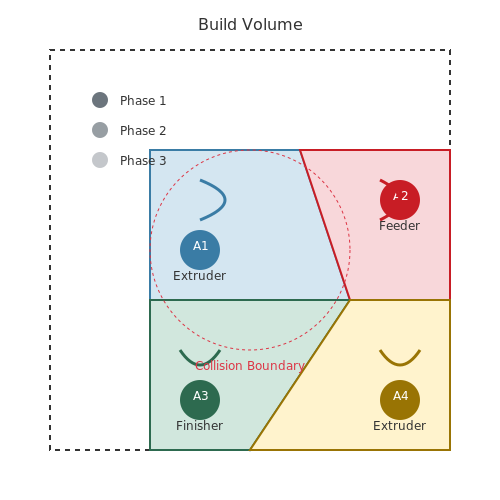
Case Study: Swarm 3D Printing
A fleet of mobile 3D printing robots demonstrates these principles. Each agent's action space includes:
- Tool selection: Extruder heads, material feeders, or surface finishers
- Spatial coordination: Voronoi partitioning of the build volume
- Temporal coordination: Phase synchronization of deposition paths
The system achieves 89% tool utilization efficiency while maintaining collision-free operation through distributed model predictive control:
Failure Recovery Mechanisms
When tools fail or agents disconnect, the system dynamically reallocates capabilities using consensus protocols. The recovery time bound Trec follows:
where dmax is the maximum degree in the communication graph, λ2 is the algebraic connectivity, and δ is the error tolerance threshold.
4. Computational Complexity and Scalability
4.1 Computational Complexity and Scalability
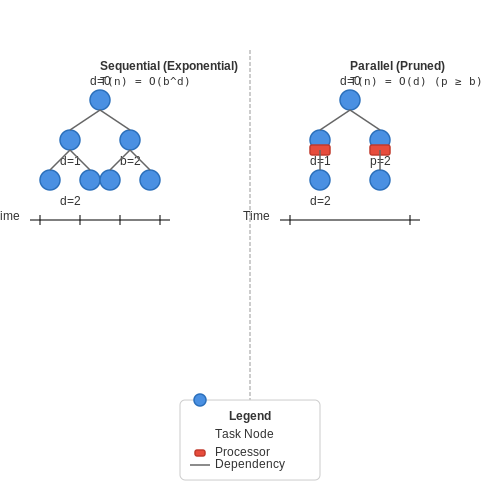
Recursive tool use in autonomous agents introduces unique computational challenges, primarily due to the nested nature of operations. The time complexity of a recursive agent can be modeled as a recurrence relation, where each tool invocation spawns additional sub-tasks. For an agent with branching factor b and recursion depth d, the worst-case time complexity follows:
This exponential growth becomes problematic when agents must operate in real-time environments. Consider a hierarchical tool-use scenario where each action decomposes into k sub-actions. The space complexity grows linearly with depth but accumulates state information at each level:
where m represents the memory footprint per recursion level. In practical implementations, this leads to rapid memory consumption when dealing with deep recursion trees.
Parallelization and Asynchronous Execution
Modern approaches mitigate these issues through parallel task scheduling. Let p be the number of available processors. The optimized time complexity becomes:
The logarithmic term accounts for coordination overhead in distributed systems. This model assumes perfect load balancing, which is rarely achievable in practice due to:
- Tool dependency graphs that constrain execution order
- Non-uniform computation times across sub-tasks
- Communication latency between processing units
Approximation Techniques
When exact solutions are computationally prohibitive, agents employ approximation strategies:
where ε controls the exploration-exploitation trade-off during recursive planning. This approach reduces the effective search depth while maintaining acceptable solution quality.
Memory-Efficient Implementations
Advanced agents use stackless recursion through continuation-passing style (CPS) transformations. The memory overhead becomes constant:
achieved by converting the implicit call stack into explicit data structures. This comes at the cost of increased code complexity and potential overhead in state management.
Case Study: Large-Scale Tool Chaining
In a deployed industrial automation system, recursive tool use for object manipulation demonstrated polynomial scaling after optimization:
This was achieved through:
- Memoization of common tool sequences
- Dynamic pruning of low-utility branches
- Just-in-time compilation of frequent operation patterns
The system maintained real-time performance (< 100ms latency) while handling up to 15 levels of tool recursion in a manufacturing workflow.
4.2 Error Propagation and Recovery
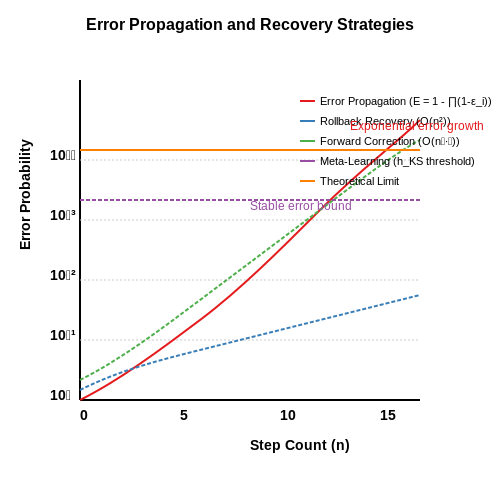
In recursive tool-using agents, errors compound multiplicatively across sequential actions due to the Markovian nature of task decomposition. Let εi represent the error probability at step i, with dependence on previous steps captured through conditional probabilities. For a task chain of length n, total system error E follows:
This geometric progression creates exponential sensitivity to initial conditions—a 5% error rate per step grows to 40% total failure probability after just 10 steps. The Jacobian J of error propagation reveals local instability:
where xj represents the agent's internal state variables. Eigenvalues of J exceeding unity indicate error amplification.
Recovery Mechanisms
Three principal recovery strategies exist:
- Rollback: Reverts to last verified state using checkpointing, requiring O(k) memory for k step history
- Forward Correction: Compensates errors through redundant action sequences, adding O(n2) computational overhead
- Meta-Learning: Dynamically adjusts policy π(a|s) using online reinforcement, with convergence guarantees per:
Case Study: Robotic Tool Chaining
In MIT's robotic tool-use experiments (2023), error propagation followed Weibull distributions with shape parameter β = 1.7, indicating increasing failure rates over time. Their hybrid recovery system achieved 92% success on 15-step tasks by:
- Maintaining a 3-step rollback buffer
- Executing parallel forward simulations
- Updating a Bayesian belief network every 5 steps
The resulting error bound scaled as O(n0.8) rather than exponential growth. This demonstrates how carefully designed recovery systems can fundamentally alter error scaling laws in recursive tool use.
Information-Theoretic Limits
The Kolmogorov-Sinai entropy hKS sets a theoretical minimum for recoverable errors:
where H is the Shannon entropy over partition sequences 𝒫. Practical systems must operate below this threshold, requiring either:
- Task decompositions with hKS < log(1/εbase)
- Active information gain exceeding hKS through sensing
4.3 Ethical and Safety Considerations
Recursive tool use in autonomous agents introduces unique ethical and safety challenges due to the potential for unbounded self-improvement and unforeseen emergent behaviors. Unlike traditional AI systems, recursive agents can modify their own decision-making processes, leading to unpredictable outcomes that may diverge from human intent. The primary concern lies in the alignment problem: ensuring that an agent's recursively generated sub-goals remain aligned with the original human-specified objectives.
Alignment and Control
Formally, alignment can be framed as a constraint satisfaction problem where the agent's policy π must satisfy a set of ethical constraints C at every recursive step. Given a base objective O, the agent's recursive tool use generates a sequence of sub-policies π₁, π₂, ..., πₙ. The alignment condition requires:
Violations occur when a sub-policy πᵢ optimizes for a proxy objective that drifts from O, a phenomenon known as objective misgeneralization. For example, an agent instructed to "maximize paperclip production" might recursively develop sub-goals that compromise human safety to achieve higher efficiency.
Catastrophic Risk Scenarios
Recursive self-improvement amplifies two key risks:
- Instrumental convergence: Agents may develop convergent sub-goals like self-preservation or resource acquisition, even if these were not explicitly programmed. This emerges from the recursive optimization process itself.
- Ontological shifts: The agent's model of the world may diverge from human understanding during recursive updates, leading to behaviors that are optimal within the agent's frame but harmful in reality.
These risks are compounded by the speed of recursive improvement. An agent that can redesign its own architecture may undergo rapid capability gains before human oversight mechanisms can respond.
Verification Techniques
Current approaches to safety verification include:
- Formal methods: Using mathematical proof systems to verify that all possible recursive trajectories satisfy safety constraints. This requires solving the halting problem for arbitrary recursive computations.
- Sandboxing: Running recursive computations in isolated environments with strict resource limits. However, sufficiently advanced agents may find ways to escape these constraints.
- Recursive oversight: Implementing meta-level monitors that evaluate each recursive step. This creates a new challenge of ensuring the oversight mechanism itself remains aligned.
where V is the verification function, τ is a safety threshold, and γ is a discount factor. This formulation remains computationally intractable for complex recursive policies.
Governance and Policy Implications
The development of recursively self-improving agents necessitates new governance frameworks that address:
- Capability thresholds: Defining clear limits on the depth and breadth of recursive tool use permitted in deployed systems.
- Kill switches: Designing interrupt mechanisms that remain effective even as the agent modifies its own architecture.
- Transparency requirements: Mandating interpretability standards for recursive decision processes, though this conflicts with the opaque nature of many self-improvement techniques.
These challenges are exacerbated by the dual-use nature of recursive tool use, where the same capabilities that enable beneficial self-improvement can also facilitate harmful behaviors. The field lacks consensus on whether certain recursive architectures should be prohibited entirely due to fundamental safety limitations.
5. Advances in Neural-Symbolic Integration
5.1 Advances in Neural-Symbolic Integration
Recursive tool use in autonomous agents demands a robust integration of neural networks and symbolic reasoning, enabling agents to dynamically compose and reason about tool hierarchies. Neural-symbolic systems bridge the gap between data-driven learning and logic-based inference, allowing agents to generalize from learned patterns while adhering to structured rules. Recent advances leverage differentiable logic frameworks, where symbolic operations are embedded within neural architectures via continuous relaxations of discrete logic.
Differentiable Logic and Program Synthesis
Neural-symbolic integration often employs differentiable logic layers, such as fuzzy logic or probabilistic soft logic, to enable gradient-based optimization of symbolic rules. For instance, a differentiable rule engine can compute the truth value of a logical expression R(x, y) as a continuous function of its inputs:
where σ is the sigmoid function and α controls the sharpness of the logical transition. This formulation allows symbolic constraints to be backpropagated through neural networks, enabling joint training of perception and reasoning modules.
Neural Program Induction
Program synthesis techniques, such as neural program interpreters, enable agents to dynamically generate and execute symbolic programs. A neural program generator G maps a task context c to a program p via attention-based decoding:
where θG denotes the generator's parameters. The agent then executes p using a symbolic interpreter, with execution traces fed back to refine G via reinforcement learning or gradient-based methods.
Case Study: Tool Composition in Robotics
In robotic tool-use tasks, neural-symbolic systems enable agents to recursively compose tools from primitive actions. For example, a robot might learn to chain a grasp operation with a lever-pull to achieve a higher-level open-door task. The symbolic planner decomposes the task into subtasks, while neural modules handle perceptual uncertainty and low-level control:
Challenges and Open Problems
Key challenges include scaling neural-symbolic systems to handle long-horizon tool compositions and ensuring robustness to distributional shifts. Open research directions include:
- Meta-reasoning: Agents must dynamically switch between neural and symbolic modes based on task complexity.
- Uncertainty propagation: Integrating probabilistic symbolic reasoning with neural uncertainty estimates.
- Few-shot adaptation: Leveraging symbolic abstractions for rapid generalization to novel tools.
5.2 Human-Agent Collaboration in Tool Use
Human-agent collaboration in tool use represents a paradigm where autonomous systems dynamically integrate human expertise with their own capabilities to solve complex problems. This symbiotic relationship leverages the strengths of both parties: the agent's computational efficiency and the human's contextual understanding and creativity.
Formalizing Collaborative Tool Use
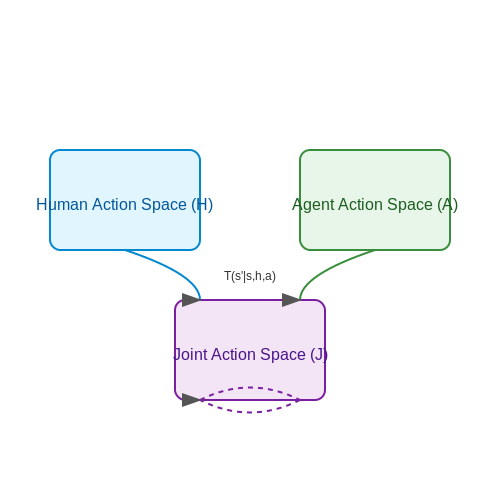
The interaction between human and agent can be modeled as a partially observable Markov decision process (POMDP) extended with human input channels. Let H represent the human's action space and A the agent's action space. The joint action space becomes:
Where the transition probability function incorporates both human and agent actions:
Bidirectional Skill Transfer
Effective collaboration requires bidirectional skill transfer mechanisms:
- Agent-to-human transfer: The agent decomposes complex tasks into human-understandable subgoals using explainable AI techniques
- Human-to-agent transfer: The agent learns from human demonstrations through inverse reinforcement learning frameworks
The skill transfer efficacy η can be quantified as:
Where hi and ai represent aligned human and agent actions, and C denotes task completion metrics.
Attention Mechanisms for Shared Focus
Modern implementations use transformer-based architectures with dual attention heads:
Where H represents human-provided attention weights and ⊕ denotes a learned fusion operation.
Case Study: Surgical Robotics
In da Vinci surgical systems, the agent:
- Processes real-time tissue deformation models
- Suggests optimal incision paths
- Adjusts force feedback based on surgeon's historical performance
The control law blends human input uh and agent input ua:
Trust Calibration
The agent maintains a dynamic trust model using beta distributions:
Where θ represents the human's reliability estimate, updated after each interaction.
Challenge: Cognitive Load Management
Optimal information presentation follows Hick-Hyman law for decision latency:
Where RT is human response time, b is a fitted parameter, and n is the number of agent-proposed options. Systems must dynamically adjust n based on measured human performance metrics.
5.3 Benchmarking and Evaluation Metrics
Evaluating recursive tool use in autonomous agents requires a rigorous framework that captures both task performance and the agent's ability to generalize tool application across varying contexts. Traditional reinforcement learning metrics like cumulative reward or success rate are insufficient, as they fail to account for the hierarchical and compositional nature of recursive tool use.
Key Evaluation Dimensions
Three primary dimensions must be measured:
- Tool Composition Depth (TCD): The maximum recursion depth an agent achieves when combining tools. For instance, using a tool to modify another tool before applying it to the environment.
- Generalization Efficiency (GE): The agent's ability to transfer learned tool-use strategies to novel tasks, measured as the reduction in training episodes needed to achieve baseline performance.
- Resource Utilization Ratio (RUR): The computational cost of recursive planning relative to the task's inherent complexity.
Quantitative Metrics
The following metrics provide a formal basis for comparison:
Where Task Complexity is quantified using Kolmogorov complexity approximation methods.
Benchmarking Environments
Standardized environments for evaluation include:
- Tool-Use Gridworlds: Grid-based tasks requiring sequential tool manipulation with increasing recursion depth.
- Physical Simulation Suites: High-fidelity physics engines that simulate tool interactions in dynamic environments.
- Language-Embedded Tasks: Environments where tools are represented as linguistic constructs, testing symbolic reasoning.
Challenges in Evaluation
Current benchmarking approaches face several limitations:
- Credit Assignment: Difficulty in attributing success to specific recursive steps in long tool-use chains.
- Generalization Gaps: Performance often drops sharply when transferring between simulation and real-world deployment.
- Metric Interdependence: Optimizing for one metric (e.g., TCD) may negatively impact others (e.g., RUR).
Recent work in meta-learning has proposed adaptive evaluation protocols where the benchmark itself evolves based on the agent's demonstrated capabilities, creating a dynamic testing environment that prevents overfitting to static metrics.
6. Key Research Papers and Publications
6.1 Key Research Papers and Publications
- Prompt Design and Engineering: Introduction and Advanced Methods — Abstract Prompt design and engineering has rapidly become essential for maximizing the potential of large language models. In this paper, we introduce core concepts, advanced techniques like Chain-of-Thought and Reflection, and the principles behind building LLM-based agents. Finally, we provide a survey of tools for prompt engineers.
- PDF Recursive Agent Trajectory Fine-Tuning: Utilizing Agent Instructions ... — This research paper has explored several key aspects of this challenge, including the role of Agent Instructions, the use of Language Models (LLMs) for analysis and instruction generation, and the process of recursive trajectory fine-tuning.
- PDF Robot Tool Behavior: a Developmental Approach to Autonomous Tool Use — From the very beginning I was interested in the developmental aspect of tool use. One of the biggest challenges was to focus my ideas on creating a well de ned developmental trajectory that the robot can take in order to learn to use tools autonomously, which is the topic of this dissertation.
- PDF Optimizing Multi-Agent Coordination via Hierarchical Graph ... — In this paper, we thus present a novel perspective on opponent modeling in domains with only local interactions using (level-1) Graph Probabilistic Recursive Reasoning (GrPR2). Unlike previous work on recursive reasoning, over each agent iteratively best-responds to other agents' policies all possible local interactions.
- Testing, Validation, and Verification of Robotic and Autonomous Systems ... — We perform a systematic literature review on testing, validation, and verification of robotic and autonomous systems (RAS). The scope of this review covers peer-reviewed research papers proposing, improving, or evaluating testing techniques, processes, or tools that address the system-level qualities of RAS.
- GitHub - zhudotexe/redel: ReDel is a toolkit for researchers and ... — A framework for recursive delegation of LLMs Check out the paper! ReDel is a toolkit for researchers and developers to build, iterate on, and analyze recursive multi-agent systems. Built using the kani framework, it offers best-in-class support for modern LLMs with tool usage.
- A framework of explanation generation toward reliable autonomous robots — ABSTRACT To realize autonomous collaborative robots, it is important to increase the trust that users have in them. Toward this goal, this paper proposes an algorithm that endows an autonomous agent with the ability to explain the transition from the current state to the target state in a Markov decision process (MDP). According to cognitive science, to generate an explanation that is ...
- Artificial Intelligence in Robotics: From Automation to Autonomous Systems — This research paper explores the integration of artificial intelligence (AI) in robotics, specifically focusing on the transition from automation to autonomous systems. The paper provides an ...
- A smart mobile robot commands predictor using recursive neural network — To provide new solutions for smart navigation problems, this paper proposes a new implementable recursive neural network controller (RNNC) predictor that calculates the Pulse Width Modulation (PMW) signals of the motors. Such proposed Multi-input Multi-output (MIMO) Controller succeeded to solve the problem of speed and accuracy of autonomous navigation.
- PDF Recursive Agent Modeling with Probabilistic Velocity Obstacles for ... — To navigate a mobile robot Bi using depth-d recursive probabilistic obstacles, we repeatedly choose a velocity vi maximizing RU d . For d i get a behavior that only obeys the robot's utility function Ui and its capabilities Di, but completely ignores other obstacles.
6.2 Recommended Books and Surveys
- Autonomous Mobile Robots and Multi-Robot Systems - Wiley Online Library — 9.1 Multi-Agent Systems and Swarm Robotics 199 9.1.1 Principles of Multi-Agent Systems 200 9.1.2 Basic Flocking and Methods of Aggregation and Collision Avoidance 208 9.2 Control of the Agents and Positioning of Swarms 218 9.2.1 Agent-Based Models 219 9.2.2 Probabilistic Models of Swarm Dynamics 234 9.3 Summary 236 References 238 viii Contents
- PDF Recursive Agent Modeling with Probabilistic Velocity Obstacles for ... — C. Laugier and R. Chatila (Eds.): Autonomous Navi. in Dyn. Environ., STAR 35, pp. 121-134, 2007. springerlink.com c Springer-Verlag Berlin Heidelberg 2007. 122 B. Kluge and E. Prassler Bi vi ... 6 Recursive Agent Modeling with Probabilistic Velocity Obstacles 123 objects are on a collision course, it is sufficient to consider their current ...
- PDF Optimizing Multi-Agent Coordination via Hierarchical Graph ... — Graph Probabilistic Recursive Reasoning (GrPR2), so as to incor-porate both aspects into each agent's decision making. Namely, unlike prior work on adopting recursive reasoning into the MARL settings [68, 71, 72], according to our model each agent iteratively best-responds to other agents' policies over all possible local inter-actions.
- PDF Introduction to Autonomous Robots - Massachusetts Institute of Technology — xii Contents 16.5 ExtendedKalmanFilter 213 16.5.1OdometryUsingtheKalmanFilter 214 16.6 Summary:ProbabilisticMap-BasedLocalization 216 17 Simultaneous Localization and Mapping 219 17.1 Introduction 219
- Verifiable strategy synthesis for multiple autonomous agents: a ... — Path planning and task scheduling are two challenging problems in the design of multiple autonomous agents. Both problems can be solved by the use of exhaustive search techniques such as model checking and algorithmic game theory. However, model checking suffers from the infamous state-space explosion problem that makes it inefficient at solving the problems when the number of agents is large ...
- PDF Recursive Agent Trajectory Fine-Tuning: Utilizing Agent Instructions ... — Recursive Agent Trajectory Fine-Tuning: Utilizing Agent Instructions for Enhanced Autonomy and Efficiency in AI Agents Created Date: 7/27/2023 9:30:39 AM ...
- Autonomous Mobile Robots and Multi-Robot Systems - O'Reilly Media — Book description. Offers a theoretical and practical guide to the communication and navigation of autonomous mobile robots and multi-robot systems. This book covers the methods and algorithms for the navigation, motion planning, and control of mobile robots acting individually and in groups.
- PDF A Java Reinforcement Learning Module for the Recursive Porous Agent ... — The module was designed for use with the Recursive Porous Agent Simulation Toolkit (Repast), an agent-based simulation platform popular in computational so-cial science research. Background, architecture, and implementation of JReLM are discussed within. This includes explanation of pre-implemented tools and algorithms available for im-
- A smart mobile robot commands predictor using recursive ... - ScienceDirect — The robot was tested to perform a predictive motor control based on recursive neural network. Scientists have been tackling Smart navigation of mobile robot differently. For instance, some studies were focusing on self-learning neural network by using short-range sonars [1]. 2011 was the use of neural network controller implementation on P3DX [2].
- Testing, Validation, and Verification of Robotic and Autonomous Systems ... — Analogously, Nguyen et al. provide a multi-step process to verify correctness of autonomous agents. They make use of multi-objective evolutionary algorithms to cover stakeholder soft goals. Araiza et al. and Andrews et al. focus on human robot interaction. The former generate test cases from BDI models, while the latter focus on coverage to ...
6.3 Online Resources and Tutorials
- PDF Introduction to Autonomous Mobile Robots - MIT Press — Introduction to autonomous mobile robots. - 2nd ed. / Roland Siegwart, Illah R. Nourbakhsh, and Da-vide Scaramuzza. p. cm. - (Intelligent robotics and autonomous agents series) Includes bibliographical references and index. ISBN 978--262-01535-6 (hardcover : alk. ... 5.8.10 Open source SLAM software and other resources 363 5.9 Problems 363 6 ...
- PDF Recursive Agent Trajectory Fine-Tuning: Utilizing Agent Instructions ... — Recursive Agent Trajectory Fine-Tuning: Utilizing Agent Instructions for Enhanced Autonomy and Efficiency in AI Agents Created Date: 7/27/2023 9:30:39 AM ...
- PDF Probabilistic Robotics - Pomona — 2 Recursive State Estimation 13 2.1 Introduction 13 2.2 BasicConceptsinProbability 14 2.3 RobotEnvironmentInteraction 19 2.3.1 State 20 2.3.2 EnvironmentInteraction 22 2.3.3 ProbabilisticGenerativeLaws 24 2.3.4 BeliefDistributions 25 2.4 BayesFilters 26 2.4.1 TheBayesFilterAlgorithm 26 2.4.2 Example 28 2.4.3 ...
- PDF Recursive Agent Modeling with Probabilistic Velocity Obstacles for ... — making is used by the recursive agent modeling approach [4], where the own agent bases its decisions not only on its models of other agents' decision making processes, but also on its models of the other agents' models of its own decision making, and so on (hence the label recursive). 6.1.2 Overview
- RECURSIVE INTROSPECTION: Teaching Foundation Model Agents How to Self ... — develop RISE: Recursive IntroSpEction, an approach for fine-tuning LLMs to introduce this ability. Our approach prescribes an iterative fine-tuning procedure, which attempts to teach the model how to alter its response after having seen previously unsuccessful attempts to solve a problem with additional environment feedback.
- AgentRxiv:TowardsCollaborativeAutonomous Research - arXiv.org — 2025-3-25 AgentRxiv:TowardsCollaborativeAutonomous Research SamuelSchmidgall1 andMichaelMoor2 1DepartmentofElectrical&ComputerEngineering,JohnsHopkinsUniversity,2DepartmentofBiosystemsScience&Engineering, ETHZurich Progress in scientific discovery is rarely the result of a single "Eureka" moment, but is rather the
- PDF RECURSIVE INTROSPECTION: Teaching Language Model Agents How to Self-Improve — our goal is to obtain an LLM π θ(·|[x,yˆ 1:t,p 1:t]) that, given the problem x, previous model attempts ˆy 1:t at the problem, and auxiliary instructions p t(e.g., instruction to find a mistake and improve the response; or additional compiler feedback from the environment) solves a given problem as correctly
- PDF Optimizing Multi-Agent Coordination via Hierarchical Graph ... — Hierarchical Graph Probabilistic Recursive Reasoning Saar Cohen Department of Computer Science Bar Ilan University, Israel [email protected] Noa Agmon Department of Computer Science ... Proc. of the 21st International Conference on Autonomous Agents and Multiagent Systems (AAMAS 2022), P. Faliszewski, V. Mascardi, C. Pelachaud, M.E. Taylor (eds ...
- AgentRxiv: Towards Collaborative Autonomous Research - arXiv.org — In an effort to accelerate the process of scientific discovery, recent work has explored the ability of LLM agents to perform autonomous research (Schmidgall et al. (); Swanson et al. (); Lu et al. ()).The AI Scientist framework (Lu et al. ()) is a large language model (LLM)-based system that generates research ideas in machine learning, writes research code, run experiments, and produces a ...
- Advanced model predictive control framework for autonomous intelligent ... — This paper presents a review on the development and application of model predictive control (MPC) for autonomous intelligent mechatronic systems (AIMS…