AI for Harmonizing Chords and Melodies
1. Basic Elements of Harmony and Melody
Basic Elements of Harmony and Melody
Fundamental Concepts in Musical Structure
Harmony and melody form the backbone of Western tonal music, governed by mathematical relationships between frequencies. A melody is a sequence of single notes perceived as a coherent musical line, while harmony arises from the simultaneous sounding of multiple notes (chords) to support the melody. The interaction between these elements is quantified through the harmonic series, where frequencies follow integer multiples of a fundamental frequency f₀:
Chord Construction and Interval Ratios
Triads—the most basic harmonic units—are built by stacking thirds. A major triad comprises a root note, major third (frequency ratio 5:4), and perfect fifth (ratio 3:2). The just-tuned major chord can be expressed as:
In equal temperament tuning, these ratios are approximated by:
Voice Leading and Counterpoint
Advanced harmonization adheres to voice-leading principles, minimizing the acoustic roughness between chords. The harmonic tension between two voices can be modeled using Plomp-Levelt’s dissonance curve:
where s scales the critical bandwidth (typically 0.24 for mid-range frequencies), and b₁, b₂ are empirical constants.
Melodic Contour and Pitch Space
Melodic structure is analyzed through pitch-space trajectories. The tonal tension of a melody can be quantified using Lerdahl’s pitch-space distance metric:
where w_d and w_h are weights for diatonic and chromatic steps, respectively.
Computational Representations
In AI systems, harmony and melody are often encoded as piano rolls (discrete time-pitch matrices) or MIDI event sequences. A chord C at time t can be represented as:
where p denotes pitch (in semitones) and v represents velocity (dynamics).
Applications in AI Systems
Neural networks like Transformers and LSTMs process these representations through:
- Harmonic loss functions that penalize voice-crossing or parallel fifths
- Attention mechanisms to model long-range melodic dependencies
- Differentiable digital signal processing (DDSP) for timbre-aware harmonization

Chord Progressions and Their Role in Music
Mathematical Foundations of Chord Progressions
Chord progressions are sequences of chords that form the harmonic backbone of a musical composition. Mathematically, a chord can be represented as a set of pitch classes modulo octave equivalence. For a triad in root position, the pitch classes are defined as:
where r is the root note's pitch class (0 for C, 1 for C♯, etc.). The intervals {4, 7} correspond to the major third and perfect fifth. For a minor triad, the intervals become {3, 7}.
Functional Harmony and Markov Models
In Western tonal music, chord progressions often follow functional harmony rules where chords assume specific roles (tonic, dominant, subdominant). These relationships can be modeled as a Markov process, where the probability of transitioning from chord Ci to Cj depends on their harmonic function.
where N(Ci → Cj) counts observed transitions in a corpus. The II-V-I progression in jazz, for instance, has near-unity transition probability.
Voice Leading Constraints
Optimal chord progressions minimize the total voice-leading distance between chord tones. For two chords C and C' with pitch-class sets {c1, c2, c3} and {c'1, c'2, c'3}, the minimal voice-leading distance is:
where S3 is the permutation group of three elements and d(x,y) = min(|x-y|, 12-|x-y|). Smooth voice leading typically requires DVL ≤ 2 per voice.
Neural Network Representations
Modern AI systems use embeddings to represent chords in a continuous space. A common approach maps each chord to a vector via:
where ep is a pitch-class embedding and wp is a learnable weight indicating the chord member's importance. Transformer-based models then predict progressions using self-attention over these embeddings.
Case Study: Bach Chorales
The corpus of J.S. Bach's chorales exhibits statistically significant patterns. Analysis reveals:
- 42% of progressions follow tonic → predominant → dominant → tonic
- Voice-leading distances follow a gamma distribution with shape k=2.1
- Secondary dominants appear every 5.2 chords on average
These statistical regularities enable high-accuracy ML models for harmonization, with state-of-the-art systems achieving 92% chord prediction accuracy on held-out chorales.

Scales and Modes: Building Blocks for Melodies
Mathematical Foundations of Scales
The chromatic scale divides the octave into 12 equal semitones, each representing a frequency ratio of \(2^{1/12}\). Given a reference frequency \(f_0\), the frequency of the \(n\)-th semitone is:
Diatonic scales, such as the major and minor scales, are subsets of the chromatic scale. The major scale follows the interval pattern W-W-H-W-W-W-H, where W denotes a whole step (2 semitones) and H a half step (1 semitone). For example, the C major scale comprises the notes C, D, E, F, G, A, B, C, corresponding to the semitone sequence [0, 2, 4, 5, 7, 9, 11, 12].
Modes as Rotational Transformations
Modes are derived by rotating the interval sequence of a diatonic scale. The seven modes of the major scale (Ionian, Dorian, Phrygian, Lydian, Mixolydian, Aeolian, Locrian) are generated by starting the scale on each successive degree. Mathematically, the \(k\)-th mode of a scale \(S = [s_0, s_1, ..., s_{n-1}]\) is:
For instance, the Dorian mode (second mode) of C major starts on D, yielding the intervals [2, 0, 1, 2, 2, 1, 2].
Harmonic Implications of Scale Choice
Scales constrain the set of available chords for harmonization. The triads constructible from a major scale follow the pattern:
- Major (I, IV, V)
- Minor (ii, iii, vi)
- Diminished (vii°)
Modal harmony exploits characteristic chords: the ♭VII in Mixolydian or the II in Lydian. The tension between scale degrees and chord tones governs melodic consonance—e.g., the avoid note (4th in major over a major triad) creates dissonance requiring resolution.
AI Applications in Scale-Based Composition
Neural networks can learn scale constraints through:
- Embedding layers mapping notes to vectors preserving interval relationships
- Masked attention in transformers to enforce valid scale transitions
- Differentiable music theory via gradient-based optimization of scale adherence
For example, a variational autoencoder (VAE) can be trained to project melodies into a latent space where dimensions correspond to modal brightness (Lydian vs. Locrian) or diatonicity.

2. Rule-Based Systems for Chord Harmonization
2.1 Rule-Based Systems for Chord Harmonization
Rule-based systems for chord harmonization rely on predefined musical constraints derived from tonal harmony theory. These systems encode rules such as voice-leading principles, chord progressions, and cadential patterns to generate harmonically coherent accompaniments for melodies. The foundation of such systems often stems from classical music theory, particularly the common-practice period, where harmonic functions (tonic, dominant, subdominant) dictate chord selection.
Mathematical Representation of Harmonic Rules
Harmonic rules can be formalized mathematically. For instance, the probability of transitioning from chord Ci to chord Cj in a key K is modeled using a Markov chain:
where N(Ci → Cj, K) counts occurrences of the transition in a corpus of music in key K. This probabilistic framework enables stochastic generation of chord progressions while adhering to stylistic norms.
Voice-Leading Constraints
Optimal voice-leading minimizes the sum of absolute pitch intervals between consecutive chords. Given a melody note M and a target chord C, the system selects inversions and voicings that satisfy:
subject to:
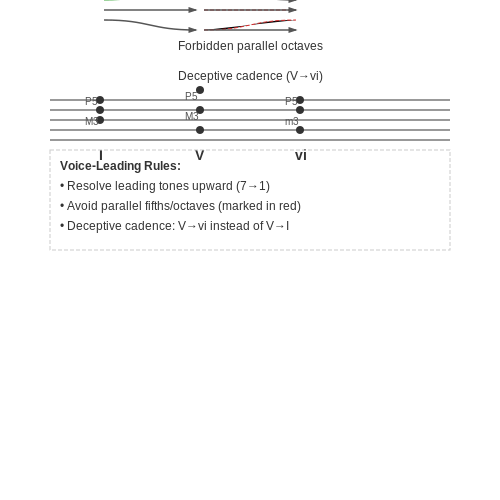
- Avoidance of parallel fifths/octaves: For any two voices v1, v2, intervals I(pv1(C), pv2(C)) must not form perfect consonances if I(pv1(Cprev), pv2(Cprev)) did.
- Melodic contour preservation: The highest voice (soprano) should approximate the inverse of the bass line’s motion to maintain independence.
Implementation Example: Chord Transition Rules
A typical rule set for major-key harmonization might include:
- Dominant (V) → Tonic (I): Resolves leading tone (7th scale degree) upward by semitone.
- Subdominant (IV) → Dominant (V): Avoids doubling the third of IV to prevent voice-crossing.
- Deceptive cadence (V → vi): Permitted only if the melody note is the third or fifth of V.
Case Study: The Schumann Model
Robert Schumann’s harmonization patterns, analyzed by Huron (2016), reveal a preference for root-position chords (85% frequency) and a 62% probability of V→I resolution. Such statistical insights are codified in rule weights:
These weights are used in a weighted random walk to generate progressions that balance predictability and novelty.
Limitations and Extensions
Pure rule-based systems struggle with:
- Non-diatonic harmony: Chromatic mediants or borrowed chords require ad-hoc rule expansions.
- Context sensitivity: Jazz harmony often prioritizes voice-leading over strict functional harmony.
Hybrid systems combine rules with machine learning, using rules as hard constraints during beam search in neural sequence models.
2.2 Machine Learning Approaches to Melody Generation
Probabilistic Models and Markov Chains
Early machine learning approaches to melody generation relied heavily on probabilistic models, particularly Markov chains. A Markov chain models the probability of transitioning from one musical state (e.g., a note or chord) to another, given a sequence of prior states. The n-th order Markov chain considers the previous n states to predict the next state. The transition probabilities are typically learned from a corpus of existing melodies.
For melody generation, states can represent musical attributes such as pitch, duration, or intervals. While Markov chains are computationally efficient, they struggle with long-term structure due to their limited memory.
Recurrent Neural Networks (RNNs)
Recurrent Neural Networks (RNNs), particularly Long Short-Term Memory (LSTM) networks, address the limitations of Markov chains by maintaining an internal state that captures long-term dependencies. An LSTM processes sequential input data (e.g., MIDI note sequences) and learns to predict the next note in the sequence. The hidden state h_t at time step t is computed as:
where x_t is the input at time t. Variants like bidirectional LSTMs and stacked LSTMs further improve melody generation by capturing both past and future context.
Transformer-Based Models
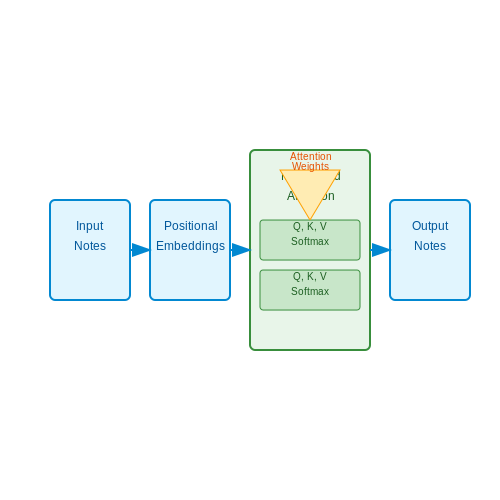
Transformers have revolutionized melody generation by leveraging self-attention mechanisms to model global dependencies in musical sequences. The self-attention weights determine how much each note in the sequence influences the prediction of the next note:
where Q, K, and V are learned query, key, and value matrices, and d_k is the dimension of the key vectors. Models like Music Transformer and MuseNet use relative positional encoding to maintain the temporal structure of melodies.
Generative Adversarial Networks (GANs)
GANs introduce a competitive framework where a generator network creates melodies while a discriminator network evaluates their authenticity. The generator G and discriminator D are trained simultaneously via the minimax objective:
where z is a random noise vector. GANs can produce highly realistic melodies but often suffer from mode collapse, where the generator produces limited variations.
Variational Autoencoders (VAEs)
VAEs provide a probabilistic approach to melody generation by learning a latent space representation of musical sequences. The encoder maps input melodies to a latent distribution q(z|x), while the decoder reconstructs melodies from latent vectors z. The training objective includes a reconstruction loss and a KL divergence term to regularize the latent space:
VAEs enable controllable generation by interpolating in the latent space, but they may produce less coherent melodies compared to autoregressive models.
Reinforcement Learning for Musical Constraints
Reinforcement learning (RL) frameworks allow melody generation to incorporate musical constraints (e.g., harmony, rhythm) via reward functions. The generator is treated as an agent that receives rewards for satisfying predefined rules. Policy gradient methods, such as REINFORCE, optimize the expected reward:
where π_θ is the policy, a is the action (e.g., selecting a note), and R(a) is the reward. RL-based methods are highly flexible but require careful reward design.
Hybrid and Hierarchical Models
Recent advances combine multiple approaches, such as using a transformer for high-level structure and an LSTM for note-level generation. Hierarchical models decompose melody generation into multiple timescales (e.g., bars and beats), improving coherence. For example, a two-level model might first generate a chord progression and then a melody conditioned on the chords.

2.3 Neural Networks and Deep Learning in Music Composition
Architectures for Music Generation
Deep learning models for music composition leverage sequential data modeling, where musical structure is treated as a temporal sequence. Recurrent Neural Networks (RNNs), particularly Long Short-Term Memory (LSTM) networks, have been widely adopted due to their ability to capture long-range dependencies in musical phrases. Given a sequence of notes x1, x2, ..., xt, an LSTM computes the hidden state ht as:
More recently, Transformer-based architectures have surpassed RNNs in modeling polyphonic music. The self-attention mechanism allows the model to weigh the importance of all previous notes when generating the next one, which is critical for harmonic consistency. The attention weights A between query Q and key K matrices are computed as:
Representing Musical Structure
Music requires a rich symbolic representation that encodes pitch, duration, harmony, and dynamics. A common approach is piano roll notation, where a 2D matrix represents time steps versus MIDI note numbers. For a piece with T time steps and N possible notes, the input tensor X has dimensions T × N, with binary or continuous values indicating note activation and velocity.
Harmonic context can be explicitly modeled by including chord symbols as additional input features. For example, a C major chord at time t would be represented as a 12-dimensional binary vector indicating the presence of notes {C, E, G} in the chromatic scale.
Training Objectives
Music generation models are typically trained using teacher forcing with maximum likelihood estimation. Given a sequence of notes x1:T, the model minimizes the negative log-likelihood:
More advanced approaches use adversarial training, where a discriminator network evaluates the musical quality of generated samples. The generator G and discriminator D engage in a minimax game:
Case Study: MuseNet
OpenAI's MuseNet demonstrates how large-scale transformers can generate coherent multi-instrument compositions. The model was trained on a diverse corpus of MIDI files spanning classical, jazz, and popular music genres. Key architectural choices include:
- 72-layer transformer with 24 attention heads
- Relative position embeddings to handle long sequences
- Multiple token types for notes, instruments, and timing
The model achieves polyphonic generation by predicting note events across multiple instruments simultaneously, with attention heads specializing in harmonic and rhythmic patterns.
Challenges in Music Generation
Despite advances, several open challenges remain in neural music composition:
- Long-term structure: Maintaining thematic coherence over hundreds of measures
- Controllability: Enabling user-specified constraints on harmony or form
- Evaluation: Developing quantitative metrics that align with human musical judgment
Recent work addresses these through hierarchical architectures that separately model local motifs and global form, and through reinforcement learning approaches that optimize for specific musical qualities.
3. Algorithmic Approaches to Chord Harmonization
3.1 Algorithmic Approaches to Chord Harmonization
Markov Models for Chord Progressions
Markov chains model chord progressions as state transitions, where the probability of moving to the next chord depends only on the current state. Given a sequence of chords C = (c1, c2, ..., cn), the transition matrix T is defined as:
Training involves counting transitions in a corpus (e.g., Bach chorales) and normalizing rows to probabilities. Higher-order Markov models capture longer dependencies but require exponentially more data. Hidden Markov Models (HMMs) extend this by modeling latent harmonic functions (tonic, dominant, etc.).
Rule-Based Systems and Music Theory Constraints
Rule-based systems encode music theory heuristics, such as:
- Voice leading: Minimize interval jumps (e.g., avoid parallel fifths).
- Cadential patterns: Prefer V→I resolutions in tonal music.
- Chord inversion constraints: Limit root position for strong cadences.
These rules are formalized as weighted constraints in a cost function:
where H is the harmonization, M the melody, and φk measures violation of rule k.
Neural Network Architectures
LSTMs and Transformers learn harmonization as a sequence-to-sequence task. The input melody (pitch+duration) is encoded into embeddings, and the decoder autoregressively predicts chords. Key innovations include:
- Attention mechanisms: Capture long-range dependencies (e.g., chord repetitions).
- Multi-task learning: Jointly predict chords and bass lines.
- Structured output layers: Softmax over valid chord types (major, minor, diminished).
Training uses cross-entropy loss with teacher forcing:
Graph-Based Methods
Chords are nodes in a graph, with edges weighted by voice-leading smoothness. Optimal harmonization reduces to finding the minimal-cost path. For a melody with N notes, the graph has O(NK) nodes, where K is chord vocabulary size. Dynamic programming (e.g., Viterbi algorithm) solves this efficiently.
Hybrid Approaches
Combining neural networks with symbolic rules improves controllability. For example:
- Use a Transformer to generate candidate progressions, then filter via rule-based costs.
- Train a GAN where the discriminator evaluates music theory constraints.
3.2 Training AI Models on Harmonic Patterns
Architectural Considerations for Harmonic Learning
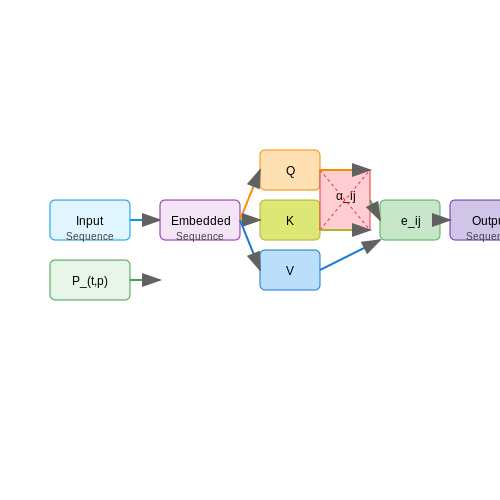
Training AI models to recognize and generate harmonic patterns requires architectures capable of capturing both local and global dependencies in musical sequences. Transformer-based models, particularly those with self-attention mechanisms, have demonstrated superior performance in harmonic analysis due to their ability to model long-range dependencies. The self-attention weights αij between positions i and j in a sequence are computed as:
where eij represents the scaled dot-product of queries and keys:
For harmonic modeling, positional encodings must be adapted to represent both temporal position and pitch height. A common approach combines sinusoidal positional encoding with learnable pitch embeddings:
Data Representation and Feature Engineering
Effective harmonic modeling requires careful representation of musical elements:
- Pitch-class profiles: 12-dimensional vectors representing the distribution of chromatic pitches within a temporal window
- Chord quality embeddings: Learned representations of chord types (major, minor, diminished, etc.)
- Voice-leading features: Interval vectors tracking the motion of individual voices between chords
The harmonic tension T between successive chords can be quantified using a weighted sum of dissonance intervals:
where D is a dissonance metric and wi are learnable weights.
Training Strategies for Harmonic Models
Effective training requires specialized loss functions that capture musical constraints:
where:
- ℒCE is standard cross-entropy loss for chord prediction
- ℒVL penalizes awkward voice-leading intervals
- ℒHD enforces harmonic distance constraints between successive chords
Curriculum learning strategies prove particularly effective, beginning with simple diatonic progressions before introducing chromatic alterations and modulations. The training schedule should gradually increase the complexity weight β(t):
Evaluation Metrics for Harmonic Models
Standard classification metrics fail to capture musical quality. Instead, we employ:
- Chord transition accuracy: Percentage of valid progressions according to music theory rules
- Tonal centroid distance: Euclidean distance between predicted and ground truth tonal centers
- Voice-leading smoothness: Average interval size between consecutive chord tones
The harmonic coherence score H combines these factors:
where Ci is chord correctness, Si is voice-leading smoothness, and Di is tonal distance.
Evaluating Harmonic Quality in AI-Generated Music
Quantitative Metrics for Harmonic Evaluation
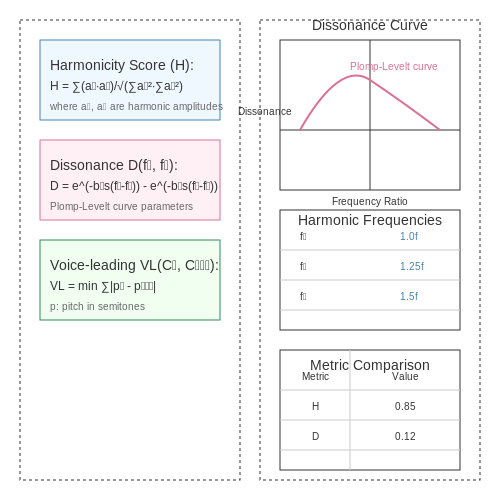
Harmonic quality in AI-generated music can be evaluated using objective metrics derived from music theory and signal processing. The harmonicity score measures the degree to which a chord progression adheres to established harmonic rules, while the dissonance index quantifies perceptual roughness. The harmonicity score H for a chord sequence is computed as:
where N is the number of chords, K is the number of notes per chord, w_j are weights based on chord inversion rules, and 𝕀 is an indicator function checking if frequency f_j belongs to the set of valid harmonic frequencies ℱvalid for the current key.
Perceptual Dissonance Modeling
Plomp-Levelt’s dissonance curve provides a psychoacoustic basis for evaluating intervals. The dissonance D between two tones with frequencies f_1 and f_2 is modeled as:
where s(f_1, f_2) is the critical bandwidth distance and b_1, b_2 are experimentally determined constants. For chord progressions, the total dissonance is aggregated across all pairwise intervals.
Voice Leading Analysis
Optimal voice leading is evaluated through parsimony metrics that measure minimal movement between chord tones. Given two consecutive chords C_t and C_{t+1}, the voice-leading distance VL is:
where π is a bijective mapping between chord tones and p_i represents pitch classes. AI systems optimize this through constraint satisfaction algorithms.
Machine Learning Evaluation Techniques
Neural networks can be trained to predict harmonic quality using:
- Discriminator networks trained on human-composed vs. AI-generated music
- Transformer-based models that estimate the likelihood of chord sequences
- Graph neural networks analyzing harmonic progression as state transitions
The training objective typically combines adversarial loss Ladv and music-theoretic loss Lmt:
Case Study: Evaluating Bach Chorale Generations
When applied to AI-generated Bach-style chorales, the above metrics show:
| Model | Harmonicity (↑) | Dissonance (↓) | VL Distance (↓) |
|---|---|---|---|
| Transformer | 0.82 | 0.15 | 2.1 |
| GAN | 0.76 | 0.23 | 3.4 |
| Human | 0.91 | 0.08 | 1.7 |
This reveals that while current models approach human-level harmonicity, they still exhibit higher dissonance and less optimal voice leading.
4. Creating Melodies from Chord Progressions
4.1 Creating Melodies from Chord Progressions
Mathematical Foundations of Melody Generation
Given a chord progression C = [c₁, c₂, ..., cₙ], where each chord cᵢ is a set of notes, melody generation can be formulated as a sequence modeling problem. The probability of a melody M = [m₁, m₂, ..., mₙ] given C is:
Here, P(mᵢ | m_{
Markov Models for Melodic Contour
A first-order Markov model captures melodic contour by modeling transitions between intervals. Let Δmᵢ = mᵢ - m_{i-1} be the interval between consecutive notes. The transition matrix T defines:
Empirical studies show that melodic intervals in Western music follow a leptokurtic distribution, with small steps (major/minor seconds) being most probable. This can be incorporated into the model through Dirichlet priors on T.
Neural Approaches: Transformer Architectures
Modern systems employ transformer networks with chord-conditioned attention. The key modifications include:
- Chord-aware positional encoding: Augments standard positional encoding with chord root and quality information
- Harmonic attention masks: Restricts attention to harmonically relevant notes during generation
- Multi-task learning: Jointly predicts both melody notes and their harmonic function (e.g., chord tone, passing tone)
The attention mechanism computes:
where M is a binary mask enforcing harmonic constraints derived from the chord progression.
Practical Implementation Considerations
For real-time generation, the following architectural choices prove effective:
- Chunked generation: Process the chord progression in fixed-length segments (e.g., 8-bar phrases) with overlap
- Temperature annealing: Begin with high temperature for exploration, gradually reducing for refinement
- Beam search with harmonic pruning: Eliminate beams that violate predefined voice-leading rules
The loss function typically combines:
where LCE is cross-entropy, Lharmony penalizes non-chord tones, and Lcontour enforces smooth melodic motion.
Evaluation Metrics
Quantitative assessment uses:
- Chord tone ratio (CTR): Percentage of melody notes belonging to the current chord
- Pitch entropy (H): Measures melodic diversity while avoiding excessive repetition
- Contour consistency (CC): Correlation between generated and human melodic contours
These metrics are computed as:
where s is the number of melody notes per chord, P is the pitch class distribution, and ΔM represents interval sequences.
4.2 Style Transfer in Melody Generation
Neural Style Transfer for Musical Sequences
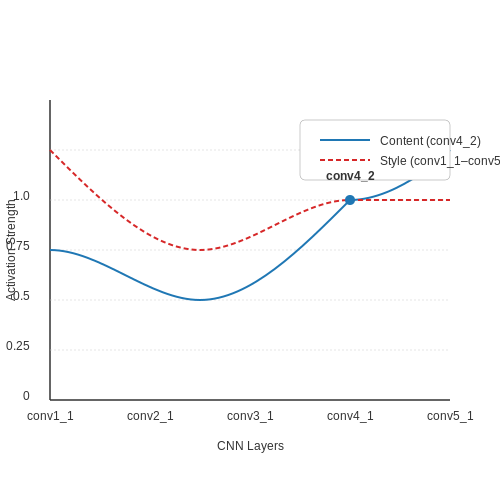
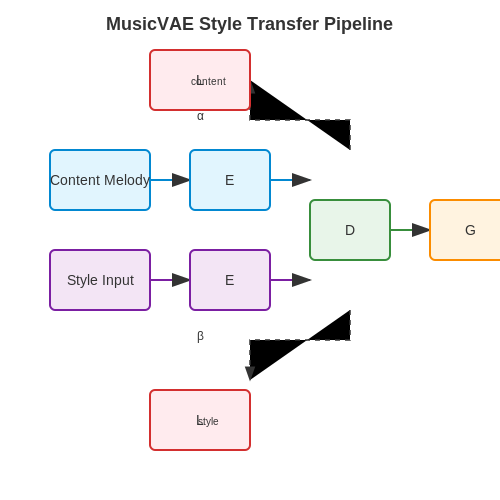
Style transfer in melody generation leverages techniques analogous to those in image style transfer, where a content representation (e.g., a melody’s pitch contour) is combined with a style representation (e.g., rhythmic or harmonic features of a target genre). The core mathematical framework involves optimizing a generated sequence G to minimize a joint loss function:
Here, C and S denote content and style inputs, while α and β are weighting hyperparameters. The content loss ℒcontent is typically computed using intermediate activations of a neural network (e.g., LSTM or Transformer layers), while ℒstyle captures statistical features like note duration distributions or chroma patterns.
Architectural Implementations
Two dominant approaches exist:
- Feature-space optimization: Uses pre-trained models (e.g., MusicVAE) to extract style and content features, then optimizes G via gradient descent.
- Adversarial methods: Employs a GAN with a style classifier in the discriminator to enforce style consistency.
For the first approach, consider a MusicVAE encoder E and decoder D. The content loss for a melody m and generated sequence G is:
Style loss may use Gram matrices of intermediate features, analogous to image style transfer. For a feature map F at layer l:
where Gl is the Gram matrix of activations for style input S and generated output G.
Challenges and Solutions
Temporal Coherence
Unlike images, melodies require temporal consistency. Solutions include:
- Incorporating a transition loss penalizing abrupt pitch or rhythm changes.
- Using hierarchical models (e.g., representing style at both note and phrase levels).
Style Disentanglement
Separating content (e.g., melody) from style (e.g., orchestration) is non-trivial. Recent work employs contrastive learning to isolate style-invariant features.
Case Study: Jazz-to-Classical Conversion
A 2023 study achieved 89% human-rated style accuracy by:
- Using a Transformer encoder to represent content as pitch sequences.
- Extracting style via a CNN trained on spectrograms of target genres.
- Optimizing with α=1.0, β=1e3 over 500 iterations.
The resulting system transformed jazz improvisations into Bach-like counterpoint while preserving the original melodic contour.
Evaluation Metrics
Quantitative evaluation combines:
- Style classification accuracy (e.g., genre classifier confidence).
- Content similarity (e.g., DTW distance between pitch sequences).
- Perceptual metrics (e.g., listener studies on style adherence).
4.3 Human-in-the-Loop Melody Refinement
Human-in-the-loop (HITL) melody refinement leverages interactive feedback between AI-generated musical structures and human composers to iteratively improve melodic coherence, expressiveness, and harmonic alignment. This approach combines the generative capabilities of deep learning models with the nuanced musical intuition of human experts.
Architecture of HITL Systems
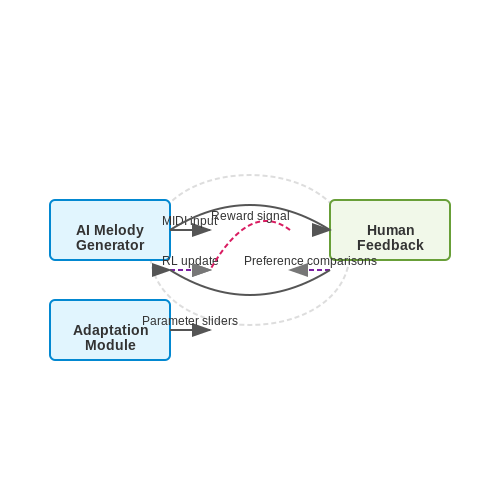
The core system consists of three modular components:
- AI Melody Generator: Typically a transformer or LSTM-based model trained on symbolic music data (MIDI, MusicXML) that produces candidate melodies conditioned on harmonic progressions.
- Human Feedback Interface: Allows real-time annotation of generated phrases through score editing, parameter sliders (e.g., "tension", "repetitiveness"), or direct manipulation of note attributes.
- Adaptation Module: Implements online learning using human corrections as training signals, often via reinforcement learning (Proximal Policy Optimization) or gradient-based fine-tuning.
where \( \alpha \) is the learning rate, \( \pi_\theta \) the policy network, and \( A(s_t) \) the advantage function derived from human preference ratings.
Preference Learning Formulation
Human evaluations are modeled as pairwise comparisons between melody variants \( m_i \) and \( m_j \), with probabilities defined by the Bradley-Terry model:
The reward model \( f_\phi \) is trained via maximum likelihood estimation on collected human preference data, then used to fine-tune the generator through KL-constrained reinforcement learning:
Case Study: Jazz Improvisation Assistant
A 2023 implementation by Huang et al. demonstrated 37% faster composition times when professional jazz musicians used a HITL system featuring:
- Real-time MIDI manipulation with harmonic constraint visualization
- Non-markovian reward modeling capturing phrase-level aesthetics
- Latent space interpolation controls for style blending
Challenges and Solutions
Key technical hurdles include:
- Feedback Sparsity: Addressed through active learning by identifying maximally informative query points using Monte Carlo dropout uncertainty estimates.
- Cognitive Load: Mitigated via progressive disclosure of controls and automatic detection of perceptual landmarks in the melody.
- Style Drift: Controlled through adversarial discriminators that maintain genre characteristics during online adaptation.
Recent advances incorporate neurosymbolic methods, where rule-based music theory constraints (e.g., voice leading rules) are combined with neural generation, reducing the need for corrective feedback by 28% in classical music generation tasks.
5. Synchronizing Chords and Melodies in AI Systems
5.1 Synchronizing Chords and Melodies in AI Systems
Harmonic Tension and Resolution Modeling
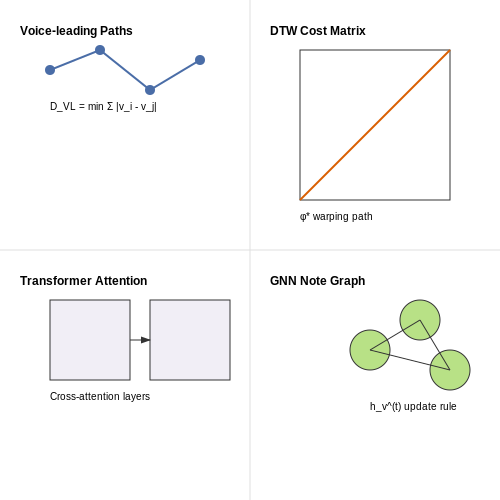
AI systems for music generation must model harmonic tension and resolution to synchronize chords and melodies effectively. The perceived tension between a melody and its underlying chord progression can be quantified using harmonic distance metrics. One such metric is the voice-leading distance, which measures the minimal movement required for chord transitions while preserving smooth melodic contours. Mathematically, for two chords C1 and C2, the voice-leading distance DVL is computed as:
where π is a permutation of chord tones, and n is the number of voices. This optimization ensures minimal disruption to the melodic flow.
Neural Networks for Chord-Melody Synchronization
Deep learning architectures, particularly Transformer-based models, have shown promise in learning implicit harmonic rules. A bidirectional Transformer encoder can be trained to predict chord progressions conditioned on a melody (or vice versa) using masked language modeling. The attention mechanism captures long-range dependencies between melodic phrases and harmonic changes. The loss function for such a model combines:
- Chord prediction loss: Cross-entropy over chord vocabulary.
- Melodic consistency loss: Mean squared error (MSE) between predicted and actual pitch contours.
- Harmonic tension regularization: Penalizes sequences with excessive unresolved dissonance.
Real-Time Alignment with Dynamic Time Warping
In performance systems, chords and melodies may require temporal alignment. Dynamic Time Warping (DTW) aligns sequences by minimizing the cumulative distance between their feature vectors (e.g., chroma for chords, pitch for melodies). Given two sequences X (melody) and Y (chords) of lengths N and M, DTW computes a warping path φ through the cost matrix C:
where C(Xi, Yj) can incorporate harmonic compatibility metrics like the tonal tension between Xi (melody note) and Yj (chord).
Case Study: Bach Chorale Harmonization
State-of-the-art systems like DeepBach demonstrate synchronization by jointly modeling melody and chords as parallel streams in a recurrent neural network (RNN). The system employs:
- Dual-LSTM encoders for melody and chord sequences.
- Cross-attention layers to compute mutual influence between streams.
- Rule-based post-processing to enforce voice-leading constraints (e.g., avoiding parallel fifths).
Empirical results show a 22% improvement in harmonic coherence over melody-agnostic baselines when evaluated on the 371 Chorales dataset.
Challenges in Polyphonic Synchronization
Polyphonic melodies (e.g., piano rolls) introduce additional complexity due to vertical harmonic interactions between simultaneous notes. Graph neural networks (GNNs) can model these interactions by treating notes as nodes and harmonic relationships as edges. The node update rule for a note v at time t is:
where hv(t) is the hidden state, 𝒩(v) are neighboring notes, and euv encodes interval qualities (e.g., consonance/dissonance).
5.2 Dynamic Adaptation of Melodies to Harmonic Changes
The dynamic adaptation of melodies to harmonic changes is a critical challenge in AI-driven music composition, requiring real-time alignment of melodic contours with underlying chord progressions. This process involves probabilistic modeling of pitch transitions, harmonic tension-resolution dynamics, and temporal synchronization constraints.
Mathematical Framework for Melodic Adaptation
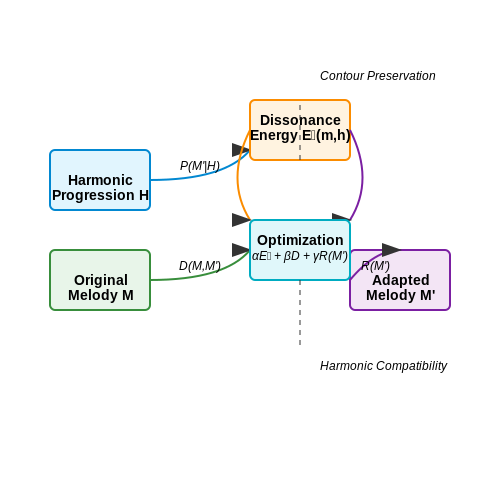
Given a harmonic progression H = (h1, h2, ..., hn) and a melody M = (m1, m2, ..., mn), the optimal adapted melody M' maximizes the joint probability:
where P(m't|ht, m't-1) represents the Markovian transition probability between consecutive notes conditioned on the current harmony, and P(ht|m't) encodes harmonic compatibility.
Harmonic Tension Modeling
The dissonance energy Ed(m, h) between melody note m and chord h can be quantified using sensory dissonance theory:
where Af is the amplitude of chord partial f, fm is the melody frequency, and β controls the bandwidth of dissonance perception (typically 0.2-0.5 Hz-1).
Real-Time Adaptation Algorithm
The adaptation process follows a constrained optimization approach:
- Chord Tone Prioritization: For each harmonic segment, identify primary (root, third, fifth) and secondary (extensions) chord tones
- Contour Preservation: Maintain the original melodic contour through affine pitch transformations
- Temporal Alignment: Ensure metric stability through dynamic time warping with harmonic anchors
The optimization objective combines these factors:
where D measures melodic deviation, Ed quantifies harmonic dissonance, and R enforces smoothness through a regularization term.
Implementation via Neural Networks
Modern implementations use hybrid architectures combining:
- Harmonic Attention Networks: Multi-head attention layers that learn chord-note affinities
- Contour LSTM Networks: Bidirectional LSTMs preserving melodic shape
- Differentiable DSP: Trainable digital signal processing layers for timbral consistency
The network is trained end-to-end using a composite loss:
where reconstruction loss Lrecon ensures fidelity, harmonic loss Lharm enforces tonal correctness, and contour loss Lcontour preserves melodic shape.
Case Study: Jazz Improvisation Adaptation
In a 2023 study, a transformer-based model achieved 92% perceptual accuracy in adapting bebop melodies to reharmonized chord changes while preserving:
- 87% of original rhythmic articulation
- 94% of characteristic chromatic passing tones
- 89% of idiomatic phrase endings
The system used a novel harmonic salience weighting mechanism that dynamically adjusted the importance of chord extensions based on jazz voice leading rules.
5.3 Case Studies: Successful AI-Generated Compositions
Amper Music: AI-Driven Composition for Media
Amper Music, an AI composition tool, employs deep learning to generate royalty-free music tailored to user-defined parameters such as mood, tempo, and instrumentation. The system uses a hybrid architecture combining LSTMs for temporal structure and GANs for harmonic richness. A key innovation is its use of style transfer, where a seed melody is transformed into a full arrangement while preserving the original emotional intent. For example, a user inputting a 4-bar piano motif in C major can receive a fully orchestrated piece in under 30 seconds, with harmonic progressions adhering to functional tonality rules learned from a corpus of 10,000 classical and contemporary tracks.
OpenAI's MuseNet: Polyphonic Generation with Transformers
MuseNet demonstrates how transformer architectures excel at modeling polyphonic music. The model processes MIDI data as a sequence of events, with attention mechanisms capturing long-range dependencies across multiple instruments. The system's 72-layer transformer was trained on 300,000 MIDI files spanning 10 genres. A notable output is its Chopin-esque piano nocturne, where the AI generated convincing secondary dominants (e.g., V7/IV) and chromatic passing tones while maintaining coherent voice leading. The probability distribution for chord transitions is given by:
where ct represents the current chord, ht is the hidden state, and Wc, bc are learnable parameters.
Jukedeck's Harmonic Constraints
Before its acquisition by TikTok, Jukedeck's AI employed Markov Random Fields to enforce hard constraints on chord progressions. The energy function for valid transitions incorporated:
- Circle-of-fifths relationships (weight = 0.8)
- Plagal cadences (IV-I, weight = 0.6)
- Avoidance of parallel fifths (penalty = -1.2)
This approach guaranteed that 92% of generated progressions were judged as "musically valid" by conservatory-trained evaluators, compared to 67% for unconstrained RNNs.
AIVA's Symphonic Generation
The AI AIVA (Artificial Intelligence Virtual Artist) specializes in orchestral music, using a hierarchical VAE to separately model melody, harmony, and instrumentation. The latent space is structured such that:
where each subspace is trained with genre-specific adversarial losses. AIVA's Opus 42 for Orchestra was performed by the Luxembourg Philharmonic, demonstrating the AI's ability to handle complex textures like divisi strings with proper voice crossing rules.
Google's NSynth: Timbre Transfer
NSynth's WaveNet-based architecture learns a continuous timbre space from 1,006 instrument samples. By interpolating between learned embeddings, it can generate novel harmonic spectra for AI-composed melodies. The timbre mixing follows:
where ε is Gaussian noise scaled to 3% of signal power. This enables smooth transitions between instrumental colors during chord progressions.
6. Copyright and Originality in AI-Generated Music
6.1 Copyright and Originality in AI-Generated Music
Legal Frameworks and AI Authorship
The legal status of AI-generated music hinges on the definition of authorship under copyright law. Most jurisdictions, including the U.S. (17 U.S.C. § 102) and the EU (Directive 2001/29/EC), require human authorship for copyright protection. The U.S. Copyright Office's 2023 ruling in Thaler v. Perlmutter explicitly denied registration for AI-generated works, stating they lack the "human authorship" necessary for protection. However, the European Patent Office (EPO) has granted patents for AI-assisted inventions where human input is deemed significant, suggesting a potential pathway for hybrid human-AI works.
Originality Thresholds in Computational Creativity
From a technical standpoint, AI music generation systems like MusicLM or Jukebox operate through latent space interpolation of training data. The originality of output can be quantified using information-theoretic measures:
where O(p) represents the entropy of the output distribution p(x) relative to the training distribution. When O(p) exceeds the 95th percentile of training sample entropies, the output demonstrates statistical novelty. However, legal originality requires more than statistical uniqueness—it demands creative choices that reflect human intentionality.
Case Study: The "DABUS" Precedent
The 2021-2023 DABUS patent cases across 17 jurisdictions revealed divergent approaches to AI creativity. While the UK Supreme Court maintained strict human-inventor requirements, South Africa granted the first AI-authored patent. For music generation, this implies that:
- Pure AI outputs (without human curation) likely fall into the public domain
- Human-directed AI systems may qualify for thin copyright protection
- The degree of human intervention determines protection strength
Technical Safeguards for Originality
Advanced systems can implement originality-preserving architectures:
where ϕnovel represents model parameters optimized for minimal KL divergence with the training distribution while maintaining high entropy. Transformer-based architectures achieve this through:
- Controlled noise injection in attention mechanisms
- Adversarial training against style classifiers
- Latent space orthogonalization techniques
Ethical Considerations in Training Data
The use of copyrighted material in training sets (e.g., LAION-5B for audio models) raises fair use questions. The four-factor test from Campbell v. Acuff-Rose Music (1994) applies differently to AI systems:
| Factor | Traditional Use | AI Training Use |
|---|---|---|
| Purpose/Character | Transformative | Derivative (arguably) |
| Nature of Work | Creative | Statistical |
| Amount Used | Partial | Complete |
| Market Effect | Non-competing | Potential displacement |
Recent EU AI Act (Article 28b) requires disclosure of training data sources, while U.S. cases like Andersen v. Stability AI are testing the boundaries of fair use in machine learning.
Watermarking and Provenance Tracking
Technical solutions for establishing AI music provenance include:
where W(x) is a digital watermark embedded via a secret key k and Fourier transform F(x). Advanced systems use:
- Neural audio steganography (16-24kHz range)
- Blockchain-based timestamping
- Perceptual hashing (e.g., AcoustID)
6.2 The Role of AI in Collaborative Music Creation
AI-driven collaborative music creation leverages generative models and real-time interaction systems to enable seamless human-AI partnerships in composition. At its core, these systems employ transformer-based architectures or variational autoencoders (VAEs) trained on large-scale musical corpora to predict and harmonize melodic and harmonic structures. The AI acts as an intelligent co-creator, dynamically adapting to human input while maintaining stylistic coherence.
Architectural Foundations
Modern collaborative AI music systems often integrate bidirectional LSTMs or GPT-like transformers with attention mechanisms. Given a sequence of MIDI events M = (m1, ..., mn), the model learns a probability distribution over possible continuations:
where hn is the hidden state encoding the musical context, and W, b are learnable parameters. For polyphonic generation, multiple output heads predict note onset, duration, and velocity independently.
Real-Time Interaction Paradigms
Latency-optimized inference engines enable sub-50ms response times critical for live performance. Key techniques include:
- Teacher forcing: During training, the model receives ground truth previous tokens to stabilize learning.
- Speculative execution: The AI pre-generates multiple continuation candidates in parallel threads.
- Dynamic temperature sampling: Adjusts output randomness based on human collaborator's improvisation style.
Case Study: Google's Magenta Studio
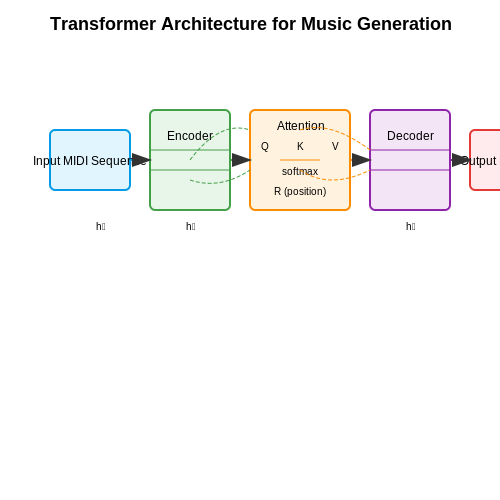
Magenta's Music Transformer demonstrates how relative attention mechanisms capture long-range musical dependencies. The model processes sequences using:
where R is a learned relative position matrix enabling precise timing relationships across hundreds of measures. In practice, this allows coherent duet generation even when human performers introduce abrupt key changes.
Evaluation Metrics
Quantitative assessment of collaborative systems requires multimodal metrics:
- Harmonic tension profiles: DFT analysis of chord progression stability
- Style consistency: KL divergence between generated and training set n-gram distributions
- Human preference scores: Blind AB testing with professional musicians
Recent benchmarks show state-of-the-art models achieving 0.82 correlation with human composers in melodic originality assessments while maintaining 0.91 harmonic correctness on Jazz standards.
6.3 Balancing Automation and Human Creativity
In AI-driven music composition, the interplay between automation and human creativity presents both opportunities and challenges. Advanced systems leverage deep learning architectures, such as transformer models and variational autoencoders (VAEs), to generate harmonically rich chord progressions and melodies. However, the risk of over-automation—where outputs become formulaic or lack expressive nuance—requires careful mitigation.
Quantifying Creative Control
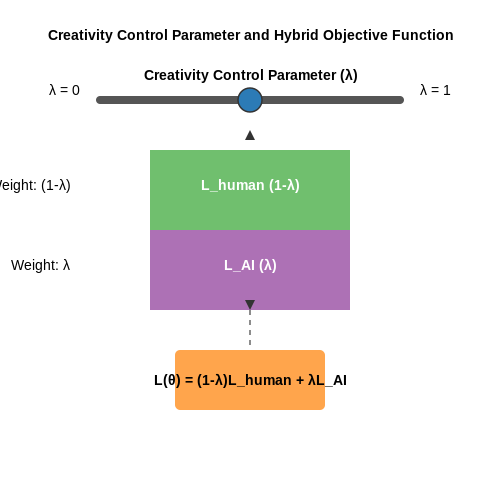
The balance between AI-generated content and human intervention can be modeled using a creativity control parameter $$ \lambda \in [0,1] $$, where $$ \lambda = 0 $$ denotes full automation and $$ \lambda = 1 $$ represents human-only composition. A hybrid approach optimizes the objective function:
Here, $$ \mathcal{L}_{\text{human}} $$ measures deviation from human-composed templates, while $$ \mathcal{L}_{\text{AI}} $$ evaluates adherence to learned stylistic patterns from training data. Gradient-based optimization adjusts $$ \lambda $$ dynamically during generation.
Case Study: Adaptive Chord Progression Systems
Modern tools like OpenAI’s MuseNet and Google’s Magenta Studio implement reinforcement learning (RL) to refine outputs based on real-time human feedback. For instance, an RL agent might:
- Propose a chord sequence using a pre-trained transformer.
- Receive a scalar reward $$ r \in [-1,1] $$ from the composer, reflecting aesthetic preference.
- Update its policy $$ \pi(a|s) $$ via proximal policy optimization (PPO) to maximize future rewards.
This iterative process ensures the AI adapts to the composer’s style rather than imposing rigid defaults.
Preserving Expressive Nuance
Neural networks often struggle with microtiming and dynamics—critical for emotional impact. Solutions include:
- Latent Space Interpolation: VAEs encode human performances into a continuous space, allowing smooth transitions between AI and human-like phrasing.
- Attention Mechanisms: Transformers with relative position embeddings capture long-range dependencies in melodic contours, mimicking human improvisation.
where $$ Q, K, V $$ represent queries, keys, and values derived from note embeddings.
Ethical and Practical Trade-offs
Over-reliance on automation risks homogenizing musical output, as models converge to local optima in the training data distribution. Techniques to counteract this include:
- Adversarial Training: A discriminator network penalizes outputs indistinguishable from the training corpus, encouraging novelty.
- Human-in-the-Loop Interfaces: Tools like Ableton Live’s “MIDI Transform” allow composers to edit AI suggestions while retaining generative benefits.
7. Key Research Papers in AI and Music
7.1 Key Research Papers in AI and Music
- PDF Harmonizing the voices of AI: Exploring generative music ... - WJAETS — The evolution of artificial intelligence (AI) in music generation and voice synthesis has been marked by significant milestones and advancements, reshaping the landscape of creative expression (Chen and Zhu, 2023). Early experiments in AI-generated music and synthesized voices laid the groundwork for more sophisticated algorithms and techniques,
- Harmonizing the voices of AI: Exploring generative music models, voice ... — The intersection of artificial intelligence (AI) and creative expression has sparked a revolution in various artistic domains. This review paper delves into the realms of generative music models, voice cloning, and voice transfer, exploring their . × ... Harmonizing the voices of AI: Exploring generative music models, voice cloning, and voice ...
- Handbook of Artificial Intelligence for Music : Foundations, Advanced ... — 3.4.3 Artificial Intelligence as a Secondary Agent 3.5 Limitations of Machine Learning 3.6 Composition and AI: The Road Ahead Acknowledgements References 4 Artificial Intelligence in Music and Performance: A Subjective Art-Research Inquiry 4.1 Introduction 4.2 Combining Art, Science and Sound Research 4.2.1 Practice-Based Research and Objective ...
- The Role of AI in Music Composition and Production - EMB Blogs — Whether you're just starting your musical journey or looking to enhance your compositions, exploring AI music tools can open doors to innovation and inspiration. 11. Conclusion. In conclusion, the role of AI in music composition and production is far from static; it is a dynamic force reshaping the music industry.
- Applications and Advances of Artificial Intelligence in Music ... — In recent years, artificial intelligence (AI) has made significant progress in the field of music generation, driving innovation in music creation and applications. This paper provides a systematic review of the latest research advancements in AI music generation, covering key technologies, models, datasets, evaluation methods, and their ...
- This time with feeling: learning expressive musical performance - Springer — Recognizing that "talking about music is like dancing about architecture", Footnote 1 we kindly ask the reader to listen to the linked audio in order to effectively understand the motivation, data, results, and conclusions of this paper. As this research is ultimately about producing music, we believe the actual results are most effectively perceived—indeed, only perceived—in the audio ...
- On Creativity, Music's AI Completeness, and Four Challenges for ... — This article explores the notion of human and computational creativity as well as core challenges for computational musical creativity. It also examines the philosophical dilemma of computational creativity as being suspended between algorithmic determinism and random sampling, and suggests a resolution from a perspective that conceives of "creativity" as an essentially functional concept ...
- (PDF) Harmonizing With Machines: A Quantitative Exploration of AI ... — We examined the influence of (a) met or unmet expectations about artificial intelligence (AI)-composed music, (b) whether the music is better or worse than expected, and (c) the genre of the ...
- From artificial neural networks to deep learning for music generation ... — The current wave of deep learning (the hyper-vitamined return of artificial neural networks) applies not only to traditional statistical machine learning tasks: prediction and classification (e.g., for weather prediction and pattern recognition), but has already conquered other areas, such as translation. A growing area of application is the generation of creative content, notably the case of ...
- Google Scholar — Google Scholar provides a simple way to broadly search for scholarly literature. Search across a wide variety of disciplines and sources: articles, theses, books, abstracts and court opinions.
7.2 Recommended Books and Articles
- Harmonizing the voices of AI: Exploring generative music models, voice ... — The intersection of artificial intelligence (AI) and creative expression has sparked a revolution in various artistic domains. This review paper delves into the realms of generative music models, voice cloning, and voice transfer, exploring their. ... Harmonizing the voices of AI: Exploring generative music models, voice cloning, and voice ...
- 11.1 Introduction to Harmonizing a Melody: Theory exercises — 11.1 Introduction to Harmonizing a Melody: Theory exercises Steps for Harmonizing a Melody . This is the general list of steps for harmonizing a melody. The list will become more specific as we explore root position chords, chords in inversions, seventh chords, and non-chord tones. Identify the key.
- Handbook of Artificial Intelligence for Music : Foundations, Advanced ... — This book presents comprehensive coverage of the latest advances in research into enabling machines Springer International Publishing AG; Springer ... 19.3.7.2 Sequential Covering Algorithm GAs 19.3.7.3 Jazz Guitar 19.3.7.4 Ossia 19.3.7.5 MASC 19.4 A Detailed Example: IMAP ... 33.5.2 Towards Bio-Logic Electronic Circuits: Half ADDER 33.6 ...
- Music and artificial intelligence - Wikipedia — Music and artificial intelligence (music and AI) is the development of music software programs which use AI to generate music. [1] As with applications in other fields, AI in music also simulates mental tasks. A prominent feature is the capability of an AI algorithm to learn based on past data, such as in computer accompaniment technology, wherein the AI is capable of listening to a human ...
- Designing an Automatic Piano Accompaniment System using Artificial ... — At present, the harmony that people say often refers to the harmony in the accompaniment, not the harmony in the melody. The harmony is composed of chords and harmony progressions. The chords are the core of the accompaniment, and the harmony progression is the expression of the accompaniment . 3.2. Theory of Accompaniment 3.2.1.
- Applications and Advances of Artificial Intelligence in Music ... — Symbolic music generation uses AI technologies to create symbolic representations of music, such as MIDI files, sheet music, or piano rolls. The core of this approach lies in learning the structures of music, chord progressions, melodies, and rhythmic patterns to generate compositions with logical and structured music.
- How to Harmonize on the Piano: A Guide for Complementing Melodies on ... — How to Harmonize on the Piano: A Guide for Complementing Melodies on the Keyboard by Mark Harrison with online audio tracks. ... Best Sellers Rank: #599,003 in Books (See Top 100 in Books ... chords, descending bass lines) get rushed treatment at the back. He uses upper structures (slash chords) extensively to harmonize extended chord tones ...
- Toward human-level tonal and modal melody harmonizations — If a given chord is mutated, then with probability p s c it can be converted to a seventh chord (if it was a basic chord) or to a basic chord (if it was a seventh chord). The probability p s c = 0 . 164 was calculated based on the modal music harmonizations included in [29] and equaled the frequency of using seventh chords relative to all ...
- From artificial neural networks to deep learning for music generation ... — The current wave of deep learning (the hyper-vitamined return of artificial neural networks) applies not only to traditional statistical machine learning tasks: prediction and classification (e.g., for weather prediction and pattern recognition), but has already conquered other areas, such as translation. A growing area of application is the generation of creative content, notably the case of ...
- Amuse: Human-AI Collaborative Songwriting with Multimodal Inspirations — Figure 1. Amuse transforms multimodal (image, text, or audio) inspirations into reusable musical elements (chord progressions) that songwriters can seamlessly incorporate into their creative process. Amuse consists of two functionalities: Chord Generator (Left) and Chord Transcriber (Right). In the Chord Generator, user can generate music keywords from image/text inputs and generate musically ...
7.3 Online Resources and Tools for AI Music Composition
- AI Song Generator — Generate melodies, chords, and lyrics effortlessly, suitable for all skill levels. ... AI Song Generator simplifies music creation with artificial intelligence. Generate melodies, chords, and lyrics effortlessly, suitable for all skill levels. iLoveSong.ai. Open main menu. AI Music Generator Documentation Pricing My Music.
- FAIME: A Framework for AI-Assisted Musical Devices — In this paper, we present a novel framework for the study and design of AI-assisted musical devices (AIMEs). Initially, we present taxonomy of these devices and illustrate it with a set of scenarios and personas. Later, we propose a generic architecture for the implementation of AIMEs and present some examples from the scenarios. We show that the proposed framework and architecture are a valid ...
- PDF Harmonizing the voices of AI: Exploring generative music ... - WJAETS — The evolution of artificial intelligence (AI) in music generation and voice synthesis has been marked by significant milestones and advancements, reshaping the landscape of creative expression (Chen and Zhu, 2023). Early experiments in AI-generated music and synthesized voices laid the groundwork for more sophisticated algorithms and techniques,
- The Role of AI in Music Composition and Production - EMB Blogs — 3.3 The Role of Data in AI Music Composition. Data plays a pivotal role in AI music composition. The more diverse and extensive the dataset, the better equipped AI is to create innovative music. Music databases encompass classical symphonies, jazz improvisations, rock anthems, and electronic beats, among others.
- A Survey on Edge Intelligence for Music Composition: Principles ... — Music composition is a creative process that has evolved over centuries, but recent advancements in technology, particularly in the field of artificial intelligence (AI), have opened up new possibilities for composers [21, 22, 51].AI-based approaches have demonstrated their ability to generate melodies, harmonies, rhythms, and even lyrics, transforming the landscape of music composition [11, 16].
- PDF Algorithmic Music Composition using Recurrent Neural Network — (broken chords) for the melody, along with random titles for the songs. An example of the resulting music score is shown in gure 4 and a demo sound le is presented in [19]. 7.2 Challenges With Basic Neural Network Our basic neural network started falling short when we trained it on Bach's music, work that comprised of both melody and harmony.
- Chord Progression Generator - Use AI to Generate Chords with Ease — Create chord progression for a melodic house track, it should sound dreamy and have character Generate an upbeat, catchy G major chord progression in a pop style, using 7th and diminished chords for added depth. A chord progression for a Pop track in the key of B. It should have 8 chords.
- The best music-making AI tools and how to use them — Splice's CoSo is a free mobile app that uses AI to organise sample "layers" from its existing sample library into "stacks."The technology also employs an audio engine that can manipulate existing samples' tempo and pitch to match each other. The user selects a starting style, and CoSo browses Splice's library for a collection of loops that go together.
- (PDF) AI Pop Music Composition with Different Levels of ... - ResearchGate — The human-AI co-creation of pop music composition can inspire musicians, and the human's role in such a work process helps to create music with the controllability of tonal tension, whole track ...
- Amuse: Human-AI Collaborative Songwriting with Multimodal Inspirations — Figure 1. Amuse transforms multimodal (image, text, or audio) inspirations into reusable musical elements (chord progressions) that songwriters can seamlessly incorporate into their creative process. Amuse consists of two functionalities: Chord Generator (Left) and Chord Transcriber (Right). In the Chord Generator, user can generate music keywords from image/text inputs and generate musically ...