AI-Powered Game Level Generation
1. What is Procedural Content Generation (PCG)?
Procedural Content Generation (PCG)
Procedural Content Generation (PCG) refers to algorithmic methods for creating game content—levels, textures, items, narratives, or even entire worlds—without direct human authoring. Unlike hand-crafted design, PCG leverages mathematical models, noise functions, grammars, or machine learning to generate content dynamically. The core advantage lies in scalability: a single algorithm can produce near-infinite variations, reducing development costs while enhancing replayability.
Mathematical Foundations
At its core, PCG relies on deterministic or stochastic processes. A common approach uses Perlin noise or simplex noise for terrain generation. For a 2D heightmap H(x,y), the value at coordinates (x,y) can be computed as:
where noise is a coherent noise function (e.g., Perlin), and n controls the level of detail. This fractal summation, known as fractional Brownian motion, produces realistic terrain with self-similar features at multiple scales.
Grammars and Rule-Based Systems
Formal grammars, such as L-systems or shape grammars, enable structured generation. An L-system is defined by:
- An alphabet V of symbols,
- An axiom ω ∈ V* (initial string),
- Production rules P: V → V*.
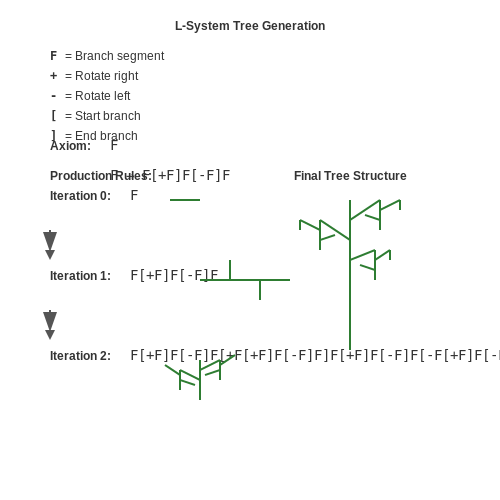
For example, a simple tree might be generated by:
where F denotes a branch segment, and +/- represent rotations. Iterative rewriting produces complex, branching structures.
Machine Learning-Driven PCG
Modern PCG integrates machine learning, particularly Generative Adversarial Networks (GANs) and Variational Autoencoders (VAEs). A GAN trains a generator G and discriminator D via minimax optimization:
where z is latent noise. For level generation, G learns to produce plausible levels (e.g., platformer layouts), while D distinguishes real vs. generated content. VAEs, conversely, optimize a variational lower bound:
enabling controlled sampling from the latent space.
Applications and Challenges
PCG is ubiquitous in roguelikes (Spelunky), open worlds (No Man’s Sky), and puzzle games (Baba Is You). Key challenges include:
- Controllability: Ensuring generated content adheres to design constraints (e.g., difficulty curves).
- Diversity: Avoiding repetitive patterns while maintaining coherence.
- Evaluation: Quantifying quality without exhaustive human testing.
Hybrid approaches, such as search-based PCG, use evolutionary algorithms to optimize content against fitness functions (e.g., fun factor, navigability).
1.2 Role of AI in Modern PCG Systems
Evolution from Heuristics to Learned Representations
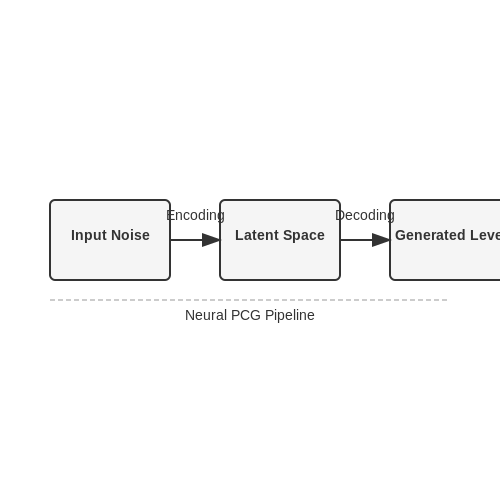
Traditional procedural content generation (PCG) relied on handcrafted heuristics and deterministic algorithms like Perlin noise or wave function collapse. Modern AI-driven approaches replace these with learned latent representations, enabling systems to capture complex patterns from existing game levels. Neural networks trained on level datasets can generate outputs that preserve gameplay-affecting topological features while exhibiting novel variations.
Key Architectural Paradigms
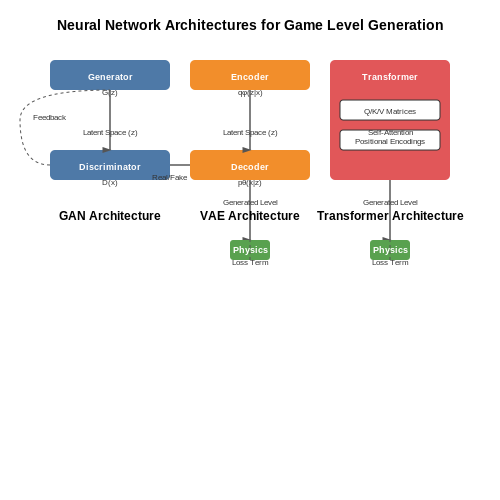
Contemporary systems employ three principal architectures:
- Generative Adversarial Networks (GANs): The discriminator learns to evaluate playability constraints while the generator produces levels adhering to those constraints. The minimax objective is:
- Variational Autoencoders (VAEs): Encode levels into a continuous latent space where interpolation maintains playability. The evidence lower bound (ELBO) objective:
- Transformer-based Models: Treat level elements as tokens in a sequence, capturing long-range dependencies through self-attention mechanisms. The scaled dot-product attention computes:
Constraint Satisfaction Through Differentiable Optimization
Modern systems integrate gameplay constraints directly into the generation process. Differentiable physics engines allow backpropagation through simulated playtests, enabling gradient-based optimization of level parameters. For a platformer level with jump mechanics, the feasible jump distance d given character velocity v and gravity g becomes a trainable constraint:
Procedural Evaluation Metrics
Quality diversity algorithms like MAP-Elites maintain archives of solutions categorized by behavioral characteristics. For a dungeon generator, dimensions might include:
- Linearity: Ratio of critical path length to total path length
- Exploration density: Number of optional branches per critical path segment
- Challenge gradient: Monotonic increase in enemy difficulty
Real-World Implementation Challenges
Commercial deployments must address:
- Computational latency: Parallelizing neural inference across GPU clusters to meet real-time generation demands
- Asset stitching: Resolving discontinuities between generated segments using boundary-aware networks
- Dynamic difficulty adjustment: Online reinforcement learning to adapt generated content to player skill
1.3 Key Benefits and Challenges of AI-Driven Level Design
Benefits of AI-Driven Level Generation
AI-powered procedural content generation (PCG) offers several advantages over traditional manual design. One of the most significant benefits is scalability. AI algorithms can generate vast, complex game worlds with minimal human intervention, reducing development time and costs. For instance, Wave Function Collapse (WFC) algorithms can produce coherent levels by propagating local constraints across a grid, enabling rapid iteration.
Another key advantage is adaptive difficulty. Reinforcement learning (RL) agents can optimize level parameters based on player performance metrics. The objective function for such an agent can be formalized as:
where θ represents the level parameters, Pplayer is the player skill distribution, L is the level generator, and R is the reward function measuring engagement.
AI also enables procedural narrative generation. Markov decision processes (MDPs) can create branching storylines where quests and events adapt to player choices while maintaining narrative coherence. This is particularly valuable in open-world RPGs where hand-crafting all possible interactions is infeasible.
Technical Challenges in Implementation
Despite these benefits, AI-driven level design faces several technical hurdles. The quality-diversity tradeoff is particularly acute—while generative adversarial networks (GANs) can produce novel levels, ensuring they meet gameplay standards requires careful loss function design:
where the λ terms weight competing objectives. Empirical studies show that improper balancing leads to either repetitive or unplayable outputs.
Computational complexity presents another challenge. Monte Carlo tree search (MCTS) for puzzle generation scales as O(bd), where b is branching factor and d is search depth. For complex games, this becomes prohibitively expensive without heuristic pruning.
Emerging Solutions and Research Directions
Recent work addresses these challenges through hybrid approaches. Neuroevolution of augmenting topologies (NEAT) combined with constraint satisfaction has shown promise in generating levels that balance novelty and functionality. The fitness function in such systems often incorporates:
where ci measures constraint satisfaction, di is novelty distance, and α, β are tuning parameters.
Another promising direction is player modeling. Deep inverse reinforcement learning (IRL) can infer reward functions from human-designed levels, then generate new ones that match the implicit design principles. This approach has successfully replicated the style of professional designers in platformer games while introducing novel variations.
The field continues to evolve with techniques like diffusion models for level generation and transformer-based approaches for narrative coherence. However, fundamental challenges remain in evaluation metrics—current quantitative measures often fail to capture subtle aspects of player experience that human designers intuitively understand.
2. Markov Chains for Sequential Level Generation
2.1 Markov Chains for Sequential Level Generation
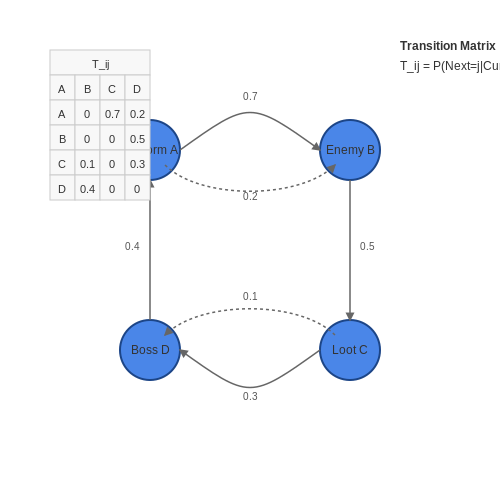
Markov chains provide a probabilistic framework for modeling sequential dependencies in game level generation, where the next state (e.g., a level segment or tile) depends only on the current state. This memoryless property, known as the Markov property, is formally defined as:
For level generation, a Markov chain is constructed by defining states as level components (e.g., platform configurations, enemy placements) and transition probabilities between them. The transition matrix T encodes these probabilities, where Tij represents the probability of transitioning from state i to state j.
Constructing the Transition Matrix
Given a training set of hand-designed levels, the transition probabilities are learned by counting state transitions. For N unique states, the maximum likelihood estimate for Tij is:
where Cij is the count of observed transitions from state i to state j. To handle unseen transitions, Laplace smoothing can be applied by adding a small constant α to each count:
Higher-Order Markov Models
While first-order Markov chains consider only the immediate previous state, k-th order Markov chains condition on the last k states. This captures longer-range dependencies at the cost of increased computational complexity. The transition probability becomes:
In practice, variable-order Markov models like the Prediction by Partial Match (PPM) algorithm adaptively select the context length based on observed patterns.
Implementation Example
The following Python snippet demonstrates first-order Markov chain level generation for a simple platformer game:
import numpy as np

class MarkovLevelGenerator:
    def __init__(self, training_levels):
        self.states = self._extract_states(training_levels)
        self.transition_matrix = self._build_transition_matrix()

    def _extract_states(self, levels):
        # Extract unique level segments (states) from training data
        return list({segment for level in levels for segment in level})

    def _build_transition_matrix(self):
        # Count transitions and normalize to probabilities
        N = len(self.states)
        counts = np.zeros((N, N))

        for level in training_levels:
            for i in range(len(level)-1):
                current = self.states.index(level[i])
                next_state = self.states.index(level[i+1])
                counts[current][next_state] += 1

        # Apply Laplace smoothing
        counts += 0.1
        return counts / counts.sum(axis=1, keepdims=True)

    def generate_level(self, length=50):
        level = []
        current = np.random.choice(len(self.states))  # Start with random state

        for _ in range(length):
            level.append(self.states[current])
            current = np.random.choice(
                len(self.states),
                p=self.transition_matrix[current]
            )

        return level
Applications and Limitations
Markov chains have been successfully applied to generate levels for games like Spelunky and Procedural Death Labyrinth. Their key advantages include:
- Computational efficiency during generation due to constant-time state transitions
- Interpretability of the transition matrix for designer oversight
- Controllability through manual adjustment of transition probabilities
However, limitations include:
- Local coherence at the expense of global structure without higher-order models
- Training data sensitivity - poor quality or insufficient training levels degrade results
- Limited creativity as the model can only recombine observed patterns
2.2 Genetic Algorithms for Evolutionary Design
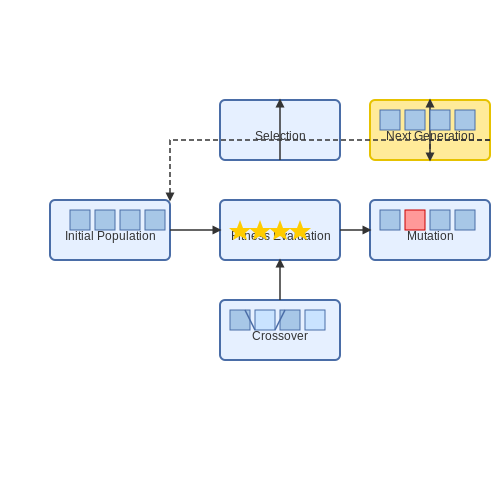
Genetic algorithms (GAs) provide a robust framework for procedural content generation in games by simulating natural selection. A population of candidate levels evolves over generations through selection, crossover, and mutation operators. The fitness function acts as the selection pressure, guiding the search toward desirable level characteristics.
Representation and Initialization
Level designs are encoded as chromosomes using either direct or indirect representations. Direct representations may use grid-based tilemaps where each gene corresponds to a specific game element (e.g., platform, enemy, power-up). Indirect representations employ generative rules or parameters that get interpreted into level geometry.
The initial population is typically generated through random sampling within constrained parameter spaces. For platformers, this might involve random platform heights and lengths while ensuring walkable paths exist.
Fitness Evaluation
The fitness function quantitatively assesses level quality across multiple dimensions:
- Playability: Ensures the level can be completed (e.g., reachable exit)
- Challenge: Measures difficulty progression through enemy density or jump precision
- Novelty: Encourages diversity using metrics like tile pattern uniqueness
- Aesthetics: Evaluates visual composition through symmetry or color distribution
Genetic Operators
Selection
Tournament selection proves effective for game levels, where subsets of candidates compete based on fitness. This maintains selective pressure while preserving some weaker designs that may contain valuable partial solutions.
Crossover
Geometric crossover operators work particularly well for spatial content:
- Cut-and-Splice: Swaps rectangular regions between parent levels
- Parameter Interpolation: Blends numerical parameters for smooth transitions
Mutation
Mutation operators introduce controlled randomness:
- Tile Replacement: Randomly alters individual tiles with probability pm
- Segment Perturbation: Shifts or resizes level components
- Rule Mutation: Modifies grammar production rules in indirect representations
Implementation Considerations
Parallel evaluation accelerates fitness computation for large populations. Niching techniques prevent premature convergence by maintaining subpopulations with distinct characteristics. Adaptive operator probabilities can improve search efficiency:
Where ΔF̄ measures generational fitness improvement and σF is the population's fitness standard deviation.
Case Study: Platformer Level Generation
In Super Mario Bros.-style games, GAs have successfully generated levels that balance difficulty progression with visual coherence. The fitness function incorporates:
- Player path length between start and exit
- Enemy distribution matching target difficulty curves
- Platform connectivity metrics
- Pattern diversity scores
Interactive evolution allows designers to manually select promising candidates, combining algorithmic search with human creativity.
2.3 Neural Networks and Deep Learning Approaches
Neural networks have emerged as a dominant paradigm for procedural content generation in games, particularly for level design. Unlike traditional procedural generation techniques that rely on handcrafted rules or noise functions, neural networks learn latent representations of level structures directly from data, enabling more organic and adaptive generation.
Generative Adversarial Networks (GANs) for Level Generation
The adversarial training framework of GANs makes them particularly suitable for level generation tasks. A typical architecture consists of:
- A generator network G that maps random noise z to level representations
- A discriminator network D that classifies between real and generated levels
The minimax objective function is given by:
Recent work has shown that conditioning the GAN on additional inputs (e.g., player skill level or desired difficulty) produces more controllable generation. The conditional GAN objective becomes:
where y represents the conditioning variable.
Variational Autoencoders (VAEs) for Latent Space Exploration
VAEs provide an alternative approach that learns a compressed latent representation of game levels. The encoder network qφ(z|x) maps input levels to a latent distribution, while the decoder pθ(x|z) reconstructs levels from latent vectors.
The evidence lower bound (ELBO) objective is:
Key advantages for level generation include:
- Continuous latent spaces enabling smooth interpolation between level styles
- Explicit control over generation through manipulation of latent variables
- Stable training compared to GANs
Transformer Architectures for Sequential Generation
For games with sequential level structures (e.g., platformers), transformer models have shown remarkable success. The self-attention mechanism allows modeling long-range dependencies in level layouts. Given a sequence of level tiles x1,...,xn, the probability of the next tile is:
where Q, K, and V are learned query, key, and value matrices respectively. Positional encodings are crucial for maintaining spatial relationships:
Physics-Informed Neural Networks
Recent advances incorporate physical constraints directly into neural generators through:
- Differentiable physics engines as part of the network architecture
- Physics-based loss terms during training
- Hybrid approaches combining neural networks with traditional simulation
For platformer generation, this might involve ensuring valid player trajectories through learned dynamics:
where fθ represents the physics model and λ controls the constraint strength.
Evaluation Metrics for Neural Generators
Quantitative assessment of generated levels requires specialized metrics:
| Metric | Description | Computation |
|---|---|---|
| Playability | Percentage of valid, completable levels | Automated agent testing |
| Diversity | Variation in generated content | Latent space distances or tile statistics |
| Style Consistency | Adherence to training distribution | Discriminator confidence scores |
2.4 Reinforcement Learning for Adaptive Level Creation
Foundations of RL in Procedural Content Generation
Reinforcement learning (RL) formulates level generation as a Markov Decision Process (MDP) where an agent interacts with an environment through states s, actions a, and rewards r. The objective is to learn a policy π(a|s) that maximizes cumulative reward:
Key components for level generation include:
- State representation: Tile maps, graph-based layouts, or latent vectors encoding level features
- Action space: Tile placement, room connection operations, or parameter adjustments
- Reward function: Player engagement metrics, challenge curves, or aesthetic scores
Advanced Policy Optimization Methods
Proximal Policy Optimization (PPO) and Soft Actor-Critic (SAC) have demonstrated superior performance in level generation tasks compared to traditional Q-learning. The PPO objective function with clipped advantages is given by:
Where ε controls the policy update constraint and Ât represents the advantage estimate. This approach enables stable training when optimizing for multiple conflicting objectives like difficulty and novelty.
Curriculum Learning Strategies
Progressive difficulty scaling can be implemented through:
- Self-play mechanisms: The generator and player models co-evolve
- Dynamic reward shaping: Adjusting reward weights based on player performance metrics
- Parameterized action spaces: Gradually expanding the action space complexity
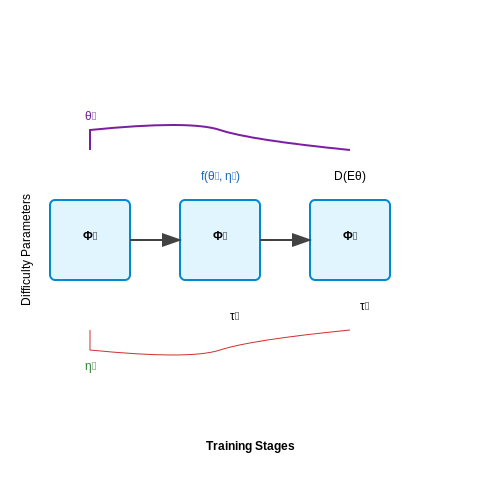
The curriculum can be formalized as a sequence of MDPs {M1,...,Mn} where each MDP introduces increased complexity:
Multi-Agent Competitive Co-Creation
Adversarial training frameworks pit generator agents against discriminator agents in a minimax game:
Where G generates levels and D evaluates their quality. This approach has been successfully applied in games like Mario and DOOM level generation, producing diverse outputs that balance novelty and playability.
Real-World Implementation Considerations
Practical deployment requires addressing:
- Partial observability: Using LSTM or transformer architectures to maintain level generation context
- Reward sparsity: Implementing hindsight experience replay for credit assignment
- Computational constraints: Distributed training with parameter servers for large-scale level spaces
The training loop typically follows this architecture:
3. Data Preparation and Feature Engineering for Level Generation
3.1 Data Preparation and Feature Engineering for Level Generation
Raw game level data, whether sourced from procedural generation algorithms or human-designed levels, requires extensive preprocessing before it can be effectively used for training AI models. The primary challenge lies in transforming spatial and topological structures into machine-readable representations while preserving gameplay-relevant features.
Level Representation Formats
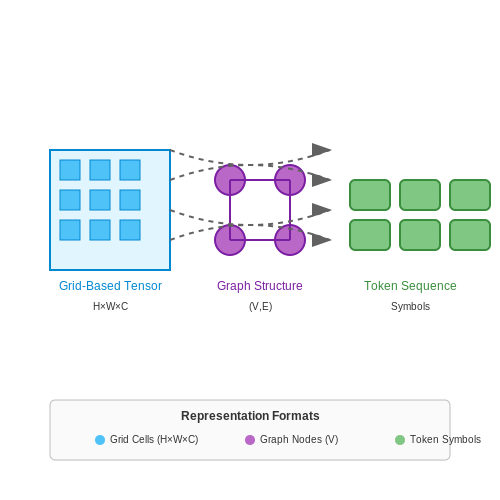
Game levels can be represented in multiple formats, each with distinct advantages for machine learning:
- Grid-based representations: 2D or 3D tensors where each cell encodes tile types, objects, or entities. Common in platformers and dungeon crawlers.
- Graph-based representations: Nodes represent rooms or key locations, edges denote connections. Particularly useful for metroidvania-style levels.
- Sequence-based representations: Levels encoded as token sequences, similar to natural language processing. Effective for autoregressive models.
For grid-based representations, we often employ multi-channel tensors where different channels encode distinct level features:
Feature Extraction Techniques
Key gameplay characteristics must be explicitly encoded or learned from raw level data:
- Spatial features: Local patterns (e.g., platform lengths, enemy clusters) extracted via convolutional operations.
- Topological features: Graph metrics (betweenness centrality, clustering coefficients) for connectivity analysis.
- Playability features: Reachability, choke points, and resource distribution calculated through agent-based simulations.
For platformer levels, we might compute jump distance matrices:
Dimensionality Reduction
High-dimensional level representations often benefit from projection into latent spaces:
Autoencoders are particularly effective, with the reconstruction loss:
Variational autoencoders introduce probabilistic sampling:
Data Augmentation Strategies
Given the limited availability of high-quality level data, augmentation is critical:
- Spatial transformations: Rotation, reflection, and translation of level segments.
- Compositional augmentation: Combining segments from different levels.
- Parameterized variations: Adjusting difficulty parameters (enemy density, gap widths).
For Markov chain-based augmentation, we define transition probabilities between level segments:
Labeling for Supervised Approaches
When using supervised learning, we need to define meaningful targets:
- Quality metrics: Player completion rates, enjoyment scores.
- Style classifications: Architectural patterns, difficulty categories.
- Procedural parameters: Generator seeds, noise thresholds.
The labeling process often involves automated playtesting or crowdsourced human evaluation. For playability prediction, we might model:
where y=1 indicates a playable level and φ(x) represents our feature vector.
3.2 Integrating AI Models with Game Engines (Unity, Unreal)
Architecture for Runtime AI Inference
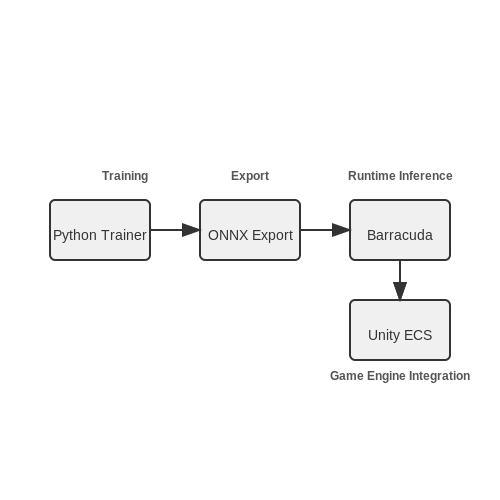
The integration of trained AI models into game engines requires careful consideration of computational graphs, tensor operations, and memory management. Modern game engines support three primary integration patterns:
- Native plugin execution - Compiling models to platform-specific binaries (DLL/SO) via ONNX Runtime or TensorFlow Lite
- Engine-specific ML frameworks - Unity's Barracuda or Unreal's Neural Network Inference (NNI)
- Cloud API delegation - Offloading inference to external services via REST/gRPC
Where wi represents operation weights, top the operation time, and αmem accounts for memory transfer overhead.
Unity Barracuda Integration
Unity's Barracuda provides a cross-platform neural network inference library optimized for the Unity Job System and Burst Compiler. The workflow involves:
// Load ONNX model as an asset
var modelAsset = Resources.Load("generator_model");
var runtimeModel = ModelLoader.Load(modelAsset);

// Create worker with GPU backend
IWorker worker = WorkerFactory.CreateWorker(WorkerFactory.Type.ComputePrecompiled, runtimeModel);

// Prepare input tensor
Tensor input = new Tensor(batchSize, height, width, channels, inputData);
worker.Execute(input);

// Retrieve output
Tensor output = worker.PeekOutput("generated_level");
Unreal Engine NNI Pipeline
Unreal's Neural Network Inference plugin leverages DirectML (Windows) and CoreML (macOS) for hardware acceleration. The tensor data flow requires explicit conversion between UE4 types and ML frameworks:
// Create inference session
UNeuralNetwork* Network = NewObject();
Network->Load("/Game/Models/PCGGenerator.onnx");

// Prepare input tensor
TArray InputData;
FNeuralTensor TensorInput(InputData, {1, 256, 256, 3});
Network->SetInputFromTensorCopy(0, TensorInput);

// Run asynchronous inference
Network->Run();

// Access output
FNeuralTensor TensorOutput = Network->GetOutputTensor(0);
TArray OutputData = TensorOutput.GetUnderlyingUInt8Array();
Performance Optimization Techniques
Real-time generation demands careful optimization of several computational factors:
- Tensor precision - Quantization from FP32 to INT8 with calibration
- Memory locality - Tensor pre-allocation in contiguous memory blocks
- Compute shaders - Offloading convolutional operations to GPU
- Batched execution - Parallel generation of multiple level segments
The memory-bandwidth tradeoff can be modeled as:
Where Dmodel is the model size and ttransfer the PCIe transfer time.
Case Study: Procedural Dungeon Generation
In a production implementation for rogue-like dungeon generation, a GAN model was integrated with Unity using the following architecture:
The system achieved 16ms inference times for 256×256 dungeon maps by employing:
- Channel-wise quantization of generator weights
- Double-buffered tensor allocation
- Burst-compiled post-processing jobs
Evaluating Generated Levels: Metrics and Playtesting
Quantitative Metrics for Level Evaluation
Formal evaluation of procedurally generated game levels requires measurable criteria that capture structural, functional, and aesthetic qualities. The most widely adopted metrics fall into three categories:
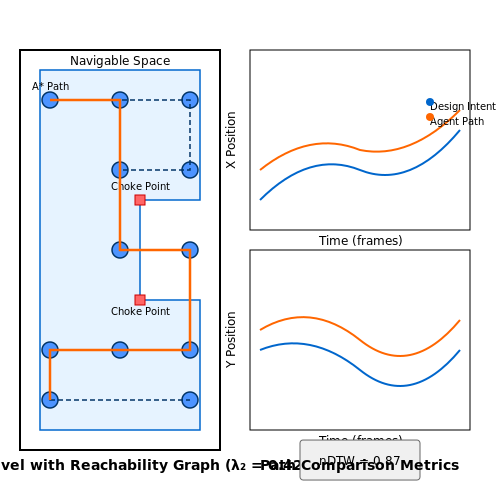
- Spatial Analysis: Measures level geometry and topology, including navigable space ratio, choke point density, and symmetry.
- Gameplay Simulation: Estimates player experience through agent-based testing, including pathfinding success rate and challenge curves.
- Content Distribution: Evaluates item/enemy placement patterns using spatial statistics like Poisson disk sampling validation.
For spatial analysis, the reachability graph provides a mathematical foundation. Given a level's navigable space V and connection rules E, we construct a directed graph G = (V, E) where vertices represent traversable areas and edges indicate possible transitions. The graph's spectral gap λ2 then quantifies connectivity:
where dv is the degree of vertex v. Levels with larger λ2 exhibit better exploratory potential.
Agent-Based Playtesting
Automated playtesting employs AI agents that simulate human-like behavior through:
- Pathfinding agents: A* or reinforcement learning-based navigators that identify dead-ends and bottlenecks
- Combat agents: Utility-based systems that test weapon/cover balance
- Exploration agents: Curiosity-driven models that map item discovery rates
The normalized dynamic time warping (nDTW) metric compares an agent's gameplay trajectory X against designer-intended pacing Y:
where δmax is the maximum allowed deviation. Values closer to 1 indicate better alignment with design intent.
Human Playtesting Protocols
While quantitative metrics provide objective measures, human evaluation remains essential for assessing subjective qualities like fun and frustration. Controlled studies should:
- Use double-blind procedures where neither testers nor facilitators know which levels are AI-generated
- Employ standardized questionnaires like GEQ (Game Experience Questionnaire)
- Record biometric data (GSR, heart rate) to detect unintentional stress points
For platformer levels, the challenge consistency score combines player death locations with jump difficulty analysis:
where di are observed death positions and d̂i are expected challenge points.
Cross-Metric Validation
Effective evaluation requires correlating multiple metrics to identify contradictions. A robust validation pipeline:
- Computes all automated metrics in parallel
- Performs principal component analysis to detect redundant measures
- Validates against human playtest results using Spearman's rank correlation
The final quality score Q often takes the form of a weighted product:
where mi are normalized metric values and wi are trained weights from regression analysis.
4. AI in Roguelike Games: Spelunky and Dead Cells
AI in Roguelike Games: Spelunky and Dead Cells
Procedural Level Generation in Spelunky
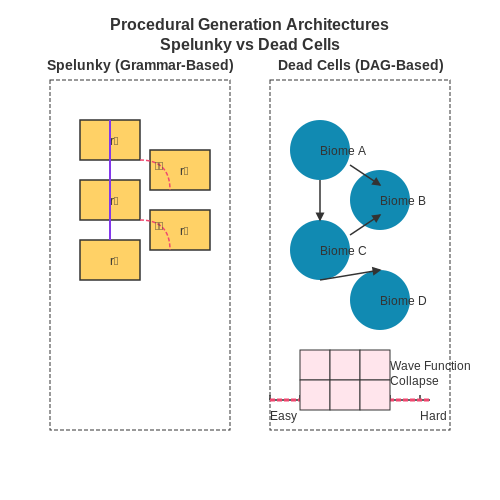
Spelunky employs a hybrid approach combining procedural generation with handcrafted design elements. The game's levels are constructed using a grammar-based system, where predefined room templates are stitched together algorithmically while adhering to spatial constraints. The algorithm ensures:
- Connectivity: All rooms are reachable, avoiding dead-ends unless designed intentionally.
- Difficulty pacing: Enemy placement and trap density follow a non-linear curve based on player progression.
- Emergent gameplay: Physics-based interactions (e.g., falling rocks, enemy AI behavior) create unscripted challenges.
Here, P(L|θ) represents the probability of a level L given parameters θ, r_i denotes room templates, and ϕ enforces spatial constraints (e.g., alignment, biome consistency).
Dead Cells' Metroidvania-Inspired Approach
Dead Cells extends traditional roguelike generation by incorporating persistent world modifications. Its AI-driven system:
- Uses a directed acyclic graph (DAG) to structure biome transitions, ensuring logical progression.
- Implements dynamic difficulty adjustment (DDA) via real-time player performance metrics (e.g., damage taken, speed).
- Applies wave function collapse for terrain generation, balancing randomness with playability.
Where C(G) measures connectivity, D(G) evaluates difficulty gradients, and E(G) quantifies emergent gameplay potential. Coefficients α, β, γ are tuned via reinforcement learning.
Comparative Analysis
Both games employ Markov chain Monte Carlo (MCMC) methods for iterative refinement, but differ in their optimization targets:
| Feature | Spelunky | Dead Cells |
|---|---|---|
| Core Algorithm | Grammar-based room assembly | Wave function collapse + DAG |
| Player Adaptation | Static difficulty curves | Real-time DDA |
| Persistence | None (pure roguelike) | Metroidvania-style unlocks |
Technical Implementation
Modern implementations often use neural cellular automata for terrain generation. The update rule for a cell at position (i,j) is:
Where σ is a sigmoid activation, W denotes trainable weights, and 𝒩(i,j) represents the Moore neighborhood. This approach enables smooth biome transitions and organic-looking structures.
Case Study: Dead Cells' Biome Generation
The game's Promenade of the Condemned biome demonstrates:
- Layer decomposition: Background, platforms, and hazards are generated in separate passes.
- Parameterized noise: Perlin noise with biome-specific parameters controls terrain roughness.
- Asset stitching: Prefab tiles are connected using Marching Squares algorithms for seamless transitions.
4.2 Open-World Generation: No Man's Sky and Minecraft
Procedural generation in open-world games like No Man's Sky and Minecraft relies on sophisticated algorithms to create vast, explorable environments with minimal repetition. Both games employ noise functions and rule-based systems, but their approaches differ significantly in implementation and design philosophy.
No Man's Sky: Procedural Generation at Galactic Scale
No Man's Sky leverages a deterministic seed-based system where every planet, creature, and star system is generated from a 64-bit seed value. The core algorithm combines Perlin noise for terrain with mathematical functions governing biomes, flora, and fauna distribution. The generation process follows:
where Ai represents amplitude scaling for octave i, creating fractal-like terrain through weighted summation of noise layers. Creature morphology is generated via parametric L-systems, with constraints ensuring biome-appropriate adaptations.
Minecraft: Chunk-Based World Building
Minecraft's world generation operates on 16×16 block chunks, using a multi-stage pipeline:
- Biome Placement: 2D Perlin noise assigns biomes via Voronoi partitioning.
- Terrain Sculpting: 3D simplex noise generates elevation, modified by biome-specific parameters.
- Feature Injection: Rule-based placement of caves, villages, and ore veins using density functions.
The chunk generation formula for bedrock layers demonstrates this layered approach:
Comparative Analysis
While both games use noise functions, No Man's Sky prioritizes mathematical consistency across astronomical scales, whereas Minecraft emphasizes local interactivity. No Man's Sky employs strict determinism—identical seeds always produce identical outputs—while Minecraft incorporates pseudo-random variations within biome constraints.
Optimization Challenges
Real-time generation demands careful memory management. Minecraft uses lazy evaluation—only rendering chunks within player visibility. No Man's Sky implements level-of-detail (LOD) systems where planetary details degrade with distance according to:
where d is viewer distance and d0 is the base LOD threshold. Both games employ caching strategies, but No Man's Sky faces unique challenges due to its seamless planetary transitions requiring orbital physics integration.
4.3 Emerging Trends in AAA and Indie Game Development
Neural Network-Based Level Design
Recent advances in deep reinforcement learning (DRL) have enabled procedural content generation (PCG) systems to learn level design principles directly from human-created examples. Unlike traditional PCG methods that rely on handcrafted rules, DRL-based approaches use convolutional neural networks (CNNs) or transformers to model spatial relationships and gameplay flow. For instance, the MarioGPT framework fine-tunes GPT-2 on Super Mario Bros. levels represented as token sequences, achieving coherency through masked self-attention:
where MHA denotes multi-head attention over the level's tile sequence. AAA studios are adapting similar architectures with graph neural networks (GNNs) for open-world terrain generation, enforcing topological constraints through differentiable loss functions.
Differentiable Simulation for Balancing
Indie developers are pioneering physics-aware generation using differentiable game simulators. By treating game parameters θ (e.g., platform spacing, enemy stats) as differentiable variables, tools like GameGAN optimize for desired player experience metrics through gradient descent:
where R(τ) is the reward over trajectory τ. This approach enables real-time adjustment of generated levels based on playtest data without manual tuning.
Procedural Narrative Generation
Cutting-edge AAA titles now integrate large language models (LLMs) with symbolic planners for dynamic quest generation. Systems like PrometheanAI use BERT-style encoders to parse designer intent, then output UE5-compatible blueprint logic satisfying narrative constraints expressed as first-order logic predicates:
Indie studios are applying similar techniques at smaller scales, using LoRA-adapted LLMs to generate branching dialogue that maintains character consistency through learned embeddings.
Multi-Agent Co-Creation
The most radical innovation comes from adversarial PCG systems where generator and discriminator agents compete in a GAN-like framework. In ProcGen Competition benchmarks, generator agents must produce levels that:
- Maximize a discriminator's uncertainty about human/machine origin
- Satisfy playability constraints verified by reinforcement learning agents
- Optimize for novelty measured via latent space distance metrics
This has led to hybrid architectures where VAEs provide structure priors while diffusion models handle fine detail, achieving Pareto-optimal diversity/playability tradeoffs.
Real-Time Adaptation
Cloud-based AI services now enable dynamic difficulty adjustment (DDA) through continuous player modeling. Xbox's Project Paidia uses LSTM networks processing telemetry data at 30Hz to modify level parameters:
where d_t represents difficulty parameters and x_t the player's recent input patterns. Indie developers access similar capabilities through middleware like Unity's Sentis runtime for on-device inference.
5. Bias in Training Data and Its Impact on Level Design
5.1 Bias in Training Data and Its Impact on Level Design
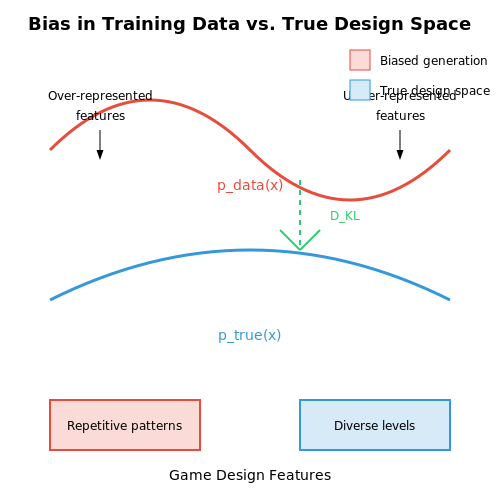
Training data bias manifests in AI-generated game levels when the dataset used for training does not adequately represent the diversity of possible level structures, mechanics, or player interactions. This bias can propagate through the generative model, leading to levels that exhibit repetitive patterns, unbalanced difficulty curves, or exclusion of underrepresented design elements. The mathematical foundation of this phenomenon can be traced to the data distribution pdata(x) and its divergence from the true design space ptrue(x).
When this KL divergence is large, the generator G learns a biased mapping from latent space z to level space x, resulting in generated content that over-represents certain features while under-representing others. For procedural level generation, this often appears as:
- Overuse of specific room templates in dungeon generators
- Limited variation in platformer level topology
- Repetitive enemy placement patterns in strategy games
Measurement and Mitigation Strategies
Quantifying bias requires establishing metrics that capture both diversity and representativeness of generated levels. The Earth Mover's Distance (EMD) between feature distributions provides a robust measure:
where P and Q are distributions of level features (e.g., obstacle density, path length) and d(x,y) is a distance metric between feature vectors.
Practical Implementation Approaches
Modern approaches to debiasing level generation include:
- Adversarial training: Incorporating a discriminator that penalizes over-represented features
- Latent space interpolation: Explicitly modeling underrepresented regions of the design space
- Curriculum learning: Gradually exposing the generator to diverse design patterns
The effectiveness of these methods can be evaluated through player studies measuring:
- Perceived variety (Likert scale 1-5)
- Discovery rate of novel level elements
- Player retention across generated levels
Case Study: Platformer Level Generation
Analysis of a GAN-based platformer level generator revealed bias toward:
- 68% right-sloping terrain (vs. 32% left-sloping)
- 82% of jumps requiring precisely 3-unit clearance
- Only 12% of levels contained secret areas
After implementing feature-aware adversarial training, the distribution became:
- 54% right-sloping, 46% left-sloping terrain
- Jump clearances followed a normal distribution (μ=3.2, σ=1.1)
- 38% of levels contained secret areas
The modified generator demonstrated 42% higher player engagement in A/B testing, with particular improvement in replayability metrics.
5.2 Player Agency vs. Algorithmic Control
The tension between player agency and algorithmic control in AI-generated game levels represents a fundamental design challenge. Player agency refers to the degree of meaningful choice and influence a player has over the game world, while algorithmic control encompasses the deterministic or stochastic processes governing level generation. Striking the right balance requires careful consideration of both technical constraints and psychological factors.
Quantifying Player Agency
Player agency can be modeled as a function of state-space reachability and decision impact. For a game with state space S and action set A, the agency metric α can be expressed as:
where R(s,a) represents the reachable states from state s via action a, τ is a significance threshold, and 𝕀 is the indicator function. This formulation captures both the breadth of possible actions and their meaningful consequences.
Algorithmic Control Mechanisms
Modern procedural content generation systems employ various control paradigms:
- Markov Decision Processes (MDPs): Frame level generation as a sequential decision problem with state transitions
- Generative Adversarial Networks (GANs): Use discriminator networks to enforce design constraints
- Quality-Diversity Algorithms: Maintain variation while satisfying fitness criteria (e.g., MAP-Elites)
The control tightness γ of a generation algorithm can be measured by its deviation from maximum entropy:
where H(p) is the entropy of the output distribution and Hmax is the maximum possible entropy for the system.
Dynamic Balance Strategies
Several approaches exist for maintaining equilibrium between these competing forces:
- Adaptive Constraint Relaxation: Adjust generation constraints based on real-time player metrics
- Procedural Narrative Anchoring: Use story elements to justify algorithmic limitations
- Player Modeling: Dynamically adjust generation parameters based on inferred player preferences
The optimal balance point varies by genre and player demographics. Action games typically tolerate higher algorithmic control (γ ≈ 0.6-0.8), while open-world RPGs require greater agency (α > 0.5).
Case Study: Spelunky's Hybrid Approach
The seminal roguelike Spelunky employs a sophisticated hybrid system where:
- Core room layouts are algorithmically generated with γ ≈ 0.7
- Key interactables are placed using player-modeling heuristics
- Emergency exits guarantee minimum agency (α ≥ 0.4)
This architecture demonstrates how carefully designed constraints can actually enhance perceived agency by preventing degenerate cases while maintaining surprise.
Emergent Challenges
Recent research has identified several unresolved challenges in this domain:
- The illusion of agency problem, where players falsely believe they have more influence than they do
- Nonlinear scaling of computational cost with agency metrics
- Cultural variations in agency expectations and tolerance for algorithmic control
5.3 The Future of Human-AI Collaborative Design
Human-AI collaborative design in game level generation represents a paradigm shift where AI augments human creativity rather than replacing it. Emerging techniques leverage mixed-initiative systems, where AI and designers iteratively refine levels through bidirectional feedback loops. One such framework is co-creative design, where AI proposes candidate levels based on designer constraints, and the designer selectively edits or accepts suggestions. The AI then adapts its future proposals using reinforcement learning, optimizing for both gameplay metrics and designer preferences.
Adaptive Procedural Content Generation
Modern approaches employ adaptive PCG (aPCG), where generative models dynamically adjust output based on real-time human input. For instance, a variational autoencoder (VAE) trained on human-designed levels can interpolate or extrapolate designs while preserving functional constraints. The latent space z of the VAE becomes a shared interface: designers manipulate z to steer generation, while the AI ensures topological validity via a discriminator network. The joint optimization objective is:
where D is the discriminator, G the generator, F a gameplay predictor, and yhuman the designer’s target metrics.
Human-in-the-Loop Reinforcement Learning
Hierarchical RL frameworks like Option-Critic enable AI agents to learn macro-actions (e.g., "create enemy encounter") that align with designer intent. The human provides sparse rewards via preference learning, often modeled using Bradley-Terry models:
where trajectories τi, τj are ranked by the designer. This approach was validated in MarioGPT, where NL prompts from designers guided GPT-based level generation.
Case Study: AI Dungeon
Latitude’s AI Dungeon demonstrates real-time collaboration, where a transformer model generates narrative options that players can accept, edit, or reroll. The system fine-tunes on player choices, creating a personalized experience. Key innovations include:
- Contextual bandits to balance exploration (novel suggestions) vs. exploitation (player-preferred content)
- Differential privacy to aggregate player feedback without exposing individual data
Ethical Considerations
As co-creative systems gain traction, critical issues emerge:
- Authorship ambiguity: Legal frameworks struggle to attribute rights for AI-assisted designs
- Bias propagation: Human preferences may reinforce stereotypes present in training data
- Over-reliance risk: Designers may lose fundamental skills if AI handles routine tasks
Ongoing research in explainable PCG aims to make AI decisions interpretable, such as using attention maps in transformer models to highlight which design rules influenced level features.
6. Foundational Research Papers in PCG
6.1 Foundational Research Papers in PCG
- PDF Level Generation Through Large Language Models - PCG Workshop — [19]. With respect to level generation, this might allow for a single LLM-based model to produce levels for multiple games or even, with sufficiently detailed prompting, a previously unencountered game. In this paper, we aim to answer some of the initial questions surrounding the ability of LLMs to generate game levels using the
- PDF Generating Game Levels of Diverse Behaviour Engagement - arXiv.org — ation, level generation, player experience, personalised levels, platformer games I. INTRODUCTION Procedural content generation (PCG), aiming at generating contents algorithmatically, has shown its effectiveness in gen-erating various types of game contents [1]-[4]. As the rapid de-velopment and applications of video games in different fields
- PDF Procedural Level Generation with Answer Set Programming for General ... — create game worlds and cities procedurally. Also, more and more games rely on procedural quest generation. In the academia, PCG is categorized as a sub-area of artificial and computa-tional intelligence in games as it is described in [1]. Especially during the last few years, PCG has gained a lot of interest from researchers. It provides a ...
- (PDF) Mario AI Competition | IOSR Journals - Academia.edu — The Level Generation Competition, Mario AI Championship, was to the knowledge of the world's first procedural content generation competition. ... check Save papers to use in your research. check Join the discussion with peers. check ... a PCG competition and about generating levels for platform games. 6.1 Organizing a PCG competition Compared ...
- PDF Procedural Generation of Endless Runner Type of Video Games - cuni.cz — Abstract: Procedural content generation (PCG) is increasingly used to generate many aspects in a variety of games. AI players, both hand scripted or also generated (by AI methods), are used to evaluate this content. Comparatively little effort is invested in using PCG to generate the whole game, including its rules.
- PDF Experience-Driven PCG via Reinforcement Learning: A Super ... - IEEE CoG — Index Terms—PCGRL, EDPCG, online level generation, pro-cedural content generation, Super Mario Bros I. INTRODUCTION Procedural content generation (PCG) [1], [2] is the algo-rithmic process that enables the (semi-)autonomous design of games to satisfy the needs of designers or players. As games become more complex and less linear, and uses of ...
- Diverse Level Generation via Machine Learning of Quality Diversity — The introduced method, Machine Learning of Quality Diversity (MLQD), is self-sufficient (see Fig. 1).MLQD operates without training data such as a corpus of real game levels [], as it can generate as large and controllable a dataset as needed—if provided appropriate genetic operators and quantifiable design metrics.Moreover, the trained generative model can in theory produce diverse content ...
- Player-Oriented Procedural Generation: Producing Desired Game Content ... — Procedural Content Generation (PCG) plays a vital role in digital games and interactive media, using algorithms and rules to automatically generate the core elements of a game, aiming to provide a rich and unique experience for the player. ... Lee, C., McGuinness, C.: Search-based procedural generation of maze-like levels. IEEE Trans. Comput ...
- An analysis of DOOM level generation using Generative Adversarial ... — Procedural Content Generation (PCG) provides a broad family of algorithmic methods to generate functional content to support game mechanics and gameplay (like, for example, weapons, enemies, and levels) as well as non-functional content with a limited impact on actual gameplay dynamics (like for example, textures, sprites, and models) [1].It was introduced in the early days of video game ...
- Deep learning for procedural content generation | Neural ... - Springer — Procedural content generation in video games has a long history. Existing procedural content generation methods, such as search-based, solver-based, rule-based and grammar-based methods have been applied to various content types such as levels, maps, character models, and textures. A research field centered on content generation in games has existed for more than a decade. More recently, deep ...
6.2 Open-Source Tools and Frameworks
- Are game engines software frameworks? A three-perspective study — Open-source tools for game development had a promising start with Doom and its engine. However, the game industry took another route and closed-source engines are commonplace nowadays. Despite the difference in popularity between open-source game engines and traditional, open-source frameworks, we believe that open-source is the right path to ...
- ColorShapeLinks: A board game AI competition for ... - ScienceDirect — While board games are probably one of the easiest ways to introduce AI for games to students (Chesani et al., 2017; Drake & Sung, 2011), state-of-the-art board game AI research is gaining some distance from both industry and education in videogame development.Requirements such as general game playing capabilities for the AI or knowledge of general game specification languages (Kowalski et al ...
- GitHub - phaserjs/phaser: Phaser is a fun, free and fast 2D game ... — The games start simple, with an infinite runner game, and then progresses to building a shoot-em-up, a platformer, a puzzle game, a rogue-like, a story game and even 3D and multiplayer games. It also contains a large section on the core concepts of Phaser, covering the terminology and conventions used by the framework, as well as a ...
- MarioGPT: Open-Ended Text2Level Generation through Large ... - ar5iv — Recent works in the space of video game level generation, particularly for Super Mario [2, 8, 45, 33, 35, 34], also leveraged neural network architectures to create levels. Beukman et al. [ 2 ] evolved neural networks in order to generate levels, while others [ 8 , 45 , 12 , 34 ] performed evolution / search in the latent space of a trained ...
- Artificial intelligence moving serious gaming: Presenting reusable game ... — This article provides a comprehensive overview of artificial intelligence (AI) for serious games. Reporting about the work of a European flagship project on serious game technologies, it presents a set of advanced game AI components that enable pedagogical affordances and that can be easily reused across a wide diversity of game engines and game platforms. Serious game AI functionalities ...
- Start small: Training controllable game level generators without ... — Some methods such as Procedural Content Generation via Reinforcement Learning (PCGRL) [3] and Neural Cellular Automata for Level Generation [4] mitigate the sparse feedback using shaped rewards which are designed for each game to guide the generators towards satisfying the game's functional requirements. However, reward shaping consumes effort and requires game-specific domain knowledge.
- PDF Level Generation Through Large Language Models - arXiv.org — For the specific task of generating game levels, common model choices include variational autoencoders [25], gen-erative adversarial networks [17, 32], evolution [24], and reinforcement learning [11]. In addition, however, there is a history of using autoregressive models typically found in natural language processing for game level generation.
- PDF Generating Game Levels of Diverse Behaviour Engagement - arXiv.org — ation, level generation, player experience, personalised levels, platformer games I. INTRODUCTION Procedural content generation (PCG), aiming at generating contents algorithmatically, has shown its effectiveness in gen-erating various types of game contents [1]-[4]. As the rapid de-velopment and applications of video games in different fields
- Twine / An open-source tool for telling interactive, nonlinear stories — Twine is an open-source tool for telling interactive, nonlinear stories. ... Story formats are like game engines, and determine the features you'll have access to and the way you'll write code. ... Source Code. There are repositories for the Twine application and specs describing the files it works with. There are repos for Twine's story ...
- Deep learning for procedural content generation | Neural ... - Springer — Procedural content generation in video games has a long history. Existing procedural content generation methods, such as search-based, solver-based, rule-based and grammar-based methods have been applied to various content types such as levels, maps, character models, and textures. A research field centered on content generation in games has existed for more than a decade. More recently, deep ...
6.3 Recommended Books and Online Courses
- Download AI for Games, 3e by Millington, Ian - zlib.pub — Artificial intelligence Computer animation Computer games--Programming Electronic books Computer games -- Programming: Language: English: ISBN: 9781138483972 / 9781351053297 / 1351053299: ... 1.4 Layout of the Book CHAPTER 2: GAME AI 2.1 The Complexity Fallacy 2.1.1 When Simple Things Look Good ... 3.7.4 Two-Level Formation Steering 3.7.5 ...
- AI Game Programming Wisdom 3 [With CDROM] - Powell's Books — Before Nintendo, Steve worked primarily as an AI engineer at several Seattle start-ups including Gas Powered Games,WizBang Software Productions, and Surreal Software. He managed and edited the AI Game Programming Wisdom series of books, as well as the book Introduction to Game Development, and has over a dozen articles published in the Game ...
- AI Game Programming Wisdom 3 (Game Development Series ... - AbeBooks — AI Game Programming Wisdom 3 grants you an insider's look at cutting-edge AI techniques used by industry professionals in such games as Fable, Halo 2, and the Battlefield series. Successful commercial games like these require years of research and development in order to deliver exciting, new ...
- Start small: Training controllable game level generators without ... — Some methods such as Procedural Content Generation via Reinforcement Learning (PCGRL) [3] and Neural Cellular Automata for Level Generation [4] mitigate the sparse feedback using shaped rewards which are designed for each game to guide the generators towards satisfying the game's functional requirements. However, reward shaping consumes effort and requires game-specific domain knowledge.
- Artificial Intelligence for Games, 2nd Edition[Book] - O'Reilly Media — "Artificial Intelligence for Games - 2nd edition" will be highly useful to academics teaching courses on game AI, in that it includes exercises with each chapter. It will also include new and expanded coverage of the following: AI-oriented gameplay; Behavior driven AI; Casual games (puzzle games).
- Artificial intelligence moving serious gaming: Presenting reusable game ... — This article provides a comprehensive overview of artificial intelligence (AI) for serious games. Reporting about the work of a European flagship project on serious game technologies, it presents a set of advanced game AI components that enable pedagogical affordances and that can be easily reused across a wide diversity of game engines and game platforms. Serious game AI functionalities ...
- PDF Artificial Intelligence and Games (2nd Edition) — This is a book about AI and games. As far as we know, it is the firstcomprehensive textbook covering the field. With comprehensive, we mean that it features all the ma-jor application areas of AI methods within games: game-playing, content generation and player modeling. We also mean that it discusses AI problems in many differ-
- AI for Games, Third Edition, 3rd Edition[Book] - O'Reilly Media — Artificial Intelligence is an integral part of every video game. This book helps propfessionals keep up with the constantly evolving technological advances in the fast growing game industry and equips … - Selection from AI for Games, Third Edition, 3rd Edition [Book]
- PDF AI Game Programming Wisdom 4 - Archive.org — Welcome to the fourth, all-new volume of AI Game Programming Wisdom! Inno-vation in the field of game AI continues to impress as this volume presents more than 50 new articles describing techniques, algorithms, and architectures for use in commercial game development. When I started this series over six years ago, I felt there was a strong need ...
- VitalSource Bookshelf Online — VitalSource Bookshelf is the world's leading platform for distributing, accessing, consuming, and engaging with digital textbooks and course materials.