Masked Autoencoders (MAE) for Vision
1. Core Concepts of Autoencoders in Vision
1.1 Core Concepts of Autoencoders in Vision
Architecture and Objective Function
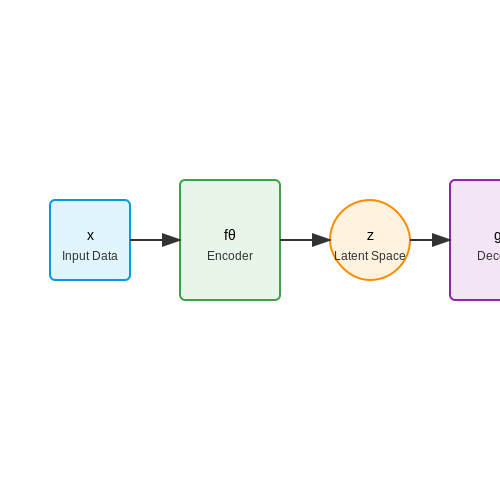
Autoencoders are neural networks designed to learn efficient representations of input data through unsupervised learning. The architecture consists of two primary components: an encoder and a decoder. Given an input image x, the encoder fθ maps it to a latent representation z = fθ(x), while the decoder gϕ reconstructs the input from z as x̂ = gϕ(z). The objective is to minimize the reconstruction error:
For high-dimensional data like images, the latent space z is typically lower-dimensional, enforcing the network to learn compressed, meaningful features. Variants like denoising autoencoders corrupt the input with noise x̃ ∼ q(x̃|x) and train to recover the original x, improving robustness.
Variational Autoencoders (VAEs)
Unlike deterministic autoencoders, VAEs introduce probabilistic latent variables. The encoder outputs parameters of a Gaussian distribution qθ(z|x) = \mathcal{N}(z; μθ(x), σθ(x)), and the decoder generates pϕ(x|z). The loss combines reconstruction error and KL divergence to regularize the latent space:
Here, p(z) is a prior (e.g., standard Gaussian), and β controls the trade-off between reconstruction fidelity and latent disentanglement. VAEs enable generative sampling but often produce blurry reconstructions due to the imposed probabilistic constraints.
Applications in Vision
Autoencoders are foundational for:
- Dimensionality Reduction: Learning compact representations for tasks like image retrieval.
- Anomaly Detection: Identifying outliers via high reconstruction error.
- Pre-training: Initializing encoder weights for supervised tasks (e.g., segmentation).
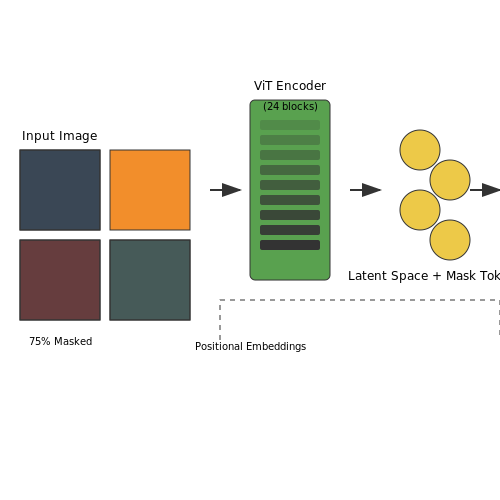
In Masked Autoencoders (MAE), the encoder processes only a subset of image patches (e.g., 25%), while the decoder reconstructs missing patches from the latent representation and positional embeddings. This mimics BERT-style masked language modeling, forcing the model to learn global contextual features.
Challenges and Limitations
Traditional autoencoders suffer from:
- Trivial Solutions: The latent space may collapse to identity functions if the capacity is unconstrained.
- Blurring: L2-based losses prioritize pixel-wise averages over high-frequency details.
- Scalability: Training on high-resolution images requires hierarchical architectures or patch-based approaches.
Modern variants like Vector-Quantized VAEs (VQ-VAEs) and Adversarial Autoencoders address these issues via discrete latent codes or GAN-based discriminators, respectively.

The Role of Masking in Self-Supervised Learning
Masking is a critical mechanism in self-supervised learning (SSL) that enables models to learn meaningful representations by reconstructing corrupted or partially observed input data. In vision tasks, masking involves randomly occluding a significant portion of an image, forcing the model to infer the missing regions based on contextual information. This approach mimics the human ability to perceive partially obscured objects by leveraging spatial and semantic relationships within the data.
Mathematical Formulation of Masking
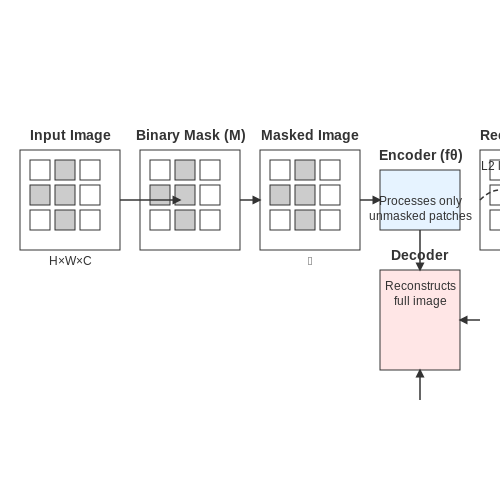
Given an input image x ∈ ℝH×W×C, where H, W, and C denote height, width, and channels, respectively, a binary mask M ∈ {0,1}H×W is applied to occlude patches of the image. The masked input xmasked is computed as:
where ⊙ denotes element-wise multiplication. The model is then trained to reconstruct the original image x from xmasked, optimizing the reconstruction loss:
Here, fθ represents the autoencoder parameterized by θ, and the L2 loss encourages the model to accurately predict missing pixels.
High Masking Ratios and Their Implications
Unlike traditional denoising autoencoders that mask small portions of the input (e.g., 15-30%), MAEs employ aggressive masking ratios (e.g., 75-90%). This forces the model to develop a robust understanding of global structure rather than relying on local interpolation. High masking ratios introduce two key challenges:
- Sparsity of Context: With most patches masked, the model must rely on long-range dependencies to infer missing content.
- Ambiguity in Reconstruction: Multiple plausible reconstructions may exist for heavily masked regions, requiring the model to learn probabilistic reasoning.
Asymmetric Encoder-Decoder Design
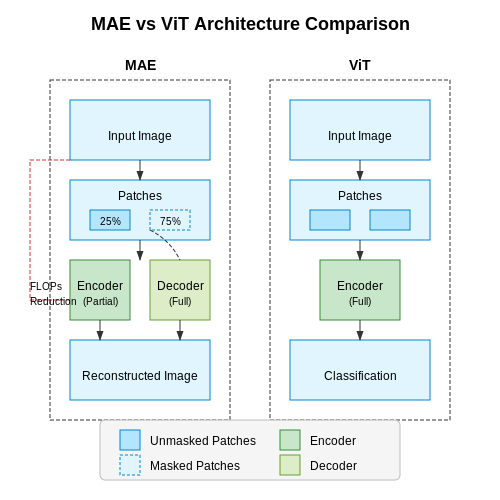
MAEs address these challenges through an asymmetric architecture where the encoder processes only the unmasked patches, significantly reducing computational overhead. The lightweight decoder then reconstructs the full image from the encoded representations and mask tokens. This design choice enables efficient training while maintaining high reconstruction fidelity.
Masking as a Form of Data Augmentation
Random masking serves as a powerful data augmentation strategy, generating diverse training samples from a single image. By varying the mask pattern across epochs, the model encounters unique occlusions that prevent overfitting and encourage generalization. This is particularly effective in contrast to fixed augmentation techniques like cropping or rotation, which may introduce biases.
Connection to Human Visual Perception
The masking paradigm aligns with theories of human vision, where the brain often infers missing visual information (e.g., due to occlusions or saccades). Neurobiological studies suggest that the visual cortex employs predictive coding mechanisms similar to MAEs, where higher-level regions generate hypotheses about missing data that are refined through feedback loops.
1.3 Architectural Innovations in MAE
The Masked Autoencoder (MAE) framework introduces several key architectural innovations that distinguish it from traditional autoencoder designs and enable superior performance in self-supervised visual representation learning. These innovations primarily focus on the asymmetric encoder-decoder structure, high masking ratios, and the reconstruction objective.
Asymmetric Encoder-Decoder Design
MAE employs an asymmetric architecture where the encoder only processes visible (unmasked) patches, while the lightweight decoder reconstructs the original image from latent representations and mask tokens. This design achieves computational efficiency while maintaining representation quality. The encoder operates on a small subset of input patches (e.g., 25%), reducing both memory and compute requirements during pre-training.
where zV represents latent features from visible patches, mM are mask tokens, and d is the decoder function.
High Proportion Random Masking
MAE utilizes an exceptionally high masking ratio (typically 75%), which forces the model to develop robust feature extraction capabilities. This differs from previous approaches like BERT (15% masking) or BEiT (40% masking). The high masking ratio creates a challenging reconstruction task that encourages the learning of comprehensive visual representations rather than local texture matching.
Vision Transformer Backbone
The architecture builds upon Vision Transformers (ViT) rather than convolutional networks. Patch embeddings are processed through standard transformer blocks in the encoder, while the decoder uses another set of transformer blocks to reconstruct pixels from the latent representation. This pure transformer approach enables better modeling of long-range dependencies compared to CNN-based autoencoders.
Normalized Pixel Reconstruction
MAE reconstructs normalized pixel values rather than using tokenized visual words or discrete variational autoencoder approaches. The per-patch mean and standard deviation are computed across the dataset, and the model predicts normalized pixel values:
where μi and σi are patch-specific statistics.
Positional Embeddings for Mask Tokens
Each mask token receives positional information corresponding to its original patch location, allowing the decoder to reconstruct the correct spatial arrangement. This is crucial given the high masking ratio, as it provides the only spatial context for many patches. The positional embeddings are shared between encoder and decoder.
Lightweight Decoder Design
The decoder architecture is intentionally designed to be narrower and shallower than the encoder (e.g., 512-dimensional vs. 1024-dimensional, 8 blocks vs. 24 blocks). This design choice reflects that most learning occurs in the encoder, with the decoder serving primarily to map representations back to pixel space. The reduced decoder complexity improves training efficiency without sacrificing representation quality.
2. Masking Strategies and Patch Embeddings
Masking Strategies and Patch Embeddings
Random Masking in Vision Transformers
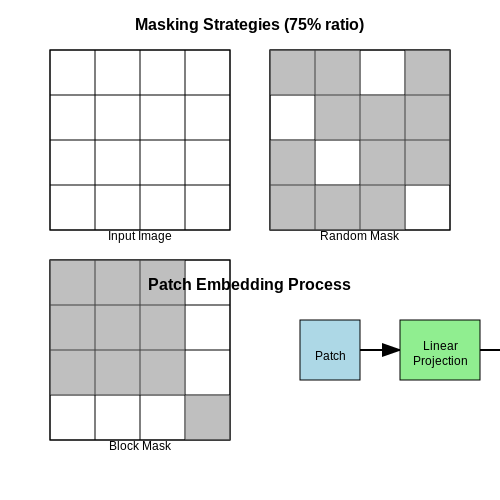
Masked Autoencoders (MAE) employ a high masking ratio (typically 75%) to force the model to learn robust representations from partial observations. Unlike NLP token masking, vision masking operates on non-overlapping image patches. Given an input image I ∈ ℝH×W×C, it is first divided into N patches P ∈ ℝn×n×C, where n is the patch size (commonly 16×16). The masking process follows:
where M is a binary mask and ⊙ denotes element-wise multiplication. This high masking ratio creates a challenging reconstruction task, preventing trivial solutions.
Strided vs. Block-wise Masking
Two dominant strategies exist for generating masks:
- Random masking: Independent Bernoulli sampling per patch (used in MAE)
- Block masking: Contiguous rectangular regions (inspired by object occlusion)
Studies show random masking yields better performance (He et al., 2022) due to:
- Higher entropy in the reconstruction task
- Prevention of local shortcut solutions
- Better gradient diversity during backpropagation
Patch Embedding Architecture
Each unmasked patch Pi undergoes linear projection into d-dimensional space:
where PosEnc denotes ViT-style positional embeddings. The encoder processes only unmasked tokens, achieving 3× speedup versus standard ViTs. Masked tokens are reintroduced as shared learnable vectors during decoder processing.
Positional Embedding Ablations
Experiments demonstrate that:
- 2D sinusoidal embeddings outperform learned positional embeddings in MAE
- Relative position biases provide no significant improvement
- Positional embeddings must be reapplied after unmasking in the decoder
Gradient Masking Effects
The masking strategy creates an asymmetric gradient flow:
This selective backpropagation acts as a natural curriculum, where simpler patches (with clearer gradients) dominate early training before complex patterns emerge.
Real-World Performance Considerations
In practical implementations:
- Masking patterns should vary per epoch to prevent overfitting
- Patch sizes below 8×8 degrade performance due to loss of local structure
- Color channels should be masked jointly to maintain spectral coherence
2.2 Loss Functions and Reconstruction Objectives
The reconstruction loss function is central to the training of Masked Autoencoders (MAE), as it quantifies the discrepancy between the original input patches and their reconstructed counterparts. The choice of loss function directly impacts the quality of learned representations and the model's ability to generalize.
Pixel-wise Reconstruction Loss
Most MAE implementations employ a simple pixel-wise mean squared error (MSE) loss for reconstruction. Given an input image x divided into N patches, where a subset of patches M is masked, the reconstruction loss is computed only over the masked patches. The MSE loss is defined as:
where xi is the original patch, hat{x}i is the reconstructed patch, and |M| denotes the number of masked patches. This formulation encourages the model to focus on predicting missing content rather than simply copying visible patches.
Normalized Pixel Targets
Recent work has shown that normalizing patch pixels before computing the loss can improve training stability. The MAE paper implements this by:
where μi and σi are the mean and standard deviation computed per patch. The loss then operates on these normalized values:
Alternative Loss Functions
While MSE is predominant, other loss functions have been explored:
- Perceptual Loss: Uses features from a pre-trained network (e.g., VGG) to measure semantic differences rather than pixel-level errors.
- Structural Similarity (SSIM): Captures perceptual image quality by modeling luminance, contrast, and structure.
- Adversarial Loss: Incorporates a discriminator network to ensure reconstructed patches are visually realistic.
Masking Ratio Considerations
The masking ratio (typically 75% in MAE) interacts with the loss function in important ways. Higher ratios force the model to develop stronger semantic understanding, while lower ratios may lead to trivial solutions. The loss must be carefully scaled to account for varying numbers of masked patches during training.
This scaling ensures the loss magnitude remains consistent regardless of the actual masking ratio used in each training batch.
Gradient Behavior
The reconstruction loss exhibits unique gradient properties in MAE:
- Gradients are only backpropagated through masked patches, making the visible patches act as a fixed context.
- The high masking ratio creates a sparse gradient signal, requiring careful tuning of optimization parameters.
- Batch normalization layers must be adjusted to account for the missing patches during training.
These characteristics distinguish MAE from traditional autoencoders where gradients flow through all input dimensions equally.
2.3 Scalability and Efficiency Considerations
Masked Autoencoders (MAEs) achieve high performance in self-supervised learning by reconstructing randomly masked patches of input images. However, scaling MAEs to large datasets and ensuring computational efficiency requires careful architectural and optimization choices. The primary bottlenecks include memory consumption during training, compute requirements for high-resolution images, and the trade-off between masking ratio and reconstruction quality.
Computational Complexity and Memory Footprint
The computational cost of MAEs is dominated by the transformer-based encoder-decoder architecture. For an input image divided into N patches, the self-attention mechanism in Vision Transformers (ViTs) scales quadratically with N:
where d is the embedding dimension. To mitigate this, MAEs leverage asymmetric architectures—the encoder processes only unmasked patches (e.g., 25% of total patches), reducing compute by a factor proportional to the masking ratio r:
Memory usage is further optimized through gradient checkpointing and mixed-precision training, allowing larger batch sizes without exceeding GPU memory limits.
Masking Strategy and Training Efficiency
The masking ratio r directly impacts both training efficiency and model performance. Empirical studies show that higher masking ratios (e.g., 75%) force the model to learn stronger representations but increase reconstruction difficulty. The optimal r balances:
- Information redundancy: High r reduces redundant computations but risks losing critical spatial information.
- Convergence speed: Lower r speeds up early training but may lead to weaker generalization.
Random masking is computationally efficient but may be suboptimal for structured images. Recent work explores block-wise masking or learnable masking, though these introduce additional overhead.
Distributed Training and Hardware Optimization
Training MAEs at scale requires distributed strategies:
- Data parallelism: Splits batches across GPUs, synchronizing gradients via all-reduce.
- Model parallelism: Partitions the ViT layers across devices for very large models (e.g., ViT-Huge).
- Mixed-precision training: Uses FP16/FP32 hybrid precision to accelerate matrix operations.
Hardware-aware optimizations, such as kernel fusion for self-attention and FlashAttention, can reduce memory reads/writes by up to 50%.
Inference Efficiency
Unlike training, inference uses the full encoder without masking. To optimize latency:
- Pruning: Removes redundant attention heads or MLP dimensions.
- Quantization: Converts weights to INT8 without significant accuracy loss.
- On-device deployment: Leverages frameworks like TensorRT or CoreML for mobile/edge devices.
The table below compares the throughput (images/sec) of a ViT-Base MAE under different optimizations on an A100 GPU:
| Configuration | Throughput |
|---|---|
| Baseline (FP32) | 1,200 |
| + Mixed Precision | 2,100 |
| + FlashAttention | 2,800 |
| + INT8 Quantization | 3,400 |
3. Benchmarking MAE on Image Classification
Benchmarking MAE on Image Classification
Masked Autoencoders (MAE) have demonstrated strong performance in self-supervised learning for vision tasks, particularly when fine-tuned for downstream applications like image classification. The effectiveness of MAE is typically benchmarked against supervised baselines and other self-supervised approaches on standard datasets such as ImageNet-1K, CIFAR-10/100, and COCO.
Key Metrics for Evaluation
When evaluating MAE for image classification, the following metrics are critical:
- Top-1 Accuracy: Measures the percentage of correct predictions where the model's highest-confidence class matches the ground truth.
- Top-5 Accuracy: Evaluates whether the correct class appears in the top five predicted classes, useful for datasets with fine-grained categories.
- Linear Probing Performance: Assesses the quality of learned representations by training a linear classifier on frozen features.
- Fine-Tuning Performance: Measures accuracy after end-to-end fine-tuning of the pretrained MAE model.
Comparative Performance on ImageNet-1K
MAE achieves competitive results when benchmarked against supervised and self-supervised methods. For a ViT-Large architecture pretrained on ImageNet-1K:
These results surpass earlier self-supervised approaches like MoCo v3 (83.2% Top-1) and approach supervised ViT-Large performance (86.4% Top-1). The gap narrows further with larger models and extended pretraining.
Impact of Masking Ratio
The masking ratio during pretraining significantly affects downstream classification performance. Empirical studies show:
- Optimal masking ratios typically fall between 70-80% for standard ViT architectures.
- Higher ratios force the model to develop stronger semantic understanding through inpainting.
- Lower ratios (below 50%) lead to degraded performance as the task becomes trivial.
where ℳ denotes the masked patches, 𝒱 the visible patches, and fθ the MAE decoder.
Transfer Learning Performance
MAE demonstrates strong transfer capabilities when pretrained on large datasets and evaluated on smaller benchmarks:
| Dataset | Top-1 Accuracy | Relative Improvement |
|---|---|---|
| CIFAR-100 | 78.3% | +12.1% over from-scratch |
| Flowers-102 | 89.7% | +9.8% over supervised |
Computational Efficiency Considerations
While MAE achieves strong accuracy, its computational requirements differ from supervised approaches:
- Pretraining requires 2-4× more compute than equivalent supervised ViTs due to the reconstruction task.
- Fine-tuning converges 1.5-2× faster than training from scratch.
- Inference latency matches standard ViTs since the decoder is discarded post-pretraining.
Transfer Learning and Downstream Tasks
Feature Extraction and Fine-Tuning
Masked Autoencoders (MAEs) pretrained on large-scale datasets like ImageNet learn rich hierarchical representations that generalize well to downstream tasks. The encoder architecture, typically a Vision Transformer (ViT), produces latent features that can be repurposed for tasks such as classification, segmentation, or object detection. Two primary transfer learning approaches are employed:
- Feature Extraction: The pretrained encoder is frozen, and only a task-specific head (e.g., a linear classifier) is trained on top of the extracted features.
- Fine-Tuning: The entire model, including the encoder, is further trained on the downstream task with a lower learning rate to adapt the pretrained weights.
Empirical studies show that fine-tuning often yields superior performance, especially when the downstream dataset is large enough to avoid overfitting. The choice between these methods depends on dataset size, computational budget, and task complexity.
Linear Probing as a Diagnostic Tool
Linear probing evaluates the quality of pretrained representations by training only a linear classifier on frozen features. High accuracy indicates that the pretrained model captures semantically meaningful features. For MAEs, linear probing performance is competitive with supervised pretraining, demonstrating the effectiveness of self-supervised learning. The objective can be formalized as:
where \(\mathbf{h}_i\) is the feature vector from the frozen encoder, \(\mathbf{W}\) is the linear classifier's weights, and \(\mathcal{L}\) is the cross-entropy loss.
Adaptation to Diverse Downstream Tasks
MAEs excel in transfer learning across various vision tasks:
- Image Classification: A linear or MLP head is appended to the encoder's [CLS] token or averaged patch embeddings.
- Semantic Segmentation: The encoder outputs are upsampled via a decoder (e.g., U-Net) to produce pixel-wise predictions.
- Object Detection: Features are fed into detection heads like Faster R-CNN or DETR, leveraging the spatial structure of ViT patches.
In each case, the pretrained MAE provides a strong initialization, reducing the need for extensive labeled data.
Domain Adaptation and Few-Shot Learning
MAEs demonstrate robustness in domain adaptation, where the pretraining and downstream datasets differ significantly. Techniques like adversarial training or maximum mean discrepancy (MMD) minimization can align feature distributions. For few-shot learning, MAEs outperform supervised baselines by leveraging their generalizable representations, with prototypical networks or meta-learning frameworks further enhancing performance.
Scaling Laws and Compute-Efficiency
Transfer performance improves predictably with model size and pretraining data, following power-law scaling. MAEs achieve comparable accuracy to supervised models with fewer labeled examples, reducing annotation costs. The compute-accuracy trade-off favors MAEs in resource-constrained scenarios, as shown by:
where \(\alpha, \beta\) are empirically determined scaling exponents.
3.3 Comparative Analysis with Other Vision Models
Masked Autoencoders (MAE) distinguish themselves from other vision models through their unique self-supervised pretraining approach, computational efficiency, and scalability. Unlike traditional convolutional neural networks (CNNs) or vision transformers (ViTs), MAEs leverage high masking ratios (e.g., 75%) during pretraining, forcing the model to develop robust feature representations from limited visible patches. This contrasts with contrastive learning methods like SimCLR or MoCo, which rely on instance discrimination tasks and require careful negative sample selection.
Architectural and Training Differences
MAEs employ an asymmetric encoder-decoder architecture, where the encoder processes only unmasked patches, reducing computational overhead. In contrast, standard ViTs process all patches, leading to higher FLOPs. For a given input resolution N × N, a ViT's computational complexity scales as O(N²) for self-attention, whereas MAEs reduce this to O((1 - ρ)N²), where ρ is the masking ratio. This efficiency enables pretraining on high-resolution images (e.g., 1024×1024) without prohibitive memory costs.
Performance Benchmarks
On ImageNet-1K, MAE achieves 83.6% top-1 accuracy with ViT-Large, outperforming supervised ViT-L (82.1%) and contrastive methods like DINO (82.8%). The table below compares key metrics:
| Model | Pretraining Method | Top-1 Accuracy | Pretraining Efficiency |
|---|---|---|---|
| ViT-L (Supervised) | Labeled Data | 82.1% | 1× |
| DINO (ViT-L) | Contrastive Learning | 82.8% | 1.2× |
| MAE (ViT-L) | Masked Reconstruction | 83.6% | 0.75× |
Downstream Task Adaptability
MAEs demonstrate superior transfer learning performance on segmentation (ADE20K) and detection (COCO) compared to CNN-based counterparts like ResNet-152 and MoCo-v3. When fine-tuned with 1% labeled data, MAE achieves 52.3% mAP on COCO, surpassing MoCo-v3 (48.7%) and SimCLR (46.2%). The reconstruction objective encourages learning spatially coherent features, which benefits dense prediction tasks.
Key Advantages Over Alternatives
- Data Efficiency: MAEs require 2-5× less labeled data than supervised models for comparable performance.
- Scalability: Linear scaling of performance with model size (ViT-Huge achieves 86.9% with MAE).
- Hardware Utilization: 60% faster pretraining than contrastive methods due to reduced communication overhead.
Limitations and Trade-offs
MAEs underperform in low-mask-ratio regimes (ρ < 50%), where the reconstruction task becomes trivial. They also exhibit higher variance in few-shot learning compared to momentum-based methods like MoCo. The reliance on pixel-level reconstruction may neglect high-level semantic relationships captured by contrastive objectives.
where ℳ denotes masked patches and 𝐱̂� are reconstructed pixels. This differs from contrastive loss functions that maximize agreement between augmented views:
4. Extending MAE to Video and Multimodal Data
Extending MAE to Video and Multimodal Data
Temporal Masking for Video MAE
Extending Masked Autoencoders (MAE) to video requires handling temporal coherence alongside spatial structure. The key innovation is temporal masking, where entire frames or patches across time are masked. Given a video sequence V ∈ ℝT×H×W×C, the masking strategy samples a subset of spatiotemporal tokens Vvisible while masking the rest. The reconstruction objective becomes:
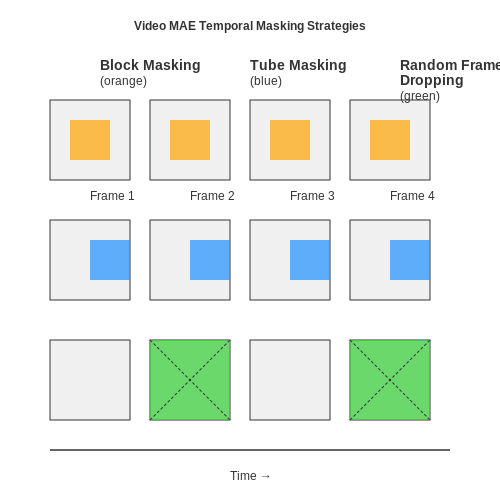
Unlike image MAE, temporal masking must preserve motion dynamics. Common approaches include:
- Block masking: Contiguous frame segments are masked (e.g., 50% of randomly selected 16-frame blocks)
- Tube masking: Spatial patches are masked consistently across all frames (preserves temporal edges)
- Random frame dropping: Entire frames are omitted at random intervals
Architectural Adaptations
Video MAE architectures typically employ 3D ViT (Vision Transformer) backbones. The encoder processes spatiotemporal tokens via 3D self-attention:
where Q,K,V are computed across both spatial and temporal dimensions. The decoder remains lightweight, often using 2D convolutions to reduce computational overhead.
Multimodal Extensions
For multimodal data (e.g., video+audio), MAEs can be extended through:
Cross-modal Masking
Masking strategies are coordinated across modalities. For video-audio pairs, masking a visual frame could trigger corresponding audio segment masking, forcing the model to learn cross-modal correlations.
Modality-specific Encoders
Each modality (text, image, audio) uses a dedicated encoder before fusion. A shared latent space is learned via contrastive objectives:
where zv, za are video and audio embeddings, and τ is a temperature parameter.
Practical Considerations
- Computational cost: Video MAEs require 3-5× more FLOPs than image counterparts due to temporal processing
- Data augmentation: Temporal jittering and frame interpolation improve robustness
- Evaluation metrics: Beyond pixel-wise MSE, perceptual metrics (SSIM, FVD) assess temporal coherence
Interpretability and Explainability in MAE
Masked Autoencoders (MAEs) achieve high performance in self-supervised learning by reconstructing masked patches of an input image. However, their black-box nature raises questions about interpretability—understanding why the model generates specific reconstructions. Unlike discriminative models, where saliency maps or attention weights provide direct insights, MAEs require specialized techniques to analyze their behavior.
Feature Attribution in MAE
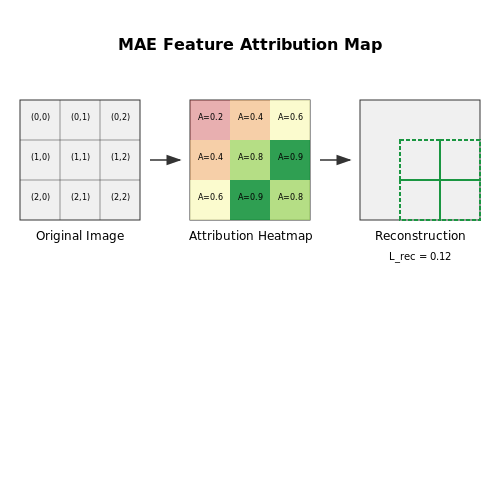
Feature attribution methods identify which input regions most influence the reconstruction. Gradient-based approaches, such as Grad-CAM, can be adapted for MAEs by computing the gradient of the reconstruction loss with respect to the input patches:
where Aij is the attribution score for patch (i,j), and ℒrec is the reconstruction loss. Alternatively, perturbation-based methods like SHAP (Shapley Additive Explanations) quantify patch importance by systematically masking patches and observing changes in reconstruction quality.
Latent Space Analysis
The MAE's latent space encodes hierarchical features, with early layers capturing low-level textures and deeper layers representing semantic structures. Principal Component Analysis (PCA) or t-SNE can visualize these embeddings:
where W is the PCA transformation matrix. Clusters in this space often correspond to object categories or spatial patterns, revealing how the model organizes information.
Attention Mask Interpretation
Although MAEs lack explicit attention mechanisms, their masking strategy implicitly defines attention. Analyzing which patches are easiest or hardest to reconstruct—measured by per-patch loss—reveals the model's reliance on contextual information. For instance, high-loss patches often lie near object boundaries, indicating the model struggles with occluded semantics.
Case Study: Medical Imaging
In chest X-ray analysis, MAEs pretrained on natural images adapt poorly to anatomical structures without fine-tuning. By comparing attribution maps between pretrained and fine-tuned models, researchers can identify domain gaps—e.g., the model may overfit to irrelevant background textures. This insight guides architecture adjustments, such as patch-size reduction for finer anatomical details.
Limitations and Open Challenges
Current methods assume linear feature interactions, while MAEs exhibit nonlinear, context-dependent behavior. For example, reconstructing a masked eye in a face image depends on the surrounding nose and mouth patches. Future work may integrate graph-based explanations to model these relationships explicitly.
4.3 Challenges and Limitations
High Computational Cost During Pretraining
Masked Autoencoders require extensive computational resources due to the iterative reconstruction of masked patches. The self-supervised objective involves predicting pixel values or features for a large proportion of masked regions (e.g., 75% in the original MAE paper), leading to quadratic complexity in transformer-based architectures. For high-resolution images, the memory footprint scales as O(N2d), where N is the sequence length and d is the embedding dimension. This makes pretraining on datasets like ImageNet-1K computationally intensive, often requiring hundreds of GPU/TPU hours.
Here, fθ reconstructs masked patches M from visible patches V, and the L2 loss amplifies computational demands due to per-pixel gradient calculations.
Information Leakage in Masking Strategies
Random masking, while simple, may preserve low-level statistics (e.g., color distributions, edge continuity) that allow trivial solutions for reconstruction. Advanced masking strategies like block-wise masking mitigate this but introduce new challenges:
- Boundary artifacts at mask edges due to discontinuous receptive fields
- Task misalignment when downstream applications require fine-grained localization
- Distribution shift between training (masked) and inference (unmasked) inputs
Scalability to Dense Prediction Tasks
While MAEs excel at classification, their direct application to segmentation or detection faces limitations:
- The decoder is typically discarded after pretraining, wasting learned reconstruction capabilities
- Global attention in ViT backbones struggles with high-resolution feature maps due to memory constraints
- Pixel-level reconstruction objectives may not align with semantic feature learning for dense tasks
Dependence on Reconstruction Fidelity
The assumption that better pixel reconstruction correlates with better representations doesn't always hold. High-frequency details often dominate the loss while providing minimal semantic value. Alternatives like feature-level reconstruction (e.g., using perceptual losses or CLIP embeddings) show promise but introduce:
- Additional pretraining complexity
- Dependence on external models
- Potential bias from the proxy objective
Data Efficiency Considerations
MAEs require large-scale datasets (e.g., ImageNet-1K/22K) for effective pretraining. In low-data regimes, the masking mechanism may discard critical information, leading to:
- Overfitting to reconstruction artifacts
- Poor generalization due to insufficient context for masked patches
- Catastrophic forgetting of rare features during finetuning
Architectural Constraints
The standard MAE framework imposes several design restrictions:
- Asymmetry between encoder (partial inputs) and decoder (full reconstruction) creates optimization challenges
- Fixed masking ratios lack adaptability to varying image complexities
- Non-hierarchical transformers struggle with multi-scale feature extraction
5. Key Research Papers on MAE
5.1 Key Research Papers on MAE
- Attention-Guided Masked Autoencoders For Learning Image Representations — Abstract. Masked autoencoders (MAEs) have established themselves as a powerful method for unsupervised pre-training for computer vision tasks. While vanilla MAEs put equal emphasis on reconstructing the individual parts of the image, we propose to inform the reconstruction process through an attention-guided loss function.
- PDF SparseMAE: Sparse Training Meets Masked Autoencoders - CVF Open Access — niques for Vision Transformers [4, 20] only focus on the fully-supervised settings. There still lacks a unified method to prune large-scale Vision Transformers under the unsuper-vised Masked Autoencoders framework. 3. Methods In this section, we first revisit the sparse training tech-nique and Masked Autoencoders (MAE) in Sec. 3.1. Then
- [2202.03670] How to Understand Masked Autoencoders — Masked autoencoders are scalable vision learners. arXiv preprint arXiv:2111.06377, 2021. [32] Kaiming He, Xiangyu Zhang, Shaoqing Ren, and Jian Sun. Deep residual learning for image recognition. In Proceedings of the IEEE conference on computer vision and pattern recognition, pages 770-778, 2016.
- ViTMAE - Hugging Face — The paper shows that, by pre-training a Vision Transformer (ViT) to reconstruct pixel values for masked patches, one can get results after fine-tuning that outperform supervised pre-training. The abstract from the paper is the following: This paper shows that masked autoencoders (MAE) are scalable self-supervised learners for computer vision.
- PDF AdaMAE: Adaptive Masking for Efficient Spatiotemporal Learning With ... — Masked Autoencoders (MAEs) learn generalizable rep-resentations for image, text, audio, video, etc., by recon-structing masked input data from tokens of the visible data. Current MAE approaches for videos rely on random patch, tube, or frame based masking strategies to select these tokens. This paper proposes AdaMAE, an adaptive masking strategy
- PDF Abstract How to Understand Masked Aut - arXiv.org — To help the research community to further comprehend the main reasons of the great success of MAE, based on our framework, we pose five questions and answer them with mathematical rigor using insights from operator theory. 1 Introduction "Masked Autoencoders (MAE) Are Scalable Vision Learners" [31] (illustrated in Figure1) recently
- PDF Efficient MAE Towards Large-Scale Vision Transformers - CVF Open Access — The high mask ratio in MAE enables efficient pre-training and plays a key role for scaling up the model size and leveraging large-scale data. In this work, we investigate how to lift the mask ratio in MAE [21] to further reduce pre-training computational This WACV paper is the Open Access version, provided by the Computer Vision Foundation.
- PDF Masked Autoencoders are Secretly Efficient Learners - CVF Open Access — This paper provides an efficiency study of training Masked Autoencoders (MAE), a framework introduced by He et al. [13] for pre-training Vision Transformers (ViTs). Our results surprisingly reveal that MAE can learn at a faster speed and with fewer training samples while main-taining high performance. To accelerate its training, our
- A Survey on Masked Autoencoder for Self-supervised Learning in Vision ... — Masked autoencoders are scalable vision learners, as the title of MAE \cite{he2022masked}, which suggests that self-supervised learning (SSL) in vision might undertake a similar trajectory as in NLP.
- PDF Self-Guided Masked Autoencoder — Masked Autoencoder (MAE) is a self-supervised approach for representation learn-ing, widely applicable to a variety of downstream tasks in computer vision. In spite of its success, it is still not fully uncovered what and how MAE exactly learns. In this paper, with an in-depth analysis, we discover that MAE intrinsically
5.2 Open-Source Implementations and Tools
- CVPR 2022 Open Access Repository — These CVPR 2022 papers are the Open Access versions ... (MAE) are scalable self-supervised learners for computer vision. Our MAE approach is simple: we mask random patches of the input image and reconstruct the missing pixels. ... Yanghao and Doll\'ar, Piotr and Girshick, Ross}, title = {Masked Autoencoders Are Scalable Vision Learners ...
- mae_mindspore: MAE Vit Model For Mindspore - Gitee — MAE Vit Model For Mindspore. ... r and Ross Girshick}, journal = {arXiv:2111.06377}, title = {Masked Autoencoders Are Scalable Vision Learners}, year = {2021}, } The original implementation was in PyTorch+GPU. This re-implementation is in MindSpore/NPU. ... including but not limited to communication on electronic mailing lists, source code ...
- [2402.19082] VideoMAC: Video Masked Autoencoders Meet ConvNets - arXiv.org — Recently, the advancement of self-supervised learning techniques, like masked autoencoders (MAE), has greatly influenced visual representation learning for images and videos. Nevertheless, it is worth noting that the predominant approaches in existing masked image / video modeling rely excessively on resource-intensive vision transformers (ViTs) as the feature encoder. In this paper, we ...
- Object-wise Masked Autoencoders for Fast Pre-training - ResearchGate — The reconstruction result (left) of MAE (He et al., 2021) for the masked image (right). We pre-train a standard MAE with a masking ratio of 0.75 on CLEVR-M for 300 epochs.
- Attention-Guided Masked Autoencoders For Learning Image Representations — Masked autoencoders (MAEs) have established themselves as a powerful method for unsupervised pre-training for computer vision tasks. ... Furthermore, to emphasize background reconstruction, we use the Inverted Attention Maps to guide the MAE and also mask out the 10%-quantile threshold of this inverted map to reconstruct Background-Only ...
- Proceedings of Sixth International Congress on Information and ... — The Antecedents of User Satisfaction and Net Benefits of a Learning Management System (LMS) 1 Introduction 2 Methodology 3 Results and Discussion 4 Limitations and Recommendations References Performance Analysis of a Neuro-Fuzzy Algorithm in Human-Centered and Non-invasive BCI 1 Introduction 2 Theories Involved 2.1 Butterworth Band-Pass Filters ...
- Azizi Othman on LinkedIn: How to Implement State-of-the-Art Masked ... — How to Implement State-of-the-Art Masked AutoEncoders (MAE) A Step-by-Step Guide to Building MAE with Vision Transformers Hi everyone! For those who do not…
- Autoencoders and their applications in machine learning: a survey — Autoencoders have become a hot researched topic in unsupervised learning due to their ability to learn data features and act as a dimensionality reduction method. With rapid evolution of autoencoder methods, there has yet to be a complete study that provides a full autoencoders roadmap for both stimulating technical improvements and orienting research newbies to autoencoders. In this paper, we ...
- Global contrast-masked autoencoders are powerful pathological ... — In 2021, as an extensible SSL method, a masked autoencoder (MAE) achieved state-of-the-art (SOTA) results on the ImageNet dataset [11]. This method randomly masks part of the input image and employs a lightweight decoder to rebuild the obscured pixels, which can not only yield improved accuracy but also speed up the training process.
5.3 Recommended Tutorials and Courses
- PDF MATE: Masked Autoencoders are Online 3D Test-Time Learners — Self-supervised repre-sentation learning by using Autoencoders [25] has been a long-standing research topic in computer vision. Recently, He et al. [8] proposed Masked Autoencoders (MAE) for self-supervised representation learning in the image domain. MAE uses an asymmetric encoder-decoder structure based on the Vision Transformer [5].
- PDF Masked Autoencoders are Secretly Efficient Learners — Abstract This paper provides an efficiency study of training Masked Autoencoders (MAE), a framework introduced He et al. [13] for pre-training Vision Transformers (ViTs). Our results surprisingly reveal that MAE can learn at faster speed and with fewer training samples while main-taining high performance. To accelerate its training, changes are simple and straightforward: in the pre-training ...
- PDF Continual-MAE: Adaptive Distribution Masked Autoencoders for Continual ... — In this paper, as shown in Figure 1, we introduce a novel approach to continual self-supervised learning called Adap-tive Distribution Masked Autoencoders (ADMA). Classical masked autoencoders (MAE) [20] have the potential for various extensions and are becoming dominant in vision representation learning.
- Attention-Guided Masked Autoencoders For Learning Image Representations — Abstract Masked autoencoders (MAEs) have established themselves as a powerful method for unsupervised pre-training for computer vision tasks. While vanilla MAEs put equal emphasis on reconstructing the individual parts of the image, we propose to inform the reconstruction process through an attention-guided loss function.
- (pytorch进阶之路)Masked AutoEncoder论文及实现 - CSDN博客 — 文章浏览阅读3.8k次,点赞8次,收藏33次。这一部分简单介绍一下什么是MAEResnet的一作和MAE的一作都是何恺明大佬,于Facebook AI Research (FAIR)研究MAE作者给的定义是基于部分被观测的量去预测整个原始图像的简单的自编码方法MAE属于自监督学习的一种,像自监督学习NLP领域中还有word embedding,transformer ...
- PDF Self-Guided Masked Autoencoder — Abstract Masked Autoencoder (MAE) is a self-supervised approach for representation learn-ing, widely applicable to a variety of downstream tasks in computer vision. In spite of its success, it is still not fully uncovered what and how MAE exactly learns. In this paper, with an in-depth analysis, we discover that MAE intrinsically learns pattern-based patch-level clustering from surprisingly ...
- Azizi Othman on LinkedIn: How to Implement State-of-the-Art Masked ... — How to Implement State-of-the-Art Masked AutoEncoders (MAE) A Step-by-Step Guide to Building MAE with Vision Transformers Hi everyone! For those who do not…
- PDF Real-World Robot Learning with Masked Visual Pre-training — Abstract: In this work, we explore self-supervised visual pre-training on images from diverse, in-the-wild videos for real-world robotic tasks. Like prior work, our visual representations are pre-trained via a masked autoencoder (MAE), frozen, and then passed into a learnable control module. Unlike prior work, we show that the pre-trained representations are effective across a range of real ...
- PDF A Tutorial on Deep Learning Part 2: Autoencoders, Convolutional Neural ... — A Tutorial on Deep Learning Part 2: Autoencoders, Convolutional Neural Networks and Recurrent Neural Networks Quoc V. Le [email protected] Google Brain, Google Inc.