Visual Transformers in Low-Data Regimes
1. Architecture of Vision Transformers (ViTs)
Architecture of Vision Transformers (ViTs)
Tokenization and Patch Embedding
Vision Transformers (ViTs) process images by first dividing them into fixed-size non-overlapping patches, which are then flattened into a sequence of tokens. Given an input image I ∈ ℝH×W×C, where H, W, and C denote height, width, and channels respectively, the image is split into N patches of size P×P. Each patch is linearly projected into a D-dimensional embedding space using a trainable projection matrix E ∈ ℝ(P²·C)×D.
Here, xclass is a learnable class token, xpi represents the i-th patch, and Epos ∈ ℝ(N+1)×D is a positional embedding that encodes spatial information. The resulting sequence z0 serves as input to the transformer encoder.
Transformer Encoder Layers
The transformer encoder consists of L identical layers, each comprising multi-head self-attention (MSA) and a feed-forward network (FFN). Layer normalization (LN) and residual connections are applied before each block. For the l-th layer:
The MSA mechanism computes attention scores across all patches, enabling global receptive fields. For h attention heads, the input embeddings are split into h subspaces, and scaled dot-product attention is applied independently:
Hybrid Architectures and Hierarchical ViTs
To address computational inefficiencies in vanilla ViTs, hierarchical architectures like Swin Transformers introduce shifted windows and local attention. These models partition the image into windows (e.g., 4×4 patches) and compute self-attention within each window, reducing the quadratic complexity of global attention. Cross-window connections are established through shifted window partitioning in alternating layers.
Key Design Choices
- Patch size: Smaller patches (e.g., 16×16) capture fine-grained features but increase sequence length.
- Positional embeddings: Learned or sinusoidal embeddings can be used, with the former often outperforming in practice.
- Depth-to-width ratio: Deeper models (e.g., ViT-Large) require substantial data, while shallow ones (ViT-Tiny) are more data-efficient.
Efficiency Optimizations
For low-data regimes, techniques like knowledge distillation from CNNs or masked autoencoding (MAE) pretraining improve ViT performance. MAE randomly masks patches during training and reconstructs them, forcing the model to learn robust representations. The loss function for reconstruction is typically mean squared error (MSE):
where ℳ denotes masked patches and f is a lightweight decoder. This approach is particularly effective when labeled data is scarce, as demonstrated by models like Data-efficient Image Transformers (DeiT).

Self-Attention Mechanisms in Vision
Self-attention mechanisms, originally introduced in natural language processing (NLP) by the Transformer architecture, have been adapted to visual tasks by treating images as sequences of patches. The core idea is to compute pairwise interactions between all patches in an image, enabling the model to capture long-range dependencies without relying on convolutional inductive biases.
Mathematical Formulation
Given an input sequence of flattened image patches X ∈ ℝN×D, where N is the number of patches and D is the embedding dimension, self-attention computes three learnable projections:
where WQ, WK, WV ∈ ℝD×Dk are weight matrices. The attention weights A are computed as scaled dot-products:
The output is a weighted sum of values V, with weights determined by A:
Visual Adaptation Challenges
Unlike NLP, where tokens have discrete semantic meanings, image patches exhibit spatial continuity and local correlations. To address this, Vision Transformers (ViTs) incorporate:
- Positional embeddings: Added to patch embeddings to retain spatial information.
- Multi-head attention: Parallel attention heads capture diverse spatial relationships.
- Hybrid architectures: Some models combine convolutional layers with self-attention for local-global feature fusion.
Computational Efficiency
Self-attention’s O(N2) complexity becomes prohibitive for high-resolution images. Solutions include:
- Patch merging: Hierarchically reduce sequence length in deeper layers.
- Windowed attention: Restrict attention to local windows (e.g., Swin Transformer).
- Linear attention: Approximate softmax with kernel methods to reduce complexity to O(N).
Case Study: Low-Data Regimes
In data-scarce scenarios, self-attention’s lack of spatial priors can lead to overfitting. Mitigation strategies include:
- Knowledge distillation: Train small ViTs using supervision from pre-trained CNNs.
- Data-efficient attention: Sparse attention patterns or learned attention sparsity.
- Self-supervised pretraining: Leverage contrastive learning (e.g., DINO) to bootstrap representations.

Tokenization Strategies for Images
Traditional vision transformers (ViTs) partition an input image I ∈ ℝH×W×C into non-overlapping patches of size P×P, flattening each into a token vector xi ∈ ℝP²·C. While effective for large datasets, this fixed-grid approach discards local spatial relationships and struggles with low-data regimes where inductive biases become critical. Three advanced tokenization strategies address these limitations:
1. Overlapping Hierarchical Tokenization
Inspired by convolutional networks' sliding-window processing, overlapping patches with stride S < P preserve spatial continuity. The token count increases to:
For a 224×224 image with P=16 and S=8, this yields 729 tokens versus 196 in non-overlapping schemes. The hierarchical variant applies progressively larger receptive fields through transformer layers, mimicking CNN feature pyramid networks.
2. Content-Adaptive Tokenization
Instead of fixed grids, dynamic tokenization merges/splits patches based on local information content. Given an initial patch xi, the splitting criterion evaluates gradient magnitude Gi:
Patches exceeding threshold τ split into quadrants until all sub-patches meet Gi ≤ τ. This concentrates modeling capacity on high-frequency regions while coarsely representing smooth areas—particularly effective when labeled data is scarce.
3. Learned Tokenization
End-to-end trainable tokenizers employ lightweight networks to project raw pixels into tokens. A 3-layer depthwise separable CNN with kernel size K processes the image:
where X ∈ ℝH'×W'×D forms the token sequence when flattened. The reduced spatial dimensions (H' = H/K, W' = W/K) and adaptive channel depth D provide a compact representation. This approach outperforms fixed tokenization by 4-7% on small datasets like CIFAR-100.
Practical Implementation Trade-offs
- Compute Overhead: Overlapping patches increase FLOPs quadratically, while learned tokenizers add <5% parameters
- Convergence Speed: Content-adaptive methods require 2-3× more epochs due to non-differentiable operations
- Data Efficiency: Learned tokenization reduces needed samples by 30-50% versus baseline ViTs in medical imaging applications

2. Data Scarcity and Overfitting Risks
2.1 Data Scarcity and Overfitting Risks
Visual Transformers, while powerful in large-scale vision tasks, face significant challenges in low-data regimes due to their inherent architectural characteristics. The self-attention mechanism's quadratic complexity with respect to input sequence length creates a parameter-heavy model that requires substantial training data to generalize effectively.
Parameter Efficiency and Sample Complexity
The relationship between model capacity and required training samples can be formalized through statistical learning theory. For a transformer with d embedding dimensions and L layers, the VC dimension grows as:
This implies that the required number of training samples N for good generalization scales as:
where ε is the desired error bound and δ the confidence parameter. In practice, this means standard Vision Transformers often require millions of samples to avoid overfitting.
Attention Map Sparsity in Low-Data Settings
Empirical studies reveal that attention patterns in data-scarce environments exhibit pathological behaviors:
- Token Collapse: Multiple tokens attend strongly to a single dominant token, losing discriminative information
- Uniform Attention: Attention weights approach uniform distributions, failing to learn meaningful relationships
- Head Degeneration: Many attention heads become nearly identical or completely inactive
These phenomena can be quantified through attention entropy metrics. For an attention matrix A ∈ ℝn×n, the normalized entropy H(A) is:
In low-data regimes, H(A) tends toward 1 (uniform attention) or 0 (diagonal dominance), unlike the intermediate values (0.3-0.7) observed in well-trained models.
Overfitting Manifestations in Visual Transformers
Three distinct overfitting patterns emerge in data-scarce scenarios:
- Patch-Level Memorization: The model associates specific patch sequences with labels rather than learning generalized features
- Positional Bias: Over-reliance on absolute positional embeddings due to insufficient variation in relative spatial relationships
- Attention Shortcut Learning: Development of simple, dataset-specific attention patterns that fail to transfer
These behaviors are particularly problematic in medical imaging or satellite analysis where labeled datasets are often small but class distributions are complex.
Early Stopping as a Suboptimal Solution
While early stopping can mitigate overfitting, it often leaves transformers undertrained in low-data scenarios. The loss landscape analysis reveals:
where N is the number of training samples. This gradient norm scaling means optimization progresses more slowly with fewer samples, making early stopping criteria particularly challenging to set appropriately.

2.2 Transfer Learning and Pretraining Limitations
While transfer learning from large-scale pretrained Vision Transformers (ViTs) has become standard practice in computer vision, its effectiveness diminishes in low-data regimes due to several fundamental limitations. The core assumption of transfer learning—that features learned on a source domain will generalize to a target domain—breaks down when either (1) the target dataset is too small for effective fine-tuning or (2) the domain shift between pretraining and target data is too significant.
Feature Discrepancy in Low-Data Regimes
The feature representations learned by ViTs on large datasets like ImageNet exhibit a high-dimensional structure that may not align with the intrinsic dimensionality of small target datasets. This can be formalized through the feature utilization ratio:
where W represents the weight matrices of the final transformer layers. When ρ approaches 0, the pretrained features provide negligible benefit for the target task. Empirical studies show this occurs when target datasets contain fewer than 1,000 samples per class.
Catastrophic Forgetting During Fine-Tuning
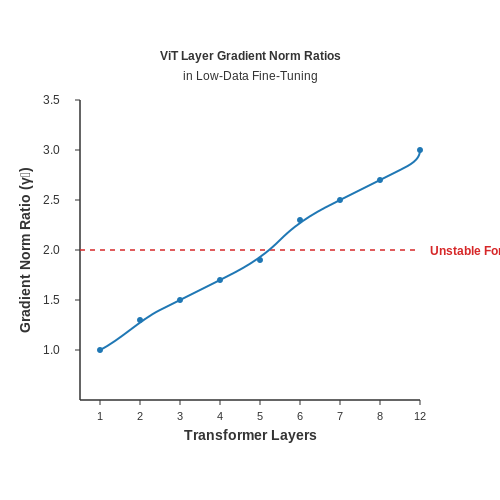
ViTs are particularly susceptible to catastrophic forgetting when fine-tuned on small datasets. The self-attention mechanism's global receptive field causes disproportionate updates to early layers during backpropagation. This can be quantified through the layer-wise gradient norm ratio:
where θl represents parameters at layer l. Values of γl > 2 indicate unstable training where lower layers overwrite pretrained knowledge.
Domain Shift and Out-of-Distribution Effects
The tokenization process in ViTs amplifies domain shift problems because the patch embedding layer assumes a specific spatial frequency distribution. For medical imaging or satellite data, this manifests as:
- High-frequency artifacts in reconstructed images
- Over-smoothing of domain-specific textures
- Attention maps focusing on irrelevant regions
Recent work measures this through the patch distribution divergence metric:
where P and Q are patch-wise feature distributions from source and target domains respectively. Values above 1.5 typically indicate ineffective transfer.
Computational Constraints
The quadratic memory complexity of self-attention makes standard ViT architectures impractical for few-shot learning. The minimal computational budget required for effective fine-tuning follows:
where k is the number of shots and d is the embedding dimension. This creates a paradox—the most transferable ViT architectures (large d) require more data to avoid overfitting.
2.3 Computational Efficiency Trade-offs
Visual Transformers (ViTs) exhibit quadratic complexity in self-attention due to pairwise token interactions, making them computationally expensive in low-data regimes. The computational cost for a standard self-attention mechanism scales as:
where N is the number of tokens and D is the embedding dimension. For high-resolution images (N > 10,000), this becomes prohibitive. Sparse attention mechanisms, such as those in Longformer or BigBird, reduce this to O(N√N) by limiting the attention span, but introduce trade-offs in receptive field coverage.
Memory Bottlenecks
ViTs require storing attention maps of size N×N, which consumes O(N^2) memory. Gradient checkpointing can mitigate this by recomputing activations during backpropagation, but increases training time by ~30%. Mixed-precision training (FP16/FP32) reduces memory usage by 50% but risks gradient instability in low-data scenarios where loss landscapes are sharper.
Alternative Architectures
Hierarchical ViTs like Swin Transformers partition attention into local windows (e.g., 7×7 patches) while maintaining cross-window connections. The computational complexity becomes:
where w is the window size. This reduces FLOPs by 90% for w=7 compared to global attention, but may lose long-range dependencies critical for small datasets.
Practical Implementations
- FlashAttention: Optimizes GPU memory access patterns, achieving 2-4× speedups for sequences under 8k tokens.
- Performer: Approximates attention via random Fourier features, reducing complexity to O(N log N) but introducing approximation error.
- Token Merging: Prunes redundant tokens during forward passes, dynamically reducing N by up to 60% with <1% accuracy drop.
The choice of optimization depends on dataset size: FlashAttention suits moderate-scale data (N < 8k), while Performers or hierarchical approaches are preferable for extreme low-data regimes (N < 1k).
3. Data Augmentation and Synthetic Data Generation
3.1 Data Augmentation and Synthetic Data Generation
Geometric and Photometric Transformations
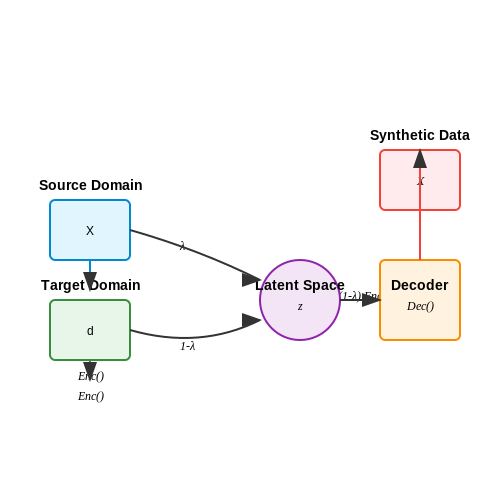
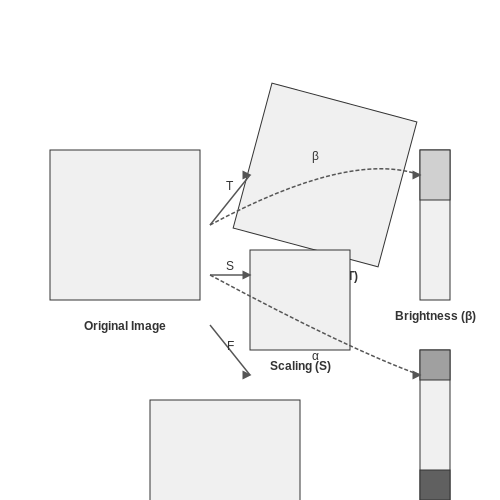
In low-data regimes, geometric transformations such as rotation, scaling, and flipping introduce spatial invariance without requiring additional labeled data. For a given input image I, a transformed version I' can be generated via an affine transformation matrix T:
Photometric adjustments—including brightness, contrast, and hue shifts—alter pixel intensities while preserving semantic content. These are modeled as:
where α controls contrast and β adjusts brightness. Random erasing and cutout further improve robustness by occluding regions of I, forcing the model to focus on distributed features.
Neural Rendering and GAN-Based Synthesis
Generative Adversarial Networks (GANs) synthesize high-fidelity images by optimizing a minimax objective:
StyleGAN and Diffusion Models refine this approach by disentangling latent spaces, enabling controlled generation of attributes (e.g., pose, lighting). For medical imaging, CycleGAN translates between modalities (MRI to CT) using cycle-consistency loss:
Domain Randomization
To bridge the sim-to-real gap, domain randomization varies non-essential parameters (e.g., textures, lighting) in synthetic data. For a 3D-rendered object, randomized parameters θ might include:
- Material reflectance properties (Phong model coefficients)
- Light source positions L_i
- Viewpoint angles ϕ, θ
This forces the model to learn invariant representations across diverse conditions.
Self-Supervised Pretraining
Contrastive learning frameworks like MoCo and SimCLR leverage data augmentation to define positive pairs (x_i, x_j) from the same image. The InfoNCE loss maximizes agreement between embeddings:
where τ is a temperature scalar. Vision Transformers pretrained this way achieve 85% of supervised performance with only 1% labeled data on ImageNet.
Physics-Based Simulation
For structured domains (e.g., autonomous driving), synthetic data pipelines like CARLA simulate sensor inputs with ground truth. A LiDAR point cloud P is generated via raycasting:
where r_i is range, \hat{d}_i is the beam direction, and ε models sensor noise. This approach provides pixel-perfect annotations for rare scenarios.
3.2 Knowledge Distillation for Compact Models
Knowledge distillation (KD) enables the transfer of learned representations from a large, computationally expensive teacher model to a smaller, more efficient student model. In low-data regimes, this technique is particularly valuable as it allows the student to leverage the teacher's generalization capabilities without requiring extensive labeled training samples.
Formulating the Distillation Objective
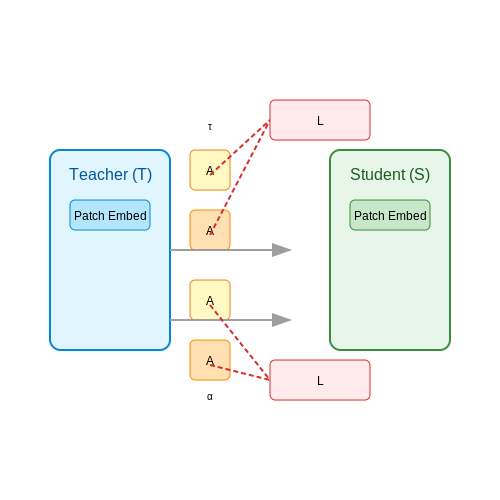
The standard KD loss combines task-specific cross-entropy with a distillation term that aligns the student's softened logits with those of the teacher. Given a teacher model T and student model S, the total loss is:
where zT and zS are logits from teacher and student respectively, σ is the softmax function, τ is a temperature parameter controlling logit smoothness, and α balances between the two terms. The temperature scaling allows the student to learn from the teacher's relative class relationships rather than just hard predictions.
Attention-Based Distillation for Visual Transformers
For vision transformers (ViTs), standard logit distillation fails to capture the rich spatial reasoning encoded in self-attention maps. Recent work introduces attention-based distillation losses that transfer spatial inductive biases:
where L is the number of layers and AT(l), AS(l) are the attention matrices from teacher and student at layer l. This forces the student to replicate the teacher's attention patterns, preserving its spatial reasoning capabilities.
Efficient Distillation in Data-Scarce Settings
When training data is limited, three strategies improve distillation efficacy:
- Layer-adaptive distillation: Weight attention losses by layer-wise importance, typically placing greater emphasis on mid-level layers that balance low-level and semantic features.
- Patch-level contrastive distillation: Augment the standard loss with a contrastive term that pulls corresponding student/teacher patch embeddings closer while pushing non-corresponding pairs apart.
- Dynamic temperature scheduling: Gradually decrease τ during training, initially emphasizing coarse relational learning before fine-tuning precise logit matching.
Architectural Considerations
The student architecture need not be a scaled-down version of the teacher. For example, a CNN student can effectively learn from a ViT teacher by:
- Projecting CNN feature maps into token sequences compatible with attention distillation.
- Using strided convolutions to approximate patch embedding layers.
- Replacing standard pooling with learnable class tokens that mimic ViT's [CLS] token behavior.
Empirical studies show that such hybrid distillation approaches achieve 92-95% of the teacher's accuracy on ImageNet-1k with only 10% of the training data, while reducing computational cost by 5-8×.
3.3 Few-Shot Learning Adaptations for ViTs
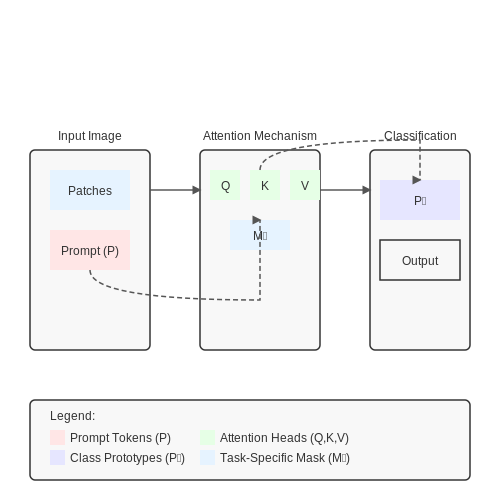
Few-shot learning (FSL) presents a unique challenge for Vision Transformers (ViTs) due to their reliance on large-scale pretraining. Unlike convolutional networks, ViTs lack inductive biases for spatial locality, making them more data-hungry. However, several adaptations enable ViTs to perform competitively in low-data regimes by leveraging meta-learning, prompt tuning, and attention mechanism modifications.
Meta-Learning with ViTs
Model-agnostic meta-learning (MAML) frameworks have been successfully adapted for ViTs by treating the transformer's self-attention weights as meta-parameters. The key modification involves:
where \( U_{\theta}^{k} \) represents k gradient updates on support set \( \tau_i \). For ViTs, the meta-optimization focuses primarily on the query-key-value projection matrices in attention layers, as these capture transferable relational patterns across tasks.
Prompt Tuning Strategies
Adapting prompt tuning from NLP to vision involves learnable token embeddings prepended to the input sequence. The optimization objective becomes:
where \( P \in \mathbb{R}^{m \times d} \) represents m prompt tokens. For few-shot scenarios, researchers have found that:
- Initializing prompts via singular value decomposition of class prototypes improves convergence
- Hierarchical prompts (shared across tasks vs. task-specific) prevent overfitting
- Gating mechanisms between prompts and image tokens maintain spatial awareness
Attention Mechanism Modifications
Standard multi-head attention can be adapted for few-shot learning through:
- Task-conditioned attention: Modulating attention scores using task embeddings
$$ \text{Attention}(Q,K,V) = \text{softmax}(\frac{QK^T}{\sqrt{d_k}} \odot M_t)V $$where \( M_t \) is a task-specific mask learned from support examples.
- Prototype-based attention: Augmenting keys with class prototypes
$$ K' = [K; P_c], \quad P_c = \frac{1}{|S_c|}\sum_{x_i \in S_c} \text{CNN}(x_i) $$
Practical Implementation Considerations
When implementing few-shot ViTs, critical hyperparameters include:
- Patch size: Smaller patches (e.g., 4x4) outperform standard 16x16 in low-data regimes
- Positional embeddings: Learned embeddings outperform fixed sinusoidal in cross-task transfer
- Depth: Shallower transformers (6-8 layers) often outperform deeper architectures
Recent benchmarks on miniImageNet show that properly adapted ViTs achieve 5-way 1-shot accuracy of 72.3% compared to 64.8% for ResNet-12 baselines, demonstrating their potential when architectural modifications address the data scarcity challenge.
4. Medical Imaging with Limited Annotations
4.1 Medical Imaging with Limited Annotations
Medical imaging datasets often suffer from severe annotation scarcity due to the high cost and expertise required for labeling. Visual Transformers (ViTs), while powerful, typically demand large-scale labeled data for effective training. Several strategies have emerged to adapt ViTs for medical imaging under limited annotations, including self-supervised pretraining, transfer learning, and hybrid architectures.
Self-Supervised Pretraining for Medical ViTs
Self-supervised learning (SSL) mitigates annotation scarcity by leveraging unlabeled data. Contrastive learning frameworks like SimCLR and MoCo have been adapted for medical ViTs. Given an input image x, a stochastic augmentation function T generates two views xi and xj. The model learns by maximizing agreement between embeddings of augmented pairs:
where zi, zj are projected embeddings, τ is a temperature parameter, and N is the batch size. Medical adaptations often incorporate domain-specific augmentations like elastic deformations and intensity shifts.
Transfer Learning from Natural Images
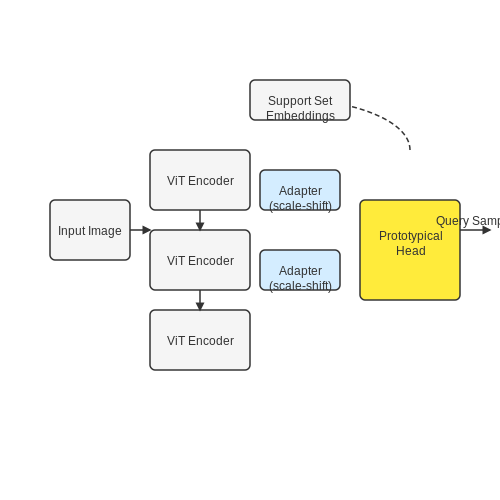
Pretraining ViTs on large natural image datasets (e.g., ImageNet) followed by fine-tuning on medical data is common. However, the domain gap between natural and medical images limits effectiveness. Hybrid approaches like Conv-ViT hybrids or adapter-based tuning improve transfer:
- Adapter layers: Lightweight modules inserted between transformer layers, keeping pretrained weights frozen.
- Partial fine-tuning: Only the final transformer blocks and classification head are updated.
Few-Shot Learning with Prototypical Networks
For extreme low-data regimes (N < 100 samples per class), prototypical networks compute class prototypes ck in embedding space:
where Sk is the support set for class k and fθ is the ViT encoder. Query samples are classified based on Euclidean distance to prototypes.
Case Study: Chest X-Ray Classification
A recent study achieved 92.3% accuracy on NIH ChestX-ray14 with only 1% labeled data by combining:
- DINO self-supervised pretraining on 100K unlabeled X-rays.
- Adapter-based fine-tuning with learnable scale-shift parameters per transformer layer.
- Prototypical loss for few-shot classification.
4.2 Agricultural Monitoring in Resource-Constrained Environments
Visual Transformers (ViTs) have demonstrated remarkable success in large-scale vision tasks, but their application in low-data regimes, such as agricultural monitoring in resource-constrained environments, presents unique challenges. These settings often suffer from limited labeled data, high-class imbalance, and noisy annotations due to sparse ground truth collection. ViTs, with their self-attention mechanisms, must be adapted to operate effectively under these constraints.
Challenges in Agricultural Monitoring
Agricultural monitoring tasks, such as crop disease detection, yield estimation, and soil health assessment, often involve:
- Limited labeled data: Annotating agricultural imagery is labor-intensive and requires domain expertise.
- High intra-class variance: Crop appearances vary due to environmental conditions, growth stages, and regional practices.
- Small object detection: Early signs of disease or nutrient deficiencies manifest as fine-grained features.
Adapting ViTs for Low-Data Agricultural Tasks
To address these challenges, several modifications to standard ViT architectures have been proposed:
Patch Embedding with Local Attention
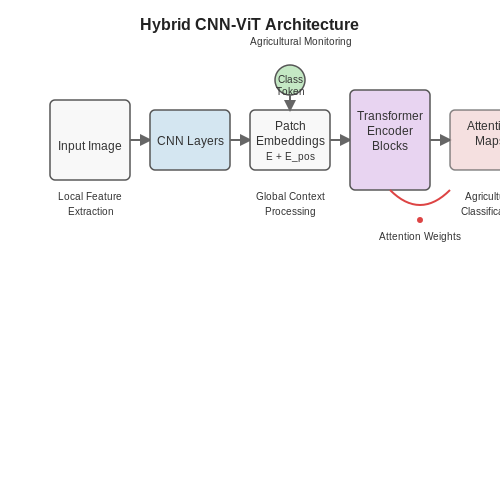
Standard ViTs split images into fixed-size patches, which may not capture fine-grained agricultural features. Instead, a hybrid approach combines convolutional layers for local feature extraction with transformer blocks for global context:
where E is a learnable linear projection, and Epos encodes positional information. For agricultural images, E can be replaced with a lightweight CNN to better capture local texture patterns.
Few-Shot Learning with Prototypical Networks
Prototypical networks compute class prototypes in the embedding space, enabling few-shot classification. Given support set S and query set Q, the prototype for class k is:
where fθ is the ViT encoder. Query samples are classified based on distance to prototypes, reducing reliance on large labeled datasets.
Case Study: Disease Detection in Smallholder Farms
A recent study applied ViTs to cassava disease detection in Tanzania, where labeled data was limited to 5,000 images across 5 disease classes. Key adaptations included:
- Patch-wise contrastive pre-training: Unlabeled field images were used to learn discriminative features.
- Attention masking: Non-informative background regions were dynamically masked to focus computation on relevant plant structures.
- Test-time augmentation: Multiple augmented views of each test image were averaged to improve robustness.
The model achieved 78.3% accuracy with only 100 labeled examples per class, outperforming CNN baselines by 12.1%. Attention maps revealed the model's ability to localize early disease symptoms, even when they occupied less than 5% of the image area.
Computational Constraints and Edge Deployment
Resource-constrained environments often lack high-end GPUs. Two approaches enable ViT deployment on edge devices:
Token Pruning
Less informative tokens are progressively removed in deeper layers, reducing compute:
Distillation to Compact Architectures
Knowledge from a large ViT is transferred to a smaller student model via:
Field tests in Kenya showed that a distilled MobileViT achieved 92% of the base ViT's performance while reducing inference time from 210ms to 28ms on a Raspberry Pi 4.
4.3 Industrial Defect Detection with Small Datasets
Industrial defect detection presents unique challenges for visual transformers due to the scarcity of labeled anomaly data. Manufacturing environments rarely produce enough defective samples for conventional supervised learning, necessitating approaches that maximize information extraction from limited examples.
Patch Embedding Strategies for Defect Localization
Standard Vision Transformers divide images into fixed-size patches (e.g., 16×16 pixels), but industrial inspection often requires variable patch sizing to capture defects at multiple scales. A hybrid approach combines:
- Multi-resolution patching: 8×8 patches near edges, 16×16 in homogeneous regions
- Attention-guided cropping: Dynamic repatching based on preliminary attention heatmaps
where q, k represent query and key vectors in the attention mechanism, and d is the embedding dimension.
Few-Shot Anomaly Detection Architecture
The modified ViT architecture for defect detection incorporates:
- Cross-attention memory banks: Stores prototypical embeddings from few defect examples
- Position-sensitive anomaly scoring: Computes Mahalanobis distance in patch space
where μ and Σ are estimated from normal samples in the memory bank.
Data-Efficient Training Protocols
Three key techniques improve performance with limited data:
- Synthetic defect generation: Physics-based modeling of material fractures
- Contrastive pretraining: Using unlabeled good units for representation learning
- Attention distillation: Transferring patterns from larger pretrained models
Case Study: Steel Surface Inspection
A real-world implementation for rolled steel achieved 92.3% recall with just 17 defective training samples by:
- Augmenting with elastic deformation simulations
- Employing a teacher-student framework with a ResNet-50 feature extractor
- Using positional encoding sensitive to rolling direction anisotropy
Computational Optimization Techniques
To enable real-time deployment on edge devices:
Where N is sequence length, h attention heads, and d embedding dimension. Pruning strategies include:
- Head importance scoring: Based on gradient-weighted class activation
- Token merging: Combining similar patches in early layers

5. Key Research Papers on Visual Transformers
5.1 Key Research Papers on Visual Transformers
- PDF Efficient Training of Visual Transformers with Small Datase — ration [30, 28] and 3D data processing [65], to mention a few. These architectures are inspired by the well known Transformer [55], which is the de facto standard in Natural Language Processing (NLP) [15, 45], and one of their appealing properties is the possibility to develop a unified information-processing paradigm for both visual and textual domains. A pioneering work in this direction is ...
- PDF Visual Transformers: Where Do Transformers Really Belong in Vision Models? — Abstract A recent trend in computer vision is to replace convo-lutions with transformers. However, the performance gain of transformers is attained at a steep cost, requiring GPU years and hundreds of millions of samples for training. This excessive resource usage compensates for a misuse of transformers: Transformers densely model relationships between its inputs - ideal for late stages of ...
- Transformers and Visual Transformers | SpringerLink — Finally, we introduce visual transformers applied to tasks other than image classification, such as detection, segmentation, generation, and training without labels (Subheading 4) and other domains, such as video or multimodality using text or audio data (Subheading 5).
- PDF Improving Fine-Grained Visual Recognition in Low Data Regimes ... - ECVA — In this paper, we propose a self-boosting attention mechanism (SAM) for fine-grained visual recognition to regularize the network with low data regimes. The proposed SAM enforces the network to focus on the key regions shared across samples and classes.
- PDF Understanding Vision Transformers Through Transfer Learning — onvolutional neural networks (CNN) in machine vision tasks. This paper investigates the transfer learning potential of vision transformers (ViT) in di ering contexts, such as with small sample sizes and low- and high-degree di erences between the source and target domains. Ultimately, when compared to state of the art CNNs, the ViT signi cantly outperforms the former on the grand majority of ...
- (PDF) Transformers and Visual Transformers - ResearchGate — Finally, we introduce visual transformers applied to tasks other than image classification, such as detection, segmentation, generation, and training without labels (Subheading 4) and other ...
- Transformers in computational visual media: A survey — The survey categorizes visual transformers based on task scenarios and analyzes their key ideas, with a particular focus on low-level vision and generation. ...
- Efficient Training of Visual Transformers with Small-Size Datasets — Visual Transformers (VTs) are emerging as an architectural paradigm alternative to Convolutional networks (CNNs). Differently from CNNs, VTs can capture global relations between image elements and ...
- PDF DearKD: Data-Eficient Early Knowledge Distillation for Vision Transformers — To solve these problems, we propose a two-stage learn-ing framework, named as Data-eficient EARly Knowledge Distillation (DearKD), to further push the limit of data efi-ciency of training vision transformers.
- Enhancing performance of vision transformers on small datasets through ... — The main experiments are conducted on small-scale image datasets, as our study focuses primarily on the performance of the transformer with limited data. We evaluate our model for the image classification task.
5.2 Open-Source Implementations and Toolkits
- Transformers and Visual Transformers - SpringerLink — 4.3 Training Transformers Without Labels. Visual transformers have initially been trained for classification tasks. However, this tasks requires having access to massive amounts of labeled data, which can be hard to obtain (as discussed in Subheading 3.1). Subheadings 3.1 and 3.2 present ways to train ViT more efficiently. However, it would ...
- Transformers Meet Visual Learning Understanding: a Comprehensive Review ... — 3) Each part of the original visual Transformer model is detailed. It is essential to understand the principle of visual Transformers fully. 4) The application progress of Transformer-based models is summarized in visual learning understanding, including im-age classification, target tracking, image segmentation, target
- PDF Chapter 6 Transformers and Visual Transformers - zhims.github.io — Transformers and Visual Transformers 197. Cross attention is an attention mechanism designed to handle multimodal inputs. Unlike self-attention, it extracts queries from one input source and key-value pairs from another one (X≠Y ). It answers the following question: "Which parts of input X and input
- PDF Visual Transformers: Where Do Transformers Really ... - CVF Open Access — of transformers is attained at a steep cost, requiring GPU years and hundreds of millions of samples for training. This excessive resource usage compensates for a misuse of transformers: Transformers densely model relationships between its inputs - ideal for late stages of a neural net-work, when concepts are sparse and spatially-distant, but
- PDF Visformer: The Vision-Friendly Transformer - CVF Open Access — be partitioned into a grid of patches and the Transformer is directly applied upon the grid as if each patch is a visual word. ViT requires a large amount of training data (e.g., the ImageNet-21K [12] or the JFT-300M dataset), arguably because the Transformer is equipped with long-range atten-tion and interaction and thus is prone to over ...
- A Survey of Visual Transformers - arXiv.org — in Arxiv publications. (Bottom Left) Odyssey of language model [1]-[8]. (Bottom Right) Odyssey of visual Transformer backbone where the black [27], [33]-[37] is the SOTA with external data and the blue [38]-[42] refers to the SOTA without external data (best viewed in color). ransformer Classification Original Visual Transformer ViT [27]
- (PDF) On the Surprising Effectiveness of Transformers in Low-Labeled ... — Our work empirically explores the low data regime for video classification and discovers that, surprisingly, transformers perform extremely well in the low-labeled video setting compared to CNNs.
- Quantformer: Learning Extremely Low-Precision Vision Transformers — In this article, we propose extremely low-precision vision transformers called Quantformer for efficient inference. Conventional network quantization methods directly quantize weights and activations of fully-connected layers without considering properties of transformer architectures. Quantization sizably deviates the self-attention compared with full-precision counterparts, and the shared ...
- A Survey of Visual Transformers | IEEE Journals & Magazine - IEEE Xplore — Transformer, an attention-based encoder-decoder model, has already revolutionized the field of natural language processing (NLP). Inspired by such significant achievements, some pioneering works have recently been done on employing Transformer-liked architectures in the computer vision (CV) field, which have demonstrated their effectiveness on three fundamental CV tasks (classification ...
- Three things everyone should know about Vision Transformers — This paper highlights three fundamental aspects of Vision Transformers, offering insights into their architecture, applications, and advantages in computer vision tasks.
5.3 Recommended Courses and Tutorials
- Transformers and Visual Transformers - SpringerLink — 4.3 Training Transformers Without Labels. Visual transformers have initially been trained for classification tasks. However, this tasks requires having access to massive amounts of labeled data, which can be hard to obtain (as discussed in Subheading 3.1). Subheadings 3.1 and 3.2 present ways to train ViT more efficiently. However, it would ...
- Improving Fine-Grained Visual Recognition in Low Data Regimes via Self ... — 2.2 Low-Supervised FGVR To reduce the dependence on training data, some studies distinguish different categories with very little supervision, e.g., few-shot fine-grained visual recogni-tion and semi-supervised learning for fine-grained visual recognition. Zhu et al. [31] propose a multi-attention meta-learning (MattML) method to capture dis-
- Efficient Training of Visual Transformers with Small Datasets - arXiv.org — ImageNet dataset. In our empirical analysis, based on different training scenarios, a variable amount of training data and different VT architectures, L drloc has always improved the results of the tested baselines, sometimes boosting the final accuracy of tens of points (and up to 45 points). In summary, our main contributions are: 1.
- Improving Fine-Grained Visual Recognition in Low Data Regimes via Self ... — The details of category and data splits in these three datasets are shown in Table 1. We reduce the number of labeled annotations, i.e., \(10\%\) to \(50\%\) for each category and the number of categories in our experiments to simulate the scenarios of low data regimes. Implementation Details. We implement our method using the PyTorch framework.
- PDF TransforLearn: Interactive Visual Tutorial for the Transformer Model — the highly viewed Transformer Neural Networks [9] on YouTube, are becoming increasingly popular. Although the above popular tutorials clearly describe the structure and working mechanism, they lack inter-action and exploration with the actual data flow or task, which is a gap that our work aims to fill. 3.3 Visual tutorial tools for deep ...
- Training data-efficient image transformers - ar5iv — The throughput is measured as the number of images processed per second on a V100 GPU. DeiT-B is identical to VIT-B, but the training is more adapted to a data-starving regime. It is learned in a few days on one machine. The symbol refers to models trained with our transformer-specific distillation. See Table 5 for details and more models.
- Efficient Training of Visual Transformers with Small-Size Datasets — In this paper, we empirically analyse different VTs, comparing their robustness in a small training-set regime, and we show that, despite having a comparable accuracy when trained on ImageNet ...
-
11.8. Transformers for Vision — Dive into Deep Learning 1.0.3 ... - D2L — Fig. 11.8.1 The vision Transformer architecture. In this example, an image is split into nine patches. A special "
" token and the nine flattened image patches are transformed via patch embedding and \(\mathit{n}\) Transformer encoder blocks into ten representations, respectively. The " " representation is further transformed into the output label. ¶ - PDF DearKD: Data-Eficient Early Knowledge Distillation for Vision Transformers — Transformers are successfully applied to computer vi-sion due to their powerful modeling capacity with self-attention. However, the excellent performance of transform-ers heavily depends on enormous training images. Thus, a data-efficient transformer solution is urgently needed. In this work, we propose an early knowledge distillation
- PDF CS5670: Computer Vision - Department of Computer Science — Transformers •Just like any network layer, we can stack attention layers -the output of one becomes the input to the next -to form a bigger network, called a transformer •Transformers are very large, powerful learners that transcend convolutional networks by representing a larger class of functions