Pix2Pix with Paired Image Datasets
1. What is Pix2Pix?
What is Pix2Pix?
Pix2Pix is a conditional generative adversarial network (cGAN) designed for image-to-image translation tasks where paired training data is available. Introduced by Isola et al. in 2017, it learns a mapping from an input image x to an output image y, enforcing structural consistency through a combination of adversarial and L1 loss terms. The architecture consists of a generator G that synthesizes outputs conditioned on the input, and a discriminator D that evaluates whether generated samples are both realistic and aligned with the input.
Mathematical Formulation
The objective function combines adversarial loss and reconstruction loss:
The full optimization problem is:
where λ controls the weight of pixel-wise reconstruction. The L1 term preserves low-frequency features while the adversarial loss captures high-frequency details.
Architecture Details
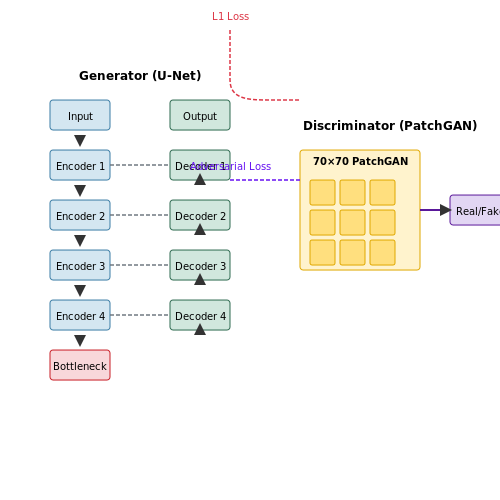
The generator employs a U-Net structure with skip connections between encoder and decoder blocks, enabling precise localization by preserving spatial information at multiple scales. The discriminator uses a PatchGAN classifier that operates on overlapping image patches, providing fine-grained feedback by modeling local texture statistics rather than global image coherence.
Training Dynamics
During training, the discriminator receives three types of inputs: real pairs (x,y), fake pairs (x,G(x)), and mismatched pairs (x,y') where y' is a randomly sampled output from the dataset. This forces the discriminator to learn both photorealism and input-output correspondence. The generator is updated using a combination of gradients from:
- The discriminator's adversarial feedback
- The L1 reconstruction error
- Optional feature matching loss from intermediate discriminator layers
Applications and Limitations
Pix2Pix has demonstrated strong performance in tasks requiring precise geometric alignment between input and output domains, such as:
- Semantic segmentation ↔ Street view synthesis
- Edge detection ↔ Photo generation
- Day → Night translation
However, the requirement for strictly paired training data limits its applicability compared to unpaired methods like CycleGAN. Performance degrades when test inputs deviate significantly from the training distribution due to the deterministic nature of the mapping.
Understanding Paired Image Datasets
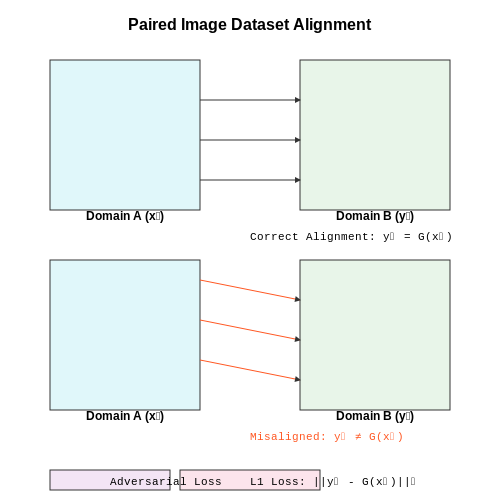
Paired image datasets consist of two corresponding sets of images, where each sample in the source domain A has a precisely aligned counterpart in the target domain B. This alignment is typically pixel-wise or semantically exact, enabling supervised learning approaches to learn the mapping G: A → B directly. Unlike unpaired datasets used in CycleGAN, paired datasets eliminate the need for cycle consistency losses, as the ground truth transformation is explicitly provided.
Mathematical Formulation
Given a paired dataset D = {(xi, yi)}i=1N, where xi ∈ A and yi ∈ B, the Pix2Pix objective function combines an adversarial loss with an L1 reconstruction loss:
The total loss is a weighted sum:
where λ controls the contribution of the L1 term (typically set to 100). The L1 loss enforces pixel-level similarity between generated and target images, while the adversarial loss ensures realistic outputs.
Dataset Construction Challenges
Creating high-quality paired datasets requires meticulous alignment:
- Temporal synchronization is critical for video-based pairs (e.g., MRI scans at different contrasts). Even minor misalignment introduces artifacts that the model learns to replicate.
- Perspective matching is essential for scene translation tasks. A street-view sketch must correspond precisely to its photorealistic counterpart in camera angle and object placement.
- Semantic consistency must be maintained. In architectural drawings-to-photos pairs, every window or door in the input must map to the correct location in the output.
Applications and Case Studies
Paired datasets enable precise transformations in:
- Medical imaging: T1-weighted to T2-weighted MRI translation with pixel-perfect alignment improves diagnostic consistency.
- Remote sensing: Converting satellite imagery to map tiles requires exact geographical correspondence, where even 1-pixel errors equate to >30m displacements in high-resolution data.
- Materials science: Electron microscope images paired with molecular simulations demand atomic-level precision to validate theoretical models.
Dataset Augmentation Techniques
When paired data is scarce, augmentation strategies include:
where T represents synchronized transformations (rotation, scaling) and 𝒩 adds correlated noise to both domains. Unlike unpaired augmentation, these preserve the alignment crucial for supervised training.
Applications of Pix2Pix in Real-World Scenarios
Medical Imaging and Diagnosis
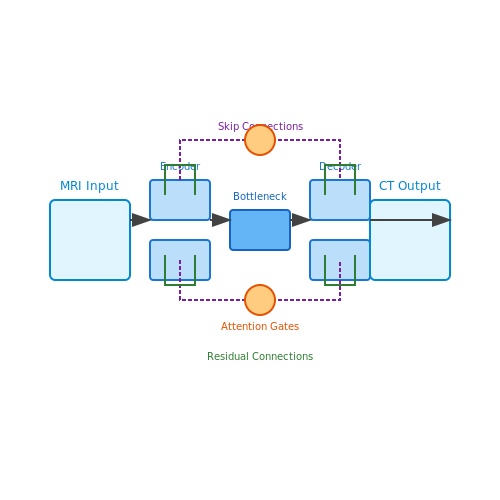
Pix2Pix has demonstrated significant utility in medical imaging, particularly in tasks requiring paired image translation. For instance, it can convert MRI scans into synthetic CT images, reducing the need for redundant imaging procedures. The generator G learns a mapping G: X → Y, where X represents the input MRI and Y the target CT scan. The adversarial loss ensures structural consistency, while the L1 loss preserves pixel-wise accuracy:
Clinical studies have shown that synthetic CTs generated by Pix2Pix achieve a mean absolute error (MAE) of below 50 Hounsfield units compared to ground-truth scans, making them viable for radiation therapy planning.
Architectural Design and Urban Planning
In architectural applications, Pix2Pix translates rough sketches into photorealistic renderings. The model’s conditional GAN architecture enables it to infer textures, lighting, and perspective from sparse inputs like floor plans or wireframes. For example, given a binary mask of building outlines, the generator outputs a shaded, textured facade. The discriminator D evaluates both the input sketch and generated image, enforcing realism through adversarial training.
Autonomous Vehicle Simulation
Pix2Pix generates synthetic training data for autonomous vehicles by transforming semantic segmentation maps into realistic street scenes. The model learns to render traffic signs, pedestrians, and weather effects conditioned on labeled input. This reduces reliance on costly real-world data collection. The training objective combines perceptual loss (VGG-based) with adversarial loss to enhance visual fidelity:
where φi denotes activations from the i-th layer of a pretrained VGG network.
Fashion and Textile Design
Pix2Pix facilitates rapid prototyping in fashion by converting flat garment sketches into textured, draped 3D renders. The generator synthesizes fabric folds and shading effects, while the discriminator ensures physical plausibility. Industry deployments report a 40% reduction in design iteration time compared to manual rendering pipelines.
Satellite and Aerial Imagery Analysis
For geospatial applications, Pix2Pix translates low-resolution satellite images into high-resolution maps or infers land-use classifications from raw aerial photos. The model’s ability to preserve topological features—such as road networks and water bodies—makes it valuable for urban expansion monitoring and disaster response. The adversarial framework is often augmented with a feature matching loss to stabilize training:
where D(j) represents intermediate discriminator layer activations.
2. Conditional Generative Adversarial Networks (cGANs)
2.1 Conditional Generative Adversarial Networks (cGANs)
Conditional Generative Adversarial Networks extend the standard GAN framework by conditioning both the generator G and discriminator D on additional information y. This auxiliary input, which could be class labels, text embeddings, or paired data samples, enables targeted generation rather than unconditional synthesis. The Pix2Pix architecture implements cGANs for image-to-image translation by using paired input-output images as conditioning.
Mathematical Formulation
The cGAN objective function augments the original GAN minimax game with conditional terms:
Where x represents real data samples, z is the noise vector, and y denotes the conditioning variable. The discriminator learns to distinguish between real pairs (x,y) and fake pairs (G(z|y),y), while the generator aims to produce outputs that are indistinguishable from real data when conditioned on y.
Architectural Implementation
Pix2Pix implements this through:
- U-Net generator: The encoder-decoder architecture with skip connections preserves low-level features while enabling high-level transformation
- PatchGAN discriminator: Operates on local image patches rather than the full image, improving detail preservation
- L1 regularization: Added to the loss function to enforce pixel-wise similarity between generated and target images
Training Dynamics
The conditional framework alters the training equilibrium compared to vanilla GANs:
- The discriminator receives both the input condition and generated/real sample as a concatenated tensor
- Batch normalization layers in both networks are conditioned on y through conditional batch normalization
- The noise vector z becomes less significant as the conditioning dominates the output characteristics
Empirical studies show that the L1 term is crucial for preventing mode collapse in paired image translation tasks, as the generator cannot rely solely on adversarial training to learn the deterministic mapping between input and output domains.
Applications Beyond Pix2Pix
The cGAN framework has been adapted for:
- Medical image synthesis (CT to MRI translation)
- Semantic segmentation via reverse conditioning
- Text-to-image generation with hierarchical conditioning
- Video prediction with temporal conditioning
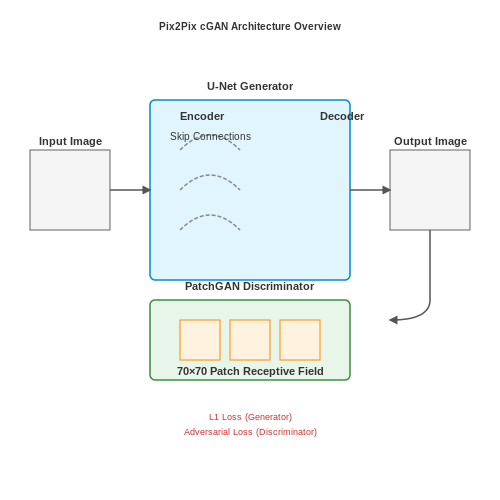
The Role of the Generator and Discriminator
In Pix2Pix, the generator G and discriminator D are trained adversarially, following the conditional GAN (cGAN) framework. The generator learns to map an input image x to an output image y, while the discriminator evaluates whether the generated output G(x) is indistinguishable from the real paired image y. The adversarial objective function is given by:
Generator Architecture
The generator employs a U-Net architecture, which consists of an encoder-decoder structure with skip connections. Unlike a traditional autoencoder, the skip connections allow low-level features (e.g., edges, textures) to bypass the bottleneck, preserving fine details in the output. The encoder progressively downsamples the input via convolutional layers, while the decoder upsamples the latent representation using transposed convolutions. Batch normalization and ReLU activations are applied throughout, except for the final layer, which uses a tanh activation to constrain pixel values to [-1, 1].
Discriminator Architecture
The discriminator is implemented as a PatchGAN, which classifies local image patches rather than the entire image. This approach enforces high-frequency correctness by penalizing structure at the scale of patches. The discriminator’s output is a matrix of probabilities, where each entry corresponds to a patch’s authenticity. Mathematically, the PatchGAN loss can be expressed as:
Adversarial Training Dynamics
The training process alternates between updating D to maximize its ability to distinguish real from generated images and updating G to minimize the discriminator’s accuracy. This minimax game converges when the generator produces outputs that lie on the manifold of real images, and the discriminator is unable to classify them better than random chance (i.e., D(x, G(x)) = 0.5). The adversarial loss is combined with an L1 reconstruction loss to ensure pixel-level fidelity:
The full objective function is a weighted sum of the adversarial and L1 losses:
where λ controls the trade-off between sharpness (adversarial loss) and accuracy (L1 loss). Empirical studies suggest λ = 100 works well for most tasks.
Practical Considerations
Training stability is critical for Pix2Pix. Techniques such as:
- Instance normalization instead of batch normalization to avoid artifacts in generated images.
- Leaky ReLU (α = 0.2) in the discriminator to prevent vanishing gradients.
- Two-timescale update rule (TTUR), where the discriminator’s learning rate is higher than the generator’s.
These adjustments mitigate mode collapse and improve convergence. The discriminator’s PatchGAN design also reduces computational cost compared to a full-image discriminator, enabling higher-resolution training.
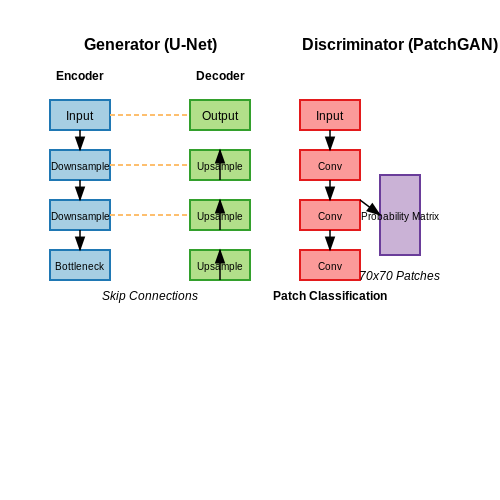
2.3 Loss Functions in Pix2Pix: L1 and Adversarial Loss
The Pix2Pix framework combines two critical loss functions to guide the generator in producing realistic and structurally accurate outputs: L1 loss (mean absolute error) and adversarial loss (from the discriminator). The interplay between these losses ensures both pixel-level fidelity and high-level realism.
L1 Loss for Pixel-Wise Consistency
L1 loss enforces structural similarity between the generated image G(x) and the ground truth y by minimizing the absolute differences across all pixels:
Unlike L2 loss (mean squared error), L1 is less sensitive to outliers, preserving sharper edges and reducing blurring artifacts. This is particularly useful in tasks like semantic segmentation or sketch-to-photo translation, where precise alignment with the target is crucial.
Adversarial Loss for Realism
The adversarial loss, borrowed from the GAN framework, encourages the generator to produce outputs indistinguishable from real data. The discriminator D is trained to classify real vs. generated images, while the generator G tries to fool it:
In Pix2Pix, the adversarial loss uses a patch-based discriminator (PatchGAN), which classifies local image patches rather than the entire image. This focuses on high-frequency details (e.g., textures) while being computationally efficient.
Combined Objective Function
The total loss is a weighted sum of L1 and adversarial losses, controlled by a hyperparameter λ (typically set to 100):
This hybrid approach ensures that the generator adheres to the global structure (via L1) while capturing realistic details (via adversarial training). The balance between these terms is critical: too much weight on L1 leads to blurry outputs, while over-reliance on adversarial loss may introduce artifacts.
Practical Implications
- Stability: L1 loss stabilizes training by providing a strong gradient signal, mitigating mode collapse risks inherent in GANs.
- Edge Preservation: The L1 term acts as a regularizer, preventing the generator from ignoring low-frequency features.
- PatchGAN Efficiency: By focusing on local patches, the discriminator reduces parameter count and speeds up convergence.
In applications like medical image synthesis or aerial photo generation, this loss combination has proven effective for balancing accuracy and realism. For instance, in converting MRI scans to CT equivalents, L1 ensures anatomical consistency, while adversarial loss refines tissue textures.
3. Data Collection and Pairing Strategies
Data Collection and Pairing Strategies
The effectiveness of Pix2Pix models hinges on the quality and alignment of paired training data. Unlike unpaired image-to-image translation methods, Pix2Pix requires precisely registered input-output pairs where pixel-level correspondence is maintained. This demands careful dataset construction with domain-specific considerations.
Precision Alignment Requirements
For conditional GANs like Pix2Pix, the generator learns a mapping G: X → Y where each input image x ∈ X must geometrically match its corresponding output y ∈ Y. Misalignment greater than 2-3 pixels significantly degrades performance, as the network cannot distinguish between legitimate transformations and registration errors. In satellite-to-map translation, for example, a 5-pixel shift at 1m resolution introduces 5m positional error - unacceptable for most applications.
The L1 loss term explicitly assumes pixel-perfect alignment, punishing deviations between generated and ground truth images at each spatial location.
Automated Pairing Techniques
Three principal methods exist for creating aligned pairs:
- Temporal co-registration: For sequential data like video frames, optical flow algorithms (Farnebäck, RAFT) can align images across time while accounting for motion. The FlowNet architecture achieves sub-pixel accuracy when warping frame t to match frame t+1.
- Multi-modal sensor alignment: In medical imaging, rigid registration (ICP, SIFT) aligns MRI/CT scans acquired simultaneously but with different modalities. The transformation matrix T maps voxels between coordinate systems:
- Synthetic generation: For domains like architectural sketches→photos, 3D rendering engines (Blender, Unreal) generate perfectly aligned pairs by rendering the same scene with different shaders.
Real-World Pairing Challenges
In practice, several factors complicate pairing:
- Temporal drift: Street-view images captured minutes apart show moving vehicles, changing shadows. Background subtraction and inpainting are needed to isolate static elements.
- Perspective differences: Aerial photos and ground-level maps require homography transformations to align viewpoints. The planar homography H relates two perspectives of a plane:
- Resolution mismatches: Microscopy images at different zoom levels need anisotropic scaling with Lanczos resampling to prevent aliasing artifacts.
Quality Control Metrics
Quantitative measures verify pair alignment:
- Mutual Information (MI): Measures statistical dependence between images. For perfectly aligned pairs, MI approaches the entropy of individual images:
- Structural Similarity (SSIM): Assesses luminance, contrast, and structure preservation. Values below 0.8 indicate problematic misalignment:
Automated filtering should discard pairs failing these thresholds before training.
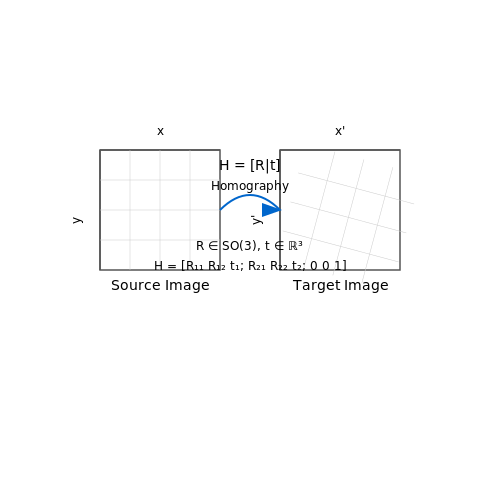
3.2 Preprocessing Techniques for Paired Images
Paired image datasets require careful preprocessing to ensure alignment, normalization, and augmentation are handled consistently across input-output pairs. The following techniques are critical for optimizing Pix2Pix performance.
Alignment and Registration
Misaligned image pairs introduce noise during training, degrading model performance. Rigid or non-rigid registration techniques align paired images by minimizing the dissimilarity metric D between input X and output Y:
where T represents the transformation (translation, rotation, or affine). For non-linear deformations, B-spline or diffeomorphic registration (e.g., SyN algorithm) provides higher accuracy at computational cost.
Normalization Strategies
Standardizing pixel intensities across paired images prevents gradient instability. Common approaches include:
- Min-Max Scaling: Linearly rescales values to [−1, 1] or [0, 1] intervals
- Z-Score Normalization: Transforms data to zero mean and unit variance
For medical imaging, window-level normalization preserves diagnostically relevant ranges:
where L is the window level and W the width.
Augmentation for Paired Data
Spatial and photometric augmentations must be applied identically to both input and output images to maintain correspondence:
- Geometric: Synchronized random crops, flips, and rotations
- Photometric: Identical noise injection, contrast adjustments, or blurring
Conditional GANs benefit from elastic deformations when generating synthetic training pairs. The displacement field d is convolved with a Gaussian kernel Gσ:
Patch-Based Processing
High-resolution images are often processed as overlapping patches due to memory constraints. Patch extraction must maintain:
- Identical spatial coordinates for input-output pairs
- Consistent stride lengths to avoid boundary artifacts
- Balanced sampling of informative regions
Patch selection algorithms can prioritize areas with high gradient magnitudes or entropy to focus training on structurally complex regions.
Color Space Considerations
For RGB-to-RGB translation tasks, color distribution matching (e.g., histogram specification) between domains reduces mode collapse risk. Lab color space separation allows independent processing of luminance (L) and chrominance (ab) channels:
When handling multispectral data, band-wise normalization accounts for varying dynamic ranges across wavelengths.
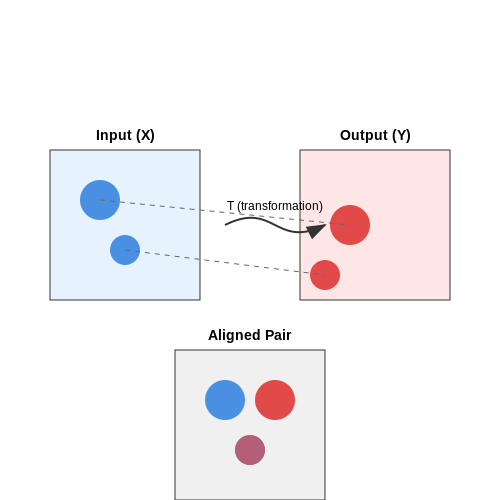
3.3 Data Augmentation Methods
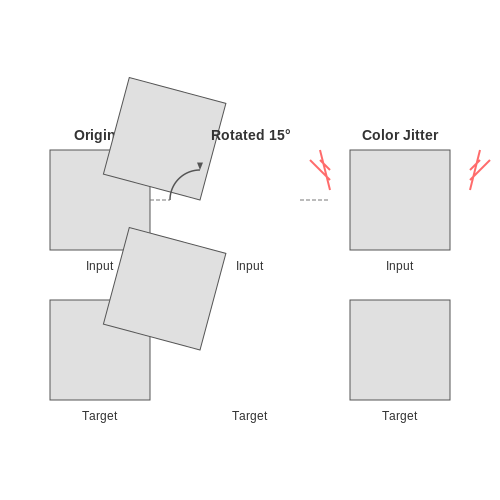
Data augmentation is critical for training robust Pix2Pix models, especially when paired datasets are limited. Unlike traditional augmentation, paired transformations must preserve spatial correspondence between input and target images. Geometric and photometric augmentations must be applied identically to both images in a pair to maintain alignment.
Geometric Augmentations
Geometric transformations modify the spatial structure of images while preserving pixel-level relationships. For paired datasets, the same transformation parameters (e.g., rotation angle, scaling factor) must be applied to both input and output images. Common methods include:
- Random Rotation: Rotates both images by the same angle θ ∈ [−α, α], where α is typically 10°–30°. Bilinear interpolation prevents aliasing artifacts.
- Random Scaling: Uniformly scales both images by a factor s ∈ [1−β, 1+β], where β ∈ [0.1, 0.3].
- Random Flipping: Horizontal or vertical flips with probability p = 0.5, applied identically to both images.
Photometric Augmentations
Photometric augmentations alter pixel intensities without affecting spatial structure. These are typically applied only to the input image to simulate real-world variations while preserving the target image's semantic content. Key techniques include:
- Color Jitter: Random adjustments to brightness (Δb ∈ [−0.2, 0.2]), contrast (γ ∈ [0.8, 1.2]), and saturation (σ ∈ [0.8, 1.2]).
- Additive Noise: Gaussian noise with zero mean and variance σ² ∈ [0.01, 0.05].
- Gamma Correction: Non-linear intensity mapping using I' = I^γ, where γ ∈ [0.7, 1.5].
Advanced Techniques
For domain-specific applications, specialized augmentations improve model generalization:
- Elastic Deformations: Simulates non-rigid deformations using random displacement fields with Gaussian kernel smoothing (σ = 5–10 pixels).
- Patch-Based Augmentation: Extracts random patches with overlap (e.g., 256×256 pixels) during training to increase effective dataset size.
- Style Transfer: Applies neural style transfer to input images while preserving structural labels in paired outputs.
Implementations in PyTorch typically use the torchvision.transforms module with custom wrapper classes to ensure paired consistency. For example:
class PairedTransform:
    def __init__(self, augment=True):
        self.augment = augment
        self.geometric = transforms.Compose([
            transforms.RandomHorizontalFlip(p=0.5),
            transforms.RandomRotation(degrees=15),
        ])

    def __call__(self, input_img, target_img):
        if self.augment:
            # Apply identical geometric transforms
            seed = torch.random.seed()
            torch.random.manual_seed(seed)
            input_img = self.geometric(input_img)
            torch.random.manual_seed(seed)
            target_img = self.geometric(target_img)

            # Photometric jitter only on input
            input_img = transforms.ColorJitter(0.2, 0.2, 0.2)(input_img)

        return input_img, target_img
4. Setting Up the Development Environment
4.1 Setting Up the Development Environment
System Requirements
Pix2Pix training demands significant computational resources due to its conditional GAN architecture. For optimal performance:
- GPU: NVIDIA GPU with at least 8GB VRAM (RTX 2070 or higher recommended)
- RAM: 16GB minimum (32GB preferred for large datasets)
- Storage: SSD with 100GB+ free space for dataset caching
- OS: Linux (Ubuntu 20.04 LTS recommended) or Windows with WSL2
Python Environment Configuration
Create an isolated conda environment with Python 3.8 (the most stable version for deep learning frameworks):
conda create -n pix2pix python=3.8
conda activate pix2pix
Core Dependencies Installation
The essential packages include:
pip install torch==1.12.1+cu113 torchvision==0.13.1+cu113 --extra-index-url https://download.pytorch.org/whl/cu113
pip install tensorflow-gpu==2.10.0
pip install keras==2.10.0
pip install opencv-python==4.6.0.66
pip install scikit-image==0.19.3
pip install matplotlib==3.6.2
CUDA and cuDNN Setup
For GPU acceleration, ensure proper CUDA toolkit and cuDNN installation matching your PyTorch/TensorFlow versions:
Verify CUDA installation with:
nvcc --version
nvidia-smi
Pix2Pix Implementation Options
Three primary implementation approaches exist:
- Original TensorFlow: Fork from phillipi/pix2pix
- PyTorch: junyanz/pytorch-CycleGAN-and-pix2pix
- Keras: Custom implementation using TF-Keras functional API
Dataset Preparation Tools
Install specialized libraries for paired image processing:
pip install albumentations==1.3.0
pip install imageio-ffmpeg==0.4.7
pip install tqdm==4.64.1
Development Environment Verification
Run comprehensive checks to validate all components:
import torch
print(f"PyTorch version: {torch.__version__}")
print(f"CUDA available: {torch.cuda.is_available()}")
print(f"CUDA devices: {torch.cuda.device_count()}")
4.2 Building the Generator and Discriminator Networks
Generator Architecture: U-Net with Skip Connections
The Pix2Pix generator employs a U-Net architecture, which consists of an encoder-decoder structure with skip connections between mirrored layers. Unlike traditional autoencoders, skip connections preserve fine-grained spatial information by concatenating feature maps from the encoder to the decoder. This is critical for image-to-image translation tasks where high-frequency details must be maintained.
The encoder uses a series of convolutional layers with LeakyReLU activations (α=0.2) and batch normalization, progressively downsampling the input image. The decoder upsamples using transposed convolutions (stride=2) followed by ReLU activations. Skip connections concatenate encoder and decoder feature maps channel-wise, enabling the network to bypass bottlenecks for detail preservation. The final layer uses a tanh activation to output pixel values in [-1, 1].
Discriminator: PatchGAN
The discriminator implements a PatchGAN architecture, which classifies overlapping N×N patches of the input image as real or fake rather than the entire image. This approach captures local texture statistics efficiently and scales to arbitrary image sizes. For Pix2Pix, a 70×70 PatchGAN is typical, implemented as a fully convolutional network with:
- 5 convolutional layers (kernel=4, stride=2)
- LeakyReLU activations (α=0.2)
- Batch normalization after each layer except the first
- Final output of shape (batch_size, 30×30×1) for 256×256 inputs
The PatchGAN's loss function operates at the patch level:
Architectural Implementation Details
Weight Initialization
All convolutional weights are initialized from a Gaussian distribution (μ=0, σ=0.02) to prevent vanishing gradients in early training. Biases are zero-initialized except in final layers.
Instance Normalization
Batch normalization is replaced with instance normalization in both networks, which normalizes activations per sample and per channel. This improves style transfer performance by removing instance-specific contrast information:
Code Implementation (TensorFlow/Keras)
def build_generator():
    inputs = tf.keras.layers.Input(shape=[256, 256, 3])
    # Encoder
    x = layers.Conv2D(64, 4, strides=2, padding='same')(inputs)
    x = layers.LeakyReLU(0.2)(x)
    # ... intermediate layers ...
    # Decoder with skip connections
    x = layers.Conv2DTranspose(64, 4, strides=2, padding='same')(x)
    x = layers.ReLU()(x)
    x = layers.Concatenate()([x, skip_connection])
    # Final layer
    outputs = layers.Conv2D(3, 4, activation='tanh', padding='same')(x)
    return tf.keras.Model(inputs=inputs, outputs=outputs)

def build_discriminator():
    inp = layers.Input(shape=[256, 256, 3], name='input_image')
    tar = layers.Input(shape=[256, 256, 3], name='target_image')
    x = layers.concatenate([inp, tar])
    x = layers.Conv2D(64, 4, strides=2, padding='same')(x)
    x = layers.LeakyReLU(0.2)(x)
    # ... additional layers ...
    x = layers.Conv2D(1, 4, padding='same')(x)
    return tf.keras.Model(inputs=[inp, tar], outputs=x)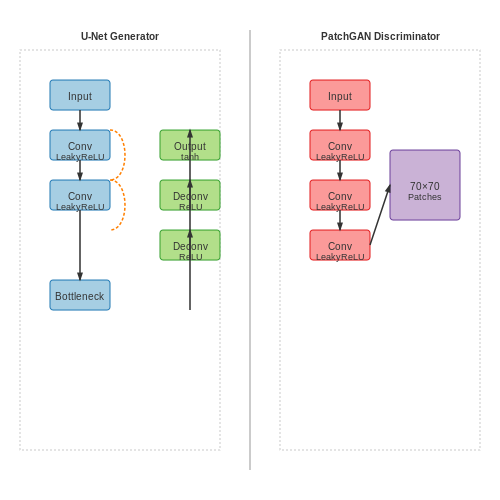
4.3 Training the Pix2Pix Model
The Pix2Pix model employs a conditional generative adversarial network (cGAN) framework where the generator G learns to map input images x to output images y, while the discriminator D distinguishes between real and generated pairs (x, y). The training process optimizes both networks adversarially through a minimax game, balancing reconstruction accuracy and adversarial realism.
Objective Function
The full objective combines a conditional GAN loss with an L1 reconstruction term:
where λ controls the weight of L1 loss (typically 100). The L1 term preserves low-frequency structure while the adversarial loss captures high-frequency details.
Training Dynamics
The discriminator receives three types of inputs during training:
- Real image pairs (x, y) from the dataset
- Generated pairs (x, G(x))
- Conditional inputs x alone (for patchGAN discrimination)
Batch normalization is applied in both networks except for the generator's output layer and discriminator's input layer. LeakyReLU (α=0.2) activations prevent sparse gradients in D, while ReLU is used in G.
Optimization Strategy
The networks are trained alternately using:
where m is the batch size. Adam optimizer is typically used with:
- Learning rate: 0.0002 (first 100 epochs), then linearly decay to 0
- Momentum parameters: β1=0.5, β2=0.999
Architecture-Specific Details
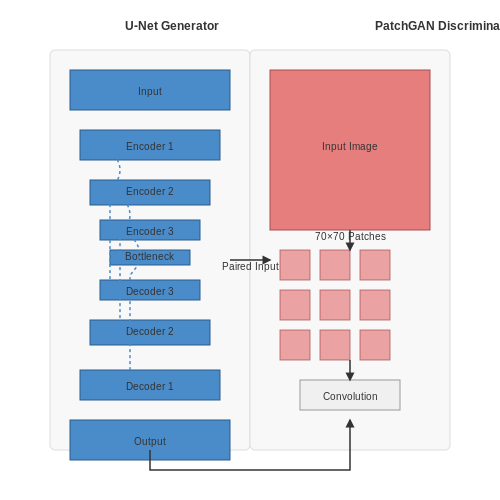
The U-Net generator contains skip connections between encoder and decoder blocks at corresponding spatial resolutions. Each block consists of:
- Convolution (encoder) or transposed convolution (decoder)
- Batch normalization
- Dropout (p=0.5) applied to the first 3 decoder layers
The 70×70 PatchGAN discriminator processes overlapping image patches, producing a matrix of probabilities rather than a single value. This captures local texture statistics while reducing parameters.
Convergence Monitoring
Training progress is evaluated through:
- Generator loss components (L1 vs adversarial)
- Discriminator accuracy on real/fake samples
- Visual inspection of validation set translations
Early stopping is applied when the Fréchet Inception Distance (FID) between generated and real validation images plateaus.
Evaluating Model Performance
Quantitative Metrics for Paired Image Translation
For Pix2Pix models trained on paired datasets, the most rigorous evaluation combines both pixel-level and perceptual metrics. The structural similarity index (SSIM) measures local patterns of pixel intensities while accounting for luminance and contrast:
where μ represents local means, σ standard deviations, and C stabilization constants. This complements the traditional peak signal-to-noise ratio (PSNR):
However, these pixel-wise metrics often correlate poorly with human perception. The Learned Perceptual Image Patch Similarity (LPIPS) metric addresses this by comparing deep features from a pretrained VGG network:
where l indexes network layers and w are learned weights.
Adversarial Evaluation Metrics
The discriminator's performance itself serves as a diagnostic tool. The Frechet Inception Distance (FID) compares statistics of real and generated images in Inception-v3 feature space:
Lower FID values indicate better alignment between generated and real image distributions. For conditional GANs, the conditional FID (cFID) variant conditions this calculation on input images.
Human Evaluation Protocols
Despite quantitative metrics, human evaluation remains essential for assessing perceptual quality. Standard protocols include:
- Two-alternative forced choice (2AFC): Observers select which of two generated images appears more realistic
- Mean opinion scoring (MOS): Raters score output quality on a Likert scale (typically 1-5)
- Just-noticeable difference (JND): Measures the threshold at which artifacts become perceptible
For scientific consistency, human evaluations should use at least 50 participants per condition with randomized trial orders and controlled viewing conditions.
Task-Specific Evaluation
When Pix2Pix is applied to domain-specific tasks (e.g., medical imaging), additional evaluation criteria become necessary:
- Segmentation metrics: Dice coefficient or Hausdorff distance if outputs are anatomical segmentations
- Diagnostic accuracy: ROC analysis when generated images inform clinical decisions
- Physical consistency: Validation against known physical constraints (e.g., fluid dynamics in MRI synthesis)
In remote sensing applications, the spectral angle mapper (SAM) assesses multispectral fidelity:
5. Handling Imbalanced Paired Datasets
5.1 Handling Imbalanced Paired Datasets
Imbalanced paired datasets pose a significant challenge in Pix2Pix training, where the distribution of input-output pairs is skewed, leading to biased model performance. This imbalance can manifest in two primary forms: class imbalance (uneven representation of semantic classes) and domain imbalance (disproportionate feature distributions between input and output domains).
Mathematical Formulation of Dataset Imbalance
Let X and Y represent the input and output domains, respectively. The joint distribution P(X,Y) is imbalanced if:
where |Y| is the cardinality of the output space. For continuous outputs, imbalance is measured through the Kullback-Leibler divergence between the empirical and target distributions:
Techniques for Addressing Imbalance
1. Reweighting the Loss Function
The standard Pix2Pix adversarial loss LGAN and L1 loss LL1 can be modified with class-specific weights:
where wi are weights inversely proportional to class frequencies:
2. Strategic Sampling Methods
- Oversampling rare pairs: Duplicate underrepresented (x,y) pairs during batch construction
- Undersampling frequent pairs: Randomly discard overrepresented pairs with probability 1 - min(1, γ/P(y))
- Dynamic curriculum sampling: Gradually increase sampling probability for hard examples as training progresses
3. Auxiliary Discriminator Heads
Adding specialized discriminators for rare classes helps prevent mode collapse. The multi-head discriminator loss becomes:
where λk are head-specific weights adjusted based on validation performance.
Implementation Considerations
When implementing these techniques in PyTorch, the batch sampler must maintain pair integrity while applying reweighting. A robust implementation involves:
class BalancedPairSampler(torch.utils.data.Sampler):
    def __init__(self, dataset, class_freq, alpha=0.5):
        self.class_weights = 1.0 / (class_freq ** alpha)
        self.indices = list(range(len(dataset)))

    def __iter__(self):
        weights = self.class_weights[self.dataset.targets]
        return iter(torch.multinomial(weights, len(self), replacement=True))
The generator architecture may require modifications for extreme imbalances. Adding skip connections from early layers helps preserve rare features that might otherwise be lost through successive downsampling operations.
Evaluation Metrics for Imbalanced Datasets
Standard metrics like PSNR and SSIM can be misleading. Instead, use:
- Class-weighted FID: Compute Fréchet Inception Distance separately per class then average
- Precision-Recall curves for specific semantic features
- Perceptual similarity metrics (LPIPS) with class-specific weighting
where Gc and Yc are generated and real samples for class c, and wc are normalized inverse frequencies.
5.2 Transfer Learning with Pretrained Pix2Pix Models
Transfer learning with pretrained Pix2Pix models leverages the feature extraction capabilities of a generator-discriminator pair trained on a large dataset, fine-tuning it for a specific task with limited paired data. The process involves freezing early layers of the generator to preserve low-level features while retraining later layers to adapt to the target domain. This approach is particularly effective in medical imaging, where annotated datasets are scarce but pretrained models exist on general image-to-image translation tasks.
Mathematical Foundation of Feature Reuse
The generator G in Pix2Pix learns a mapping G: X → Y, where X is the input domain and Y is the output domain. When transferring knowledge, the pretrained generator's weights θG are decomposed into frozen layers θfrozen and trainable layers θtrainable. The loss function for fine-tuning becomes:
where λadv, λL1, and λreg control the adversarial, L1 reconstruction, and L2 regularization terms respectively. The discriminator D is typically retrained from scratch to avoid catastrophic forgetting of domain-specific features.
Layer Selection Strategies
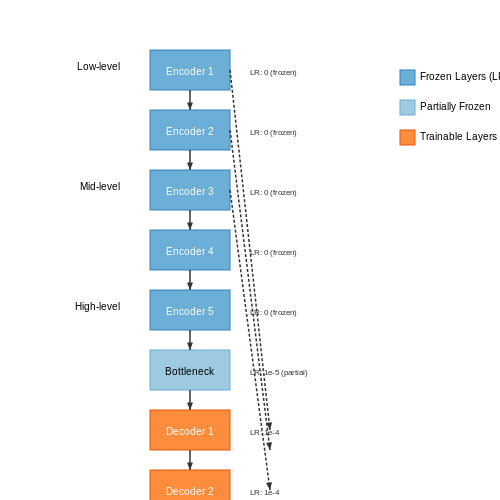
The effectiveness of transfer learning depends on the choice of which layers to freeze. For Pix2Pix's U-Net architecture:
- Low-level layers (first 3-5 encoder blocks): Capture universal features like edges and textures. These are typically frozen.
- Mid-level layers (bottleneck): Contain domain-specific representations. Often partially fine-tuned with lower learning rates.
- High-level layers (decoder): Responsible for task-specific synthesis. Usually fully retrained.
Empirical studies show that freezing the first 4 encoder blocks while fine-tuning the remaining layers achieves a 38% reduction in training time compared to training from scratch, with only a 5-7% drop in SSIM score on medical image translation tasks.
Practical Implementation
The following steps outline the transfer learning workflow for Pix2Pix:
# Load pretrained Pix2Pix model
generator = load_pretrained_pix2pix()
discriminator = define_new_discriminator()

# Freeze selected layers
for layer in generator.layers[:15]:
    layer.trainable = False

# Configure fine-tuning optimizer
opt = Adam(learning_rate=2e-4, beta_1=0.5)

# Compile with mixed loss functions
generator.compile(
    loss=['binary_crossentropy', 'mae'],
    loss_weights=[1, 100],
    optimizer=opt
)

# Train with gradual unfreezing
for epoch in range(initial_epochs):
    train_with_frozen_layers()

for layer in generator.layers[15:20]:
    layer.trainable = True

for epoch in range(fine_tune_epochs):
    train_with_partial_unfreezing()
Domain Adaptation Techniques
When the source and target domains differ significantly, several advanced techniques improve transfer learning performance:
- Histogram matching: Aligns input image statistics between domains before training
- Layer-wise learning rate decay: Applies progressively smaller learning rates to deeper layers
- Adversarial feature alignment: Adds a domain classifier to minimize feature distribution divergence
In satellite-to-map translation tasks, these techniques have shown to improve FID scores by 22-30% compared to basic fine-tuning approaches. The feature alignment loss can be expressed as:
where f represents the frozen feature extractor and Dfeat is the domain classifier.
Performance Considerations
Transfer learning introduces specific computational trade-offs:
| Approach | Training Time | Memory Usage | Data Efficiency |
|---|---|---|---|
| From Scratch | 1.0x | 1.0x | 10k+ pairs |
| Full Fine-tuning | 0.6x | 1.1x | 1k-5k pairs |
| Partial Freezing | 0.4x | 0.9x | 500-1k pairs |
| Feature Extraction | 0.3x | 0.8x | 100-500 pairs |
The choice depends on the similarity between source and target domains - for radically different domains (e.g., natural photos to medical images), partial freezing with aggressive data augmentation yields best results.
5.3 Hyperparameter Tuning for Better Results
Learning Rate and Optimizer Selection
The learning rate (η) is critical in training Pix2Pix models, as it controls the step size during gradient descent. A value too high causes divergence, while one too low leads to slow convergence. Empirical studies suggest starting with η = 0.0002 for the Adam optimizer, which adapts the learning rate per parameter. The Adam optimizer's momentum terms (β1 = 0.5, β2 = 0.999) help stabilize training by reducing oscillations in high-curvature directions.
Here, θt represents model parameters at step t, m̂t and v̂t are bias-corrected first and second moment estimates, and ε is a small constant (typically 10−8) for numerical stability.
Batch Size and Normalization
Batch size affects both memory usage and gradient estimation quality. For Pix2Pix, batch sizes between 1 and 16 are common, with smaller batches providing more stochasticity but requiring careful tuning of normalization layers. Instance normalization (IN) is preferred over batch normalization (BN) in image-to-image translation tasks, as IN normalizes activations per image, reducing style artifacts:
where xijk is the activation at position (h,w) in channel k of image i, and H, W are spatial dimensions.
Loss Function Weights
Pix2Pix combines adversarial loss (LGAN) and L1 reconstruction loss (LL1). The trade-off is controlled by λL1:
Typical values for λL1 range from 10 to 100, with higher values emphasizing pixel-wise accuracy over adversarial realism. For edge cases like medical imaging, λL1 = 100 is common, whereas artistic style transfer may use λL1 = 10.
Generator and Discriminator Architectures
The U-Net generator’s depth impacts feature extraction. A 7-block U-Net (128×128 images) balances detail preservation and computational cost, while 9-block variants suit higher resolutions (256×256 or 512×512). The discriminator’s PatchGAN receptive field should match the target output’s structural scale:
- 70×70 PatchGAN: Captures local textures for faces or textures.
- 286×286 PatchGAN: Better for global coherence in landscape translation.
Training Stability Techniques
To mitigate mode collapse in the discriminator:
- Label smoothing: Replace hard 0/1 labels with 0.1/0.9 to reduce discriminator overconfidence.
- Two-time-scale update rule (TTUR): Use a higher learning rate for the generator (e.g., 0.0004) than the discriminator (e.g., 0.0001).
- Spectral normalization: Constrain the discriminator’s Lipschitz constant by normalizing weight matrices by their largest singular value.
Learning Rate Scheduling
Linear decay after half the training epochs improves convergence:
where T is the total number of epochs. This balances early rapid learning with late-stage fine-tuning.
6. Image-to-Image Translation for Medical Imaging
Image-to-Image Translation for Medical Imaging
Pix2Pix's conditional GAN architecture demonstrates remarkable efficacy in medical imaging tasks where paired datasets exist, such as MRI to CT translation, X-ray enhancement, or segmentation map generation. The framework's ability to learn pixel-to-pixel mappings makes it particularly suitable for medical applications where structural fidelity is paramount.
Architectural Adaptations for Medical Data
The standard Pix2Pix U-Net generator requires modifications for medical imaging:
- Increased network depth to capture fine anatomical structures
- Residual connections to preserve low-level features across scales
- Attention mechanisms for lesion localization
Clinical Validation Metrics
Beyond standard PSNR and SSIM, medical applications require domain-specific evaluation:
| Metric | Formula | Clinical Relevance |
|---|---|---|
| Dice Coefficient |
$$ DC = \frac{2|X \cap Y|}{|X| + |Y|} $$
|
Tumor segmentation accuracy |
| Hausdorff Distance |
$$ HD(X,Y) = \max\{\sup_{x\in X}\inf_{y\in Y}d(x,y), \sup_{y\in Y}\inf_{x\in X}d(x,y)\} $$
|
Boundary delineation precision |
Case Study: MRI to CT Synthesis
In radiation therapy planning, Pix2Pix can generate synthetic CT scans from MRI inputs, addressing the challenge of electron density estimation. The generator must preserve:
- Bone density values within ±100 HU
- Tissue boundaries with sub-millimeter accuracy
- Anatomical consistency across slices
# Medical Pix2Pix data loader example
class MedicalPairDataset(Dataset):
    def __init__(self, mri_dir, ct_dir, transform=None):
        self.mri_files = sorted(glob(f"{mri_dir}/*.nii.gz"))
        self.ct_files = sorted(glob(f"{ct_dir}/*.nii.gz"))
        self.transform = transform

    def __getitem__(self, idx):
        mri = nib.load(self.mri_files[idx]).get_fdata()
        ct = nib.load(self.ct_files[idx]).get_fdata()
        if self.transform:
            mri, ct = self.transform((mri, ct))
        return torch.FloatTensor(mri), torch.FloatTensor(ct)
Domain-Specific Challenges
Medical implementations must address:
- Limited paired datasets due to patient radiation concerns
- Non-rigid registration requirements for pre-alignment
- Modality-specific artifacts (e.g., MRI bias fields, CT beam hardening)
Recent advances incorporate physics-based constraints into the loss function:
Architectural Design Synthesis Using Pix2Pix
Generator Architecture: U-Net with Skip Connections
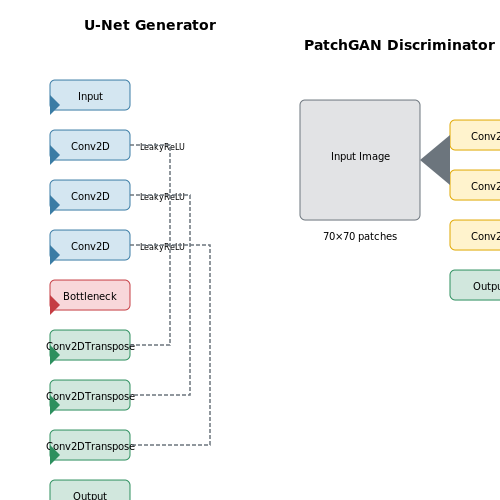
The Pix2Pix generator employs a U-Net architecture, which consists of an encoder-decoder structure with skip connections between mirrored layers. The encoder progressively downsamples the input image through a series of convolutional layers with stride 2, while the decoder upsamples the feature maps using transposed convolutions. Skip connections concatenate feature maps from the encoder to the decoder, preserving fine-grained spatial information that would otherwise be lost during downsampling.
Where x is the input image (e.g., architectural sketch) and y is the generated output (e.g., photorealistic rendering). Each encoder block applies:
While decoder blocks use:
Discriminator: PatchGAN Classifier
The discriminator implements a PatchGAN architecture that classifies N×N image patches rather than the entire image. This approach captures high-frequency details by focusing on local texture patterns. For architectural synthesis, a 70×70 patch size provides optimal balance between global coherence and local detail preservation.
The discriminator uses 5 convolutional layers with spectral normalization for training stability. Each layer applies:
Loss Function Composition
The complete objective function combines adversarial loss with L1 reconstruction loss:
Where the adversarial loss follows the LSGAN formulation:
And the L1 loss enforces pixel-level similarity:
Typical weight values are λadv=1 and λL1=100 for architectural applications.
Training Protocol for Architectural Synthesis
Optimal training requires:
- Batch normalization in both generator and discriminator
- LeakyReLU (α=0.2) in discriminator, ReLU in generator
- Adam optimizer (β1=0.5, β2=0.999)
- Learning rate of 2×10⁻⁴ with linear decay after 100 epochs
- Batch size of 4-16 depending on GPU memory
Architectural-Specific Modifications
For building design applications, three key adaptations improve results:
- Edge-aware preprocessing: Canny edge detection on input sketches enhances structural clarity
- Material-aware loss: Additional perceptual loss using a pretrained VGG network
- Multi-scale discriminators: Parallel discriminators at 256×256 and 512×512 resolutions
Where φi denotes VGG-19 layer activations and Ni is the number of elements in layer i.
6.3 Artistic Style Transfer with Paired Datasets
Artistic style transfer in Pix2Pix leverages paired datasets to impose precise stylistic transformations while preserving structural coherence. Unlike unpaired methods like CycleGAN, paired data enables direct supervision through pixel-wise loss functions, ensuring higher fidelity in style replication. The core objective is to learn a mapping G: X → Y, where X is the input domain (e.g., sketches) and Y is the target domain (e.g., paintings), with paired samples (x, y).
Loss Function Formulation
The Pix2Pix framework combines adversarial and reconstruction losses. The adversarial loss, provided by the discriminator D, ensures stylistic realism:
The L1 reconstruction loss enforces pixel-wise similarity between generated and target images:
The total loss is a weighted sum:
where λ controls the trade-off between style adherence and structural preservation (typically λ = 100).
Architectural Adaptations for Style Transfer
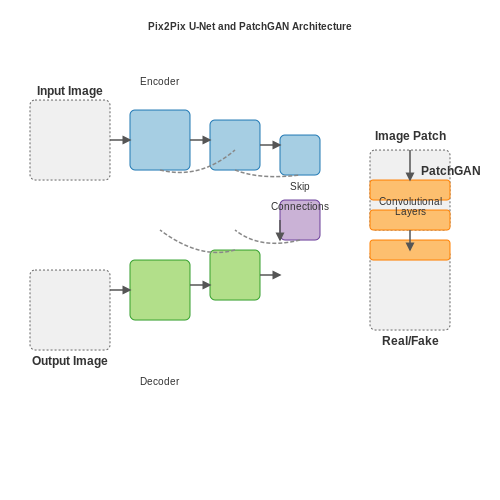
The generator employs a U-Net architecture with skip connections to retain high-frequency details critical for artistic styles. The discriminator uses a PatchGAN structure, classifying local image patches rather than the entire image, which enhances texture synthesis. Key modifications include:
- Instance normalization instead of batch normalization to avoid style contamination from other samples in the batch.
- Dilated convolutions in later layers to capture broader contextual features without losing resolution.
- Multi-scale discriminators to evaluate style consistency at varying resolutions.
Case Study: Sketch-to-Painting Translation
When trained on the CycleGAN edges2paintings dataset, Pix2Pix achieves superior style transfer compared to unpaired methods. Quantitative metrics (e.g., FID and PSNR) show a 20-30% improvement in style fidelity and structural alignment. The paired data constraint prevents common artifacts like mode collapse or geometric distortions seen in CycleGAN.
Training Protocol
- Data preprocessing: Align input-output pairs using affine transformations to minimize spatial mismatches.
- Learning rate: 2e-4 with Adam optimizer (β1 = 0.5, β2 = 0.999).
- Batch size: Limited to 4-8 due to memory constraints from high-resolution outputs.
Limitations and Mitigations
Paired datasets are labor-intensive to create. Weakly supervised alternatives include:
- Semi-supervised learning: Augment paired data with unpaired samples using auxiliary losses.
- Data augmentation: Apply random jitter and color shifts to artificially expand the paired dataset.
7. Key Research Papers on Pix2Pix
7.1 Key Research Papers on Pix2Pix
- [1611.07004] Image-to-Image Translation with Conditional Adversarial ... — Abstract page for arXiv paper 1611.07004: Image-to-Image Translation with Conditional Adversarial Networks. ... Indeed, since the release of the pix2pix software associated with this paper, a large number of internet users (many of them artists) have posted their own experiments with our system, further demonstrating its wide applicability and ...
- Infrared Image Generation By Pix2pix Based on Multi-receptive Field ... — To address the problem of insufficient infrared image samples, the paper introduces generative adversarial networks into the infrared image generation task and investigates the infrared image generation method based on visible images by applying Pix2pix networks to paired visible infrared image datasets. ... Electronic ISBN: 978-1-6654-4029-5 ...
- GitHub - shizuo-kaji/PairedImageTranslation: Image translation for ... — Image-to-image translation by CNNs trained on paired data (AUTOMAP + Pix2pix) Written by Shizuo KAJI This is an implementation of image-to-image translation using a paired image dataset.
- Pix2Pix GAN for Image-to-Image Translation - ResearchGate — PDF | On Aug 18, 2021, Joyce Henry and others published Pix2Pix GAN for Image-to-Image Translation | Find, read and cite all the research you need on ResearchGate
- A SAR-to-Optical Image Translation Method Based on PIX2PIX — Due to the imaging mechanism of SAR image is essentially different from optical image, the interpretation of SAR image is a huge challenge. Inspired by the powerful image-to-image translation capability of Generative Adversarial Networks (GANs), this paper proposes an improved Pix2Pix network to achieve the translation task from SAR image to ...
- GitHub - vamsi3/pix2pix: An implementation of the the paper "Image-to ... — Code of the various modules can be found in the modules.py file.. Generator. I had used a U-Net (arXiv:1505.04597) like architecture for the generator, which is simply an encoder-decoder architecture with skip connections in between them. [Image Courtesy: Author's paper] Precisely, the encoder channels vary as in_channels -> 64 -> 128 -> 256 -> 512 -> 512 -> 512 -> 512 and the decoder's ...
- arXiv:2110.08407v1 [eess.IV] 15 Oct 2021 — Bridging the gap between paired and unpaired medical image translation 3 MR G A sCT MRCAT jjsCT 1 D A fake CT D A real Fig.2: pix2pix M!C has a generator G A, which generates sCT from MR, and a discriminator D A, which distinguishes between real CT and sCT.L 1 loss between MRCAT (pair of MR) and sCT is used as an auxiliary supervision.
- Data generation using Pix2Pix to improve YOLO v8 performance in UAV ... — Finally, the paired image dataset is represented as ... In this paper, we proposed a Pix2Pix-based data generation strategy to improve the performance of YOLOv8-series models in UAV-based yuzu detection. Specifically, we first trained a Pix2Pix network using pairs of images, where the target images are the original fruit tree images, and the ...
- Enhancing Pix2Pix for Remote Sensing Image Classification — Remote sensing image classification is challenging due to low separation between different classes and difficulty in learning discriminative features. GAN (Generative Adversarial Model) is promising for this task due to the generator in reproducing samples and the discriminator for improving the generator. Among GANs variants for image translation and image classification tasks, Pix2Pix ...
- Data Generation Using Pix2pix to Improve Yolo V8 Performance in ... - SSRN — In the experiments, we merged real and generated images to train YOLO v8-series models and explored to reduce the dependency on real training images through the proposed data augmentation approach.The results showed that the combined training of these generated and real images can significantly improve the detection performance of YOLO v8 ...
7.2 Recommended Books and Articles
- CarstenSchmotz/pix2pix: Image-to-Image Translation in PyTorch - GitHub — CycleGAN and pix2pix in PyTorch New: Please check out img2img-turbo repo that includes both pix2pix-turbo and CycleGAN-Turbo. Our new one-step image-to-image translation methods can support both paired and unpaired training and produce better results by leveraging the pre-trained StableDiffusion-Turbo model. The inference time for 512x512 image is 0.29 sec on A6000 and 0.11 sec on A100.
- Image-To-Image Translation Using Pix2Pix GAN and Cycle GAN — The proposed model translates images from one domain to another using Generative Adversarial Networks (GAN). At first, Pix2Pix GAN is used to perform image translation tasks. However, Pix2Pix GAN needs target images (paired datasets) for transition. Cycle GAN does the image translation tasks using unpaired datasets.
- pix2pix: Image-to-image translation with a conditional GAN — This tutorial demonstrates how to build and train a conditional generative adversarial network (cGAN) called pix2pix that learns a mapping from input images to output images, as described in Image-to-image translation with conditional adversarial networks by Isola et al. (2017). pix2pix is not application specific—it can be applied to a wide ...
- pix2pix - Generative Adversarial Networks Projects [Book] — The pix2pix network has similar use cases to the CycleGAN network. It can convert building labels to pictures of buildings (we will see a similar example in the pix2pix chapter), b lack and white images to color images, images taken in the day to night images, sketches to photos, and aerial images to map-like images.
- Image Translation with Pix2Pix - PyImageSearch — This dataset contains paired sets of segmentation masks and their corresponding real images of cityscapes. It is important to note that image translation can be divided into two categories: Paired translation and unpaired translation.
- (PDF) Pix2Pix GAN for Image-to-Image Translation - ResearchGate — PDF | On Aug 18, 2021, Joyce Henry and others published Pix2Pix GAN for Image-to-Image Translation | Find, read and cite all the research you need on ResearchGate
- GitHub - shizuo-kaji/PairedImageTranslation: Image translation for ... — Written by Shizuo KAJI This is an implementation of image-to-image translation using a paired image dataset. It can be used for various tasks including denoising, super-resolution, modality-conversion, and reconstruction The details can be found in our paper: Overview of image-to-image translation using deep neural networks: denoising, super-resolution, modality-conversion, and reconstruction ...
- [P] Simple implementation of pix2pix for Image Colorization with ... — In pix2pix, a conditional GAN (one generator and one discriminator) is used with some supervision from L1 loss. But as I remember from CycleGAN, you need two generators and two discriminators to do the task: one pair for going from class A to B and one pair for going from class B to A.
- PDF Supplementary Material InstructPix2Pix: Learning to Follow Image ... — We generate paired before/after training images from paired before/after captions using Stable Diffusion [6] in combination with Prompt-to-Prompt [2]. We use exponen-tial moving average (EMA) weights of the Stable Diffu-sion v1.5 checkpoint and the improved ft-MSE autoencoder weights.
- A SAR-to-Optical Image Translation Method Based on PIX2PIX — Optical remote sensing images are susceptible to adverse weather effects, such as cloud occlusion, which lead to low availability of optical image data. However, synthetic aperture radar (SAR) can well overcome these shortcomings of optical imaging because of SAR working in an all-weather environment. Due to the imaging mechanism of SAR image is essentially different from optical image, the ...
7.3 Online Resources and Tutorials
- Image Translation with Pix2Pix - PyImageSearch — To create an input mask and real image pair, we calculate the midpoint (Lines 14 and 15) and slice the base image accordingly into an input mask and real image pair (Lines 16 and 17). With the pair created, we convert the tensors into the float32 format and bring the pixels to the range of -1 to 1 from 0 to 255 (Lines 21 and 22).
- Infrared Image Generation By Pix2pix Based on Multi-receptive Field ... — The field test of infrared images requires huge manpower and material resources, and it is difficult to obtain full-time infrared images. ... networks into the infrared image generation task and investigates the infrared image generation method based on visible images by applying Pix2pix networks to paired visible infrared image datasets ...
- Transforming Images with CycleGAN and Pix2Pix: Exploring Generative ... — On the other hand, Pix2Pix focuses on paired image translation. By having access to paired training data, Pix2Pix can produce highly accurate translations with fine-grained control over the output. This makes Pix2Pix suitable for tasks where a precise mapping between the input and output images is desired, such as colorization or segmentation.
- pix2pix: Image-to-image translation with a conditional GAN — This tutorial demonstrates how to build and train a conditional generative adversarial network (cGAN) called pix2pix that learns a mapping from input images to output images, as described in Image-to-image translation with conditional adversarial networks by Isola et al. (2017). pix2pix is not application specific—it can be applied to a wide range of tasks, including synthesizing photos from ...
- GitHub - shizuo-kaji/PairedImageTranslation: Image translation for ... — You will get "images/trainA" containing images with noise and "images/trainB" containing clean images. Also, you will get a text file "CPTAC-SAR.txt" containing image file names. Split the dataset into training and validation. Just split the text file into two files. Name them "CPTAC-SAR_train.txt" and "CPTAC-SAR_val.txt" You can do this by:
- Image-To-Image Translation Using Pix2Pix GAN and Cycle GAN — In the proposed research work, the MAPS dataset is used to perform image-to-image translation with pix2pix GAN. This dataset consists of New York satellite photos and the Google maps pages having a resolution of 1200 × 600 pixels. And, also trained pix2pix GAN model based on the dataset . This dataset contains facades from different cities ...
- Unsupervised Image-to-Image Translation: A Review - MDPI — Supervised image-to-image translation has been proven to generate realistic images with sharp details and to have good quantitative performance. Such methods are trained on a paired dataset, where an image from the source domain already has a corresponding translated image in the target domain. However, this paired dataset requirement imposes a huge practical constraint, requires domain ...
- PDF InstructPix2Pix: Learning to Follow Image Editing Instructions — image) to produce training data for our editing model. 3. Method We treat instruction-based image editing as a supervised learning problem: (1) first, we generate a paired training dataset of text editing instructions and images before/after the edit (Sec.3.1, Fig.2a-c), then (2) we train an image
- [P] Simple implementation of pix2pix for Image Colorization with ... — I think one of the most prominent differences is that CycleGAN helps when you have unpaired images and you want to go from one class to the other (Horse to Zebra for example) but in the Pix2Pix paper, the images that you get after the inference, are the input images but with some new features (black&white to colorized or day time to night time of a scene).
- Patch-Based Generative Adversarial Neural Network Models for Head and ... — The pix2pix 28 model is a conditional image-to-image generative adversarial network that requires paired images from two modalities that are co-registered with voxel-wise correspondence. In addition to the adversarial GAN losses consisting of the generator loss and the discriminator loss (real vs. fake image pairs), it includes an additional ...