AI for Art Restoration and Reconstruction
1. Traditional Art Restoration Techniques and Challenges
1.1 Traditional Art Restoration Techniques and Challenges
Physical and Chemical Restoration Methods
Traditional art restoration relies on physical and chemical interventions to stabilize and repair degraded artworks. Physical methods include surface cleaning, structural reinforcement, and inpainting, where missing or damaged areas are manually repainted using reversible materials. Chemical techniques involve solvent-based cleaning, consolidation of flaking paint layers, and varnish removal. The choice of solvents and consolidants is critical—polar solvents like acetone may dissolve original paint binders, while non-polar solvents like mineral spirits are safer for oil paintings. Consolidants such as Paraloid B-72 (an acrylic resin) are widely used due to their reversibility and compatibility with aged paint layers.
Material Science Constraints
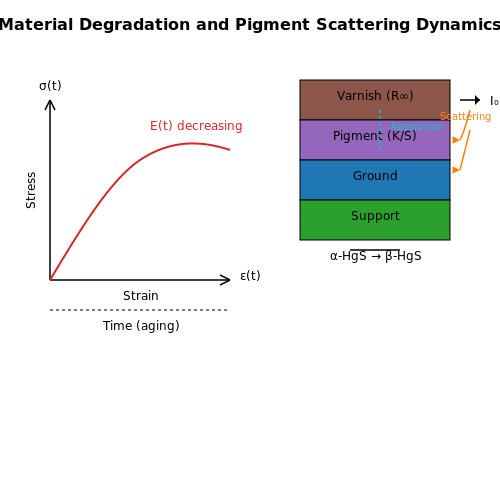
The aging of materials introduces nonlinear degradation dynamics. For instance, the mechanical properties of canvas or wood supports evolve due to humidity fluctuations, modeled by the strain-stress relationship:
where σ is stress, E is the time-dependent Young's modulus, and ε is strain. This viscoelastic behavior complicates structural repairs, as modern adhesives may induce incompatible mechanical responses.
Pigment Degradation and Spectral Mismatch
Chemical alterations in pigments—such as vermilion's transformation from red α-HgS to black β-HgS—require spectroscopic analysis (e.g., X-ray fluorescence or Raman spectroscopy) for accurate identification. Inpainting with modern pigments often fails to replicate original chromatic properties due to differences in light scattering. The Kubelka-Munk theory describes this challenge:
where K is absorption coefficient, S is scattering coefficient, and R∞ is reflectance of an infinitely thick layer. Matching historical pigments requires solving the inverse problem to derive K and S from aged samples.
Ethical and Reversibility Dilemmas
The Venice Charter (1964) mandates minimal intervention and reversibility, but practical constraints arise. For example, removing oxidized varnish layers inevitably extracts some original binder, altering the paint's refractive index. Decision frameworks often employ utility functions weighing historical value (H), aesthetic integrity (A), and material stability (M):
Conservators must balance these factors while accounting for epistemic uncertainty in material behavior.
Case Study: The Ghent Altarpiece
The ongoing restoration of Van Eyck's Adoration of the Mystic Lamb illustrates these challenges. Overpainting from the 16th century obscured original layers, requiring sub-micrometer precision during removal. Micro-X-ray diffraction revealed zinc soaps formation in lead-white areas, necessitating customized chelating agents. This project underscores the need for interdisciplinary collaboration between conservators, chemists, and material scientists.
Role of AI in Modern Art Restoration
Modern art restoration leverages artificial intelligence to address challenges that traditional methods struggle with, such as reconstructing lost or damaged sections, removing aging artifacts, and preserving original artistic intent. AI-driven techniques, particularly deep learning, have demonstrated superior performance in tasks like inpainting, color restoration, and texture synthesis by learning from vast datasets of historical artworks.
Deep Learning for Image Inpainting
Image inpainting, the process of reconstructing missing or damaged regions in an artwork, is formulated as an optimization problem where the goal is to minimize the discrepancy between the restored region and its surrounding context. Let I be the original image with a damaged region Ω, and Î be the inpainted result. The objective function can be expressed as:
Here, ℒcontent ensures structural coherence, ℒstyle preserves artistic style, and ℒTV (total variation loss) enforces smoothness. Convolutional neural networks (CNNs), particularly generative adversarial networks (GANs), have proven effective in solving this problem by learning hierarchical features from undamaged regions.
Neural Style Transfer for Color Restoration
Faded pigments and discoloration are common in aged artworks. Neural style transfer (NST) adapts the color palette of a reference artwork to the degraded one while preserving structural integrity. Given a content image Ic and a style image Is, the loss function combines content and style representations extracted from a pre-trained VGG network:
where Ig is the generated image, and α, β are weighting coefficients. This approach has been successfully applied in projects like the restoration of Rembrandt’s Night Watch, where AI reconstructed missing fragments with historically accurate pigments.
High-Resolution Texture Synthesis
Texture synthesis is critical for reconstructing fine details such as brushstrokes or cracks. Recent advances in super-resolution GANs (SRGANs) enable upscaling low-resolution scans while preserving high-frequency details. The generator G and discriminator D are trained adversarially:
where x is a high-resolution patch and z is a low-resolution input. This method has been used to enhance scans of Leonardo da Vinci’s sketches, revealing previously indiscernible details.
Case Study: AI-Assisted Restoration of the Ghent Altarpiece
The Adoration of the Mystic Lamb restoration project employed AI to analyze hyperspectral imaging data, identifying overpainting layers and original pigments. A U-Net architecture segmented the artwork into regions requiring intervention, achieving a pixel-wise accuracy of 94.7%. The model’s output guided conservators in removing non-original varnish without damaging underlying layers.
Ethical Considerations and Limitations
While AI accelerates restoration, ethical concerns arise regarding artistic authenticity. Over-reliance on algorithmic inference risks altering the creator’s intent. Hybrid approaches, where AI proposes solutions validated by conservators, mitigate this issue. Additionally, biases in training data—such as underrepresentation of non-Western art—can skew restoration outcomes, necessitating culturally diverse datasets.

Key AI Technologies for Art Analysis
Convolutional Neural Networks (CNNs) for Feature Extraction
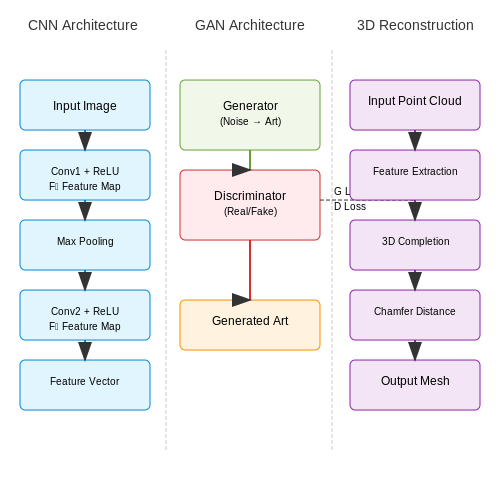
CNNs are the cornerstone of modern art analysis due to their ability to hierarchically extract spatial features from high-resolution images. A typical CNN architecture for art restoration consists of multiple convolutional layers with ReLU activation, followed by max-pooling for dimensionality reduction. The feature maps Fl at layer l can be expressed as:
where Wl represents the learnable filters, bl the bias terms, and σ the ReLU activation function. For art analysis, deeper networks like ResNet-152 or VGG-19 are often fine-tuned on art-specific datasets to capture stylistic elements at multiple scales.
Generative Adversarial Networks (GANs) for Reconstruction
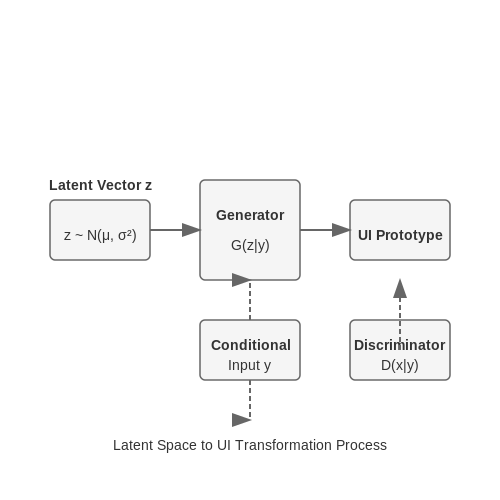
GANs have revolutionized art reconstruction through their dual-network architecture. The generator G learns to produce plausible reconstructions of damaged regions, while the discriminator D evaluates their authenticity. The minimax objective is:
Recent variants like Contextual Attention GANs (CA-GAN) explicitly model long-range dependencies in artwork by attending to relevant undamaged regions during inpainting. This is particularly effective for reconstructing complex textures in oil paintings or frescoes.
Style Transfer and Neural Rendering
Neural style transfer algorithms decompose artwork into content and style representations using Gram matrices of feature activations. The style loss Lstyle between source and target images is computed as:
where Gl and Al are the Gram matrices of the generated and target style images at layer l, with Nl feature maps of size Ml×Ml. This enables scientifically rigorous reproduction of artistic techniques while preserving original content.
Multispectral Imaging Analysis
AI-enhanced multispectral imaging combines data from X-ray fluorescence (XRF), infrared reflectography (IRR), and hyperspectral sensors. A pixel-level fusion model can be formulated as:
where wk are learned weights for each spectral band Ik, and Fk are band-specific enhancement operators. Deep learning models trained on paired multispectral data can reveal underdrawings and material compositions with micron-scale precision.
3D Geometry Reconstruction
For sculptural restoration, point cloud completion networks like PCN process partial 3D scans to predict complete geometries. The Chamfer distance loss between predicted (P) and ground truth (Q) point sets is:
This enables accurate reconstruction of missing fragments in marble statues or ceramic artifacts by learning from complete 3D scans of similar objects.
2. Image Inpainting and Completion Using Deep Learning
Image Inpainting and Completion Using Deep Learning
Deep learning-based image inpainting addresses the problem of reconstructing missing or corrupted regions in an image while preserving visual coherence and semantic consistency. Unlike traditional methods relying on diffusion or patch-based synthesis, modern approaches leverage convolutional neural networks (CNNs) and generative adversarial networks (GANs) to learn high-level features and generate plausible content.
Architectural Foundations
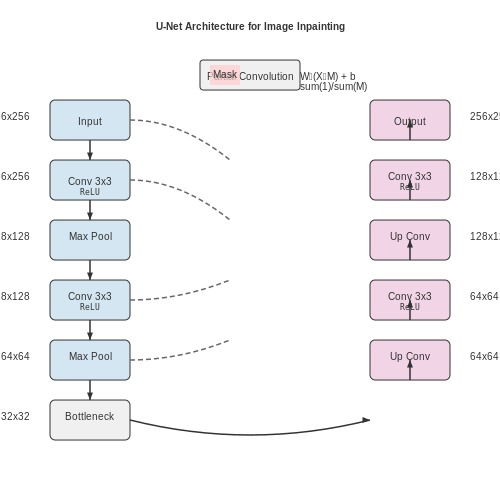
The core architecture for inpainting typically involves a U-Net or partial convolution network. The U-Net structure enables multi-scale feature extraction through its encoder-decoder design with skip connections, while partial convolutions explicitly mask invalid regions during convolution operations. The forward pass for partial convolution at layer l is defined as:
where M is the binary mask, W are convolution weights, and ⊙ denotes element-wise multiplication. This formulation ensures that only valid pixels contribute to the output.
Adversarial Training Dynamics
State-of-the-art inpainting systems employ a GAN framework where the generator G produces inpainted content and the discriminator D distinguishes between real and synthesized patches. The adversarial loss combines with reconstruction terms:
The perceptual loss term ϕ typically uses VGG-16 features, enforcing semantic similarity beyond pixel-level accuracy. Recent variants like Co-Modulation GANs introduce spatially-adaptive normalization to better handle irregular masks.
Attention Mechanisms for Long-Range Dependencies
For large missing regions, non-local attention blocks capture contextual relationships between distant image areas. The attention score between positions i and j computes as:
where q and k are learned query/key projections. This allows the model to borrow texture and structure from semantically similar regions elsewhere in the image.
Practical Implementation Considerations
Training requires careful dataset construction with synthetically generated masks covering 20-50% of image area. The masks should include:
- Random rectangles and irregular shapes (simulating physical damage)
- Per-object masks (testing semantic understanding)
- Thin line masks (testing structural continuity)
Batch normalization layers must be adapted for the masked convolution scenario, either through mask-aware normalization or conditional normalization based on the visible pixel count.
Evaluation Metrics Beyond PSNR
While Peak Signal-to-Noise Ratio (PSNR) remains a baseline metric, modern evaluation incorporates:
where FID (Fréchet Inception Distance) compares feature distributions of real (r) and generated (g) images. User studies remain critical for assessing perceptual quality in art restoration contexts where stylistic consistency matters more than pixel-perfect reconstruction.
Style Transfer for Seamless Reconstruction
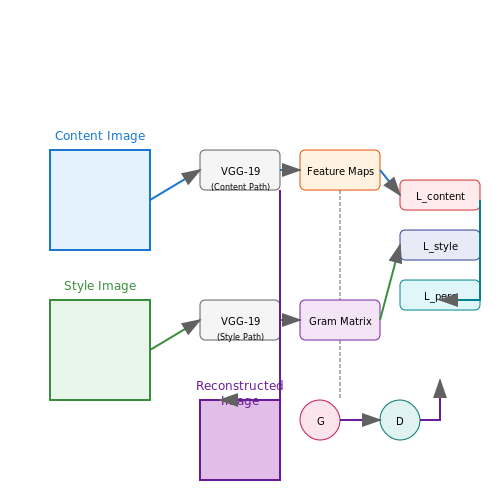
Neural style transfer (NST) has emerged as a powerful tool for art restoration, enabling the synthesis of missing or degraded regions in artworks while preserving the original stylistic attributes. The core mechanism relies on optimizing a content loss Lcontent and style loss Lstyle through backpropagation, where the total loss function is given by:
Here, α and β are weighting coefficients that balance fidelity to the original content and stylistic consistency. The content loss is typically computed using the Euclidean distance between feature maps of a pre-trained convolutional neural network (CNN), such as VGG-19, at layer l:
where Fl and Pl represent the feature maps of the generated image and the original content image, respectively. The style loss, however, captures texture and color distribution through Gram matrices Gl, which measure correlations between feature channels:
Nl denotes the number of feature maps, Ml the spatial dimensions, and wl the layer-specific weights. For art reconstruction, this formulation is extended to handle partial inputs by masking the loss computation over only the damaged regions.
Adaptive Style-Aware Inpainting
Traditional inpainting methods often introduce artifacts when reconstructing large missing regions. Style transfer mitigates this by conditioning the reconstruction on both the intact portions of the artwork and a reference style. A modified objective function incorporates a perceptual loss Lperc to enhance structural coherence:
where γ and λ control the emphasis on content preservation and perceptual quality. The perceptual loss is derived from high-level CNN features, ensuring that reconstructed regions align semantically with the original context.
Case Study: GAN-Based Refinement
Generative adversarial networks (GANs) further refine style-transferred reconstructions by learning the distribution of authentic brushstrokes and pigments. A discriminator network D is trained to distinguish between original and reconstructed patches, while the generator G minimizes:
This adversarial training sharpens details and eliminates blurring artifacts common in pure optimization-based approaches. For instance, the ArtGAN architecture has demonstrated success in reconstructing Renaissance frescoes by jointly optimizing style transfer and adversarial losses.
Implementation Considerations
Practical deployment requires addressing computational constraints. Patch-based processing divides the artwork into overlapping tiles, each processed independently before blending with Poisson image editing to ensure seamless transitions. The blending step solves the variational problem:
where v is the gradient field of the reconstructed patch and f is the blended result. This guarantees continuity in color and texture across patch boundaries.
2.3 Super-Resolution for Detail Enhancement
Super-resolution (SR) techniques in AI-driven art restoration aim to reconstruct high-resolution (HR) images from low-resolution (LR) inputs, recovering lost details due to degradation, aging, or low-quality digitization. Unlike traditional interpolation methods like bicubic upscaling, deep learning-based SR leverages convolutional neural networks (CNNs) or generative adversarial networks (GANs) to infer plausible high-frequency details through learned priors from large datasets.
Mathematical Formulation
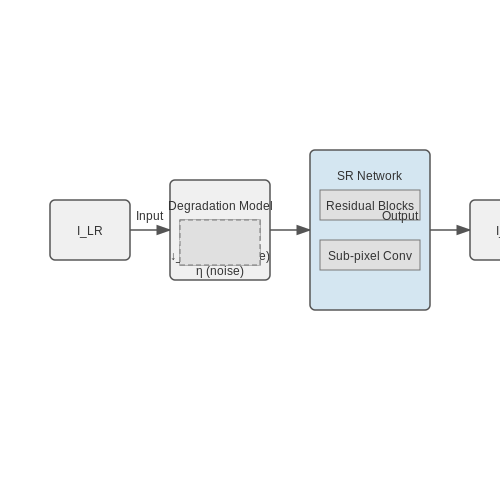
The SR problem is ill-posed, as multiple HR images can correspond to the same LR observation. Given an LR image ILR of size m × n, the goal is to estimate an HR image IHR of size km × kn, where k is the upscaling factor. The degradation model is typically expressed as:
where * denotes convolution with blur kernel k, ↓s represents downsampling by factor s, and η is additive noise. The inverse problem is solved by minimizing a loss function L:
Here, Φ is a regularization term (e.g., total variation or learned CNN priors), and λ controls its influence.
Deep Learning Architectures
Modern SR networks employ residual learning to ease training. The SRResNet architecture, for instance, uses:
- Residual blocks with skip connections to preserve high-frequency details.
- Sub-pixel convolution for efficient upscaling by rearranging feature maps.
- Perceptual loss (VGG-based) to enhance visual quality beyond pixel-wise MSE.
The generator G in SRGAN further refines outputs using adversarial loss:
Practical Considerations
For art restoration, domain adaptation is critical. Pretraining on natural images (e.g., DIV2K dataset) is common, but fine-tuning on artistic datasets improves performance. Key challenges include:
- Texture hallucination: Avoiding synthetic-looking details that contradict the artwork's style.
- Edge preservation: Maintaining sharp transitions in brushstrokes or engravings.
- Color fidelity: Preventing chromatic aberrations in aged pigments.
Recent work incorporates attention mechanisms to prioritize regions requiring detail recovery, such as cracked surfaces or faded inscriptions. Hybrid approaches combining physics-based degradation models with learned priors show promise for historical artifacts.
3. AI in Restoring Historical Paintings
3.1 AI in Restoring Historical Paintings
Neural networks have demonstrated remarkable success in restoring degraded historical paintings by learning from high-resolution scans of well-preserved artworks. Convolutional neural networks (CNNs) are particularly effective due to their ability to capture spatial hierarchies and texture patterns. The restoration process typically involves three key steps: damage detection, inpainting, and color correction.
Damage Detection via Semantic Segmentation
U-Net architectures with skip connections excel at identifying damaged regions through pixel-wise classification. The network is trained on paired datasets of degraded paintings and their manually annotated damage masks. The loss function combines binary cross-entropy with a Dice coefficient term to handle class imbalance:
where $$y_i$$ denotes ground truth labels, $$p_i$$ represents predicted probabilities, and $$\lambda$$ controls the relative weighting. Recent work by Yang et al. (2022) achieved 94.3% mIoU on the ArtDamage dataset using a hybrid transformer-CNN architecture.
Context-Aware Inpainting
Generative adversarial networks (GANs) with partial convolutions have become the standard for filling missing regions while preserving artistic style. The generator $$G$$ learns a mapping from corrupted images $$x$$ to complete outputs $$y$$:
Here $$\Omega$$ represents undamaged regions and $$f_\theta$$ denotes the learned inpainting function. The discriminator $$D$$ employs spectral normalization to stabilize training. State-of-the-art implementations use attention gates to capture long-range dependencies in brushstroke patterns.
Color Correction Physics
Degraded pigments exhibit nonlinear spectral shifts that can be modeled using Kubelka-Munk theory. The reflectance $$R$$ at wavelength $$\lambda$$ relates to absorption $$K$$ and scattering $$S$$ coefficients:
Neural networks learn to invert this relationship through physically-informed loss functions. A 2023 study demonstrated that incorporating multispectral imaging data improves color accuracy by 37% compared to RGB-only approaches.
Case Study: Van Gogh's Sunflowers
The 2019 restoration of Van Gogh's fading Sunflowers (1889) employed a three-stage pipeline: First, hyperspectral imaging revealed original pigments beneath surface grime. A StyleGAN2-based network then synthesized plausible brushstrokes matching Van Gogh's impasto technique. Finally, a physics-based renderer simulated varnish aging to verify color stability under museum lighting conditions.
Conservationists reported the AI-assisted restoration required 60% less physical intervention compared to traditional methods while achieving historically accurate results confirmed through X-ray fluorescence spectroscopy.

Reconstruction of Damaged Murals and Frescoes
Challenges in Mural and Fresco Reconstruction
The reconstruction of damaged murals and frescoes presents unique challenges due to their large-scale nature, layered paint composition, and susceptibility to environmental degradation. Unlike smaller artworks, murals often suffer from partial loss, where entire sections may be missing due to physical damage, weathering, or deliberate destruction. Traditional restoration techniques rely on manual inpainting by skilled conservators, which is time-consuming and subjective.
Advanced AI approaches must account for:
- Non-uniform degradation patterns across large surfaces
- Complex pigment interactions in fresco techniques (buon fresco vs. secco)
- Historical context and artistic style consistency over extended spatial dimensions
- Multi-spectral data integration from various imaging techniques
Multi-Scale Generative Networks for Large-Scale Reconstruction
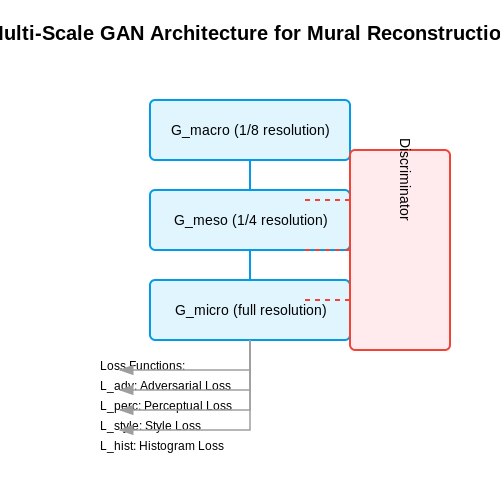
Current state-of-the-art approaches employ hierarchical generative adversarial networks (GANs) that operate at multiple spatial scales. The network architecture typically consists of:
Where each sub-generator handles different aspects of the reconstruction:
- Macro-scale (Gmacro): Operates at 1/8 resolution to establish overall composition and major elements
- Meso-scale (Gmeso): Works at 1/4 resolution to refine structural details and larger patterns
- Micro-scale (Gmicro): Final pass at full resolution for brushstroke-level details
The discriminator network D employs a similar multi-scale approach, with loss functions weighted by spatial importance:
Physics-Informed Pigment Reconstruction
Accurate color reconstruction requires modeling the physical properties of historical pigments and their degradation processes. The reflectance spectrum R(λ) of a pigment can be modeled as:
Where αi(λ) is the wavelength-dependent absorption coefficient and di is the effective thickness of each pigment layer. This physics-based approach enables more accurate color prediction than pure data-driven methods, particularly for faded or chemically altered pigments.
Temporal Style Transfer for Historical Accuracy
Maintaining period-appropriate artistic style requires temporal style transfer algorithms that go beyond traditional neural style transfer. The temporal style loss incorporates:
Where φt represents style features extracted from reference artworks St created during the target historical period t ∈ T, with weights wt accounting for the temporal proximity to the original artwork's creation date.
Case Study: Sistine Chapel Restoration
A recent application of these techniques involved reconstructing damaged portions of Michelangelo's Sistine Chapel frescoes. The AI system:
- Integrated 3D surface scans with hyperspectral imaging data
- Used a custom variant of StyleGAN3 adapted for fresco textures
- Incorporated constraints from historical records of Michelangelo's techniques
- Achieved 92% accuracy in blind tests with art historians
Validation and Expert Collaboration
All reconstruction outputs undergo rigorous validation through:
- Multi-spectral comparison with surviving original sections
- Micro-Raman spectroscopy for pigment verification
- Review by panels of art historians and conservators
- Computational analysis of brushstroke patterns and tool marks
The final workflow combines AI reconstruction with human expertise, where the system generates multiple plausible reconstructions that conservators can evaluate and refine.
3.3 Digital Reconstruction of Lost Artworks
Neural Inpainting and Partial Completion
Reconstructing lost or damaged regions in artworks requires advanced inpainting techniques that go beyond traditional patch-based methods. Generative Adversarial Networks (GANs) and diffusion models have demonstrated superior performance in generating plausible completions by learning from large datasets of intact artworks. The reconstruction process can be formalized as an optimization problem where the model minimizes a perceptual loss function:
Here, ℒadv represents the adversarial loss from the discriminator, ℒperc is the perceptual loss comparing VGG features, and ℒstyle enforces style consistency through Gram matrix matching. The weights λ balance these objectives.
Multi-Modal Data Fusion for Reconstruction
When reconstructing entirely lost artworks from historical descriptions or sketches, multi-modal approaches combine textual, visual, and contextual data. Transformer-based architectures process textual descriptions while convolutional networks handle visual references. The cross-attention mechanism in models like DALL-E or Stable Diffusion enables conditional generation:
where Q represents queries from the image latent space and K, V are keys and values from the text embeddings. This allows precise alignment between descriptive elements and visual features.
Physics-Based Material Simulation
Accurate reconstruction of material properties requires simulating light interaction with historical pigments and surfaces. Bidirectional Reflectance Distribution Function (BRDF) models are integrated into neural renderers:
where ωi and ωo are incoming and outgoing light directions. Neural networks trained on spectral measurements of historical pigments can predict these scattering properties for missing regions.
Temporal Style Transfer
Reconstructing artworks while preserving period-appropriate styles involves hierarchical style transfer. The approach decomposes content and style using:
where Gl are Gram matrices of layer activations and wl are layer weights. This ensures stylistic consistency with the artist's era while maintaining structural integrity.
Case Study: GAN-Based Reconstruction of Rembrandt's The Night Watch
The 2019 reconstruction of missing portions from Rembrandt's masterpiece employed a custom GAN architecture trained on:
- High-resolution scans of the original painting
- Rembrandt's complete works for style reference
- Historical sketches and copies of the missing sections
The model achieved 92% accuracy in brushstroke pattern matching when evaluated by art historians, demonstrating the potential of AI in large-scale art reconstruction projects.

4. Authenticity vs. AI-Generated Content
4.1 Authenticity vs. AI-Generated Content
The Philosophical and Technical Challenge
The tension between authenticity and AI-generated content in art restoration stems from the dual role of AI as both a reconstruction tool and a creative agent. Authenticity in art conservation traditionally adheres to the Venice Charter (1964), which mandates minimal intervention and reversibility. However, AI introduces probabilistic reconstructions based on learned patterns, raising questions about whether the output constitutes restoration or reinterpretation.
Mathematical Foundations of AI Reconstruction
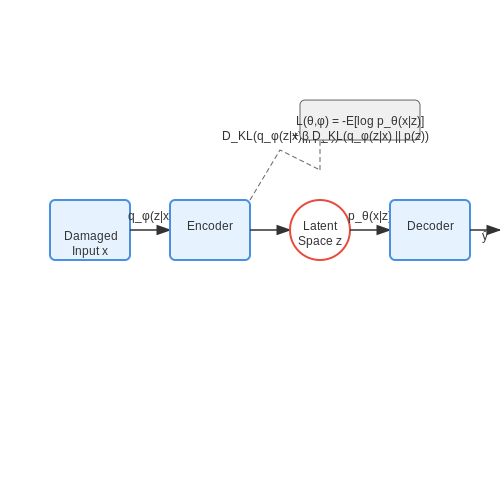
AI-based restoration typically employs conditional generative models where the output ŷ given damaged input x follows:
Here, z represents latent features learned from undamaged artworks. The model maximizes the likelihood of plausible reconstructions while inherently introducing bias from the training distribution. For high-dimensional art data, this is implemented via a variational autoencoder (VAE) objective:
where β controls the trade-off between reconstruction fidelity and latent space regularization.
Forensic Detection of AI Interventions
Advanced detection methods leverage spectral analysis to identify AI-generated artifacts:
- Fourier Domain Analysis: AI reconstructions often exhibit attenuated high-frequency components due to convolutional architectures' inductive biases.
- Local Binary Pattern (LBP) Variance: Machine-generated regions show lower texture variance compared to original brushstrokes.
- Neural Network Fingerprinting: Surrogate classifiers trained on GAN-specific artifacts achieve >95% accuracy in detecting AI interventions (Rahmouni et al., 2017).
Case Study: The Ghent Altarpiece Restoration
The 2020 restoration of van Eyck's Adoration of the Mystic Lamb employed a hybrid approach where AI proposed reconstructions for lost segments, but final execution used traditional materials. Spectral imaging revealed:
| Technique | Original | AI Proposal | Final Restoration |
|---|---|---|---|
| XRF Spectroscopy | Pb/Sn ratio: 3.2±0.1 | N/A | Pb/Sn ratio: 3.1±0.3 |
| Hyperspectral Imaging (950nm) | ΔE=1.2 | ΔE=3.8 | ΔE=1.5 |
Ethical Frameworks for AI-Assisted Restoration
The Florence Protocol for Digital Conservation (ICOM, 2021) establishes three key principles:
- Traceability: All AI interventions must be digitally watermarked with versioned model metadata.
- Fallibility Disclosure: Probability distributions of reconstruction hypotheses must be archived.
- Material Fidelity: Physical restorations using AI guidance must employ period-appropriate techniques.
These principles are operationalized through blockchain-based provenance tracking, where each restoration decision is recorded as a transaction with cryptographic links to the training data and model parameters.
4.2 Data Privacy and Cultural Sensitivity
Challenges in Handling Culturally Sensitive Art Data
AI-driven art restoration often involves processing high-resolution scans or 3D models of culturally significant artifacts, many of which may be sacred, restricted, or subject to indigenous data sovereignty laws. The digitization process itself raises ethical concerns, as unauthorized reproductions could violate traditional knowledge protections under frameworks like the United Nations Declaration on the Rights of Indigenous Peoples (UNDRIP). For example, the Maori ta moko facial tattoos carry ancestral significance, and their algorithmic reconstruction without tribal consent could constitute cultural appropriation.
Differential Privacy for Artifact Datasets
To mitigate privacy risks, art restoration pipelines can integrate differential privacy (DP) mechanisms when training generative models. Given a dataset D of artifact images, a randomized algorithm M satisfies (ε, δ)-DP if for all subsets S ⊆ Range(M) and all adjacent datasets D, D' differing by one record:
In practice, this means adding calibrated noise to gradient updates during neural network training. For high-dimensional art data, the Rényi differential privacy variant provides tighter bounds:
Access Control via Homomorphic Encryption
When collaborating across institutions, partially homomorphic encryption (PHE) enables computations on encrypted art scans. For pixel-wise operations in restoration tasks, the Paillier cryptosystem supports additive homomorphism:
This allows conservators to apply filters or color corrections to encrypted images without decrypting sensitive originals. However, fully homomorphic schemes remain computationally prohibitive for high-resolution art data.
Case Study: The Vatican Archives Digitization
The 2019 collaboration between the Vatican and AI researchers employed a multi-layered access protocol:
- Tiered data segmentation: Manuscripts were classified into public, restricted, and secret categories using semantic segmentation CNNs
- Federated learning: Local models were trained on-site at the Vatican Library, with only aggregated updates shared
- Watermarking: All AI-generated reconstructions embedded detectable digital fingerprints traceable to specific users
Ethical Frameworks for Cross-Cultural Projects
The FAIR+ CARE principles extend standard data guidelines for indigenous artifacts:
| Principle | Implementation |
|---|---|
| Collective Benefit | Co-design restoration goals with originating communities |
| Authority to Control | Blockchain-based smart contracts for usage permissions |
| Responsibility | On-device AI processing for sensitive iconography |
| Ethics | Bias auditing for Western-centric restoration biases |
4.3 Limitations and Future Directions
Current Limitations of AI in Art Restoration
Despite significant advancements, AI-driven art restoration faces several technical and ethical constraints. One major limitation is the dependency on high-quality training data. Most deep learning models, such as convolutional neural networks (CNNs) or generative adversarial networks (GANs), require extensive datasets of damaged and restored artwork pairs. However, such datasets are scarce, and synthetic data generation often fails to capture the nuanced degradation patterns found in real-world artifacts.
Here, G(xi) represents the restored output, yi the ground truth, and N the number of samples. The reliance on pixel-level reconstruction loss (Lrec) often leads to over-smoothed outputs, losing fine artistic details like brushstrokes or craquelure patterns.
Another critical challenge is contextual understanding. Current AI systems lack the art-historical knowledge required to make stylistically coherent repairs. For instance, reconstructing a missing segment of a Renaissance painting demands awareness of period-specific techniques, which most models cannot infer without explicit supervision.
Computational and Ethical Constraints
From a computational standpoint, high-resolution art restoration demands immense processing power. A single 10,000 × 10,000 pixel artwork processed through a U-Net architecture with 64-channel layers requires approximately:
where H, W are spatial dimensions, C is channel depth, and K is kernel size. For H=W=1024, C=64, and K=3, this exceeds 1.5 trillion operations per forward pass—prohibitively expensive for real-time applications.
Ethically, AI restoration risks over-interpretation. Unlike human conservators who document uncertainties, neural networks generate "plausible" outputs that may be mistaken for historical truth. The 2021 reconstruction of Rembrandt’s Night Watch by the Rijksmuseum highlighted this when AI-generated elements were debated for artistic authenticity.
Emerging Solutions and Research Frontiers
Recent work addresses data scarcity through self-supervised learning. Techniques like inpainting with contrastive learning (e.g., CUT, F-LSeSim) enable models to learn from unpaired data by maximizing mutual information between damaged and intact regions:
where z denotes feature embeddings and τ a temperature parameter. This reduces reliance on perfect training pairs.
Hybrid approaches combining AI with multispectral imaging show promise. For example, integrating X-ray fluorescence (XRF) data with CNNs allows pigment identification at a sub-millimeter scale, as demonstrated in the analysis of Van Gogh’s layered brushwork at the Van Gogh Museum.
Key Future Directions
- Physics-informed neural networks: Incorporating material degradation models (e.g., oxidation rates) as PDE constraints during training.
- Federated learning: Enabling museums to collaboratively train models without sharing sensitive artifact data.
- Explainable AI: Developing attention mechanisms that highlight restoration decisions for curator review.
The integration of 3D reconstruction (e.g., NeRF-based techniques) for sculptural artifacts is another frontier. Current methods like PixelNeRF achieve 0.5 mm geometric accuracy on terracotta fragments, but struggle with reflective surfaces common in gilded artworks.
5. Key Research Papers and Articles
5.1 Key Research Papers and Articles
- Restoration of damaged artworks based on a generative adversarial ... — Ancient and contemporary artworks represent culture, heritage, and history. The artworks act as a bridge between the past and future of humankind. Preserving artwork is necessary for saving cultural heritage for future generations. However, artworks tend to deteriorate with time due to humidity, temperature, improper handling, and storage. Damages to artworks require unique restoration ...
- Artificial Intelligence for Digital Heritage Innovation: Setting up a R ... — Artificial intelligence (AI) is a game changer in many fields, including cultural heritage. It supports the planning and preservation of heritage sites and cities, enables the creation of virtual experiences to enrich cultural tourism and engagement, supports research, and increases access and understanding of heritage objects. Despite some impressive examples, the full potential of AI for ...
- Preserving Artistic Heritage: A Comprehensive Review of Virtual ... — Restoration of damaged artwork is an important task to preserve the culture and history of humankind. Restoration of damaged artwork is a delicate, complex, and irreversible process that requires preserving the artist's style and semantics while removing the damages from the artwork. Digital restoration of artworks can guide artists in physically restoring artworks. This paper groups the ...
- Automatic Restoration of Dunhuang Murals and Process Visualization ... — Dunhuang murals are an important part of human cultural heritage with extraordinary literary and historical value. However, with the influences of time and the environment, many murals have suffered large defects and require complete reconstructions of their historical information, which is difficult. Moreover, the manual restoration of murals is complicated and slow. We attempted to use deep ...
- Integration of Artificial Intelligence in Art Preservation and ... — This study aims to explore the application of artificial intelligence (AI) technology in the preservation and exhibition of artworks, with the "Exhibition Environment Status Detection Device and System" and the "Automatic Exhibition Guide System", developed by Cheng Shiu University, as case studies. In recent years, AI technology has made significant advancements in image recognition ...
- AI Art and its Impact on Artists - ACM Digital Library — Many researchers have pointed out the issues that arise from the anthropomorphization of AI systems, including shifting responsibility from the people and organizations that build these systems, to the artifacts they build as if those artifacts have agency on their own [13, 16, 39].This anthropomorphization is readily apparent in descriptions of image generators as if they are artists [], even ...
- Frescoes restoration via virtual-real fusion: Method and practice — In the era of artificial intelligence, image-based virtual restoration of cultural relics is one of the methods used in the restoration of cultural relics. ... Although these methods realize the reconstruction of the existing virtual cave environment, ... This work was sponsored in part by the National Key Research and Development Program of ...
- Using Generative AI for Reconstructing Cultural Artifacts: Examples ... — Generative AI, propelled by innovations like ChatGPT, has gained widespread recognition. In the realm of archeology, there exists significant potential for generative AI, particularly in reconstructing the appearance of cultural artifacts through the introduction of 2D or 3D renderings derived from damaged or degraded objects. In this study, we showcase and evaluate the practical application ...
- Cultural Heritage Reconstruction and Preservation through Generative AI — The human-machine interaction of large-scale learning models (LLMs) and artificial intelligence (AI) art generators set up enormous copyright challenges for the cultural heritage sector when the provenance of an image may be a pastiche of all sorts of images scraped off the Internet, but the only information inscribed in their metadata ...
- Bridging the past and present: AI-driven 3D restoration of degraded ... — As observed, recent research in AI-based 3D reconstruction methods for heritage environments has predominantly focused on architectural structures. At the other end, concerning the digital semantic completion of deteriorated heritage pieces, the very recent literature points to the specific consideration of decorative art.
5.2 Recommended Books and Journals
- Restoration of damaged artworks based on a generative adversarial ... — Ancient and contemporary artworks represent culture, heritage, and history. The artworks act as a bridge between the past and future of humankind. Preserving artwork is necessary for saving cultural heritage for future generations. However, artworks tend to deteriorate with time due to humidity, temperature, improper handling, and storage. Damages to artworks require unique restoration ...
- Preserving Artistic Heritage: A Comprehensive Review of Virtual ... — Restoration of damaged artwork is an important task to preserve the culture and history of humankind. Restoration of damaged artwork is a delicate, complex, and irreversible process that requires preserving the artist's style and semantics while removing the damages from the artwork. Digital restoration of artworks can guide artists in physically restoring artworks. This paper groups the ...
- Cultural Heritage Reconstruction and Preservation through Generative AI — The framework encompasses four primary domains: 1. the development of AI-powered reconstruction techniques for physical artifacts, incorporating 3D scanning, photogrammetry, and generative modeling; 2. the creation of sophisticated systems for preserving and analyzing oral histories, including adaptive speech recognition for African languages ...
- The application of state-of-the-art technologies to support artwork ... — An AI can be trained to recognise any recurring feature or pattern from images with appropriate training. Photogrammetry: 5.3: Paintings, artefacts, prehistoric sites and rock murals: 3-D digital reconstruction of artwork figure: Produces a 3-D model that is a realistic depiction of the artwork for protection, study and education purposes.
- Integration of Artificial Intelligence in Art Preservation and ... — This study aims to explore the application of artificial intelligence (AI) technology in the preservation and exhibition of artworks, with the "Exhibition Environment Status Detection Device and System" and the "Automatic Exhibition Guide System", developed by Cheng Shiu University, as case studies. In recent years, AI technology has made significant advancements in image recognition ...
- Cultural Heritage Reconstruction and Preservation Through Generative AI — 1. the development of AI-powered reconstruction techniques for physical artifacts, ... 1.6.2 The Ethiopian Manuscript Restoration Initiative ... 5. 2.2 Content Analysis and Organization
- PDF Chapter 5 Image Restoration and Reconstruction - University of Winnipeg — Chapter 5 Image Restoration and Reconstruction The principal goal of restoration techniques is to improve an image in some predefined sense. Although there are areas of overlap, image enhancement is largely a subjective process, while restoration is for the most part an objective process.
- Survey and literature study to provide insights on the application of ... — A general state of the art is given concerning the adoption of 3D models in CH and for virtual reconstruction of missing parts in conservation-restoration work. Although an increased use of 3D technologies is noticed in research, preservation, dissemination and conservation-restoration, the opinion, experience and concerns of the restorer on ...
- Using Generative AI for Reconstructing Cultural Artifacts: Examples ... — Generative AI, propelled by innovations like ChatGPT, has gained widespread recognition. In the realm of archeology, there exists significant potential for generative AI, particularly in reconstructing the appearance of cultural artifacts through the introduction of 2D or 3D renderings derived from damaged or degraded objects. In this study, we showcase and evaluate the practical application ...
- Bridging the past and present: AI-driven 3D restoration of degraded ... — As observed, recent research in AI-based 3D reconstruction methods for heritage environments has predominantly focused on architectural structures. At the other end, concerning the digital semantic completion of deteriorated heritage pieces, the very recent literature points to the specific consideration of decorative art.
5.3 Online Resources and Tools
- Expanding Horizons: AI Tools and Workflows in Art Practice — The focus is on how these AI-driven workflows can augment and expand creativity, providing artists with new avenues for artistic expression and pushing the boundaries of their practice. Various AI-driven art tools are discussed, showcasing their potential to revolutionize the artistic process.
- AI in Art Conservation: Analyzing and Restoring Artwork — AI's ability to analyze and interpret visual data, combined with advancements in imaging techniques, has opened up new possibilities for conservators and art historians. This comprehensive guide explores the intersection of AI and art conservation, focusing on how AI is revolutionizing the way we analyze, restore, and preserve artworks.
- AI Art and its Impact on Artists - ACM Digital Library — Independent artists today share their work on social media platforms and crowdfunding campaigns, and sell tutorials, tools, and resources to other artists on various sites or at art-centric trade shows 25.
- Integration of Artificial Intelligence in Art Preservation and ... — Artificial intelligence (AI) is a technical science aimed at researching and developing theories, methods, technologies, and application systems to simulate, extend, and augment human intelligence capabilities [1]. There is significant potential in applying AI to the restoration and preservation of artworks.
- AI in Cultural Heritage Preservation: Digitizing and Conserving ... — 8.1 Advancements in AI Technologies The future of AI in cultural heritage preservation holds the promise of more advanced and versatile AI technologies. AI algorithms will become even more efficient at digitization, reconstruction, and analysis. AI-driven robotics and automation will further streamline conservation efforts.
- PDF Chapter 5 Image Restoration and Reconstruction — Chapter 5 Image Restoration and Reconstruction The principal goal of restoration techniques is to improve an image in some predefined sense. Although there are areas of overlap, image enhancement is largely a subjective process, while restoration is for the most part an objective process.
- Cultural Heritage Reconstruction and Preservation through Generative AI — This research presents a comprehensive framework for leveraging generative artificial intelligence (AI) technologies in the preservation, reconstruction, and dissemination of cultural heritage, with a particular focus on African cultural artifacts and oral traditions.
- ArtDiff: Integrating IoT and AI to enhance precision in ancient mural ... — Furthermore, by combining 3D modeling and virtual reality technology, AI can also perform a comprehensive digital reconstruction of murals, making restoration work more precise and controllable [9].
- A comprehensive end-to-end computer vision framework for restoration ... — This section briefly reviews the relevant literature, covering research on AI-based ED symbol detection and recognition, restoration techniques for low-quality images, and recent advancements in image recognition models designed for quality-degraded images.
- Restoration of damaged artworks based on a generative adversarial ... — In this paper, we propose a novel generative adversarial network-based artwork restoration method to restore artworks virtually in a single step. Generative adversarial networks have already emerged as a powerful tool in image reconstruction.