MoCo (Momentum Contrast) for Vision Tasks
1. Key Concepts in Self-Supervised Learning
Key Concepts in Self-Supervised Learning
Contrastive Learning Framework
Self-supervised learning (SSL) formulates representation learning as a pretext task where the model learns by solving an automatically generated supervisory signal. Contrastive learning, a dominant SSL paradigm, operates by maximizing agreement between differently augmented views of the same data instance while minimizing agreement with other instances. Given an anchor sample x, its positive pair x+, and negative samples xi-, the InfoNCE loss function is:
where f(·) denotes the encoder, τ is a temperature parameter, and N is the number of negative samples. This formulation directly relates to mutual information maximization between positive pairs.
Dynamic Dictionaries and Momentum Encoders
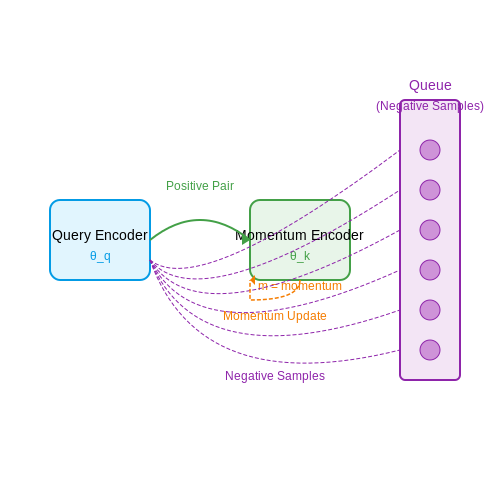
MoCo introduces a queue-based dynamic dictionary that decouples the batch size from the number of negatives. The key innovation is a momentum encoder updated via:
where θq is the query encoder, θk the key encoder, and m ∈ [0,1) the momentum coefficient. This creates a slowly evolving key encoder that maintains consistency in the feature space while allowing the query encoder to rapidly adapt.
Feature Space Properties
The learned representations exhibit several desirable properties:
- Alignment: Features of positive pairs cluster tightly in the embedding space
- Uniformity: The distribution of features covers the unit hypersphere without collapse
- Invariance: Representations become robust to predefined augmentations
These properties emerge from the interplay between the contrastive loss, data augmentation strategy, and the momentum update mechanism. The temperature parameter τ controls the sharpness of the similarity distribution, with lower values yielding more discriminative features.
Practical Implementation Considerations
Effective MoCo implementations require careful attention to:
- Augmentation policies combining cropping, color jitter, and Gaussian blur
- Queue sizes typically ranging from 65,536 to 131,072 negative samples
- Momentum values between 0.99 and 0.9999 for stable training
- Projection heads with 2-3 fully connected layers before the contrastive loss
The memory bank mechanism allows efficient computation by maintaining negative samples in a first-in-first-out queue, enabling large-scale contrastive learning without prohibitive memory requirements. Batch normalization layers require special handling, often being synchronized across GPUs or replaced with alternative normalization schemes.
1.2 Contrastive Learning Principles
Contrastive learning operates on the principle of learning representations by maximizing agreement between differently augmented views of the same data instance while minimizing agreement with views from other instances. This approach leverages a noise-contrastive estimation (NCE) framework, where the model learns to distinguish between positive pairs (augmented views of the same instance) and negative pairs (views from different instances).
InfoNCE Loss Formulation
The core objective function in contrastive learning is the InfoNCE loss, which extends NCE to high-dimensional spaces. Given an encoded query q and a set of encoded keys {k+, k1, ..., kK}, where k+ is the positive key (matching the query) and the rest are negative samples, the loss is defined as:
Here, τ is a temperature hyperparameter controlling the concentration level of the distribution. The dot product q · k measures similarity, typically implemented as cosine similarity in practice.
Key Properties
- Alignment: Positive pairs should map to nearby points in the embedding space.
- Uniformity: The embeddings should be roughly uniformly distributed on the unit hypersphere to maximize information retention.
- Stability: The learning process must maintain consistent representations despite the dynamic nature of the negative samples.
Momentum Contrast Enhancement
MoCo improves upon basic contrastive learning through two key innovations:
where m ∈ [0,1) is the momentum coefficient. This creates a slowly evolving key encoder whose parameters are an exponential moving average of the query encoder, providing stable targets for learning.
The second innovation is maintaining a large dictionary of negative samples through a queue mechanism, allowing the model to learn from many more negatives than would fit in a single batch. The queue is updated dynamically by enqueuing the current batch's keys and dequeuing the oldest ones.
Practical Implementation Considerations
Effective contrastive learning requires careful handling of several hyperparameters:
- Temperature (τ): Lower values sharpen the similarity distribution, emphasizing hard negatives.
- Momentum (m): Typically set between 0.99-0.9999 for stable key encoder updates.
- Dictionary size: Larger queues (e.g., 65,536 keys) generally improve performance but increase memory usage.
- Augmentation strength: Must be strong enough to create diverse views but not so strong as to destroy semantic content.
The effectiveness of these principles is demonstrated by MoCo's performance on downstream tasks, where it achieves state-of-the-art results in linear evaluation protocols, showing that the learned representations capture semantically meaningful features transferable to various vision tasks.
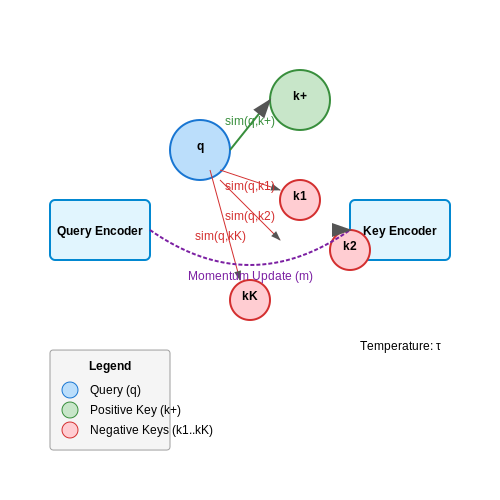
The Role of Momentum in MoCo
Momentum Contrast (MoCo) leverages a momentum-based update mechanism to maintain consistency in the key encoder while allowing the query encoder to evolve during training. The key insight is that a slowly evolving key encoder, updated via exponential moving average (EMA), provides stable negative samples for contrastive learning. This prevents abrupt changes in the representation space, which could destabilize training.
Momentum Update Mechanism
The momentum update rule for the key encoder parameters θk is defined as:
where θq are the query encoder parameters, and m ∈ [0, 1) is the momentum coefficient. This formulation ensures the key encoder evolves more slowly than the query encoder, with larger m values resulting in slower updates. Typical values range from 0.99 to 0.999, balancing stability with adaptability.
Why Momentum Matters
The momentum mechanism addresses two critical challenges in contrastive learning:
- Representation Consistency: Without momentum, rapidly changing key representations would make the contrastive task too difficult, as negative samples would not remain consistent long enough for the query encoder to learn meaningful features.
- Gradient Stability: The EMA update smooths out high-frequency parameter changes, preventing oscillations in the loss landscape that could hinder convergence.
Empirical Analysis
Experiments show that the choice of m significantly impacts downstream task performance. For ImageNet linear evaluation, m = 0.999 yields optimal results, while smaller values (e.g., 0.99) degrade accuracy by 2-3%. This suggests that very slow updates are crucial for maintaining a stable dynamic dictionary.
The contrastive loss above benefits from momentum because the negative samples ki come from a consistent representation space. Without momentum, the rapidly changing ki would introduce noise, making it harder for the network to distinguish positive pairs from negatives.
Implementation Considerations
In practice, the momentum update is applied after each mini-batch, but only to the key encoder. The query encoder is updated via standard backpropagation. This asymmetry is critical—it allows the query encoder to learn rapidly while the key encoder provides a slowly evolving target. The gradient flow is illustrated below:
The momentum mechanism also enables the use of a large memory bank (queue) of negative samples, as their representations remain valid for longer periods. This is computationally efficient, as it avoids recalculating features for the entire dataset at each step.
2. Query and Key Encoders
Query and Key Encoders
The Momentum Contrast (MoCo) framework relies on two neural network encoders that play distinct but complementary roles: the query encoder and the key encoder. Both are typically implemented as convolutional neural networks (CNNs) or vision transformers (ViTs), mapping input images to dense feature representations in a latent space.
Architecture and Parameterization
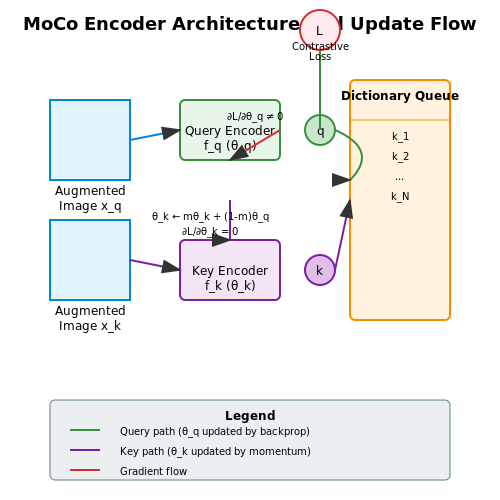
The query encoder fq and key encoder fk share the same architectural design but differ in how their parameters θq and θk are updated:
While θq is updated via standard backpropagation, θk evolves through an exponential moving average (EMA) of θq:
where m ∈ [0,1) is a momentum coefficient typically set close to 1 (e.g., 0.999). This creates a slowly-evolving key encoder that maintains consistency in the feature space while the query encoder learns.
Dynamic Dictionary Mechanism
The key encoder serves as a dynamic dictionary that provides consistent representations for contrastive learning. Each mini-batch of queries q = fq(xq) is compared against a queue of keys k = fk(xk) from previous batches. The dictionary:
- Decouples batch size from negative sample size
- Maintains representation consistency via momentum updates
- Enables large-scale contrastive learning with limited GPU memory
Implementation Considerations
In practice, both encoders process augmented views of the same image batch. The query encoder receives stronger augmentations (e.g., random cropping with resizing, color jitter) while the key encoder processes weaker augmentations. This asymmetry:
- Forces the query encoder to learn more robust features
- Prevents collapse by maintaining predictable key representations
- Improves downstream task performance by learning invariant features
Gradient Flow
Critical to MoCo's design is that gradients only flow through the query encoder during backpropagation. The key encoder's parameters are updated solely through momentum, creating a form of slow feature consistency that has been shown to improve representation learning stability.
This asymmetric update rule is fundamental to MoCo's success, as it prevents representation collapse while enabling effective contrastive learning.
Dynamic Memory Bank Design
The dynamic memory bank in MoCo addresses a critical limitation of static memory banks: the inability to adapt to evolving feature representations during training. Traditional contrastive learning methods rely on a fixed queue of negative samples, which can become stale as the encoder improves. MoCo's dynamic memory bank mitigates this by employing a momentum-updated key encoder and a queue mechanism that progressively replaces old entries with new ones.
Momentum Update Mechanism
The key encoder parameters θk are updated via an exponential moving average (EMA) of the query encoder parameters θq:
where m ∈ [0, 1) is the momentum coefficient. This ensures the key encoder evolves smoothly, preventing abrupt changes that could destabilize training. The momentum update is performed after each mini-batch, making the memory bank dynamically consistent with the latest feature space.
Queue-Based Memory Bank
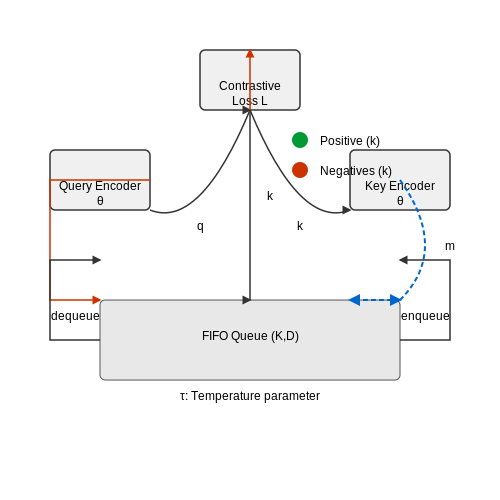
Instead of recomputing all negative samples on-the-fly, MoCo maintains a FIFO queue of encoded keys from previous batches. The queue is updated as follows:
- Current batch keys are enqueued.
- Oldest keys are dequeued to maintain fixed capacity (e.g., 65,536 samples).
This design decouples the batch size from the number of negatives, enabling large-scale contrastive learning without memory bottlenecks. The queue’s dynamic nature ensures negatives are neither too stale (like a static dataset) nor too correlated (like in-batch negatives).
Gradient Isolation
Keys in the memory bank are treated as constants during backpropagation. While the key encoder receives gradients via the momentum update, the stored keys themselves are detached from the computational graph. This prevents the loss function from backpropagating through the memory bank, which would otherwise create a computational deadlock.
Here, k+ is the positive key, {ki} includes negatives from the queue, and τ is the temperature hyperparameter. The gradient flows only through q and k+, not the queued negatives.
Practical Implementation
The memory bank is implemented as a matrix of shape (K, D), where K is the queue size and D is the feature dimension. During training:
- Enqueue: New keys are appended via concatenation.
- Dequeue: Old keys are removed by slicing the matrix.
This avoids expensive insertions/deletions and leverages GPU-optimized tensor operations. The queue is typically initialized with random keys and quickly converges to meaningful features within a few epochs.
Performance Impact
Experiments show that a dynamic memory bank improves linear evaluation accuracy by 2-4% compared to static alternatives on ImageNet. The momentum coefficient m is critical—values between 0.99 and 0.999 balance consistency and adaptability. Lower values cause noisy key representations, while higher values slow the bank’s response to encoder improvements.
Momentum Update Mechanism
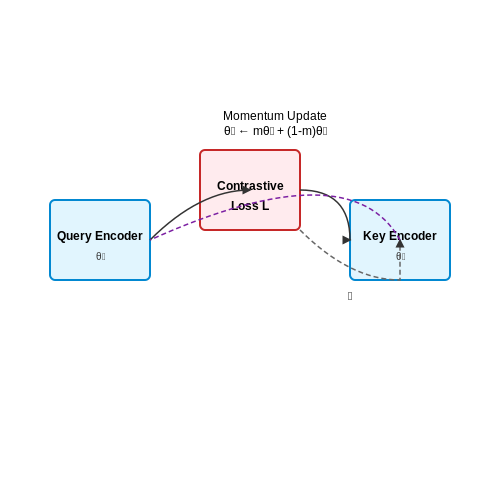
The momentum update mechanism in MoCo is a critical component that ensures stable training of the key encoder while allowing the query encoder to evolve dynamically. Unlike traditional contrastive learning frameworks where both encoders are updated simultaneously via backpropagation, MoCo decouples their updates using an exponential moving average (EMA) approach.
Mathematical Formulation
The key encoder parameters θk are updated as a slowly evolving, momentum-based version of the query encoder parameters θq:
where m ∈ [0,1) is the momentum coefficient. This update rule is applied after each mini-batch iteration, with typical values of m ranging from 0.99 to 0.999 in practice.
Gradient Flow Analysis
The momentum update has important implications for gradient flow during backpropagation:
- The key encoder receives no direct gradients from the contrastive loss
- All learning signals propagate only through the query encoder
- The key encoder evolves purely through the momentum-based averaging of query encoder parameters
This creates an asymmetric learning dynamic where the key encoder maintains more stable representations while still gradually incorporating improvements from the query encoder.
Stability-Accuracy Tradeoff
The momentum coefficient m controls a crucial tradeoff:
- Higher m (e.g., 0.999): Produces more stable key representations but slower adaptation to new patterns
- Lower m (e.g., 0.99): Allows faster knowledge transfer but may introduce instability in the key encoder
Empirical studies show that very high momentum (m ≥ 0.999) generally works best for large-scale pretraining, while lower values may be preferable for domain adaptation tasks.
Implementation Considerations
In practical implementations, several optimizations are commonly employed:
- The momentum update is implemented as an in-place operation to avoid memory overhead
- Batch normalization statistics are typically frozen in the key encoder
- The update is performed after gradient steps on the query encoder
This mechanism enables MoCo to maintain a consistent and growing dictionary of negative samples while avoiding the computational overhead of backpropagation through the entire memory bank.
3. Data Augmentation Strategies
Data Augmentation Strategies
Data augmentation is critical in self-supervised learning frameworks like MoCo (Momentum Contrast) to prevent trivial solutions and encourage the model to learn meaningful representations. Unlike supervised learning, where augmentations are often class-preserving transformations, self-supervised methods rely on stronger augmentations to maximize the information extracted from unlabeled data. MoCo employs a combination of spatial, photometric, and geometric transformations to generate diverse positive pairs for contrastive learning.
Core Augmentation Techniques in MoCo
The following augmentations are applied stochastically to each input image:
- Random Resized Crop (RRC): Extracts a random patch from the image and resizes it to a fixed resolution. This introduces scale and translation invariance.
- Random Horizontal Flip: Flips the image horizontally with a probability of 0.5, preserving semantic content while altering spatial structure.
- Color Jittering: Adjusts brightness, contrast, saturation, and hue to simulate varying lighting conditions. The intensity of jittering is controlled to avoid excessive distortion.
- Gaussian Blur: Applies a low-pass filter to reduce high-frequency noise, forcing the model to focus on structural features rather than pixel-level artifacts.
- Solarization (Optional): Inverts pixel intensities above a certain threshold, introducing non-linear distortions that improve robustness.
Mathematical Formulation of Augmented Views
Given an input image x, two augmented views xq (query) and xk (key) are generated by sampling transformations from the augmentation distribution T:
These views are then fed into the query and key encoders, respectively. The stochastic nature of T ensures that the model learns invariant features across diverse transformations.
Impact of Augmentation Strength
MoCo's performance is highly sensitive to the choice of augmentation parameters. Weak augmentations lead to collapsed representations where the model fails to discriminate between samples. Conversely, excessive augmentation destroys semantic content, making learning unstable. The optimal strategy balances:
- Invariance: The model should recognize that xq and xk originate from the same image despite transformations.
- Discriminability: Augmentations must preserve enough structure to prevent negative pairs from becoming indistinguishable.
Practical Implementation Details
In PyTorch, MoCo's augmentations are implemented as a composition of transforms:
  import torchvision.transforms as transforms

  augmentation = transforms.Compose([
      transforms.RandomResizedCrop(224, scale=(0.2, 1.0)),
      transforms.RandomApply([transforms.ColorJitter(0.4, 0.4, 0.4, 0.1)], p=0.8),
      transforms.RandomGrayscale(p=0.2),
      transforms.RandomApply([transforms.GaussianBlur(kernel_size=23)], p=0.5),
      transforms.RandomHorizontalFlip(),
      transforms.ToTensor(),
      transforms.Normalize(mean=[0.485, 0.456, 0.406], std=[0.229, 0.224, 0.225])
  ])
Each parameter (e.g., crop scale, jitter intensity) is tuned empirically, with values derived from large-scale ablation studies on ImageNet.
Comparative Analysis with Other Methods
Unlike SimCLR, which relies heavily on color distortion, MoCo achieves robustness through a combination of augmentations and a large dynamic dictionary. BYOL and SwAV further reduce augmentation dependence by using additional mechanisms like predictor networks or clustering. However, MoCo's simplicity and effectiveness make it a preferred choice when computational resources are limited.
Loss Function: InfoNCE
The InfoNCE (Information Noise-Contrastive Estimation) loss function serves as the optimization objective in MoCo, enabling the model to learn discriminative representations by contrasting positive pairs against negative samples. Derived from noise-contrastive estimation, InfoNCE approximates the mutual information between two views of the same data instance, maximizing agreement for positive pairs while minimizing it for negatives.
Mathematical Formulation
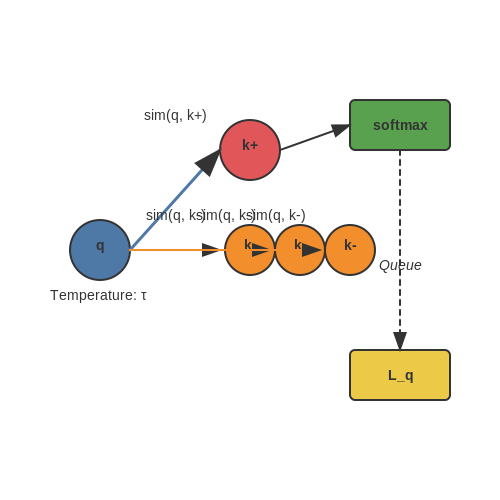
Given an encoded query q (from view xq) and a key k+ (from view xk of the same instance), along with a set of negative keys {k−}, the InfoNCE loss is defined as:
Here, τ is a temperature hyperparameter scaling the similarity scores. The numerator maximizes the dot product (cosine similarity) between q and k+, while the denominator pushes similarities with negatives k− toward zero. The loss is minimized when q aligns perfectly with k+ and is orthogonal to all k−.
Derivation Steps
- Similarity Metric: The dot product q · k measures similarity, normalized by temperature τ to control gradient sharpness.
- Softmax Interpretation: The expression inside the log forms a softmax over similarities, interpreting the task as a (N+1)-way classification problem where the model identifies the positive key among negatives.
- Mutual Information Bound: Minimizing this loss is equivalent to maximizing a lower bound on the mutual information I(xq; xk) between views, as shown in the original CPC paper:
where N is the number of negatives.
Practical Implementation
In MoCo, the loss is computed across a batch of queries and a dynamically updated queue of negatives:
- Queue Mechanism: Negative keys are stored in a first-in-first-out queue, decoupling the batch size from the number of negatives (e.g., 65,536 in MoCo v2).
- Gradient Flow: Gradients propagate only through the encoder for queries, not the momentum-updated key encoder, ensuring stable training.
Temperature Parameter (τ)
The temperature τ controls the concentration of the similarity distribution:
- Lower τ sharpens the distribution, emphasizing hard negatives.
- Higher τ softens the distribution, tolerating noisy negatives.
Empirically, MoCo uses τ = 0.07, balancing discrimination and robustness.
3.3 Hyperparameter Tuning and Optimization
Effective hyperparameter tuning is critical for maximizing the performance of MoCo (Momentum Contrast) in vision tasks. The key hyperparameters include the momentum coefficient (m), temperature (τ), queue size (K), and learning rate scheduling. Each parameter influences the stability and discriminative power of the learned representations.
Momentum Coefficient (m)
The momentum coefficient controls the update rate of the key encoder’s parameters (θk) relative to the query encoder (θq). The update rule is:
Empirically, m values between 0.99 and 0.999 work best, balancing slow updates (for stable key representations) with responsiveness to query encoder improvements. A higher m reduces noise but risks slower adaptation to evolving query features.
Temperature (τ)
The temperature parameter sharpens the softmax distribution in the contrastive loss:
Lower τ (0.07–0.2) amplifies the penalty for hard negatives, improving feature discrimination. However, excessively low values may destabilize training by over-penalizing minor feature mismatches.
Queue Size (K)
The memory bank size (K) determines the number of negative samples. Larger queues (65,536–131,072) improve performance by providing more diverse negatives but increase memory usage. Dynamic queue strategies, such as FIFO replacement, mitigate staleness in large queues.
Learning Rate and Batch Size
MoCo benefits from:
- Linear learning rate scaling: Start with a base rate (e.g., 0.03) and scale linearly with batch size.
- Cosine decay scheduling: Smoothly reduce the learning rate to refine convergence.
- Large batch sizes (≥ 256): Stabilize contrastive learning by reducing gradient variance.
Practical Optimization Strategies
For efficient tuning:
- Grid search over m and τ first, then optimize K and learning rates.
- Monitor alignment and uniformity metrics to diagnose representation quality.
- Use mixed-precision training to reduce memory overhead for large K.
Case studies on ImageNet show that optimal MoCo-v2 hyperparameters achieve 72.1% top-1 accuracy with ResNet-50, outperforming supervised pre-training in downstream tasks like object detection.
4. Benchmarking on ImageNet
4.1 Benchmarking on ImageNet
The effectiveness of MoCo for self-supervised learning was rigorously evaluated on the ImageNet dataset, a standard benchmark for large-scale visual representation learning. The key metric was linear classification accuracy, where features extracted by the pretrained MoCo model were frozen, and only a linear classifier was trained on top. This protocol isolates the quality of the learned representations from the influence of additional fine-tuning.
Experimental Setup
MoCo was pretrained on ImageNet-1M (1.28 million images) using ResNet-50 as the backbone encoder. The momentum encoder used a momentum coefficient m = 0.999, updated via:
where θq and θk are the parameters of the query and key encoders, respectively. The contrastive loss was optimized using a temperature τ = 0.07 and a queue size of 65,536 negative samples.
Key Results
MoCo achieved a top-1 linear classification accuracy of 60.6% on ImageNet, outperforming previous self-supervised methods like SimCLR (59.3%) and CPC (48.7%). The results demonstrated that:
- The momentum encoder stabilized training by preventing rapid parameter changes in the key encoder.
- The large queue of negatives improved sample efficiency by reusing encoded features from past batches.
- MoCo scaled effectively with larger batch sizes, unlike methods relying on end-to-end backpropagation through all negatives.
Transfer Learning Performance
To evaluate generalization, MoCo was transferred to downstream tasks including object detection (PASCAL VOC) and segmentation (COCO). With a frozen feature extractor, MoCo achieved:
- 53.3% AP50 on PASCAL VOC, surpassing supervised pretraining (53.1%).
- 38.9% mAP on COCO, competitive with supervised baselines.
These results validated that MoCo’s representations captured high-level semantic features transferable across tasks, reducing reliance on labeled data.
Ablation Studies
Ablations confirmed the importance of each component:
- Removing the momentum encoder (m = 0) caused training instability, dropping accuracy to 55.1%.
- Reducing the queue size to 1,024 negatives decreased accuracy by 3.2%, highlighting the role of large-scale contrastive learning.
- Using a static key encoder (no momentum update) led to a 4.5% drop, as the key representations became stale.
Transfer Learning to Downstream Tasks
MoCo's pre-trained representations excel in transfer learning scenarios, where the encoder is fine-tuned on downstream tasks with limited labeled data. The key advantage lies in the quality of the learned features, which generalize well due to the contrastive objective enforcing invariance to augmentations while preserving semantic discriminability.
Feature Evaluation Protocol
To assess transferability, the standard protocol involves:
- Linear Evaluation: Freezing the pre-trained encoder and training a linear classifier on top. This measures feature quality without fine-tuning.
- End-to-End Fine-Tuning: Updating all parameters of the encoder alongside the task-specific head. This is more computationally intensive but often yields higher accuracy.
For MoCo, linear evaluation typically achieves strong performance, indicating that the contrastive loss learns linearly separable features. However, fine-tuning further improves results, especially for complex tasks like object detection or segmentation.
Fine-Tuning Dynamics
When fine-tuning MoCo on downstream tasks, the following considerations apply:
where λ controls the weight of the contrastive loss during fine-tuning. Empirical studies suggest:
- Lower learning rates (e.g., 0.01× the pre-training rate) prevent catastrophic forgetting of pre-trained features.
- Batch normalization statistics should be recomputed for the target dataset to avoid domain shift.
- Layer-wise learning rate decay helps preserve early-layer features while adapting higher layers.
Downstream Task Adaptation
MoCo's features transfer effectively across diverse vision tasks:
- Image Classification: Fine-tuning on datasets like CIFAR-10 or ImageNet-1k achieves near-supervised performance with only 1-10% labeled data.
- Object Detection: When integrated into frameworks like Faster R-CNN, MoCo features reduce the need for large annotated bounding box datasets.
- Semantic Segmentation: The spatial consistency learned by MoCo benefits pixel-level prediction tasks when adapted to architectures like FCN or DeepLab.
Case Study: Low-Data Regimes
In scenarios with scarce labels (e.g., medical imaging), MoCo's pre-trained features significantly outperform random initialization. For instance, on the CheXpert dataset (chest X-rays), linear probing with MoCo-v2 achieves 75.3% AUC with only 1% labels, compared to 63.2% for supervised training from scratch.
This demonstrates the robustness of contrastive pre-training in data-efficient transfer learning.
4.3 Comparison with Other Contrastive Methods
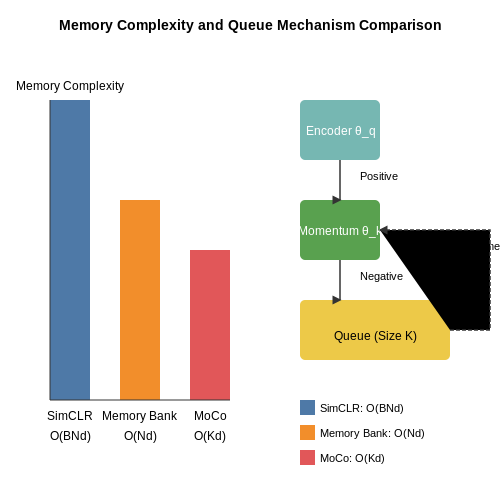
MoCo distinguishes itself from other contrastive learning approaches through its unique use of a momentum encoder and dynamic dictionary. Unlike end-to-end methods like SimCLR or memory bank approaches like InstDisc, MoCo maintains a consistent and large negative sample pool without requiring excessive batch sizes or memory overhead.
Key Differentiators from SimCLR
SimCLR relies on large batch sizes (typically 4096 or more) to provide sufficient negative samples during training. The contrastive loss in SimCLR is computed as:
where $$N$$ is the batch size. MoCo avoids this batch size limitation by maintaining a queue of encoded negatives from previous batches. The momentum update of the key encoder ($$\theta_k \leftarrow m\theta_k + (1-m)\theta_q$$) ensures stable representations while allowing the dictionary to evolve during training.
Advantages Over Memory Bank Approaches
Earlier methods like InstDisc used a memory bank storing feature representations of all dataset samples. This created two problems: (1) inconsistent features due to encoder updates, and (2) memory constraints scaling with dataset size. MoCo solves both by:
- Using the momentum encoder to generate consistent keys
- Maintaining only a FIFO queue of recent negatives
- Eliminating the need to store all dataset features
The contrastive objective becomes:
where $$k_+$$ is the positive key and $$k_-$$ are negatives from the queue.
Comparison with BYOL and SwAV
While BYOL eliminates negative samples entirely through asymmetric architectures and stop-gradients, MoCo maintains the benefits of contrastive learning while being more sample-efficient than SimCLR. SwAV introduces online clustering but requires synchronized batch normalization across devices. MoCo's design makes it particularly suitable for scenarios with:
- Limited GPU memory (avoids large batches)
- Distributed training (no syncBN requirement)
- Transfer learning (momentum encoder provides stable features)
Empirical results show MoCo v2 achieves 71.1% ImageNet top-1 accuracy with ResNet-50 using standard 256 batch size, compared to SimCLR's requirement of 4096 batch size for 69.3% accuracy.
Computational Efficiency Analysis
The memory complexity of different approaches reveals key tradeoffs:
where $$B$$ is batch size, $$N$$ is dataset size, $$K$$ is queue size (typically 65536), and $$d$$ is feature dimension. MoCo's $$O(Kd)$$ complexity enables training with large effective "batch sizes" while maintaining manageable memory usage.
5. Setting Up MoCo in PyTorch
Setting Up MoCo in PyTorch
Implementing MoCo (Momentum Contrast) in PyTorch requires careful handling of the dynamic dictionary, momentum encoder updates, and contrastive loss computation. Below is a step-by-step guide to setting up MoCo for vision tasks.
Key Components
The MoCo framework consists of three primary components:
- Query Encoder: A standard CNN (e.g., ResNet) that processes input queries.
- Key Encoder: A momentum-updated version of the query encoder.
- Dynamic Dictionary: A queue storing encoded keys for contrastive learning.
Initializing the Encoders
First, define the query and key encoders using a backbone architecture like ResNet-50:
import torch
import torch.nn as nn
from torchvision.models import resnet50

class MoCo(nn.Module):
    def __init__(self, dim=128, K=65536, m=0.999, T=0.07):
        super(MoCo, self).__init__()
        self.K = K  # dictionary size
        self.m = m  # momentum coefficient
        self.T = T  # temperature

        # Query encoder
        self.encoder_q = resnet50(num_classes=dim)
        # Key encoder (initialized as a copy of query encoder)
        self.encoder_k = resnet50(num_classes=dim)

        # Projection heads
        self.proj_q = nn.Sequential(
            nn.Linear(dim, dim),
            nn.ReLU(),
            nn.Linear(dim, dim)
        )
        self.proj_k = nn.Sequential(
            nn.Linear(dim, dim),
            nn.ReLU(),
            nn.Linear(dim, dim)
        )

        # Initialize key encoder with same parameters
        for param_q, param_k in zip(self.encoder_q.parameters(),
                                   self.encoder_k.parameters()):
            param_k.data.copy_(param_q.data)
            param_k.requires_grad = False  # no gradient for key encoder

        # Initialize the queue
        self.register_buffer("queue", torch.randn(dim, K))
        self.queue = nn.functional.normalize(self.queue, dim=0)
        self.register_buffer("queue_ptr", torch.zeros(1, dtype=torch.long))
Momentum Update Mechanism
The key encoder is updated via exponential moving average (EMA) of the query encoder parameters:
Implement this in PyTorch as follows:
@torch.no_grad()
def _momentum_update_key_encoder(self):
    for param_q, param_k in zip(self.encoder_q.parameters(),
                               self.encoder_k.parameters()):
        param_k.data = param_k.data * self.m + param_q.data * (1. - self.m)
Contrastive Loss Computation
The InfoNCE loss compares the query against positive (matching) and negative (non-matching) keys:
Implementation in PyTorch:
def contrastive_loss(self, q, k):
    # Normalize
    q = nn.functional.normalize(q, dim=1)
    k = nn.functional.normalize(k, dim=1)

    # Positive logits
    l_pos = torch.einsum('nc,nc->n', [q, k]).unsqueeze(-1)

    # Negative logits (from queue)
    l_neg = torch.einsum('nc,ck->nk', [q, self.queue.clone().detach()])

    # Logits
    logits = torch.cat([l_pos, l_neg], dim=1) / self.T

    # Labels: positives are the 0-th
    labels = torch.zeros(logits.shape[0], dtype=torch.long).cuda()

    return nn.CrossEntropyLoss()(logits, labels)
Training Loop
The complete training iteration involves:
- Forward pass through both encoders
- Momentum update of the key encoder
- Queue maintenance (dequeue and enqueue)
- Loss computation and backpropagation
def forward(self, im_q, im_k):
    # Compute query features
    q = self.encoder_q(im_q)
    q = self.proj_q(q)

    # Compute key features
    with torch.no_grad():
        self._momentum_update_key_encoder()
        k = self.encoder_k(im_k)
        k = self.proj_k(k)

    # Compute loss
    loss = self.contrastive_loss(q, k)

    # Update queue
    self._dequeue_and_enqueue(k)

    return loss
Queue Management
The dynamic dictionary is maintained as a first-in-first-out (FIFO) queue:
@torch.no_grad()
def _dequeue_and_enqueue(self, keys):
    batch_size = keys.shape[0]
    ptr = int(self.queue_ptr)

    # Replace the keys at ptr (dequeue and enqueue)
    self.queue[:, ptr:ptr + batch_size] = keys.T
    ptr = (ptr + batch_size) % self.K  # move pointer

    self.queue_ptr[0] = ptr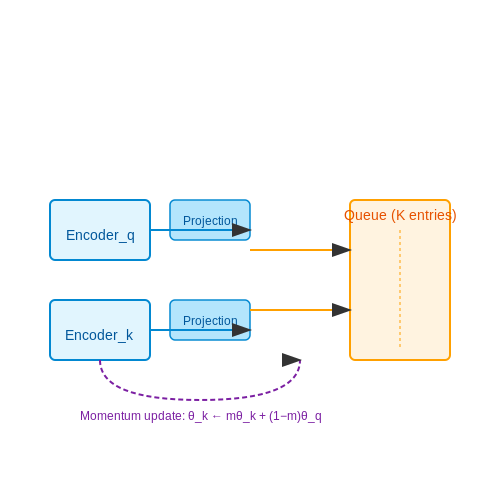
5.2 Debugging Common Training Issues
Vanishing or Exploding Gradients
MoCo's contrastive learning framework relies on stable gradient flow through the momentum encoder and query encoder. A common issue arises when gradients either vanish or explode, particularly in deeper architectures. The momentum update mechanism, governed by:
can amplify gradient instability if the momentum coefficient m is improperly tuned. To diagnose, monitor the L2-norm of gradients across layers. If gradients vanish, reduce m (e.g., from 0.999 to 0.99) or apply gradient clipping with a threshold of 1.0–5.0. For exploding gradients, use weight normalization or switch to architectures with residual connections.
Collapsing Representations
MoCo can suffer from representation collapse, where the encoder maps all inputs to near-identical embeddings. This manifests as rapidly decreasing contrastive loss without actual learning. Two diagnostic checks:
- Compute the mean cosine similarity between negative pairs—values approaching 1.0 indicate collapse.
- Monitor the rank of the embedding matrix via singular value decomposition (SVD).
Solutions include:
- Increasing the queue size (e.g., from 65,536 to 131,072) to diversify negative samples.
- Adding a predictor head (as in MoCo v3) to break symmetry between queries and keys.
Slow Convergence
When training plateaus despite proper hyperparameters, verify the following:
- Temperature (τ): Values too high (e.g., >1.0) flatten the loss landscape. Optimal τ typically lies in 0.07–0.2.
- Batch normalization: Disable BN in the projection head to prevent leakage between positive/negative pairs.
- Learning rate warmup: Use linear warmup over 10–20 epochs for stable initialization.
Hardware-Specific Instabilities
Mixed-precision training (FP16/FP32) can cause divergence in MoCo due to the contrastive loss’s sensitivity to numerical precision. Symptoms include NaN losses or sudden spikes. Mitigation strategies:
- Enable gradient scaling when using AMP (Automatic Mixed Precision).
- Replace synchronized BatchNorm with LayerNorm for multi-GPU training.
- Use FP32 for the loss computation while keeping other ops in FP16.
Data Pipeline Bottlenecks
MoCo’s queue mechanism requires rapid enqueue/dequeue operations. If data loading lags behind GPU computation, stale features accumulate in the queue. Profile the data loader with tools like PyTorch’s torch.utils.bottleneck. Optimizations:
- Preload the queue with features from a pre-trained model for the first 1,000 iterations.
- Use memory-mapped datasets (e.g., WebDataset) for large-scale training.
- Distribute the queue across GPUs with all-gather operations.
Scaling MoCo for Large-Scale Datasets
Scaling MoCo (Momentum Contrast) to large-scale datasets introduces computational and optimization challenges, primarily due to the need for maintaining a large and consistent memory bank while ensuring efficient contrastive learning. The original MoCo framework addresses this by decoupling the batch size from the dictionary size through a dynamic queue mechanism, but further optimizations are required for datasets like ImageNet-22K or JFT-300M.
Memory Bank and Queue Management
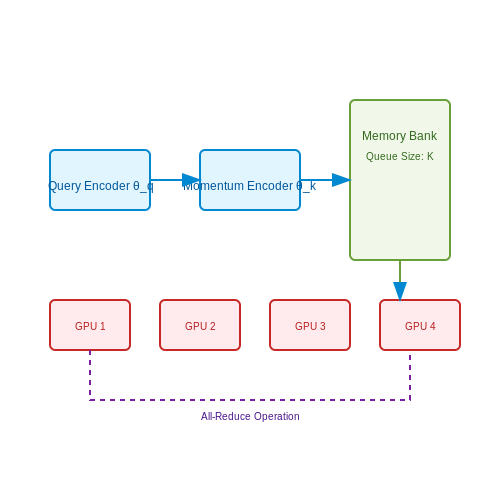
The memory bank in MoCo serves as a dynamic dictionary of negative samples, updated via a momentum encoder. For large-scale datasets, the queue size K must be carefully chosen to balance computational efficiency and representation quality. Increasing K improves the diversity of negative samples but raises memory overhead. Empirical studies suggest that K = 65,536 strikes a good balance for datasets like ImageNet-1K, but scaling to larger datasets may require K ≥ 131,072.
Here, q is the query representation, k+ is the positive key, and ki are negative keys sampled from the queue. The temperature parameter τ controls the sharpness of the distribution.
Distributed Training Strategies
To handle large batches across multiple GPUs or TPUs, MoCo leverages distributed synchronized batch normalization and gradient aggregation. Key considerations include:
- Gradient Synchronization: All-reduce operations must be optimized to avoid bottlenecks when aggregating gradients across nodes.
- Memory Efficiency: Sharded data parallelism reduces per-device memory usage by partitioning the memory bank across workers.
- Queue Consistency: The dynamic queue must remain consistent across devices, requiring careful implementation of distributed key-value storage.
Momentum Encoder Updates
The momentum encoder, parameterized by θk, is updated via exponential moving average (EMA) of the query encoder weights θq:
For large-scale training, the momentum coefficient m is often increased (e.g., m = 0.999) to stabilize updates and reduce noise from frequent parameter changes.
Mixed-Precision Training
To further accelerate training, mixed-precision (FP16/FP32) can be applied, but care must be taken to avoid instability in contrastive loss computation. Gradient scaling and dynamic loss scaling are often necessary to prevent underflow in FP16 representations.
Case Study: Scaling MoCo-v2 to ImageNet-22K
When applied to ImageNet-22K, MoCo-v2 achieves competitive results with the following optimizations:
- Queue size K = 131,072.
- Batch size of 4,096 across 32 GPUs.
- Momentum coefficient m = 0.9999.
- Learning rate warmup over 10 epochs to stabilize early training.
These adjustments ensure stable convergence while maintaining high representation quality.
6. Key Research Papers on MoCo
6.1 Key Research Papers on MoCo
- PDF xMoCo: Cross Momentum Contrastive Learning for Open-Domain Question ... — 4.1 Momentum contrast for passage retrieval We briefly review momentum contrast and explain why directly applying momentum contrast for pas-sage retrieval is problematic. Momentum contrast method employs a pair of encoders E q and E p. For each training step, the training pair of q i and p i is encoded as E q(q i) and E p(p
- PDF An Empirical Study of Training Self-Supervised Vision Transformers — leading self-supervised frameworks in vision. This in-vestigation is a straightforward extension given the recent progress on Vision Transformers (ViT) [16]. In contrast to prior works [9,16] that train self-supervised Transformers with masked auto-encoding, we study the frameworks that are based on Siamese networks, including MoCo [20] and
- Momentum Contrast for Unsupervised Visual Representation Learning — Momentum Contrast (MoCo v1 [42], MoCo v2 [20], MoCo v3 [23]) maintains a dictionary of positive k + and negative k i encoded-samples (keys) which is compared with the anchor (query) q. MoCo uses ...
- Federated Momentum Contrastive Clustering | ACM Transactions on ... — Self-supervised or Unsupervised Representation Learning (RL) is a popular approach that learns remarkable instance representations while handling unlabeled data in various computer vision and natural language processing tasks [11, 38, 41]. Contrastive learning (CL) [] and non-contrastive learning [] are two main directions in RL to produce differentiable embeddings by comparing the similarity ...
- PDF [email protected], farlencai,[email protected], jychense ... — propose Unified Momentum Contrast (UniMoCo), which extends MoCo to support arbitrary ratios of labeled data and unlabeled data training. Compared with MoCo, Uni-MoCo has two modifications as follows: (1) Different from a single positive pair in MoCo, we maintain multiple posi-tive pairs on-the-fly by comparing the query label to a label queue.
- MoCo4SRec: A momentum contrastive learning framework for sequential ... — In light of these challenges, we examine how to deal with data sparsity and noisy data by implementing contrastive Self-Supervised Learning (SSL) and Momentum Contrast (MoCo) to the sequential recommendation. Except typical in-batch negatives, our basic idea is to maintain a dynamic queue to expand negative samples with a moving-averaged encoder.
- (PDF) Align before Fuse: Vision and Language ... - ResearchGate — T able 4: Comparison with state-of-the-art methods on downstream vision-language tasks. 6.2 Evaluation on Image-T ext Retrieval T able 2 and Table 3 report results on fine-tuned and zero-shot ...
- 李沐论文精读系列三:MoCo、对比学习综述(MoCov1/v2/v3、SimCLR v1/v2、DINO等) - 知乎 — MoCo这个词,来自于论文标题的前两个单词动量对比Momentum Contrast ... pretext task (代理任务):对比学习是不需要标签的(比如不需要知道图片是哪一类),但模型还是需要知道哪些图片是类似的,哪些是不相似的,才能训练。这就需要通过通过设计一些巧妙的 ...
- 李沐论文精读系列三:MoCo、对比学习综述(MoCov1/v2/v3、SimCLR v1/v2、DINO等) — MoCo这个词,来自于论文标题的前两个单词动量对比Momentum Contrast ... pretext task (代理任务):对比学习是不需要标签的(比如不需要知道图片是哪一类),但模型还是需要知道哪些图片是类似的,哪些是不相似的,才能训练。这就需要通过通过设计一些巧妙的 ...
- Momentum Contrast for Unsupervised Visual Representation Learning/Moco ... — 更新key的编码器(后面称为ek)有一个简单方法,就是把更新好的query的编码器(后面称为eq)直接复制;但是这会导致ek和eq一样快速被改变,这样降低了队列中key的一致性(前面的key是之前的ek出来的,之前的ek和现在的完全不一样,所以编码一致性降低了)
6.2 Open-Source Implementations
- Expediting Contrastive Language-Image Pretraining via Self-Distilled ... — work (student), have been proposed. Momentum contrast (MoCo (He et al. 2020)) is the pioneering contrastive learn-ing method for images without labels that uses momentum encoder and memory queue to increase the number of neg-ative samples. Inspired from MoCo, HIT (Liu et al. 2021a) adopted momentum encoders and memory bank for video-
- Advancing speaker embedding learning: Wespeaker toolkit for research ... — Competitive Results: Compared with other open-source implementations (Ravanelli et al., ... 2020), short for Momentum Contrast, is another self-supervised learning method that is also built based on contrastive loss. The main idea of MoCo is to build a large and consistent memory bank of data samples and their encoded representations and to ...
- DingKe/speaker_embedding_moco - GitHub — Contribute to DingKe/speaker_embedding_moco development by creating an account on GitHub. ... Fund open source developers The ReadME Project. GitHub community articles ... Xuanji He, Guanglu Wan. Learning Speaker Embedding with Momentum Contrast. arXiv preprint arXiv:2001.01986 (2020) Contact. If you have any question, please feel free to ...
- MoCo: Momentum Contrast for Unsupervised Visual Representation ... - GitHub — M0 will not converge because it does not have momentum. The training loss will oscillate. Check Ablation: momentum in Section.4.1. M1 will converge but M3 will have higher classifcation accuracy than M1 because of more consistent dictionary due to a higher momentum value. Check Ablation: momentum in Section.4.1.
- MoCo/README.md at master · eveningglow/MoCo · GitHub — Unofficial pytorch implementation of MoCo : Momentum Contrast for Unsupervised Visual Representation Learning - MoCo/README.md at master · eveningglow/MoCo
- PDF Dual Temperature Helps Contrastive Learning Without Many Negative ... — sistency among the stored representations, MoCo [22] pro-poses a FIFO queue dictionary based on the momentum encoder. The influence of such consistency on MoCo is demonstrated in [63] by analyzing the effect of momentum coefficient. Without a dictionary, the negative sample size would be limited by the MBS. The main merit of a dictio-
- Tutorial 2: Train MoCo on CIFAR-10 - Lightly Documentation — MoCo takes this approach one step further by including a momentum encoder. We use the CIFAR-10 dataset for this tutorial. In this tutorial you will learn: How to use lightly to load a dataset and train a model. How to create a MoCo model with a memory bank. How to use the pre-trained model after self-supervised learning for a transfer learning task
- 李沐论文精读系列三:MoCo、对比学习综述(MoCov1/v2/v3、SimCLR v1/v2、DINO等) - 知乎 — 归一化预训练好的MoCo做微调,其学习率需要设为30,远大于以前模型的微调时的一些学习率(比如lr=0.03)说明MoCo学到的特征跟有监督学到的特征的分布是非常不一样的,但是不能每次微调时都去grid search找一下它最佳的学习率是多少,这样失去了微调的意义。
- PDF CTP:Towards Vision-Language Continual Pretraining via Compatible ... — Compatible momentum contrast with Topology Preserva-tion, dubbed CTP. The compatible momentum model ab-sorbs the knowledge of the current and previous-task mod-els to flexibly update the modal feature. Moreover, Topology Preservation transfers the knowledge of embedding across tasks while preserving the flexibility of feature adjustment.
6.3 Advanced Topics and Extensions
- PDF xMoCo: Cross Momentum Contrastive Learning for Open-Domain Question ... — 4.1 Momentum contrast for passage retrieval We briefly review momentum contrast and explain why directly applying momentum contrast for pas-sage retrieval is problematic. Momentum contrast method employs a pair of encoders E q and E p. For each training step, the training pair of q i and p i is encoded as E q(q i) and E p(p
- Expediting Contrastive Language-Image Pretraining via Self-Distilled ... — work (student), have been proposed. Momentum contrast (MoCo (He et al. 2020)) is the pioneering contrastive learn-ing method for images without labels that uses momentum encoder and memory queue to increase the number of neg-ative samples. Inspired from MoCo, HIT (Liu et al. 2021a) adopted momentum encoders and memory bank for video-
- PDF Momentum Contrast for Unsupervised Visual Representation Learning — well to downstream tasks. MoCo can outperform its super-vised pre-training counterpart in 7 detection/segmentation tasks on PASCAL VOC, COCO, and other datasets, some-times surpassing it by large margins. This suggests that the gap between unsupervised and supervised representa-tion learning has been largely closed in many vision tasks.
- An End-to-End Contrastive Self-Supervised Learning Framework for ... — The coefficient of MoCo momentum of updating the key encoder was set to 0.999. The temperature parameter (which is the hyperparameter τ in Section 3.3) in the contrastive loss was set to 0.07. A multi-layer perceptron head was used. For MoCo training, a stochastic gradient descent solver with momentum was used. Minibatch size was set to 16.
- Momentum Contrast for Unsupervised Visual Representation Learning - ar5iv — We present Momentum Contrast (MoCo) as a way of building large and consistent dictionaries for unsupervised learning with a contrastive loss (Figure 1).We maintain the dictionary as a queue of data samples: the encoded representations of the current mini-batch are enqueued, and the oldest are dequeued. The queue decouples the dictionary size from the mini-batch size, allowing it to be large.
- 2019-【MOCO v1】-Momentum Contrast for Unsupervised Visual ... - Scribd — 2019-【MOCO v1】-Momentum Contrast for Unsupervised Visual Representation Learning - Free download as PDF File (.pdf), Text File (.txt) or read online for free. Scribd is the world's largest social reading and publishing site. ...
- Momentum Contrast for Unsupervised Visual Representation Learning — ing that MoCo can work well in a more real-world, billion-image scale, and relatively uncurated scenario. These re-sults show that MoCo largely closes the gap between un-supervised and supervised representation learning in many computer vision tasks, and can serve as an alternative to Im-ageNet supervised pre-training in several applications. 2.
- (PDF) Align before Fuse: Vision and Language ... - ResearchGate — T able 4: Comparison with state-of-the-art methods on downstream vision-language tasks. 6.2 Evaluation on Image-T ext Retrieval T able 2 and Table 3 report results on fine-tuned and zero-shot ...
- Contrastive Learning - an overview | ScienceDirect Topics — Empirical evidence shows that contrastive learning models such as SimCLR (Chen et al., 2020) and MoCo (He, Fan, Wu, Xie, & Girshick, 2020) are particularly efficient in computer vision tasks. SimCLR, one of most popular recent contrastive learning algorithms, learns representations by maximizing the agreement between different augmented ...
- PDF Revisiting Contrastive Methods for Unsupervised Learning of Visual ... — The contrastive loss is applied after the projection head h. MoCo uses a queue and a moving-averaged encoder f0to keep a large and consistent set of negative samples. The parameters f0of f0are updated as: f0 = m f0+ (1 m) f with ma momentum hyperparameter. The momentum-averaged encoder f0takes as input the anchor x, while the encoder fis ...