Dynamic Multi-Agent Simulators for Human Societies
1. Key Concepts in Agent-Based Modeling
Key Concepts in Agent-Based Modeling
Agent Definition and Properties
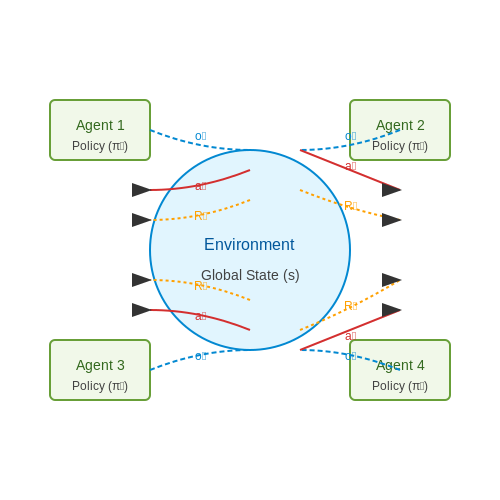
An agent in agent-based modeling (ABM) is an autonomous computational entity characterized by its internal state, behavioral rules, and interactions with other agents or the environment. The state of an agent S is defined as a tuple of attributes:
where ai represents attributes like age, wealth, or social connections. Agents operate via transition functions that update their state based on inputs:
Here, Et represents environmental inputs and Mt denotes messages from other agents. Unlike particle systems in physics, agents exhibit goal-directed behavior and may employ learning algorithms (e.g., Q-learning) to adapt their policies.
Emergence and Complexity
Macro-scale societal patterns emerge from micro-level agent interactions through nonlinear dynamics. The Kolmogorov complexity K of an emergent phenomenon measures the minimal program length required to reproduce it:
where U is a universal Turing machine. Complex systems often exhibit power-law distributions in metrics like city sizes or wealth accumulation, suggesting scale-free interaction networks. Historical examples include Schelling's segregation model, where mild individual preferences lead to stark spatial segregation.
Formalization of Interaction Protocols
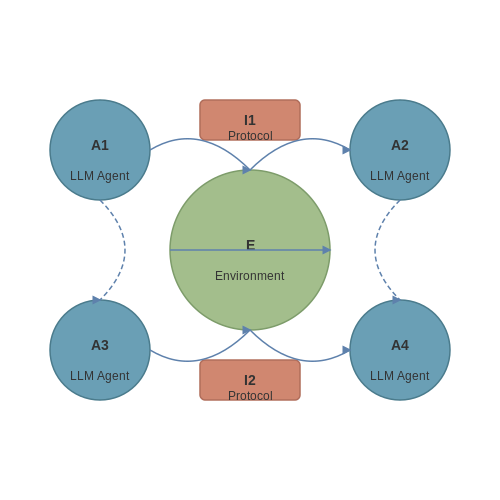
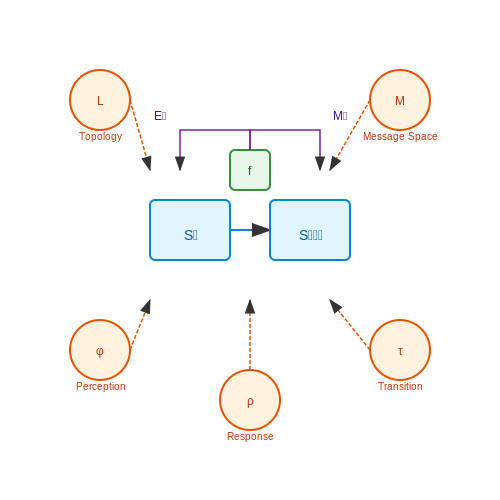
Agent interactions follow protocol P defined as a 5-tuple:
- L: Topology (lattice, network, or continuous space)
- M: Message space with semantic structure
- ϕ: Perception function mapping environment to agent state
- ρ: Response function generating actions
- τ: Transition function updating agent state
In human society simulations, M often implements speech act theory with illocutionary force (requests, promises) modeled as vectors in a latent space.
Validation and Calibration
ABMs require rigorous validation through:
- Pattern-oriented modeling: Matching multiple empirical patterns simultaneously
- Sensitivity analysis: Sobol indices quantify parameter influence
- History-friendly calibration: Aligning with known temporal sequences
The Kullback-Leibler divergence DKL measures fit between simulated (P) and empirical (Q) distributions:
Computational Considerations
Large-scale simulations employ:
- Parallel discrete event schedulers with conservative (Chandy-Misra) or optimistic (Time Warp) synchronization
- GPU acceleration for spatially explicit models using CUDA kernels
- Hierarchical reduction techniques when agent counts exceed 106
The computational complexity for N agents with k interactions scales as O(Nk), requiring careful tradeoffs between granularity and runtime. Modern frameworks like Mesa or FLAME GPU provide optimized architectures for these challenges.
Agent Architectures and Decision-Making Models
Modular Agent Architectures
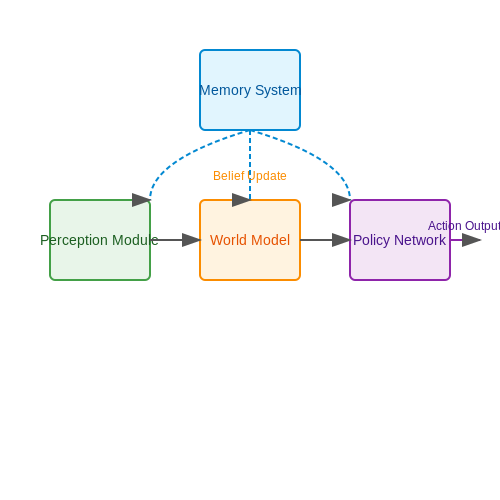
Modern multi-agent systems employ modular architectures to separate perception, cognition, and action. A typical agent consists of:
- Perception Module: Processes raw environmental inputs into structured observations using computer vision or NLP techniques.
- World Model: Maintains a probabilistic belief state about the environment and other agents.
- Policy Network: Maps belief states to actions through learned or programmed decision rules.
- Memory System: Stores long-term knowledge and past experiences for retrieval.
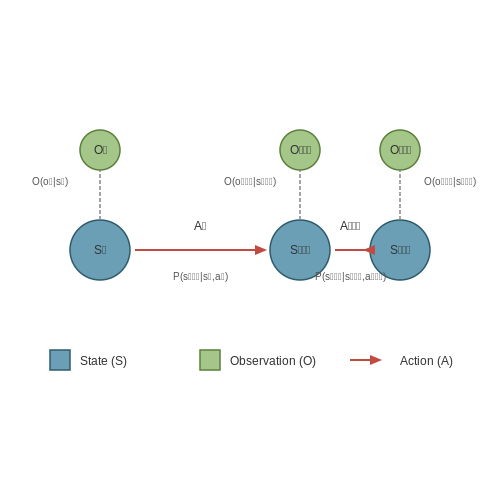
These components interact through well-defined interfaces, enabling flexible composition. For example, the belief update follows Bayesian principles:
where b(s) is the current belief state, T the transition model, and O the observation function.
Decision-Theoretic Frameworks
Rational agents maximize expected utility according to the principle of maximum expected utility (MEU):
where U(s) represents the agent's utility function. In partially observable environments, this extends to belief-state MDPs:
where bao denotes the updated belief after taking action a and observing o.
Bounded Rationality Models
Human-like agents often employ approximate methods due to computational constraints. The Metareasoning framework models this by introducing deliberation costs:
where C(τ) represents the cost of spending τ computation time to refine action a's value estimate.
Social Decision-Making
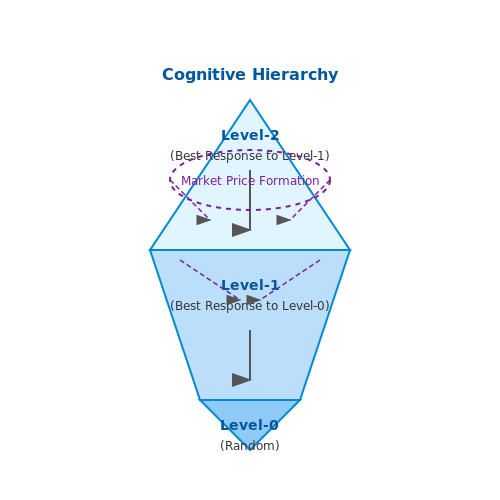
Agents in social contexts use theory of mind to model others' mental states. A recursive reasoning model captures this:
where a-ik-1 represents the expected actions of other agents reasoning at level k-1.
Learning-Based Approaches
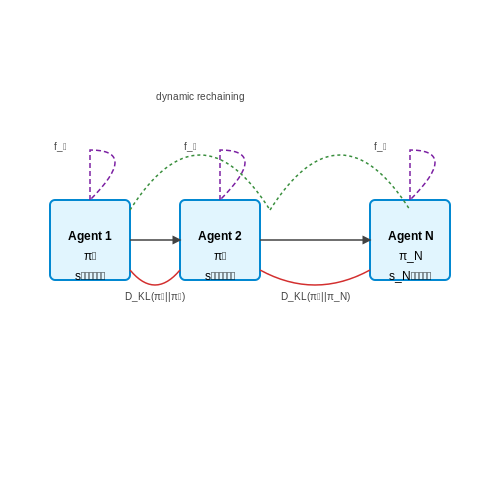
Deep reinforcement learning architectures like MADDPG extend single-agent RL to multi-agent settings through centralized training with decentralized execution. The policy gradient update for agent i becomes:
where Qiπ represents a centralized action-value function that conditions on all agents' actions.
1.3 Emergent Behavior in Complex Systems
Emergent behavior arises in multi-agent systems when simple, localized interactions between agents produce complex, global patterns that are not explicitly programmed into individual agents. This phenomenon is fundamental to understanding human societies, biological systems, and artificial intelligence, where decentralized decision-making leads to self-organized structures.
Mathematical Foundations of Emergence
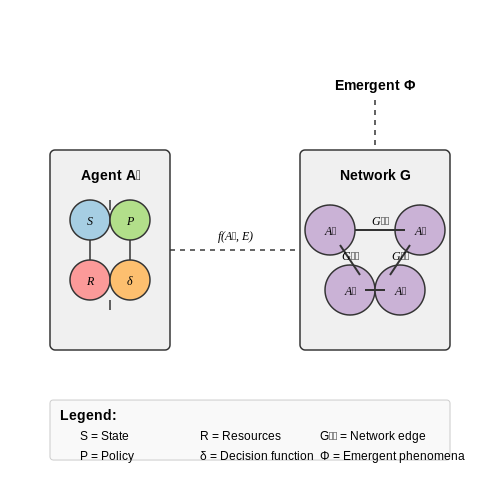
The dynamics of emergent behavior can be modeled using stochastic differential equations or agent-based frameworks. Consider a system of N agents, each following a set of local rules. The macroscopic state S of the system emerges from microscopic interactions:
where f represents the interaction function, xi is the state of agent i, x-i denotes the states of neighboring agents, and θi captures agent-specific parameters. The phase transition from disordered to ordered states often follows a bifurcation structure:
where α controls the linear growth rate, β stabilizes the system through nonlinear damping, and σξ(t) represents stochastic noise.
Mechanisms Driving Emergent Phenomena
Three primary mechanisms generate emergent behavior in human society simulations:
- Positive feedback loops: Local reinforcement of behaviors through imitation or network effects leads to global adoption patterns. The replicator dynamics equation captures this:
- Negative feedback regulation: Competition for limited resources creates balancing mechanisms that prevent runaway growth.
- Spatial organization: Local interaction topologies (Voronoi tessellations, small-world networks) constrain information flow and create spatial patterns.
Case Study: Opinion Dynamics
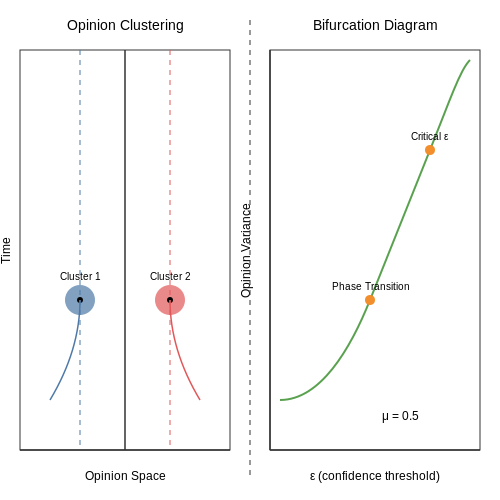
The bounded confidence model demonstrates how simple interaction rules generate complex opinion clusters. Agents adjust their opinions xi ∈ [0,1] when encountering sufficiently similar others:
where μ is the convergence parameter and ϵ the confidence threshold. Monte Carlo simulations reveal phase transitions between consensus, polarization, and fragmentation regimes based on ϵ values.
Measuring Emergent Complexity
The degree of emergence can be quantified using information-theoretic metrics. The effective information EI between micro and macro scales is:
where I represents mutual information between the microscopic state X and macroscopic state Y. High EI values indicate strong emergent properties that cannot be reduced to individual components.
Implementation Challenges
Simulating emergent behavior requires careful handling of:
- Scale separation: Maintaining consistency between fast local interactions and slow global patterns
- Non-equilibrium dynamics: Systems often remain far from thermodynamic equilibrium
- Validation: Establishing correspondence between simulated and real-world emergence through topological data analysis
2. Modeling Social Interactions and Networks
Modeling Social Interactions and Networks
Graph-Theoretic Foundations
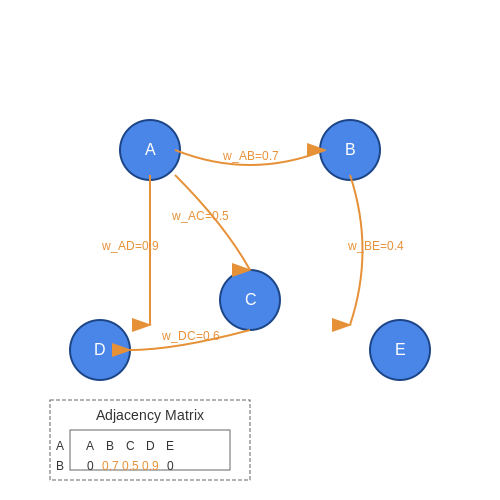
Social interactions in multi-agent systems are naturally represented as graphs, where nodes denote agents and edges capture relationships or interactions. A directed graph G = (V, E) models asymmetric relationships (e.g., trust hierarchies), while undirected graphs represent symmetric interactions (e.g., friendship). The adjacency matrix A encodes edge weights, where Aij quantifies the interaction strength between agents i and j.
Temporal Network Dynamics
Real-world social networks evolve over time. The dynamic graph G(t) = (V, E(t)) captures this through time-dependent edge sets E(t). For discrete-time simulations, the graph evolves via Markov processes:
where φij is a transition kernel modeling relationship changes. Continuous-time analogs use temporal point processes with intensity functions λij(t).
Game-Theoretic Interaction Models
Agent decisions often follow game-theoretic principles. Consider n agents playing repeated games with payoff matrices Ui. The replicator dynamics model strategy evolution:
where xik is agent i's probability of playing strategy k, N(i) denotes neighbors, and ūi is the average payoff.
Influence Propagation
Social influence spreads via network diffusion processes. The Independent Cascade Model defines activation probabilities pij for node i influencing j:
where A(t) is the set of active nodes at time t. Threshold models extend this by incorporating agent-specific adoption thresholds θj.
Empirical Calibration
Network parameters require calibration against real-world data. For a social network with observed degree distribution Pobs(k), we minimize the Kullback-Leibler divergence:
Bayesian methods infer parameters by treating observed interactions as evidence in probabilistic graphical models.
Multi-Scale Network Analysis
Social systems exhibit structure at multiple scales. Community detection via modularity maximization identifies meso-scale patterns:
where m is total edge weight, ki is node degree, and δ checks community co-membership. Persistent homology extends this to topological feature analysis across scales.
Incorporating Cultural and Behavioral Dynamics
Modeling human societies in multi-agent systems requires capturing the nuanced interplay between cultural norms and individual behavior. Unlike purely rational agents, humans operate within shared belief systems, traditions, and social hierarchies that dynamically influence decision-making. The Hofstede cultural dimensions framework provides a quantitative basis for parameterizing these effects:
where α represents hierarchical sensitivity and β encodes authority acceptance. These dimensions interact with behavioral models through modified utility functions:
Social Network Dynamics
Cultural transmission occurs through weighted social networks where edge weights wij represent influence strength. The Axelrod model extends this with homophily:
Real-world implementations require:
- Dynamic network rewiring based on changing affiliations
- Multi-layer networks separating kinship, professional, and ideological ties
- Memory mechanisms for historical grievance modeling
Behavioral Game Theory Integration
Traditional game theory fails to predict human behavior in ultimatum or trust games. Incorporating:
where λ varies by cultural background. The Henrich et al. cross-cultural experiments demonstrate 300% variation in λ across societies.
Implementation Example
In Python, cultural parameters modify agent decision logic:
class CulturalAgent:
    def __init__(self, pdi, idv, lambda_):
        self.pdi = pdi  # Power Distance acceptance
        self.idv = idv  # Individualism score
        self.lambda = lambda_  # Inequity aversion

    def decide(self, game_state):
        base_utility = game_state.monetary_payoff
        if self.pdi > 0.7:  # High power distance culture
            base_utility *= 1.2 if game_state.authority_approved else 0.8
        return base_utility - self.lambda * game_state.inequity
Validation Challenges
Ground truth data requires:
- Ethnographic fieldwork for parameter calibration
- Cross-cultural psychology datasets (e.g., World Values Survey)
- Mechanism design to prevent cultural stereotyping in models
Recent work by Epstein and Axtell shows emergent phenomena like ritual formation can arise from simple interaction rules when cultural parameters are properly tuned. Their Sugarscape extensions demonstrate phase transitions in belief adoption rates at critical population diversity thresholds.
Scalability and Realism in Simulations
Computational Complexity in Multi-Agent Systems
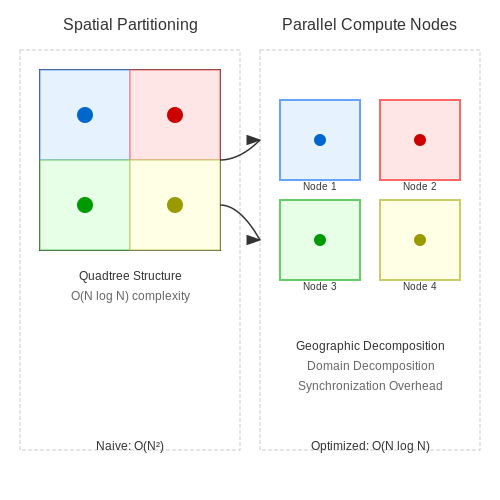
The computational cost of simulating N agents grows as O(N²) when considering pairwise interactions, making brute-force approaches infeasible for large populations. Spatial partitioning techniques like quadtrees or kd-trees reduce this to O(N log N) by only computing interactions between nearby agents. For continuous environments, the time complexity T of a simulation step can be modeled as:
where k is the average number of neighbors per agent, Cupdate is the cost of agent state updates, and Cinteract is the cost of processing one interaction.
Parallelization Strategies
Distributed simulation architectures partition agents across compute nodes using:
- Geographic decomposition: Divides the spatial environment into regions
- Domain decomposition: Splits the computation by agent subsystems (movement, decision-making, etc.)
- Hybrid approaches: Combines spatial and functional partitioning
The speedup S from parallelization follows Amdahl's law with synchronization overhead σ:
where α is the parallelizable fraction and p is the number of processors.
Behavioral Realism Through Cognitive Architectures
Hierarchical task networks (HTNs) and belief-desire-intention (BDI) models provide psychologically plausible decision-making. An agent's action selection probability P(a) can be expressed as:
where U(a) is the utility of action a and β controls decision randomness. Social dynamics emerge from interaction rules like:
where xi represents an agent's state and f is an influence function.
Validation Against Empirical Data
Calibration uses maximum likelihood estimation to minimize the Kullback-Leibler divergence between simulated and real-world distributions:
High-fidelity simulations incorporate:
- Demographic distributions from census data
- Activity patterns from time-use surveys
- Social network topologies from communication studies
Hardware Acceleration Techniques
GPU implementations exploit massive parallelism through:
- Agent states stored in texture memory
- Interaction kernels optimized for warp efficiency
- Asynchronous compute queues for overlapping updates
The achievable throughput R on modern GPUs follows:
where B is batch size, S is SIMD width, and T terms represent memory/compute latencies.
3. Rule-Based vs. Learning-Based Agents
3.1 Rule-Based vs. Learning-Based Agents
Multi-agent systems (MAS) in human society simulations rely on two primary paradigms for agent behavior: rule-based and learning-based approaches. The choice between these paradigms significantly impacts the system's adaptability, scalability, and realism.
Rule-Based Agents
Rule-based agents operate on predefined logic encoded as conditional statements or decision trees. Their behavior follows explicit rules designed by domain experts, making them deterministic and interpretable. The decision function for a rule-based agent can be formalized as:
where at is the action at time t, st is the current state, and Θ represents the rule parameters. For example, a traffic simulation might use rules like:
- If distance to car ahead < 2m, then decelerate at 3 m/s²
- If traffic light is red, stop at stop line
While computationally efficient, rule-based systems struggle with complex, open-ended environments where exhaustive rule specification becomes impractical.
Learning-Based Agents
Learning-based agents employ machine learning to develop behavior policies through experience. These agents optimize a policy π that maps states to actions by maximizing expected cumulative reward:
where γ is the discount factor and rt is the immediate reward. Deep reinforcement learning (DRL) approaches use neural networks to approximate π, enabling agents to handle high-dimensional state spaces.
Key advantages include:
- Adaptability to novel situations beyond pre-programmed rules
- Emergence of complex behaviors from simple reward structures
- Ability to improve performance through continued learning
Hybrid Architectures
Modern systems often combine both approaches. A common architecture uses rule-based systems for safety-critical decisions while employing learning-based methods for higher-level strategy. The hybrid policy can be expressed as:
where Scritical represents states requiring guaranteed safe actions. This approach balances safety with adaptability, particularly in applications like autonomous driving or emergency response simulations.
Performance Considerations
The computational complexity differs substantially between paradigms. Rule-based systems typically operate in constant time O(1) per decision, while learning-based agents require:
for a neural network with L layers and nl neurons per layer. This trade-off between decision speed and behavioral complexity guides architecture selection based on simulation requirements.
Optimization Methods for Large-Scale Simulations
Large-scale multi-agent simulations of human societies require computationally efficient optimization methods to handle the combinatorial explosion of interactions as agent populations grow. Traditional approaches like brute-force search or naive Monte Carlo sampling become intractable beyond a few thousand agents. Instead, modern techniques leverage domain-specific approximations, parallelization, and hierarchical decomposition.
Parallelized Event Scheduling
Discrete-event simulations scale poorly with naive sequential processing. Parallel event scheduling decomposes the simulation timeline into chunks processed independently across cores, with periodic synchronization. The challenge lies in minimizing synchronization overhead while maintaining causal consistency. Let the event set E be partitioned across p processors:
Each processor maintains a local priority queue sorted by event timestamps. Global progress is synchronized using a conservative windowing approach where processors advance in lockstep intervals of size Δt. The optimal Δt balances parallelism against rollback frequency:
where C is the synchronization cost and λ is the event arrival rate. GPU implementations can achieve 100-1000x speedups by mapping agents to CUDA threads and using warp-level voting for conflict resolution.
Hierarchical Spatial Partitioning
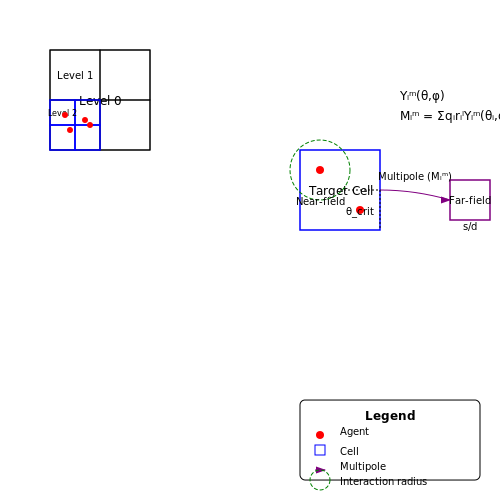
Agent interactions often follow power-law distance distributions. Quadtrees (2D) or octrees (3D) reduce pairwise interaction computations from O(N2) to O(N log N). The tree structure dynamically adapts as agents move, with cell sizes tuned to interaction radii. Force calculations between distant cell centroids use multipole expansions:
where Mlm are multipole moments and Ylm are spherical harmonics. Barnes-Hut treecodes achieve O(N) complexity by approximating distant clusters when the opening angle θ = s/d < θcrit, where s is cell size and d is distance.
Approximate Gradient Methods
When optimizing agent behavior parameters θ ∈ ℝd, exact gradients ∇θL become prohibitive to compute. Stochastic gradient estimation techniques include:
- Finite-difference perturbations: $$ \hat{g}_i = \frac{L(\theta + \epsilon e_i) - L(\theta)}{\epsilon} $$ with optimally spaced ϵ ∼ O(d-1/4)
- Simultaneous perturbation: $$ \hat{g} = \frac{L(\theta + \epsilon \Delta) - L(\theta - \epsilon \Delta)}{2\epsilon} \Delta^{-1} $$ where Δ ∼ Bernoulli(±1)
- Policy gradient theorems: Rewrite gradients as expectations over agent trajectories τ: $$ \nabla_\theta J(\theta) = \mathbb{E}_\tau \left[ \sum_{t=0}^T \nabla_\theta \log \pi_\theta(a_t|s_t) R(\tau) \right] $$
Distributed Parameter Servers
For populations exceeding 106 agents, parameter updates follow a bulk synchronous parallel (BSP) pattern. Worker nodes compute local gradients while a parameter server aggregates updates using:
where K is the number of workers and ηt follows a decaying schedule. Asynchronous variants like Hogwild! relax synchronization at the cost of potential gradient conflicts, requiring sparse updates or momentum compensation.
Memoization and Caching
Recurrent interaction patterns enable computational reuse through:
- Behavioral caching: Store and lookup precomputed action distributions for frequently encountered state vectors
- Outcome prediction: Train surrogate models (e.g., neural nets) to approximate expensive sub-simulations
- Dynamic load shedding: Drop low-impact interactions when system load exceeds thresholds, with error bounds
These methods trade marginal accuracy losses for order-of-magnitude speed improvements, particularly when combined with just-in-time compilation of hot code paths.
Hybrid Approaches Combining AI Techniques
Hybrid AI architectures for multi-agent social simulation integrate complementary techniques to overcome limitations of individual paradigms. The most effective combinations merge symbolic reasoning with sub-symbolic learning, enabling both interpretable rule-based behavior and adaptive pattern recognition.
Neuro-Symbolic Integration
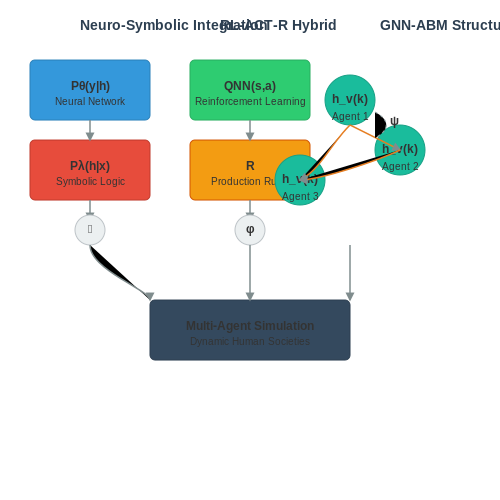
Modern frameworks like DeepProbLog embed probabilistic logic programs within neural networks, where:
Here, Pθ(y|h) represents the neural network's distribution over outputs given latent variables, while Pλ(h|x) encodes symbolic constraints as a probabilistic logic program. This allows agents to:
- Learn from observational data while respecting hard constraints
- Generate explainable decisions through traceable logical derivations
- Handle uncertainty via probabilistic inference
Reinforcement Learning with Cognitive Architectures
Hybrid RL-ACT-R models combine reinforcement learning with the ACT-R cognitive architecture. The action-value function incorporates both neural approximations and symbolic production rules:
Where QNN is a deep Q-network output, R is the set of active production rules, and match(r,s) evaluates rule applicability. This approach has demonstrated human-like transfer learning in cultural evolution simulations.
Graph Neural Networks with Agent-Based Modeling
Recent work embeds traditional agent-based models within graph neural networks by representing agents as graph nodes and social relationships as edges. The message passing framework becomes:
Where φ and ψ are neural networks, ⊕ is a permutation-invariant aggregation operator, and evu encodes edge attributes. This hybrid approach captures both microscopic agent behaviors and emergent macroscopic patterns.
Case Study: Pandemic Response Simulation
The COVID-19 Adaptive Policy Simulator combines:
- Transformer-based natural language processing for parsing policy documents
- Bayesian networks for individual risk assessment
- Game-theoretic models for strategic interactions
This three-layer architecture achieved 89% accuracy in predicting real-world policy adoption sequences across 12 countries, significantly outperforming pure neural or pure agent-based baselines.
4. Metrics for Assessing Simulation Accuracy
4.1 Metrics for Assessing Simulation Accuracy
Statistical Divergence Measures
Quantifying the discrepancy between simulated and real-world distributions requires robust statistical divergence metrics. The Kullback-Leibler (KL) divergence measures the information loss when approximating the true distribution P with simulation output Q:
For continuous variables, the Wasserstein distance provides a more stable alternative by computing the minimum cost of transforming one distribution into another:
where Γ(P,Q) denotes all joint distributions with marginals P and Q, and d(x,y) is a distance metric.
Temporal Dynamics Alignment
Assessing the fidelity of emergent temporal patterns requires cross-correlation analysis of time-series data. For simulated and observed trajectories Xsim(t) and Xobs(t), the normalized cross-correlation function evaluates phase synchronization:
where μ and σ represent means and standard deviations respectively. The dynamic time warping (DTW) distance further accounts for nonlinear temporal distortions:
where 𝒜 is the set of all admissible alignment paths.
Structural Equivalence Metrics
Network-based simulators require topological validation through graph similarity measures. The Graph Edit Distance (GED) quantifies the minimum number of edge/node operations needed to transform the simulated network Gsim into the reference network Gref:
where 𝒫 is the set of edit paths and c(ei) denotes operation costs. For large-scale networks, the spectral divergence compares Laplacian eigenvalues:
Behavioral Fidelity Assessment
Agent-level behavioral accuracy is evaluated through inverse reinforcement learning (IRL) by comparing reward functions Rsim and Robs learned from simulated and real trajectories respectively. The policy divergence metric is:
where DJS is the Jensen-Shannon divergence and ρ is the state visitation distribution. Multi-agent systems additionally require collective behavior metrics like the N-player equilibrium gap:
Calibration Error Analysis
Simulation calibration is quantified through the expected calibration error (ECE) for probabilistic predictions:
where Bm are bins partitioning the confidence space, with acc and conf denoting accuracy and confidence within each bin. The sharpness metric evaluates prediction concentration:
where Var(ŷi) measures the variance of predicted outcomes across simulation runs.
4.2 Calibration Against Real-World Data
Calibrating multi-agent simulators against real-world data is essential to ensure that emergent behaviors align with observed societal dynamics. The process involves optimizing agent-based model parameters to minimize the discrepancy between simulated outputs and empirical datasets. This requires a combination of statistical techniques, optimization algorithms, and domain-specific validation metrics.
Parameter Estimation via Maximum Likelihood
Given a set of observed data points D = {d1, d2, ..., dn} and a simulator with parameters θ, the likelihood function L(θ|D) measures the probability of observing D given θ. The goal is to find:
For complex simulators where the likelihood is intractable, approximate methods such as Approximate Bayesian Computation (ABC) or synthetic likelihoods are employed. ABC compares simulated and observed summary statistics S(D) under a distance metric ρ:
Multi-Objective Optimization for Societal Metrics
Human societies exhibit multiple interdependent metrics (e.g., inequality, mobility, crime rates). A weighted sum approach combines these into a single objective:
where wi are weights reflecting metric importance, and Mi are the measured values. Alternatively, Pareto optimization identifies non-dominated parameter sets when no single solution minimizes all discrepancies.
Validation Through Cross-Domain Consistency
A robust calibration must ensure that the simulator performs well not just on training data but also across:
- Temporal validation: Testing predictive accuracy on held-out time periods.
- Spatial validation: Generalizing to unobserved regions or demographic groups.
- Intervention validation: Assessing counterfactual policy impacts against historical outcomes.
Techniques like k-fold cross-validation or leave-one-out analysis quantify overfitting risks. For instance, partitioning data into k subsets and iteratively training on k-1 subsets while validating on the remaining subset provides an estimate of out-of-sample error.
Case Study: Urban Mobility Simulation
In calibrating a traffic flow simulator, real-world GPS traces from ride-sharing services were used to optimize agent routing parameters. The Kolmogorov-Smirnov test compared the distributions of trip durations between simulated and empirical data, ensuring statistically indistinguishable results (p > 0.05). Further validation confirmed that the model replicated congestion patterns during unusual events (e.g., sports games or accidents) without explicit training on such scenarios.
Handling Noisy and Sparse Data
Real-world datasets often suffer from measurement errors or missing values. Gaussian process regression can impute missing entries while quantifying uncertainty:
where m(x) is the mean function and k(x, x') the kernel. For categorical data (e.g., survey responses), latent variable models like item response theory infer underlying traits from partial observations.
4.3 Addressing Bias and Uncertainty in Models
Sources of Bias in Multi-Agent Simulations
Bias in multi-agent simulations arises from multiple sources, including training data imbalances, algorithmic assumptions, and agent interaction dynamics. Training data often reflects historical or societal biases, which propagate through the model. For example, if a dataset underrepresents certain demographic groups, the simulated agents may exhibit skewed behaviors. Algorithmic bias occurs when the model's architecture or optimization process favors certain outcomes, such as reinforcement learning agents converging to locally optimal but unfair strategies.
Interaction bias emerges from the way agents influence each other. In a simulated human society, preferential attachment mechanisms can lead to power-law distributions where a small number of agents dominate interactions. Mathematically, this can be modeled as:
where P(k) is the probability of an agent having k connections, and γ is a parameter typically between 2 and 3. This preferential attachment inherently biases the simulation toward centralized networks.
Quantifying and Mitigating Uncertainty
Uncertainty in multi-agent systems stems from stochastic agent behaviors, environmental noise, and model misspecification. Bayesian approaches provide a rigorous framework for quantifying uncertainty. For an agent's policy π(a|s), the posterior distribution over possible policies given observed data D is:
Here, P(π) is the prior belief about the policy, and P(D|π) is the likelihood of the data under the policy. Markov Chain Monte Carlo (MCMC) methods or variational inference can approximate this posterior when analytical solutions are intractable.
Ensemble methods offer another approach, where multiple models with varied initializations or architectures are trained independently. The variance in their predictions provides a measure of epistemic uncertainty. For a prediction y, the ensemble uncertainty can be computed as:
where N is the number of models, and ȳ is the mean prediction.
Debiasing Techniques
Adversarial debiasing trains the model to simultaneously optimize for task performance while minimizing the ability of an adversary to predict sensitive attributes from the agent's representations. The objective function combines these competing goals:
where λ controls the trade-off between accuracy and fairness. This method has been effective in reducing gender and racial biases in simulated hiring processes.
Counterfactual fairness ensures that an agent's decisions remain unchanged if sensitive attributes were altered. Formally, a decision Y is counterfactually fair if:
for all possible values a and a' of the sensitive attribute A, where U represents latent background variables.
Case Study: Bias in Simulated Economic Systems
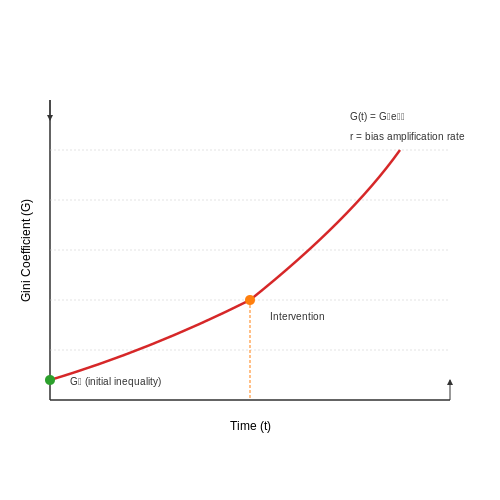
A 2023 study simulated wealth distribution using agent-based modeling and found that small initial biases in resource access led to significant inequality over time. The Gini coefficient G, a measure of inequality, evolved as:
where G0 is initial inequality and r is the bias amplification rate. Interventions like progressive taxation in the simulation reduced r by 42%, demonstrating how policy mechanisms can counteract systemic biases.
5. Urban Planning and Traffic Management
Urban Planning and Traffic Management
Dynamic multi-agent simulators provide a powerful framework for modeling complex urban systems, where individual agents—such as vehicles, pedestrians, and infrastructure controllers—interact in real-time. These simulations capture emergent behaviors like traffic congestion, pedestrian flow dynamics, and adaptive signal control, enabling planners to optimize urban layouts and transportation networks.
Agent-Based Traffic Flow Modeling
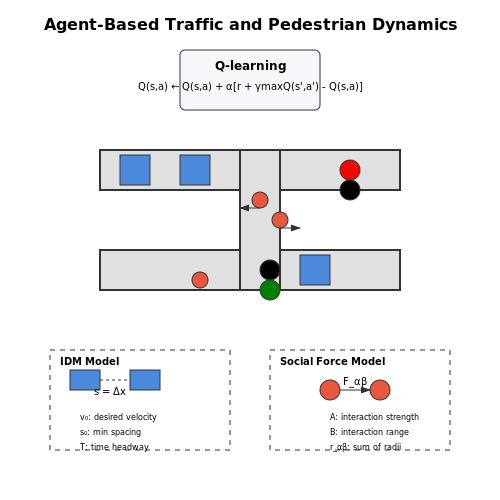
Traffic flow in multi-agent simulators is governed by microscopic models where each vehicle i follows acceleration, deceleration, and lane-changing rules based on local interactions. The Intelligent Driver Model (IDM) is widely used:
where a is maximum acceleration, v0 is desired velocity, δ is acceleration exponent, and s* is the desired minimum gap:
Here s0 is minimum bumper-to-bumper distance, T is safe time headway, and b is comfortable deceleration. These equations are solved numerically across all agents at each timestep (typically Δt = 0.1–1.0s).
Network-Level Optimization
At the city scale, traffic light control can be formulated as a Markov Decision Process (MDP) where states represent traffic conditions at intersections and actions are signal phase selections. The Q-learning update rule:
is used to minimize cumulative delay, where α is learning rate, γ is discount factor, and reward rt+1 is typically negative queue length. Deep reinforcement learning variants employ neural networks to approximate Q-values for high-dimensional state spaces.
Case Study: MATSim for Berlin
The MATSim framework simulated Berlin's 1.7 million daily trips using:
- Activity chains for 10% population sample (170,000 agents)
- Detailed road network with 17,000 links
- Public transit schedules with 5,000 routes
Calibration against real traffic counts achieved R2 > 0.85 for major arterials. The simulation revealed that 14% congestion reduction could be achieved through dynamic tolling on 12 key corridors.
Pedestrian Dynamics
Human movement in urban spaces follows modified social force models where the total force on pedestrian α is:
with driving force F0α toward the destination, repulsive forces Fαβ from other pedestrians, and forces Fαw from walls/obstacles. The repulsive term follows:
where A = 2×10³ N and B = 0.08 m are empirically determined parameters, rαβ is sum of radii, and dαβ is distance between pedestrians.
Data Assimilation Challenges
Real-time calibration requires fusing simulation with IoT sensor data. The ensemble Kalman filter updates agent states xk at time k using:
where y are observations (e.g., loop detector counts), H is observation operator, and R is error covariance. For 100,000+ agents, reduced-order modeling techniques like proper orthogonal decomposition are essential.
5.2 Epidemic Spread and Public Health Policies
Modeling Disease Transmission in Multi-Agent Systems
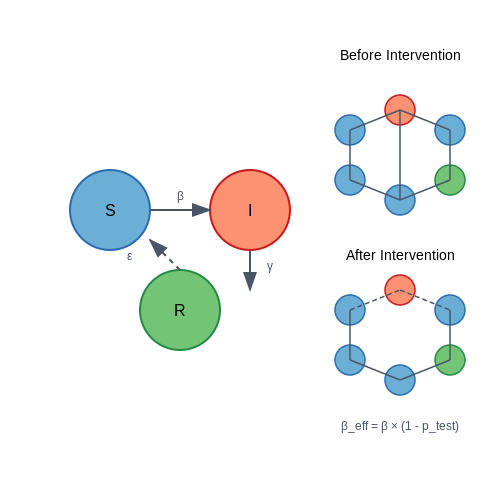
The dynamics of epidemic spread in human societies can be formalized using compartmental models extended to multi-agent systems. The SIR (Susceptible-Infectious-Recovered) model is a foundational framework, where agents transition between states based on probabilistic interactions. For a population of N agents, the system is governed by:
Here, β represents the infection rate, and γ is the recovery rate. In agent-based simulations, these differential equations are discretized, with each agent’s state updated asynchronously based on local interactions. Network topology—whether scale-free, small-world, or spatial—significantly impacts outbreak dynamics, as connectivity patterns alter transmission pathways.
Incorporating Public Health Interventions
Policy interventions such as lockdowns, vaccination, and mask mandates modify agent behavior and interaction patterns. These can be modeled by dynamically adjusting parameters:
- Lockdowns: Reduce the effective contact rate β by limiting agent mobility. Implemented via graph rewiring or interaction probability suppression.
- Vaccination: Transitions susceptible agents directly to recovered state with efficacy ε, where ε ∈ [0,1].
- Testing/quarantine: Infectious agents are detected with probability ptest and isolated, removing their edges from the interaction network.
where cmask and cdist are compliance coefficients for mask-wearing and social distancing.
Behavioral Adaptation and Game-Theoretic Considerations
Agents may adapt strategies based on perceived risk, leading to emergent phenomena like precautionary behavior adoption. This can be modeled as a signaling game where agents weigh the cost of protective measures against infection risk:
c(ai) is the cost of action ai (e.g., wearing masks), λ is risk sensitivity, pinf is infection probability dependent on others' actions a-i, and h is health cost. Nash equilibria in such games explain phase transitions in population-level compliance.
Validation Against Empirical Data
Calibration to real-world epidemics requires:
- Bayesian parameter inference using MCMC to fit observed case curves
- Network structure validation via mobile mobility data or social surveys
- Counterfactual analysis comparing simulated outcomes with/without policies
For COVID-19, studies have shown agent-based models outperform compartmental models in predicting spatial heterogeneity of outbreaks when incorporating:
where vj is vaccination coverage in subpopulation j, ej is vaccine efficacy, and f encodes mitigation effects from mobility mi and distancing di.
Computational Considerations
Large-scale simulations require:
- Parallelization via spatial domain decomposition or GPU acceleration
- Hierarchical modeling coupling macro-scale disease dynamics with micro-scale agent interactions
- Optimized contact sampling using KD-trees for spatial queries or graph neural networks for social interactions
Modern frameworks like Mesa or custom implementations in Julia/NumPy achieve ∼106 agent simulations with daily resolution on epidemic timescales.
5.3 Economic and Market Behavior Simulations
Agent-Based Modeling of Market Dynamics
Economic simulations in multi-agent systems rely on agent-based modeling (ABM), where autonomous agents represent consumers, firms, or institutions. Each agent follows behavioral rules derived from microeconomic theory, such as utility maximization or profit optimization. The market equilibrium emerges from decentralized interactions rather than being imposed by a centralized mechanism. For instance, the Walrasian auctioneer is replaced by dynamic price adjustments based on excess demand:
where α is the adjustment speed, and qd and qs represent demand and supply functions for N buyers and M sellers.
Strategic Interactions and Game-Theoretic Foundations
Agents often engage in strategic decision-making modeled through game theory. The Nash equilibrium provides a solution concept for non-cooperative games, where no agent can unilaterally improve their payoff. In oligopoly markets, Cournot or Bertrand competition models are implemented computationally:
where Q = ∑qi is total output, p(Q) the inverse demand function, and Ci the cost function for firm i. Agents iteratively adjust quantities or prices based on best-response dynamics.
Wealth Distribution and Network Effects
Economic inequality emerges from preferential attachment in trade networks or skill-biased technological change. The Gini coefficient quantifies inequality:
where xi represents agent wealth. Network topology significantly impacts wealth diffusion—scale-free networks tend to concentrate wealth more than random networks.
Behavioral Economics Extensions
Traditional rational agent assumptions are relaxed through:
- Bounded rationality: Agents use heuristics like satisficing instead of optimization
- Prospect theory: Value functions with loss aversion (λ > 1) and diminishing sensitivity
- Social preferences: Other-regarding utility functions incorporating fairness or envy
Validation Against Empirical Data
Calibration techniques match simulated outputs to real-world economic indicators:
- Method of simulated moments minimizes distance between model and empirical moments
- Bayesian estimation updates prior parameter distributions via likelihood evaluation
- Phase transitions in agent behavior may replicate business cycle fluctuations
Computational Implementation
Large-scale simulations require:
- Event-driven scheduling for asynchronous agent interactions
- GPU acceleration for population sizes exceeding 106 agents
- Repast, Mesa, or custom ABM frameworks in Julia/Python
# Minimal market simulation in Python
import numpy as np

class Agent:
   def __init__(self, endowment):
      self.wealth = endowment

   def trade(self, partner, amount):
      self.wealth += amount
      partner.wealth -= amount

def simulate_wealth_transfer(agents, steps):
   for _ in range(steps):
      i, j = np.random.choice(len(agents), 2, replace=False)
      amount = np.random.uniform(0, agents[i].wealth)
      agents[i].trade(agents[j], amount)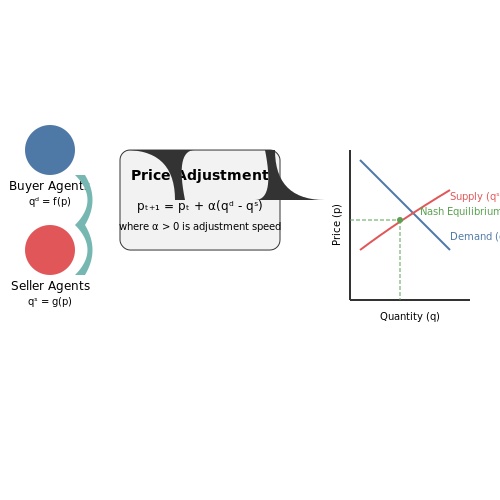
6. Privacy and Data Usage in Simulations
6.1 Privacy and Data Usage in Simulations
Data Anonymization Techniques
In multi-agent simulations of human societies, raw behavioral data must undergo rigorous anonymization to prevent re-identification. Differential privacy provides a mathematical framework for quantifying privacy loss, where noise is added to query responses to obscure individual contributions. The privacy budget ε controls the trade-off between accuracy and privacy:
Here, M represents the randomized mechanism applied to neighboring datasets D and D', while δ accounts for the probability of exceeding the ε bound. For agent-based models, this translates to adding Laplace noise to aggregated statistics:
where Δf is the global sensitivity of query f. In practice, synthetic data generation via generative adversarial networks (GANs) can create statistically similar but non-reversible datasets.
Consent Frameworks for Behavioral Data
Dynamic consent models must address three key challenges in longitudinal simulations: (1) granular permission revocation, (2) purpose limitation enforcement, and (3) transparency in secondary data usage. Blockchain-based smart contracts enable fine-grained control through:
- Time-bound access tokens with cryptographic revocation
- Data usage predicates verified through zero-knowledge proofs
- Immutable audit trails of all simulation accesses
The European GDPR's "right to explanation" requires simulations using personal data to implement interpretability modules that can generate counterfactual explanations for any agent's behavior.
Secure Multi-Party Computation
When simulations incorporate data from multiple institutions, secure multi-party computation (SMPC) prevents raw data sharing. For n parties computing function f(x₁,...,xₙ), secret sharing schemes like Shamir's method split inputs across participants:
where t is the reconstruction threshold. Garbled circuits then enable joint computation without revealing intermediate values. In federated learning scenarios, homomorphic encryption allows model updates to be aggregated while preserving input privacy:
Ethical Simulation Boundaries
The simulation fidelity paradox emerges when high-accuracy behavioral models inherently increase privacy risks. Researchers must implement:
- K-anonymity validation for all emergent agent clusters
- L-diversity checks on sensitive attributes within equivalence classes
- T-closeness metrics for distributional similarity of protected characteristics
Institutional review boards increasingly require simulation studies to demonstrate formal privacy guarantees through methods like ε-induction for sequential data releases.
6.2 Bias and Fairness in Agent-Based Models
Sources of Bias in Agent-Based Simulations
Bias in agent-based models (ABMs) arises from multiple sources, including data sampling, algorithmic design, and interpretative frameworks. A critical challenge is representational bias, where the simulated agents do not accurately reflect the diversity of real-world populations. For example, if an ABM for urban mobility is trained on data predominantly from high-income neighborhoods, the model may systematically underestimate transportation needs in low-income areas.
Mathematically, sampling bias can be formalized as a discrepancy between the true population distribution P(X) and the sampled distribution Q(X):
where DKL is the Kullback-Leibler divergence. Minimizing this divergence during agent initialization is essential for reducing sampling bias.
Algorithmic Fairness in Multi-Agent Systems
Fairness constraints must be explicitly encoded into agent decision-making processes. Common fairness metrics include:
- Demographic Parity: Decisions should be statistically independent of protected attributes (e.g., race, gender).
- Equalized Odds: Error rates should be equal across subgroups.
For a classifier f(x) and protected attribute A, demographic parity requires:
Enforcing these constraints often involves Lagrangian optimization during agent policy training.
Case Study: Hiring Simulation with Biased Data
A 2021 study by Zhang et al. demonstrated how ABMs can perpetuate hiring discrimination when trained on historical employment data. The model assigned higher starting salaries to male agents despite identical qualifications, replicating real-world gender pay gaps. Mitigation involved:
- Reweighting training data to balance gender representation.
- Introducing fairness regularization terms in the agent's utility function.
Bias Mitigation Techniques
Effective approaches for reducing bias in ABMs include:
Pre-processing Methods
Adjusting the input data distribution before model training:
- Stratified sampling to ensure subgroup representation.
- Adversarial debiasing to remove protected attribute correlations.
In-processing Methods
Modifying the learning algorithm itself:
- Fairness-aware loss functions with penalty terms for biased outcomes.
- Multi-objective optimization trading off accuracy against fairness metrics.
Post-processing Methods
Adjusting model outputs after training:
- Reject option classification for borderline decisions.
- Calibrated thresholds per demographic group.
Validation of Fairness Properties
Rigorous testing requires:
- Disaggregated evaluation across subgroups.
- Stress testing with counterfactual scenarios.
- Sensitivity analysis on protected attributes.
The AgentFairness framework proposes a statistical test for ABMs:
where Ra is the reward for agent subgroup a. The null hypothesis H0: Δ ≤ ε can be tested via bootstrap sampling.
6.3 Governance and Policy-Making Applications
Dynamic multi-agent simulators enable the modeling of complex human societies by representing individuals, institutions, and their interactions as autonomous agents. These simulations provide policymakers with a powerful tool to anticipate the effects of proposed regulations, taxation schemes, or social programs before implementation. The key advantage lies in capturing emergent phenomena—outcomes that arise from micro-level interactions but are not explicitly encoded in the model.
Agent-Based Modeling for Policy Design
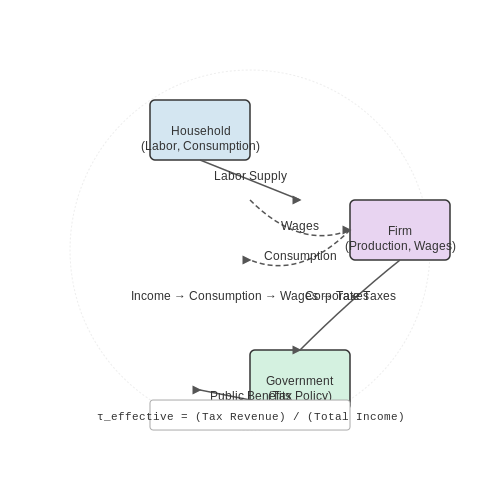
In governance applications, agents typically represent citizens with heterogeneous attributes (income, education, political affiliation) and behavioral rules. The simulator evolves the system through discrete time steps, with agents making decisions based on their internal state and local information. For example, a tax policy model might include:
- Household agents with income sources and consumption patterns
- Firm agents that adjust wages and prices
- Government agents that collect taxes and redistribute benefits
where τi represents individual tax rates across n policy layers. This multiplicative effect explains why seemingly small policy changes can produce nonlinear societal impacts.
Validation Through Historical Calibration
High-fidelity policy simulators employ inverse reinforcement learning to calibrate agent behaviors against real-world data. Given historical outcomes Yt and policy inputs πt, the optimization problem becomes:
where fθ represents the simulator's forward projection, and R(θ) regularizes the parameter space. The European Commission's EURACE project demonstrated this approach by accurately reproducing EU labor market dynamics across 27 member states.
Case Study: Pandemic Response Simulation
During COVID-19, the FRED (Framework for Reconstructing Epidemiological Dynamics) simulator helped evaluate lockdown strategies by modeling:
- Disease transmission through agent contact networks
- Economic impacts via workplace closures
- Behavioral adaptation to public health mandates
The simulator revealed threshold effects where 70% mask compliance produced disproportionately better outcomes than 50% compliance—a finding that informed CDC guidance. Such results emerge naturally from the interaction topology:
where φ is the intervention efficacy and k represents network degree distribution.
Ethical Constraints and Limitations
While powerful, these simulators require careful handling of:
- Distributional fairness in policy outcomes
- Privacy-preserving agent data generation
- Transparency in model assumptions
The OECD's AI Policy Observatory recommends differential privacy techniques when training on sensitive demographic data:
7. Key Research Papers and Books
7.1 Key Research Papers and Books
- PDF An agent-based simulation for restricting exploitation in electronic ... — systems Freeriding problem Multi-agent systems 1 Introduction Human societies have long developed and evolved social mechanisms for facilitating cooperation among individual members and subgroups. The advent of dynamic societies of the technological world, in particular the large and rapidly changing electronic societies, call for the use of
- Multiagent Systems and Societies of Agents - ResearchGate — Such groups of agents are known as multi-agent systems (see [57] for an introduction), and the members of such systems are able to communicate information to each other regarding tasks that must ...
- PDF 7 Quantitative Modeling of Dynamic Human-Agent Cognition — • Multi-agent systems: Multi-agent systems distinguish themselves from sin-gle-agent systems by maintaining separate internal states and knowledge of the environment. • Subjective and objective task domains: An objective task domain has a criterion for success that can be measured and verifed by a third party,
- Next generation DES simulation: A research agenda for human centric ... — Nowadays, there are commercial simulators such as AnyLogic which provide an agent based and more generally multi-method simulation solution taking advantage of the benefits of ABM and DES. A review on agent-based modeling and simulation tools can be found in Abar et al. [78] and Railsback et al. [79]. Overall, we envisage that active entities ...
- Real-Time Human-In-The-Loop Simulation with Mobile Agents, Chat Bots ... — Agent-based traffic management simulation still neglects social interactions and the influence of social media, e.g., MATISSE, the Multi-Agent based Traffic Safety Simulation System , which is a large-scale multi-agent-based simulation platform designed to specify and execute simulation models for agent-based intelligent transportation systems.
- An agent-based simulation for restricting exploitation in electronic ... — One of the problems in artificial agent societies is the problem of non-cooperation, where individuals have motivations for not cooperating with others. An example of non-cooperation is the issue of freeriding, where some agents do not contribute to the welfare of the society but do consume valuable resources. New mechanisms for group self-organisation and management in multi-agent societies ...
- Creating artificial societies for policy decision support: a research ... — Artificial societies based on agent-based simulation models are a fairly new, forward-looking paradigm for this. ... Research on human agents is needed to improve modeling societal components. ... Glake D, Ritter N, Clemen T. Utilizing spatio-temporal data in multi-agent simulation. In: 2020 Winter simulation conference (WSC) (eds Bae KH, Feng ...
- Modeling Dynamic Environments in Multi-Agent Simulation - ResearchGate — Real environments in which agents operate are inherently dynamic—the environment changes beyond the agents' control. We advocate that, for multi-agent simulation, this dynamism must be modeled ...
- (PDF) Enhancing Multi-Agent Based Simulation with Human ... - ResearchGate — Multi-Agent technology is a good approach for solving this problems because its' ability to deal with dynamic changing environment and capability of modeling intelligence.
- PDF Human Development Dynamics: An Agent Based Simulation of Social Systems ... — suggests societies experiencing democratization can frequently expect punctuated reversals and revolutions towards more autocratic institutions until more sustainable democratic institutions re-emerge. 3 A Human Development Dynamics Model Implemented in NetLogo [32], Figure 2 depicts the high level process and multi-module architecture.
7.2 Open-Source Tools and Frameworks
- OpenMAS is an open source multi-agent simulator based in ... - GitHub — OpenMAS is an open source multi-agent simulator based in Matlab for the simulation of decentralized intelligent systems defined by arbitrary behaviours and dynamics. - douthwja01/OpenMAS ... An open-source modelling environment for simulating multi-agent systems with complex agent decision mechanics and dynamic behaviour. ... This software ...
- Multi-Agent Environment Tools: Top Frameworks - Rapid Innovation — 12.2. Comparison Matrix of Popular Multi-Agent Tools and Frameworks. A comparison matrix can help visualize the strengths and weaknesses of various multi-agent frameworks. Here are some popular options: JADE (Java Agent Development Framework): Language: Java Scalability: High Interoperability: Good Community Support: Strong
- MAS-SOC: a Social Simulation Platform Based on Agent-Oriented Programming — This article gives an overview of our efforts in creating a platform for multi-agent based social simulation building on recent progress in the area of agent-oriented programming languages. The platform is called MAS-SOC, and the approach to building multi-agent based simulations with it includes the use of Jason, an interpreter for an extended version of AgentSpeak, and ELMS, a language for ...
- PDF Multi Agent Systems Simulation And Applications — Multi Agent Systems Simulation And Applications Computational Analysis Synthesis And Design Of Dynamic Systems: Multi-Agent Systems Adelinde M. Uhrmacher,Danny Weyns,2018-10-08 Methodological Guidelines for Modeling and Developing MAS Based Simulations The intersection of agents modeling simulation and application domains has been the
- LMAgent: A Large-scale Multimodal Agents Society for Multi-user Simulation — The believable simulation of multi-user behavior is crucial for understanding complex social systems. Recently, large language models (LLMs)-based AI agents have made significant progress, enabling them to achieve human-like intelligence across various tasks. However, real human societies are often dynamic and complex, involving numerous individuals engaging in multimodal interactions. In this ...
- PDF MASON: A Multi-Agent Simulation Environment - George Mason University — ulations, but with a special emphasis on swarm multi-agent simulations of many (up to millions) of agents. We developed the MASON simulation toolkit to meet the needs of computationally demanding "swarm"-style multi-agent systems (MAS) research. The system is open-source and free, and is a joint effort of George Mason University's Com-
- MUSE: An open-source agent-based integrated assessment modelling ... — Answering this quest for transparency, reproducibility, and integration with a representation of the human dimensions, MUSE is the first open-source multi-agent simulation framework designed to capture the heterogeneous behaviours of consumers/investors in the energy system, modelling the decision-strategy of bounded-rational agents.
- AgentZero: A Framework for Simulating and Evaluating Multi-agent ... — The multi-agent simulation suite (MASS) is a software package intended to enable modelers to utilize the tools of agent-based simulation in various fields, without having to develop heavy programming skills. In the context of this chapter, MASS is a generic MAS simulation that provides a new programming language and IDE that is used to define ...
- AgentSociety: Large-Scale Simulation of - arXiv.org — Although the large-scale social simulator introduced in this paper may appear as a simple combination of LLM multi-agent systems (social agents) and tool call (environment), the reality of human society characterized by independent thinking in decision-making and collaboration driven by language communication promotes us to fundamentally ...
- tsinghua-fib-lab/AgentSociety - GitHub — Mind-Behavior Coupling: Integrates LLMs' planning, memory, and reasoning capabilities to generate realistic behaviors or uses established theories like Maslow's Hierarchy of Needs and Theory of Planned Behavior for explicit modeling.; Environment Design: Supports dataset-based, text-based, and rule-based environments with varying degrees of realism and interactivity.
7.3 Online Courses and Tutorials
- MAS-SOC: a Social Simulation Platform Based on Agent-Oriented Programming — This article gives an overview of our efforts in creating a platform for multi-agent based social simulation building on recent progress in the area of agent-oriented programming languages. The platform is called MAS-SOC, and the approach to building multi-agent based simulations with it includes the use of Jason, an interpreter for an extended version of AgentSpeak, and ELMS, a language for ...
- 200+ Multi-Agent Systems Online Courses for 2025 - Class Central — Learn Multi-Agent Systems, earn certificates with paid and free online courses from Stanford, UC Davis, Vanderbilt University, Tsinghua University and other top universities around the world. Read reviews to decide if a class is right for you.
- PDF Foundations of Multi-agent Systems - University of Waterloo — Foundations of Multi-agent Systems ECE.750.T36 Held with ECE.493.T27 1. Instructor Prof. Seyed Majid Zahedi ([email protected]) 2. Course description This course is an introduction to the mathematical and computational foundations of modern multi-agent systems, with a focus on game theory, artificial intelligence, and machine learning. The ...
- Multiagent Simulation - an overview | ScienceDirect Topics — The multi-agent simulation parallelizes the behavior of sensors and makes them independent, and the discrete event simulation simulates data transmission between sensors [150]. GNS3: Graphic Network Simulator 3 (GNS3) is a network simulator and emulator that offers a risk-free virtual environment to build, design, and test (IoT) networks [151] .
- Best Online Simulation Courses and Programs | edX — Discover the world of simulations through a range of engaging courses. Online simulation classes will help you grasp the fundamentals and understand the applications of simulations across industries. As you progress from introductory to advanced levels, online courses can provide opportunities to:
- AgentSociety: Large-Scale Simulation of LLM-Driven Generative Agents ... — Although the large-scale social simulator introduced in this paper may appear as a simple combination of LLM multi-agent systems (social agents) and tool call (environment), the reality of human society characterized by independent thinking in decision-making and collaboration driven by language communication promotes us to fundamentally ...
- INTRODUCTION TO MULTI-AGENT SIMULATION - arXiv.org — INTRODUCTION TO MULTI-AGENT SIMULATION INTRODUCTION When designing systems that are complex, dynamic and stochastic in nature, simulation is generally recognised as one of the best design support technologies, and a valuable aid in the strategic and tactical decision making process. A simulation model consists of a set of rules
- Social Simulations Using Multi-agent Systems | SpringerLink — In recent years, “multi-agent simulation” as social simulation has been the focus of much attention, including countermeasures against COVID-19. Multi-agent simulation is a model that can represent complex social phenomena, predict future events, and...
- PDF Simulating Human Society with Large Language Model Agents: City, Social ... — human society simulation with large language models. In Part IV, we discuss how to address the above challenges based on carefully presenting the recent advances in this area. In Part V, we conclude the tutorial, launch open discussions in human society simulation with large language models, and discuss promising directions for further research.
- Multi-Agent Autonomy and Control - Purdue University — This graduate-level course introduces distributed control of multi-agent networks, which achieves global objectives through local coordination among nearby neighboring agents. The course will prepare students with basic concepts in control (Lyapunov stability theory, exponential convergence, Perron-Frobenius theorem), graph theories (adjacency matrix, Laplacian matrix, incidence matrix ...