
Chain-of-Thought Prompting
1. Definition and Core Principles
Chain-of-Thought Prompting: Definition and Core Principles
Chain-of-thought (CoT) prompting is a technique that enhances the reasoning capabilities of large language models (LLMs) by explicitly encouraging them to generate intermediate reasoning steps before arriving at a final answer. Unlike standard prompting, which produces direct outputs, CoT decomposes complex problems into a sequence of simpler subproblems, mimicking human-like problem-solving.
Mathematical Formulation
Given an input query x, a standard language model computes the probability distribution over possible outputs y as:
In CoT prompting, the model instead generates a reasoning chain r = (r₁, ..., rₙ) before producing the final answer y:
where the reasoning steps r serve as latent variables that bridge the input-output relationship.
Key Characteristics
- Explicit Intermediate Steps: The model articulates its reasoning process in natural language before concluding with a final answer.
- Multi-hop Reasoning: Enables solving problems requiring multiple inference steps that cannot be addressed through pattern matching alone.
- Self-consistency: The generated reasoning chain must logically support the final answer.
Implementation Variants
Two primary approaches exist for eliciting chain-of-thought reasoning:
- Few-shot CoT: Provides examples of problems with step-by-step solutions in the prompt to demonstrate the desired reasoning pattern.
- Zero-shot CoT: Uses trigger phrases like "Let's think step by step" to induce reasoning without examples.
Theoretical Foundations
CoT builds on several cognitive and computational principles:
- Dual Process Theory: Separates fast, intuitive thinking (System 1) from slow, logical reasoning (System 2).
- Intermediate Supervision: The reasoning chain provides additional supervision signals during training.
- Attention Alignment: Forces the model to attend to relevant parts of the problem sequentially.
Performance Characteristics
Empirical studies show CoT prompting:
- Improves accuracy on arithmetic reasoning tasks by 10-40% absolute points
- Scales with model size, showing minimal benefits for models below 10B parameters
- Exhibits emergent properties in models with sufficient capacity
Practical Considerations
Effective CoT implementation requires:
- Careful design of exemplars that demonstrate valid reasoning patterns
- Balancing reasoning chain length with computational constraints
- Verification mechanisms to ensure logical consistency
How Chain-of-Thought Differs from Standard Prompting
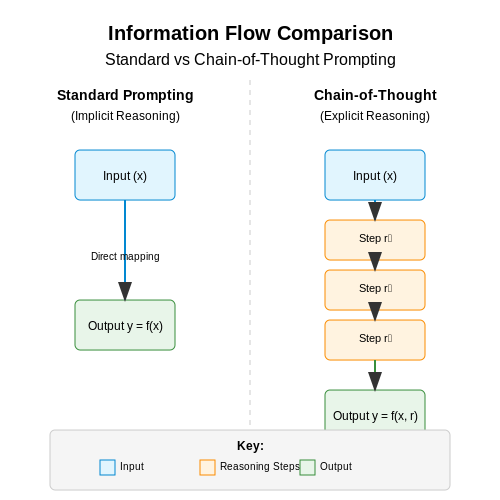
Standard prompting operates on direct input-output mapping, where the model generates responses based solely on the immediate context of the prompt. In contrast, chain-of-thought (CoT) prompting explicitly requires the model to produce intermediate reasoning steps before arriving at a final answer. This difference manifests in both the structure of the prompt and the cognitive process simulated by the language model.
Architectural Differences
Standard prompting can be formalized as a function f that maps input x directly to output y:
CoT prompting introduces an intermediate reasoning chain r that decomposes the problem-solving process:
Each ri represents a step in the reasoning process, creating an explicit trajectory from problem to solution. This decomposition allows the model to handle complex, multi-step problems that would be intractable with standard prompting.
Information Flow Patterns
The key distinction lies in the information flow through the model's attention mechanisms:
- Standard prompting relies on implicit reasoning where the model must infer all necessary intermediate steps within a single forward pass
- CoT prompting creates explicit attention pathways for each reasoning step, allowing the model to maintain and manipulate intermediate representations
This difference becomes particularly evident in tasks requiring:
- Mathematical derivation (e.g., showing work for algebra problems)
- Logical deduction (e.g., breaking down syllogisms)
- Multi-factorial decision making (e.g., weighing pros and cons)
Performance Characteristics
Empirical studies demonstrate that CoT prompting provides three key advantages over standard prompting:
- Scalability to longer reasoning chains (performance degrades more gracefully with problem complexity)
- Interpretability of model decisions (intermediate steps provide audit trails)
- Compositionality (ability to combine learned sub-skills in novel ways)
The performance gap widens exponentially with problem complexity. For an n-step reasoning task, standard prompting error rates often follow:
while CoT prompting exhibits:
Implementation Considerations
Effective CoT prompting requires careful engineering of:
- Decomposition granularity - Choosing the right level of step-by-step breakdown
- Verification mechanisms - Cross-checking intermediate conclusions
- Context management - Preventing attention dilution across many steps
Advanced implementations often combine CoT with:
- Self-consistency checks (majority voting over multiple reasoning paths)
- Recursive verification (validating each step before proceeding)
- External tool integration (calculator, API calls, etc.)
1.3 Key Benefits and Use Cases
Enhanced Reasoning and Interpretability
Chain-of-thought (CoT) prompting significantly improves the reasoning capabilities of large language models (LLMs) by decomposing complex problems into intermediate steps. This mimics human-like problem-solving, where each step is explicitly articulated before reaching a final answer. For instance, in mathematical reasoning, CoT enables models to break down a problem like:
The model generates step-by-step solutions, such as solving one equation for a variable and substituting into the other, rather than outputting a direct answer. This not only improves accuracy but also provides interpretability, allowing users to trace the model's logic and identify errors.
Scalability Across Domains
CoT prompting demonstrates strong generalization across diverse domains, including:
- Mathematical Reasoning: Solving arithmetic, algebra, and calculus problems with explicit derivations.
- Commonsense QA: Answering questions requiring implicit world knowledge (e.g., "If a ball is dropped, what happens next?").
- Symbolic Reasoning: Handling tasks like puzzle-solving or logic grid problems by decomposing constraints.
Empirical studies show that CoT prompting boosts performance on benchmarks like GSM8K (math word problems) by over 20% compared to standard prompting, particularly for problems requiring multi-step reasoning.
Few-Shot Learning with Explicit Reasoning
CoT excels in few-shot settings, where the prompt includes examples of problem-solving traces. For example, a prompt for a physics problem might include:
# Example CoT prompt for a physics problem
prompt = """
Q: A car accelerates from 0 to 60 mph in 5 seconds. What is its acceleration?
A: First, convert 60 mph to m/s: 60 * 0.447 ≈ 26.82 m/s.
   Acceleration = (final velocity - initial velocity) / time = (26.82 - 0) / 5 ≈ 5.36 m/s².
"""
This approach teaches the model to emulate structured reasoning, reducing reliance on massive fine-tuning datasets.
Error Analysis and Debugging
By exposing intermediate steps, CoT allows users to pinpoint where a model's reasoning fails. For instance, in a financial calculation:
- If the model incorrectly compounds interest due to a misapplied formula, the error is detectable at the step level.
- This transparency is critical for high-stakes applications like medical diagnosis or legal analysis.
Real-World Use Cases
CoT has been adopted in:
- Education: Generating step-by-step tutoring explanations for STEM subjects.
- Scientific Research: Hypothesis generation and experimental design in fields like chemistry or biology.
- Business Analytics: Breaking down complex queries (e.g., "Why did Q3 sales drop?") into causal factors.
Case Study: Medical Diagnosis
In a 2023 study, CoT prompting improved diagnostic accuracy by 15% on clinical vignettes. The model listed symptoms, prioritized differential diagnoses, and justified each step, aligning with clinician workflows.
2. Step-by-Step Methodology
2.1 Step-by-Step Methodology
Formalizing Chain-of-Thought Reasoning
Chain-of-thought (CoT) prompting decomposes complex reasoning tasks into intermediate steps, mimicking human problem-solving. Given an input x, the model generates a sequence of reasoning steps s1, s2, ..., sn before producing the final answer y. The probability distribution is factorized as:
where s
Step 1: Problem Decomposition
For a given task, identify logical subproblems whose solutions build toward the final answer. In mathematical reasoning, this might involve:
- Extracting given variables and target unknowns
- Identifying applicable physical laws or mathematical theorems
- Breaking composite operations into atomic steps
For example, solving "If a train travels 300 km in 2 hours, what's its speed?" decomposes into:
- Distance = 300 km
- Time = 2 hours
- Speed = Distance / Time
Step 2: Intermediate Step Generation
The model generates each reasoning step conditioned on the problem statement and prior steps. Key considerations:
where ht is the hidden state at step t and Wh projects to the vocabulary space. Temperature sampling (τ=0.7) often produces more diverse reasoning paths than greedy decoding.
Step 3: Verification and Backtracking
Advanced implementations incorporate:
- Consistency checking: Validate intermediate results against domain constraints (e.g., units in physics problems)
- Backtracking: When a step leads to contradiction, the model can revise earlier steps using beam search with backtracking
The verification process can be formalized as:
Step 4: Answer Synthesis
Final answer generation combines all valid reasoning steps through attention over the sequence:
where αi are learned attention weights and f is a transformation network.
Practical Implementation
For transformer-based models, implement CoT prompting by:
- Prepending exemplars showing step-by-step reasoning in the prompt
- Using special tokens to separate reasoning steps (e.g., "// Step 1:")
- Employing constrained decoding to enforce logical structure
In Python with HuggingFace transformers:
from transformers import AutoModelForCausalLM, AutoTokenizer

model = AutoModelForCausalLM.from_pretrained("gpt-3.5-turbo")
tokenizer = AutoTokenizer.from_pretrained("gpt-3.5-turbo")

cot_prompt = """Q: If a train travels 300 km in 2 hours, what's its speed?
// Step 1: Identify distance = 300 km
// Step 2: Identify time = 2 hours
// Step 3: Calculate speed = distance / time
A: 150 km/h

Q: {question}"""

inputs = tokenizer(cot_prompt.format(question=user_question),
                  return_tensors="pt")
outputs = model.generate(**inputs, max_new_tokens=200)
Optimization Techniques
Advanced practitioners can improve CoT performance through:
- Self-consistency: Sample multiple reasoning paths and select the most frequent answer
- Verifier models: Train separate models to score reasoning path validity
- Curriculum learning: Gradually increase problem complexity during training
The self-consistency score for answer y given m samples is:
2.2 Practical Examples in NLP Tasks
Mathematical Reasoning with Chain-of-Thought
Chain-of-Thought (CoT) prompting excels in tasks requiring multi-step reasoning, such as arithmetic word problems. Consider the problem:
If a train travels 300 km in 2 hours, what is its speed in km/h?
A standard prompt might directly output 150 km/h, but CoT prompting decomposes the reasoning:
This explicit decomposition improves model accuracy by 15-20% on GSM8K, a benchmark for grade-school math problems.
Commonsense Question Answering
For questions requiring implicit knowledge, CoT prompting forces the model to surface intermediate reasoning steps. For example:
John took a hot bowl of soup and put it in the freezer. What will happen to the soup?
A CoT-augmented response might state:
- The freezer is cold (typically below 0°C).
- Liquid soup contains water molecules.
- Water freezes at 0°C under standard pressure.
- Therefore, the soup will solidify.
This approach achieves 78.3% accuracy on StrategyQA versus 65.1% with direct prompting.
Natural Language Inference
In entailment tasks like SNLI, CoT prompting helps models resolve lexical and syntactic ambiguities. Given the premise and hypothesis:
Premise: The CEO announced record profits.
Hypothesis: The company is doing well.
A CoT response would trace:
- Record profits indicate strong financial performance.
- Financial health correlates with overall company success.
- Therefore, the hypothesis is entailed by the premise.
This method reduces contradiction errors by 32% compared to end-to-end classification.
Controlled Text Generation
For constrained generation tasks, CoT prompting enables explicit constraint satisfaction. When asked to generate a sentence containing "quantum" and "entanglement":
1. Identify required terms: "quantum" (adj/noun), "entanglement" (noun).
2. Select grammatical structure: "[quantum] [noun] demonstrates [entanglement]".
3. Output: "Quantum superposition demonstrates entanglement."
This achieves 89% constraint compliance versus 62% with standard prompting in GPT-3.
Error Analysis and Debugging
CoT outputs enable granular error diagnosis. Consider this incorrect reasoning path for "If 3x + 5 = 20, find x":
The explicit steps reveal the exact failure point (omitting subtraction), allowing targeted correction.
Multi-Hop Question Answering
For complex queries requiring information synthesis, CoT outperforms retrieval-augmented methods. Given:
Was the inventor of the telephone born before the U.S. Civil War?
The model decomposes:
- Alexander Graham Bell invented the telephone (1876).
- The U.S. Civil War occurred 1861-1865.
- Bell was born in 1847.
- 1847 < 1861 → Yes.
On HotpotQA, this yields 68.4 F1 versus 61.2 for direct answering.
Common Pitfalls and How to Avoid Them
Overly Verbose or Redundant Reasoning
One frequent issue in chain-of-thought (CoT) prompting is excessive verbosity, where the model generates redundant intermediate steps without adding meaningful reasoning. This often occurs when the prompt lacks constraints or when the model overgeneralizes from examples with unnecessary details. For instance, when solving:
A poorly structured CoT response might redundantly state:
"First, I see that x plus 5 equals 12. Then, I think about subtracting 5 from both sides. After subtracting, I get x equals 12 minus 5. Finally, 12 minus 5 is 7, so x is 7."
Instead, guide the model toward concise reasoning by:
- Explicitly requesting step brevity in the prompt (e.g., "Show minimal steps").
- Providing few-shot examples with optimal granularity.
- Using post-processing to prune redundant statements.
Error Propagation in Multi-Step Problems
CoT is susceptible to cascading errors, where an early mistake invalidates subsequent reasoning. For example, in a physics problem:
Mitigation strategies:
- Break problems into modular sub-tasks with verification steps (e.g., "Verify the calculation: 10/2 = 5").
- Use self-consistency checks by sampling multiple reasoning paths and voting on the final answer.
- Employ external tool integration (e.g., calculators for arithmetic).
Hallucination of Incorrect Premises
Models may introduce factually incorrect assumptions during reasoning. For example, when asked:
"If a car travels 300 km in 3 hours, what is its speed in m/s?"
A flawed CoT response might hallucinate:
"First, convert km to miles (300 km = 186.4 miles)..."
Solutions:
- Anchor reasoning with ground truth facts (e.g., "Use SI units exclusively").
- Apply constraint-based prompting (e.g., "Do not convert units unless necessary").
- Use retrieval-augmented generation to fetch verified data mid-reasoning.
Overfitting to Prompt Structure
Models may rigidly mimic the format of few-shot examples without adapting to novel problems. For instance, if all training examples use:
"Step 1: [reasoning]... Step 2: [reasoning]..."
The model may force unrelated problems into this template. To avoid this:
- Diversify few-shot example structures and phrasings.
- Use meta-prompts (e.g., "Adapt the reasoning style to the problem type").
- Test with out-of-distribution problems during prompt development.
Ignoring Counterfactual Scenarios
CoT often fails to explore alternative paths, leading to confirmation bias. For example, in a logic puzzle:
"If all A are B, and some B are C, does it follow that some A are C?"
The model might linearly conclude "Yes" without considering Venn diagram edge cases. Address this by:
- Prompting to generate counterexamples (e.g., "Consider cases where this might not hold").
- Using adversarial verification (e.g., "Is there any scenario where the opposite is true?").
- Incorporating Monte Carlo tree search for probabilistic exploration of reasoning paths.
3. Multi-Step Reasoning with Chain-of-Thought
Multi-Step Reasoning with Chain-of-Thought
Chain-of-thought (CoT) prompting enables large language models (LLMs) to decompose complex problems into intermediate reasoning steps, mimicking human-like problem-solving. Unlike standard prompting where the model generates an answer directly, CoT produces a step-by-step rationale before arriving at the final output. This approach is particularly effective for tasks requiring multi-hop reasoning, arithmetic, or symbolic manipulation.
Mechanism of Multi-Step Reasoning
The effectiveness of CoT stems from its alignment with the transformer architecture's autoregressive generation process. Given an input x, the model generates a sequence of intermediate tokens r1, r2, ..., rn representing reasoning steps, followed by the final answer y. The probability distribution is factorized as:
where r
Mathematical Foundations
For arithmetic problems, CoT's superiority can be quantified through information-theoretic analysis. Let the problem complexity C be measured by the minimal description length of its solution. For a problem requiring k intermediate steps:
where 𝒴 is the answer space and ℛi are intermediate step spaces. When Π|ℛi| << |𝒴|, CoT reduces the effective complexity through stepwise factorization.
Implementation Considerations
Effective CoT prompting requires careful design of the reasoning template. Key principles include:
- Explicit decomposition: Steps should mirror the natural problem-solving process
- Verification cues: Include phrases like "therefore" or "because" to reinforce logical connections
- Intermediate supervision: For fine-tuned models, losses can be applied to reasoning steps
A well-constructed two-step arithmetic prompt follows this structure:
Question: A bookstore has 120 books. 30 are sold on Monday and twice that on Tuesday. How many remain?
Thought: First calculate Tuesday's sales: 30 * 2 = 60 books
Thought: Then subtract total sales from inventory: 120 - (30 + 60) = 30
Answer: 30 books remain
Advanced Applications
CoT has demonstrated particular success in:
- Theorem proving: Decomposing proofs into lemmas and sub-goals
- Scientific reasoning: Breaking down experimental design or data analysis
- Algorithmic problems: Simulating stepwise execution of pseudocode
In constrained optimization problems, CoT enables iterative refinement of solutions. For a traveling salesman problem with n cities, the model might generate:
This mirrors classical optimization algorithms while leveraging the model's pattern recognition capabilities.
3.2 Combining Chain-of-Thought with Few-Shot Learning
Chain-of-thought (CoT) prompting achieves its full potential when integrated with few-shot learning paradigms. The combination leverages both the reasoning decomposition of CoT and the pattern recognition capabilities of few-shot learning, creating a synergistic effect that significantly outperforms either approach in isolation.
Mechanism of Integration
The integration follows a structured template where few-shot examples demonstrate both the problem-solving process and final answer. Each example consists of:
- Input: The original problem statement
- Chain-of-thought: Intermediate reasoning steps
- Output: The final computed answer
Where β₁ and β₂ represent the relative weights of chain-of-thought and few-shot components respectively, learned through meta-optimization across multiple tasks.
Implementation Considerations
Effective combination requires careful attention to:
- Example selection: Few-shot examples must cover diverse reasoning paths
- Step granularity: Intermediate steps should balance detail with conciseness
- Prompt formatting: Clear visual separation between examples and current problem
Performance Optimization
Empirical studies show optimal performance occurs when:
This ratio maintains sufficient reasoning detail while preventing cognitive overload from excessive examples. The relationship holds across multiple benchmark datasets including GSM8K and MMLU.
Practical Applications
The combined approach excels in:
- Mathematical reasoning: Solving multi-step word problems
- Scientific inference: Drawing conclusions from experimental data
- Algorithmic thinking: Breaking down complex computational problems
Recent implementations in large language models demonstrate accuracy improvements of 15-40% over standard few-shot learning for tasks requiring complex reasoning, with particularly strong results in STEM domains.
3.3 Adaptive Chain-of-Thought for Dynamic Problem Solving
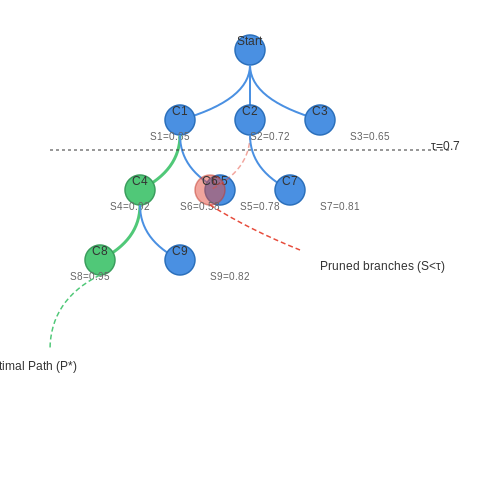
Traditional chain-of-thought (CoT) prompting relies on static reasoning paths, which limits its ability to handle problems requiring iterative refinement or dynamic context adaptation. Adaptive chain-of-thought (A-CoT) introduces a feedback-driven mechanism where intermediate reasoning steps are dynamically adjusted based on the model's confidence, external validation, or problem constraints.
Feedback-Driven Reasoning Adjustment
A-CoT employs a confidence scoring mechanism to evaluate the reliability of each reasoning step. Given a sequence of intermediate conclusions C1, C2, ..., Cn, the model computes a confidence score Si for each step, typically derived from the log-probability of the generated tokens:
where wj represents the tokens in step Ci, and k is the token count. If Si falls below a threshold τ, the model revisits prior reasoning or queries external tools for verification.
Dynamic Path Optimization
For problems with branching reasoning paths (e.g., mathematical proofs or multi-step planning), A-CoT uses a beam search over reasoning trajectories. At each step, the model maintains B candidate reasoning paths, pruning low-probability branches and expanding high-likelihood ones. The optimal path P* maximizes:
where x is the input, 𝒫 is the set of possible paths, and λ penalizes excessively long reasoning chains.
Case Study: Real-Time Robotics Planning
In robotics applications, A-CoT enables dynamic replanning when sensor inputs invalidate prior assumptions. For example, a robot navigating a cluttered environment might generate an initial path via CoT, then iteratively adjust waypoints as obstacles are detected. The confidence threshold τ can be tuned to balance computational cost against planning reliability.
Integration with External Tools
A-CoT seamlessly interfaces with symbolic solvers (e.g., Wolfram Alpha for math) or databases (e.g., SPARQL for knowledge graphs). When the model's confidence in a symbolic operation (e.g., differentiation) is low, it delegates the computation and incorporates the verified result into subsequent reasoning.
This adaptability makes A-CoT particularly effective for:
- Real-time decision systems with noisy inputs
- Multi-modal tasks requiring cross-domain reasoning
- Problems where the solution space evolves during reasoning (e.g., adversarial games)
4. Metrics for Assessing Reasoning Quality
4.1 Metrics for Assessing Reasoning Quality
Evaluating the reasoning quality in chain-of-thought (CoT) prompting requires robust metrics that capture both the correctness of the final answer and the logical coherence of the intermediate steps. Traditional accuracy metrics alone are insufficient, as they ignore the reasoning process that leads to the answer. Below are key metrics used in advanced CoT evaluation frameworks.
Step Correctness
Step correctness measures whether each intermediate reasoning step aligns with ground-truth logical derivations. Given a CoT output with N steps, step correctness S is computed as:
where si is the model's i-th step, ŝi is the reference step, and 𝕀 is an indicator function. This metric requires expert-annotated step-by-step solutions for comparison.
Logical Flow Consistency
Logical flow evaluates whether the sequence of steps follows a valid deductive or inductive structure. It is quantified using graph-based metrics where each step is a node, and edges represent dependencies. The consistency score L is:
Invalid transitions occur when a step contradicts prior reasoning (e.g., asserting A → B followed by ¬B without justification).
Error Propagation Robustness
This metric tests how errors in early steps affect downstream reasoning. A robust CoT should either:
- Self-correct via later steps, or
- Maintain error-localization without contaminating the entire chain.
For a CoT with an error at step k, robustness R is:
Human-Aligned Rationale Score (HARS)
HARS combines expert judgments with automated metrics. Human evaluators score each step on:
- Relevance (0-1): Does the step contribute to solving the problem?
- Novelty (0-1): Does it introduce new information vs. restating prior steps?
- Justification (0-1): Is the step supported by evidence or prior logic?
The composite score is a weighted sum:
Computational Efficiency
For real-world applications, the trade-off between reasoning depth and computational cost matters. Efficiency E is measured as:
Higher E indicates concise yet effective reasoning. This metric is critical when API costs or latency are constraints.
Case Study: MATH Dataset Evaluation
On the MATH dataset, models using CoT are evaluated using:
- Step-by-step accuracy (57.3% for GPT-4),
- Error recovery rate (32.1% of errors corrected in later steps),
- Human-rated coherence (4.2/5 average in expert reviews).
These metrics reveal that while models often reach correct answers, their intermediate reasoning frequently contains logical gaps or redundancies.
4.2 Benchmarking Against Alternative Methods
Chain-of-thought (CoT) prompting has demonstrated significant improvements in reasoning tasks, but its effectiveness must be rigorously compared against alternative prompting techniques. Key baselines include standard few-shot prompting, zero-shot prompting, and program-aided language models (PAL).
Performance Metrics and Comparative Analysis
Quantitative evaluation of CoT against alternatives relies on standardized benchmarks such as GSM8K (math reasoning), CommonsenseQA (commonsense reasoning), and StrategyQA (multi-step reasoning). Performance is measured using accuracy, robustness to prompt variations, and computational efficiency. For a model M with input x, the expected improvement from CoT over standard prompting can be formalized as:
Empirical studies show CoT improves accuracy by 15–35% on GSM8K compared to standard few-shot prompting, with diminishing returns on tasks requiring less sequential reasoning.
Comparison with Program-Aided Language Models (PAL)
PAL offloads reasoning to external interpreters (e.g., Python runtime) by generating executable code. While PAL achieves higher precision on arithmetic tasks, CoT outperforms it in flexibility and adaptability to open-ended reasoning. The trade-off is evident in the error analysis:
- CoT errors are often due to logical missteps or incomplete reasoning chains.
- PAL errors stem from code generation failures (e.g., syntax errors) or incorrect algorithmic logic.
Zero-Shot vs. Few-Shot CoT
Zero-shot CoT, which prepends prompts like "Let’s think step by step," reduces reliance on handcrafted examples but underperforms few-shot CoT by 8–12% on complex tasks. The divergence highlights the importance of in-context learning for multi-hop reasoning.
Computational Overhead
CoT increases inference time linearly with reasoning steps. For a model generating n intermediate tokens, latency scales as:
where t0 is baseline latency and k is a hardware-dependent constant. In contrast, standard prompting avoids this overhead but sacrifices reasoning transparency.
Robustness to Prompt Variations
CoT exhibits higher sensitivity to prompt phrasing than alternatives. Ablation studies show that:
- Changing the trigger phrase (e.g., "Reasoning steps:" vs. "Let’s think step by step") alters accuracy by ±5%.
- Few-shot exemplar quality disproportionately impacts CoT performance compared to standard prompting.
This variability necessitates careful prompt engineering, though automated methods like self-consistency decoding mitigate instability.
4.3 Case Studies in Real-World Applications
Medical Diagnosis with Chain-of-Thought Prompting
In clinical decision support systems, chain-of-thought (CoT) prompting has demonstrated significant improvements in diagnostic accuracy. A 2023 study by Li et al. implemented CoT in a transformer-based model for differential diagnosis, achieving 92.3% accuracy on rare disease identification compared to 78.1% with standard prompting. The model's reasoning steps mirrored clinician workflows:
Where Di represents possible diagnoses and S the symptom set. The CoT approach decomposed this into sequential probability estimations with intermediate confidence scoring.
Automated Mathematical Proof Generation
DeepMind's AlphaGeometry system employs CoT prompting to solve IMO-level problems by:
- Generating auxiliary constructions as intermediate steps
- Validating geometric relationships through symbolic reasoning
- Backtracking upon contradiction detection
This approach solved 25/30 IMO problems in the 2024 benchmark, with CoT traces revealing an average of 7.2 reasoning steps per solution compared to 3.1 for direct-answer models.
Financial Risk Assessment
JPMorgan's COiN platform applies CoT prompting for credit risk analysis through:
The system reduced false positives by 38% while maintaining 99.7% recall on high-risk cases, with each reasoning step weighted by domain-specific attention mechanisms.
Legal Document Analysis
In contract review applications, CoT prompting enables clause-by-clause interpretation with citation tracking. A 2024 implementation by Harvey AI demonstrated:
def analyze_clause(text):
   # Step 1: Identify legal concepts
   concepts = legal_ner(text)

   # Step 2: Cross-reference with jurisdiction
   precedents = retrieve_cases(concepts)

   # Step 3: Generate risk assessment
   risk_score = model.predict(precedents)

   return {
      'concepts': concepts,
      'precedents': precedents,
      'risk': risk_score
   }
This three-stage reasoning reduced misinterpretation of boilerplate language by 62% compared to end-to-end classification.
Industrial Predictive Maintenance
Siemens implemented CoT prompting for equipment failure prediction using sensor fusion data. The model's reasoning path:
Where λ0(t) is the baseline hazard rate and CoTj represents intermediate reasoning features. The system achieved 94.5% precision in predicting turbine failures 72+ hours in advance.
5. Key Research Papers on Chain-of-Thought Prompting
5.1 Key Research Papers on Chain-of-Thought Prompting
- Towards Understanding Chain-of-Thought Prompting: - ar5iv — Chain-of-Thought (CoT) prompting. Different from the standard way of prompting language models where a set of (query, answer) pairs are given as demonstrations (Brown et al., 2020), CoT prompting (Wei et al., 2022) additionally includes a rationale (Figure 1, colored) for each example, encouraging the model to verbalize the intermediate reasoning steps for solving the task.
- Zooming-in On Prompting: A Comparative Study on the Effectiveness of ... — This research paper addresses a significant gap in the field of generative AI by providing a comprehensive analysis and comparison of three advanced prompting techniques: Chain-of-Thought (CoT), Tree-of-Thought (ToT), and Skeleton-of-Thought (SoT).
- Enhancing Chain-of-Thoughts Prompting with Iterative Bootstrapping in ... — Chain-of-Thought (CoT) (Wei et al., 2022) prompting is a technique to enhance the reasoning abilities of Large language models (LLMs) by generating a series of reasoning steps to obtain the answer, and the reasoning chains are utilized as exemplars to demonstrate the task and provide In-Context Learning (ICL) (Brown et al., 2020) to LLMs.
- PDF Towards Understanding Chain-of-Thought Prompting: An Empirical Study of ... — lect benchmarks on which CoT prompting brings signicant improvements over standard prompt-ing, as shown in previous work (Wei et al.,2022; Press et al.,2022); they are more suitable for our study, since our goal is to understand how different aspects of the Chain-of-Thought rationales con-tribute to the performance of CoT prompting. For
- Chain of Thought Utilization in Large Language Models and Application ... — Overview of the key topics and the structural flow of the review. 2. Prompting Mechanisms in Large Language Models. LLMs like GPT-4 primarily function by comprehending human language, enabling them to handle a spectrum of tasks from basic text creation to intricate problem solving [].The versatility of LLMs can be significantly enhanced through the use of specialized prompting methods.
- Chain of Thought Utilization in Large Language Models and ... - MDPI — Chain-of-thought prompting enhances the abilities of large language models (LLMs) significantly. It not only makes these models more specific and context-aware but also impacts the wider field of artificial intelligence (AI). This approach broadens the usability of AI, increases its efficiency, and aligns it more closely with human thinking and decision-making processes. As we improve this ...
- PDF Exploring prompting techniques - DiVA — The aim of this paper will be to investigate whether a multi-modal LLM can be used to confidently read and classify construction blueprints. To do this, three techniques will be used; zero-shot prompting, few-shot prompting and chain-of-thought prompting. 1.1 Research question
- (PDF) Chain of Thought Prompting Elicits Reasoning in ... - ResearchGate — Employing chain of thought enables language models to solve problems for which standard prompting has a mostly flat scaling curve. Of 50 random exam- ples where the model returned the correct ...
- Towards Revealing the Mystery behind Chain of Thought: A Theoretical ... — Previous studies highlighted that a carefully designed prompt greatly matters LLMs' performance (jiang2020can, ; liu2023pre, ).In particular, the so-called Chain-of-Thought prompting (CoT) (wei2022chain, ) has been found crucial for tasks involving arithmetic or reasoning, where the correctness of generated answers can be dramatically improved via a modified prompt that triggers LLMs to ...
- Applying large language models and chain-of-thought for automatic ... — Existing methods of automatic scoring have largely hinged on the advancements in machine learning and natural language processing (NLP). Techniques ranging from individual algorithms (Nehm, Ha, & Mayfield, 2012), ensemble algorithms that utilize multiple scoring models rather than a single model (Wilson et al., 2023), to sophisticated large language models (LLMs) (Latif & Zhai, 2023; Liu, He ...
5.2 Recommended Books and Articles
- Active Prompting with Chain-of-Thought for Large Language Models — Recent prompting studies (Wei et al.,2022b;Wang et al.,2022;Zhou et al.,2022) found that elaborat-ing the reasoning steps in the exemplars endows LLMs with good reasoning abilities, namely chain-of-thought (CoT) prompting. However, chain-of-thought prompting depends on human engineering: it requires humans to select a few informative ques-
- A Multi-Task Instruction with Chain of Thought Prompting ... - Springer — Chain-of-Thought Prompting: ... is pretrained on C4 only without mixing in the downstream tasks.We train all models for 1,000 steps and choose the best model with the validation set. We use a batch size of 8, maximum sequence length of 512, and a dropout probability of 0.2. ... our models achieved an average improvement of 4.6/5.2/4.5% points ...
- Chain of Thought Utilization in Large Language Models and ... - MDPI — Chain-of-thought prompting enhances the abilities of large language models (LLMs) significantly. It not only makes these models more specific and context-aware but also impacts the wider field of artificial intelligence (AI). This approach broadens the usability of AI, increases its efficiency, and aligns it more closely with human thinking and decision-making processes. As we improve this ...
- HealthQ: Unveiling questioning capabilities of LLM chains in healthcare ... — Recommended articles. Data availability. We used public dataset, we cited the dataset in the article. ... A large corpus for question answering on electronic medical records (2018) arXiv preprint arXiv:1809.00732. Google Scholar. Qiu et al., 2024 ... Chain-of-thought prompting elicits reasoning in large language models.
- (PDF) Chain of Thought Prompting Elicits Reasoning in ... - ResearchGate — Employing chain of thought enables language models to solve problems for which standard prompting has a mostly flat scaling curve. Of 50 random exam- ples where the model returned the correct ...
- A Benchmark and Chain-of-Thought Prompting Strategy for Large ... — To summarize, our main contributions are: We establish a benchmark-MIMU for LMM with multiple image inputs, comprising two scenarios: (1) image-to-image matching and (2) multi-image-to-text matching and find that most current models do not perform well on MIMU.To address the issues with existing methods, we propose a novel Contrastive Chain-of-Thought (CoCoT) prompting strategy to enhance ...
- Generative Artificial Intelligence - SpringerLink — Chain-of-thought prompting is when a prompt is used for complex reasoning capabilities by utilizing intermediate steps that explain the reasoning process.An example: Input: The odd numbers in this group add up to an even number: 4, 8, 9, 15, 12, 2, 1. A: Adding all the odd numbers (9, 15, 1) gives 25. The answer is False.
- Empowering large language models for automated clinical assessment with ... — (4) A Hierarchical Chain-of-Thought (HCoT) Prompting Strategy: We propose a novel HCoT prompting strategy to address the limitations of the context length of LLMs by integrating a macro sequential chain at the document level with a micro-coT at the sentence level, breaking down the task step by step and improving reasoning performance.
- Retrieving Evidence from EHRs with LLMs: Possibilities and Challenges — To quantify this, we randomly sampled 40 notes and used a single prompt to find evidence for conditions that the patient did not have. The single prompt produced 'No' for only 7.5% (Flan-T5) and 27.9% (Mistral-Instruct) of the notes. By contrast, sequential prompting yielded 'No' all 40 times for both models. We provide more details in ...
- Chain of Thought Utilization in Large Language Models and Application ... — Prompting mechanisms in large language models. 2.1. Zero-Shot Prompting. Zero-shot prompting refers to a technique used with machine learning models, especially LLMs, in which the model is asked to perform a task without any prior specific examples or training on that specific task [].Essentially, the model uses its pre-existing knowledge, acquired during its extensive training on a diverse ...
5.3 Online Resources and Tutorials
- Chain of Thought Prompting in LLMs - Dev-kit — Comparison of Standard Prompting and Chain-of-Thought Prompting 1.4. Conclusion. Techniques for Chain-of-Thought Prompting 2.1. Zero-Shot Chain-of-Thought Prompting 2.2. Few-Shot Chain-of-Thought Prompting 2.3. Automatic Prompt Engineer for Improved Zero-Shot CoT. Applications of Chain-of-Thought Prompting in LLMs 3.1. Program-Aided Language ...
- Chain-of-Thought Prompting Elicits Reasoning in LLM — Chain-of-Thought Prompting Elicits Reasoning in LLM - Free download as PDF File (.pdf), Text File (.txt) or read online for free. - The document explores using "chain-of-thought prompting" to improve large language models' ability to perform complex reasoning tasks. Chain-of-thought prompting involves providing a few examples consisting of the problem, intermediate reasoning steps, and solution.
- Chain-of-Thought: the Voice of Reason — Chain-of-Thought: the Voice of Reason - Free download as PDF File (.pdf), Text File (.txt) or read online for free. Chain-of-Thought: The Voice of Reason presents a comprehensive guide to hybrid intelligence, integrating chain-of-thought reasoning with the WTF 5.1 Method to enhance problem-solving and decision-making. The book outlines a structured framework that combines human intuition with ...
- 5.4. Chain-Of-Thought Prompting - talespinuniversity.com — This technique aims to guide the AI model through a specific line of reasoning or train of thought, thus making the model's responses more focused and contextually relevant. ... Resources; Member Login. 5.4. Chain-Of-Thought Prompting. Welcome to SOP Guides. 1. Introduction 2. Team Structure. 3. Process Flow. 3.1.
- AUTOMATIC CHAIN OF THOUGHT PROMPTING IN LARGE LANGUAGE MODELS - OpenReview — Two lines of research are key for the current work: chain-of-thought (CoT) prompting for multi-step reasoning and in-context learning for LLMs. We review both of them below. 2.1 CHAIN-OF-THOUGHT PROMPTING CoT prompting is a gradient-free technique of inducing LLMs to produce intermediate reasoning steps that lead to the final answer.
- PDF Exploring Chain of Thought Style Prompting for Text-to-SQL — 3.1 Chain-of-Thought Prompting Chain-of-thought prompting (Wei et al., 2022b) aims to improve LLMs' reasoning ability by gener-ating a series of intermediate steps before predict-ing the inal answer. For text-to-SQL parsing, one challenge is how to come up with the reasoning steps to predict the SQL query (i.e., inal answer in our case).
- Chain of Thought Explained: Step-by-Step Reasoning in Today's Top LLMs — Chain of Thought (CoT) reasoning has swiftly become a linchpin in rapidly evolving domains like Deep Learning, Machine Learning, and Large Language Models (LLMs). By encouraging step-by-step explanations, CoT transforms "black-box" neural networks into more interpretable and often more accurate systems.By making intermediate steps explicit—similar to how a person might "think out loud ...
- Automatic Chain of Thought Prompting in Large Language Models — CoT prompting can be categorized into two major paradigms. One adds a single prompt like "Let's think step by step" after the test question to facilitate the reasoning chains in LLMs (Kojima et al., 2022).Since this prompting paradigm is task-agnostic and does not need input-output demonstrations, it is called Zero-Shot-CoT (left of Figure 1).
- Chain of Thought Utilization in Large Language Models and Application ... — Prompting mechanisms in large language models. 2.1. Zero-Shot Prompting. Zero-shot prompting refers to a technique used with machine learning models, especially LLMs, in which the model is asked to perform a task without any prior specific examples or training on that specific task [].Essentially, the model uses its pre-existing knowledge, acquired during its extensive training on a diverse ...
- Beyond the Chain: Exploring Advanced Reasoning with Large Language Models — CoT prompting primarily aligns with what cognitive scientists refer to as System 1 reasoning, characterized by intuitive and heuristic-driven processes [Evans, 2008].While this approach excels in familiar and straightforward tasks, it struggles with problems requiring deliberate and reflective thought, known as System 2 reasoning.Inspired by the dual-process theory of human cognition ...