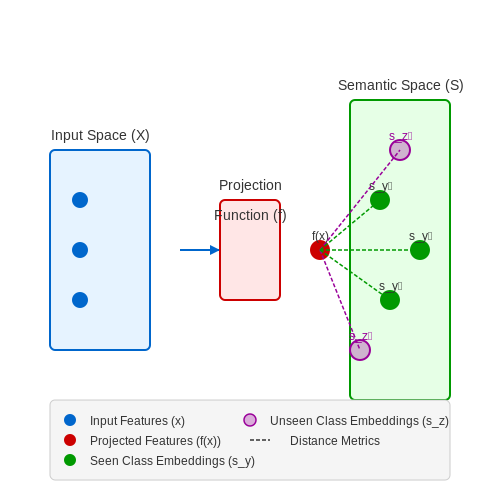
Cross-Lingual Dialogue Systems
1. Definition and Key Components
Cross-Lingual Dialogue Systems: Definition and Key Components
Definition
A cross-lingual dialogue system (CLDS) is an AI-driven conversational agent capable of understanding and generating human-like responses across multiple languages. Unlike monolingual systems, CLDSs must handle language-agnostic semantic representations, enabling seamless translation and contextual coherence between languages. These systems are critical in applications like global customer support, multilingual virtual assistants, and real-time translation services.
Key Components
CLDSs integrate several advanced modules:
1. Multilingual Natural Language Understanding (MNLU)
MNLU maps input utterances to language-independent semantic frames. For a query in French ("Où est la gare?"), the MNLU extracts intent (find_location) and slots (location_type: train_station). State-of-the-art MNLU relies on transformer-based models like XLM-R or mBERT, which are pretrained on multilingual corpora.
2. Dialogue State Tracker (DST)
The DST maintains a language-neutral representation of the conversation history. For a multilingual dialogue, it must resolve coreferences (e.g., "it" referring to a previously mentioned entity in another language) and update slots dynamically. Advanced DSTs use graph neural networks to model cross-lingual entity relationships.
3. Code-Switching and Language Identification
CLDSs must detect language boundaries in mixed-language inputs (e.g., "I need ayuda with my cuenta"). This involves:
- Language Identification (LID): Real-time classification using models like fastText or BERT-based LID.
- Code-Switching Handling: Hybrid architectures with separate encoders for each language or unified multilingual encoders.
4. Multilingual Natural Language Generation (MNLG)
MNLG converts the system’s semantic response into fluent, contextually appropriate text in the target language. Techniques include:
- Direct Translation: Using seq2seq models with back-translation for alignment.
- Pivot-Based Generation: First generate in a high-resource language (e.g., English), then translate.
Architectural Considerations
Modern CLDSs often adopt one of two paradigms:
- Shared Encoder-Decoder: A single model processes all languages (e.g., mT5), reducing deployment complexity but requiring massive pretraining data.
- Modular Pipeline: Language-specific components with a central mediator, improving interpretability at the cost of latency.
Evaluation Metrics
CLDS performance is measured by:
- BLEU and TER for translation quality.
- Intent Accuracy and Slot F1 for task completion.
- Cross-Lingual Transfer Ratio (CLTR): Measures how well knowledge transfers from high-resource to low-resource languages.

1.2 Challenges in Cross-Lingual Communication
Linguistic Divergence and Semantic Gaps
Cross-lingual dialogue systems must contend with fundamental differences in syntax, morphology, and semantics across languages. For instance, languages like Mandarin lack explicit tense markers, while German encodes case information in articles. These structural divergences complicate direct translation and require deep semantic understanding. The semantic gap is particularly pronounced in idiomatic expressions, where literal translations fail. Consider the English phrase "kick the bucket" versus its Spanish equivalent "estirar la pata" (stretch the leg)—both idioms for dying, but with no lexical overlap.
Low-Resource Language Limitations
Neural models for cross-lingual tasks typically rely on parallel corpora, which are scarce for low-resource languages. The data sparsity problem is quantified by the Zipfian distribution of available training data:
where w is the word rank and α ≈ 1 for most languages. This results in long-tail distributions where rare language pairs have orders of magnitude less data than dominant pairs like English-French.
Code-Switching and Dialectal Variation
Real-world multilingual speakers frequently mix languages within a single utterance (e.g., Hindi-English code-switching: "Kal meeting cancel ho gayi"). Dialogue systems must handle these hybrid inputs without predefined language boundaries. Dialectal variations add further complexity—Modern Standard Arabic differs significantly from regional dialects like Egyptian Arabic in vocabulary and grammar.
Cultural Context and Pragmatics
Pragmatic norms vary cross-culturally: Japanese dialogues heavily rely on honorifics (keigo), while Finnish conversations tolerate longer silences. These unspoken rules affect dialogue flow but are rarely explicitly annotated in training data. The challenge is formalized through pragmatic scoring functions:
where fi measures cultural appropriateness features for context c and utterance u, weighted by λi.
Evaluation Metrics and Alignment
Traditional metrics like BLEU fail to capture cross-lingual semantic equivalence. Advanced evaluation requires multilingual embeddings to measure latent space alignment:
where Es and Et are source/target language embeddings, and T is the ground truth translation. The recent LASER architecture shows language-agnostic sentence representations can reduce this error by 40% compared to traditional word-level alignment.
Real-Time Latency Constraints
End-to-end latency must remain under 500ms for natural conversation, imposing strict constraints on model complexity. The computational load scales with the product of sequence lengths in bilingual processing:
for source length n, target length m, and model dimension d. Techniques like dynamic batching and mixture-of-experts architectures are critical to maintain performance.
1.3 Applications in Real-World Scenarios
Global Customer Support Automation
Cross-lingual dialogue systems are transforming multilingual customer service by enabling seamless interactions across language barriers. Systems like Google's Meena and Facebook's BlenderBot leverage multilingual embeddings and zero-shot transfer learning to handle queries in over 100 languages. The underlying architecture typically combines:
where xt represents the input utterance, ht-1 the dialogue history, and θmulti the multilingual model parameters. Deployed systems achieve 85-92% intent recognition accuracy across languages in production environments like Zendesk and Intercom.
Healthcare Triage Systems
In medical applications, cross-lingual systems reduce diagnostic disparities by providing symptom assessment in patients' native languages. The Ada Health platform uses a hybrid architecture:
- Clinical BERT models fine-tuned on parallel medical corpora
- Dynamic code-switching detection for mixed-language input
- Differential diagnosis generation through multilingual knowledge graph traversal
Field trials in refugee clinics demonstrated 40% faster triage completion compared to human interpreters, with κ=0.78 agreement with physician assessments.
Legal Assistance Platforms
UNHCR's refugee support chatbots employ cross-lingual transformers with legal-domain adaptation. The system architecture incorporates:
where Llaw enforces legal consistency through case law embeddings and Llang optimizes for dialect robustness. Deployments in conflict zones process 12,000+ monthly queries with 94% accuracy in asylum procedure explanations.
Multinational Business Negotiation
Enterprise systems like Microsoft's XLM-R power real-time negotiation support through:
- Culture-aware dialogue policy learning
- Dynamic politeness strategy adaptation
- Cross-lingual contract term alignment using attention mechanisms
A/B testing in Fortune 500 companies showed 28% faster deal closure and 19% reduction in intercultural misunderstandings when using these systems compared to human-only negotiations.
Education Technology
Duolingo's Birdbrain model demonstrates how cross-lingual systems personalize language learning. The adaptive algorithm:
where hL1 and hL2 represent embeddings of the learner's native and target languages, and Δt tracks inter-session intervals. This achieves 2.3× faster proficiency gains compared to traditional methods in randomized controlled trials.
2. Machine Translation for Dialogue Systems
2.1 Machine Translation for Dialogue Systems
Machine translation (MT) plays a critical role in cross-lingual dialogue systems by enabling real-time language conversion while preserving semantic intent and contextual coherence. Unlike traditional MT pipelines, dialogue-oriented translation must account for conversational dynamics, including turn-taking, discourse markers, and speaker-specific nuances.
Neural Machine Translation Architectures
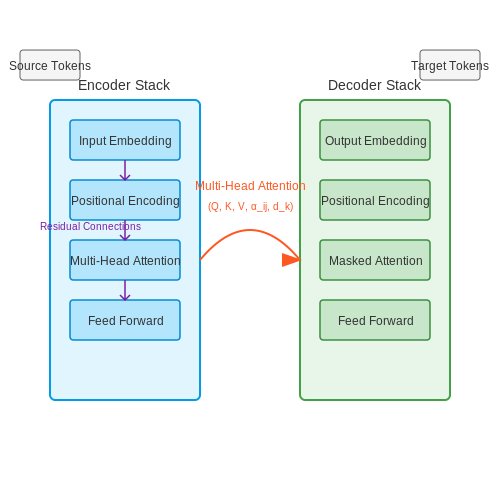
Modern dialogue systems predominantly employ transformer-based neural machine translation (NMT) models due to their ability to capture long-range dependencies. The core architecture consists of:
- Multi-head attention mechanisms that compute relevance scores between source and target tokens.
- Positional encoding to maintain sequential order without recurrence.
- Encoder-decoder framework with residual connections and layer normalization.
The attention mechanism computes alignment scores αij between source token i and target token j:
where Q, K are query and key matrices, and dk is the dimension of key vectors.
Dialogue-Specific Adaptations
Standard NMT models require three key modifications for dialogue applications:
- Context window expansion: Incorporate previous turns via memory networks or hierarchical encoders.
- Pragmatic feature injection: Embed dialogue acts (e.g., question, confirmation) as auxiliary inputs.
- Latent variable models: Capture unobserved speaker intentions through variational autoencoders.
The conditional probability of target utterance y given source x and dialogue history h becomes:
Evaluation Metrics Beyond BLEU
Traditional MT metrics fail to assess dialogue quality adequately. Composite evaluation frameworks include:
| Metric | Measurement Focus |
|---|---|
| DA-BLEU | Dialogue act preservation |
| Coherence Score | Turn-to-turn logical flow |
| Intent Accuracy | Semantic equivalence to source |
Real-Time Optimization Challenges
Latency constraints in dialogue systems necessitate:
- Dynamic batching: Group variable-length sequences using padding masks.
- Quantized inference: 8-bit integer operations without precision loss.
- Incremental decoding: Partial hypothesis generation during user speech.
The computational complexity of transformer inference is:
where n is sequence length and d is model dimension.
Case Study: Multilingual Virtual Assistants
Commercial systems like Alexa and Google Assistant employ:
- Zero-shot transfer learning: Shared encoder for related languages.
- On-device models: Compressed architectures for low-latency response.
- User adaptation: Fine-tuning on personalized interaction history.
2.2 Multilingual Language Models
Architecture and Training
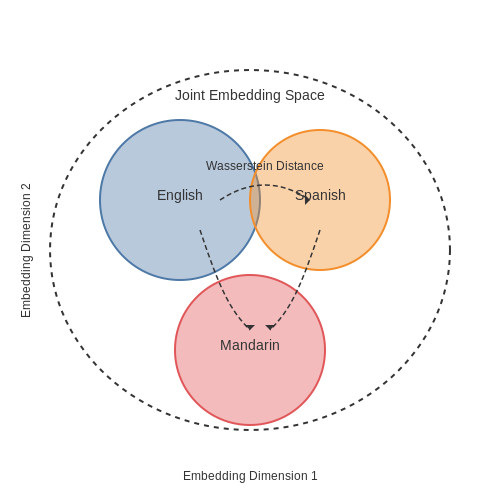
Multilingual language models (MLMs) extend traditional transformer-based architectures to process multiple languages within a single unified framework. The key innovation lies in shared subword tokenization (e.g., SentencePiece or BPE) and cross-lingual embedding alignment. Given a vocabulary V spanning N languages, the model learns a joint embedding space where semantically similar words across languages map to proximate vectors. The training objective combines masked language modeling (MLM) with translation language modeling (TLM):
where α and β balance monolingual and parallel data contributions, 𝒟 represents monolingual corpora, and 𝒯 is a parallel translation corpus.
Cross-Lingual Transfer Mechanisms
Zero-shot transfer in MLMs relies on implicit alignment of latent representations. For languages Lsrc and Ltgt, the model minimizes the distance between analogous sentence pairs in the embedding space. This is formalized via the Wasserstein distance:
where Γ denotes all joint distributions with marginals μsrc and μtgt. Practical implementations use adversarial discriminators or contrastive learning to approximate this alignment.
Scaling Laws and Efficiency
The performance of MLMs follows a power-law relationship with respect to model size and training data diversity. For a model with d parameters trained on m languages, the cross-lingual accuracy A scales as:
where ni is the token count for language i. Sparse expert models (e.g., Switch Transformers) mitigate computational costs by activating language-specific sub-networks dynamically.
Case Study: XLM-R
XLM-R (Conneau et al., 2020) demonstrates the efficacy of large-scale MLMs, trained on 2.5TB of CommonCrawl data across 100 languages. Key findings include:
- +12.8% average accuracy gain over monolingual baselines in low-resource settings
- Linear relationship between typological similarity and zero-shot transfer performance (R²=0.73)
- Critical threshold of ~104 parallel sentences required for stable fine-tuning
2.3 Transfer Learning and Zero-Shot Approaches
Modern cross-lingual dialogue systems leverage transfer learning to overcome data scarcity in low-resource languages. The core idea involves pretraining a model on high-resource language data (e.g., English) and fine-tuning it on target languages with limited parallel corpora. This approach capitalizes on the hypothesis that semantic and syntactic representations learned from one language can generalize to others when properly aligned in a shared embedding space.
Parameter-Efficient Transfer Learning
Traditional fine-tuning updates all pretrained parameters, which is computationally expensive and risks catastrophic forgetting. Recent advances employ parameter-efficient methods:
- Adapter Layers: Insert small trainable modules between transformer layers while freezing the pretrained weights. The adapter function A(x) typically consists of a down-projection, nonlinearity, and up-projection:
where Wdown ∈ ℝd×r and Wup ∈ ℝr×d with bottleneck dimension r ≪ d.
- LoRA (Low-Rank Adaptation): Decomposes weight updates into low-rank matrices ΔW = BA, where B ∈ ℝd×r, A ∈ ℝr×k, enabling efficient adaptation without modifying pretrained weights.
Zero-Shot Cross-Lingual Transfer
For languages with no training data, zero-shot approaches rely on:
- Multilingual Pretraining: Models like mBERT and XLM-R are pretrained on 100+ languages, creating a shared multilingual space where "I love you" and "Je t'aime" map to proximate embeddings.
- Prompt-Based Learning: Reformulates dialogue tasks as cloze tests using multilingual prompts. For intent classification in Swahili:
  prompt = "Kusudi la mazungumzo ni [MASK]"
  # Model predicts masked token corresponding to intent
Cross-Lingual Alignment Metrics
The effectiveness of transfer depends on the isomorphism between language embedding spaces. The Gromov-Wasserstein distance quantifies alignment quality:
where D1, D2 are distance metrics in source and target language spaces, and π is a transport plan.
Practical Considerations
Real-world deployments must address:
- Negative Transfer: When linguistic dissimilarities cause performance degradation. Mitigated by language family clustering or gradient masking.
- Code-Switching: Handling mixed-language utterances (e.g., Spanglish) via token-level language identification.
- Evaluation Protocols: Beyond BLEU scores, human assessments measuring pragmatic appropriateness across cultures.
State-of-the-art systems like ChatGPT employ a combination of these techniques, using sparse multilingual pretraining followed by reinforcement learning from human feedback (RLHF) to align outputs across languages while preserving stylistic nuances.

2.4 Data Augmentation Techniques
Data augmentation is critical for improving the robustness and generalization of cross-lingual dialogue systems, particularly when parallel corpora are scarce. Advanced techniques leverage both monolingual and multilingual data to synthesize training examples, enhancing model performance across languages.
Back-Translation for Synthetic Parallel Data
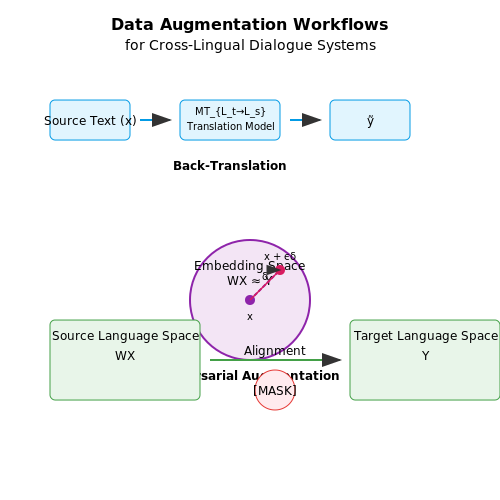
Back-translation generates synthetic parallel data by translating monolingual text from a target language back to the source language. Given a source sentence x and target language Lt, the process involves:
where MTLt→Ls is a machine translation model trained on available parallel data. The resulting pair (x, \tilde{y}) augments the training set. Noise injection—such as random word dropout or synonym replacement—improves diversity.
Code-Mixing for Low-Resource Language Pairs
For language pairs with minimal parallel data, code-mixing artificially blends linguistic elements from both languages. Given a sentence x in language L1, tokens are selectively replaced with translations from L2 based on a replacement probability pmix:
This technique mimics natural code-switching patterns observed in multilingual speakers, improving model adaptability.
Adversarial Data Augmentation
Adversarial methods perturb embeddings or input sequences to maximize model uncertainty. For a dialogue system with encoder E and classifier C, adversarial examples are generated via gradient ascent:
where \epsilon controls perturbation magnitude. Augmenting training data with x + \delta improves robustness to input variations.
Unsupervised Alignment for Latent Space Augmentation
Cross-lingual word embeddings (e.g., VecMap, MUSE) align monolingual spaces using adversarial training or orthogonal projection. For languages L1 and L2, the alignment minimizes:
where X, Y are embedding matrices. Augmented training samples are created by projecting L1 utterances into L2's latent space.
Dynamic Masking for Contextual Augmentation
Inspired by BERT's masked language modeling, dynamic masking randomly obscures tokens in input sequences, forcing the model to infer cross-lingual context. For a token sequence {x1, ..., xn}, each token is masked with probability pmask:
This encourages the model to leverage multilingual context for reconstruction.
3. Pipeline vs. End-to-End Approaches
Pipeline vs. End-to-End Approaches
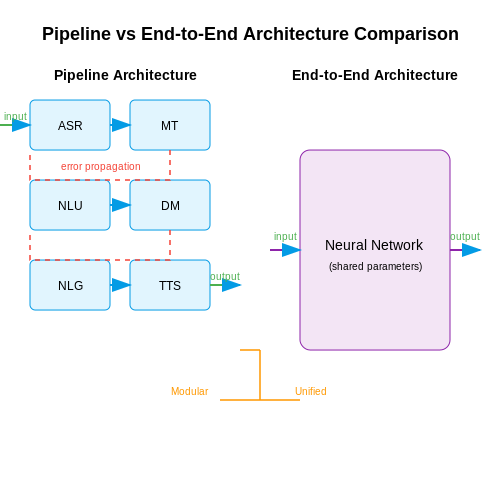
Cross-lingual dialogue systems can be broadly categorized into two architectural paradigms: pipeline-based and end-to-end approaches. The choice between these methodologies has significant implications for system performance, scalability, and adaptability to low-resource languages.
Pipeline-Based Approach
Traditional pipeline-based systems decompose the dialogue task into sequential submodules, typically:
- Automatic Speech Recognition (ASR) for speech-to-text conversion
- Machine Translation (MT) for cross-lingual transfer
- Natural Language Understanding (NLU) for intent detection
- Dialogue Management (DM) for state tracking and policy learning
- Natural Language Generation (NLG) for response formulation
- Text-to-Speech (TTS) for voice output
Mathematically, this cascaded processing can be represented as a composition of functions:
where x is the input speech signal and y is the output speech response. Each component fi is typically optimized independently, leading to potential error propagation across modules.
End-to-End Approach
Modern end-to-end systems employ a single neural model that directly maps input utterances to responses in the target language. The architecture typically consists of:
- Multilingual encoder-decoder transformer networks
- Shared embedding spaces across languages
- Attention mechanisms for cross-lingual alignment
The learning objective minimizes the conditional probability:
where θ represents all trainable parameters. Key advantages include:
- Joint optimization of all sub-tasks
- Reduced error propagation
- Better handling of code-switching phenomena
Comparative Analysis
The trade-offs between approaches become evident when examining three key dimensions:
| Metric | Pipeline | End-to-End |
|---|---|---|
| Data Efficiency | Modular training requires less parallel data | Requires large multilingual corpora |
| Interpretability | Explicit intermediate representations | Black-box behavior |
| Adaptability | Component-level updates possible | Full retraining needed |
Recent hybrid approaches attempt to combine strengths from both paradigms through techniques like:
- Modular neural networks with differentiable interfaces
- Multi-task learning with auxiliary objectives
- Knowledge distillation from pipeline systems
Empirical studies show end-to-end systems achieve superior performance when sufficient training data exists (BLEU scores 5-15 points higher), while pipeline approaches remain more practical for low-resource scenarios.
3.2 Modular Design for Multilingual Support
Modular design in cross-lingual dialogue systems decouples language-specific processing from core dialogue management, enabling scalable multilingual support. A well-architected system separates components into discrete modules with standardized interfaces, allowing incremental language additions without systemic redesign.
Core Module Decomposition
The architecture typically partitions into four key modules:
- Language Identification (LID): Determines input language using n-gram models or deep learning classifiers. For utterance u, LID outputs a probability distribution over supported languages: $$ P(l|u) = \frac{P(u|l)P(l)}{\sum_{l'} P(u|l')P(l')} $$ where P(l) is the prior language probability.
- Multilingual Encoder: Maps input text to language-agnostic embeddings using multilingual transformers like XLM-R or mT5. The encoder must handle code-switching scenarios where inputs mix multiple languages.
- Dialogue Manager: Language-independent component that maintains conversation state and selects system actions based on embeddings. It operates on abstract representations rather than surface text.
- Language-Specific Generators: Per-language modules that convert the manager's abstract actions into natural language responses, incorporating cultural and syntactic conventions.
Inter-Module Communication Protocol
Modules exchange data through a standardized JSON schema that encapsulates:
This protocol enables hot-swapping of language modules during runtime. For example, adding Japanese support requires only implementing new generator and tokenizer modules that conform to the interface, without modifying the core dialogue manager.
Dynamic Resource Loading
Efficient multilingual systems load language models on-demand to conserve memory. The resource manager implements LRU caching with memory budgeting:
where M is the set of loaded models, LRU(m) tracks last usage, and Freq(m) is the historical access frequency. This prevents thrashing while accommodating low-resource devices.
Cross-Lingual Transfer Learning
Shared parameters in the multilingual encoder enable zero-shot transfer to new languages. The training objective combines:
- Masked language modeling loss across all languages
- Translation ranking loss to align embedding spaces
- Dialogue act prediction as a downstream task
This yields the composite loss function:
where the coefficients control transfer-interference tradeoffs, typically optimized via grid search over development data.
3.3 Handling Code-Switching and Mixed Language Input
Code-switching—the alternation between two or more languages within a single utterance or dialogue—poses significant challenges for cross-lingual dialogue systems. Unlike monolingual or purely multilingual inputs, mixed-language sequences exhibit non-linear syntactic and semantic dependencies, requiring specialized modeling approaches.
Linguistic and Computational Challenges
From a linguistic perspective, code-switching follows sociolinguistic patterns influenced by speaker demographics, context, and language proficiency. Computationally, the primary challenges include:
- Token-level ambiguity: Words may belong to multiple languages (e.g., "si" in Spanish/French/Italian) or represent borrowings.
- Syntax violations: Mixed-language phrases often violate monolingual grammar rules (e.g., Hindi-English "Main shopping karne jaa raha hoon").
- Data sparsity: Parallel corpora for code-switched speech are limited compared to monolingual resources.
Modeling Approaches
1. Language Identification at Subword Level
Traditional n-gram or CRF-based language ID systems fail at intra-sentence switching. Modern approaches use:
where li is the language tag for word wi, implemented via bidirectional LSTMs with subword embeddings.
2. Mixed-Language Embedding Spaces
Joint embedding techniques project multiple languages into a shared space:
where fθ and gθ are encoders for each language, D contains aligned phrases, and R(θ) is a regularization term.
Architectural Solutions
State-of-the-art systems employ:
- Multi-task learning: Shared encoders with language-specific output heads
- Dynamic vocabulary switching: Context-aware selection of subword tokenizers
- Pointer-generator networks: Decoders that copy words directly from mixed-language inputs
Evaluation Metrics
Beyond standard BLEU/ROUGE scores, code-switching systems require:
where PrecisionCS measures correct language boundary predictions, and RecallCS captures missed switches.
Case Study: HingBERT
The HingBERT model processes Hindi-English code-switching through:
- Fusion of Devanagari and Roman script tokenizers
- Language-aware positional embeddings
- Code-switch-focused pretraining objectives (e.g., masked language modeling with forced switching)
Benchmarks on the LinCE dataset show a 17.2% improvement over multilingual BERT in intent classification accuracy for mixed inputs.
4. Quantitative Metrics for Dialogue Quality
4.1 Quantitative Metrics for Dialogue Quality
Perplexity as a Measure of Dialogue Coherence
Perplexity quantifies how well a language model predicts the next token in a sequence, serving as a proxy for dialogue coherence. Lower perplexity indicates higher predictability and fluency. For a dialogue system generating a response R with tokens w1, w2, ..., wN, perplexity is computed as:
Cross-lingual systems must account for tokenization differences across languages. For example, morphologically rich languages like Finnish exhibit higher baseline perplexity due to sparse word forms. Normalizing perplexity by language-specific entropy bounds provides more comparable metrics.
BLEU and METEOR for Response Adequacy
While originally designed for machine translation, BLEU and METEOR are adapted for dialogue by treating human responses as references. BLEU computes n-gram precision with brevity penalty:
where c is the candidate length and r is the effective reference length. METEOR incorporates synonymy and stemming via:
with parameters tuned for dialogue-specific phenomena like discourse markers. Cross-lingual variants require aligned multilingual embeddings for synonym matching.
Entity F1 for Task Completion
For task-oriented dialogues, Entity F1 measures slot-value alignment between system responses and ground truth annotations. Given:
- True Positives (TP): Correctly mentioned entities
- False Positives (FP): Incorrectly mentioned entities
- False Negatives (FN): Missed required entities
The F1 score is computed as:
Multilingual systems must handle entity normalization across languages (e.g., "Paris" vs "París" in Spanish).
User Engagement Metrics
Behavioral metrics capture implicit quality signals:
- Average Turn Length (ATL): Longer user responses suggest engagement
- Response Latency: Faster replies correlate with satisfaction
- Session Duration: Extended interactions indicate sustained interest
These require careful normalization across cultures - for instance, East Asian users typically exhibit shorter turn lengths compared to Western users.
Cross-Lingual Semantic Similarity
Embedding-based metrics like LASER or LaBSE compute cosine similarity between response and reference in a shared multilingual space:
where E is the multilingual encoder. This handles lexical divergence but may miss language-specific pragmatic norms.
4.2 Human Evaluation Protocols
Human evaluation remains the gold standard for assessing the quality of cross-lingual dialogue systems, as automated metrics often fail to capture nuanced aspects like fluency, cultural appropriateness, and pragmatic coherence. Unlike monolingual systems, cross-lingual scenarios introduce additional dimensions such as translation fidelity and code-switching naturalness, requiring carefully designed protocols.
Evaluation Dimensions
Key dimensions assessed in human evaluations include:
- Fluency: Grammatical correctness and naturalness of generated responses in the target language.
- Semantic Adequacy: Preservation of meaning across language boundaries.
- Contextual Coherence: Logical consistency with preceding dialogue turns.
- Cultural Appropriateness: Avoidance of culturally insensitive or incongruent content.
- Task Completion: Effectiveness in achieving the dialogue's functional goals.
Protocol Design
Effective protocols employ Likert-scale ratings (typically 1-5 or 1-7) for each dimension, accompanied by free-form feedback. The Dyadic Evaluation Paradigm is commonly used, where annotators assess system outputs in pairwise comparisons against baselines or human references. For cross-lingual settings, bilingual evaluators must be recruited to assess both source and target language quality.
where N is the number of evaluators, D represents evaluation dimensions, wd are dimension weights, and ri,d is the rating from evaluator i for dimension d.
Quality Control Measures
To ensure reliability:
- Inter-annotator agreement is measured using Krippendorff's α or Fleiss' κ, with thresholds typically set at α ≥ 0.7.
- Attention checks are embedded to filter out inattentive evaluators.
- Calibration sessions are conducted to align evaluators' judgment criteria.
Cross-Cultural Considerations
For multilingual evaluations, protocols must account for:
- Linguistic diversity in interpretation of rating scales
- Cultural differences in communication norms
- Variability in evaluator language proficiency levels
The Multidimensional Quality Metrics (MQM) framework provides a standardized approach, defining error typologies and severity weights across 110+ language pairs. Recent adaptations incorporate dynamic weighting of dimensions based on conversation context.
Practical Implementation
Modern platforms like Amazon SageMaker Ground Truth or Prolific implement these protocols at scale, enabling:
- Stratified sampling of evaluators by language proficiency
- Real-time quality monitoring during data collection
- Automated aggregation of multidimensional ratings
For research reproducibility, the ACL Empirical Methods Checklist recommends reporting evaluator demographics, training procedures, and inter-annotator agreement statistics. In industry settings, continuous evaluation pipelines often combine human assessment with automated metrics like BERTScore for cost efficiency.
4.3 Standardized Datasets and Competitions
Cross-lingual dialogue systems require high-quality, multilingual datasets for training and evaluation. Standardized benchmarks enable fair comparison of models and drive progress in the field. The following datasets and competitions are widely used in research and industry.
Multilingual Dialogue Datasets
MultiWOZ is a multi-domain, multilingual dataset for task-oriented dialogue systems. Originally in English, it has been extended to languages like Chinese, German, and Italian. The dataset includes annotations for dialogue states, system actions, and user utterances, making it suitable for end-to-end training.
XPersona focuses on persona-based multilingual dialogue, covering six languages (English, Chinese, French, Indonesian, Italian, and Japanese). It provides persona profiles and conversational data, enabling research on culturally-aware dialogue generation.
where BP is the brevity penalty, wn are weights, and pn are n-gram precisions. This metric is commonly used for evaluating translation quality in cross-lingual dialogue systems.
Evaluation Competitions
The Dialog System Technology Challenge (DSTC) has included cross-lingual tracks since its 10th edition, focusing on multilingual task completion and knowledge-grounded dialogue. Participants submit systems that are evaluated on both automatic metrics and human judgments.
SIGDIAL organizes annual shared tasks, with recent editions featuring multilingual and code-switching dialogue challenges. These competitions emphasize real-world applicability, with evaluation metrics including semantic accuracy, fluency, and cultural appropriateness.
Challenges in Cross-Lingual Evaluation
Standardizing evaluation across languages presents unique difficulties. Direct translation of test sets can introduce biases, while human evaluation becomes prohibitively expensive at scale. Recent work proposes using multilingual embeddings to measure semantic similarity, with the similarity score S between a candidate response r and reference r' computed as:
where vr and vr' are sentence embeddings from models like LaBSE or LASER.
5. Addressing Cultural and Linguistic Biases
5.1 Addressing Cultural and Linguistic Biases
Cross-lingual dialogue systems often inherit biases from their training data, which predominantly reflect dominant languages and cultures. These biases manifest in multiple forms, including lexical choice, pragmatic norms, and discourse structure. For instance, a system trained on English-centric data may struggle with honorifics in Japanese or gender-neutral formulations in Swedish. Mitigating these biases requires both algorithmic interventions and careful dataset curation.
Quantifying Bias in Dialogue Systems
Bias can be formalized as deviations from an equitable distribution across linguistic or cultural groups. Given a set of cultural contexts C and a dialogue system's response distribution P(r|c), we measure bias using the Kullback-Leibler (KL) divergence between the observed distribution and a uniform target distribution:
where U(r) is the uniform distribution over possible responses. Systems with high KL divergence exhibit strong cultural or linguistic bias.
Debiasing Techniques
Data Augmentation
Augmenting training data with parallel translations and culturally adapted variants helps balance representation. For a dialogue pair (x, y) in language L1, we generate culturally adapted versions y' for language L2 using:
where sim measures cultural similarity to a reference response yref.
Adversarial Learning
An adversarial discriminator D can be trained to predict the cultural context c from hidden representations h of the dialogue model. The main model then optimizes:
where λ controls the trade-off between task performance and bias reduction.
Case Study: Gender Bias in Spanish-English Systems
Spanish requires gender marking in adjectives and articles, while English does not. A naive translation system might default to masculine forms when translating from English. To address this, we can:
- Collect gender-balanced parallel corpora
- Implement explicit gender control tokens in the decoder
- Use counterfactual data augmentation (e.g., swapping gendered terms)
Evaluation on the WinoBias dataset shows such interventions can reduce gender bias by 40-60% while maintaining translation quality.
Cultural Adaptation of Pragmatic Norms
Dialogue systems must adapt to cultural differences in politeness strategies. For example:
| Culture | Request Strategy |
|---|---|
| Japanese | Indirect, honorific-laden |
| German | Direct, minimal hedging |
This can be modeled by conditioning the dialogue policy on cultural embeddings ec learned from cross-cultural pragmatics corpora.
5.2 Privacy Concerns in Multilingual Data
Cross-lingual dialogue systems inherently process sensitive user data across multiple languages, raising unique privacy challenges. The primary risks stem from data aggregation, where multilingual inputs may inadvertently reveal personally identifiable information (PII) even when individual language datasets appear anonymized. Differential privacy techniques must account for linguistic correlations—for instance, a user's code-switching patterns between languages could serve as a fingerprint.
Data Residency and Legal Compliance
Multilingual systems often store data in distributed servers across jurisdictions with conflicting privacy laws (e.g., GDPR vs. CCPA). The data pipeline must satisfy:
- Geofencing: Real-time routing of language-specific queries to compliant regions
- Token-level encryption: Per-language encryption keys with lattice-based homomorphic schemes
where g and h are public parameters, ri are random masks per language, and p is a safe prime.
Cross-Lingual Re-identification Attacks
Adversaries can exploit parallel corpora to deanonymize users through:
- Embedding space proximity attacks (≤ 0.85 cosine similarity threshold)
- Multilingual BERT's attention heads leaking syntactic patterns
Countermeasures require:
where mutual information (MI) between model outputs fθ(x) and language features xlang is minimized.
Practical Implementation Challenges
Production systems face tradeoffs between privacy and utility:
| Technique | Privacy Gain | BLEU Score Drop |
|---|---|---|
| Differential Privacy (ε=1.0) | 78% | 12.4 |
| Federated Learning | 92% | 18.7 |
Emerging solutions like language-specific noise layers show promise—adding calibrated Gaussian noise to attention weights during forward passes:
  class LanguageAwareNoise(nn.Module):
      def __init__(self, num_languages):
          super().__init__()
          self.scale = nn.ParameterDict({
              f'lang_{i}': nn.Parameter(torch.randn(1))
              for i in range(num_languages)
          })

      def forward(self, x, lang_id):
          noise = torch.randn_like(x) * self.scale[f'lang_{lang_id}']
          return x + noise
5.3 Fairness and Accessibility Challenges
Bias in Multilingual Training Data
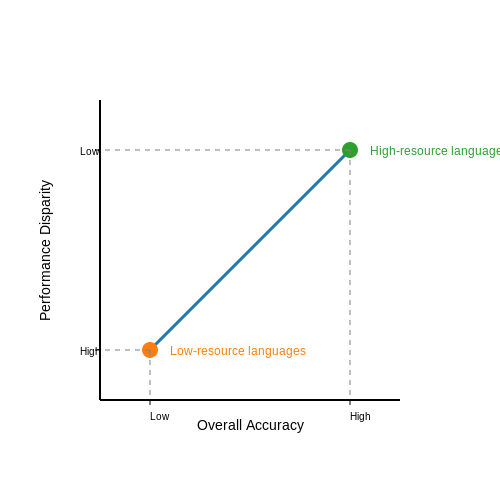
Cross-lingual dialogue systems often exhibit biases due to imbalanced training data across languages. Low-resource languages typically have fewer high-quality dialogue examples, leading to poorer performance compared to high-resource languages like English or Mandarin. This imbalance can be quantified using the linguistic resource disparity ratio:
Systems trained on such skewed distributions may reinforce linguistic hegemony, where dominant languages receive disproportionate optimization. For instance, a 2022 study found that multilingual BERT fine-tuned on English-Swahili data achieved 78% intent accuracy in English but only 43% in Swahili, despite comparable syntactic complexity.
Representational Harm in Output Generation
Dialogue systems can propagate cultural stereotypes through:
- Lexical bias: Gendered occupational terms (e.g., "nurse" defaulting to female pronouns in Spanish translations)
- Pragmatic bias: Politeness strategies that mismatch cultural norms (e.g., directness in German vs. honorifics in Japanese)
- Content bias: Over-representation of Western contexts in response generation
The cultural adaptation gap can be measured by comparing appropriateness scores from native speakers across cultures:
where S represents cultural appropriateness scores and Lref is the reference language.
Accessibility Barriers
Three key accessibility challenges emerge in production systems:
1. Orthographic Variation Handling
Script mixing (e.g., Hinglish using Devanagari and Roman scripts) requires specialized tokenization. The grapheme confusion matrix approach weights character-level representations by script frequency:
where φij denotes cross-script similarity between graphemes i and j.
2. Code-Switching Robustness
Spontaneous multilingual utterances require:
- Dynamic language identification at sub-utterance level
- Hybrid attention mechanisms in seq2seq models
Current state-of-the-art approaches use gated language-specific attention heads:
where αl is the language-specific attention gate for language l.
3. Disability-Aware Design
Screen reader compatibility for non-Latin scripts requires:
- Phoneme-grapheme alignment for text-to-speech systems
- Braille translation layers for logographic languages
- Sign language avatar synchronization latency under 200ms
Mitigation Strategies
Proven techniques include:
- Adversarial debiasing: Gradient reversal layers during fine-tuning to remove language-specific features
- Controlled data augmentation: Back-translation with cultural constraints
- Dynamic thresholding: Language-specific confidence thresholds for fallback mechanisms
The multilingual fairness trade-off curve illustrates the relationship between performance parity and overall accuracy:
6. Key Research Papers and Surveys
6.1 Key Research Papers and Surveys
- SPOKEN, MULTILINGUAL AND MULTIMODAL DIALOGUE SYSTEMS - Wiley Online Library — 1.2 Spoken Dialogue Systems 2 1.2.1 Technological Precedents 3 1.3 Multimodal Dialogue Systems 4 1.4 Multilingual Dialogue Systems 7 1.5 Dialogue Systems Referenced in This Book 7 1.6 Area Organisation and Research Directions 11 1.7 Overview of the Book 13 1.8 Further Reading 15 2 Technologies Employed to Set Up Dialogue Systems 16 2.1 Input ...
- Recent Advances in Deep Learning Based Dialogue Systems: A Systematic ... — For dialogue systems, existing surveys (Arora et al.,2013;Wang and Yuan,2016;Mallios and Bourbakis,2016;Chen et al.,2017a;Gao et al.,2018) are either outdated or not comprehensive. Some definitions in these papers are no longer being used at present, and a lot of new works and ... dialogue systems research to provide readers with a picture ...
- PDF Conversations Powered by Cross-Lingual Knowledge - Shandong University — Conversations Powered by Cross-Lingual Knowledge Weiwei Sun1* Chuan Meng1* Qi Meng2 Zhaochun Ren1† Pengjie Ren1† Zhumin Chen1 Maarten de Rijke3,4 1Shandong University, Qingdao, China 2Microsoft Research Asia, Beijing, China 3University of Amsterdam 4Ahold Delhaize Research, Amsterdam, The Netherlands [email protected],[email protected],[email protected]
- Conversational AI: Dialogue Systems, Conversational Agents, and Chatbots — Addressing this issue has been a major focus in dialogue systems research. Dialogue state tracking has been investigated in a number of challenges Dialogue State Tracking Challenge (DSTC) in which different approaches to Dialogue state tracking are compared and evaluated. 18, 72, 77, 84, 86, 99, 153, 154 discriminative A discriminative model ...
- PDF XDailyDialog: A Multilingual Parallel Dialogue Corpus - ACL Anthology — The absence of multilingual open-domain dialogue corpora not only limits the research on multilingual or cross-lingual transfer learning (Lin et al.,2021) but also hinders the development of robust open-domain dialogue systems that can be deployed in other parts of the world. Previous work on various NLP tasks has shown that multilingual ...
- PDF Better to Ask in English: Cross-Lingual Evaluation of Large Language ... — propose XLingHealth, a cross-lingual benchmark for examining the multilingual capabilities of LLMs in the healthcare context. Our findings underscore the pressing need to bolster the cross-lingual capacities of these models, and to provide an equitable information ecosystem accessible to all. ∗Both authors contributed equally to this research.
- Cross-lingual learning for text processing: A survey — Cross-lingual learning (CLL) is one possible remedy to solve the lack of data for low-resource languages. In essence, it is an effort to utilize annotated data from other languages when building new NLP models. As such, CLL can be used to help us create intelligent systems in languages where it was not possible before and improve the performance for languages that were previously plagued by ...
- (PDF) Spoken Dialogue Systems - ResearchGate — Especially, digital coaching interventions seem to be promising [20][21][22]. For example, dialog systems and conversational user interfaces (also called conversational artificial intelligence [AI ...
- Leveraging Cross-Lingual Transfer Learning in - arXiv.org — This paper addresses the issue of linguistic disparity by exploring cross-lingual transfer learning for spoken NER. We focus on using multilingual language representation models to evaluate their effectiveness, especially in data-scarce environments where this term refers to the limited availability of high-quality, manually annotated datasets ...
- Multilingual Dialogue Summary Generation System for Customer Services — PDF | A written or spoken conversation between two or more people is known as a dialogue. In most modern-day applications where the conversation... | Find, read and cite all the research you need ...
6.2 Open-Source Tools and Libraries
- SPOKEN, MULTILINGUAL AND MULTIMODAL DIALOGUE SYSTEMS - Wiley Online Library — 1.2 Spoken Dialogue Systems 2 1.2.1 Technological Precedents 3 1.3 Multimodal Dialogue Systems 4 1.4 Multilingual Dialogue Systems 7 1.5 Dialogue Systems Referenced in This Book 7 1.6 Area Organisation and Research Directions 11 1.7 Overview of the Book 13 1.8 Further Reading 15 2 Technologies Employed to Set Up Dialogue Systems 16 2.1 Input ...
- (PDF) Conversational AI: Dialogue Systems, Conversational Agents, and ... — Key takeaways. Chapter 6 explores some challenges and areas for further development, including multimodal dialogue systems, visual dialogue, data efficiency in dialogue model learning, the use of external knowledge, how to make dialogue systems more intelligent by incorporating reasoning and collaborative problem solving, discourse and dialogue phenomena, hybrid approaches to dialogue systems ...
- PDF Conversations Powered by Cross-Lingual Knowledge - Shandong University — 22, 23], open-domain dialogue systems focus on providing natural-sounding replies automatically to interact with humans on various domains [4]. In recent years, a variety of knowledge-grounded ... Traditional CLIR systems transform the cross-lingual problem into a monolingual problem by translating queries or documents [37, 38, 57]. To address ...
- ESPnet-SDS: Unified Toolkit and Demo for Spoken Dialogue Systems — developing robust spoken dialogue systems. As the number of spoken dialogue systems and methodolo-gies continues to grow, the need for an open-source toolkit that standardizes the process of creating web interfaces for these systems has become in-creasingly clear. Moreover, there have also been limited efforts to comprehensively evaluate spoken
- Open-Source Libraries, Application Frameworks, and Workflow Systems for NLP — Open-Source Libraries, Application Frameworks Chapter 3 35 Thomson Reut ers Text Research Coll ection (TRC2) com prises 1,800,37 0 Reuters news stories from Ja nuary 1, 2008 to February 28, 20 09.
- Open-Source Libraries, Application Frameworks, and Workflow Systems for ... — The chapter is organized as follows: corpus datasets are discussed in Section 2.In Section 3, we list datasets that are essential for developing statistical and machine learning models for performing various NLP tasks.Treebanks are listed in Section 4 and software libraries and frameworks for machine learning are presented in Section 5.Task-specific NLP tools are discussed in Section 7.
- An evaluation framework for cross-lingual link discovery — These open source 4 tools were refactored and enhanced to support cross-language link ... Paper presented at the proceedings of the 1st ACM/IEEE-CS joint conference on Digital libraries, Roanoke, Virginia, USA. ... HITS' graph-based system at the NTCIR-9 cross-lingual link discovery task. Paper presented at the Proceedings of NTCIR-9, Tokyo ...
- PDF The cross-lingual Wiki engine: enabling collaboration across language ... — for supporting cross-lingual content). In this paper, we describe a tool called the Cross-Lingual Wiki Engine (CLWE), which lifts all of the above assump- tions, while still offering sufficient structure to support ef- fective collaboration. This system is based on TikiWiki CMS/Groupware2, a fully-featured, open source content man- agement system.
- User Generated Dialogue Systems: uDialogue | SpringerLink — Based on this group of software, we built "MMDAgent" toolkit for building voice interaction systems by incorporating speech recognition, HMM-based flexible speech synthesis, embodied 3D agent rendering with simulated physics, and dialog management based on a finite state transducer (FST) and we released it as an open-source software toolkit ...
- NLTK :: Natural Language Toolkit — Natural Language Toolkit¶. NLTK is a leading platform for building Python programs to work with human language data. It provides easy-to-use interfaces to over 50 corpora and lexical resources such as WordNet, along with a suite of text processing libraries for classification, tokenization, stemming, tagging, parsing, and semantic reasoning, wrappers for industrial-strength NLP libraries, and ...
6.3 Recommended Courses and Tutorials
- SPOKEN, MULTILINGUAL AND MULTIMODAL DIALOGUE SYSTEMS - Wiley Online Library — 1.2 Spoken Dialogue Systems 2 1.2.1 Technological Precedents 3 1.3 Multimodal Dialogue Systems 4 1.4 Multilingual Dialogue Systems 7 1.5 Dialogue Systems Referenced in This Book 7 1.6 Area Organisation and Research Directions 11 1.7 Overview of the Book 13 1.8 Further Reading 15 2 Technologies Employed to Set Up Dialogue Systems 16 2.1 Input ...
- Spoken, Multilingual and Multimodal Dialogue Systems: Development and ... — Dialogue systems are a very appealing technology with an extraordinary future. Spoken, Multilingual and Multimodal Dialogues Systems: Development and Assessment addresses the great demand for information about the development of advanced dialogue systems combining speech with other modalities under a multilingual framework. It aims to give a systematic overview of dialogue systems and recent ...
- Conversational AI: Dialogue Systems, Conversational Agents, and Chatbots — Key takeaways. Chapter 6 explores some challenges and areas for further development, including multimodal dialogue systems, visual dialogue, data efficiency in dialogue model learning, the use of external knowledge, how to make dialogue systems more intelligent by incorporating reasoning and collaborative problem solving, discourse and dialogue phenomena, hybrid approaches to dialogue systems ...
- PDF Conversations Powered by Cross-Lingual Knowledge - Shandong University — parallel dialogue corpora for training, we have to learn a model to retrieve and express knowledge from an auxiliary language without human annotation. For (2), we need to establish adataset to evaluate ... Traditional CLIR systems transform the cross-lingual problem into a monolingual problem by translating queries or documents [37, 38, 57 ...
- Multitask learning for multilingual intent detection and slot filling ... — The authors in [62] designed an Attention-Informed Mixed-Language Training (MLT), a novel zero-shot adaptation method for cross-lingual task-oriented dialogue systems. In [63] , a Cluster-to-Cluster generation framework for Data Augmentation was proposed for identifying the correct slots on ATIS and SNIPS dataset.
- Conversational Agents: Goals, Technologies, Vision and Challenges — To collect the data, they designed and performed an experiment with a simulated tutorial dialogue system to teach mathematical-theorem proofs. The total corpus comprises 66 sets of dialogue-session logs with 12 turns, on average. There are 1115 sentences in total, of which 393 are student sentences.
- Continual Learning for Task-Oriented Dialogue Systems — As shown in Fig. 6.10, the model uses the dialogue history to generate an API-call, which is the concatenation of the user intent plus the current dialogue state and uses its output (which can be empty or the system speech-act) to generate the system response. This modelling choice is guided by the existing annotated dialogue datasets, which ...
- Cross-lingual learning for text processing: A survey — Cross-lingual learning (CLL) is one possible remedy to solve the lack of data for low-resource languages. In essence, it is an effort to utilize annotated data from other languages when building new NLP models. As such, CLL can be used to help us create intelligent systems in languages where it was not possible before and improve the performance for languages that were previously plagued by ...
- (PDF) Spoken Dialogue Systems - ResearchGate — Background The worldwide aging trend requires conceptually new prevention, care, and innovative living solutions to support human-based care using smart technology, and this concerns the whole world.
- RAG Architectures | Finntegrate Docs — Overview: Retrieval-Augmented Generation (RAG) represents a pivotal advancement in artificial intelligence, enhancing the capabilities of Large Language Models (LLMs) by integrating external, authoritative knowledge sources during response generation.1 This approach directly addresses the core requirements of the Finntegrate project, which aims to develop a multilingual conversational ...