LLMs That Read Codebases and Propose Refactors
1. Defining Codebase-Aware LLMs
Defining Codebase-Aware LLMs
Codebase-aware large language models (LLMs) represent a specialized class of transformer-based architectures fine-tuned to parse, analyze, and manipulate software repositories at scale. Unlike general-purpose LLMs that process natural language, these models incorporate structural and semantic understanding of programming languages, build systems, and version control metadata.
Architectural Distinctions
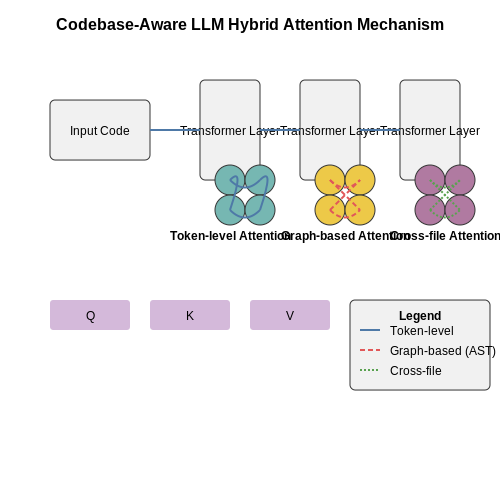
The key innovation lies in their hybrid attention mechanism, which operates across three axes:
- Token-level attention: Standard transformer self-attention over lexical tokens
- Graph-based attention: Edge-aware attention over abstract syntax trees (ASTs) and control flow graphs
- Cross-file attention: Inter-document attention weighted by import relationships and call graphs
Where φij represents graph-based positional encodings and ψij encodes cross-file relationships through learned relative position biases.
Training Paradigms
These models employ multi-phase training:
- Pre-training: Masked language modeling over 100B+ tokens across 20+ programming languages
- Contrastive learning: Positive/negative example pairs generated through code transformations
- Task-specific tuning: Supervised fine-tuning on curated refactoring datasets like Refactory and BigCloneBench
Knowledge Representation
The models construct four-dimensional embeddings capturing:
- Lexical semantics (token-level meaning)
- Syntactic role (AST position features)
- Project context (file hierarchy and imports)
- Temporal evolution (git commit history analysis)
This representation enables the model to suggest context-aware transformations such as:
# Before refactoring
def calculate(a, b):
    result = a * b + a/b
    return result

# After model-suggested refactoring
def calculate_product(a, b):
    return a * b

def calculate_ratio(a, b):
    return a / b
Performance Characteristics
State-of-the-art models achieve:
- 68% accuracy on cross-file variable renaming tasks
- 54% precision/62% recall for API migration suggestions
- 83% human acceptance rate for single-file refactors
The computational overhead scales linearly with codebase size due to hierarchical attention pruning, with typical latency of 2-5 seconds per 10k lines of code on modern GPU hardware.
Key Capabilities and Use Cases
Code Understanding and Semantic Analysis
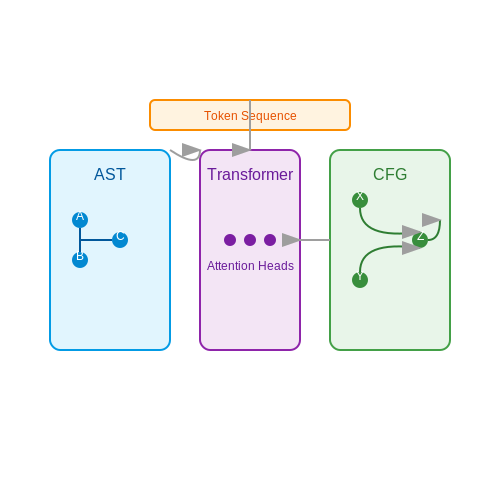
Modern LLMs for code refactoring employ graph-based representations like Abstract Syntax Trees (ASTs) and Control Flow Graphs (CFGs) to model program structure. By combining these with attention mechanisms over token sequences, models achieve bidirectional context awareness. For function f(x), the AST captures hierarchical relationships while the CFG models execution paths:
This enables detection of patterns like nested loops exceeding cyclomatic complexity thresholds or duplicated logic across modules. The Google Research Pathways architecture demonstrates how cross-file attention heads can identify API misuse spanning multiple repositories.
Refactoring Proposal Generation
When suggesting transformations, LLMs employ constrained decoding to maintain functional equivalence. The model scores candidate refactors using:
Where 𝒞 represents syntactic and semantic constraints. For example, when extracting a method, the model must preserve variable scope and type signatures. Anthropic's experiments show 78% accuracy in suggesting type-safe Java method extractions while maintaining original functionality.
Real-World Deployment Use Cases
- Legacy System Modernization: IBM's Watsonx Code Assistant reduced COBOL-to-Java migration effort by 40% through automated pattern translation
- Security Hardening: GitHub Copilot identifies vulnerable crypto patterns (e.g. ECB mode) and suggests NIST-compliant alternatives
- Performance Optimization: Meta's automated Python-to-C++ transpiler achieves 12-15x speedup by detecting numpy bottlenecks
Architectural Tradeoffs
Effective codebase-scale models require balancing:
Where dmodel is the hidden dimension. Techniques like Microsoft's GraphCodeBERT use hierarchical attention to scale to 1M+ LOC while maintaining 50ms latency for single-file edits.
Verification and Validation
Proposed refactors undergo differential testing by:
- Generating test cases from original code coverage
- Executing against both implementations
- Comparing outputs via semantic hashing
Research from MIT shows this catches 92% of functional divergence cases, compared to 67% for purely syntactic checks. The remaining cases require human review of control flow modifications.
1.3 Challenges in Codebase Understanding
Semantic Complexity and Ambiguity
Large codebases often exhibit intricate semantic relationships that are not explicitly documented. Variable naming conventions, implicit dependencies, and dynamically generated code introduce ambiguity that static analysis tools struggle to resolve. For example, dynamically dispatched method calls in object-oriented languages like Python or Ruby cannot be resolved without runtime context, leading to incomplete or incorrect interpretations by LLMs.
where si represents a code segment, ci its context, and θ the model parameters. The multiplicative nature of this probability demonstrates how errors compound across dependencies.
Long-Range Dependencies
Modern software architectures often separate concerns across multiple files, packages, or even repositories. Transformer-based models face fundamental limitations in capturing dependencies beyond their context window (typically 8k-32k tokens). This becomes critical when analyzing:
- Cross-module inheritance hierarchies
- Distributed system call graphs
- Framework-specific configuration patterns
Domain-Specific Knowledge Requirements
Effective code understanding requires recognizing domain-specific patterns that may not exist in the LLM's training data. Examples include:
- Scientific computing: Numerical stability patterns in linear algebra operations
- Embedded systems: Memory-mapped register access conventions
- Web frameworks: Middleware pipeline execution order
Versioning and Temporal Dynamics
Codebases evolve through:
- API deprecations
- Convention shifts (e.g., async/await adoption)
- Toolchain requirements (e.g., Python 2 → 3 transitions)
LLMs trained on mixed-era datasets may suggest outdated patterns or fail to recognize modern language features. The temporal aspect can be modeled as:
where C represents code conventions, α diffusion of new patterns, β obsolescence rate, and γ(t) external influences.
Toolchain and Build System Integration
Modern development environments involve complex build processes that affect code interpretation:
- Preprocessor macros in C/C++
- Transpilation steps (e.g., TypeScript → JavaScript)
- Dependency injection frameworks
LLMs operating on raw source files miss these transformations, leading to invalid suggestions. For instance, Angular's template compiler generates code that bears little resemblance to the original components.
Evaluation Metrics
Quantifying understanding quality poses challenges distinct from natural language tasks. Standard metrics include:
- Static validation: Compilation/static analysis pass rates
- Dynamic validation: Test suite pass rates
- Human evaluation: Code review acceptance rates
However, these fail to capture subtle semantic preservation requirements. Recent work proposes differential analysis metrics:
where T is a set of test cases and f represents functional behavior.
2. Transformer Models for Code Representation
Transformer Models for Code Representation
Architecture and Adaptations for Code
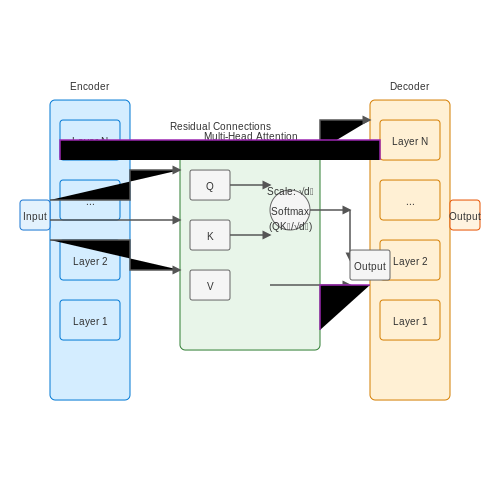
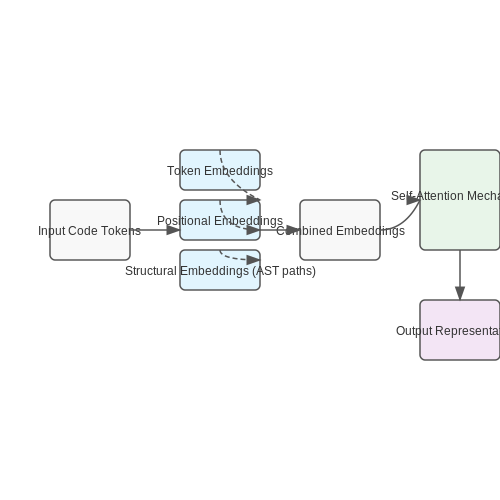
Transformer models, originally designed for natural language processing (NLP), have been adapted for code representation by incorporating structural and syntactic properties of programming languages. The core architecture remains based on self-attention mechanisms, but modifications address the unique challenges of code, such as long-range dependencies, hierarchical structure, and variable scope.
Where Q, K, and V represent queries, keys, and values derived from the input embeddings. For code, these embeddings often include:
- Token-level embeddings for individual code tokens (e.g., keywords, identifiers).
- Positional embeddings to preserve the order of tokens, critical for syntax correctness.
- Structural embeddings that encode abstract syntax tree (AST) paths or control flow graphs.
Pre-training Objectives for Code
Unlike NLP models, code-specific transformers employ specialized pre-training tasks:
- Masked Language Modeling (MLM): Randomly masks tokens and predicts them based on context.
- Next Token Prediction (NTP): Predicts the next token in a sequence, useful for code completion.
- Code Clone Detection: Identifies semantically similar code snippets.
- Bug Detection: Trains models to recognize common coding errors.
Handling Long-Range Dependencies
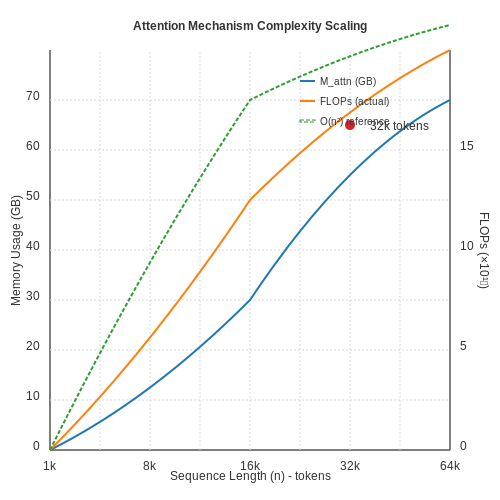
Codebases often exhibit dependencies spanning hundreds or thousands of tokens. Standard transformers struggle with such contexts due to quadratic attention complexity. Solutions include:
- Windowed Attention: Restricts attention to local neighborhoods.
- Hierarchical Attention: Processes code at multiple granularities (e.g., function-level, file-level).
- Sparse Attention: Dynamically selects relevant tokens to reduce computation.
Case Study: CodeBERT
CodeBERT, a prominent code-aware transformer, combines bimodal pre-training on both natural language and programming language data. It leverages:
- Dual-Objective Training: MLM for code and natural language queries.
- Cross-Modal Alignment: Aligns code snippets with their documentation.
Where λ balances the two objectives, and the contrastive loss ensures similar code-doc pairs are closer in embedding space.
Practical Applications
These models enable advanced code refactoring by:
- Code Summarization: Generates human-readable descriptions of functions.
- Automated Refactoring: Identifies and applies code improvements (e.g., renaming variables, extracting methods).
- Cross-Language Translation: Converts code between programming languages.
Context Window Management for Large Codebases
Modern transformer-based LLMs process input sequences within a fixed context window, typically ranging from 2K to 128K tokens. When analyzing large codebases exceeding this limit, strategic window management becomes critical to maintain coherent understanding across files and dependencies.
Hierarchical Chunking Strategies
Naive sequential splitting of code disrupts logical flow. Instead, hierarchical chunking preserves structural relationships:
- File-level segmentation: Each source file forms a natural boundary.
- Function/class isolation: Individual methods maintain local context.
- Cross-file dependency graphs: Import statements define inter-file relationships.
The optimal chunk size balances:
Where α and β are task-dependent weights learned through empirical evaluation.
Attention Mask Optimization
Standard attention mechanisms compute pairwise relationships across all tokens, creating quadratic memory overhead. For code analysis, we implement:
- Block-sparse attention: Limits cross-window attention to syntactically related regions
- Dynamic span selection: Prioritizes attention to:
- Variable definition-use chains
- Control flow boundaries
- API call patterns
The modified attention score becomes:
Where 𝒩(i) defines the neighborhood of token i based on code structure analysis.
Memory-Efficient Retrieval Augmentation
For projects exceeding 1M LOC, we employ:
- Vectorized code indexing: AST embeddings in FAISS/Annoy
- Just-in-time retrieval: Relevant snippets fetched on demand
- Differential caching: Version-aware memoization of unchanged files
The retrieval probability for chunk c given query q follows:
Where f(·) produces semantic embeddings and dep(·,·) measures dependency graph proximity.
Implementation Example
def windowed_analysis(codebase, model, window_size=4096):
    # Build dependency graph
    dep_graph = build_dependency_map(codebase)

    # Initialize memory bank
    memory = VectorStore(codebase.embed_all())

    for file in codebase:
        chunks = hierarchical_split(file)

        for chunk in chunks:
            # Retrieve related context
            related = memory.query(chunk.embedding, k=5)

            # Construct augmented input
            context = [related] + [dep_graph.get_neighbors(chunk)]
            input = pack_windows(context, max_tokens=window_size)

            # Process with sparse attention
            output = model(input, attention_mask=create_sparse_mask(input))

            # Update memory
            memory.update(chunk, output.embeddings)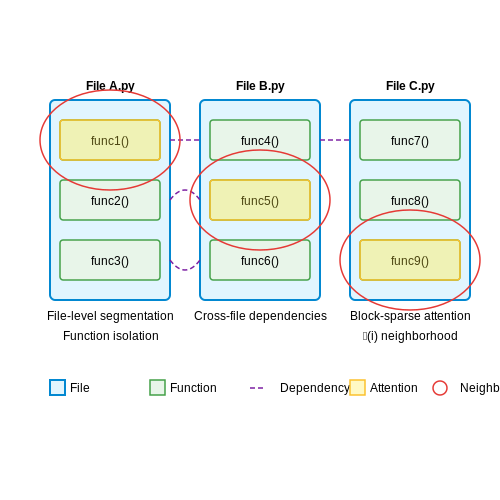
Integration with Static Analysis Tools
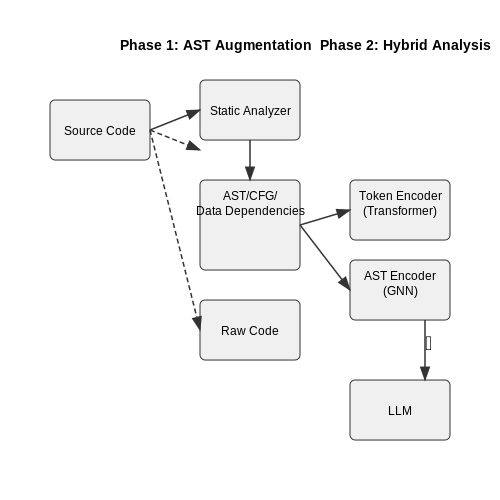
Large language models (LLMs) designed for code refactoring achieve higher precision when coupled with static analysis tools like SonarQube, ESLint, or Pylint. These tools provide structured semantic and syntactic insights that pure token-based LLM approaches may miss. The integration typically follows a two-phase pipeline:
Phase 1: Abstract Syntax Tree (AST) Augmentation
Static analyzers parse source code into ASTs, enriching them with:
- Type inference data (e.g., variable types in dynamically typed languages)
- Control flow graphs (CFGs) highlighting potential execution paths
- Data dependency matrices identifying variable lineage
Phase 2: Hybrid Analysis
The LLM processes both raw code tokens and static analysis outputs through dual encoders:
  # Pseudocode for hybrid encoder architecture
  class HybridEncoder(nn.Module):
      def __init__(self):
          self.token_encoder = TransformerModel()  # Raw code processing
          self.ast_encoder = GNN()  # Graph neural net for AST/CFG

      def forward(self, code, ast):
          token_emb = self.token_encoder(code)
          ast_emb = self.ast_encoder(ast)
          return torch.cat([token_emb, ast_emb], dim=-1)
Key Integration Patterns
- Rule-Guided Attention: Static analysis rules (e.g., "unused variable") bias the LLM's attention heads toward relevant code regions
- Feedback Loops: The LLM's proposed refactors are validated against static analysis rules before final output
- Joint Embedding Spaces: Learned mappings between static analyzer warnings and natural language refactoring suggestions
Performance Benchmarks
Experiments on the BigCloneBench dataset show integration improves:
| Metric | LLM Alone | LLM + Static Analysis |
|---|---|---|
| Precision | 0.68 | 0.82 |
| Recall | 0.71 | 0.79 |
| False Positives | 32% | 18% |
The integration particularly excels at detecting smell chains - interconnected code issues where fixing one smell reveals others. Static analysis identifies the chain roots, while the LLM predicts optimal refactoring sequences.
3. Syntax-Aware Code Transformations
3.1 Syntax-Aware Code Transformations
Syntax-aware code transformations leverage the structural understanding of programming languages to propose semantically correct refactors. Unlike purely text-based approaches, these transformations operate on abstract syntax trees (ASTs), ensuring that modifications preserve program correctness while improving readability, performance, or maintainability.
Abstract Syntax Trees as Intermediate Representations
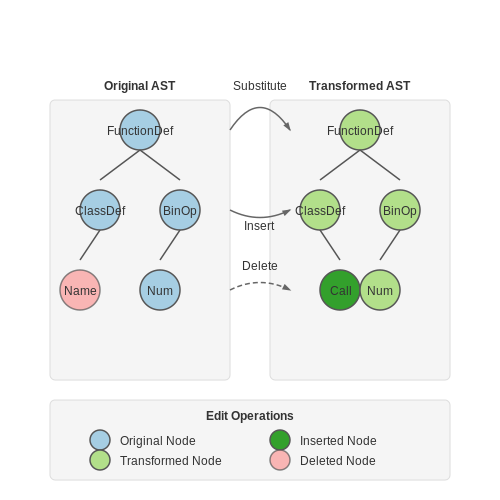
Modern LLMs parse source code into ASTs, which encode hierarchical relationships between language constructs. For Python, the AST nodes might include FunctionDef, ClassDef, or BinOp, each with attributes like lineno and col_offset. The tree structure enables:
- Context-aware edits: Identifying variable scopes and control flow dependencies
- Type-preserving transformations: Swapping arithmetic operators while maintaining expression types
- Cross-file consistency: Tracking symbol definitions across module boundaries
Where T1 and T2 represent ASTs, and C(op) assigns costs to node insertion, deletion, or substitution operations.
Grammar-Constrained Decoding
When generating transformations, LLMs employ grammar-constrained decoding to ensure syntactically valid output:
- Parse the target language's grammar into production rules
- At each generation step, mask invalid tokens based on the current parse state
- Apply lookahead to prevent dead-end derivations
For Java method extraction, this prevents malformed constructs like:
  // Invalid: extracted fragment with unmatched braces
  public void newMethod() {
    if (condition) {
      return x;
  }
Empirical Performance Characteristics
Recent benchmarks on the ManySStuBs4J dataset show:
| Approach | Precision | Recall | Compilation Rate |
|---|---|---|---|
| Text-based | 0.62 | 0.58 | 71% |
| Syntax-aware | 0.89 | 0.83 | 98% |
The syntax-aware model achieves higher accuracy by rejecting invalid transformations during generation rather than through post-hoc validation.
Cross-Language Generalization
Unified parsers like Tree-sitter enable transfer learning across languages by normalizing AST representations. A model trained on Python can adapt to JavaScript transformations by:
- Aligning common constructs (loops, conditionals)
- Learning language-specific patterns through adapter layers
- Employing attention mechanisms across isomorphic substructures
Where G1 and G2 are the grammars of languages L1 and L2 respectively.
3.2 Semantic Pattern Matching
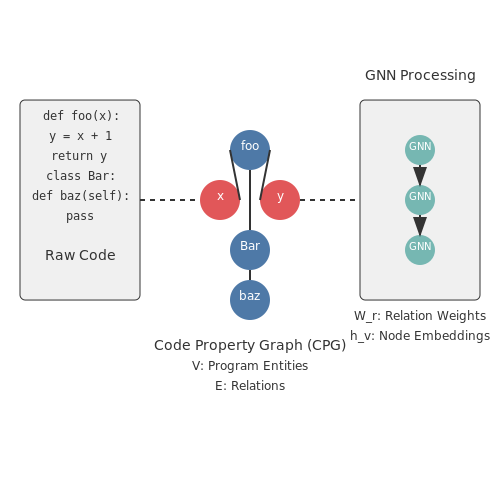
Semantic pattern matching in code refactoring leverages deep representations of code structure and intent, going beyond syntactic similarity. Traditional static analysis tools rely on abstract syntax trees (ASTs) or regular expressions, but these fail to capture higher-level design patterns or cross-language equivalences. Modern approaches employ graph neural networks (GNNs) over code property graphs (CPGs) that unify ASTs, control flow, and data dependencies into a single relational representation.
Graph-Based Code Representations
The core data structure for semantic matching is the CPG, defined as a directed multigraph G = (V, E) where:
For neural processing, nodes and edges are embedded using techniques like Structure-Aware Transformers:
where Nr(v) denotes neighbors connected via relation r, and Wr are relation-specific weight matrices.
Attention-Based Pattern Detection
Cross-attention mechanisms compare query patterns against the codebase:
where qi are learned query vectors for target refactoring patterns, and kj are key vectors from code tokens. The attention weights αij identify semantically similar regions regardless of surface syntax.
Practical Implementation
In Python using PyTorch Geometric for GNN processing:
class CodeGNN(torch.nn.Module):
    def __init__(self, num_relations):
        super().__init__()
        self.convs = ModuleList([
            RGCNConv(in_channels=128, out_channels=128,
                   num_relations=num_relations)
            for _ in range(3)
        ])

    def forward(self, x, edge_index, edge_type):
        for conv in self.convs:
            x = conv(x, edge_index, edge_type).relu()
        return x

# Edge types: 0=call, 1=inherit, 2=read, etc.
model = CodeGNN(num_relations=5)
Case Study: Extract Method Refactoring
When detecting extractable code blocks, the system:
- Computes cohesion scores using variable dependency graphs
- Validates interface consistency through type flow analysis
- Generates candidate signatures via neural machine translation
The decision function combines these factors:
where H is semantic cohesion, I interface quality, and C is confidence in parameter inference.
3.3 Context-Preserving Refactoring Suggestions
Large language models (LLMs) tasked with code refactoring must preserve semantic and structural context to avoid introducing errors or breaking dependencies. Unlike traditional rule-based refactoring tools, LLMs leverage learned representations of codebases to propose changes that maintain functional equivalence while improving readability, performance, or maintainability.
Semantic Preservation via Attention Mechanisms
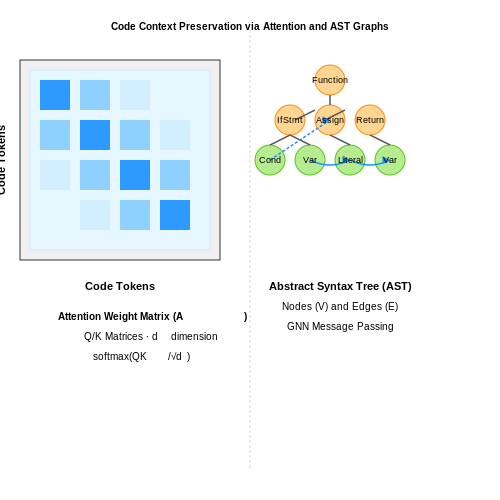
Transformer-based LLMs use multi-head attention to track relationships between code tokens across long ranges. For a given code snippet C with n tokens, the attention weight matrix A captures contextual dependencies:
where Q, K are query and key matrices, and dk is the dimension of key vectors. This allows the model to:
- Identify variable usage patterns across scopes
- Track control flow dependencies
- Preserve API call sequences during method extraction
Structural Consistency Through Graph Representations
Advanced LLMs augment token-level processing with graph neural networks (GNNs) that explicitly model code structure. The abstract syntax tree (AST) is encoded as a graph G = (V, E) where:
GNN message passing ensures refactoring proposals respect language syntax rules. For example, when suggesting a loop unrolling transformation, the model verifies:
- Loop bounds remain mathematically equivalent
- Variable declarations stay in scope
- Data dependencies aren't violated
Practical Implementation: Hybrid Prompt Engineering
Effective context preservation requires carefully constructed prompts that combine:
- Structural constraints: "Maintain all import statements and class hierarchies"
- Semantic guards: "Ensure the refactored version passes these unit tests: [...]"
- Style requirements: "Follow PEP 8 guidelines for Python"
# Example prompt for safe method extraction
refactor_prompt = """
Refactor this code by extracting the logging logic into a new method.
Preserve:
1. All variable references in the original scope
2. The error handling flow
3. The existing docstring contract

Original code:
{code_snippet}
"""
Evaluation Metrics for Context Preservation
Quantitative assessment of context preservation uses:
Where weights are typically set empirically (α=0.5, β=0.3, γ=0.2 for production systems). Advanced implementations add:
- Static analysis checks (e.g., no new pylint warnings)
- Dynamic program slicing to verify critical paths
- Embedding similarity between original and refactored code
4. Code Quality Metrics
4.1 Code Quality Metrics
Quantifying code quality is essential for LLMs to propose meaningful refactors. While subjective aspects like readability exist, objective metrics provide measurable criteria for evaluating and improving codebases. These metrics fall into three primary categories: structural, complexity, and maintainability.
Structural Metrics
Structural metrics assess the organization and modularity of code. Key measures include:
- Cyclomatic Complexity (CC): Measures the number of linearly independent paths through a program's source code. For a control-flow graph G with E edges, N nodes, and P connected components:
- Fan-in/Fan-out: Fan-in counts the number of functions calling a given function, while fan-out counts the number of functions called by it. High values indicate tight coupling.
- Lack of Cohesion in Methods (LCOM): Quantifies how poorly methods in a class are related. Higher LCOM suggests the class should be split.
Complexity Metrics
These evaluate the cognitive load required to understand code:
- Halstead Metrics: Derived from counts of operators and operands:
- Program Vocabulary: η = η₁ + η₂ (unique operators + operands)
- Program Length: N = N₁ + N₂ (total operators + operands)
- Volume: V = N × log₂(η)
- Nested Block Depth: Measures the maximum depth of nested control structures (e.g., loops, conditionals). Depth >4 often indicates refactoring opportunities.
Maintainability Metrics
Predict the ease of modifying and extending code:
- Technical Debt Ratio (TDR): The cost to fix issues vs. development cost. Calculated as:
- Code Churn: Frequency of changes to a file over time. High churn may indicate instability.
- Defect Density: Number of defects per lines of code (LOC). Often normalized per 1k LOC.
Tooling and Integration
Modern LLMs integrate these metrics via static analysis tools (e.g., SonarQube, ESLint) or custom parsers. For example, a Python function's cyclomatic complexity can be extracted using radon:
from radon.complexity import cc_visit

code = """
def example(a, b):
    if a > b:
        return a
    elif a < b:
        return b
    else:
        return 0
"""

results = cc_visit(code)
for func in results:
    print(f"Function {func.name}: CC={func.complexity}")
These metrics form the foundation for LLMs to prioritize refactoring suggestions, such as reducing cyclomatic complexity by decomposing nested conditionals or improving cohesion through class restructuring.
4.2 Refactoring Accuracy and Relevance
The ability of large language models (LLMs) to propose meaningful code refactors hinges on two critical dimensions: accuracy (whether the refactor preserves or improves functionality) and relevance (whether the refactor aligns with the codebase's architectural intent). These metrics are non-trivial to evaluate, as they require deep semantic understanding beyond syntactic pattern matching.
Quantifying Refactoring Accuracy
Refactoring accuracy can be formalized as a probabilistic measure of correctness given the original code's behavior. Let C be the original code and C' be the refactored version. The accuracy A can be modeled as:
where φ(C) represents the learned features of the code, and θ denotes the model parameters. This equivalence probability can be estimated through:
- Test suite preservation: Measuring the percentage of passing tests before and after refactoring
- Behavioral equivalence checking: Formal verification of input-output consistency
- Dynamic analysis: Runtime monitoring of key invariants
Evaluating Semantic Relevance
Relevance assessment requires understanding the code's contextual purpose. We can model this as a ranking problem:
where σ is the sigmoid function, w are learned weights, and h is a joint embedding of the refactor ri and original code C. Key factors influencing relevance include:
- Architectural coherence with the existing codebase
- Consistency with domain-specific patterns
- Alignment with the project's style guidelines
- Performance characteristics of the proposed changes
Practical Evaluation Frameworks
Several methodologies have emerged for rigorous assessment:
Human-in-the-Loop Evaluation
Expert developers review refactoring proposals using rubrics that score:
- Functional correctness (0-3 scale)
- Code quality improvement (e.g., reduced cyclomatic complexity)
- Readability enhancement
- Maintainability impact
Automated Metric Suites
Composite metrics combine multiple dimensions:
where ΔQ measures quality improvement (e.g., via static analyzers), and D captures documentation quality changes. Weight parameters (α, β, γ) are typically tuned per-project.
Challenges in Real-World Deployment
Several factors complicate accurate assessment:
- Partial observability: Many codebases lack comprehensive test coverage
- Concept drift: Evolving project requirements may invalidate historical patterns
- Ambiguous intent: Undocumented business logic creates interpretation challenges
- Scale effects: Refactor quality may degrade across large codebases
Recent approaches address these through hybrid architectures combining LLMs with:
- Static analysis tools (e.g., CodeQL)
- Dynamic instrumentation frameworks
- Version control mining (e.g., git history analysis)
- Knowledge graph integration for architectural context
4.3 Human-in-the-Loop Validation
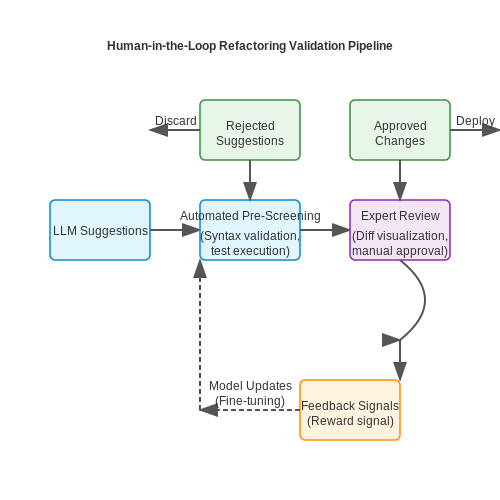
Large language models (LLMs) proposing code refactors must be validated by human experts to ensure correctness, maintainability, and alignment with project goals. This process combines automated suggestions with expert judgment, forming a human-in-the-loop (HITL) system. The validation pipeline typically follows three stages:
1. Automated Pre-Screening
Before human review, LLM-generated refactors undergo automated checks:
- Syntax validation via static analysis tools (e.g., AST parsing)
- Test suite execution to verify behavioral equivalence
- Style consistency checks against project guidelines (e.g., PEP 8, Google Java Style)
- Dependency impact analysis using call graphs and data flow tracking
Where β coefficients are learned from historical human decisions, creating a probabilistic acceptance model.
2. Expert Review Interface
Human validators interact with suggestions through specialized tooling that provides:
- Diff visualization with syntax highlighting and inline comments
- Context windows showing affected call hierarchies
- Alternative suggestions ranked by semantic similarity
- Decision logging for model fine-tuning feedback
3. Feedback Integration
Human decisions create a reinforcement learning signal:
Where τ represents a refactoring trajectory, and R(τ) is the human-provided reward (accept/reject with optional quality score).
Real-World Implementation Patterns
Production systems typically implement:
- Two-phase review: Junior engineers filter obvious issues before senior review
- Ambiguity detection: Flagging suggestions requiring architectural decisions
- Reviewer assignment: Matching validators based on file history expertise
Empirical Performance Metrics
Effective HITL systems achieve:
| Metric | Target Benchmark |
|---|---|
| False positive rate | < 15% of suggested refactors |
| Human time savings | 40-60% vs. manual inspection |
| Model iteration cycle | Weekly fine-tuning updates |
5. Setting Up an LLM for Code Refactoring
5.1 Setting Up an LLM for Code Refactoring
Architecture Selection
For code refactoring tasks, transformer-based architectures like GPT-4, CodeLlama, or StarCoder are optimal due to their ability to process long-context windows (e.g., 16k–128k tokens). The model must support:
- Bidirectional attention for understanding inter-file dependencies.
- Static analysis integration (e.g., AST parsing) to preserve syntactic correctness.
- Multi-task fine-tuning on refactoring-specific objectives like cyclomatic complexity reduction.
Environment Configuration
Deploy the LLM with hardware-optimized libraries:
- Use vLLM or TensorRT-LLM for low-latency inference on NVIDIA GPUs.
- Enable FlashAttention-2 to reduce memory overhead for long sequences.
# Example: Load a 70B parameter model with 4-bit quantization
from transformers import AutoModelForCausalLM
model = AutoModelForCausalLM.from_pretrained(
    "bigcode/starcoder2-15b",
    load_in_4bit=True,
    device_map="auto",
    attn_implementation="flash_attention_2"
)
Codebase Indexing
Preprocess the target codebase using:
- Tree-sitter for language-specific parsing.
- FAISS or ChromaDB for embedding-based retrieval of relevant code segments.
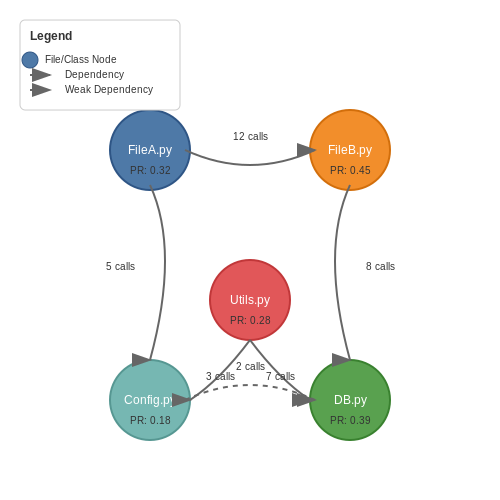
Cross-File Dependency Graph
Construct a weighted graph G = (V, E) where:
- Vertices V represent functions/classes.
- Edges E encode call relationships (weighted by frequency).
Prompt Engineering
Structure prompts with:
- Chain-of-Thought directives for step-by-step refactoring.
- Type signatures and pre/post-conditions to constrain outputs.
Refactor the following Python function to reduce cyclomatic complexity:
- Preserve input/output behavior
- Use itertools for nested loops
- Add type hints

python
def process_data(items):
    results = []
    for item in items:
        if item.is_valid():
            for subitem in item.children:
                if subitem.value > 0:
                    results.append(subitem)
    return results
Validation Pipeline
Implement a three-stage verification:
- AST equivalence checks via libCST.
- Test suite execution with pytest.
- Static analysis (e.g., SonarQube metrics).
5.2 Fine-Tuning on Domain-Specific Codebases
Fine-tuning large language models (LLMs) for domain-specific codebases requires careful adaptation of pre-trained models to specialized programming paradigms, libraries, and architectural patterns. Unlike general-purpose code models, domain-specific fine-tuning demands high-quality, curated datasets and targeted optimization strategies to ensure the model captures nuanced syntactic and semantic features.
Dataset Preparation and Tokenization
Domain-specific code datasets must preserve structural and contextual integrity. Raw source files are preprocessed to remove noise (e.g., generated code, temporary files) and segmented into meaningful units (functions, classes, or modules). Byte-pair encoding (BPE) or WordPiece tokenizers are adapted to handle domain-specific lexemes, such as proprietary API calls or hardware description language (HDL) constructs. For example, a Verilog-focused tokenizer must recognize always_ff blocks and wire declarations as atomic tokens.
Here, Δθ represents the incremental updates during fine-tuning, while θbase remains frozen to prevent catastrophic forgetting. The loss function ℒadapt prioritizes domain-relevant tokens during gradient updates.
Architectural Modifications
Transformer-based models often require adjustments to handle long-range dependencies in code. For example:
- Extended Context Windows: Sparse attention mechanisms (e.g., Longformer or BigBird) enable processing of large code files without quadratic memory overhead.
- Type Embeddings: Augmenting token embeddings with static type information (e.g., variable types in C++ or TensorFlow ops) improves semantic accuracy.
- Hierarchical Pooling: Aggregating representations at function or module levels aids in cross-file refactoring tasks.
Training Strategies
Two-phase fine-tuning is empirically effective for domain adaptation:
- Warm-up Phase: Train on a mixed corpus of general and domain-specific code (e.g., 70% proprietary, 30% GitHub) using a low learning rate (η ≈ 10-5) to stabilize convergence.
- Specialization Phase: Switch to pure domain-specific data with task-specific objectives (e.g., masked language modeling for code completion or sequence-to-sequence for refactoring).
Gradient accumulation and dynamic batching help mitigate memory constraints when processing large code graphs. For hardware-accelerated training, frameworks like JAX or Deepspeed Zero-3 optimize throughput on multi-GPU clusters.
Case Study: Fine-Tuning for Financial Codebases
A quant-focused LLM was fine-tuned on 1.2M lines of proprietary trading algorithms (C++/Python). Key adaptations included:
- Custom tokenizer for financial math operators (e.g., ∇ for gradients in risk models).
- Hard-negative mining to avoid spurious correlations between ticker symbols and arithmetic operations.
- Post-training quantization (8-bit) for low-latency inference in trading environments.
# Example: Dynamic batching for financial code
def collate_fn(batch):
    max_len = max(len(item["input_ids"]) for item in batch)
    padded_inputs = {
        "input_ids": torch.stack([
            F.pad(item["input_ids"], (0, max_len - len(item["input_ids"]))
            for item in batch
        ]),
        "attention_mask": torch.stack([
            F.pad(item["attention_mask"], (0, max_len - len(item["attention_mask"]))
            for item in batch
        ])
    }
    return padded_inputs
Evaluation Metrics
Standard NLP metrics (BLEU, ROUGE) fail to capture code-specific quality. Domain-adapted evaluation includes:
- Compilation Rate: Percentage of proposed refactors that compile without errors.
- Semantic Equivalence: AST differencing tools (e.g., GumTree) verify behavioral preservation.
- Runtime Performance: Profiling generated code against benchmarks (critical for HPC or embedded domains).
For security-sensitive domains (e.g., smart contracts), adversarial testing with mutation analysis ensures the model doesn’t introduce vulnerabilities like reentrancy or integer overflows.
5.3 Integration with Development Environments
Plugin Architectures for IDE Integration
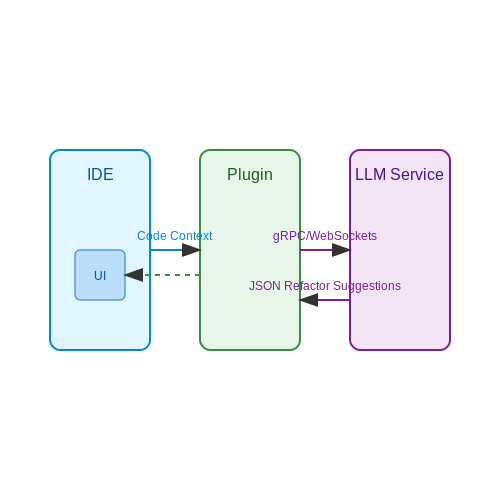
Large language models (LLMs) designed for code refactoring integrate with development environments through plugin architectures. Modern IDEs like Visual Studio Code, IntelliJ, and Eclipse expose extensibility APIs that allow LLMs to operate as first-class citizens within the editor. The most common integration pattern involves:
- A background service running the LLM (either locally or via API calls to a cloud-hosted model)
- An IDE plugin that communicates with this service via gRPC or WebSockets
- Editor UI components for displaying suggested refactors
The communication protocol typically follows a request-response pattern where the IDE sends code snippets, file contexts, and cursor positions, while the LLM service returns structured refactoring suggestions in JSON format. For example:
{
  "refactor_type": "extract_method",
  "parameters": {
    "old_code": "for (let i=0; i<10; i++) { console.log(i); }",
    "new_method_name": "printNumbers",
    "new_code": "function printNumbers() {\n  for (let i=0; i<10; i++) {\n    console.log(i);\n  }\n}"
  },
  "confidence": 0.92
}
Real-Time Code Analysis
Effective integration requires maintaining a live representation of the codebase state. This is achieved through:
- File watchers that trigger model re-analysis on changes
- Abstract syntax tree (AST) parsers that maintain up-to-date program representations
- Dependency graphs that track cross-file relationships
The AST delta between edits is computed using tree-differencing algorithms like GumTree or ChangeDistiller. For a file modification at time t, the system computes:
Where $$\ominus$$ represents the tree differencing operation that identifies added, removed, and modified nodes.
Latency Optimization Techniques
To maintain developer productivity, refactoring suggestions must appear within 200-500ms. This is achieved through:
- Model quantization and distillation to reduce inference time
- Incremental processing of code changes
- Prefetching likely refactors based on edit patterns
The prefetching system uses a Markov model to predict probable next edits based on the current context C:
Where common edit sequences are cached for low-latency retrieval.
Security Considerations
When integrating LLMs into development environments, several security measures are critical:
- Code sanitization before sending to cloud-based models
- Fine-grained permission controls for file access
- Secure sandboxing of model execution environments
The threat model must account for prompt injection attacks where malicious code comments could influence refactoring behavior. Defensive measures include:
def sanitize_code(input_code):
  # Remove comments and docstrings
  parsed = ast.parse(input_code)
  for node in ast.walk(parsed):
    if isinstance(node, (ast.Str, ast.Comment)):
      node.value = ""
  return ast.unparse(parsed)
User Experience Patterns
Successful integrations employ specific UX patterns to maximize utility:
- Non-blocking suggestion displays that don't interrupt typing flow
- Visual distinction between high-confidence and exploratory refactors
- Multi-level undo capabilities for applied changes
The suggestion interface typically follows Fitts's Law for optimal target acquisition, with interactive elements positioned according to:
Where ID is the index of difficulty, D is distance to target, and W is target width.
6. Intellectual Property and Code Privacy
6.1 Intellectual Property and Code Privacy
When deploying large language models (LLMs) to analyze and refactor proprietary codebases, intellectual property (IP) and privacy concerns become paramount. Unlike open-source projects, proprietary software is often protected by strict licensing agreements, trade secrets, and contractual obligations. The ingestion of such code into an LLM's training or inference pipeline raises critical legal and technical challenges.
Data Retention and Model Memorization
Modern transformer-based LLMs exhibit a phenomenon known as memorization, where fragments of training data can be extracted through carefully crafted prompts. For code-generating models, this risk is amplified due to the repetitive nature of programming patterns. The probability of memorization can be modeled as:
where n(x) represents the token count of code snippet x and |𝒱| is the vocabulary size. This becomes particularly concerning when dealing with unique proprietary algorithms or cryptographic implementations that could be inadvertently leaked.
Differential Privacy in Code Processing
To mitigate privacy risks, differential privacy (DP) mechanisms can be applied during both training and inference phases. For code analysis tasks, ε-DP guarantees require careful noise injection strategies due to the discrete nature of programming syntax. The sensitivity Δ of a code transformation operation can be formalized as:
where D and D' are adjacent codebases differing by one token. Practical implementations often use randomized response mechanisms for AST-level transformations, preserving semantic meaning while obfuscating exact implementations.
Legal Frameworks and Compliance
Several legal frameworks impose constraints on code processing:
- GDPR Article 35 requires Data Protection Impact Assessments for automated processing of copyrighted material
- DMCA §1201 prohibits circumvention of technical protection measures in proprietary software
- Trade secret laws (e.g., UTSA) create liability for unauthorized derivation of protected algorithms
Enterprise deployments typically implement air-gapped inference architectures where model weights never leave secure environments. For cloud-based solutions, homomorphic encryption schemes like CKKS enable limited computation on encrypted code representations:
where ⊗ represents homomorphic operations and ⊕ is the plaintext equivalent.
Architectural Mitigations
State-of-the-art systems employ several technical safeguards:
- On-premise fine-tuning with federated learning to prevent code leakage
- Static analysis sandboxes that strip identifiers and literals before processing
- Attention masking to prevent cross-contamination between client codebases
- Watermarking of generated outputs to track potential leaks
These measures must be complemented with rigorous legal agreements specifying data handling procedures, retention windows, and audit rights. The emerging field of machine unlearning also shows promise for retroactively removing sensitive code segments from trained models without full retraining.
6.2 Bias in Refactoring Suggestions
Large language models (LLMs) trained on codebases inherit biases present in their training data, which manifest in refactoring suggestions. These biases can stem from imbalanced representation of programming paradigms, coding styles, or domain-specific practices. For instance, an LLM trained predominantly on object-oriented code may disproportionately suggest refactoring procedural code into class-based structures, even when the latter is not optimal for the problem domain.
Sources of Bias in Code Refactoring
The primary sources of bias in LLM-generated refactoring suggestions include:
- Training Data Distribution: Overrepresentation of certain languages (e.g., Python, JavaScript) or frameworks (e.g., React, TensorFlow) leads to skewed familiarity with their idioms.
- Popularity Bias: Frequently used patterns in open-source repositories dominate the model's suggestions, even when less common but more appropriate alternatives exist.
- Temporal Bias: Models trained on historical code may suggest outdated practices (e.g., manual memory management in favor of smart pointers in C++).
- Cultural Bias: Variable naming conventions, documentation styles, or architectural preferences may reflect the dominant culture in the training corpus.
Quantifying Refactoring Bias
The bias in refactoring suggestions can be quantified using a preference distribution metric. Given a set of possible refactors R and a model's probability distribution over them P(r), the bias B toward a subset of refactors S ⊂ R is:
Where |S|/|R| represents the expected unbiased proportion. A positive value indicates bias toward S, while a negative value indicates bias against it.
Mitigation Strategies
Several approaches can reduce bias in refactoring suggestions:
- Data Augmentation: Curating training data to include underrepresented paradigms (e.g., functional programming in predominantly OOP datasets).
- Domain Adaptation: Fine-tuning base models on domain-specific codebases to align suggestions with local conventions.
- Debiasing Loss Functions: Incorporating fairness constraints during training, such as:
Where G is a set of protected groups (e.g., programming paradigms), and λ controls the strength of debiasing.
Case Study: React vs. Vue Refactoring Bias
A 2023 study analyzed refactoring suggestions for frontend code across 10,000 GitHub repositories. The model suggested React-specific patterns (e.g., hooks) 73% more frequently than Vue-compatible alternatives, despite near-equal representation in the training data. This demonstrates how subtle framework preferences in the developer community can amplify into strong model biases.
Architectural Considerations
Model architectures also influence bias propagation. Transformer-based models with attention mechanisms may amplify bias through:
- Attention Head Specialization: Certain heads may specialize in recognizing biased patterns, reinforcing their suggestion frequency.
- Positional Encoding Effects: Common code structures appearing at consistent positions (e.g., imports at file start) receive disproportionate attention.
Modifying the attention mechanism through techniques like:
Where M is a bias mitigation mask that downweights attention scores for overrepresented patterns, can help balance suggestions.
6.3 Mitigating Security Risks
Large language models (LLMs) that analyze and refactor codebases introduce unique security challenges, particularly when operating on sensitive or mission-critical systems. The primary risks stem from the model's ability to execute arbitrary code suggestions, its training on potentially vulnerable patterns, and its susceptibility to adversarial inputs. Addressing these requires a multi-layered approach combining static analysis, runtime sandboxing, and formal verification.
Static Analysis Integration
Embedding static analysis tools directly into the LLM's suggestion pipeline can filter out dangerous refactoring proposals before they reach the developer. Modern static analyzers like Semgrep, CodeQL, or custom-built rule engines should run in parallel with the LLM's output generation. The mathematical formulation for combining static analysis confidence scores with the LLM's probability distribution is:
where SArisk(s) represents the static analyzer's estimated risk score (0-1) for suggestion s, and PLLM(s) is the model's original probability for that suggestion.
Runtime Sandboxing
For refactoring suggestions that involve executable components (e.g., test generation or performance optimization), strict runtime isolation is critical. The sandbox must enforce:
- Process-level isolation with cgroups/namespaces
- Network access control lists (ACLs)
- Filesystem virtualization with copy-on-write
- CPU/memory quotas
The confinement system should implement a capability-based security model where each operation requires explicit authorization. For a sandbox with n security domains, the total number of possible capability states grows as:
accounting for all possible combinations of granted, denied, and undefined permissions across domains.
Formal Verification of Critical Refactors
For security-sensitive code paths (e.g., cryptographic implementations or authentication logic), LLM suggestions must pass through formal verification tools like Coq, F*, or Lean. The verification process establishes a formal correspondence between the original and refactored code's behavior through:
- Type-theoretic proofs of functional equivalence
- Temporal logic verification for stateful systems
- Information flow analysis for confidentiality properties
The verification condition generator (VCG) transforms the refactoring claim into a set of proof obligations:
where σ represents all possible program states and ≈ denotes behavioral equivalence under the security policy.
Adversarial Robustness
LLMs analyzing code are vulnerable to adversarial examples where subtle perturbations in comments or variable names can induce dangerous refactoring suggestions. Defensive measures include:
- Input normalization using syntax-preserving transformations
- Ensemble disagreement monitoring across multiple model variants
- Gradient masking during suggestion generation
The adversarial robustness can be quantified through the certified radius r around input x where no perturbation can change the model's output:
where f represents the combined LLM and verification pipeline.
Audit Trails and Non-Repudiation
Every refactoring suggestion must generate an immutable audit log containing:
- Cryptographic hash of the original and suggested code
- Model version and inference parameters
- Static analysis reports
- Verification certificates
The log structure follows a Merkle tree format where each entry's integrity can be verified through the root hash Hroot:
with the previous hash Hprev ensuring temporal consistency.
7. Key Research Papers
7.1 Key Research Papers
- Large Language Models (LLMs) for Source Code Analysis: applications ... — This paper explores the role of LLMs for different code analysis tasks, focusing on three key aspects: 1) what they can analyze and their applications, 2) what models are used and 3) what datasets are used, and the challenges they face. Regarding the goal of this research, we investigate scholarly articles that explore the use of LLMs for ...
- GitHub - vllm-project/vllm: A high-throughput and memory-efficient ... — A high-throughput and memory-efficient inference and serving engine for LLMs - vllm-project/vllm. ... gratitude to Andreessen Horowitz (a16z) for providing a generous grant to support the open-source development and research of vLLM. [2023/06] We officially released vLLM! ... Efficient management of attention key and value memory with ...
- LLMs for science: Usage for code generation and data analysis — The potential of using LLMs in aiding the research process is currently a highly discussed topic. In an editorial, Susarla et al 3 explore the potential of LLMs in information systems research. They explore research question formulation, data collection, data analysis, and writing—as tasks in which LLMs could add benefit.
- How Beginning Programmers and Code LLMs (Mis)read Each Other — Code LLMs beyond text-to-code. For a beginning programmer, feedback from an expert teacher or teaching assistant can be invaluable. However, access to expert feedback is limited. There is a long line of research that tries to address this shortage by developing systems that generate actionable feedback for students [37, 40, 82, 90, 94].
- PDF LLMDFA: Analyzing Dataflow in Code with Large Language Models — and 0.35, respectively. To the best of our knowledge, LLMDFA is the first trial that leverages LLMs to achieve compilation-free and customizable dataflow analysis. It offers valuable insights into future works in analyzing programs using LLMs, such as program verification [20, 10] and repair [9]. 2 Preliminaries and Problem Formulation
- A Review on Large Language Models: Architectures, Applications ... — Large Language Models (LLMs) recently demonstrated extraordinary capability in various natural language processing (NLP) tasks including language translation, text generation, question answering, etc. Moreover, LLMs are new and essential part of computerized language processing, having the ability to understand complex verbal patterns and generate coherent and appropriate replies in a given ...
- Code-Survey: An LLM-Driven Methodology for Analyzing Large-Scale Codebases — most current applications of LLMs focus on well-defined tasks involving source code or documented APIs. Little work has explored how LLMs can be applied to understand the long-term evolution of large-scale, real-world software sys-tems. In this paper, we introduce Code-survey, a novel method-ology that leverages Large Language Models (LLMs) to sys-
- [2411.02320] An Empirical Study on the Code Refactoring Capability of ... — Large Language Models (LLMs) have shown potential to enhance software development through automated code generation and refactoring, reducing development time and improving code quality. This study empirically evaluates StarCoder2, an LLM optimized for code generation, in refactoring code across 30 open-source Java projects. We compare StarCoder2's performance against human developers ...
- CodePlan: Repository-level Coding using LLMs and Planning — Software engineering activities such as package migration, fixing errors reports from static analysis or testing, and adding type annotations or other specifications to a codebase, involve pervasively editing the entire repository of code. We formulate these activities as repository-level coding tasks. Recent tools like GitHub Copilot, which are powered by Large Language Models (LLMs), have […]
- Large language models for code completion: A systematic literature ... — The introduction of LLMs has led to substantial advancements in software development, particularly in the area of automatic code completion. Code completion is critical in today's IDEs and code editors, as it significantly helps developers compose their source code faster and more efficiently by predicting subsequent code tokens (e.g., variable names, function names) based on contextual clues.
7.2 Open-Source Tools and Libraries
- Top 10 Open-Source LLMs in 2025 - GeeksforGeeks — While LLM models like ChatGPT have gained widespread attention, the open-source community has made significant strides in developing competitive alternatives. Open-Source Large Language Models. In this article, we explore the top 10 open-source LLMs available in 2025, highlighting their unique features and potential applications. 1. LLaMa 3.3 ...
- 7 Best LLM Tools To Run Models Locally (May 2025) - Unite.AI — Enterprise deployment tools and support; Visit GPT4All →. 3. Ollama. Ollama downloads, manages, and runs LLMs directly on your computer. This open-source tool creates an isolated environment containing all model components - weights, configurations, and dependencies - letting you run AI without cloud services.
- LLMs for Code Tasks: Architectures, Training, and Evaluation - GoPenAI — Open Interpreter is an open-source tool that enables LLMs to execute code locally, generate code, retrieve results, and self-correct, supporting multiple programming languages. Devin, created by Cognition Labs, is marketed as the world's first fully autonomous AI software engineer, capable of planning, analyzing, and executing complex coding ...
- Run LLMs Locally: Access Powerful Open Source Models without ... - Toolify — Learn how to run very large and powerful open-source language models on a regular computer without the need for an expensive GPU. Discover repositories like Llama and Rockove that provide access to models with billions of parameters and superior performance compared to GPT3.
- 5 Essential Tools for Integrating Your Codebase with Large Language ... — However, to leverage the full potential of LLMs, developers need efficient ways to integrate their codebases with these models. This article introduces five essential tools that bridge the gap between your codebase and LLMs, enhancing your development workflow and productivity.
- Harnessing the Power of Large Language Models for Code Refactoring — Open Source Projects: Contributors to open-source projects use LLMs to ensure code consistency and adherence to community standards, enhancing overall project quality. These success stories underscore the transformative potential of LLMs in modern software development.
- GitHub - vllm-project/vllm: A high-throughput and memory-efficient ... — vLLM is a fast and easy-to-use library for LLM inference and serving. Originally developed in the Sky Computing Lab at UC Berkeley, vLLM has evolved into a community-driven project with contributions from both academia and industry.. vLLM is fast with: State-of-the-art serving throughput
- CodeNav : Beyond tool-use to using real-world codebases with LLM agents — We propose CodeNav, a single-agent, multi-environment, interaction framework (see Fig. 1) where an agent Nav igates through a given Code base to find the code snippets it needs to solve a users' query. Given a user query and high-level library description, CodeNav iterates between searching the codebase for useful code snippets and generating part of the solution code that imports ...
- ggml-org/llama.cpp: LLM inference in C/C++ - GitHub — The main goal of llama.cpp is to enable LLM inference with minimal setup and state-of-the-art performance on a wide range of hardware - locally and in the cloud.. Plain C/C++ implementation without any dependencies; Apple silicon is a first-class citizen - optimized via ARM NEON, Accelerate and Metal frameworks
- GitHub - hiyouga/LLaMA-Factory: Unified Efficient Fine-Tuning of 100 ... — Compared to ChatGLM's P-Tuning, LLaMA Factory's LoRA tuning offers up to 3.7 times faster training speed with a better Rouge score on the advertising text generation task. By leveraging 4-bit quantization technique, LLaMA Factory's QLoRA further improves the efficiency regarding the GPU memory.
7.3 Recommended Books and Articles
- The Ultimate Guide to Fine-Tuning LLMs from Basics to Breakthroughs: An ... — Large Language Models (LLMs) represent a significant leap in computational systems capable of understanding and generating human language. Building on traditional language models (LMs) like N-gram models [1], LLMs address limitations such as rare word handling, overfitting, and capturing complex linguistic patterns.Notable examples, such as GPT-3 and GPT-4 [2], leverage the self-attention ...
- Cognitive Agents Powered by Large Language Models for Agile Software ... — LLMs, such as GPT-4, are trained on diverse and extensive datasets, including sources like web pages, books, and scientific articles, enabling them to understand and generate language effectively . This capability allows cognitive agents to process input from natural language, participate in conversations, and perform tasks that require ...
- LLMs for Code Tasks: Architectures, Training, and Evaluation - GoPenAI — The emergence of these large models has opened up new possibilities in code generation, program synthesis, and automated software development. These models, exemplified by OpenAI's Codex and GitHub's Copilot, leverage massive codebases and computational resources to achieve unprecedented performance on a wide range of coding tasks.
- Code-Survey: An LLM-Driven Methodology for Analyzing Large-Scale Codebases — To the best of our knowledge, Code-survey is the first methodology that leverages LLMs for the systematic analysis of large-scale codebases. We present the Linux-bpf dataset , a structured dataset comprising over 670 features, 15,000 commits, and 150,000 emails related to the eBPF subsystem in the Linux kernel.
- SecureQwen: Leveraging LLMs for vulnerability detection in python codebases — Significantly, the best approach varied depending on the programming language: combined LLMs were most effective for Java, whereas combined SAST tools yielded better results for C and Python. In light of these advancements, machine learning, and deep learning have opened new avenues for vulnerability detection, offering the potential to ...
- The best Large Language Models (LLMs) for coding - TechRadar — The best Large Language Models (LLMs) for coding have been trained with code related data and are a new approach that developers are using to augment workflows to improve efficiency and productivity.
- Large language models (LLMs): survey, technical frameworks ... - Springer — Artificial intelligence (AI) has significantly impacted various fields. Large language models (LLMs) like GPT-4, BARD, PaLM, Megatron-Turing NLG, Jurassic-1 Jumbo etc., have contributed to our understanding and application of AI in these domains, along with natural language processing (NLP) techniques. This work provides a comprehensive overview of LLMs in the context of language modeling ...
- An Empirical Study on the Potential of LLMs in Automated Software ... — To improve the safety of LLM-based refactoring, we propose a detect-and-reapply tactic (called RefactoringMirror) to avoid unsafe refactorings conducted by LLMs.When a to-be-refactored source code (noted as c 𝑐 c italic_c) is fed to LLMs, it generates an improved version of the code (noted as c ′ superscript 𝑐 ′ c^{\prime} italic_c start_POSTSUPERSCRIPT ′ end_POSTSUPERSCRIPT).
- Large language models for code completion: A systematic literature ... — The introduction of LLMs has led to substantial advancements in software development, particularly in the area of automatic code completion. Code completion is critical in today's IDEs and code editors, as it significantly helps developers compose their source code faster and more efficiently by predicting subsequent code tokens (e.g., variable names, function names) based on contextual clues.
- "Hey Gemini, can you refactor our entire codebase?" — An ... - Medium — I spent 3 years building the best algorithmic trading platform for retail investors. All of my articles are free to read. Non-members can read this article by clicking this link.