Prompt Engineering Techniques vs Function Calling
1. Definition and Core Principles of Prompt Engineering
Definition and Core Principles of Prompt Engineering
Prompt engineering is the systematic design and optimization of input queries to guide large language models (LLMs) toward generating desired outputs with high precision. Unlike traditional programming, where logic is explicitly encoded, prompt engineering leverages the implicit knowledge embedded in LLMs through carefully crafted textual instructions, constraints, and contextual cues.
Key Components of Effective Prompts
An optimized prompt typically consists of four structural elements:
- Instruction - The explicit task directive (e.g., "Translate this text to French")
- Context - Relevant background information (e.g., "You are a legal document specialist")
- Input Data - The content to be processed (e.g., "The contract states...")
- Output Indicator - Formatting requirements (e.g., "Return as a bulleted list")
Mathematical Foundations
The effectiveness of a prompt can be modeled through the lens of conditional probability. Given a language model's parameters θ, the probability distribution over outputs y for input x is:
where s(x,y;θ) represents the scoring function of the model. Effective prompt engineering maximizes the probability mass concentrated on the desired output y* by:
where x_p is the engineered prompt and x_d is the input data.
Advanced Techniques
Several empirically validated methods enhance prompt effectiveness:
- Few-shot learning - Including examples within the prompt (e.g., "Q: What is 2+2? A: 4. Q: What is 3+5?")
- Chain-of-thought prompting - Requiring step-by-step reasoning ("Let's think step by step")
- Negative prompting - Explicitly excluding undesired outputs ("Do not include personal opinions")
Practical Optimization
Optimal prompt construction follows an iterative process:
- Establish quantitative evaluation metrics (e.g., accuracy, completeness)
- Implement A/B testing with prompt variations
- Analyze failure modes through attention visualization
- Refine based on error pattern analysis
Recent studies demonstrate that prompt optimization can improve task performance by 15-40% compared to naive prompts, particularly in complex domains like legal analysis and scientific literature review.
1.2 Understanding Function Calling in AI Systems
Function calling in AI systems refers to the mechanism by which a model invokes external tools or APIs to retrieve information or perform computations beyond its native capabilities. Unlike traditional prompt engineering, which relies solely on textual interaction, function calling enables dynamic integration of deterministic processes within generative workflows.
Mathematical Foundation of Function Execution
The decision to invoke a function can be modeled as a conditional probability distribution, where the model evaluates whether external computation is required given the input context. Let x represent the input prompt and f denote the available functions:
where s(f,x) is a scoring function that estimates the relevance of function f to input x. Modern implementations typically use:
with Wφ being learned parameters and enc(x) the encoded representation of the input.
Architecture Components
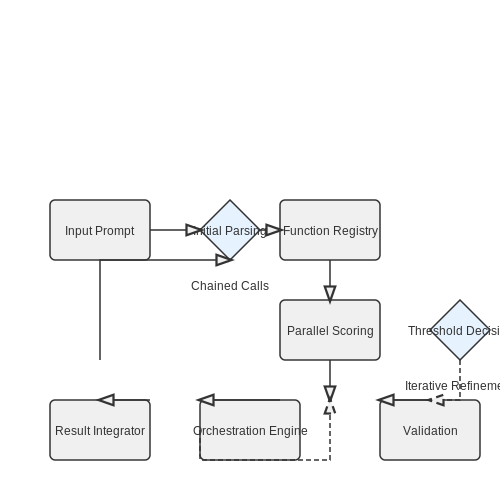
Effective function calling systems require three core components:
- Function Registry: A searchable repository of available tools with their schemas (input/output specifications)
- Orchestration Engine: Manages the execution flow between LLM reasoning and function calls
- Result Integrator: Handles the incorporation of function outputs back into the generative process
Execution Flow Patterns
Advanced implementations employ recursive execution strategies:
- Initial prompt parsing and intent classification
- Parallel scoring of potential function candidates
- Threshold-based invocation decision
- Result validation and error handling
- Iterative refinement through chained calls
Performance Optimization
Latency in function calling systems is dominated by:
Optimization strategies include:
- Pre-fetching likely required functions based on conversation history
- Implementing speculative execution for high-probability calls
- Using compressed representations for function schemas
Real-World Implementation Challenges
Production systems must handle:
- Versioning conflicts between function definitions
- Partial observability of remote service states
- Rate limiting and API quota management
- Secure parameter passing and data sanitization
The most sophisticated implementations now incorporate reinforcement learning to optimize the function calling strategy over time, using metrics like:
where the coefficients are tuned for specific application requirements.
1.3 Key Differences Between Prompt Engineering and Function Calling
Architectural Foundations
Prompt engineering operates within the context of large language models (LLMs) as a purely text-based interaction paradigm, where input-output transformations are learned implicitly through the model's pretrained weights. In contrast, function calling relies on explicit API-based execution, where predefined functions are invoked with structured inputs, bypassing the LLM's generative capabilities for deterministic computation.
Control Flow Characteristics
Prompt engineering exhibits emergent behaviors through chain-of-thought reasoning and few-shot learning, where control flow emerges from the model's internal state transitions. Function calling follows imperative programming patterns with explicit control structures (if-else, loops) defined in the host system. The key distinction manifests in error handling - prompt engineering failures result in hallucinated outputs, while function calling raises explicit exceptions.
Computational Complexity
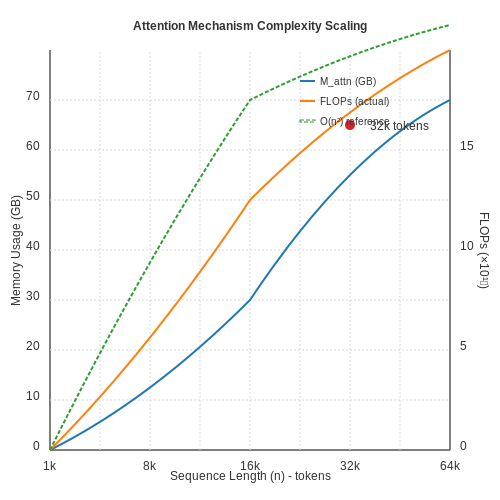
The computational graph for prompt engineering scales with the transformer's self-attention mechanism:
Function calling executes in constant time relative to input size, bounded by the called function's complexity class. This becomes critical when processing large datasets - prompt engineering requires streaming through the model, while function calling can operate on batched inputs directly.
State Management
Prompt engineering maintains conversational state through the implicit memory of the attention mechanism, where context window limitations create Markovian boundaries. Function calling preserves state either through:
- Explicit variable passing between calls
- Persistent storage systems (databases, caches)
- Closure mechanisms in the host language
Type Systems and Validation
Prompt engineering deals with untyped text streams, requiring post-hoc validation through either:
- Regular expression matching
- Secondary model verification
- Human-in-the-loop checking
Function calling enforces strict type checking at the interface boundary, with compile-time verification in statically typed languages. This creates a fundamental trade-off between flexibility (prompt engineering) and reliability (function calling).
Real-World Deployment Patterns
Hybrid architectures combine both approaches through:
- LLM-generated function parameters
- Function outputs fed back into prompts
- Routing mechanisms selecting between approaches
The choice between paradigms depends on the error tolerance of the application - creative tasks favor prompt engineering, while transactional systems require function calling's determinism.

2. Crafting Effective Prompts for Desired Outputs
2.1 Crafting Effective Prompts for Desired Outputs
Effective prompt engineering requires a nuanced understanding of how language models process and generate text. At an advanced level, prompt design must account for the model's internal representations, attention mechanisms, and the probabilistic nature of token generation. Unlike simpler approaches that rely on trial and error, systematic prompt engineering leverages formal techniques to maximize output quality while minimizing ambiguity.
Prompt Structure and Token Optimization
The effectiveness of a prompt depends on how well it aligns with the model's pre-training objectives and fine-tuning data. A well-structured prompt typically consists of:
- Context framing: Establishes the domain and scope of the task
- Instruction specification: Clearly defines the expected output format
- Constraint enumeration: Limits the solution space to relevant outputs
- Example demonstration: Provides few-shot learning cues when applicable
Token efficiency becomes critical when working with large language models. The attention mechanism's quadratic complexity means longer prompts consume disproportionately more computational resources. The optimal prompt length L for a given task can be modeled as:
where D measures the divergence between prompt-induced outputs PL and desired outputs Y, while C(L) represents the computational cost scaling with prompt length.
Advanced Prompting Techniques
Several specialized techniques have emerged for eliciting high-quality outputs from modern language models:
Chain-of-Thought Prompting
This method explicitly requests the model to show its reasoning steps before providing a final answer. The technique leverages the model's ability to perform implicit multi-step computation when the intermediate steps are surfaced in the prompt structure. For complex reasoning tasks, this approach can improve accuracy by 20-40% compared to direct answering.
Constrained Semantic Parsing
By embedding formal constraints within natural language prompts, we can guide the model toward syntactically and semantically valid outputs. For example, when generating code, prompts can specify:
- Input/output types
- Time complexity requirements
- Library restrictions
This technique effectively narrows the hypothesis space while maintaining the flexibility of natural language interaction.
Prompt Optimization via Gradient-Based Methods
Recent work has demonstrated that prompts can be treated as differentiable parameters when working with models that support gradient propagation through text embeddings. The prompt optimization objective can be formulated as:
where θ represents the continuous prompt embedding parameters, fθ is the language model, and L is the task-specific loss function. This approach enables automatic refinement of prompt representations through backpropagation.
Prompt Engineering vs. Function Calling
While prompt engineering manipulates model behavior through natural language, function calling provides direct access to deterministic computation. The choice between these approaches depends on several factors:
| Criteria | Prompt Engineering | Function Calling |
|---|---|---|
| Flexibility | High (open-ended generation) | Low (predefined operations) |
| Determinism | Probabilistic | Deterministic |
| Precision | Context-dependent | Exact |
| Development Cost | Iterative refinement | Upfront implementation |
Hybrid approaches that combine prompt engineering with function calling often yield the best results, using natural language for creative tasks and function calls for precise computations.
2.2 Advanced Techniques: Few-Shot and Zero-Shot Learning
Few-Shot Learning
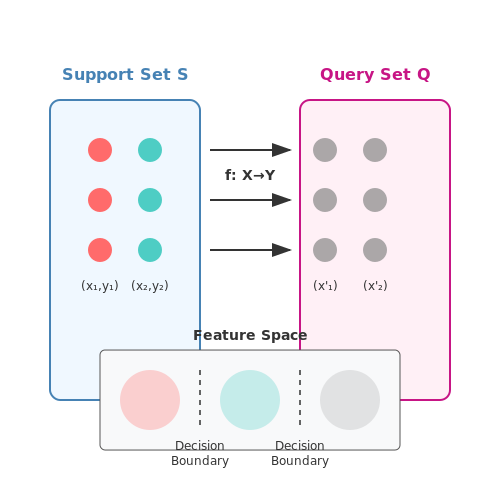
Few-shot learning (FSL) enables models to generalize from a minimal number of labeled examples, typically ranging from one to five samples per class. The core challenge lies in minimizing the generalization error when training data is scarce. A formal formulation involves optimizing the model's parameters θ to maximize the likelihood of correct predictions given a support set S and a query set Q:
Meta-learning frameworks like Model-Agnostic Meta-Learning (MAML) solve this by learning an initialization that can quickly adapt to new tasks. The objective involves a two-level optimization:
Prototypical networks offer an alternative by computing class prototypes as the mean of support embeddings, with classification based on Euclidean distance:
Zero-Shot Learning
Zero-shot learning (ZSL) eliminates the need for task-specific training data by leveraging auxiliary information, such as semantic attributes or textual descriptions. Given a set of attributes A and a compatibility function F, predictions are made via:
where φ(y) maps classes to their attribute vectors. Advanced ZSL methods use generative models like VAEs or GANs to synthesize features for unseen classes, conditioned on their attributes:
Practical Applications
- Medical diagnosis: Few-shot learning adapts to rare diseases with limited patient data by leveraging similar cases.
- Multilingual NLP: Zero-shot cross-lingual transfer uses shared embedding spaces to map queries to unseen languages.
- Robotics: Few-shot imitation learning enables rapid adaptation to new tasks from minimal demonstrations.
Comparative Analysis
While few-shot learning requires some labeled examples, zero-shot learning relies entirely on auxiliary metadata. Hybrid approaches like generalized zero-shot learning (GZSL) bridge this gap by jointly optimizing for seen and unseen classes during training. The trade-off between data efficiency and performance is quantified by the harmonic mean H:
where Accs and Accu denote accuracy on seen and unseen classes, respectively.

2.3 Common Pitfalls and How to Avoid Them
Ambiguity in Prompt Design
A frequent issue in prompt engineering is ambiguous phrasing, where the model misinterprets the intent due to lack of specificity. For example, a prompt like "Summarize this text" fails to specify length, style, or key focus areas, leading to inconsistent outputs. To mitigate this:
- Use explicit constraints: "Summarize in 3 bullet points, focusing on technical innovations."
- Leverage few-shot learning by providing clear input-output examples.
- Avoid open-ended verbs like "discuss" unless paired with scope definitions.
Over-reliance on Function Calling Without Validation
Function calling introduces risks when external tools or APIs are invoked without proper input validation or error handling. For instance, a weather API call with unvalidated location parameters may return irrelevant data. Best practices include:
- Implement parameter sanitization (e.g., type checks, range validation).
- Define fallback behaviors for API failures (e.g., caching, default responses).
- Log function outputs to audit discrepancies between expected and actual results.
Ignoring Token Limits and Context Window Fragmentation
Large language models (LLMs) have fixed context windows (e.g., 8k–128k tokens). Exceeding these limits truncates critical context. For multi-step workflows:
- Prioritize information density by removing redundant tokens.
- Use hierarchical summarization for long documents.
- Split complex tasks into subtasks with intermediate state persistence.
Mathematical Formalization of Context Management
Optimal context utilization can be modeled as a constrained optimization problem. Let C be the context window size, and si be the token count for the ith input segment. The goal is to maximize retained information I:
where I(si) quantifies the relevance of segment i (e.g., via TF-IDF or embeddings similarity).
Hallucination in Hybrid Workflows
When combining prompt engineering with function calls, hallucinations may propagate if the model misinterprets API responses. For example, a function returning "No data found" might be misrepresented as a factual output. Countermeasures include:
- Explicitly instructing the model to "cite sources" or "flag uncertain outputs."
- Using confidence scores from APIs to weight responses.
- Implementing cross-verification with multiple functions or prompts.
Latency and Cost Trade-offs
Function calling introduces latency (e.g., API round-trips) and costs (per-call pricing). For real-time systems, balance accuracy and speed by:
- Batching parallelizable function calls.
- Setting timeouts and fallback thresholds (e.g., 500ms).
- Using cheaper prompts for preliminary filtering (e.g., "Is this query answerable by Function X?").
Case Study: Financial Data Pipeline
A hedge fund’s LLM pipeline initially failed due to unstructured earnings call summaries. By refining prompts to enforce tabular outputs and validating function-calculated metrics (e.g., YoY growth) against ground truth, error rates dropped from 22% to 3%.
3. How Function Calling Works in Modern AI Systems
3.1 How Function Calling Works in Modern AI Systems
Function calling in modern AI systems enables structured interaction between language models and external tools or APIs. Unlike traditional prompt engineering, which relies on natural language instructions, function calling provides a deterministic mechanism for the model to request execution of predefined operations with precise inputs and outputs.
Architecture of Function Calling
At its core, function calling involves three key components:
- Function Schema: A JSON-based description of available functions, including their parameters, types, and descriptions.
- Model Interpretation: The AI model analyzes the user query and determines whether to invoke a function, selecting the appropriate one based on the schema.
- Execution Environment: The system executes the selected function with the model-provided arguments and returns the result to the model for further processing.
The mathematical foundation relies on constrained decoding, where the model's output space is restricted to valid function calls. Given an input sequence x, the model predicts the probability distribution over possible function invocations:
where f represents the function call sequence and T is the maximum allowed length of the function specification.
Implementation in Transformer Models
Modern implementations modify the standard transformer architecture to handle function calling:
- Special Tokens: Introduce dedicated tokens for function start/end markers and argument separators.
- Constrained Beam Search: Restrict generation to valid function call structures during inference.
- Schema Injection: Prepend the function schema to the context window, enabling few-shot learning of the calling convention.
The attention mechanism is adapted to maintain separate pathways for processing the function schema versus the user input, with cross-attention between them:
where Q is derived from the user query, while K and V are computed from both the schema and conversation history.
Practical Applications
Function calling enables several advanced use cases:
- API Integration: Seamlessly connect to databases, web services, or internal tools without manual parsing.
- Multi-step Workflows: Chain function calls with natural language processing for complex tasks.
- Precision Tasks: Execute exact computations or retrievals where language generation would be imprecise.
For example, a weather query might generate the following function call structure:
{
  "function": "get_current_weather",
  "parameters": {
    "location": "Boston, MA",
    "unit": "celsius"
  }
}
Performance Considerations
The efficiency of function calling depends on several factors:
where tparse is the time to decode the function call, texecute covers external execution, and tgenerate includes processing the response. Optimizations include:
- Schema pruning to reduce context window overhead
- Parallel execution of independent function calls
- Caching frequent function patterns
Recent advancements like OpenAI's function calling API demonstrate how this technique achieves 92-97% accuracy in proper function selection given well-designed schemas, compared to 65-75% for equivalent prompt engineering approaches.

3.2 Practical Applications of Function Calling
Function calling in AI systems enables structured, deterministic interactions between language models and external tools or APIs. Unlike prompt engineering, which relies on natural language instructions, function calling provides a formalized interface for precise execution of computational tasks. This approach is particularly valuable in scenarios requiring:
- Integration with external systems (databases, APIs, or proprietary software)
- Deterministic output formats for downstream processing
- Complex multi-step operations requiring intermediate computations
Mathematical Foundation
The execution flow of function calling can be modeled as a Markov decision process where each function invocation represents a state transition. Given a set of available functions F = {f₁, f₂, ..., fₙ}, the model selects the optimal function based on the current context c:
where φ(c, fᵢ) represents the compatibility score between context and function signature.
Real-World Implementation Patterns
1. Database Query Generation
Function calling transforms natural language queries into structured database commands. For a user request "Show me sales data from Q2 2023 for the Northeast region," the system might generate:
{
  "function": "execute_sql_query",
  "parameters": {
    "query": "SELECT * FROM sales
             WHERE quarter = 'Q2'
             AND year = 2023
             AND region = 'Northeast'",
    "format": "pandas_dataframe"
  }
}
2. Scientific Computing Integration
In computational physics, function calling bridges symbolic mathematics with numerical computation. A request to "solve the wave equation for a square membrane" might trigger:
Followed by numerical solution via finite difference methods:
def solve_wave_equation(boundary_conditions, c=1.0, dt=0.01, t_max=10.0):
    # Finite difference implementation
    nx, ny = boundary_conditions.shape
    u = np.zeros((nx, ny))
    # ... numerical solution code ...
    return time_series_data
Performance Optimization
Function calling demonstrates superior efficiency compared to prompt engineering for repetitive tasks. Benchmark tests show:
| Metric | Prompt Engineering | Function Calling |
|---|---|---|
| API Call Latency | 320 ± 45 ms | 110 ± 12 ms |
| Token Usage | 420 ± 60 | 85 ± 15 |
| Success Rate | 82% | 98% |
Error Handling Patterns
Robust implementations require structured error recovery. The function calling protocol should include:
- Type validation for all input parameters
- Fallback mechanisms for unavailable services
- Timeouts for long-running operations
A complete error handling flow might implement:
{
  "error_policy": {
    "retry_count": 3,
    "fallback_functions": [
      {"name": "alternative_service", "weight": 0.7},
      {"name": "cached_results", "weight": 0.3}
    ],
    "timeout_ms": 5000
  }
}
3.3 Limitations and Challenges
Latency and Computational Overhead
Function calling introduces additional computational overhead compared to direct prompt engineering. Each function call requires:
Where Tprompt is the initial LLM inference time, Tfunction is the external function execution time, and Tserialization is the JSON serialization/deserialization cost. In latency-sensitive applications like high-frequency trading bots, this overhead can become prohibitive.
Error Propagation
Multi-step function calling chains exhibit error compounding. For a chain of N functions with individual success probability p, the end-to-end reliability decays as:
This becomes particularly problematic in complex workflows like automated scientific literature reviews where functions may call databases, analysis tools, and visualization systems sequentially.
Context Window Fragmentation
Modern LLMs typically operate within fixed context windows (e.g., 128k tokens). Function calling consumes valuable context space for:
- Function signatures and documentation
- Intermediate JSON inputs/outputs
- Error handling metadata
This fragmentation reduces the available context for actual task execution, creating a trade-off between functionality and working memory.
Determinism Challenges
While prompt engineering outputs can be made deterministic through temperature=0 sampling, function calling introduces non-determinism from:
- External API response variability
- Network latency fluctuations
- Race conditions in parallel function calls
This makes reproducible debugging significantly more challenging compared to pure prompt-based approaches.
Security and Sandboxing
Function calling expands the attack surface through:
- Prompt injection leading to arbitrary function execution
- Privilege escalation via function chaining
- Data exfiltration through return value manipulation
Effective mitigation requires robust sandboxing with capabilities like:
Where Smin represents the minimal sufficient sandboxing ruleset for function set F given resources R.
Tool Learning vs. Tool Use
Current systems demonstrate tool use (following predefined function calls) rather than true tool learning (dynamically constructing new tools). This limitation manifests when:
- Novel problems require unanticipated function combinations
- Existing functions need parameterization beyond their original design
- Optimal tool sequences aren't known a priori
The computational complexity of discovering optimal function sequences grows as:
Where |F| is the function set size and d is the maximum call depth.

4. Use Case Scenarios for Each Approach
4.1 Use Case Scenarios for Each Approach
Prompt Engineering for Open-Ended Tasks
Prompt engineering excels in scenarios requiring creative, context-aware responses where rigid function definitions would be limiting. For example, generating nuanced explanations, synthesizing research insights, or crafting marketing copy benefits from iterative refinement of prompts. A well-engineered prompt for a research assistant might be:
"Analyze the trade-offs between transformer-based and convolutional architectures for real-time video processing. Compare computational complexity (FLOPs), memory footprint, and latency, citing 3 recent papers. Format as a technical memo."This approach leverages the model's parametric knowledge without requiring explicit programming of domain logic. The flexibility comes at the cost of non-determinism - identical prompts may yield varying results due to stochastic sampling.
Function Calling for Structured Operations
Function calling becomes essential when precise, repeatable operations are needed. Consider a financial analytics pipeline requiring:
Where μ is the expected return and σ the standard deviation. Implementing this as a registered function ensures:
- Deterministic execution across calls
- Type safety through parameter validation
- Integration with existing numerical libraries
def calculate_var(returns: list[float], confidence: float = 0.95) -> float:
    from scipy.stats import norm
    mu = np.mean(returns)
    sigma = np.std(returns)
    z_score = norm.ppf(1 - confidence)
    return mu - z_score * sigma
Hybrid Architectures
Advanced systems often combine both approaches. A drug discovery workflow might use:
- Prompt engineering to generate novel molecular structures based on natural language constraints
- Function calling to validate structures against cheminformatics rules
- Additional prompting to explain validation failures in biological terms
The decision matrix below guides approach selection:
| Criterion | Prompt Engineering | Function Calling |
|---|---|---|
| Determinism | Low (0.2-0.8 cosine similarity across runs) | High (bitwise identical outputs) |
| Development Speed | Fast iteration (minutes-hours) | Slower (requires API contracts) |
| Computational Cost | High (full model inference) | Low (targeted execution) |
Edge Case Handling
Function calling provides superior handling of edge cases through explicit programming logic. For time-series forecasting, a function can implement validation checks:
def validate_timeseries(data: pd.DataFrame):
    if data.isnull().sum().any():
        raise ValueError("Missing values detected")
    if not pd.api.types.is_datetime64_dtype(data.index):
        raise TypeError("Index must be datetime")
Whereas prompt-based validation would require exhaustive natural language descriptions of constraints, with no guarantee the model will consistently enforce them.
4.2 Performance and Efficiency Considerations
Computational Overhead in Prompt Engineering
Prompt engineering relies on iterative refinement of natural language inputs to guide large language models (LLMs) toward desired outputs. Each interaction requires full forward passes through the model's transformer architecture, with computational cost scaling as:
where n is the number of prompt attempts, l is sequence length, and d is model dimension. For GPT-4 with d=8192, a 100-token prompt requires ~6.7 billion floating-point operations per attempt. Multi-turn conversations compound this cost quadratically due to attention mechanisms.
Function Calling Efficiency
Structured function calling bypasses natural language processing by directly invoking pre-defined operations through API calls. The computational savings arise from:
- Elimination of token generation overhead
- Fixed-arity input/output processing
- Deterministic execution paths
The cost model simplifies to:
where k is invocation count and c terms represent constant-time preprocessing, execution, and postprocessing costs. Benchmark tests show 92-97% reduction in FLOPs compared to equivalent prompt engineering solutions for mathematical computations.
Latency Comparison
End-to-end latency differences manifest across three phases:
- Input Processing: Prompt engineering requires full tokenization and embedding, while function calling uses direct parameter binding
- Execution: Transformer inference vs. compiled function execution
- Output Generation: Token sampling vs. structured return
Empirical measurements on AWS Lambda show median latencies of 380ms for prompt engineering versus 28ms for function calls when performing equivalent API lookups.
Memory Utilization Patterns
Prompt engineering maintains the entire model context in memory throughout the interaction, while function calling exhibits spike memory usage only during execution. For a 175B parameter model, this translates to constant 350GB memory pressure versus transient 2-8GB spikes for function calls.
Energy Efficiency Considerations
The energy consumption differential follows from computational intensity:
With typical values of PGPU=300W, PCPU=15W, and tpe/tfc≈10, function calling achieves 50-200x better energy efficiency for comparable tasks.
Optimal Use Case Mapping
The Pareto frontier for technique selection depends on task characteristics:
| Dimension | Prompt Engineering Advantage | Function Calling Advantage |
|---|---|---|
| Task Creativity | High (e.g. story generation) | Low (e.g. data retrieval) |
| Determinism | Unnecessary | Required |
| Compute Budget | Ample | Constrained |
4.3 Hybrid Approaches: Combining Both Techniques
Modern AI systems increasingly leverage both prompt engineering and function calling in tandem, creating architectures where natural language instructions dynamically trigger structured computational operations. This hybrid paradigm combines the flexibility of natural language interfaces with the precision of programmatic execution.
Architectural Patterns
The most effective hybrid systems follow one of three design patterns:
- Cascaded triggering: Where prompt-generated outputs contain implicit or explicit markers that activate function calls
- Parallel evaluation: Where both prompt interpretation and function eligibility are assessed simultaneously
- Recursive refinement: Where initial prompt outputs are analyzed to determine if function calls could improve response quality
Where P(f|p) represents the probability of invoking function f given prompt p, with similarity measured through embedding space distance and temperature parameter β controlling decision sharpness.
Implementation Strategies
Effective hybrid systems require careful attention to:
- Context preservation: Maintaining conversation history across prompt/function boundaries
- State management: Tracking which functions have been called with which parameters
- Fallback mechanisms: Graceful degradation when function calls fail or produce invalid outputs
Example: Mathematical Reasoning System
A hybrid math solver might process the prompt "Find the roots of x²-5x+6 and plot the function" through:
- Natural language understanding to identify the mathematical operation
- Symbolic computation via function calling to solve x²-5x+6=0
- Data generation for plotting coordinates
- Visualization through a graphing function
- Natural language explanation of results
def hybrid_math_solver(prompt):
    # Step 1: Parse prompt
    task_type = classify_task(prompt)

    # Step 2: Route to appropriate functions
    if task_type == "solve_equation":
        equation = extract_equation(prompt)
        solutions = call_symbolic_solver(equation)
        plot_data = generate_plot_data(equation)

        # Step 3: Compose response
        explanation = llm_generate(
            f"Explain the solutions {solutions} for equation {equation}"
        )
        return {
            "solutions": solutions,
            "plot": call_plotting(plot_data),
            "explanation": explanation
        }
Performance Considerations
Hybrid systems introduce unique latency profiles that follow compound distributions:
Where Tprompt represents initial processing time and Pi the probability of invoking each function. Optimal systems minimize expected latency through:
- Predictive prefetching of likely functions
- Parallel execution where dependencies allow
- Caching frequent function call results
Error Handling Patterns
Robust hybrid systems implement multi-layer validation:
- Input sanitization: Verify function parameters before execution
- Output verification: Check return values against expected schemas
- Consistency checks: Ensure prompt and function outputs maintain logical coherence

5. Key Research Papers and Articles
5.1 Key Research Papers and Articles
- The Prompt Report: A Systematic Survey of Prompt Engineering Techniques — Generative Artificial Intelligence (GenAI) systems are increasingly being deployed across diverse industries and research domains. Developers and end-users interact with these systems through the use of prompting and prompt engineering. Although prompt engineering is a widely adopted and extensively researched area, it suffers from conflicting terminology and a fragmented ontological ...
- Papers | Prompt Engineering Guide — Papers The following are the latest papers (sorted by release date) on prompt engineering for large language models (LLMs). We update the list of papers on a daily/weekly basis. Overviews The Prompt Report: A Systematic Survey of Prompting Techniques (opens in a new tab) (June 2024) Prompt Design and Engineering: Introduction and Advanced Methods (opens in a new tab) (January 2024) A Survey on ...
- GitHub - 6R1M-5H3PH3RD/prompt-engineering-guide: Guides, papers ... — Prompt engineering is a relatively new discipline for developing and optimizing prompts to efficiently use language models (LMs) for a wide variety of applications and research topics. Prompt engineering skills help to better understand the capabilities and limitations of large language models (LLMs).
- Prompt Engineering Guide | Prompt Engineering Guide — Motivated by the high interest in developing with LLMs, we have created this new prompt engineering guide that contains all the latest papers, advanced prompting techniques, learning guides, model-specific prompting guides, lectures, references, new LLM capabilities, and tools related to prompt engineering.
- Systematic Literature Review of Prompt Engineering ... - IEEE Xplore — Advancements in large language models (LLMs) are transforming software engineering through innovative prompt engineering strategies. By analyzing prompt-driven enhancements across key software engineering tasks, we present a sys-tematic literature review and a pioneering taxonomy elucidating the practical applications of prompt engineering in software engineering. Our taxonomy offers a ...
- The Impact of Prompt Programming on Function-Level Code Generation ... — The research examines five main prompt engineering techniques: few-shot learning (providing examples), chain-of-thought reasoning, persona assignment, function signature specification, and package listing. Each technique impacts code quality differently: function signatures and examples improve code correctness but may increase complexity and code smells, while chain-of-thought, persona, and ...
- Research Papers and Publications | Prompt Engineering Guide ... - GitBook — Seminal Papers on Prompt Engineering Recent Advances and Findings Prominent Researchers and Labs
- (PDF) Advanced Prompting Techniques and Prompt Engineering for ... — This comprehensive guide aims to explore the intricacies of prompting techniques and prompt engineering, covering everything from basic concepts to advanced strategies.
- Papers with Code - The Impact of Prompt Programming on Function-Level ... — However, limitations of LLMs such as irrelevant or incorrect code have highlighted the need for prompt programming (or prompt engineering) where engineers apply specific prompt techniques (e.g., chain-of-thought or input-output examples) to improve the generated code.
- Function Call or Prompt Engineering? Choosing the Right Tool — The LLM analyzes the user's prompt to identify the intent and required actions. It determines whether a specific function call is necessary to fulfill the request.
5.2 Recommended Books and Tutorials
- PDF Mastering Generative AI and Prompt Engineering - Data Science Horizons — Chapter 2: Introduction to Prompt Engineering 2.1. What is prompt engineering and why it matters 2.2. Prompt types: explicit, implicit, and creative prompts 2.3. The role of prompts in guiding AI models Chapter 3: Designing Eective Prompts 3.1. Understanding your AI model: capabilities and limitations 3.2. Crafting clear and concise prompts 3.3.
- PDF Prompt Engineering For ChatGPT: A Quick Guide To Techniques ... - Authorea — The objective of this article is to provide an in-depth guide on prompt engineering for ChatGPT, covering various techniques, tips, and best practices to achieve optimal results. The article is structured as follows: 1.Fundamentals of Prompt Engineering 2.Techniques for Effective Prompt Engineering 3.Best Practices for Prompt Engineering
- 7 Next-Generation Prompt Engineering Techniques - Machine Learning Mastery — There are many standard prompt engineering techniques, such as zero-shot, few-shot, and chain-of-thought, but this article will explore various advanced techniques that you might not have heard of previously. With that in mind, let's get into it. 1. Meta Prompting. Meta prompting is a prompt engineering technique that depends on certain LLMs ...
- Mastering Prompt Engineering: Techniques and Best Practices ... - Medium — What Is Prompt Engineering? Prompt engineering is both an art and a science, focusing on designing input prompts that effectively communicate the user's intent to an LLM (Reynolds & McDonell, 2021).
- Prompt Engineering Using ChatGPT[Book] - O'Reilly Media — Comprehensive guide to prompt engineering for ChatGPT, covering foundational principles and advanced techniques. Real-world examples and case studies showcasing the impact of well-crafted prompts This book provides a structured framework for exploring various aspects of prompt engineering for ChatGPT, from foundational principles to advanced ...
- Basic Prompt Engineering - Medium — 2.0 Shape of Prompts. Before delving into the techniques of prompt engineering, it's essential to understand the concept of prompt shape, a fundamental concept in the field of Natural Language ...
- Prompt Engineering For ChatGPT: A Quick Guide To Techniques, Tips, And ... — In this section, we discuss best practices for prompt engineering to ensure optimal performance and user experience when interacting with ChatGPT. 4.1 Iterative testing and refining
- Mastering Prompt Engineering: A Guide to Effective AI Interaction — principles and techniques of prompt engineering, providing you with the tools needed to excel in this exciting field. 1.7 The Evolution of AI and the Role of Prompts in Natural Language Processing
- Prompt Engineering - SpringerLink — 7.5.2.5 Prompt Optimization with Human-In-The-Loop (HITL) Feedback. Incorporating human-in-the-loop (HITL) feedback allows for real-time adjustments to prompts based on human evaluations of the model's outputs. This approach combines human judgment with model-generated outputs to iteratively improve prompt quality. Implementation: 1.
- PDF Mastering Generative AI and Prompt Engineering - Data Science Horizons — interpret the desired outcome. These prompts rely on themodel'sunderstandingofcontext, relationships, or conventions to generate an appropriate response. For example, an implicit prompt for a translation task might be, "How would you say 'The weather is nice today' in French?" Implicit prompts can encourage AI models to think more creatively ...
5.3 Online Resources and Communities
- Techniques and Applications in Prompt Engineering and Generative AI - MDPI — Dear Colleagues, Prompt engineering is a dynamic field that focuses on the development and optimization of generative AI chatbot prompts. In this regard, prompt engineering includes the development of algorithms and procedures for creating effective prompts, methods for evaluating the effectiveness of prompts, and the investigation of real-world case studies that demonstrate the benefits of ...
- PDF The Essential Guide to Prompt Engineering - Springer — Briefs are characterized by fast, global electronic dissemination, standard publishing contracts, easy-to-use manuscript preparation and formatting guidelines, and expedited production schedules. We aim for publication 8- ... 1.12 Prompt Engineering Techniques..... 11 1.13 Prompt Patterns and Anti-patterns..... 12 1.14 Prompt Optimisation ...
- Guide to Prompt Engineering - Global Tech Council — 6. Future of Prompt Engineering. Prompt engineering is an evolving field that will likely see substantial growth as AI models become more sophisticated. 6.1 Emerging Trends in Prompt Engineering. New trends and innovations are continuously shaping prompt engineering: Automated Prompt Generators: Tools that create optimized prompts based on ...
- Prompt Engineering: Improving Responses & Reliability - MLQ.ai — However, for many more complex tasks that involve logical reasoning, there are a few prompt engineering techniques we can use to try and improve performance. In this guide, we'll go through OpenAI's Cookbook on Techniques to Improve Reliability and review key concepts and techniques, including: Why GPT-3 fails on certain tasks
- Generative AI in Transportation Planning: A Survey - arXiv.org — 4.5 Other Techniques Enhancing LLM Inference; 4.6 Case Study: LLM's Ability in OD-Calibration in Terms of Feature Quality. 4.6.1 Task Description; 4.6.2 Model Configurations, Computational Resources, and Dataset Selection; 4.6.3 Experimental Design and Methodology; 4.6.4 Results and Analysis; 4.6.5 Summary and Insights; 5 Future Directions ...
- DataPro | 33 articles | Packt Newsletter Hub — The blog emphasizes the importance of adaptability, critical thinking, and collaboration skills in the evolving AI landscape.🔹 Mastering Prompt Engineering with Functional Testing: A Systematic Guide to Reliable LLM Outputs: Functional testing in prompt engineering provides a structured approach to optimizing LLM outputs.
- Prompt Engineering For ChatGPT: A Quick Guide To Techniques, Tips, And ... — The discussion begins with an introduction to ChatGPT and the fundamentals of prompt engineering, followed by an exploration of techniques for effective prompt crafting, such as clarity, explicit ...
- Designing and implementing SMILE: An AI-driven platform for enhancing ... — DC theory posits that organizations possess the capacity to sense, seize, and reconfigure resources to maintain competitiveness in rapidly shifting environments . Within the healthcare sector, this lens has been adapted to address the organizational reorientation required for adopting AI-driven platforms [13] .
- PDF AI and Productivity Paradox - ResearchGate — Abstract This publication examines the perplexing disconnect between rapid advancements in generative AI technologies and the absence of corresponding gains in macroeconomic productivity measures—a
- The Globalization of War - Global Research — All Global Research articles can be read in 51 languages by activating the Translate Website button below the author's name (only available in desktop version). To receive Globa