Self-Healing Models and Online Updating
1. Definition and Core Principles of Self-Healing Models
Definition and Core Principles of Self-Healing Models
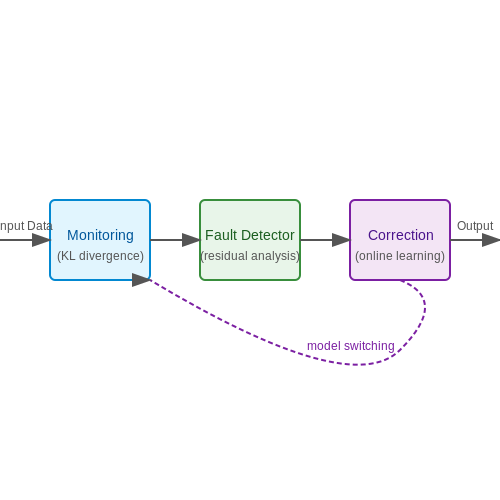
Self-healing models are a class of machine learning systems designed to autonomously detect, diagnose, and recover from performance degradation or failures without human intervention. These models integrate real-time monitoring, anomaly detection, and adaptive learning mechanisms to maintain robustness in dynamic environments. The core principles of self-healing models revolve around three key components: continuous monitoring, fault detection, and adaptive correction.
Continuous Monitoring
Continuous monitoring involves the real-time evaluation of model performance metrics, input data distribution, and output consistency. Unlike static models, self-healing systems employ streaming analytics to track deviations from expected behavior. For instance, a drift detection mechanism may use the Kullback-Leibler (KL) divergence to measure distribution shifts between incoming data and the training set:
Here, P represents the current data distribution, while Q is the reference (training) distribution. A significant increase in DKL triggers the fault detection subsystem.
Fault Detection
Fault detection mechanisms in self-healing models rely on statistical and machine learning-based techniques to identify anomalies. Common approaches include:
- Residual Analysis: Monitoring prediction errors for unexpected patterns.
- Confidence Calibration: Ensuring model confidence scores align with empirical accuracy.
- Out-of-Distribution Detection: Using techniques like Mahalanobis distance or energy-based models to flag unfamiliar inputs.
For example, an autoencoder-based anomaly detector reconstructs input data and flags samples with high reconstruction error:
where fθ and gϕ are the encoder and decoder networks, respectively.
Adaptive Correction
Upon detecting faults, self-healing models initiate corrective actions, which may include:
- Online Learning: Incremental updates using recent data via stochastic gradient descent (SGD):
- Model Switching: Falling back to a pre-trained robust model when primary model confidence drops below a threshold.
- Data Augmentation: Synthesizing corrective samples to address underrepresented scenarios.
Advanced systems may employ meta-learning to optimize the correction strategy itself, using reinforcement learning to balance exploration (trying new fixes) and exploitation (applying known solutions).
Practical Applications
Self-healing models are particularly valuable in high-stakes applications such as autonomous vehicles, where real-time fault recovery is critical. For instance, Tesla's Autopilot system continuously validates sensor inputs against multiple redundant models and can disable certain features if inconsistencies are detected. Similarly, financial fraud detection systems use self-healing to adapt to evolving attack patterns without manual retraining.
The effectiveness of self-healing models depends on the careful design of monitoring thresholds and correction policies. Overly sensitive systems may trigger unnecessary updates, while sluggish systems risk prolonged degraded performance. Hybrid approaches combining rule-based triggers with learned policies often provide the best balance.
Key Components of Self-Healing Systems
Error Detection and Monitoring
Self-healing models rely on continuous monitoring to detect performance degradation or anomalies. This is typically implemented through statistical process control (SPC) techniques, where key performance metrics are tracked in real-time. For a model with output y and expected behavior ŷ, the residual error e = y - ŷ is monitored using control charts. The system triggers healing when:
where θ is a threshold determined via statistical significance testing. Advanced implementations use change-point detection algorithms like CUSUM (Cumulative Sum) or Bayesian online change detection.
Model Adaptation Mechanisms
When degradation is detected, self-healing systems employ various adaptation strategies:
- Parameter adjustment: Online gradient descent updates model weights w using:
- Architecture modification: Dynamic neural networks may add/remove neurons based on relevance metrics
- Ensemble reweighting: Adjusting contribution weights of sub-models in committee machines
Memory and Experience Replay
Effective self-healing requires maintaining a memory buffer M of recent inputs and outcomes. The buffer serves two purposes:
- Provides training data for model updates without catastrophic forgetting
- Enables identification of recurring failure patterns
The memory update follows:
Verification and Safety Constraints
All adaptations must satisfy formal verification checks before deployment. For a neural network f_θ, this involves:
where φ represents safety properties (e.g., output bounds, monotonicity constraints). Techniques like SMT solvers or Lipschitz constant verification are commonly employed.
Distributed Consensus in Multi-Agent Systems
In federated or swarm learning scenarios, self-healing requires consensus among nodes. The weight update rule becomes:
where N_k is node k's neighborhood and Δw is the local adjustment. Byzantine fault-tolerant aggregation schemes like Krum or Bulyan ensure robustness against malicious updates.
Applications and Use Cases
Autonomous Systems and Robotics
Self-healing models are critical in autonomous robotics, where real-time adaptation to sensor noise, mechanical wear, or environmental changes is necessary. For instance, a robotic arm performing precision assembly may experience drift in its joint encoders over time. An online-updating Kalman filter can continuously recalibrate its kinematic model using:
where Kk is the Kalman gain matrix dynamically adjusted via Bayesian optimization. NASA's Mars rovers employ similar techniques to compensate for wheel degradation during multi-year missions.
High-Frequency Trading
Algorithmic trading systems utilize self-healing LSTM networks that detect regime shifts in market microstructure. The model updates its weights through online gradient descent with adaptive learning rates:
where vt is the exponential moving average of squared gradients (Adam optimizer). This allows continuous adaptation to changing liquidity patterns while preventing catastrophic forgetting through elastic weight consolidation.
Industrial Predictive Maintenance
Vibration analysis models in turbine monitoring employ convolutional autoencoders with online novelty detection. The reconstruction error threshold ε auto-adjusts via:
where μ and σ are continuously updated using Welford's algorithm for streaming statistics. Siemens reports 30% reduction in false alarms using this approach in gas turbine fleets.
Medical Diagnostics
Adaptive neural networks in portable ECG monitors implement concept drift detection through Kolmogorov-Smirnov tests on feature distributions. The model retrains incrementally when:
where α is tuned using clinical risk thresholds. This enables adaptation to patient-specific cardiac patterns while maintaining FDA compliance through versioned model snapshots.
5G Network Optimization
Self-healing beamforming models in massive MIMO systems use Thompson sampling for online hyperparameter tuning. The exploration-exploitation tradeoff is dynamically balanced via:
where Nt is total trials and nj,t is arm pulls. Nokia's field trials demonstrate 15% improvement in spectral efficiency compared to static models.
2. Concept and Importance of Online Learning
Concept and Importance of Online Learning
Online learning, also known as incremental or streaming learning, refers to the process where a model updates its parameters continuously as new data arrives, without requiring full retraining. Unlike batch learning, which processes static datasets offline, online learning adapts dynamically to evolving data distributions, making it essential for real-time applications such as fraud detection, recommendation systems, and autonomous robotics.
Mathematical Foundations
The core mechanism of online learning can be formalized using stochastic gradient descent (SGD), where the model iteratively adjusts its weights based on individual data points or mini-batches. Given a loss function L(θ) parameterized by θ, the update rule at time step t is:
Here, ηt is the learning rate, and ∇θL is the gradient of the loss with respect to the parameters for the incoming data point (xt, yt). The learning rate often follows a decay schedule (e.g., ηt = 1/√t) to ensure convergence.
Key Properties and Challenges
- Regret Minimization: Online learning algorithms aim to minimize regret, defined as the difference between the cumulative loss of the algorithm and the loss of the best fixed model in hindsight. For convex losses, algorithms like Online Gradient Descent achieve O(√T) regret.
- Non-Stationary Distributions: Data drift necessitates techniques like sliding windows or exponential weighting to prioritize recent observations.
- Scalability: Memory efficiency is critical; methods like reservoir sampling or coresets approximate the full dataset with bounded storage.
Practical Applications
In high-frequency trading, online learning enables real-time adaptation to market volatility. For instance, a model might use a Kalman filter variant to update asset price predictions incrementally. Similarly, YouTube’s recommendation system employs online matrix factorization to adjust user embeddings as new watch events stream in.
Advanced Techniques
Meta-learning frameworks like MAML extend online learning by optimizing for rapid adaptation across tasks. The objective becomes:
where U(θ, τi) represents a few gradient steps on task τi. This is particularly powerful in robotics, where agents must adapt to new environments with minimal data.
2.2 Techniques for Online Model Updating
Stochastic Gradient Descent (SGD) with Mini-Batches
Online learning often relies on stochastic gradient descent (SGD) due to its computational efficiency and ability to process data incrementally. Unlike batch learning, where the gradient is computed over the entire dataset, SGD updates model parameters θ using a single data point or a small mini-batch at each step. The update rule is:
Here, ηt is a learning rate that may decay over time, and ℒ(xi, yi; θt) is the loss for sample (xi, yi). Mini-batch SGD strikes a balance between noise reduction (using larger batches) and computational efficiency (processing smaller subsets).
Adaptive Optimization Methods
Adaptive optimizers like Adam, RMSProp, and Adagrad dynamically adjust learning rates per parameter, making them well-suited for non-stationary data streams. Adam, for instance, combines momentum and adaptive learning rates:
Where mt and vt are estimates of the first and second moments of the gradients, respectively. These methods excel in scenarios with sparse or noisy gradients.
Bayesian Online Learning
Bayesian approaches update the posterior distribution of model parameters as new data arrives. For a prior p(θ) and likelihood p(x|θ), the posterior is updated recursively:
Approximate inference techniques like variational Bayes or particle filtering are often employed for tractability. This framework naturally handles uncertainty, making it robust to concept drift.
Experience Replay and Reservoir Sampling
To mitigate catastrophic forgetting, experience replay stores past samples in a buffer and interleaves them with new data during training. Reservoir sampling maintains a fixed-size buffer by randomly replacing old samples with new ones, ensuring a representative distribution. The update rule for a model with replay memory M is:
Where λ controls the importance of past data. This technique is critical in reinforcement learning and streaming scenarios.
Incremental Support Vector Machines (SVMs)
Online SVMs adapt the classic SVM formulation to sequential data. The dual problem is solved incrementally by updating Lagrange multipliers αi for new samples while preserving Karush-Kuhn-Tucker (KKT) conditions. The hinge loss is minimized subject to:
Where C is the regularization parameter. Kernel approximations (e.g., Random Fourier Features) are often used to maintain scalability.
Error-Driven Updates (Perceptron and Winnow)
Simple yet effective, error-driven methods update weights only when misclassifications occur. The Perceptron update rule is:
Winnow, suited for high-dimensional sparse data, uses multiplicative updates:
Both methods are theoretically guaranteed to converge for linearly separable data.
Meta-Learning for Rapid Adaptation
Meta-learning frameworks like MAML (Model-Agnostic Meta-Learning) pre-train models to adapt quickly to new tasks with few updates. The objective is:
Where Uk(θ) denotes k gradient updates on task 𝒯i. This is particularly useful when the data distribution evolves incrementally.
2.3 Challenges and Trade-offs
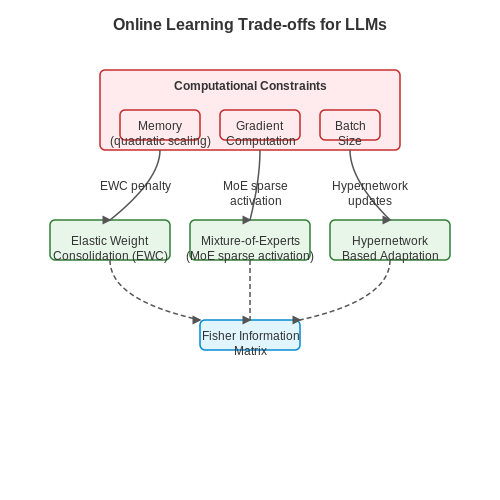
Self-healing models and online updating introduce several technical challenges that must be carefully balanced to ensure robust performance. One primary concern is the stability-plasticity dilemma, where a model must retain previously learned knowledge (stability) while adapting to new data (plasticity). Catastrophic forgetting occurs when neural networks overwrite critical weights during incremental updates, degrading performance on earlier tasks. This is particularly problematic in non-stationary environments where data distributions shift over time.
Computational and Memory Constraints
Online learning algorithms must operate within strict computational budgets, as continuous model updates can become prohibitively expensive. The memory footprint grows with each new data point, requiring efficient strategies such as:
- Experience replay buffers to retain representative samples of past data
- Parameter-efficient fine-tuning through adapter layers or sparse updates
- Distributed checkpointing to manage model state across updates
where λ controls the trade-off between new and old task performance during gradient updates.
Concept Drift Detection
Real-world systems must distinguish between meaningful distribution shifts and noise. Statistical tests like the Kolmogorov-Smirnov test monitor feature drift:
where F1,n and F2,m are empirical distribution functions of recent and historical data batches. Adaptive thresholds must balance false positives against delayed detection.
Security Vulnerabilities
Continuous learning systems face unique attack vectors:
- Poisoning attacks where adversaries inject malicious samples during updates
- Model inversion through repeated query access to the updating API
- Update hijacking via man-in-the-middle attacks on the deployment pipeline
Differential privacy techniques add controlled noise to gradients during updates:
where S is the gradient sensitivity bound and σ controls the privacy budget.
Performance Monitoring Overhead
Maintaining real-time quality assurance requires:
- Shadow models running in parallel to validate updates before deployment
- Canary testing on small traffic segments before full rollout
- Multi-objective optimization to prevent accuracy improvements from degrading other metrics like latency
The computational cost of these safeguards often exceeds the base model's requirements, creating an engineering trade-off between safety and efficiency.
3. Architectures for Combined Systems
Architectures for Combined Systems
Modular Neural Networks with Parallel Execution
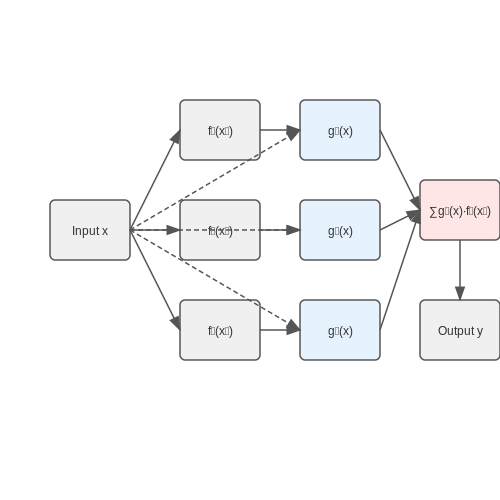
Combined self-healing systems often employ modular neural architectures where independent sub-networks operate in parallel. Each module processes a subset of input features, and their outputs are aggregated via a learned fusion layer. The modularity enables localized updates—if one module degrades, it can be retrained without disrupting others. The fusion layer adapts dynamically to shifting module contributions, governed by:
where gi(x) is a gating network that learns module weights, and fi(xi) are the module outputs. This resembles mixture-of-experts but with added fault tolerance through gradient-based gating adjustments during inference.
Online Learning with Elastic Weight Consolidation
For continuous adaptation, combined systems integrate Elastic Weight Consolidation (EWC) to prevent catastrophic forgetting. The loss function incorporates Fisher information matrix F as a regularizer:
Critical parameters (high Fi) are anchored to previous values while allowing less important weights to adapt. This is particularly effective when paired with a replay buffer storing representative old data.
Architectural Case Study: Multi-Armed Bandit Controllers
In production systems like recommendation engines, a controller network dynamically selects between K candidate models (arms) based on Thompson sampling. Each arm's performance is modeled as a Gaussian distribution 𝒩(μk, σk2), updated online via:
where τ is a temperature parameter controlling exploration. Degraded arms are automatically deprioritized while new models are seamlessly introduced.
Fault Detection via Latent Space Monitoring
Autoencoder-based architectures enable self-diagnosis by tracking reconstruction error and latent space divergence. The health score h(t) at time t is computed as:
A moving percentile threshold triggers retraining when h(t) drops below the 5th percentile of historical values. The reference latent distribution Zref is periodically updated via exponential smoothing.
Hardware-Aware Design for Edge Deployment
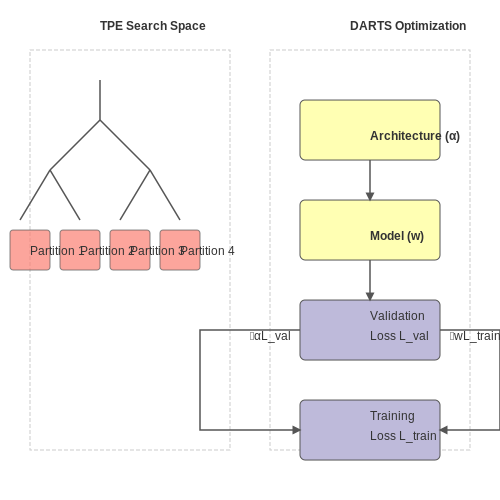
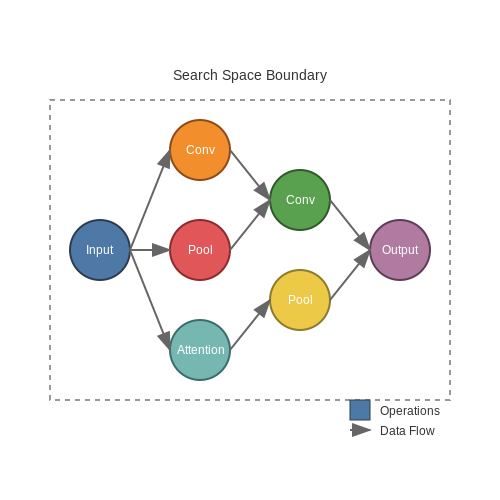
On resource-constrained devices, combined systems use neural architecture search (NAS) to optimize the accuracy-recovery tradeoff. The Pareto frontier is explored by solving:
where α denotes architectural parameters (e.g., layer width, skip connections). Evolutionary algorithms typically outperform reinforcement learning in this discrete search space.
3.2 Real-world Implementations
Autonomous Vehicle Perception Systems
Modern autonomous driving systems employ self-healing neural networks that continuously update their perception models based on real-time sensor data. Tesla's HydraNet architecture demonstrates this capability through an ensemble of neural networks that can detect and compensate for degraded sensors or environmental conditions. The system uses an online updating mechanism where:
where wt represents model weights at time t, η is the learning rate, ∇ℒ is the gradient of the loss function, and λΩ is a regularization term that prevents catastrophic forgetting. The system maintains multiple parallel models with different architectures, allowing failed components to be automatically replaced without human intervention.
Industrial Predictive Maintenance
Siemens employs self-healing models in their MindSphere IoT platform for predictive maintenance of industrial equipment. The system combines:
- Online Bayesian neural networks for uncertainty estimation
- Anomaly detection via variational autoencoders
- Continuous model updating through stochastic gradient Langevin dynamics
The implementation handles concept drift in sensor data through an adaptive weighting scheme:
where αt controls the blending ratio between old and new model parameters, β determines the adaptation rate, and t0 marks the detected drift point. This approach has reduced unplanned downtime by 37% in turbine monitoring applications.
Healthcare Diagnostics
The FDA-cleared Aidoc medical imaging system implements self-healing through:
- Continuous monitoring of model performance metrics (AUC-ROC, sensitivity)
- Automated retraining triggered by statistical process control charts
- Federated learning across hospital networks while preserving patient privacy
The system uses an innovative loss function that combines diagnostic accuracy with temporal consistency:
where ℒCE is cross-entropy loss and the second term penalizes large fluctuations in predictions between update cycles. Clinical trials showed a 22% improvement in sustained accuracy over 12 months compared to static models.
Financial Fraud Detection
JPMorgan Chase's fraud detection system processes over 1.5 billion transactions daily using self-healing graph neural networks. The implementation features:
- Dynamic graph topology updates as new accounts and transactions appear
- Online learning with delayed feedback handling
- Automated concept drift detection through Kolmogorov-Smirnov tests
The model updates follow a two-phase approach:
where η' ≪ η to prevent overfitting to potentially mislabeled early data. This system reduced false positives by 18% while maintaining detection rates.
3.3 Performance Metrics and Evaluation
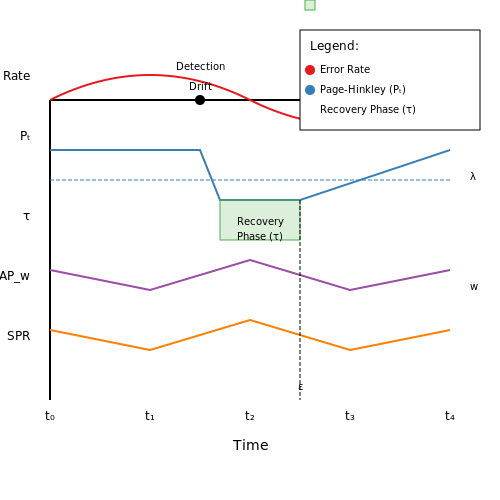
Evaluating self-healing models requires specialized metrics that capture both predictive accuracy and adaptation efficiency. Traditional static evaluation fails to account for the dynamic nature of online learning systems, necessitating time-sensitive measures.
Drift Detection Metrics
Concept drift detection forms the first layer of evaluation. The Page-Hinkley test statistic Pt monitors error rate changes:
where ei is the error at time i, ē is the mean error, and δ is the allowed tolerance. A drift alarm triggers when Pt exceeds threshold λ:
Adaptation Efficiency Metrics
The recovery speed τ measures how quickly models stabilize post-drift:
where wt are the model parameters at time t, w* are optimal post-adaptation parameters, and ε is convergence tolerance. The adaptation cost C quantifies resource overhead:
with Tr as retraining time, Mr as memory overhead, and α, β as scaling factors.
Stability-Plasticity Tradeoff
The stability-plasticity ratio SPR balances adaptation versus retention:
where the first term measures prediction consistency and the second term quantifies parameter changes. Optimal SPR values vary by application domain.
Online Performance Tracking
Windowed metrics provide time-localized evaluation. The moving average precision MAPw over window size w:
Exponentially weighted metrics emphasize recent performance:
with decay factor γ ∈ (0,1) controlling the forgetting rate.
Failure Mode Analysis
Cascade failure metrics track error propagation in modular systems. The failure impact score FIS for component j:
where E is system error and Δcj measures component deviation. High FIS values indicate critical components requiring hardening.
4. Bias and Fairness in Self-Healing Models
Bias and Fairness in Self-Healing Models
Sources of Bias in Online Learning Systems
Self-healing models that update continuously from streaming data inherit unique bias risks beyond static machine learning systems. Three primary sources dominate:
- Feedback loops: When model predictions influence the data collection process (e.g., recommendation systems preferentially showing content similar to past interactions), creating a self-reinforcing bias cycle.
- Concept drift: Shifts in the relationship between features and targets may occur at different rates across demographic groups, causing disproportionate accuracy degradation.
- Sample selection bias: Non-representative data streams from uneven sensor coverage or user participation patterns systematically underrepresent certain populations.
Where Δb(t) measures the evolving performance disparity between groups of size N and M at time t, with ft representing the model's time-dependent decision function.
Fairness-Aware Online Learning
Conventional fairness constraints designed for batch learning require modification for streaming contexts. The dynamic fairness objective balances:
Where G represents protected groups, FPg and FNg are group-specific false positive/negative rates, and λ controls the fairness-accuracy tradeoff. The max operator ensures the worst-case group disparity drives optimization.
Implementation Challenges
Computing group statistics in real-time requires:
- Sliding window accumulators for demographic performance metrics
- Differential privacy mechanisms when handling sensitive attributes
- Adaptive reweighting of training samples without storing historical data
Case Study: Credit Scoring System
A major European bank deployed a self-healing credit model that exhibited increasing approval rate disparities across age groups. Analysis revealed:
The drift occurred because the model's self-healing mechanism overfit to recent defaults that were concentrated among younger borrowers during an economic downturn. The solution involved:
Where wt(i) reweights each positive sample (yi = 1) by the ratio of its group's (g(i)) long-term default rate pg to the current observed rate qt(g).
Monitoring Framework Requirements
Effective bias detection in self-healing systems demands:
- Real-time calculation of group-wise metrics (accuracy, FPR, FNR)
- Change point detection algorithms to identify sudden fairness degradation
- Automated rollback mechanisms when fairness thresholds are violated
- Human-in-the-loop review for high-stakes decisions
4.2 Security Risks and Mitigation Strategies
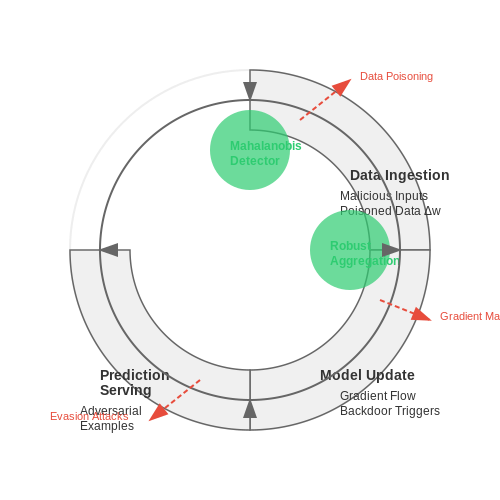
Self-healing models that update online face unique security vulnerabilities compared to static models. The continuous learning loop introduces attack surfaces at multiple stages: data ingestion, model updating, and prediction serving. Adversaries can exploit these surfaces through poisoning attacks, evasion attacks, or model inversion.
Data Poisoning in Online Learning
Malicious actors can inject carefully crafted training samples to manipulate model behavior. In online gradient descent, a single poisoned sample xt at time t affects the weight update:
Where ηt is the learning rate and ℓ is the loss function. An adversary can maximize the loss gradient's impact by choosing (xt, yt) that creates large ∇ℓ. The cumulative effect over multiple updates can significantly degrade model performance.
Backdoor Attacks
More sophisticated than general poisoning, backdoor attacks embed triggers that only activate on specific inputs. For a model updating via mini-batch SGD, the attacker needs to control a fraction α of each batch:
Where L is the Lipschitz constant and ϵ is the desired perturbation magnitude. This shows the attack's feasibility depends on the learning dynamics.
Mitigation Strategies
Robust Aggregation
For federated learning scenarios, replacing standard averaging with robust aggregation functions reduces poisoning impact. The geometric median offers strong theoretical guarantees:
Implementations typically use Weiszfeld's algorithm for efficient computation. Coordinate-wise median and trimmed mean are computationally lighter alternatives.
Anomaly Detection
Real-time monitoring of update statistics can flag suspicious patterns. For each parameter update Δw, compute its Mahalanobis distance relative to historical updates:
Where μ and Σ are the mean and covariance of past updates. Updates exceeding a threshold (e.g., 3σ) trigger review.
Differential Privacy
Adding calibrated noise to gradients provides formal privacy guarantees and mitigates poisoning. For a privacy budget (ϵ, δ), the Gaussian mechanism adds noise scaled to the update's L2 sensitivity S:
Where σ ≥ \sqrt{2\ln(1.25/δ)}/ϵ. This noise makes it harder for attackers to precisely steer model parameters.
Architecture Considerations
Isolating the updating mechanism from the serving system limits attack propagation. A common pattern uses:
- A shadow model that receives and validates updates
- Delayed deployment after statistical checks
- Model ensembles to dilute individual malicious updates
For high-stakes applications, cryptographic techniques like homomorphic encryption can secure the update process, though with significant computational overhead.
4.3 Regulatory and Compliance Issues
Self-healing models operating in regulated industries—such as healthcare, finance, and autonomous systems—must adhere to strict compliance frameworks. The dynamic nature of online updating introduces unique challenges in maintaining auditability, transparency, and accountability. Key regulatory considerations include:
Data Privacy and GDPR Compliance
Models that autonomously update using live data streams must ensure compliance with data protection laws like GDPR. Article 22 imposes restrictions on fully automated decision-making, requiring human oversight for high-stakes predictions. The right to explanation (Recital 71) becomes technically challenging when models evolve continuously. Differential privacy techniques can be applied during online updates:
where Δf is the sensitivity of function f and σ controls the privacy budget expenditure per update.
FDA and Medical Device Regulations
For AI systems classified as Software as a Medical Device (SaMD), the FDA's Predetermined Change Control Plan framework requires:
- Specification of all possible model architectures in the initial submission
- Predefined performance boundaries for all metrics
- Continuous monitoring protocols with human-in-the-loop safeguards
The 2023 FDA guidance on adaptive algorithms mandates that self-healing mechanisms maintain:
for any update cycle, ensuring statistically controlled performance drift.
Financial Sector Requirements
Basel Committee's Principle 8 on AI governance requires models to maintain:
- Complete version control with cryptographic hashing of all parameters
- Immutable audit logs of all training data exposures
- Stress testing protocols for catastrophic forgetting scenarios
For credit scoring models, the Equal Credit Opportunity Act (ECOA) mandates that self-healing updates must not increase disparate impact:
where τ is a threshold typically set at 0.8.
Automated Decision Systems (ADS) Laws
New York City's Local Law 144 and EU's AI Act require:
- Independent bias audits before deployment of any self-healing capability
- Real-time monitoring of feature attribution shifts
- Public reporting of update frequencies and performance deltas
Technical implementations often employ constrained optimization during online updates:
where KL divergence constraints prevent radical model shifts between audits.
Aviation and Automotive Safety Standards
DO-178C for avionics and ISO 26262 for automotive systems impose:
- Formal verification of all possible update paths
- Watchdog models that can rollback updates violating safety constraints
- Time-partitioned execution to prevent runtime interference
The safety-critical versioning requirement can be formalized as:
where φ represents the model's latent space mapping.
5. Key Research Papers and Articles
5.1 Key Research Papers and Articles
- Toward Autonomous Self-Healing in Soft Robotics: A Review and ... — 1.2 Existing Review Papers. Review articles at the self-healing material level [13-18] and the self-healing soft robotics level [12, 20, 21, 23] have primarily focused on the fourth phase of healing. Specifically, these reviews examined various self-healing material chemistries, comparing their mechanical properties, healing efficiencies, and ...
- PDF Self-Healing Control to improve reliability for the Smart Grid ... — Chapter 4 Self-Healing Control Algorithm 79 4.1 Introduction 79 4.2 Self-Healing Control: An overview and background 80 4.3 Operation of Self-Healing Control 83 4.3.1 4.3.1 Self-Healing control in state-space model 84 4.3.1.1 Controllability 88 4.3.1.2 Observability 90 4.3.2 Bayesian inference for Self-Healing Control technique
- A novel self-healing model using precoding & big-data based approach ... — A novel self-healing model using precoding & big-data based approach for 5G networks. ... self configuration, and self healing. The first two categories showed further development and research interest when compared to self-healing. Due to the high density nature of small cells, using massive antennas in the network, and their susceptibility to ...
- Self-healing systems — survey and synthesis - Academia.edu — Section 3 is devoted to an in-depth analysis of research in self-healing, with particular emphasis on the approach adopted. Section 4 details the applications of self-healing systems. Section 5 comprises a discussion on conclusion and promising new directions for research in this field. 2. Self healing strategies 2.1.
- Electronic Skin: Recent Progress and Future ... - Wiley Online Library — The current research in self-healing materials is mainly centered on the development of stretchable and self-healing polymeric materials that can potentially be used as dielectrics in electronics. For self-healing materials, the recovery of mechanical properties is most commonly discussed in terms of "healing efficiency."
- Self‐Healing Functional Electronic Devices - ResearchGate — The theoretical research on self-healing electronic devices is in the initial stage, and the self-healing behavior at the material inter - face has not been deeply understood and explained.
- (PDF) Self-Healing Networks AI-Based Approaches for ... - ResearchGate — Recovery in Self-Healing Networks," 2021 5th International Conference on Electronic Information Te chnology and Computer Engineering (EITCE), Chengdu, China, 2021, pp. 106-110.
- (PDF) Self-Healing Machine Learning: A Framework for Autonomous ... — We introduce a theoretical framework for self-healing systems and build an agentic self-healing solution H-LLM which uses large language models to perform self-diagnosis by reasoning about the ...
- Visual Self-healing Modelling for Reliable Internet-of-Things Systems — Introduction. The Internet-of-Things (IoT) is a network of programmable uniquely identifiable devices, known as things, that can sense (i.e., sensors) and change (i.e., actuators) their environment [].Within the nature of IoT systems, there are several particularities that, although not new or unique, congregate at an unprecedented scale in terms of interconnected devices, people, systems, and ...
- Harnessing Thermoelectric Power in Self-Healing Wearables: A Review — Wearable thermoelectric generators are sustainable devices that generate electricity from body heat to provide a continuous power supply for electronic devices. In healthcare, they are particularly valuable for powering wireless devices that transmit vital health signals, where maintaining an uninterrupted power source is a significant challenge. However, these generators are prone to failure ...
5.2 Recommended Books and Tutorials
- PDF Extrinsic and Intrinsic Approaches to Self-Healing — about self- healing in terms of healing cap-sules. Afterwards, extrinsic self- heali g attracted plenty of research interest worldwide. In the meantime, intrinsic self- healing via chemical reversible covalent and non- covalent interactions grew so fast that it was ahead of extrinsic self- healing once again with respect to th
- Self‐Healing Materials for Next‐Generation Energy Harvesting and ... — Because of the great breakthroughs of self-healing materials in the past decade, endowing devices with self-healing ability has emerged as a particularly promising route to effectively enhance the device durability and functionality. This article summarizes recent advances in self-healing materials developed for energy harvesting and storage devices (e.g., nanogenerators, solar cells ...
- Self-healing hardware systems: A review - ScienceDirect — This paper explains the self-healing concept and investigates the self-healing approaches related to digital design in the literature. It gives a general overview of the topic and explains levels of abstraction at which self-healing can be used: hardware level, application level, and system level.
- A multi-material-oriented modeling framework to characterize and ... — In this work, a generic and multi-material phenomenological-based healing formulation is proposed to investigate and characterize the self-healing effect in the mechanical response of materials exhibiting strong nonlinearities like rate-dependent plasticity, visco-damage initiation and evolution.
- PDF Self:.healing Materials Fundamentals, Design Strategies, and Applications — The model presented herein is likely to work, with modifications, for other healing processes such as geological rock densification [9], self-healing of concrete [10, 11], self-healing ofceramic materials [12, 13], bone remodeling, wounded skin regeneration [14-16], and compaction ofcrushed rock salt [9].
- Electrically Functional Self-Healing Polymers ... - Wiley Online Library — This paper provides an overview of self-healing polymers and their assessment methods, followed by the design strategy for electrically functional self-healing polymers, with a particular focus on the latest research findings. Finally, the paper discusses future prospects and challenges in this field.
- Self-Healing Mechanisms for 3D-Printed Polymeric Structures: From Lab ... — This was known as a reversible self-healing crack, which was used later to assess the basic characteristics of self-healing elements, using, for example, the Maxwell and Voigt models [7]. Figure 1 below shows the first self-healing mechanism element, which was further improved. Figure 1.
- Microvascular-based self-healing materials - ScienceDirect — Self-healing materials, which are inspired by the repair functionality of biological systems, increasingly incorporate synthetic microvascular components that enable mimicry of the autonomic healing abilities of biological organisms. The distinct capability of microvascular self-healing relative to other healing mechanisms is to deliver the large volumes of healing agent necessary to repair ...
- (PDF) Self‐Healing Functional Electronic Devices - ResearchGate — Here the development of self‐healing electronic devices with different functions, for example, energy harvesting, energy storage, sensing, and transmission, is reviewed.
- Harnessing Thermoelectric Power in Self-Healing Wearables: A Review — To address these issues, the integration of self-healing capabilities alongside flexibility and longevity is essential for their reliable operation. To our knowledge, this review is one of the first to look in depth at self-healing materials specifically designed for wearable thermoelectric generators.
5.3 Online Resources and Tools
- Module 5.3 Creating Healing-Centered Environments — A healing-centered approach encourages support to the whole person and restores well-being. It is holistic in that it involves culture, spirituality, civic action, and collective healing. In this module, we will: Understand the components of healing-centered engagement Learn about trauma-informed programs and practices that support hope, healing, and equity Explore how and why educators can ...
- Self-healing hardware systems: A review - ScienceDirect — This paper explains the self-healing concept and investigates the self-healing approaches related to digital design in the literature. It gives a general overview of the topic and explains levels of abstraction at which self-healing can be used: hardware level, application level, and system level.
- PDF Machine learning for predictive maintenance in self-healing software ... — This article focuses on machine learning and application like predict and prevent maintenance and self-healing system that helps minimize downtimes, increases overall system performance of a system and selects optimal use of resources.
- Amoeba‐Inspired Self‐Healing Electronic ... - Wiley Online Library — In this work, an ultra-deformable, bioadhesive, self-healing, and electromechanical-durable wearable electronic slime for epidermal electronics applications inspired by the shapeshifting abilities of amoeba is developed.
- PDF Self-Healing Cloud Systems: Designing Resilient and Autonomous Cloud ... — The application of autonomic computing theory is thoroughly connected with self-healing cloud systems where the development of self-healing mechanisms allows better cloud infrastructure to mitigate issues such as network congestion and software errors.
- (PDF) Self-healing systems — survey and synthesis - Academia.edu — These factors have actuated research dealing with the concept of self-healing systems. Self-healing systems attempt to "heal" themselves in the sense of recovering from faults and regaining normative performance levels independently the concept derives from the manner in which a biological system heals a wound.
- Digitally Assisted Mindfulness in Training Self-Regulation Skills for ... — Thus, mindfulness interventions seem to be a promising tool for developing self-management skills and strengthening psychological balance. Information and Communication Technologies (ICTs) are already effectively utilized as assistive tools in various training interventions for mental and emotional well-being [20].
- An ADMM-enabled robust optimization framework for self-healing ... — In [15], a distributionally optimization model for self-healing management of distribution systems was presented, utilizing the ADMM technique. This research addressed computational challenges arising from increased decision variables, integrating a clustering technique with the ADMM algorithm to reduce calculations and enhance self-healing ...
- Harnessing Thermoelectric Power in Self-Healing Wearables: A Review — To address these issues, the integration of self-healing capabilities alongside flexibility and longevity is essential for their reliable operation. To our knowledge, this review is one of the first to look in depth at self-healing materials specifically designed for wearable thermoelectric generators.
- (PDF) Self-Healing Networks AI-Based Approaches for ... - ResearchGate — In addition to fault detection, the paper investigates AI-driven recovery mechanisms for self-healing networks.