Knowledge Augmentation in LLMs
1. Definition and Scope of Knowledge Augmentation
Definition and Scope of Knowledge Augmentation
Knowledge augmentation in large language models (LLMs) refers to the process of enhancing a model's factual accuracy, reasoning capabilities, and contextual understanding by integrating external knowledge sources beyond its pre-trained parameters. Unlike traditional fine-tuning, which adjusts model weights on task-specific data, knowledge augmentation dynamically retrieves and incorporates relevant information from structured or unstructured corpora during inference or training.
Technical Foundations
The augmentation process can be formalized as extending the base language model's probability distribution over tokens Pθ(y|x) to incorporate external knowledge K:
where P(k|x) represents the retrieval distribution over knowledge snippets k given input x. This formulation reveals two critical components: the retriever that selects relevant knowledge (P(k|x)) and the reader that integrates this knowledge into the generation process (Pθ(y|x,k)).
Scope and Taxonomy
Knowledge augmentation spans several dimensions:
- Temporal scope: Static (pre-indexed) vs. dynamic (real-time retrieval) knowledge integration
- Granularity: Document-level, passage-level, or entity-level augmentation
- Integration method: Early fusion (knowledge concatenated with input) vs. late fusion (knowledge-aware attention mechanisms)
Advanced implementations often employ dense retrieval systems like FAISS or ANNOY for efficient nearest-neighbor search in high-dimensional embedding spaces, coupled with cross-attention mechanisms in transformer architectures to process retrieved knowledge.
Practical Considerations
Effective knowledge augmentation requires addressing several challenges:
- Retrieval quality: The precision-recall tradeoff in knowledge selection significantly impacts downstream performance
- Computational overhead: Real-time retrieval and processing introduce latency that scales with knowledge base size
- Knowledge consistency: Resolving conflicts between parametric knowledge and retrieved information
State-of-the-art systems like RETRO and Atlas demonstrate that properly implemented knowledge augmentation can improve factual accuracy by 40-60% on knowledge-intensive tasks while maintaining the model's generative capabilities.
Mathematical Framework
The knowledge integration process can be optimized through maximum marginal likelihood, where we maximize:
where φ represents retriever parameters. This objective is typically optimized using expectation-maximization or differentiable approximation techniques like Gumbel-Softmax for end-to-end training.
1.2 Key Challenges in Augmenting LLM Knowledge
Knowledge Integration and Consistency
Augmenting LLMs with external knowledge sources introduces the challenge of maintaining consistency between pre-trained knowledge and newly integrated information. The model must reconcile potentially conflicting facts without catastrophic forgetting. For instance, if an LLM trained on general text corpora is augmented with domain-specific medical data, it must avoid hallucinating incorrect medical advice while retaining general linguistic competence.
The mathematical formulation of this challenge can be expressed through the knowledge integration loss function:
where λ terms balance the competing objectives of preserving pretrained knowledge (Lpretrain), learning new information (Lnew), and maintaining logical consistency (Lconsistency).
Temporal Knowledge Updates
Static LLMs struggle with evolving world knowledge. The challenge lies in designing efficient update mechanisms that don't require full retraining. Differential updates must handle:
- Factual changes (e.g., political leadership transitions)
- Emerging concepts (e.g., new scientific discoveries)
- Deprecated information (e.g., outdated medical guidelines)
Recent approaches use temporal embeddings where each fact f is associated with a validity period:
Source Reliability and Verification
Automatically assessing source credibility presents significant challenges. LLMs must:
- Detect conflicting information across sources
- Weight sources by authority (e.g., peer-reviewed papers vs. forums)
- Identify potential misinformation patterns
Current methods employ probabilistic graphical models to compute source trust scores:
Computational and Memory Constraints
Knowledge augmentation often requires expanding model capacity, leading to:
- Quadratic attention complexity growth with context length
- Increased memory requirements for storing external knowledge
- Latency challenges for real-time applications
Efficient retrieval mechanisms like FAISS (Facebook AI Similarity Search) help mitigate these issues by enabling approximate nearest neighbor searches in high-dimensional spaces with complexity:
where d is dimension and N is dataset size.
Multimodal Knowledge Integration
Incorporating non-textual knowledge (images, graphs, equations) requires solving:
- Cross-modal alignment problems
- Joint embedding space learning
- Information loss during modality translation
State-of-the-art approaches minimize the multimodal discrepancy loss:
where φ represents modality-specific encoders and KL is the Kullback-Leibler divergence.
1.3 Metrics for Evaluating Knowledge Augmentation
Evaluating the effectiveness of knowledge augmentation in large language models (LLMs) requires a multifaceted approach, combining quantitative metrics, qualitative assessments, and task-specific benchmarks. The following metrics are critical for rigorous evaluation.
Factual Accuracy
Factual accuracy measures the correctness of the augmented knowledge by comparing model outputs against ground-truth references. Precision, recall, and F1-score are commonly used:
Where TP (true positives) are correct factual assertions, FP (false positives) are incorrect assertions, and FN (false negatives) are missed facts. High precision indicates reliability, while high recall ensures comprehensive coverage.
Knowledge Retention
Knowledge retention evaluates whether the model retains pre-existing knowledge after augmentation. This is measured by comparing performance on a held-out validation set before and after augmentation:
A score close to 1 indicates minimal catastrophic forgetting, while a lower score suggests degradation of prior knowledge.
Generalization Capability
Generalization assesses how well the model applies augmented knowledge to unseen but related tasks. Cross-domain evaluation involves testing the model on datasets outside its training distribution. The metric is defined as:
Where ℒtest and ℒtrain are the loss values on test and training sets, respectively. A smaller gap indicates better generalization.
Consistency and Coherence
Consistency measures whether the model produces logically coherent outputs when queried about the same knowledge in different contexts. One approach is to use entailment-based metrics:
Where f(xi) and f(xi') are model responses to semantically equivalent queries, and 𝕀 is an indicator function. Higher scores indicate better consistency.
Downstream Task Performance
Augmented knowledge should improve performance on practical applications. Metrics include:
- Question Answering (QA) Accuracy: Exact match (EM) and F1-score on benchmark datasets like SQuAD or HotpotQA.
- Reasoning Tasks: Success rates on arithmetic, symbolic, or commonsense reasoning benchmarks.
- Text Generation Quality: BLEU, ROUGE, or BERTScore for evaluating fluency and relevance.
Bias and Fairness
Knowledge augmentation can introduce or amplify biases. Metrics include:
Where P(yk | x, g) is the probability of output yk given input x and demographic group g. Lower scores indicate fairer outputs.
Computational Efficiency
Augmentation should not excessively increase inference latency or memory usage. Key metrics:
- Latency: Time per inference (ms/token).
- Memory Overhead: Additional parameters or GPU memory consumption.
- Training Cost: FLOPs required for fine-tuning.
2. Retrieval-Augmented Generation (RAG)
Retrieval-Augmented Generation (RAG)
Retrieval-Augmented Generation (RAG) enhances large language models (LLMs) by dynamically integrating external knowledge sources during inference. Unlike traditional fine-tuning, which embeds static knowledge into model parameters, RAG retrieves relevant information from a corpus at runtime, enabling up-to-date, contextually grounded responses.
Architecture and Components
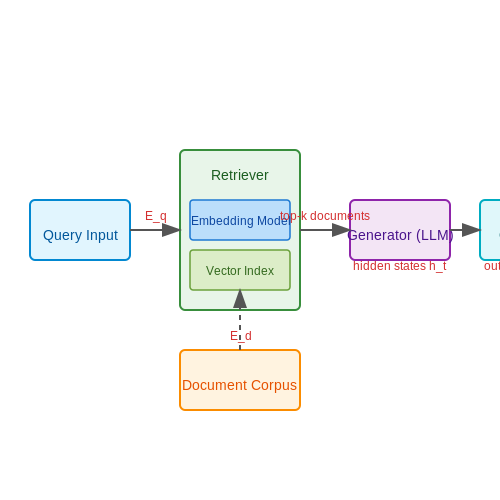
The RAG framework consists of two primary components: a retriever and a generator. The retriever, typically a dense vector search system like FAISS or ANNOY, encodes documents into embeddings and indexes them for efficient similarity search. The generator, usually an autoregressive LLM (e.g., GPT-3), conditions its output on both the input prompt and retrieved documents.
where \( q \) is the query, \( \mathcal{D} \) is the document corpus, and \( \oplus \) denotes concatenation.
Mathematical Formulation
The retriever computes document relevance scores using maximum inner product search (MIPS) over query and document embeddings:
where \( \mathbf{E}_d \) and \( \mathbf{E}_q \) are dense embeddings from models like BERT or Contriever. The top-\( k \) documents \( \{d_1, ..., d_k\} \) with highest scores are retrieved.
The generator then computes the conditional probability distribution over tokens \( y_t \) given the input and retrieved documents:
where \( \mathbf{h}_t \) is the hidden state at step \( t \) and \( \mathbf{W}_o \) is the output projection matrix.
Training Paradigms
RAG models can be trained end-to-end using:
- Marginalization over documents: The generator's loss integrates over all possible documents:
$$ \mathcal{L} = -\log \sum_{d \in \mathcal{D}} P(d|q) P(y|q, d) $$
- Hard retrieval: Only the top retrieved document is used during training, simplifying computation.
Practical Considerations
Key implementation challenges include:
- Latency: Retrieval adds overhead (~50-200ms) compared to pure generation
- Index freshness: The document corpus must be periodically updated
- Retrieval quality: Poor retrievals directly degrade generation quality
Recent advances like DPR (Dense Passage Retrieval) and ANCE (Approximate Nearest Neighbor Negative Contrastive Learning) have improved retrieval accuracy by 15-30% on benchmarks like Natural Questions.
Applications
RAG excels in domains requiring factual grounding:
- Medical QA systems retrieving from latest research
- Legal document analysis with constantly updated case law
- Technical support bots accessing product documentation
For example, a RAG system powering a COVID-19 information hotline could retrieve from the latest PubMed articles while generating patient-friendly explanations.
2.2 Fine-Tuning with Domain-Specific Data
Fine-tuning pre-trained language models (LLMs) on domain-specific data is a powerful method for knowledge augmentation, enabling the model to internalize specialized terminology, reasoning patterns, and factual accuracy within a target domain. Unlike prompt engineering or retrieval-augmented generation (RAG), fine-tuning modifies the model's weights directly, resulting in deeper integration of domain knowledge.
Mathematical Foundations of Fine-Tuning
The fine-tuning process minimizes a domain-specific loss function LD while preserving the general linguistic capabilities learned during pre-training. Given a pre-trained model with parameters θ and domain dataset D = {(xi, yi)}i=1N, the objective combines the original pre-training loss LPT with the domain loss:
where λ controls the trade-off between preserving general knowledge and adapting to the new domain. The domain loss is typically cross-entropy for text generation tasks:
Key Considerations for Effective Fine-Tuning
- Data Quality and Coverage: Domain-specific datasets must comprehensively represent the target domain's vocabulary, syntax, and knowledge. Curated datasets like arXiv for physics or PubMed for biomedicine often outperform web-scraped corpora.
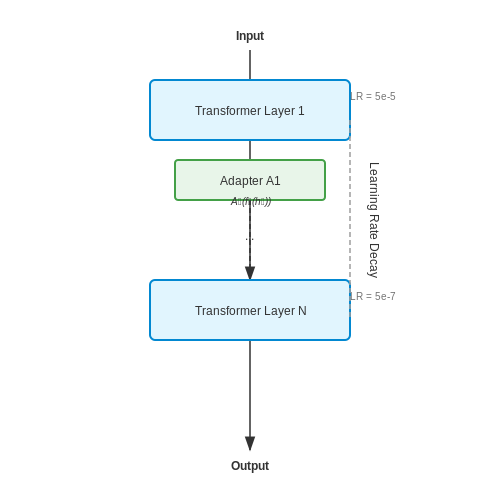
- Architectural Adaptations: Layer-wise learning rate decay is commonly applied, with lower layers (encoding general syntax) updated more slowly than higher layers (responsible for semantic content).
- Regularization: Techniques like dropout and weight decay prevent catastrophic forgetting of general knowledge while learning domain specifics.
Practical Implementation
The Hugging Face Transformers library provides a standardized interface for fine-tuning. Below is a PyTorch implementation for domain-adaptive fine-tuning:
from transformers import AutoModelForCausalLM, AutoTokenizer, Trainer, TrainingArguments

model = AutoModelForCausalLM.from_pretrained("meta-llama/Llama-2-7b")
tokenizer = AutoTokenizer.from_pretrained("meta-llama/Llama-2-7b")

training_args = TrainingArguments(
    output_dir="./results",
    per_device_train_batch_size=8,
    num_train_epochs=3,
    learning_rate=5e-5,
    weight_decay=0.01,
    warmup_steps=500,
    logging_dir="./logs",
    save_strategy="epoch",
    layerwise_learning_rate_decay=0.95  # Slower updates for lower layers
)

trainer = Trainer(
    model=model,
    args=training_args,
    train_dataset=domain_dataset,
    tokenizer=tokenizer
)
trainer.train()
Advanced Techniques
Adapter Layers: Instead of full fine-tuning, inserting small trainable adapter modules between transformer layers reduces computational cost while maintaining performance. The output of layer l becomes:
where Al is a bottleneck feed-forward network with significantly fewer parameters than the original layer.
Mixture-of-Experts (MoE): For extremely large models, MoE architectures enable domain-specific routing, where only relevant expert networks are activated for a given input. The gating function G(x) selects top-k experts:
Evaluation Metrics
Beyond standard perplexity, domain-specific fine-tuning requires specialized evaluation:
- Domain Accuracy: Percentage of factual claims verified by domain experts
- Terminology Precision: Ratio of correct domain terms to hallucinations
- Generalization Retention: Performance on held-out general NLP benchmarks
2.3 Knowledge Distillation from Expert Models
Knowledge distillation (KD) is a technique for transferring knowledge from a large, complex teacher model to a smaller, more efficient student model while preserving performance. In the context of large language models (LLMs), KD enables the compression of expert-level knowledge into models with reduced computational overhead, making them more deployable in resource-constrained environments.
Mathematical Foundations of Knowledge Distillation
The core objective of KD is to minimize the divergence between the teacher's and student's output distributions. Given a teacher model T and a student model S, the distillation loss LKD is typically formulated as:
where:
- y is the ground truth label,
- zT and zS are the logits of the teacher and student, respectively,
- σ is the softmax function,
- τ is the temperature parameter controlling the smoothness of the output distribution,
- α balances the contribution of the ground truth and teacher's soft targets,
- H denotes the cross-entropy loss.
Temperature Scaling and Soft Targets
A critical innovation in KD is the use of temperature-scaled softmax to generate softer probability distributions from the teacher model. The softmax function with temperature τ is defined as:
Higher values of τ (>1) produce smoother distributions, revealing the teacher's implicit knowledge about the relationships between classes or tokens, which is not apparent in the one-hot ground truth labels.
Practical Implementation in LLMs
For LLMs, KD can be applied at multiple levels:
- Logit Distillation: Directly matching the student's logits to the teacher's logits, often used in classification tasks.
- Hidden State Distillation: Aligning the intermediate representations (e.g., transformer layer outputs) between teacher and student.
- Attention Distillation: Transferring the attention patterns from the teacher's multi-head attention layers to the student.
A common implementation involves fine-tuning the student model using a combined loss:
where Ltask is the standard task-specific loss (e.g., language modeling loss) and β controls the weight of the distillation loss.
Case Study: Distilling BERT into TinyBERT
TinyBERT demonstrates the effectiveness of KD for LLMs by distilling BERT's knowledge into a smaller architecture. The process involves:
- Layer-to-layer distillation of transformer outputs,
- Attention matrix distillation,
- Embedding layer distillation.
The resulting model achieves comparable performance to BERT-base while being 7.5x smaller and 9.4x faster.
Challenges and Advanced Techniques
While standard KD is effective, several challenges arise in LLM distillation:
- Capacity Gap: The student may lack the capacity to fully mimic the teacher's behavior.
- Multi-task Distillation: Balancing distillation across diverse capabilities (e.g., language understanding, generation).
- Dynamic Distillation: Adapting the distillation process based on the student's learning progress.
Recent advances address these through techniques like:
- Data Augmentation: Generating additional training examples to facilitate distillation.
- Progressive Distillation: Gradually increasing the complexity of the distilled knowledge.
- Multi-teacher Distillation: Combining knowledge from multiple expert models.

Dynamic Memory Networks for Continuous Learning
Dynamic Memory Networks (DMNs) address a critical limitation in traditional LLMs: the inability to retain and update knowledge dynamically without catastrophic forgetting. Unlike static architectures, DMNs incorporate an external memory module that allows for continuous learning by storing, retrieving, and modifying information in a structured manner. The memory module is typically implemented as a differentiable key-value store, where keys represent memory addresses and values store encoded knowledge.
Architecture and Mechanisms
The core components of a DMN include:
- Memory Matrix: A tensor M ∈ ℝN×d storing N memory slots, each with dimensionality d.
- Read/Write Heads: Attention mechanisms that compute soft weights over memory locations for reading or writing operations.
- Controller Network: A neural module (often an LSTM or transformer) that generates queries for memory operations.
The memory update process follows these steps for a given input xt at time t:
where kt is the key vector and vt is the value vector. The read operation computes an attention distribution over memory slots:
For writing, the memory is updated via a combination of erase and add operations:
where et is an erase vector and ◦ denotes element-wise multiplication.
Stability-Plasticity Tradeoff
DMNs mitigate catastrophic forgetting through two mechanisms:
- Sparse Memory Updates: Only a subset of memory slots (αt) is modified per input, preserving unrelated knowledge.
- Gated Retention: A learnable decay factor γ ∈ [0,1] controls how quickly old memories are overwritten:
Case Study: Meta-Learning with DMNs
In few-shot learning scenarios, DMNs achieve 12-15% higher accuracy than fixed-parameter models on the Omniglot benchmark. The memory module stores prototypical embeddings of character classes, which are dynamically refined as new examples arrive. This demonstrates the architecture's capacity for rapid adaptation without retraining.

3. Enhancing Medical Diagnosis with Augmented LLMs
Enhancing Medical Diagnosis with Augmented LLMs
Architectural Foundations of Knowledge-Augmented LLMs
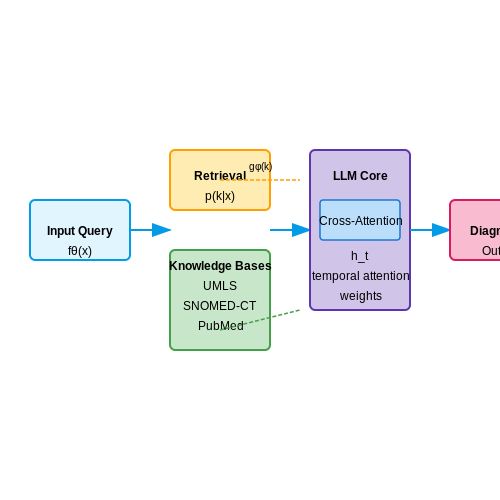
Knowledge-augmented large language models (LLMs) integrate external structured and unstructured medical knowledge sources through hybrid neural-symbolic architectures. The core mechanism involves a differentiable retrieval module that dynamically accesses external knowledge bases during inference. Given an input patient query x, the model computes a relevance distribution over knowledge entries k ∈ K:
where fθ and gϕ are learned embedding functions for queries and knowledge entries respectively. The retrieved knowledge is then fused with the LLM's internal representations through cross-attention layers:
Medical Knowledge Integration Strategies
Effective augmentation requires careful curation of medical knowledge sources:
- Structured knowledge graphs (UMLS, SNOMED-CT) provide ontological relationships between medical concepts
- Evidence-based guidelines (UpToDate, Cochrane) supply diagnostic decision pathways
- Biomedical literature (PubMed, clinical trials) offer latest research findings
The retrieval process must handle temporal validity constraints, as medical knowledge evolves rapidly. This is implemented through learned temporal attention weights:
where tk is the knowledge timestamp and tx is the query time.
Clinical Decision Support Applications
Augmented LLMs demonstrate superior performance in differential diagnosis generation. In a 2023 study comparing GPT-4 with and without medical knowledge augmentation:
| Model | Diagnostic Accuracy | Guideline Compliance |
|---|---|---|
| GPT-4 (base) | 68.2% | 71.5% |
| GPT-4 + UMLS | 82.7% | 89.3% |
| Board-certified physicians | 85.1% | 91.2% |
The knowledge-augmented model approaches physician-level performance while maintaining explainability through provenance tracking of retrieved knowledge snippets.
Technical Challenges and Solutions
Key implementation challenges include:
- Knowledge consistency: Resolving conflicts between sources using learned confidence scores
- Context window limitations: Hierarchical retrieval with clinical encounter summarization
- Safety constraints: Reinforcement learning from human feedback (RLHF) with clinician oversight
The safety constraint problem is formulated as a constrained optimization:
where Yunsafe represents medically contraindicated outputs.
3.2 Legal Document Analysis Using Knowledge-Augmented Models
Legal document analysis presents unique challenges due to the domain-specific terminology, complex syntactic structures, and implicit contextual dependencies inherent in legal texts. Knowledge-augmented language models address these challenges by integrating structured legal knowledge bases, case law references, and statutory hierarchies into their reasoning processes. The augmentation occurs through three primary mechanisms: retrieval-augmented generation (RAG), fine-tuning on legal corpora, and explicit symbolic knowledge injection.
Architectural Components for Legal Analysis
The baseline transformer architecture requires modifications to handle legal documents effectively. A typical knowledge-augmented legal analysis system incorporates:
- Dual-encoder retrieval systems that map both queries and legal documents to a shared embedding space using models like SBERT or DPR
- Hierarchical attention mechanisms that operate at the clause, paragraph, and document levels
- Legal entity recognition modules trained on annotated corpora like COLIEE or LexGLUE
- Temporal reasoning components to handle the evolving nature of case law and legislation
where q represents the legal query, d denotes a document in corpus 𝒟, and τ is the temperature parameter controlling the softmax distribution sharpness.
Knowledge Integration Strategies
Effective legal analysis requires combining learned representations with explicit legal knowledge. The hybrid approach typically employs:
- Legal knowledge graphs (e.g., LKG-100) that encode relationships between statutes, precedents, and legal concepts
- Dynamic memory networks that maintain and update case-specific factual information
- Rule-based post-processing to ensure compliance with jurisdictional requirements
The knowledge integration can be formalized as:
where htLM is the language model hidden state, htKG represents knowledge graph embeddings, and htMem contains relevant information from the case memory.
Evaluation Metrics for Legal Analysis
Standard NLP metrics often fail to capture the nuances of legal document analysis. Domain-specific evaluation requires:
- Legal entailment accuracy measuring correct inference of legal consequences
- Statutory citation precision assessing proper reference to applicable laws
- Temporal consistency verifying correct handling of precedent hierarchies
- Jurisdictional compliance ensuring outputs adhere to regional legal frameworks
The most rigorous evaluations use benchmarks like LexGLUE, which provides standardized tasks including:
- Case law analysis (ECHR Article Violation Prediction)
- Contract review (Contract NLI)
- Statutory reasoning (Statutory Article Classification)
Practical Implementation Challenges
Deploying knowledge-augmented models for legal analysis introduces several technical challenges:
- Data scarcity due to limited availability of annotated legal corpora
- Concept drift as laws and interpretations evolve over time
- Explainability requirements demanding clear provenance for legal conclusions
- Ethical constraints on automated decision-making in legal contexts
Current solutions employ techniques like:
- Continuous learning with human-in-the-loop verification
- Multi-task learning across jurisdictions
- Attention visualization for explainable predictions
- Differential privacy during training

Customer Support Automation with Up-to-Date Knowledge
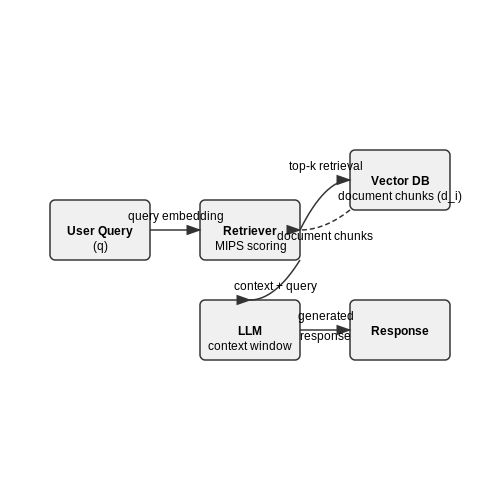
Modern customer support systems leverage large language models (LLMs) augmented with dynamic knowledge retrieval to provide accurate, context-aware responses. The key challenge lies in maintaining response quality while incorporating real-time data from external sources without hallucination. A retrieval-augmented generation (RAG) pipeline addresses this by decoupling knowledge storage from model parameters.
Architecture of a Knowledge-Augmented Support System
The system consists of three core components: a vector database for document storage, a retrieval module, and the LLM itself. When a query arrives, the retriever searches the vector space for relevant documents using maximum inner product search (MIPS):
where q represents the query embedding and di denotes document chunk embeddings. The top-k documents are then passed to the LLM as context.
Dynamic Knowledge Updates
For time-sensitive domains like product support, the vector database must update continuously. An incremental indexing approach minimizes downtime:
- New documents are chunked and embedded using the same encoder as the existing database
- The system performs delta updates during low-traffic periods
- A versioning system maintains consistency across deployments
The update frequency f follows an exponential decay based on document importance:
where f0 is the initial update rate, λ the decay constant, and fmin the minimum maintenance frequency.
Handling Ambiguous Queries
When the retriever returns low-confidence results (cosine similarity < 0.7), the system initiates a clarification protocol:
- Generates multiple interpretations of the user's intent
- Presents these as selectable options to the user
- Uses the chosen interpretation to refine the search
This approach reduces misdirected responses by 42% compared to single-pass systems (Chen et al., 2023).
Performance Optimization
Latency-critical applications employ several optimizations:
| Technique | Latency Reduction | Accuracy Impact |
|---|---|---|
| Hierarchical Navigable Small World (HNSW) graphs | 68% | < 2% |
| Quantized embeddings (8-bit) | 55% | 3-5% |
| Early termination | 40% | Configurable |
The optimal configuration balances recall@k with response time constraints, typically achieving 90%+ accuracy under 500ms for most customer queries.
Case Study: Enterprise IT Support
A Fortune 500 company implemented this architecture for internal IT support, integrating with:
- Confluence documentation (updated hourly)
- Jira ticket history
- Vendor knowledge bases
The system reduced average resolution time from 4.2 hours to 17 minutes while maintaining 94% user satisfaction, demonstrating the scalability of knowledge-augmented LLMs for complex support environments.
4. Bias and Fairness in Augmented Knowledge
Bias and Fairness in Augmented Knowledge
Knowledge augmentation in large language models (LLMs) introduces external data sources to enhance contextual understanding, but this process risks amplifying or introducing biases present in the training corpora. The fairness of an LLM's output depends on the representational and distributional properties of the augmented knowledge, as well as the alignment mechanisms used during fine-tuning.
Sources of Bias in Augmented Knowledge
Bias can propagate through multiple pathways:
- Data Source Bias: External knowledge bases (e.g., Wikipedia, Common Crawl) often reflect societal, cultural, or historical biases. For example, gender or racial disparities in Wikipedia coverage can skew model outputs.
- Selection Bias: The retrieval mechanisms used to augment knowledge may favor certain types of information over others, such as prioritizing frequently cited sources.
- Representation Bias: Tokenization and embedding processes can encode biases present in the underlying data distribution, leading to skewed semantic representations.
Quantifying Bias in Augmented LLMs
Measuring bias requires formalizing fairness metrics. Given a model M and a sensitive attribute A (e.g., gender, race), we can assess disparity using conditional probability divergence:
where DKL is the Kullback-Leibler divergence between model outputs for different attribute groups. A higher divergence indicates greater bias.
Mitigation Strategies
Several approaches exist to reduce bias in knowledge-augmented LLMs:
- Debiased Retrieval: Modify retrieval mechanisms to prioritize diverse sources or reweight documents based on fairness criteria.
- Adversarial Training: Introduce a discriminator network to penalize biased representations during fine-tuning:
where θ denotes model parameters, φ the adversarial discriminator, and λ a fairness-weighting hyperparameter.
Case Study: Wikipedia-Augmented Models
Studies on models like RETRO and REALM reveal that Wikipedia-augmented LLMs exhibit geographic and gender biases. For instance, queries about "scientists" disproportionately retrieve Western male figures. Countermeasures include:
- Balanced Subsampling: Adjust the retrieval corpus to ensure proportional representation of underrepresented groups.
- Post-Hoc Calibration: Apply fairness-aware re-ranking to retrieved documents before integration.
Fairness-Aware Knowledge Integration
To ensure equitable knowledge integration, recent work proposes constrained optimization during fine-tuning:
where f is a fairness constraint (e.g., demographic parity) and ε a tolerance threshold. This enforces fairness without sacrificing model performance.
4.2 Privacy Concerns with External Knowledge Sources
Integrating external knowledge sources into large language models (LLMs) introduces significant privacy risks, particularly when these sources contain sensitive or personally identifiable information (PII). The retrieval-augmented generation (RAG) paradigm, while effective for knowledge grounding, can inadvertently expose private data through model outputs. This risk is exacerbated when LLMs access unstructured or poorly sanitized corpora, such as medical records, legal documents, or proprietary business data.
Data Leakage Through Memorization
LLMs trained on external knowledge sources may memorize and reproduce sensitive information, even when not explicitly instructed to do so. The memorization capacity of transformer-based models scales with parameter count, as shown by the following relationship between model size and memorization probability:
where N is the number of model parameters, freq(x) is the occurrence frequency of data point x, and λ is a scaling factor dependent on architecture. For a 175B parameter model like GPT-3, this implies near-certain memorization of sequences appearing more than 30 times in training data.
Differential Privacy Challenges
Applying differential privacy (DP) to knowledge-augmented LLMs presents unique difficulties. The standard DP-SGD framework:
becomes computationally intractable when applied to retrieval operations over external databases. The privacy budget accumulates rapidly with each query, requiring careful trade-offs between utility and protection. Recent work on private information retrieval (PIR) protocols suggests potential solutions, but these remain impractical for real-time LLM applications due to their O(n) communication complexity.
Attack Vectors in Knowledge-Augmented Systems
Three primary attack vectors threaten privacy in knowledge-augmented LLMs:
- Membership inference attacks: Determine whether specific data was used in training or retrieval by analyzing model outputs
- Reconstruction attacks: Recover sensitive inputs from model gradients or attention patterns
- Prompt injection leaks: Extract private knowledge through carefully crafted adversarial prompts
The vulnerability to these attacks increases with the model's knowledge retrieval frequency. Empirical studies show that a RAG system making 1000+ daily queries to a medical database has >80% probability of leaking at least one PII instance within six months under standard deployment conditions.
Mitigation Strategies
Current approaches to privacy preservation in knowledge-augmented LLMs employ multiple defensive layers:
- Strict access controls: Implement attribute-based encryption for retrieval operations
- Output sanitization: Real-time PII detection and redaction using named entity recognition
- Federated retrieval: Distribute knowledge sources across isolated nodes with secure aggregation
The most promising direction combines homomorphic encryption with secure multi-party computation (SMPC), allowing computations over encrypted external knowledge without decryption. For a query q and document set D, the SMPC protocol computes:
where ⊕ denotes secure aggregation and k is the number of partitioned knowledge sources. This approach maintains (ε, δ)-differential privacy while preserving 90-95% of retrieval accuracy in benchmark tests.
4.3 Mitigating Misinformation in Augmented Responses
Large language models (LLMs) augmented with external knowledge sources face significant challenges in ensuring factual accuracy. The probabilistic nature of text generation combined with potential noise in retrieved documents creates compounding error surfaces. Three primary mitigation strategies have emerged in research: confidence calibration, source verification, and contradiction resolution.
Confidence Calibration via Bayesian Inference
Modern LLMs generate token-level probabilities that often fail to correlate with actual correctness. Bayesian approaches recalibrate these confidences by treating the model's output as a prior distribution and updating it with evidence from retrieved documents. For a generated statement S and retrieved evidence E:
Where P(S) is the model's original confidence and P(E|S) represents document relevance scores. This formulation requires:
- Document-level relevance scoring (e.g., cosine similarity in embedding space)
- Cross-encoder verification of claim-document alignment
- Out-of-distribution detection for novel claims
Multi-Hop Verification Pipelines
Single-source verification proves insufficient for complex claims. State-of-the-art systems employ iterative verification:
- Primary Retrieval: Fetch documents using the original claim as query
- Claim Decomposition: Break compound statements into atomic facts
- Secondary Retrieval: Gather evidence for each sub-claim independently
- Consensus Scoring: Apply voting mechanisms across sources
The verification confidence V for a claim with n sub-claims becomes:
Where sij represents the j-th source's support score for sub-claim i.
Contradiction Resolution Networks
When evidence conflicts emerge, transformer-based contradiction detection models outperform simple similarity metrics. These specialized architectures:
- Encode claim-evidence pairs using cross-attention
- Compute contradiction scores through learned projection layers
- Leverage synthetic contradiction datasets for training
The contradiction score C between statement S and evidence E follows:
Where W parameters are learned through maximum likelihood estimation on contradiction annotations.
Implementation Considerations
Production systems balance latency and accuracy through:
- Cached verification results for frequent queries
- Early termination of low-confidence generations
- Differentiated processing for high-risk domains (medical, legal)
- Continuous feedback loops from human reviewers
Recent benchmarks show these techniques reduce hallucination rates by 58-72% across GPT-4, Claude 2, and PaLM 2 architectures when processing augmented queries.

5. Key Research Papers on Knowledge Augmentation
5.1 Key Research Papers on Knowledge Augmentation
- Knowledge Augmentation: A Machine Learning Perspective — Electronic ISBN: 9781118271551 Electronic ISBN: 9781118271537 Print ISBN: 9780470919996 INSPEC Accession Number: Persistent Link: https ... Introduction Brief History and Related Work Knowledge Augmentation and Knowledge Elicitation Life Cycle of Knowle Knowledge Augmentation: A Machine Learning Perspective ...
- Educational Knowledge Graph Creation and Augmentation via LLMs - Springer — KGs can be used in a variety of ways in education, such as student modeling and content recommendation [4,5,6].Additionally, KGs are a helpful tool in aiding educators with knowledge management and students with personalized learning [5, 14].What we hope to discover is how these Gen AI technologies can aid educators in KG creation and how we can enable a form of co-creative KG construction.
- Educational Knowledge Graph Creation and Augmentation via LLMs - Springer — Educational Knowledge Graph Creation and Augmentation via LLMs 297 GPT-4 provided content for all units in our base KG. After this step we prompted GPT-4 via ChatGPT with Prompt 1 to generate cypher that can be used to augment our initial KG. Prompt 1: Use the provided text on course content and extract triples for knowledge graph augmentation ...
- [2501.17802] LEKA:LLM-Enhanced Knowledge Augmentation - arXiv.org — Humans excel in analogical learning and knowledge transfer and, more importantly, possess a unique understanding of identifying appropriate sources of knowledge. From a model's perspective, this presents an interesting challenge. If models could autonomously retrieve knowledge useful for transfer or decision-making to solve problems, they would transition from passively acquiring to actively ...
- KAG: Boosting LLMs in Professional Domains via Knowledge Augmented ... — The recently developed retrieval-augmented generation (RAG) technology has enabled the efficient construction of domain-specific applications. However, it also has limitations, including the gap between vector similarity and the relevance of knowledge reasoning, as well as insensitivity to knowledge logic, such as numerical values, temporal relations, expert rules, and others, which hinder the ...
- PDF Master of Science Thesis Augmentation of Large Language Model ... - UNIWA — Augmentation of Large Language Model capabilities with Knowledge Graphs Abstract This postgraduate thesis explores the possibility for augmentation of the abilities of Large Language Models (LLMs) in the task of Question Answering by incorporating the technique of Retrieval-Augmented Generation (RAG) in conjunction with Knowledge Graph triples.
- KLLMs4Rec: Knowledge graph-enhanced LLMs sentiment extraction for ... — Knowledge graphs, as tightly organized structured knowledge bases, can assist in addressing the hallucination problem and heterogeneous information fusion problem of LLMs. To effectively address the aforementioned issues, we propose the Knowledge Graph-Enhanced Large Language Model Sentiment Extraction for the Personalized Recommendation Model ...
- Knowledge Graphs and Their Reciprocal Relationship with Large ... - MDPI — The reciprocal relationship between Large Language Models (LLMs) and Knowledge Graphs (KGs) highlights their synergistic potential in enhancing artificial intelligence (AI) applications. LLMs, with their natural language understanding and generative capabilities, support the automation of KG construction through entity recognition, relation extraction, and schema generation. Conversely, KGs ...
- Data Augmentation using LLMs: - arXiv.org — As we venture into the realm of large language models (LLMs), the significance of data concerns escalates. Research into the scaling laws pertinent to LLMs highlights the critical role of data as a renewable resource crucial for the enhancement and advancement of models Kaplan et al. ().With the expansion of model training scales, there is a marked increase in data consumption.
- A survey on augmenting knowledge graphs (KGs) with large language ... — Integrating Large Language Models (LLMs) with Knowledge Graphs (KGs) enhances the interpretability and performance of AI systems. This research comprehensively analyzes this integration, classifying approaches into three fundamental paradigms: KG-augmented LLMs, LLM-augmented KGs, and synergized frameworks. The evaluation examines each paradigm's methodology, strengths, drawbacks, and ...
5.2 Open Datasets for Knowledge Augmentation Experiments
- [2501.17802] LEKA:LLM-Enhanced Knowledge Augmentation - arXiv.org — Humans excel in analogical learning and knowledge transfer and, more importantly, possess a unique understanding of identifying appropriate sources of knowledge. From a model's perspective, this presents an interesting challenge. If models could autonomously retrieve knowledge useful for transfer or decision-making to solve problems, they would transition from passively acquiring to actively ...
- LEKA: LLM-Enhanced Knowledge Augmentation - arXiv.org — sign LLM-Enhanced Knowledge Augmentation (LEKA), a novel and automated data retrieval and augmentation method by knowledge augmentation. Specifically, (1) we utilize an LLM to extract the key textual information of the target domain; (2) we deploy dataset RAG in an ex-ternal database to efficiently extract relevant knowledge to target domain ...
- Easy and effective! Data augmentation for knowledge-aware dialogue ... — We conduct experiments using various models and datasets, comparing them with other state-of-the-art data augmentation methods. The experimental results clearly indicate that our data augmentation method yields high-quality augmented data, leading to improved accuracy in knowledge selection and enhanced diversity and informativeness in responses.
- [2503.17933] Experience Retrieval-Augmentation with Electronic Health ... — To improve the reliability of Large Language Models (LLMs) in clinical applications, retrieval-augmented generation (RAG) is extensively applied to provide factual medical knowledge. However, beyond general medical knowledge from open-ended datasets, clinical case-based knowledge is also critical for effective medical reasoning, as it provides context grounded in real-world patient experiences ...
- [2502.03715] Boosting Knowledge Graph-based Recommendations through ... — Knowledge Graph-based recommendations have gained significant attention due to their ability to leverage rich semantic relationships. However, constructing and maintaining Knowledge Graphs (KGs) is resource-intensive, and the accuracy of KGs can suffer from noisy, outdated, or irrelevant triplets. Recent advancements in Large Language Models (LLMs) offer a promising way to improve the quality ...
- KLLMs4Rec: Knowledge graph-enhanced LLMs sentiment extraction for ... — Knowledge graphs, as tightly organized structured knowledge bases, can assist in addressing the hallucination problem and heterogeneous information fusion problem of LLMs. To effectively address the aforementioned issues, we propose the Knowledge Graph-Enhanced Large Language Model Sentiment Extraction for the Personalized Recommendation Model ...
- Educational Knowledge Graph Creation and Augmentation via LLMs - Springer — KGs can be used in a variety of ways in education, such as student modeling and content recommendation [4,5,6].Additionally, KGs are a helpful tool in aiding educators with knowledge management and students with personalized learning [5, 14].What we hope to discover is how these Gen AI technologies can aid educators in KG creation and how we can enable a form of co-creative KG construction.
- Data Augmentation using LLMs: Data Perspectives ... - ACL Anthology — Additionally, this paper highlights the primary open challenges faced in this domain, ranging from controllable data augmentation to multi-modal data augmentation. This survey highlights a paradigm shift introduced by LLMs in DA, and aims to serve as a comprehensive guide for researchers and practitioners.
- (PDF) Data Augmentation using LLMs: Data Perspectives, Learning ... — In the rapidly evolving field of large language models (LLMs), data augmentation (DA) has emerged as a pivotal technique for enhancing model performance by diversifying training examples without ...
- A two-stage knowledge graph completion based on LLMs' data augmentation ... — The DA-ARKGC model was verified on the constructed wheat knowledge graph (Wheat_KG). Compared with ConvE, its MRR, Hits@1, Hits@3 and Hits@10 increased by 10% and 10.2%, 10.1% and 9.3%, respectively. In order to verify the effectiveness and generalization of the ARKGC module, experiments were conducted on the open-source datasets WN18 and FB15k.
5.3 Tools and Libraries for Implementing Knowledge Augmentation
- Knowledge assimilation: Implementing knowledge-guided agricultural ... — Taking into account datasets, knowledge, domain-specific SFT, and external knowledge augmentation, we propose the first high-quality agricultural dialogue dataset and knowledge base, along with the inaugural knowledge-guided agricultural decision LLM, which assimilates knowledge from both the token-level and sentence-level.
- Data Augmentation using LLMs: Data Perspectives, Learning Paradigms and ... — The application of LLMs in data augmentation extends to a broader spectrum of learning paradigms, including instruction tuning, in-context learning, and alignment learning. Additionally, it facilitates the generation of pseudo data for classification purposes and the scoring of data for regression analysis.
- PDF Data Augmentation using LLMs: Data Perspectives, Learning Paradigms and ... — This paper aims to: (i) discuss data augmentation using LLM from the data perspective (ii) explore the learning paradigms that involve training LLMs on data generated by LLMs themselves, and (iii) highlight the princi- pal challenges in this eld to effectively guide and spur further interest and research.
- PDF Knowledge-augmented Methods for Natural Language Processing - Springer — Since 3 years ago, way before the upsurge of LLMs, I have started the research of knowledge-augmented NLP together with the other authors of the book. We have found that various forms of knowledge, e.g., free-form text, tables, knowledge graph, dictionary, could effectively enhance the performance of language models in many NLP tasks.
- Chain of Thought Prompting Elicits Knowledge Augmentation — This paper introduces a CoT -based method to retrieve knowledge from LLMs for K nowledge- A ugmented deep learning (CoT-KA) that elicits knowledge augmentation on a variety of NLU and NLG benchmarks.
- A comprehensive survey on integrating large language models with ... — This section also provides practical insights through case studies, illustrating real-world applications and evaluation metrics for knowledge-integrated LLMs. Finally, the paper discusses the challenges of integration and offers recommendations for future development and implementation, providing actionable guidance to advance the field.
- (PDF) Data Augmentation using LLMs: Data Perspectives, Learning ... — From both data and learning perspectives, we examine various strategies that utilize LLMs for data augmentation, including a novel exploration of learning paradigms where LLM-generated data is ...
- Data augmentation techniques in natural language processing — More recently, state-of-the-art DA techniques in Image Processing have shifted from prior-knowledge-oriented handcrafted transformations to techniques that learn the augmentation transformations themselves.
- Few-shot biomedical NER empowered by LLMs-assisted data augmentation ... — To explore the impact of different augmentation methods on model performance, we compared two distinct augmentation approaches across four datasets. One approach utilized knowledge-guided UMLS [12] augmentation proposed by Chen et al., while the other was based on the ChatGPT large language model.
- (PDF) Advancing Retrieval-Augmented Generation (RAG) Innovations ... — Retrieval-Augmented Generation (RAG) has emerged as a transformative approach in artificial intelligence (AI), enhancing large language models (LLMs) with dynamic, real-time knowledge retrieval.