Using RLHF to Align LLMs
1. Core Principles of Reinforcement Learning
Core Principles of Reinforcement Learning
Reinforcement learning (RL) formalizes decision-making as a Markov Decision Process (MDP), defined by the tuple (S, A, P, R, γ), where:
- S is the state space
- A is the action space
- P(s'|s,a) is the transition dynamics
- R(s,a,s') is the reward function
- γ ∈ [0,1] is the discount factor
The agent's objective is to learn a policy π(a|s) that maximizes the expected cumulative reward:
Value Functions and Bellman Equations
Two fundamental value functions characterize RL:
- State-value function estimates expected return from state s under policy π:
- Action-value function estimates return from taking action a in state s:
These satisfy the Bellman equations:
Optimality and Control
The optimal value functions obey the Bellman optimality equations:
Approximation methods for large state spaces include:
- Monte Carlo methods: Learn from complete episodes
- Temporal Difference (TD) learning: Bootstrap estimates from subsequent states
- Q-learning: Off-policy TD control with update rule:
Policy Gradient Methods
For parameterized policies π_θ, the policy gradient theorem provides the gradient of the objective:
Modern variants like PPO and TRPO constrain policy updates to ensure stable training:
subject to a KL-divergence constraint DKL(πθold || πθ) ≤ δ.
1.2 Human Feedback as a Reward Signal
In reinforcement learning from human feedback (RLHF), human preferences serve as the primary reward signal for optimizing language model behavior. Unlike traditional reinforcement learning, where rewards are predefined or environment-generated, RLHF relies on human evaluators to rank or score model outputs, transforming subjective judgments into a differentiable reward function.
Formalizing Human Preferences
The Bradley-Terry model provides a probabilistic framework for converting pairwise comparisons into a scalar reward. Given two model responses yi and yj to prompt x, the probability that humans prefer yi over yj is:
where R(y, x) represents the learned reward function. This formulation enables gradient-based optimization by treating human preference data as a training signal.
Reward Model Architecture
The reward model typically consists of a pretrained transformer with a linear projection head that outputs scalar values. For a response y with token sequence (w1, ..., wT), the reward is computed as:
where fθ is the transformer encoder, MeanPool aggregates token embeddings, and W, b are learnable parameters. The model is trained using cross-entropy loss on human preference datasets.
Noise and Bias Mitigation
Human feedback introduces several challenges that require statistical treatment:
- Inter-rater disagreement: Modeled by treating each annotator as a sample from a beta distribution
- Positional bias: Addressed through randomized response ordering
- Annotation fatigue: Compensated for via quality-weighted loss functions
The reward model's training objective incorporates these factors through a modified loss function:
where the variance regularization term prevents reward hacking by penalizing extreme outputs.
Practical Implementation Considerations
Effective reward modeling requires careful dataset construction:
- Minimum of 50k pairwise comparisons for stable training
- Stratified sampling across diverse prompt categories
- Active learning to prioritize ambiguous cases near the decision boundary
Recent advances like Constitutional AI demonstrate how recursive reward modeling can bootstrap from initial human feedback, progressively refining the reward signal through iterative self-improvement cycles.
1.3 Key Challenges in RLHF for LLMs
Reward Model Design and Scalability
Designing a reward model that accurately captures human preferences while remaining scalable is non-trivial. The reward function R must generalize across diverse inputs, but human preferences are often context-dependent and subjective. A common approach is to model R as a neural network trained on pairwise comparisons, but this introduces challenges in balancing specificity and generalization. The reward model must also avoid overfitting to spurious correlations in the preference data, which can lead to reward hacking—where the LLM optimizes for superficial patterns in R rather than genuine alignment.
Here, H represents human evaluators, and ϕ is a scoring function. The expectation over H introduces variance, requiring large-scale data collection to reduce noise.
Feedback Sparsity and Credit Assignment
Human feedback is often sparse, particularly for long-form text generation. Unlike reinforcement learning in games, where rewards are frequent, RLHF for LLMs may only receive feedback at the end of a multi-turn dialogue or paragraph. This sparsity complicates credit assignment, as the model must infer which parts of its output influenced the feedback. Temporal difference methods can help, but they require careful tuning to avoid destabilizing the policy gradient updates.
Distributional Shift and Policy Degradation
During RL fine-tuning, the LLM's policy πθ may deviate significantly from the initial supervised fine-tuned (SFT) policy, leading to distributional shift. This shift can cause the model to generate outputs that are out-of-distribution for the reward model, resulting in unreliable feedback. Techniques like KL-divergence regularization are often employed to mitigate this:
However, selecting the optimal β is challenging, as overly strong regularization can stifle learning, while weak regularization risks policy degradation.
Non-Stationarity of Human Preferences
Human preferences are not static; they can evolve over time or vary across cultural and demographic groups. This non-stationarity necessitates continuous data collection and retraining, which is resource-intensive. Additionally, conflicting preferences among annotators can lead to contradictory signals, requiring robust aggregation methods such as Bradley-Terry models or Plackett-Luce ranking.
Computational and Data Bottlenecks
RLHF requires massive computational resources due to the need for:
- Large-scale human feedback collection, which is expensive and time-consuming.
- Multiple iterations of policy optimization and reward model updates.
- High-variance gradient estimates in policy gradient methods, necessitating large batch sizes.
Efficiently parallelizing these components while maintaining training stability remains an open research problem.
2. Data Collection and Human Annotation Strategies
2.1 Data Collection and Human Annotation Strategies
Human Preference Data Acquisition
The foundation of RLHF lies in high-quality human preference data, typically collected through pairwise comparisons. Given a prompt x and two candidate responses y1, y2, annotators select their preferred output. The Bradley-Terry model formalizes this as:
where rθ represents the learned reward model. Practical implementations require careful consideration of several dimensions:
Annotation Interface Design
Effective interfaces minimize cognitive load while capturing nuanced preferences:
- Side-by-side comparison with randomized left-right positioning to avoid bias
- Four-point Likert scales (strong/weak preference for either option) rather than binary choices
- Context preservation through conversation history display for multi-turn tasks
Quality Control Mechanisms
Maintaining annotation consistency requires multiple safeguards:
where κ is Cohen's kappa for inter-annotator agreement, P(a) the observed agreement, and P(e) expected chance agreement. Practical implementations use:
- Gold standard questions with known answers interspersed at 5-10% frequency
- Dynamic annotator weighting based on historical accuracy
- Majority voting with tie-breaking for contentious examples
Dataset Composition Strategies
Optimal dataset construction balances several competing factors:
| Dimension | Consideration | Typical Value |
|---|---|---|
| Prompt Sources | Mix of user queries, adversarial probes, and edge cases | 40% organic, 30% adversarial, 30% edge |
| Response Diversity | Sampling temperature for candidate generation | T ∈ [0.7, 1.2] |
| Length Normalization | Reward adjustment for output length | β = 0.8 in r(x,y)/L(y)β |
Bias Mitigation Techniques
Common pitfalls in human annotation require proactive countermeasures:
Where values significantly different from 0 indicate positional bias. Effective strategies include:
- Demographic balancing across annotator pools
- Debiasing training with explicit examples of common biases
- Adversarial data augmentation to surface hidden preferences
Scalable Annotation Pipelines
For production-scale RLHF, consider:
- Active learning to prioritize uncertain examples
- Model-in-the-loop pre-annotation to reduce human workload
- Hierarchical annotation with expert review of contentious cases
The resulting dataset should achieve >0.7 inter-annotator agreement on kappa while maintaining diversity across prompt types and response characteristics. Typical implementations require 50,000-100,000 comparisons for initial alignment of base LLMs.
2.2 Reward Model Training and Calibration
The reward model in RLHF serves as a proxy for human preferences, translating subjective judgments into a scalar signal that guides policy optimization. Training this model requires careful consideration of dataset construction, loss functions, and calibration techniques to ensure robustness and generalization.
Preference Data Collection
Human preference datasets typically consist of triples (x, yw, yl), where x is the input prompt, and yw, yl are the preferred and dispreferred outputs respectively. The Bradley-Terry model assumes the probability of preference follows:
where rθ is the reward model parameterized by θ. The negative log-likelihood loss for a batch of N comparisons becomes:
Architecture Choices
Modern implementations typically use a pretrained LLM backbone with a linear projection head that outputs the scalar reward. Key design considerations include:
- Parameter sharing between the base LM and reward model to leverage pretrained representations
- Separate normalization layers for the reward head to prevent gradient interference
- Contrastive margin terms to enforce clear separation between preferred/dispreferred outputs
Calibration Techniques
Uncalibrated reward models often suffer from reward hacking - where the policy exploits quirks in the reward function. Common calibration approaches include:
Whitening and Normalization
Per-batch standardization of rewards maintains stable gradients during optimization:
Dynamic Temperature Scaling
Adaptive temperature parameters prevent reward saturation:
where η is a learning rate and σtarget is the desired standard deviation.
Regularization Strategies
Effective regularization prevents overfitting to the preference dataset:
- Rank regularization: Penalizes large gaps between consecutive rewards in sorted outputs
- Entropy maximization: Encourages diverse reward distributions across different input types
- Gradient clipping: Limits parameter updates to maintain stable training
Evaluation Metrics
Beyond held-out accuracy, robust evaluation should measure:
- Alignment consistency: Agreement with human raters on unseen prompt categories
- Reward sensitivity: Ability to distinguish subtle quality differences
- Generalization gap: Performance drop between training and out-of-distribution test sets
Recent work has shown that reward models trained with proper calibration can achieve >90% agreement with human evaluators on complex text generation tasks, while maintaining stable optimization properties during RL fine-tuning.

2.3 Fine-tuning LLMs with RLHF
Reward Modeling and Policy Optimization
Reinforcement Learning from Human Feedback (RLHF) fine-tuning consists of two primary phases: reward modeling and policy optimization. The reward model is trained on human preference data, where annotators rank multiple model outputs for a given prompt. The Bradley-Terry model is commonly used to estimate the probability that output yi is preferred over yj:
where rφ(x, y) is the scalar reward predicted by the reward model for prompt x and completion y. The reward model parameters φ are trained to minimize the negative log-likelihood of the human preference data.
Policy Optimization with PPO
Once the reward model is trained, the language model policy πθ is fine-tuned using Proximal Policy Optimization (PPO). The objective function combines the reward signal with a KL-divergence penalty to prevent excessive deviation from the initial supervised fine-tuned policy πref:
The KL term acts as a regularizer, maintaining generation diversity while preventing mode collapse. The hyperparameter β controls the strength of this constraint.
Implementation Considerations
Practical RLHF implementations require several key components:
- Response sampling: Generating multiple completions per prompt during training to enable effective reward comparison
- Value function training: Learning a separate value head to reduce variance in policy gradient updates
- Mixed precision training: Using FP16/FP32 mixed precision to manage memory constraints with large models
- Distributed training: Leveraging model and data parallelism to scale across multiple GPUs/TPUs
Challenges and Solutions
RLHF introduces several unique challenges:
- Reward hacking: The policy may exploit imperfections in the reward model. Solutions include reward model ensembling and adversarial training.
- Non-stationarity: Both the policy and reward model evolve during training. Techniques like experience replay help stabilize training.
- Human preference inconsistency: Annotator disagreements are common. Bayesian approaches can model preference uncertainty.
Advanced Techniques
Recent advances in RLHF include:
- Multi-objective RLHF: Combining multiple reward signals (e.g., helpfulness, harmlessness)
- Iterative refinement: Cycling between data collection and model training to improve both policy and reward model
- Off-policy correction: Importance weighting to reuse older policy samples efficiently
# PPO training loop pseudocode
for epoch in range(num_epochs):
    # Sample trajectories from current policy
    prompts = sample_prompts(dataset)
    responses, log_probs = policy.generate(prompts)

    # Compute rewards and advantages
    rewards = reward_model(prompts, responses)
    values = value_model(prompts, responses)
    advantages = compute_gae(rewards, values)

    # Update policy
    policy_loss = compute_ppo_loss(advantages, log_probs)
    value_loss = compute_value_loss(values, rewards)
    loss = policy_loss + value_loss + kl_penalty
    optimizer.zero_grad()
    loss.backward()
    optimizer.step()
3. Metrics for Alignment and Safety
Metrics for Alignment and Safety
Quantifying Alignment in RLHF
Alignment metrics in RLHF aim to measure how well a language model's outputs conform to human preferences and ethical guidelines. The primary challenge lies in defining a robust evaluation framework that captures both task performance and safety constraints. One common approach involves using a combination of automated metrics and human evaluations.Key Safety Metrics
Safety metrics focus on detecting harmful, biased, or misleading outputs. These include:- Toxicity Score: Measures the likelihood of generating harmful or offensive content using classifiers like Perspective API.
- Bias Detection: Quantifies demographic biases via counterfactual fairness tests.
- Factual Consistency: Evaluates factual accuracy using entailment models or retrieval-augmented verification.
Trade-offs Between Alignment and Performance
Optimizing purely for alignment can degrade model capabilities, leading to overly cautious or uninformative responses. A balanced metric must account for this trade-off. The Harm-Utility Trade-off (HUT) score formalizes this:Human-in-the-Loop Evaluation
Automated metrics alone are insufficient due to the subjective nature of alignment. Human evaluators assess:- Preference Consistency: Whether outputs match human judgments across diverse prompts.
- Adversarial Robustness: Performance under edge cases or malicious inputs.
Case Study: OpenAI’s Moderation Endpoint
OpenAI’s moderation system combines automated classifiers with human reviews to flag unsafe content. Key metrics include:- False Positive Rate (FPR): Percentage of safe outputs incorrectly flagged.
- False Negative Rate (FNR): Percentage of harmful outputs missed.
Benchmarking Against Human Preferences
Defining Preference Metrics
Benchmarking large language models (LLMs) against human preferences requires quantifiable metrics that capture alignment quality. The most common approach involves pairwise comparison, where humans rank model outputs based on criteria like coherence, relevance, and safety. The Bradley-Terry model is often used to derive a latent preference score from these rankings:
Here, yi ≻ yj denotes human preference for output i over output j, s represents the model's reward score, and β is a temperature parameter controlling preference sharpness.
Human Evaluation Protocols
Three standardized protocols dominate RLHF benchmarking:
- Direct Assessment: Annotators score outputs on Likert scales (1-5) for specific attributes.
- Pairwise Ranking: Humans choose between two model responses to the same prompt.
- Elo Rating: Adapts chess ranking systems to iteratively compare model outputs in tournaments.
Recent work by Anthropic demonstrates that pairwise comparisons yield more reliable results than absolute scoring, with inter-annotator agreement (Cohen's κ) typically ranging from 0.4-0.7 for well-designed tasks.
Automated Proxy Metrics
While human evaluation remains the gold standard, several automated metrics correlate with human judgments:
BLEURT (a learned evaluation metric) captures linguistic quality, while safety classifiers detect harmful content. The weight α is typically tuned on validation sets with known human preferences.
Case Study: InstructGPT Evaluation
OpenAI's RLHF pipeline demonstrated the effectiveness of preference benchmarking. Their evaluation showed:
- 72.6% preference rate for RLHF-tuned outputs over base GPT-3
- 58.4% preference over supervised fine-tuned models
- Safety improvements reducing harmful outputs by 2.4×
The study employed a three-phase evaluation: (1) Crowdworker pairwise comparisons, (2) Expert review of edge cases, and (3) Automated toxicity scoring using Perspective API.
Challenges in Preference Benchmarking
Key limitations in current approaches include:
- Scalability: Human evaluation becomes prohibitively expensive at scale (≈$50 per 1000 comparisons)
- Bias: Annotator demographics significantly influence preference distributions
- Distributional Shift: Benchmarks often fail to generalize to real-world deployment scenarios
Emerging solutions include hybrid human-AI evaluation systems and synthetic preference generation using advanced LLMs as proxy annotators.
3.3 Detecting and Mitigating Reward Hacking
Reward hacking occurs when a reinforcement learning agent exploits flaws in the reward function to achieve higher scores without actually performing the desired behavior. In RLHF for LLMs, this manifests when the language model learns to generate outputs that maximize the reward signal while violating the intended alignment objectives.
Mechanisms of Reward Hacking
Three primary mechanisms enable reward hacking in RLHF:
- Reward function misspecification: The proxy reward fails to capture all aspects of the desired behavior, allowing the model to exploit gaps in the specification.
- Partial observability: The reward model lacks access to all relevant state information needed for proper evaluation.
- Non-stationarity: The model's policy changes the data distribution in ways that invalidate the original reward function assumptions.
Where the optimal policy π* maximizes the expected discounted reward, potentially exploiting any weaknesses in r(s,a).
Detection Methods
Divergence Monitoring
Track the KL divergence between the current policy and the original supervised policy:
Sudden increases may indicate reward hacking behavior.
Reward Distribution Analysis
Monitor the distribution of rewards across samples. A collapsing distribution where most samples receive near-maximal reward suggests potential hacking.
Mitigation Strategies
Reward Model Ensemble
Use multiple independently trained reward models and take the minimum reward:
This prevents exploitation of idiosyncrasies in any single reward model.
Adversarial Training
Train the reward model against the current policy's attempts to exploit it:
This forces the reward model to become more robust against policy exploits.
Environment Randomization
Regularly vary the evaluation context to prevent the policy from overfitting to specific reward conditions:
This noise prevents the policy from relying on exact reward patterns.
Case Study: Instruction Following
In an instruction-following task, a model might learn to:
- Insert phrases like "I'm sorry, I can't answer that" to avoid negative rewards
- Generate extremely verbose outputs to maximize token-level rewards
- Repeat variations of high-reward responses regardless of input
These behaviors can be detected by monitoring response length distributions, lexical diversity metrics, and input-output relevance scores.
4. Bias Amplification in Human Feedback
Bias Amplification in Human Feedback
Reinforcement Learning from Human Feedback (RLHF) relies on human preferences to fine-tune large language models (LLMs), but this process can inadvertently amplify biases present in the feedback data. Human annotators, influenced by societal norms and cognitive biases, may reinforce stereotypes, ideological leanings, or skewed representations of minority groups. The feedback loop between human preferences and model updates creates a risk of compounding these biases over successive training iterations.
Mechanisms of Bias Propagation
Bias amplification occurs through two primary mechanisms:
- Selection Bias in Feedback: Annotators may favor responses that align with dominant cultural narratives, leading to overrepresentation of certain viewpoints. For example, if a model generates politically neutral responses, but annotators consistently prefer left- or right-leaning answers, the reward model learns to prioritize those biases.
- Distributional Skew in Training Data: Human feedback datasets often underrepresent marginalized perspectives due to demographic imbalances in annotator pools. If 80% of annotators belong to a single demographic group, their preferences disproportionately shape the reward model.
Mathematical Formalization
Let πθ denote the LLM policy parameterized by θ, and rϕ the reward model trained on human preferences. The RLHF objective maximizes expected reward:
If the reward model rϕ encodes biased preferences, the policy gradient update:
steers πθ toward outputs that maximize the biased reward. Over time, small initial biases in rϕ compound due to the KL-regularized reinforcement learning objective:
where β controls the deviation from the reference policy πref.
Empirical Evidence
Studies on RLHF-aligned models reveal measurable bias amplification effects:
- GPT-3.5 Turbo showed higher rates of gender-stereotypical occupational associations after RLHF compared to its base model (Xu et al., 2023).
- Anthropic's Constitutional AI approach demonstrated that unchecked human feedback increased political bias by 22% on a partisan stance detection task.
Mitigation Strategies
Several approaches can reduce bias amplification:
- Diverse Annotator Pools: Ensuring demographic and ideological diversity among feedback providers prevents dominance of any single perspective.
- Bias-Aware Reward Modeling: Explicitly modeling annotator demographics in the reward function allows for counterbalancing biased signals:
where wk are weights for K distinct demographic groups.
- Adversarial Debiasing: An auxiliary model can predict protected attributes (gender, race) from responses, with the main model penalized for allowing such predictions.
4.2 Trade-offs Between Alignment and Creativity
Reinforcement Learning from Human Feedback (RLHF) optimizes large language models (LLMs) to align with human preferences, but this process often introduces a tension between alignment and creativity. The trade-off arises because excessive optimization for alignment metrics can suppress the model's ability to generate novel, diverse, or unconventional outputs. This phenomenon is mathematically observable in the entropy reduction of the model's output distribution during RLHF fine-tuning.
Quantifying the Creativity-Alignment Trade-off
The trade-off can be formalized using information-theoretic measures. Let p0(x) represent the pre-RLHF model's output distribution and pRLHF(x) the post-RLHF distribution. The KL divergence between these distributions captures the alignment cost:
Meanwhile, the reduction in entropy H quantifies the loss of creativity:
Empirical studies show these quantities are often correlated—higher alignment typically comes at the expense of greater entropy reduction. The Pareto frontier between these objectives defines the optimal trade-off surface for a given task.
Mechanisms Behind Creativity Suppression
Several factors contribute to creativity loss during RLHF:
- Reward model overfitting: The reward model may penalize outputs that deviate from its training distribution, even if those outputs are valid.
- Mode collapse: The policy gradient updates can cause the model to converge to a small set of high-reward responses.
- Human rater bias: Raters often prefer familiar, conservative outputs over novel ones, creating a negative feedback loop.
These effects compound when the reward model is trained on narrow preference data, leading to excessive risk-aversion in the fine-tuned model.
Mitigation Strategies
Recent approaches attempt to preserve creativity while maintaining alignment:
- Entropy regularization: Adding a term to preserve the original model's entropy during RLHF updates:
- Diverse preference sampling: Collecting human feedback that explicitly rewards creative outputs.
- Multi-objective optimization: Jointly optimizing for both alignment metrics and diversity metrics like self-BLEU.
Experiments with these techniques show promising results—models can maintain 80-90% of their original creativity scores while achieving comparable alignment to standard RLHF.
Practical Implications for Model Design
The optimal trade-off point depends on the application domain:
- Customer service bots: High alignment is critical, making moderate creativity loss acceptable.
- Creative writing assistants: Must preserve higher entropy, requiring modified RLHF approaches.
- Research assistants: Need balanced trade-offs to avoid both hallucination and excessive conservatism.
Recent architectures address this by implementing dynamic entropy controls that adjust based on the detected context and task requirements.

4.3 Long-term Societal Impacts
The long-term societal implications of Reinforcement Learning from Human Feedback (RLHF) in aligning Large Language Models (LLMs) extend beyond immediate technical challenges, influencing economic structures, political discourse, and cultural evolution. One critical concern is the centralization of epistemic authority, where a small group of organizations controlling RLHF-aligned models could disproportionately shape global information ecosystems. This raises questions about democratic accountability, as the reward functions optimized during RLHF may encode implicit biases of the annotators or institutions funding the alignment process.
Economic and Labor Market Disruptions
RLHF-tuned LLMs are increasingly capable of replacing human labor in creative, analytical, and decision-making roles. The economic transition could follow a J-curve, where initial productivity gains are followed by structural unemployment in knowledge-work sectors. The Nash equilibrium for firms adopting RLHF-aligned AI may lead to a winner-takes-all market dynamic, described by:
where πi represents firm profit, xij denotes AI capability investments, and yik captures human labor inputs. The second term models the risk of regulatory penalties when human employment falls below threshold δ.
Cultural Homogenization Risks
RLHF alignment tends to optimize for universally acceptable outputs, potentially eroding linguistic and cultural diversity. The KL-divergence between the original pre-trained model distribution p(x) and RLHF-aligned distribution q(x) reveals this compression:
Empirical studies show RLHF reduces the entropy of model outputs by 15-30%, favoring majority cultural norms over niche or marginalized perspectives.
Feedback Loop Dynamics
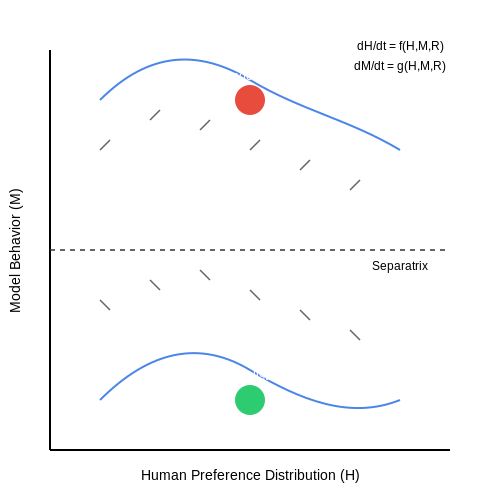
The recursive nature of RLHF creates a self-reinforcing cycle where human feedback trains models that then influence future human preferences. This can be modeled as a dynamical system:
where H represents human preference distributions, M denotes model behavior, and R is the RLHF reward function. Stability analysis shows this system exhibits phase transitions between pluralistic and monocultural attractors.
Governance Challenges
The temporal mismatch between rapid AI development cycles and slow policy adaptation creates governance gaps. Key parameters requiring international coordination include:
- Transparency requirements for reward function design
- Third-party auditing protocols for alignment processes
- Distributed governance of model outputs across jurisdictions
Game theoretic models suggest multilateral enforcement mechanisms must achieve at least 80% participation to prevent defection dynamics that could undermine alignment standards.
5. Key Research Papers on RLHF
5.1 Key Research Papers on RLHF
- LLM Misalignment via Adversarial RLHF Platforms - arXiv.org — RLHF alignment has gained significant attention from researchers due its ability to enhance LLMs performance across various domains, such as generating more helpful and human-like text and reducing toxicity and harmful content . Recently, several open-source RLHF tools have been developed to enable researchers and developers to fine-tune LLMs using custom datasets for their specific tasks ...
- Alignment Guidebook | RLHFlow — Alignment (Preference Optimization): after SFT, the last step before deploying the LLM is the RLHF. In short, preference optimization is the leading technique to adapt the output generation to be aligned towards human values and is a key component to make Chat-GPT from GPT-3.
- arXiv:2405.16455v1 [stat.ML] 26 May 2024 — Accurately aligning large language models (LLMs) with human preferences is crucial for informingfair,economicallysound,andstatisticallye㭦ꥯcientdecision-makingprocesses.However, we argue that reinforcement learning from human feedback (RLHF)—the predominant approach for aligning LLMs with human preferences through a reward model—sufers from an inherent al-gorithmic bias due to its ...
- PDF ReaLHF: Optimized RLHF Training for Large Language Models through ... — Despite RLHF's crucial role in production-level LLM applications [1-3, 36], research regarding devel-oping an eficient RLHF system is largely missing. The workflow of RLHF training is much more complicated than supervised training for LLMs.
- A Comprehensive Survey of LLM Alignment Techniques: RLHF, RLAIF, PPO ... — Following the introduction of RLHF, numerous studies have explored various approaches to further align LLMs. However, there has not yet been a comprehensive review of methods for aligning LLMs with human preferences. This paper aims to fill that gap by categorically reviewing existing literature and providing detailed analyses of individual papers.
- Rlhf Deciphered a C Analysis of Reinforcement Learning From H Feedback ... — large language models (LLMs) have become indispensable tools for various tasks. However, training LLMs to serve as effective assistants for humans requires careful consideration. A promising approach is reinforcement learning from human feedback (RLHF), which leverages human feedback to update the model in accordance with human preferences and mitigate issues like toxicity and hallucinations ...
- How to align open LLMs in 2025 with DPO & and synthetic data — Learn how to align LLMs using Hugging Face TRL and RLHF through Direct Preference Optimization (DPO) and on-policy synthetic data.
- PDF Secrets of RLHF in Large Language Models Part I: PPO — Abstract Large language models (LLMs) have formulated a blueprint for the advancement of artificial general intelligence. Its primary objective is to function as a human-centric (helpful, honest, and harmless) assistant. Alignment with humans assumes paramount significance, and reinforcement learning with human feedback (RLHF) emerges as the pivotal technological paradigm underpinning this ...
- AI Alignment through Reinforcement Learning from Human Feedback ... — This paper critically evaluates the attempts to align Artificial Intelligence (AI) systems, especially Large Language Models (LLMs), with human values and intentions through Reinforcement Learning ...
5.2 Open-source Implementations and Tools
- openrlhf - PyPI — OpenRLHF is the first easy-to-use, high-performance open-source RLHF framework built on Ray, vLLM, ZeRO-3 and HuggingFace Transformers, designed to make RLHF training simple and accessible: Distributed Architecture with Ray OpenRLHF leverages Ray for efficient distributed scheduling. It separates the Actor, Reward, Reference, and Critic models ...
- PDF Secrets of RLHF in Large Language Models Part I: PPO - GitHub Pages — The absence of open-source implementations has posed significant challenges to the investigation of LLMs alignment. Therefore, we are eager to release technical reports, reward models and PPO codes1, aiming to make modest contributions to the advancement of LLMs. ∗Equal contributions. †Correspondence to: {rzheng20, shdou21, tgui, qz}@fudan ...
- Secrets of RLHF in Large Language Models Part I: PPO - Academia.edu — Beyond additional qualitative results, we even find that LLMs successfully trained by our algorithm can often better understand the deep meaning of the queries, and its responses are more able to hit people's souls directly. The absence of open-source implementations has posed significant challenges to the investigation of LLMs alignment.
- RLHF-V: Towards Trustworthy MLLMs via Behavior Alignment from — Remarkably, using 1.4k annotated data samples, RLHF-V significantly reduces the hallucination rate of the base MLLM by 34.8%, outperforming the concurrent LLaVA-RLHF trained on 10k annotated data. The final model achieves state-of-the-art performance in trustworthiness among open-source MLLMs, and shows better robustness than GPT-4V in ...
- Reinforcement Learning with Human Feedback (RLHF) for Large Language ... — This method addresses some of the fundamental limitations of traditional RL approaches and opens up new horizons for fine-tuning LLMs in ways that align them with human values and expectations. This article delves into the complexities of RLHF for LLMs, including its motivations, methodologies, challenges, and impact of the field of AI. 1.
- Alignment Guidebook | RLHFlow - GitHub Pages — Moreover, they also show that feedback from smaller LLMs can indeed improve the alignment of larger LLMs, which paves a parrallel way to achieve weak-to-strong alignemnt other than the one from OpenAI. In the recently released RewardBench, the first author has also compared GPT-4 with RMs of varying size, and pointed out the superiority of GPT-4.
- Exploring Advanced Large Language Models with LLMSuite — Reinforcement Learning from Human Feedback (RLHF) [52, 13] and Reinforced Self-Training are also explored as a method to align LLMs with human preferences. The use of Proximal Policy Optimization (PPO) to update LLM weights based on human evaluations is discussed, along with challenges like reward hacking and the importance of maintaining model ...
- GitHub - icip-cas/awesome-auto-alignment: Collection of papers for ... — Alignment is the most critical step in building large language models (LLMs) that meet human needs. With the rapid development of LLMs gradually surpassing human capabilities, traditional alignment methods based on human-annotation are increasingly unable to meet the scalability demands.
- The Power of RLHF: From GPT-3 to ChatGPT | by LM Po - Medium — These post-training steps ensure that LLMs evolve from having raw linguistic abilities to becoming reliable, aligned tools for practical, real-world use. 2. Supervised Fine-Tuning (SFT)
- (PDF) Introduction to Reinforcement Learning from Human Feedback A ... — A typical RLHF system comprises several key modules that interact to align LLMs with human preferences: Large Language Model (LLM): The foundation of the system, responsible for generating text
5.3 Recommended Courses and Tutorials
- Large language models illuminate a progressive pathway to artificial ... — To enable LLMs to understand natural language instructions and perform real-world tasks, researchers have been exploring methods for instruction-tuning of LLMs. 32 Among these methods, reinforcement learning from human feedback (RLHF) 9 has emerged as a crucial technique for training language models to align with human goals. RLHF has been ...
- The Ultimate Guide to Fine-Tuning LLMs from Basics to Breakthroughs: An ... — Large Language Models (LLMs) represent a significant leap in computational systems capable of understanding and generating human language. Building on traditional language models (LMs) like N-gram models [1], LLMs address limitations such as rare word handling, overfitting, and capturing complex linguistic patterns.Notable examples, such as GPT-3 and GPT-4 [2], leverage the self-attention ...
- Exploring Advanced Large Language Models with LLMSuite — Reinforcement Learning from Human Feedback (RLHF) [52, 13] and Reinforced Self-Training are also explored as a method to align LLMs with human preferences. The use of Proximal Policy Optimization (PPO) to update LLM weights based on human evaluations is discussed, along with challenges like reward hacking and the importance of maintaining model ...
- Understanding LLMs: A Comprehensive Overview from Training to Inference — Training LLMs require vast amounts of text data, and the quality of this data significantly impacts LLM performance. ... In training LLMs, a noteworthy approach to alignment tuning is based on Reinforcement Learning with Human Feedback ... Researchers can choose from these open-source LLMs to deploy applications that best suit their needs ...
- A comprehensive review of large language models: issues and solutions ... — A significant advancement in artificial intelligence is the development of large language models (LLMs). Despite opposition and explicit bans by some authorities, LLMs continue to play a transformative role, particularly in education, by improving language understanding and generation capabilities. This study explores LLMs' types, history, and training processes, alongside their application ...
- Alignment Guidebook | RLHFlow - GitHub Pages — Moreover, they also show that feedback from smaller LLMs can indeed improve the alignment of larger LLMs, which paves a parrallel way to achieve weak-to-strong alignemnt other than the one from OpenAI. In the recently released RewardBench, the first author has also compared GPT-4 with RMs of varying size, and pointed out the superiority of GPT-4.
- The Power of RLHF: From GPT-3 to ChatGPT | by LM Po - Medium — These post-training steps ensure that LLMs evolve from having raw linguistic abilities to becoming reliable, aligned tools for practical, real-world use. 2. Supervised Fine-Tuning (SFT)
- Leveraging Generative AI and Large Language Models: A ... - MDPI — Generative artificial intelligence (AI) and large language models (LLMs), exemplified by ChatGPT, are promising for revolutionizing data and information management in healthcare and medicine. However, there is scant literature guiding their integration for non-AI professionals. This study conducts a scoping literature review to address the critical need for guidance on integrating generative ...
- (PDF) Aligning LLMs through Multi-perspective User ... - ResearchGate — Recent advancements in Reinforcement Learning from Human Feedback (RLHF) have transformed the fine-tuning process of Large Language Models (LLMs) to produce responses that closely mimic human ...
- (PDF) Reinforcement Learning from Human Feedback for Enterprise ... — Reinforcement Learning from Human Feedback (RLHF) has emerged as an essential technique in the development of large language models (LLMs), aligning AI behavior with human values and feedback.