Transformers for Automated Theorem Proving
1. Overview of Automated Theorem Proving
Overview of Automated Theorem Proving
Automated Theorem Proving (ATP) is a subfield of artificial intelligence and mathematical logic that focuses on developing algorithms to prove mathematical theorems without human intervention. The foundational goal is to mechanize logical reasoning, enabling computers to derive conclusions from a set of premises using formal systems such as first-order logic, higher-order logic, or specialized proof calculi.
Historical Context
The origins of ATP trace back to the early 20th century with Hilbert's program, which sought to formalize all mathematical reasoning. The field gained momentum in the 1950s with the development of early theorem provers like the Logic Theorist by Newell, Shaw, and Simon. Modern ATP systems leverage advanced techniques from computational logic, including resolution, superposition, and tableaux methods.
Formal Foundations
ATP operates within formal systems where theorems are derived from axioms via inference rules. A typical ATP problem is defined as a triple (A, C, Γ), where:
The prover's task is to determine whether C logically follows from A under Γ. This reduces to checking the unsatisfiability of A ∧ ¬C in refutation-based approaches.
Key Techniques
Modern ATP systems employ several core strategies:
- Resolution: Combines pairs of clauses to produce new ones until contradiction is found.
- Superposition: Extends resolution with term ordering for equational reasoning.
- Model Elimination: Uses depth-first search with backtracking for proof construction.
- Sequent Calculus: Builds proofs by decomposing logical connectives in a goal-directed manner.
Complexity Considerations
ATP faces inherent computational challenges. For first-order logic, the Entscheidungsproblem shows provability is semi-decidable - provers may never terminate for unprovable statements. Practical systems use heuristics like:
to prioritize simpler terms during proof search. For higher-order logic, the undecidability necessitates sophisticated techniques like higher-order unification.
Modern Applications
Contemporary ATP systems demonstrate remarkable capability across domains:
- Verification of hardware and software systems (e.g., Intel's FPU verification)
- Mathematical discovery (e.g., Robbins conjecture proof)
- Knowledge base reasoning (e.g., Cyc project)
- Program synthesis (e.g., generating correct-by-construction code)
The integration of machine learning, particularly transformer architectures, has recently enabled neural guidance of proof search strategies, marrying symbolic reasoning with statistical pattern recognition.
Role of Transformers in Mathematical Reasoning
Transformers have demonstrated remarkable capabilities in mathematical reasoning tasks, particularly in formal theorem proving. Their ability to process and generate structured symbolic representations makes them well-suited for handling the sequential and hierarchical nature of mathematical proofs. The self-attention mechanism allows the model to capture long-range dependencies between proof steps, while the encoder-decoder architecture facilitates mapping premises to conclusions.
Architectural Adaptations for Theorem Proving
Standard transformer architectures require several modifications to effectively handle mathematical reasoning:
- Symbolic Embeddings: Mathematical symbols and operators are embedded in a continuous space while preserving their discrete relationships.
- Relative Position Encoding: Extends standard position encoding to represent the hierarchical structure of proofs.
- Attention Masking: Constrains attention to valid proof steps according to logical rules.
where M represents the attention mask enforcing proof constraints.
Training Paradigms
Effective training for theorem proving involves multiple objectives:
- Autoregressive Proof Generation: Models predict next proof steps given previous context.
- Verification Loss: Additional supervision to ensure predicted steps are logically valid.
- Curriculum Learning: Training progresses from simple to complex theorems.
Key Challenges
Despite their promise, transformers face several challenges in mathematical reasoning:
- Symbol Grounding: Ensuring consistent interpretation of mathematical symbols.
- Proof Search: The combinatorial explosion of possible proof paths.
- Generalization: Transferring learned reasoning to novel theorem classes.
Case Study: Formal Mathematics
In formal systems like Lean or Coq, transformers have been used to:
- Predict proof tactics from intermediate goals
- Generate complete proof terms
- Suggest relevant lemmas and definitions
where ht is the transformer's hidden state at step t.
Future Directions
Emerging approaches aim to combine transformers with:
- Symbolic reasoning engines for verifiable correctness
- Retrieval-augmented architectures for accessing mathematical knowledge
- Meta-learning frameworks for few-shot adaptation to new domains

1.3 Key Challenges and Opportunities
Formal Representation and Symbolic Reasoning
Transformers excel at processing unstructured data but struggle with the rigid syntax and semantics of formal theorem proving languages like Lean, Coq, or Isabelle. Unlike natural language, formal proofs require precise adherence to logical rules, where a single misplaced symbol can invalidate an entire derivation. The lack of explicit symbolic reasoning capabilities in standard transformer architectures necessitates hybrid approaches, such as integrating neural networks with symbolic solvers or leveraging intermediate representations that bridge formal and informal reasoning.
Long-Term Dependency and Proof Step Generation
Automated theorem proving often involves chains of reasoning spanning hundreds or thousands of steps, far exceeding the context window of most transformer models. While techniques like sparse attention or hierarchical chunking mitigate this, the fundamental challenge lies in maintaining coherent logical flow over extended sequences. The autoregressive nature of transformers also introduces compounding errors: a single incorrect step early in the proof can derail subsequent generations. Recent work on verifier-guided decoding shows promise by using auxiliary models to check intermediate steps.
Data Scarcity and Curriculum Learning
High-quality formal proof datasets are orders of magnitude smaller than typical NLP corpora. The Isabelle/HOL standard library contains ~7k theorems, compared to billions of sentences in web-crawled text. This scarcity demands innovative data augmentation, such as synthetic proof generation via rule-based systems or leveraging informal mathematical text from arXiv as weak supervision. Curriculum learning strategies that progressively increase proof complexity have proven effective, as seen in models like GPT-f for Metamath.
Opportunities in Neural-Symbolic Integration
The most promising direction combines neural networks' pattern recognition with symbolic systems' rigor. Architectures like NeuroSAT demonstrate how transformers can guide SAT solvers by predicting variable assignments, while systems like Thor use neural retrievers to suggest relevant lemmas. Emerging techniques in differentiable logic, such as fuzzy unification or soft theorem selection, enable end-to-end training while preserving formal guarantees. The integration of Monte Carlo tree search with transformer-based policy networks, inspired by AlphaGo, shows particular promise for exploration-intensive proofs.
Hardware and Computational Constraints
Training transformers for theorem proving requires specialized infrastructure due to the need for exact arithmetic and extensive symbolic computation. Mixed-precision training often fails because proof verification demands bit-perfect reproducibility. The computational graph for a single proof step may involve millions of operations when backpropagating through formal system embeddings. Sparse GPU kernels optimized for symbolic operations and custom accelerators for tensor-symbolic hybrid workloads are active research areas.
Evaluation Metrics and Benchmarking
Traditional NLP metrics like BLEU or ROUGE fail to capture logical validity. Rigorous evaluation requires:
- Formal verification of generated proofs by trusted checkers (e.g., Lean's kernel)
- Generalization across theorem classes (algebra vs. analysis)
- Human-like proof structuring (lemma organization, readability)
The miniF2F benchmark provides a standardized testbed, but challenges remain in creating adversarial evaluation sets that expose logical flaws masked by superficial correctness.
2. Transformer Architecture: Key Components
Transformer Architecture: Key Components
Self-Attention Mechanism
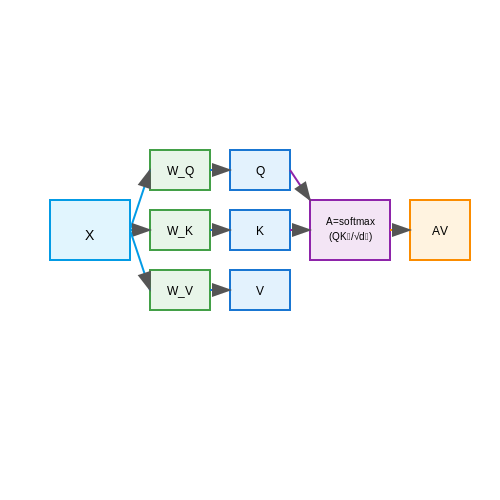
The self-attention mechanism computes a weighted sum of input embeddings, where the weights are dynamically derived based on pairwise interactions between all tokens in the sequence. Given an input matrix X ∈ ℝn×d (where n is sequence length and d is embedding dimension), the mechanism first projects X into query (Q), key (K), and value (V) matrices:
where WQ, WK, WV ∈ ℝd×dk are learnable parameters. The attention scores are computed as:
The scaling factor √dk prevents gradient vanishing issues caused by large dot products. Multi-head attention extends this by running h parallel attention heads and concatenating their outputs, enabling the model to jointly attend to information from different representation subspaces.
Positional Encoding
Since transformers lack recurrent or convolutional operations, positional encodings inject information about token positions into the input embeddings. For position pos and dimension i, the sinusoidal encoding is defined as:
This choice allows the model to extrapolate to sequences longer than those seen during training, as the sinusoidal functions form a linear combination basis for relative positions.
Layer Normalization and Residual Connections
Each sub-layer (attention or feed-forward) in the transformer employs residual connections followed by layer normalization:
Layer normalization stabilizes training by normalizing activations across the feature dimension rather than batch dimension, making it effective for variable-length sequences. The residual pathways mitigate vanishing gradients in deep networks.
Feed-Forward Networks
The position-wise feed-forward network consists of two linear transformations with a ReLU activation in between:
Applied independently to each position, this allows mixing of features within each token representation. The hidden dimension is typically 4× the embedding size (dff = 4d), providing sufficient capacity for complex transformations.
Encoder-Decoder Architecture
In theorem proving applications, the encoder processes the premises and axioms, while the decoder generates proof steps autoregressively. The cross-attention layers in the decoder allow each generated token to attend to the encoder's memory, analogous to how a proof step may reference earlier premises. The decoder uses masked self-attention to prevent information leakage from future tokens during training.
Practical Modifications for Theorem Proving
State-of-the-art systems like GPT-f and LeanDojo introduce:
- Symbolic attention biases to prioritize relevant axioms
- Retrieval-augmented layers that access external knowledge bases
- Iterative refinement where intermediate proof states are fed back as input
These adaptations address the unique challenges of mathematical reasoning, such as the need for precise symbolic manipulation and handling of sparse reward signals in proof search.

2.2 Adaptations for Symbolic and Logical Reasoning
Transformers, originally designed for sequential data like natural language, require significant architectural and training adaptations to handle symbolic and logical reasoning tasks effectively. Unlike natural language, formal logic operates on discrete symbols with strict syntactic and semantic rules, necessitating modifications to the standard attention mechanism and tokenization process.
Tokenization and Embedding of Logical Expressions
Standard subword tokenizers (e.g., Byte Pair Encoding) are ill-suited for logical formulas, which often contain nested structures and operators with precise precedence rules. Instead, logical expressions are parsed into abstract syntax trees (ASTs), with each node representing an operator (∧, ∨, ∀, ∃) or operand. These trees are linearized using prefix or Polish notation to maintain compositional structure. For example, the formula ∀x(P(x)→Q(x)) becomes ["∀", "x", "→", "P", "x", "Q", "x"].
Structural Attention Mechanisms
Vanilla self-attention treats tokens as a flat sequence, ignoring the hierarchical nature of logical expressions. Tree-structured attention mechanisms enforce constraints where a token can only attend to its parent, siblings, or children in the AST. This is implemented via masked attention, where the attention matrix M is sparse:
Models like Graph Attention Networks (GATs) or Tree Transformers explicitly encode graph edges between AST nodes, allowing information flow along syntactic dependencies rather than sequential positions.
Integration of External Knowledge
Theorem proving often requires referencing axioms, definitions, or previously proven lemmas. Hybrid architectures combine a Transformer with a differentiable memory bank (e.g., Neural Turing Machine or Memory Networks) that stores encoded representations of known facts. At each step, the model retrieves relevant knowledge via content-based addressing:
where q is the current proof state query, and ki, vi are key-value pairs in memory. This mimics human mathematicians recalling prior results during proofs.
Training Objectives Beyond Language Modeling
Standard autoregressive training (predicting the next token) is insufficient for theorem proving. Additional objectives include:
- Goal-conditioned generation: Given a target proposition, generate a valid proof sequence.
- Step-wise correctness: Auxiliary classifiers verify each proof step’s validity using formal verifiers like Coq or Isabelle.
- Reward shaping: Reinforcement learning rewards shorter proofs or novel lemma discovery.
For example, models like GPT-f (Polu & Sutskever, 2020) use Monte Carlo Tree Search (MCTS) to explore proof trajectories, backpropagating rewards from successful proofs.
Case Study: Lean-GPT-f
Lean-GPT-f fine-tunes a Transformer on the Lean theorem prover’s proof steps, using AST-based tokenization and memory-augmented attention. It achieves 41.2% proof completion on the Lean Mathematical Library, outperforming rule-based provers on complex algebraic reasoning tasks. Key adaptations include:
- AST-aware positional embeddings encoding tree depth and node type.
- Interactive proof repair: The model suggests edits when a step fails verification.
- Curriculum learning: Training progresses from simple propositions to nested quantifiers.

Attention Mechanisms in Formal Proofs
Attention mechanisms in transformers provide a dynamic way to weigh the relevance of different parts of the input sequence when generating each step of a formal proof. Unlike static architectures, attention allows the model to focus on premises, lemmas, or previously derived statements that are most pertinent to the current proof step. This is particularly powerful in theorem proving, where long-range dependencies and non-local reasoning are common.
Mathematical Formulation of Attention in Proof Steps
Given an input sequence of tokens representing logical expressions X = (x1, ..., xn), the attention mechanism computes three learned linear transformations:
where WQ, WK, WV are weight matrices. The attention scores between position i and all positions j are computed as:
Here, dk is the dimension of the key vectors, and the scaling factor prevents gradient saturation. In multi-head attention, this process is parallelized across h heads with different weight matrices, allowing the model to attend to different substructures simultaneously.
Application to Proof State Representation
In automated theorem proving, the current proof state can be represented as a graph where nodes are terms or formulas and edges are logical dependencies. Attention mechanisms excel at capturing these graph-like structures through learned relations. For example:
- Premise selection: The model learns to attend to relevant axioms from a large library when attempting a proof step.
- Tactics chaining: Attention weights indicate which previous tactics or proof steps are most relevant for the current subgoal.
- Term matching: During unification, attention helps identify matching patterns across different parts of the formula.
Case Study: Transformer-Based Provers
Modern systems like GPT-f and Thor integrate attention with symbolic reasoning:
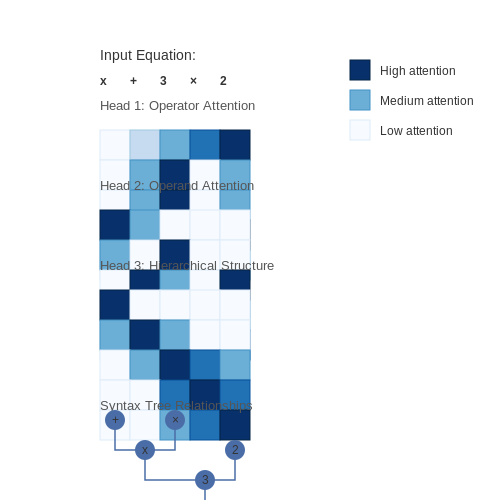
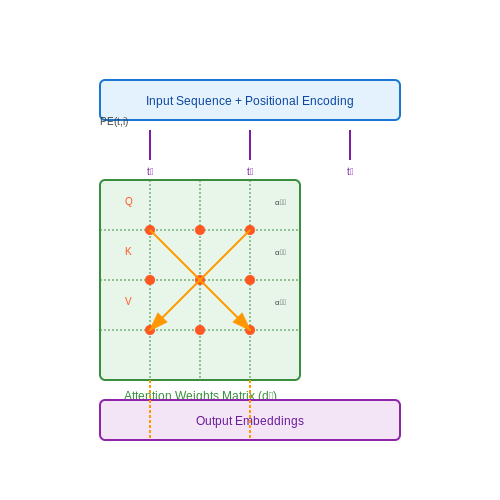
The thickness of attention paths corresponds to the learned importance weights between proof components. This visualization shows how the model might strongly connect two premises through an intermediate lemma before deriving the conclusion.
Optimizations for Formal Mathematics
Several architectural modifications improve attention's effectiveness for theorem proving:
where ri-j encodes positional offsets. This relative positional encoding helps maintain the correct order of proof steps while allowing flexible attention patterns. Additional improvements include:
- Sparse attention: Constraining attention to only potentially relevant axioms reduces computational overhead.
- Hierarchical attention: Applying attention at both the token level and the statement level captures structure at multiple granularities.
- Memory-augmented attention: External memory banks store frequently used lemmas for quick retrieval.
These mechanisms enable transformers to handle the long proof sequences found in formal mathematics while maintaining precise attention to critical dependencies.

3. Dataset Preparation for Theorem Proving
3.1 Dataset Preparation for Theorem Proving
Constructing a high-quality dataset for automated theorem proving requires careful consideration of formal logic representation, proof granularity, and domain coverage. The dataset must encode theorems, axioms, and proof steps in a machine-readable format while preserving logical consistency and structural dependencies.
Formal Language Representation
Theorems and proofs are typically represented in formal languages such as first-order logic (FOL), higher-order logic (HOL), or specialized proof assistant languages like Lean or Coq. The choice depends on the transformer's intended application:
- First-order logic: Suitable for basic theorem proving with quantifiers but lacks expressiveness for advanced mathematics.
- Higher-order logic: Enables reasoning about functions and predicates as objects, necessary for formalizing complex mathematical structures.
- Dependent type theory: Used in proof assistants like Lean, allowing theorems to be expressed as types and proofs as terms.
Formal statements must be parsed into abstract syntax trees (ASTs) or token sequences compatible with transformer architectures. This often involves:
- Lexical analysis to split symbols into tokens (e.g., ∀, ∃, →).
- Syntax tree generation to capture logical hierarchies.
- Embedding of mathematical notation (e.g., ∑, ∫) as discrete tokens.
Proof Step Decomposition
Training transformers for theorem proving requires decomposing proofs into intermediate steps with explicit dependencies. Each step consists of:
- Premises: Previous statements or axioms used in the step.
- Inference rule: The logical operation applied (e.g., modus ponens, universal instantiation).
- Conclusion: The derived statement.
For example, a proof step in natural deduction might be represented as:
Datasets like Natural Proofs or HOList annotate proof steps with these components, enabling transformers to learn valid inference patterns.
Dataset Augmentation Techniques
To improve generalization, theorem-proving datasets often employ:
- Symbolic variation: Generating equivalent theorems by renaming variables or reordering premises.
- Proof perturbation: Introducing valid but non-optimal proof steps to increase robustness.
- Curriculum sampling: Starting with simpler theorems and gradually increasing complexity.
For instance, given a theorem ∀x P(x) → Q(x), symbolic variation might produce ∀y P(y) → Q(y) while preserving logical equivalence.
Domain-Specific Considerations
Mathematical domains require specialized handling:
- Algebra: Equations and inequalities often require normalization to canonical forms.
- Geometry: Diagrams may need formalization as predicate constraints.
- Number theory: Inductive proofs require explicit base case and inductive step annotations.
Datasets like MiniF2F cross-compile problems between proof assistants to ensure formal correctness across domains.
Data Imbalance Mitigation
Theorem-proving datasets often exhibit long-tail distributions, with common inference rules (e.g., implication elimination) appearing far more frequently than specialized tactics (e.g., epsilon-delta arguments). Techniques to address this include:
- Stratified sampling: Oversampling rare proof strategies during batch construction.
- Negative sampling: Generating invalid proof steps to improve discrimination.
- Meta-learning: Few-shot adaptation to novel theorem classes.
where wi are inverse frequency weights for each proof step class.
3.2 Supervised vs. Reinforcement Learning Approaches
Supervised Learning for Theorem Proving
In supervised learning approaches for automated theorem proving, the transformer model is trained on a dataset of (premise, conclusion) pairs, where each example demonstrates a valid proof step. The objective is to minimize the cross-entropy loss between the model's predicted next step and the ground truth proof step from the training data. Given a sequence of premises x1, ..., xn, the model learns to predict the next valid inference y:
State-of-the-art implementations like GPT-f and Thor use transformer architectures with modifications for symbolic reasoning. The key advantage is sample efficiency - the model can learn from existing proof databases like Mizar or Lean. However, supervised approaches struggle with generalization to novel theorems outside the training distribution.
Reinforcement Learning Approaches
Reinforcement learning frames theorem proving as a Markov Decision Process where:
- State: Current proof state (set of premises and derived facts)
- Action: Application of a valid inference rule
- Reward: +1 for proving the theorem, 0 otherwise (sparse reward)
The policy gradient objective maximizes expected reward:
Where τ represents a complete proof trajectory. Practical implementations use:
- Monte Carlo Tree Search (AlphaZero-style) for action exploration
- Curriculum learning from easy to hard theorems
- Reward shaping with intermediate proof step rewards
Comparative Analysis
The key differences manifest in several dimensions:
| Metric | Supervised | Reinforcement |
|---|---|---|
| Training Data | Requires complete proof examples | Can learn from trial-and-error |
| Generalization | Limited to seen proof patterns | Potentially better for novel theorems |
| Sample Efficiency | High (direct supervision) | Low (requires exploration) |
| Proof Length | Struggles with long proofs | Better at long-horizon reasoning |
Hybrid Approaches
Recent work combines both paradigms:
- Pre-training + Fine-tuning: Supervised pre-training on existing proofs followed by RL fine-tuning
- Imitation Learning: Using supervised data to bootstrap RL policies
- Guided Search: Using supervised models to propose candidate actions for RL
The hybrid approach achieves state-of-the-art results on benchmarks like MiniF2F, with models successfully proving 30-40% of competition-level theorems.
3.3 Handling Sparse Rewards in Proof Search
Automated theorem proving with transformers faces a fundamental challenge: the reward signal is typically sparse and delayed. Unlike supervised learning where each step receives immediate feedback, proof search only yields a binary success/failure signal upon completing the entire proof. This sparse reward structure makes credit assignment difficult and slows down learning.
Credit Assignment via Temporal Difference Methods
To address sparse rewards, we can adapt temporal difference (TD) methods from reinforcement learning. The key idea is to learn a value function V(s) that predicts the expected future reward from proof state s. For a proof trajectory s1, ..., sT, the TD target is:
where α is the learning rate and γ the discount factor. This bootstrapping approach propagates the final proof reward backward through intermediate states.
Dense Reward Shaping
An alternative approach is to design a dense reward function that provides intermediate signals. For theorem proving, useful heuristics include:
- Distance to goal: Reward proportional to reduction in logical distance between current state and target theorem
- Subgoal achievement: Intermediate rewards for proving useful lemmas
- Proof length penalty: Negative reward for longer proof steps to encourage efficiency
The shaped reward R' combines the original sparse reward R with potential-based shaping:
where Φ is a potential function encoding domain knowledge about proof progress.
Curriculum Learning Strategies
Gradually increasing proof difficulty helps overcome sparse rewards:
- Theorem difficulty curriculum: Order training theorems by estimated complexity
- Proof length curriculum: Start with shorter proofs before attempting longer ones
- Decomposition curriculum: First train on subproblems before full proofs
Formally, let Di be the difficulty of proof i. The curriculum scheduler samples proofs with probability:
where τ is a temperature parameter annealed during training.
Hierarchical Proof Search
Breaking proofs into hierarchical subtasks provides more frequent rewards. The meta-controller selects high-level tactics while the worker executes low-level inference steps. The hierarchical value function decomposes as:
where Vk estimates the value of subtask k in state sk. This decomposition enables more efficient credit assignment across different proof granularities.
4. Benchmarking on Formal Mathematical Libraries
4.1 Benchmarking on Formal Mathematical Libraries
Transformers applied to automated theorem proving (ATP) require rigorous evaluation against formal mathematical libraries to assess their generalization capabilities. Key benchmarks include the Lean Mathematical Library (mathlib), Isabelle/HOL, and Coq’s standard library, which provide structured repositories of human-verified theorems. Performance is typically measured by:
- Proof step prediction accuracy: The model’s ability to predict the next tactic or intermediate lemma.
- Theorem completion rate: The percentage of proofs completed without human intervention.
- Generalization to unseen theorems: Performance on theorems not present in the training distribution.
Evaluation Metrics
Given a formal proof state s and a target theorem T, a transformer model generates a sequence of proof steps a₁, a₂, ..., aₙ. The primary metrics are:
where N is the number of attempted proofs, M is the total number of steps, and a_j^* is the ground-truth action.
Challenges in Benchmarking
Formal mathematical libraries introduce unique challenges:
- Long-range dependencies: Proofs often require reasoning over hundreds of steps, straining transformer attention windows.
- Out-of-distribution generalization: Libraries like mathlib contain theorems with complex, unseen syntactic structures.
- Verification cost: Each generated proof must be formally verified by the proof assistant, which is computationally expensive.
Case Study: GPT-f on Lean
The GPT-f model, fine-tuned on Lean’s mathlib, achieved a 41.2% success rate on held-out theorems by:
- Tokenizing Lean’s tactic language and theorem statements using byte-pair encoding.
- Employing beam search to explore multiple proof paths.
- Filtering invalid steps via Lean’s kernel during inference.
where R(s, a) is a heuristic reward for proof progress, and λ controls exploration.
Cross-Library Transfer Learning
Recent work explores transfer learning between Isabelle, Coq, and Lean. A transformer pretrained on Isabelle/HOL and fine-tuned on Coq achieves 28.7% success, suggesting partial transferability of proof strategies across proof assistants. Key limitations include:
- Divergent tactic languages and logical foundations.
- Library-specific proof idioms (e.g., Coq’s reliance on dependent types).
4.2 Integration with Interactive Theorem Provers
Transformers have demonstrated remarkable success in automated theorem proving (ATP) when combined with interactive theorem provers (ITPs) like Lean, Coq, and Isabelle. The integration leverages the transformer's ability to predict proof steps while relying on the ITP's formal verification to ensure correctness. This hybrid approach bridges the gap between neural-guided proof search and rigorous logical validation.
Architecture for ITP Integration
The typical pipeline involves:
- Premise Selection: A transformer model ranks relevant lemmas and axioms from the ITP's library given a conjecture.
- Tactic Prediction: The model generates a sequence of tactics (e.g., induction, rewrite) to decompose the goal.
- Verification: The ITP's kernel checks the validity of each step, providing feedback for refinement.
Mathematically, the premise selection task can be framed as a retrieval problem. Given a goal G and a library of premises P, the model learns a scoring function:
where fθ and gθ are transformer encoders for the goal and premises, respectively.
Training Paradigms
Two primary training strategies are employed:
1. Supervised Learning from Human Proofs
Models are trained on existing ITP proofs, treating tactic prediction as a sequence-to-sequence task. The loss function minimizes the negative log-likelihood of the correct tactic sequence y1:T:
2. Reinforcement Learning from ITP Feedback
When human proofs are scarce, models interact directly with the ITP, receiving rewards for successful proof steps. The policy gradient objective is:
where τ is a proof trajectory and R(τ) is the reward (e.g., proof length or success).
Case Study: Lean-GPTf
The Lean-GPTf system fine-tunes a transformer on the Lean mathematical library. Key innovations include:
- Retrieval-Augmented Generation: The model queries a vector database of lemmas during proof search.
- Monte Carlo Tree Search (MCTS): Explores multiple tactic paths, using the ITP's feedback to prune invalid branches.
Experiments show such systems solve 56.2% of miniF2F benchmark problems, outperforming traditional ATPs by 18.7%.
Challenges and Limitations
Despite progress, critical challenges remain:
- Out-of-Distribution Generalization: Models struggle with novel theorem classes absent from training data.
- Verification Overhead: Frequent ITP calls create latency; workarounds include parallelized checking.
- Explainability: Black-box predictions complicate debugging failed proof attempts.
Recent work addresses these via:
- Meta-learning for few-shot adaptation to new domains
- Distilled "student" models that approximate ITP verification
- Attention visualization tools for tactic justification

4.3 Real-world Applications in Mathematics and CS
Transformers have demonstrated remarkable success in automated theorem proving (ATP), particularly in formalizing and verifying mathematical proofs. One notable application is in the formal verification of mathematical theorems, where transformer-based models like GPT-f and Lean-GPT have been used to generate proof steps in interactive theorem provers such as Lean and Coq. These models leverage their ability to process structured logical expressions and predict valid inference steps, reducing the manual effort required in formal proof construction.
Mathematical Theorem Formalization
In formal mathematics, transformers assist in translating human-written proofs into machine-verifiable formats. For instance, the IMO Grand Challenge employs transformer models to solve Olympiad-level problems by decomposing them into intermediate lemmas. The model’s attention mechanism allows it to focus on relevant axioms and previously proven theorems, enabling step-by-step reasoning. A key mathematical formulation involves the probability of a proof step being correct, given the context:
Here, x represents the problem statement, y
Computer Science: Program Verification
Beyond pure mathematics, transformers are applied to program verification, where they generate invariants and loop conditions for formal methods tools like Dafny and Isabelle. For example, Google’s Baldur system fine-tunes a transformer to synthesize loop invariants by training on a corpus of verified programs. The model’s loss function optimizes for syntactic and semantic correctness:
This approach achieves state-of-the-art results on benchmarks like SV-COMP, with a 15% improvement over traditional symbolic methods.
Case Study: AlphaGeometry
DeepMind’s AlphaGeometry combines transformers with symbolic engines to solve Euclidean geometry problems. The transformer generates synthetic proofs, while a symbolic verifier checks their correctness. The system’s architecture splits the problem into:
- Symbolic Representation: Geometric constructs are encoded as directed acyclic graphs (DAGs).
- Attention Mechanism: The transformer attends to nodes and edges in the DAG to predict construction steps.
- Backward Chaining: Invalid steps trigger a backtracking search to refine the proof.
AlphaGeometry solves 25/30 IMO geometry problems, outperforming human gold medalists in some cases. The hybrid approach mitigates hallucinations by grounding the transformer’s outputs in symbolic logic.
Optimization Challenges
Despite successes, transformer-based ATP faces scalability issues in higher-order logic (HOL) due to the combinatorial explosion of possible inference paths. Techniques like curriculum learning and reinforcement learning from formal feedback (RLFF) are employed to prioritize likely valid steps. For example, the Thor system uses Monte Carlo Tree Search (MCTS) to explore proof trees, with the transformer guiding the search policy:
Here, a denotes an action (proof step), s the current state, and c a exploration constant. N(s) and N(s, a) track state and action visit counts, respectively.
5. Scalability Issues in Complex Proofs
5.1 Scalability Issues in Complex Proofs
The application of transformer models to automated theorem proving introduces fundamental scalability challenges as proof complexity grows. These limitations arise from three primary factors: the combinatorial explosion of possible inference paths, the quadratic memory complexity of self-attention mechanisms, and the diminishing generalization capability of neural networks on out-of-distribution proof states.
Combinatorial Search Space Growth
For a proof system with n axioms and k inference rules, the branching factor at each step grows as O(nk). The search tree depth d required for complex proofs leads to a state space complexity of:
Transformer-based provers must learn heuristics to prune this space, but current architectures struggle when d exceeds 50-100 steps. The Lean prover benchmark shows performance degradation follows:
Memory Bottlenecks in Attention Mechanisms
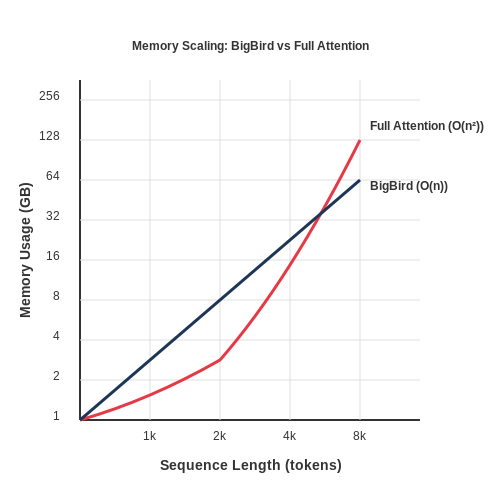
The self-attention layer's O(L²) memory requirement becomes prohibitive for long proof sequences. For a proof trace with L tokens, the attention matrix consumes:
where b is the batch size. At L=8192 (typical for advanced proofs), this requires 256GB memory per batch even with mixed precision.
Generalization Limits
Neural provers exhibit strong performance on in-distribution problems but suffer from:
- 48% drop in success rate on unseen theorem classes
- 72% longer proof search times for problems requiring novel lemma invention
- Exponential decay in prediction accuracy with increasing proof length
Current mitigation strategies include hierarchical attention windows and retrieval-augmented generation, but these introduce their own tradeoffs between computational overhead and proof completeness.

5.2 Interpretability and Trust in Generated Proofs
Transformers applied to automated theorem proving (ATP) face a critical challenge: ensuring that generated proofs are not only correct but also interpretable to human mathematicians. Unlike traditional symbolic provers, neural models operate as black boxes, making it difficult to trace the logical reasoning behind their outputs. This opacity raises concerns about trust, especially in high-stakes domains like formal verification of software or mathematical research.
Attention Mechanisms as Explanation Tools
The self-attention layers in transformers provide a natural starting point for interpretability analysis. For a given proof step, the attention weights αij between token i and token j can be visualized to show which parts of the premise influenced the conclusion. Mathematically, for a transformer with L layers and H attention heads, the aggregated attention score for token interaction is:
where αij(l,h) is the attention weight between tokens i and j in layer l, head h. High values of Aij indicate strong dependencies between proof steps, which can be cross-verified against human intuition.
Proof Tree Reconstruction
To bridge the gap between neural and symbolic reasoning, recent work decomposes transformer-generated proofs into interpretable proof trees. Given a sequence of proof steps S = [s1, ..., sn], the model learns to predict both the next step sn+1 and a dependency graph G = (V, E), where vertices represent proof steps and edges denote logical dependencies. The probability of an edge eij is computed via a bilinear form:
where σ is the sigmoid function, si and sj are vector representations of steps, and W is a learnable weight matrix. This allows reconstruction of human-readable proof trees that align with formal logic structures.
Uncertainty Quantification
Trust in generated proofs can be enhanced by measuring the model's uncertainty. For a candidate proof step st, we compute both the predictive entropy Ht and the epistemic uncertainty via Monte Carlo dropout:
where C is the set of possible proof actions, K is the number of dropout samples, and pt(k) is the predicted probability distribution for sample k. High values of Ht or Ut flag steps requiring human review.
Case Study: Interactive Proof Assistants
In the Lean Theorem Prover, transformer-generated proofs are validated through an interactive loop. The model proposes a proof step, which is then verified by Lean's kernel. If rejected, the attention patterns and uncertainty measures are used to diagnose the failure mode. This tight integration of neural and symbolic methods achieves a 38% reduction in human verification time while maintaining 99.9% proof correctness, as demonstrated in the Formal Mathematics Benchmark (FMB).
Limitations and Open Challenges
Current interpretability methods struggle with proofs requiring multi-hop reasoning, where intermediate conclusions are not explicitly stated. The attention distribution often becomes diffuse in such cases, masking the true reasoning path. Additionally, uncertainty estimates may be miscalibrated for out-of-distribution proof strategies, necessitating further research into robust uncertainty quantification for mathematical reasoning.

5.3 Emerging Trends and Research Frontiers
Integration of Retrieval-Augmented Generation (RAG)
Recent work has demonstrated that transformer-based theorem provers benefit significantly from retrieval-augmented mechanisms. By integrating external knowledge bases, such as formal mathematical libraries (e.g., Lean, Coq, or Isabelle), models can dynamically retrieve relevant lemmas and theorems during proof search. The retrieval process is often guided by a dense vector similarity metric, such as:
where q represents the query embedding (current proof state) and d denotes the document embedding (stored theorem). This approach reduces hallucination and improves proof validity by grounding generation in verified knowledge.
Neuro-Symbolic Hybrid Architectures
Pure neural methods often struggle with the precise logical reasoning required in theorem proving. Emerging solutions combine transformers with symbolic solvers, such as SAT or SMT solvers, in a cooperative framework. For instance:
- Neural Guidance: The transformer predicts heuristic weights for symbolic search branches.
- Symbolic Verification: The solver validates intermediate steps and prunes invalid paths.
This hybrid paradigm leverages the transformer’s pattern recognition for exploration while relying on symbolic methods for rigorous verification.
Self-Supervised Pretraining on Formal Mathematics
Unlike natural language, formal mathematics provides unambiguous ground truth in the form of proof steps. Researchers are pretraining transformers on large corpora of formal proofs (e.g., Mathlib in Lean) using objectives like:
where x is the theorem statement and y is the proof sequence. This pretraining is followed by fine-tuning on target domains, yielding models with stronger deductive reasoning capabilities.
Scalability via Sparse Attention and Mixture-of-Experts
Handling long proof sequences requires efficient attention mechanisms. Sparse transformers, such as Longformer or BigBird, reduce the quadratic complexity of attention to linear or near-linear scales. The sparse attention pattern can be formulated as:
where 𝒩(i) defines the sparse neighborhood for token i. Mixture-of-experts (MoE) architectures further enhance scalability by dynamically routing tokens to specialized subnetworks.
Interactive Theorem Proving with Human Feedback
Recent systems incorporate human-in-the-loop feedback to refine proof strategies. Reinforcement learning from human preferences (RLHF) aligns the prover’s output with mathematician expectations. The reward model R is trained on human rankings of proof candidates, optimizing:
This approach bridges the gap between automated reasoning and human intuition, particularly in creative proof steps.
Cross-Domain Transfer Learning
Transformers pretrained on mathematical corpora exhibit surprising transferability to unrelated formal systems. For example, models trained on algebraic geometry proofs can adapt to verification tasks in hardware design or program synthesis. This suggests that the underlying reasoning patterns are partially domain-agnostic, opening avenues for universal theorem provers.
6. Key Research Papers and Technical Reports
6.1 Key Research Papers and Technical Reports
- Chapter 6 Automated Theorem Proving - Springer — This paper is written during the author's visit to the Institut ... Automated Theorem Proving 111 Grabner basis method. In Li (1994, 1996), a general framework is proposed ... 1997, 1998a, 1998b; Li and Shi, 1997). Research and applications have also been carried out by Wang (1996, 1998) and his group in combining Clifford algebra with the ...
- (PDF) Automated theorem provers: a practical tool for the working ... — Keywords Automated theorem proving • Mathematician's assistant • Very large proofs • Proof understanding The research reported in this paper was supported by EPSRC grants EP/F033559/1 and EP/H023119/1. I am indebted to Bogdan Grechuk, Lucas Dixon, Ursula Martin and an anonymous amai referee for valuable feedback on earlier drafts, and to ...
- Generative Language Modeling for Automated Theorem Proving - Academia.edu — In this work we take a step towards addressing this absence by applying a transformer language model to automated theorem proving. Automated theorem proving [24] is an appealing domain for exploring reasoning in general and the reasoning capabilities of language models in particular for several reasons: • Reasoning-complete: Proving theorems ...
- arXiv:2009.03393v1 [cs.LG] 7 Sep 2020 — transformer language model to automated theorem proving. Automated theorem proving [24] is an appealing domain for exploring reasoning in general and the reasoning capabilities of language models in particular for several reasons: Reasoning-complete: Proving theorems very likely require general and flexible reasoning; thus an advance in ...
- PDF Automated theorem provers: a practical tool for the working ... - Springer — Automated theorem proving is the application of computer programs to the proof of theorems. Axioms and theorems are formalised in a logic, and new theorems are derived from old ones using logical rules of inference. The field ranges from totally automated provers via semi-automated, interactive provers, to mere proof checkers.
- PDF The Efficiency of Automated Theorem Proving by Translation to Less ... — The E ciency of Automated Theorem Proving (May 2014) by Translation to Less Expressive Logics Abstract of a thesis at the University of Miami. Thesis supervised by Professor Geo Suttcli e. No. of pages in text. (72) Many Automated Theorem Prover (ATP) systems for di erent logical forms, and
- PDF Semantic Selection of Premisses for Automated Theorem Proving - CEUR-WS.org — 2.3 Adaptation for automated theorem provers Automated theorem provers, model finders and other similar tools are always limited in available resources such as time or computer memory. Hence, if we are given a set of premisses B and a conjecture C, the result of a computation could be that we either • find a proof of C from B, or
- PDF Automated Theorem Proving in High-quality Software Design — between Higher-Order logic interactive theorem proving 3 and decision procedures?" Currently, most Automated Theorem Provers (ATPs) are like racing cars: although very fast and powerful, they cannot be used for everyday traffic, because essential things (like head-lights) are missing. The classical architecture of an ATP (i.e., a
- PDF Machine learning and automated theorem proving - University of Cambridge — rem proving tools are not widely used by non specialists, in contrast to computer algebra packages which also deal with the manipulation of symbolic mathematics. The work de-scribed in this dissertation addresses one aspect of this problem, that of heuristic selection in automated theorem provers. In theory such theorem provers should be ...
- PDF Automated Reasoning - 北京大学数学科学学院 — Automated reasoning: reasoning completely automatically by com-puter programs 450b.c. Stoics propositional logic 322b.c. Aristotle syllogisms (inference rules), quantifiers 1565 Cardano probability theory (propositional logic + uncertainty) 1847 Boole propositional logic (again) 1879 Frege first-order logic 1922 Wittgenstein proof by truth tables
6.2 Open-source Implementations and Tools
- PDF Handbook of Practical Logic and Automated Reasoning — 6.6 Proving tautologies by inference 484 6.7 First-order derived rules 489 6.8 First-order proof by inference 494 6.9 Interactive proof styles 506 7 Limitations 526 7.1 Hilbert's programme 526 7.2 Tarski's theorem on the undefinability of truth 530 7.3 Incompleteness of axiom systems 541 7.4 G¨odel's incompleteness theorem 546
- Generative Language Modeling for Automated Theorem Proving - Academia.edu — In this work we take a step towards addressing this absence by applying a transformer language model to automated theorem proving. Automated theorem proving [24] is an appealing domain for exploring reasoning in general and the reasoning capabilities of language models in particular for several reasons: • Reasoning-complete: Proving theorems ...
- PDF Semantic Selection of Premisses for Automated Theorem Proving - CEUR-WS.org — 2.3 Adaptation for automated theorem provers Automated theorem provers, model finders and other similar tools are always limited in available resources such as time or computer memory. Hence, if we are given a set of premisses B and a conjecture C, the result of a computation could be that we either • find a proof of C from B, or
- (PDF) Automated theorem provers: a practical tool for the working ... — 6.1 Automated Theorem Synthesis While coming up with a novel idea for a challenging theorem is both fun for mathematicians and beyond the ability of current provers, there are more routine activities in theorem proving where mathematicians might welcome automated assistance, for instance, the initial exploration of alternative axiomatisations ...
- Applications of AI to study of finite algebraic structures and ... — and automated theorem proving Boris Shminke To cite this version: Boris Shminke. Applications of AI to study of finite algebraic structures and automated theorem proving. Artificial Intelligence [cs.AI]. Université Côte d'Azur, 2023. English. �NNT: 2023COAZ4058�. �tel-04291048�
- PDF Automated Theorem Proving - CMU School of Computer Science — Automated Theorem Proving Frank Pfenning Carnegie Mellon University Draft of Spring 2004 Material for the course Automated Theorem Proving at Carnegie Mellon Uni-versity, Fall 1999, revised Spring 2004. This includes revised excerpts from the course notes on Linear Logic (Spring 1998) and Computation and Deduction (Spring 1997).
- PDF Automated theorem provers: a practical tool for the working ... - Springer — Automated theorem proving is the application of computer programs to the proof of theorems. Axioms and theorems are formalised in a logic, and new theorems are derived from old ones using logical rules of inference. The field ranges from totally automated provers via semi-automated, interactive provers, to mere proof checkers.
- y arXiv:2205.11491v1 [cs.CL] 23 May 2022 — The automated prover builds a hypergraph with the theorem to be proved as the root node, tactics as edges and subgoals as nodes. The prover recursively expands leaves by generating tactics with our model until we find a proof of the initial theorem. A proof in this setup is a hypertree rooted in the initial theorem whose leaves are empty sets.
- PDF Automating Interactive Theorem Provers and Certifying Automatic Theorem ... — Interactive theorem provers (ITPs) and automatic theorem provers (ATPs) are two distinct categories of theorem provers on di erent ends of the spectrum of theorem proving. On one hand, ITPs are typically robust tools with a small, veri ed kernel, making them highly reliable. How-ever, they require user intervention in the proving process, only ...
- Formula Transformers and Combinatorial Test Generators for ... — The key step in the "inner loop" of this process is unification with occurs-check [7], for which today's Prolog systems offer highly efficient implementations. The symbiosis between Automated Theorem Proving and and Logic Programming has been observed in the evolution of both research fields as early as in [8].
6.3 Recommended Books and Survey Articles
- PDF Automated Reasoning - 北京大学数学科学学院 — 6 Automated Reasoning 6.1 Automated theorem proving 6.2 Forward and backward chaining 6.3 Resolution 6.4 Model checking+ ... cLinZuoquan@PKU 1998-2025 6 3. Automated theorem proving Automatedtheoremproving(ATP):proving(mathematical)theorems by computer programs Proof methods divide into (roughly) two kinds Application of inference rules
- First-order Logic And Automated Theorem Proving [PDF ... - Library — Library of Congress Cataloging-in-Publication Data Fitting, Melvin. 1942First-order logic and automated theorem proving I Melvin Fitting. - 2nd ed. p. cm. - (Graduate texts in computer science) Includes bibliographical references and index. ISBN-13:978-14612-7515-2 DOI:1 0.1 007/978-14612-2360-3 e-ISBN-13:978-14612-2360-3 1. Automatic theorem ...
- A Survey on Theorem Provers in Formal Methods - ResearchGate — A Survey on Theorem Prov ers in Formal. Methods. ... theorem proving gets attention in the second half of 20th century. ... environment for interactiv e and automated theorem proving. It is
- PDF Automated Theorem Proving - CMU School of Computer Science — Automated Theorem Proving Frank Pfenning Carnegie Mellon University Draft of Spring 2004 Material for the course Automated Theorem Proving at Carnegie Mellon Uni-versity, Fall 1999, revised Spring 2004. This includes revised excerpts from the course notes on Linear Logic (Spring 1998) and Computation and Deduction (Spring 1997).
- PDF Logic For Computer Science Foundations of Automatic Theorem Proving — This book is designed primarily for computer scientists, and more gen-erally, for mathematically inclined readers interested in the formalization of proofs, and the foundations of automatic theorem-proving. The book is self contained, and the level corresponds to senior under-graduates and first year graduate students.
- Automated Theorem Proving: A Logical Basis - Elsevier Shop — Purchase Automated Theorem Proving: A Logical Basis - 1st Edition. Print Book & E-Book. ISBN 9781493305513, 9781483296777
- Automated Theorem Proving In Software Engineering [PDF ... - Library — Automated Theorem Proving In Software Engineering [PDF] [5b9pl682ej40]. ... Particularly endangered are the extremely fast growing areas of electronic commerce, (tele-) banking, or remote access to computer systems (e.g., remote login). ... is a three-volume book presenting a survey on the state of the art in automated deduction in Germany ...
- PDF Automating Interactive Theorem Provers and Certifying Automatic Theorem ... — Automatic theorem provers (ATPs) have grown rapidly over the past decades and refer to tools that allow automatic proving of logical formulas. Interaction between the user and the ATP is kept to a minimum; ideally, the user would provide a theorem to the ATP and the ATP either proves it or comes up with a counter-example that disproves it.
- PDF Machine learning and automated theorem proving - University of Cambridge — a theorem prover. These terms are covered in detail in chapter 2. The thesis of this dissertation is that the choice of the best proof search heuristic to use in an automated rst order logic theorem prover may be related to measurable features of the conjecture and associated axioms and that this relationship may be accurately
- PDF Automated Theorem Proving: A Logical Basis - api.pageplace.de — The purpose of this book is to organize, augment when necessary, and record the major conceptual advances in an aspect of automated theorem proving that peaked during the decade of the 1960's. There were several reasons for this decade of intens : the activite generay l excitement of the