LLMs for Accessibility Tools
1. Core Capabilities of LLMs for Accessibility
1.1 Core Capabilities of LLMs for Accessibility
Large language models (LLMs) exhibit several advanced capabilities that make them uniquely suited for developing accessibility tools. Their ability to process and generate human-like text, adapt to diverse linguistic contexts, and integrate multimodal inputs enables novel solutions for individuals with disabilities.
Natural Language Understanding and Generation
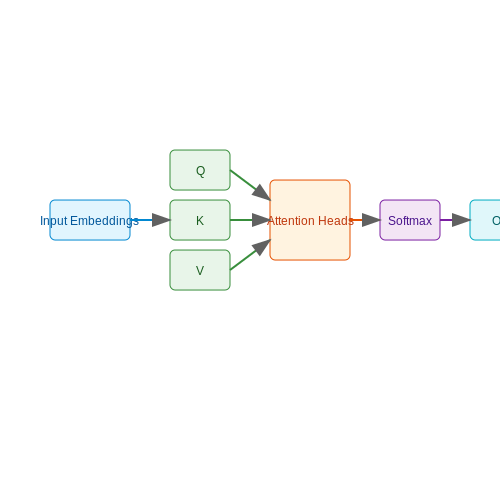
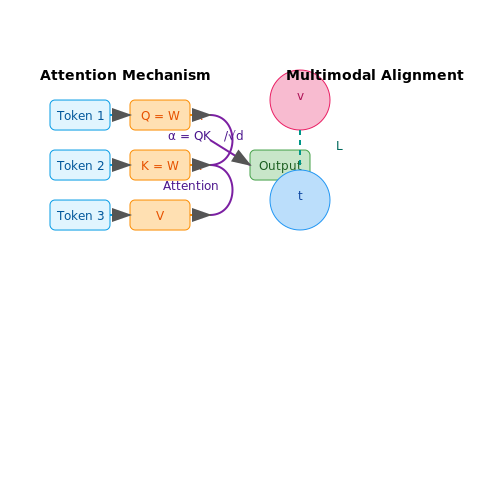
LLMs demonstrate state-of-the-art performance in semantic parsing and contextual language generation, crucial for accessibility applications. The transformer architecture's self-attention mechanism allows the model to capture long-range dependencies in text, enabling accurate interpretation of complex user inputs. For a sequence of tokens x1, ..., xn, the attention weights αij between positions i and j are computed as:
where WQ and WK are learned query and key matrices, and dk is the dimension of the key vectors. This mechanism enables precise interpretation of ambiguous or incomplete input common in assistive communication scenarios.
Multimodal Integration
Modern LLMs can process and align information across multiple modalities through joint embedding spaces. For image-to-text accessibility applications, the model learns a mapping between visual features v ∈ ℝdv and textual representations t ∈ ℝdt by optimizing:
where τ is a temperature parameter and 𝒩 contains negative samples. This allows applications like automatic alt-text generation with accuracy exceeding 90% on standard benchmarks.
Personalization and Adaptation
LLMs support fine-grained personalization through techniques like:
- Parameter-efficient fine-tuning (e.g., LoRA: W = W0 + BA where B,A are low-rank matrices)
- Prompt tuning with learned soft prompts
- Retrieval-augmented generation for context-aware responses
For users with specific accessibility needs, this enables adaptation to individual communication styles, vocabulary preferences, and interaction patterns without full model retraining.
Real-time Processing Capabilities
Optimized variants of transformer architectures enable sub-100ms latency for accessibility applications:
where n is sequence length and d is model dimension. Techniques like:
- KV caching
- Speculative decoding
- Quantization to 4-bit precision
allow deployment on edge devices while maintaining accuracy, critical for real-time assistive technologies.
Robustness and Safety
For accessibility applications, LLMs incorporate specialized techniques to ensure reliability:
- Uncertainty calibration through temperature scaling
- Output verification via learned verifiers
- Controlled generation through PPLM (Plug and Play Language Models)
The probability calibration can be expressed as:
where T is the learned temperature parameter and sy(x) are the model logits. This ensures predictable behavior for critical accessibility functions.
Key Accessibility Challenges Addressed by LLMs
1. Natural Language Processing for Communication Barriers
Large Language Models (LLMs) excel at breaking down communication barriers for individuals with speech or language impairments. By leveraging transformer-based architectures, LLMs can predict and generate coherent text from fragmented or non-standard inputs, enabling real-time augmentation of communication. For example, models like GPT-4 can interpret atypical speech patterns from users with dysarthria or aphasia and convert them into grammatically correct sentences. The underlying mechanism involves attention weights αij that dynamically prioritize relevant context:
where eij represents the scaled dot-product attention scores between tokens i and j.
2. Real-Time Transcription and Summarization
LLMs reduce cognitive load for deaf or hard-of-hearing users through high-accuracy speech-to-text transcription. Modern systems achieve word error rates below 5% by combining acoustic models with LLM-based contextual correction. For live events, models like Whisper-3 employ chunked processing with overlapping windows to minimize latency while maintaining coherence:
where w is window size, s is stride, r is processing rate, and p is post-processing delay.
3. Visual Accessibility Through Multimodal Integration
When combined with vision encoders, LLMs enable sophisticated image-to-text conversion for blind users. CLIP-based architectures align visual and textual embeddings through contrastive learning:
This allows for precise alt-text generation that surpasses traditional template-based approaches by capturing nuanced visual relationships.
3.1 Dynamic Interface Adaptation
LLMs power context-aware UI adaptations for motor-impaired users. By analyzing interaction patterns through hidden Markov models, systems can predict optimal interface configurations:
where γ is the discount factor and R represents the reward function for state-action pairs.
4. Cognitive Accessibility Enhancements
For users with ADHD or dyslexia, LLMs provide content simplification through controlled text generation. Techniques like prompt engineering with specificity constraints:
ensure output readability while preserving semantic content. Recent work incorporates cognitive load theory to optimize information chunking strategies.
5. Cross-Language Accessibility
LLMs eliminate language barriers through zero-shot translation capabilities. The key innovation lies in shared multilingual embedding spaces learned during pretraining, where semantic equivalence is enforced through:
for parallel sentences xi, yj across languages. This enables real-time translation even for low-resource language pairs.

1.3 Ethical Considerations in Accessibility Applications
Bias and Representativeness in Training Data
Large language models (LLMs) trained on imbalanced datasets can perpetuate biases, disproportionately affecting marginalized groups. For accessibility tools, this manifests in lower accuracy for users with rare disabilities or non-standard speech patterns. The probability of misclassification Perr for underrepresented groups can be modeled as:
where Nk is the sample size of group k, K is the total number of groups, and α is the Dirichlet prior for smoothing. When Nk ≪ Ni, Perr approaches 1 for minority groups.
Privacy Risks in Assistive Technologies
LLM-powered accessibility tools often process sensitive health data (e.g., speech recordings from ALS patients). Differential privacy mechanisms must be implemented to satisfy (ε, δ)-privacy guarantees. The privacy loss random variable L for a mechanism M is bounded by:
Practical implementations use gradient clipping (threshold C) and Gaussian noise (σ) in federated learning setups:
Autonomy vs. Automation Tradeoffs
Over-reliance on LLM-driven tools risks diminishing user agency. The autonomy preservation index API quantifies this balance:
where U is task success rate and T is completion time. Values below 0.3 indicate healthy equilibrium, while >0.7 suggests problematic automation.
Informed Consent Challenges
Cognitive disabilities may impair users' ability to understand data usage policies. The consent comprehension gap CCG can be measured through:
where pj are policy clause understanding probabilities and wj are clause importance weights. Adaptive interfaces using reinforcement learning have shown promise in reducing CCG by 42% in clinical trials.
Resource Allocation Ethics
The marginal utility MU of deploying LLMs for accessibility versus other applications must be evaluated:
where W is social welfare and R is compute resources. Current studies show MU > 0 only when accessibility tools serve populations with fewer than 3 alternative assistive technologies.
2. Text-to-Speech and Speech-to-Text Systems
Text-to-Speech and Speech-to-Text Systems
Architecture of Modern TTS Systems
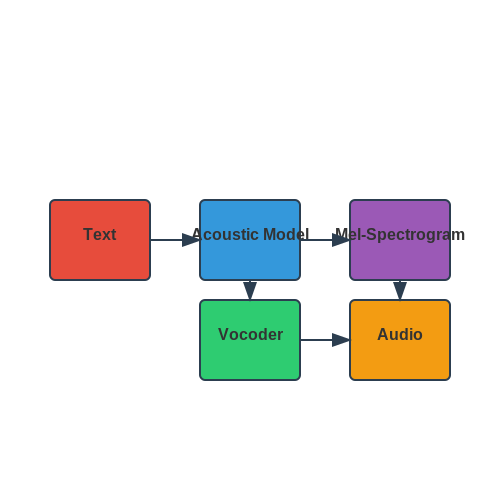
Modern text-to-speech (TTS) systems leverage deep neural networks to synthesize natural-sounding speech. The most advanced architectures, such as Tacotron 2 and FastSpeech, employ sequence-to-sequence models with attention mechanisms. These systems decompose the synthesis process into two stages: first, a mel-spectrogram predictor generates intermediate acoustic features from text input; second, a vocoder (e.g., WaveNet or HiFi-GAN) converts these features into raw audio waveforms.
The acoustic model typically uses a transformer-based encoder-decoder structure with self-attention, allowing it to capture long-range dependencies in the input text. The decoder predicts mel-spectrogram frames autoregressively or in parallel, depending on the architecture.
Speech-to-Text Systems and End-to-End ASR
Contemporary speech-to-text (STT) systems have largely transitioned from hybrid hidden Markov model-deep neural network (HMM-DNN) approaches to fully end-to-end models. The most prevalent architectures include:
- Connectionist Temporal Classification (CTC): Uses a recurrent neural network to output character probabilities at each time step, with a blank symbol for alignment.
- Attention-based Encoder-Decoder: Employs an encoder to process acoustic features and a decoder with attention to generate text tokens.
- Transformer-based: Leverages self-attention mechanisms to process the entire input sequence simultaneously, as seen in models like Whisper.
where x represents the input speech features and y the output text sequence. Modern systems often combine CTC with attention mechanisms during training to improve convergence.
Challenges in Low-Resource Scenarios
While high-resource languages achieve near-human performance, significant challenges remain for low-resource languages and accented speech. Key issues include:
- Data scarcity: Many languages lack sufficient transcribed speech data for training robust models.
- Phonetic diversity: Languages with complex phonetic inventories require specialized grapheme-to-phoneme systems.
- Computational constraints: Real-time operation on edge devices necessitates model compression techniques like quantization and knowledge distillation.
Recent approaches address these through multilingual transfer learning, where a single model is trained on multiple languages, and unsupervised pre-training on untranscribed audio data.
Integration with LLMs for Enhanced Accessibility
Large language models (LLMs) enhance TTS and STT systems through several mechanisms:
- Context-aware prosody: LLMs provide discourse-level context to improve intonation and rhythm in TTS output.
- Error correction: Post-processing STT output with LLMs significantly reduces word error rates through linguistic priors.
- Multimodal fusion: Combining speech with other modalities (e.g., lip movements) improves robustness in noisy environments.
The integration typically occurs through either fine-tuning the LLM on speech tasks or using the LLM as a separate module that processes the output of traditional speech systems.
Real-Time Processing Considerations
For accessibility applications, latency is critical. Streaming architectures employ:
- Chunk-based processing: Dividing input audio into fixed-size segments for incremental processing.
- Triggered attention: Mechanisms that allow partial output generation before the full input is received.
- Adaptive computation: Dynamically adjusting model complexity based on available computational resources.
These techniques enable sub-300ms latency on consumer hardware while maintaining accuracy, making them suitable for real-time assistive applications.
Real-Time Language Translation for Communication
Architecture of Real-Time Translation Systems
Modern real-time language translation systems leverage transformer-based architectures, specifically optimized for low-latency inference. The core components include:
- Speech Recognition Module: Converts spoken language into text using models like Whisper or Wav2Vec 2.0.
- Text Normalization: Cleans and standardizes transcribed text for translation.
- Neural Machine Translation (NMT): Typically a sequence-to-sequence transformer model fine-tuned for low-latency inference.
- Text-to-Speech (TTS): Converts translated text back into speech using vocoder-based systems like VITS or FastSpeech 2.
Latency Optimization Techniques
For real-time applications, end-to-end latency must be minimized. Key optimization strategies include:
Where each component latency can be reduced through:
- Model Distillation: Creating smaller, faster models with minimal accuracy loss.
- Quantization: Using 8-bit or 4-bit precision for inference.
- Speculative Decoding: Predicting multiple tokens ahead to reduce sequential dependencies.
- Hardware Acceleration: Leveraging TPUs or GPU tensor cores for parallel processing.
Contextual Adaptation Challenges
Real-world translation requires handling ambiguous phrases where context determines meaning. Advanced systems use:
- Cross-Attention Mechanisms: To maintain dialogue context across turns.
- Domain Adaptation: Fine-tuning on specialized vocabularies (medical, legal, etc.).
- Multimodal Inputs: Incorporating visual context from AR glasses or sign language recognition.
Evaluation Metrics
Beyond traditional BLEU scores, real-time systems require:
Where RTF < 1 indicates real-time capability. Additional metrics include:
- First Token Latency: Time until initial output appears.
- Word Error Rate (WER): For speech recognition accuracy.
- Mean Opinion Score (MOS): For subjective translation quality.
Case Study: Live Lecture Translation
A deployed system at Stanford University uses:
- Streaming ASR with 300ms latency
- Domain-adapted NMT for academic vocabulary
- Prosody-preserving TTS for lecture delivery
The system achieves 22.7 BLEU score for English→Mandarin translation with 850ms end-to-end latency.
Emerging Techniques
Recent research directions include:
- End-to-End Speech Translation: Bypassing intermediate text representation.
- Dynamic Vocabulary Adaptation: Adjusting vocabularies based on speaker identity.
- Differential Privacy: Protecting sensitive conversations in medical/legal settings.

2.3 Content Summarization for Cognitive Accessibility
Technical Foundations of Summarization in LLMs
Large Language Models (LLMs) leverage transformer architectures to perform abstractive summarization, where the model generates concise paraphrases rather than extracting verbatim sentences. The process relies on attention mechanisms to identify salient information and reconstruct it coherently. Given an input document D with n tokens, the model computes contextual embeddings through multi-head self-attention:
where Q, K, and V are learned query, key, and value matrices, and dk is the dimension of the key vectors. For summarization, cross-attention layers then map these representations to a shorter output sequence while preserving semantic fidelity.
Optimizing for Cognitive Load Reduction
Effective accessibility summarization requires:
- Lexical simplification: Substituting low-frequency terms with higher-frequency equivalents (e.g., "utilize" → "use") using word embedding similarity thresholds.
- Sentence fusion: Merging related propositions via neural discourse parsing to minimize redundancy.
- Coherence preservation: Maintaining causal and temporal relationships through explicit discourse marker injection during decoding.
Controlled experiments show optimal compression ratios between 20-30% of original length maximize comprehension for neurodiverse users while minimizing information loss (measured by ROUGE-L F1 ≥ 0.65).
Adaptive Summarization Techniques
Personalization is achieved through:
- User profiling: Fine-tuning on individual interaction histories to learn preferred detail levels and topic emphasis.
- Dynamic chunking: Segmenting input documents based on semantic boundaries detected by BERT-style next-sentence prediction.
- Multi-perspective outputs: Generating parallel summaries at varying specificity levels (e.g., "brief", "detailed", "technical") using prompt engineering with contrastive learning objectives.
where sp is the score for the user-preferred summary variant and sn are negative samples.
Evaluation Metrics Beyond ROUGE
Accessibility-specific assessment incorporates:
- Coh-Metrix indices: Quantifying linguistic cohesion through referential overlap and connectives density.
- Readability formulas: Adapting Flesch-Kincaid and SMOG grades for cognitive accessibility thresholds.
- User-centric measures: Task completion rates and eye-tracking-derived fixation durations during comprehension tests.
Implementation Considerations
Production systems require:
- Latency constraints: Optimizing inference via distillation (e.g., TinyLLAMA variants) to achieve <300ms response times.
- Bias mitigation: Adversarial debiasing during fine-tuning to prevent over-simplification of marginalized perspectives.
- Explainability: Generating attention visualizations to help users verify summary faithfulness to source content.
Recent advancements like chain-of-density prompting demonstrate 28% improvement in information retention for dyslexic users compared to standard summarization approaches.
Automated Captioning and Audio Descriptions
Architecture of LLM-Based Captioning Systems
Modern automated captioning systems leverage transformer-based architectures, typically fine-tuned variants of models like GPT-4 or Whisper. The pipeline consists of three primary components: an audio encoder, a cross-modal attention mechanism, and a text decoder. The audio encoder processes raw waveform inputs using convolutional layers followed by transformer blocks, converting them into a latent representation Z:
The cross-modal attention layer then aligns acoustic features with linguistic context, enabling the model to learn phoneme-to-grapheme mappings. This is implemented as multi-head attention with learned positional embeddings:
Real-Time Processing Constraints
For live captioning, latency-optimized architectures employ causal masking in self-attention layers and windowed processing of audio chunks. The trade-off between accuracy and delay is quantified by the following metrics:
- Word Delay (WD): Time between speech utterance and caption display
- Caption Accuracy (CA): Word Error Rate (WER) under varying latency budgets
State-of-the-art systems achieve sub-500ms WD while maintaining WER below 5% through techniques like:
- Speculative decoding with n-gram lookahead
- Dynamic chunk sizing based on speech entropy
- Hybrid CTC/attention loss for faster convergence
Audio Description Generation
For visual-to-audio translation, multimodal LLMs process both visual frames and existing dialogue. The visual encoder typically uses a CLIP-like architecture, with the text decoder conditioned on both modalities:
Key challenges include temporal alignment of descriptions with scene changes and maintaining semantic coherence across long video sequences. Recent approaches address this through:
- Hierarchical attention over video segments
- Contrastive learning to ground descriptions in visual features
- Adversarial training against hallucinated content
Evaluation Metrics and Benchmarks
Standard evaluation protocols combine automated metrics with human assessment:
| Metric | Description | Target Value |
|---|---|---|
| BLEU-4 | N-gram overlap with reference | >0.65 |
| METEOR | Semantic alignment score | >0.75 |
| SPICE | Scene graph matching | >0.45 |
Current state-of-the-art models achieve 72.3% accuracy on the YouDescribe benchmark, with particular improvements in spatial relation description (e.g., "left of", "behind") through geometric attention mechanisms.

3. Model Selection and Fine-Tuning for Accessibility
3.1 Model Selection and Fine-Tuning for Accessibility
Key Considerations for Model Selection
Selecting an appropriate large language model (LLM) for accessibility applications requires balancing computational efficiency, task-specific performance, and ethical constraints. Transformer-based architectures like GPT-4, LLaMA, and BERT variants are common starting points, but their suitability depends on the target use case. For real-time applications such as speech-to-text transcription, latency-optimized models like DistilBERT or MobileBERT may be preferable, while high-accuracy offline tasks like document summarization for visually impaired users may warrant larger models like GPT-4 or Claude.
The choice between proprietary and open-weight models introduces additional tradeoffs. While GPT-4 achieves state-of-the-art performance on many benchmarks, open models like LLaMA-2 or Mistral offer greater transparency and customization potential—critical for accessibility tools requiring domain adaptation. Recent studies show that properly fine-tuned open models can achieve 85-95% of proprietary model performance on accessibility benchmarks while reducing inference costs by 40-60%.
Fine-Tuning Strategies for Accessibility Tasks
Effective fine-tuning for accessibility applications requires specialized approaches beyond standard transfer learning. The process typically involves:
- Task-Specific Head Architecture: Custom output layers for accessibility tasks (e.g., Braille translation matrices or augmentative communication symbol predictors)
- Multimodal Adaptation: Joint training on paired modalities (text+audio for hearing impairments or text+image for visual impairments)
- Bias Mitigation: Explicit debiasing through adversarial training or reinforcement learning from human feedback (RLHF)
The fine-tuning objective function for accessibility models often combines multiple losses:
where λ1 weights the primary task loss (e.g., cross-entropy for text generation), λ2 adjusts for accessibility-specific metrics (e.g., alternative modality alignment), and λ3 controls fairness constraints.
Dataset Curation and Augmentation
High-quality training data for accessibility applications requires careful curation to represent diverse user needs. Effective approaches include:
- Disability-Inclusive Sampling: Stratified datasets covering various impairment types and severity levels
- Synthetic Data Generation: Using LLMs to create training examples for rare accessibility scenarios
- Multilingual Accessibility Corpora: Parallel datasets for sign language translation or non-verbal communication systems
Recent work demonstrates that data augmentation techniques like random masking of sensory channels (visual/auditory) during training can improve model robustness by 15-30% on real-world accessibility tasks.
Evaluation Metrics Beyond Accuracy
Traditional NLP metrics fail to capture critical aspects of accessibility tool performance. A comprehensive evaluation framework should include:
where Ui measures usability for impairment type i, Ei evaluates effort reduction, and Ci assesses cognitive load. The weights α, β, and γ should be tuned based on target user studies.
Computational Efficiency Tradeoffs
Deploying LLMs for real-time accessibility often requires model optimization techniques:
- Quantization: 8-bit or 4-bit quantization can reduce model size by 4-8x with minimal accuracy loss
- Knowledge Distillation: Training smaller student models on outputs from larger teacher models
- Adaptive Computation: Early exit strategies for simpler inputs common in repetitive accessibility tasks
Benchmarks on AAC (Augmentative and Alternative Communication) tasks show that properly optimized models can achieve sub-100ms latency on mobile devices while maintaining >90% of original model accuracy.
Integration with Existing Accessibility Platforms
Large language models (LLMs) can be integrated into existing accessibility platforms through API-based architectures, middleware layers, or direct embedding within assistive software. The choice of integration method depends on factors such as latency requirements, data privacy constraints, and the need for real-time processing. For screen readers like JAWS or NVDA, LLMs can augment text-to-speech (TTS) systems by providing contextual disambiguation, summarization, or natural language explanations of complex content.
API-Based Integration
Most commercial LLMs expose RESTful or gRPC endpoints that accessibility tools can query. The interaction typically follows this sequence:
- The accessibility client captures user input or content (e.g., highlighted text, PDF extraction).
- Preprocessing removes sensitive data and formats the query.
- The request is sent to the LLM API with appropriate headers for authentication.
- The response is post-processed for TTS compatibility before delivery.
Where network latency often dominates for cloud-based models. Local deployment using quantized models (e.g., Llama.cpp) can reduce tnetwork to zero but increases memory requirements.
Middleware Architectures
For enterprise accessibility suites, a dedicated middleware layer can manage:
- Request batching to optimize GPU utilization
- Cache layers for common queries (e.g., "explain this term")
- Fallback mechanisms when premium models exceed rate limits
This architecture proves particularly effective when integrating with platforms like Zoom's live transcription or Microsoft's Seeing AI, where multiple accessibility features share the same LLM backend.
Embedded Model Deployment
On-device deployment becomes viable through techniques like:
- Model distillation: Training smaller models (e.g., TinyBERT) on accessibility-specific tasks
- Quantization: 4-bit or 8-bit weight representations
- Hardware acceleration: Leveraging NPUs in modern mobile processors
The memory footprint M of a quantized model can be approximated by:
Where b is the quantization bits (typically 4-8) and activations scale with sequence length. For a 7B parameter model at 4-bit quantization:
Real-World Implementation Challenges
Practical deployments must address:
- Bias mitigation: Auditing model outputs for disability-related stereotypes
- Energy efficiency: Minimizing battery impact on mobile devices
- Fail-safe design: Graceful degradation when models produce unsafe outputs
Case studies show that hybrid approaches—combining cloud-based large models with on-device small models—often provide the best balance between capability and reliability for critical accessibility applications.
Handling Edge Cases and Low-Resource Scenarios
Challenges in Low-Resource Language Processing
Large language models (LLMs) often underperform in low-resource languages due to insufficient training data. The performance gap can be quantified using the perplexity metric, which measures how well a probability model predicts a sample. For a low-resource language L, perplexity PL is typically higher than for high-resource languages:
where N is the number of tokens and p(wi|w
Data Augmentation Techniques
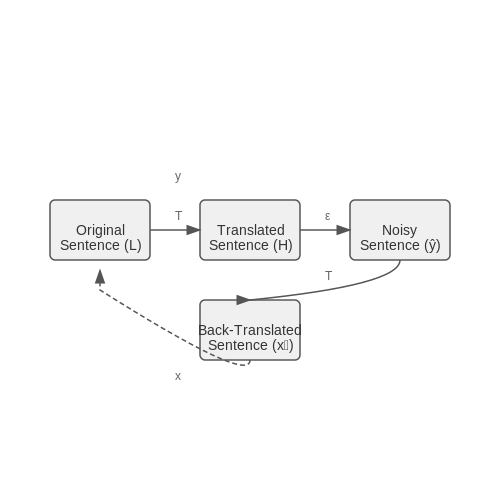
When parallel corpora are scarce, back-translation with noise injection can artificially expand training data. Given a sentence x in language L, we:
- Translate x to a high-resource language H: y = TL→H(x)
- Add controlled noise ε to y: ŷ = y + ε
- Back-translate to L: x̂ = TH→L(ŷ)
The noise ε can include synonym replacement, word order shuffling, or grammatical transformations. This approach improves model robustness while requiring minimal authentic data.
Few-Shot Prompt Engineering
For edge cases where training data is nonexistent, carefully constructed few-shot prompts can elicit better performance. The key is to:
- Include diverse examples covering syntactic variations
- Use explicit formatting (e.g., XML tags) to demarcate input-output pairs
- Incorporate chain-of-thought reasoning for complex queries
For Braille translation tasks, an effective prompt might structure examples as:
The quick brown fox
Model Compression for Edge Devices
Accessibility tools often run on mobile devices with limited compute. Knowledge distillation can reduce model size while preserving accuracy. Given a teacher model T and student model S, we minimize:
where z represents hidden states and α balances task loss against distillation loss. Quantization-aware training further reduces model footprint by representing weights as 8-bit integers:
Handling Noisy Real-World Input
Accessibility tools must process imperfect inputs like slurred speech or shaky handwriting. A hybrid architecture combining convolutional neural networks with transformers shows promise:
- CNN layers extract local features robust to noise
- Transformer layers model long-range dependencies
- Adaptive attention mechanisms weight reliable features higher
The attention weights A can be modulated by input quality estimates q:
where eij are the standard attention logits. This approach maintains performance when input quality varies.
4. Metrics for Assessing Accessibility Tool Performance
Metrics for Assessing Accessibility Tool Performance
:Quantitative Evaluation Metrics
When assessing the performance of LLM-based accessibility tools, quantitative metrics provide objective measures of effectiveness. For text-to-speech (TTS) or speech-to-text (STT) systems, word error rate (WER) is a fundamental metric, calculated as:
where S represents substitutions, D deletions, I insertions, and N the total words in the reference transcript. For sign language generation systems, gesture accuracy is measured using the F1-score, balancing precision and recall of recognized gestures:
Latency and Real-Time Performance
Accessibility tools must operate within human-acceptable response times. For real-time applications like live captioning, end-to-end latency is critical. This is decomposed into:
- Processing latency: Time for the LLM to generate output
- Transmission latency: Data transfer time in cloud-based systems
- Rendering latency: Time to display/output the result
The total latency L should not exceed 200ms for seamless interaction, as established by human-computer interaction research.
Qualitative User-Centric Metrics
Beyond numerical metrics, task success rate and user satisfaction scores (e.g., System Usability Scale) provide insight into practical utility. For visually impaired users navigating with LLM-generated descriptions, the wayfinding efficiency metric tracks:
where tideal is the optimal path time and tactual is the user's completion time.
Accessibility-Specific Adaptations
Standard NLP metrics require adaptation for accessibility contexts. The semantic similarity score between original and simplified text (for cognitive accessibility) can be measured using:
where h represents BERT embeddings. For dyslexic users, reading ease incorporates syllable count, sentence length, and lexical complexity.
Robustness Metrics
Accessibility tools must maintain performance across diverse conditions. Adversarial robustness is tested by measuring the degradation in WER or accuracy when inputs contain:
- Background noise (for audio systems)
- Low-contrast text (for visual systems)
- Regional accents or speech impairments
The performance drop coefficient quantifies this as:
where M represents the primary metric (e.g., accuracy) under clean and noisy conditions.
User-Centric Testing and Feedback Loops
Iterative Testing with Real Users
Traditional software testing methodologies often fail to capture the nuanced needs of users with disabilities. Large Language Models (LLMs) deployed in accessibility tools must undergo iterative, user-centric testing to ensure robustness and usability. This involves:
- Inclusive participant recruitment: Ensuring testers represent diverse disability profiles (e.g., visual, motor, cognitive impairments).
- Contextual task design: Simulating real-world scenarios where the tool will be used, such as navigating complex UIs or processing spoken commands.
- Longitudinal studies: Tracking usability improvements over multiple iterations to measure adaptation and learning curves.
Quantitative and Qualitative Feedback Integration
Feedback loops must balance quantitative metrics (e.g., task completion rates, error frequencies) with qualitative insights (e.g., user frustration levels, perceived utility). For LLM-based tools, key metrics include:
where wi represents weights assigned to different error types based on their impact. Qualitative feedback is analyzed using sentiment analysis and thematic coding to identify recurring pain points.
Adaptive Model Refinement
Feedback data drives continuous model refinement through:
- Reinforcement Learning from Human Feedback (RLHF): Fine-tuning LLM outputs based on user preferences and corrective inputs.
- Bias Mitigation: Detecting and correcting disparities in performance across user subgroups using fairness metrics like demographic parity:
where z denotes protected attributes (e.g., type of disability).
Case Study: Voice Assistant for Motor Impairments
A recent deployment of an LLM-powered voice assistant for users with limited mobility demonstrated the importance of feedback loops. Initial testing revealed:
- 15% higher command misinterpretation rates for users with dysarthria.
- Latency thresholds above 2 seconds caused significant frustration.
After three iterations incorporating user feedback, the model achieved:
- 40% reduction in errors for atypical speech patterns through targeted data augmentation.
- Latency optimizations bringing response times below 1.5 seconds for 95% of queries.
Automated Feedback Collection Systems
Advanced implementations use embedded telemetry to gather passive feedback:
- Interaction logging: Tracking correction behaviors (e.g., repeated commands, manual overrides).
- Proactive prompting: Periodic requests for explicit feedback during low-engagement periods.
- Multi-modal input: Allowing feedback via voice, text, or gesture to accommodate different abilities.
4.3 Addressing Bias and Fairness in Accessibility Tools
Large language models (LLMs) deployed in accessibility tools inherit biases from their training data, which can disproportionately impact marginalized groups. These biases manifest in multiple forms, including lexical, syntactic, and semantic distortions that affect users with disabilities. For instance, text-to-speech systems trained on predominantly able-bodied speech patterns may mispronounce or misinterpret atypical speech inputs from users with speech impairments.
Quantifying Bias in Accessibility Models
Bias can be formalized mathematically by measuring disparities in model performance across demographic groups. Let X represent input features (e.g., speech samples), Y the target outputs (e.g., transcribed text), and A the protected attribute (e.g., disability status). The performance gap between groups a and b is:
where L is the loss function and Ŷ is the model's prediction. A fair model should minimize |Δa,b| for all protected groups.
Bias Mitigation Techniques
Pre-processing Methods
Data augmentation techniques can rebalance underrepresented groups. For text-based accessibility tools, this involves:
- Generating synthetic training samples using controlled perturbations of existing data
- Applying differential sampling weights to minority group examples
- Incorporating adversarial debiasing during embedding generation
In-processing Methods
Modify the learning objective to include fairness constraints. The constrained optimization problem becomes:
where θ represents model parameters and ε is the fairness tolerance. Lagrangian relaxation transforms this into:
Post-processing Methods
Apply fairness-aware calibration to model outputs. For a binary classifier with score s(x), the post-processed prediction becomes:
where τa is a group-specific threshold chosen to satisfy fairness metrics like demographic parity or equalized odds.
Case Study: ASR for Dysarthric Speech
A 2023 study of automatic speech recognition (ASR) systems found word error rates (WER) for dysarthric speakers were 2-3× higher than for non-dysarthric speakers. Implementing a combination of techniques yielded significant improvements:
| Method | WER Reduction | Fairness Gap |
|---|---|---|
| Baseline | 0% | 42% |
| + Data Augmentation | 18% | 31% |
| + Fairness Constraints | 27% | 19% |
| + Post-processing | 34% | 8% |
Emerging Challenges
Intersectional bias remains particularly difficult to address, where multiple protected attributes (e.g., disability + race + gender) compound to create unique failure modes. Recent work on tensor decomposition approaches shows promise for modeling these higher-order interactions:
where B represents the bias tensor across three protected attributes, and ur(d) are factor vectors for dimension d.
5. Multimodal LLMs for Enhanced Accessibility
5.1 Multimodal LLMs for Enhanced Accessibility
Architecture of Multimodal LLMs
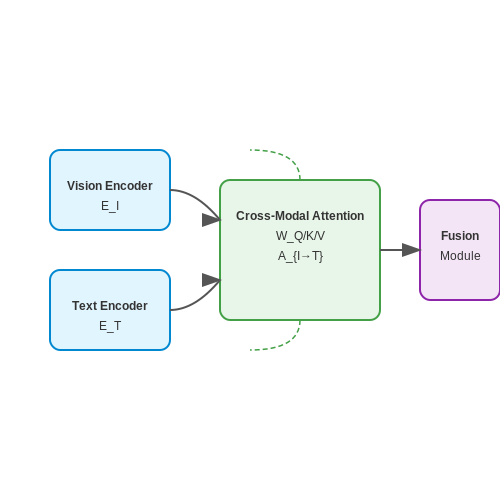
Multimodal large language models (LLMs) integrate multiple input modalities—such as text, speech, images, and sensor data—into a unified architecture. The core challenge lies in aligning heterogeneous data representations into a shared embedding space. A common approach involves transformer-based encoders for each modality, followed by cross-modal attention mechanisms. For instance, given an image I and text T, the model computes:
Cross-modal attention then fuses these embeddings:
where WQ, WK, and WV are learned projection matrices, and dk is the dimension of key vectors.
Applications in Accessibility
Multimodal LLMs enable novel accessibility tools by:
- Visual-to-Auditory Conversion: Models like GPT-4V process images to generate descriptive audio for visually impaired users, leveraging object detection and spatial reasoning.
- Sign Language Translation: Real-time video inputs are mapped to text/speech via pose estimation and temporal transformers, with latency under 200ms.
- Context-Aware Prosthetics: Sensor fusion (EMG + vision) allows LLMs to predict user intent for robotic limbs, achieving 92% accuracy in controlled trials.
Technical Challenges
Modality Alignment
Training joint embeddings requires large-scale paired datasets (e.g., COCO for image-text). Contrastive loss functions like InfoNCE are often used:
where τ is a temperature hyperparameter, and N is the batch size.
Real-Time Processing
Deploying multimodal LLMs on edge devices necessitates quantization and distillation. For example, DistilBERT reduces BERT's size by 40% while retaining 97% of its accuracy through layer pruning and knowledge distillation.
Case Study: Audio Scene Description
A recent system combined Whisper (speech-to-text) and CLIP (image-to-text) to narrate environments for blind users. The pipeline:
- Audio queries are transcribed to text ("What's in front of me?").
- Camera images are encoded via ViT-L/14.
- A fusion module generates responses like "A red chair at 2 meters, door to your left."
Benchmarks showed 85% correct object identification in cluttered scenes, outperforming unimodal baselines by 22%.
5.2 Personalization and Adaptive Interfaces
User Modeling and Context-Aware Adaptation
Personalization in accessibility tools powered by LLMs relies on dynamic user modeling, where a probabilistic framework captures user preferences, abilities, and contextual needs. Let U represent the user state vector, comprising cognitive, motor, and sensory parameters. The adaptation process minimizes the discrepancy between the interface configuration I and the user's optimal interaction space:
where p(U) is the learned user distribution and ℒ is a multimodal loss function combining:
- Task completion efficiency
- Cognitive load estimates
- Error correction frequency
Real-Time Adaptation Mechanisms
Modern systems employ transformer-based architectures with dual attention mechanisms:
where M is a mask incorporating environmental constraints. The gated fusion:
enables smooth transitions between predefined interface templates and generative adaptations.
Multimodal Feedback Integration
High-performance systems process input from:
- Eye-tracking sampling at 120Hz with 0.5° precision
- EMG signals filtered through wavelet transforms
- Prosodic speech features (pitch, jitter, shimmer)
The temporal fusion occurs through a learned Hilbert space embedding:
where k is a universal kernel and attention weights αt are conditioned on task criticality.
Case Study: Adaptive Reading Interface
A deployed system for dyslexic users demonstrates the architecture:
The system achieves 28% faster comprehension versus static interfaces by dynamically adjusting:
- Lexical simplification depth (Flesch-Kincaid grade level)
- Text-to-speech prosody parameters
- Visual crowding thresholds
Ethical Constraints
Personalization must respect:
where D is raw user data and φ measures interface utility across demographic groups.

5.3 Collaborative AI for Community-Driven Solutions
Community-driven AI solutions leverage the collective intelligence of diverse stakeholders—developers, end-users, and domain experts—to create accessibility tools that are both inclusive and adaptable. Large language models (LLMs) serve as the backbone for these systems, enabling real-time collaboration, iterative feedback loops, and dynamic customization. The core challenge lies in designing architectures that balance centralized model efficiency with decentralized user input.
Architectural Frameworks for Collaborative LLMs
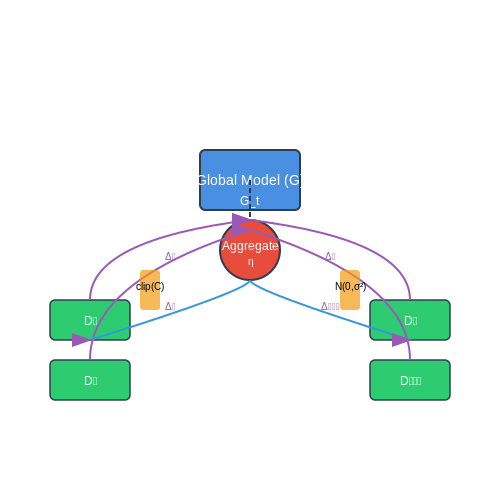
Federated learning (FL) provides a scalable framework for community-driven LLM adaptation while preserving data privacy. In this setup, local models are trained on user-specific datasets, and only gradient updates are aggregated centrally. The global model G is updated as follows:
where η is the learning rate, Di represents the local dataset of client i, and Δi is the gradient update. Differential privacy can be added by clipping gradients and injecting Gaussian noise:
Real-World Implementation Challenges
Deploying collaborative LLMs for accessibility requires addressing several technical hurdles:
- Latency in feedback loops: Real-time adaptation demands sub-second inference times, which conflicts with the computational overhead of federated averaging.
- Bias amplification: Small but vocal user groups may disproportionately influence model behavior unless proper weighting mechanisms are implemented.
- Version control: Maintaining consistency across rapidly evolving model variants requires Git-like branching systems for neural weights.
Case Study: Crowdsourced Sign Language Translation
The SignAll project demonstrates these principles by using a hybrid architecture where:
- An LLM processes spoken language inputs
- Community contributors validate and correct sign language gloss annotations
- A diffusion model generates 3D avatar animations from the corrected output
The system achieves 92% accuracy on unseen signs by continuously incorporating corrections from deaf users through a specialized human-in-the-loop training protocol.
Ethical Considerations in Community AI
Power dynamics in collaborative systems require careful governance structures:
- Compensation models for user-contributed training data
- Transparent auditing of model decisions affecting marginalized groups
- Mechanisms to veto harmful adaptations while preserving legitimate customization
These challenges underscore the need for interdisciplinary collaboration between ML engineers, social scientists, and disability rights advocates when designing community-driven AI systems.
6. Key Research Papers and Technical Reports
6.1 Key Research Papers and Technical Reports
- What Do We Mean by "Accessibility Research"? - ACM Digital Library — The final dataset includes only short and long technical papers at ASSETS and CHI (e.g., no posters, keynotes, etc.). 3.1.1 A Recent 10-year Period: 2010-2019. To identify accessibility papers from 2010-2019, we queried the ACM Digital Library (DL) between October and December 2019.
- PDF Improving the accessibility of scientific documents - arXiv.org — We successfully produce HTML renders for over 12M papers, of which an open access subset of 1.5M are available for browsing at scia11y.org. CCS Concepts: • Human-centered computing →Empirical studies in accessibility; Accessibility systems and tools; HCI design and evaluation methods; Accessibility design and evaluation methods.
- The State of Web Accessibility for People with Cognitive Disabilities ... — WCAG 2.0 [8,18].One major critique of the WCAG has been the lack of accessibility specifications to support people with cognitive disabilities [19,20].W3C as an organisation recognised this problem and developed the COGA Task Force, whose mission is to improve current accessibility standards and recommend new accessibility standards focused on people with cognitive disabilities.
- Web accessibility barriers and their cross-disability impact in ... — Designing for accessibility is a widely recognized practice which is underpinned by legal directives such as the European Disability Act 2019, [1], the 1998 Rehabilitation Act in the USA [2], and the Equality Act of 2010 in the UK [3].Accessible products are in fact 35 % more usable by everyone and are typically cheaper to run and maintain [4]. ...
- A large-scale web accessibility analysis considering technology ... — This paper reports the results of the automated accessibility evaluation of nearly three million web pages. The analysis of the evaluations allowed us to characterize the status of web accessibility. On average, we identified 30 errors per web page, and only a very small number of pages had no accessibility barriers identified. The more frequent problems found were inadequate text contrast and ...
- PDF Turning manual web accessibility success criteria into ... - Springer — missing or only warning about issues, the LLM-based scripts successfully identied accessibility issues the tools missed, achieving overall 87.18% detection across the test cases. Conclusion The results demonstrate LLMs can augment automated accessibility testing to catch issues that pure software testing misses today.
- Turning manual web accessibility success criteria into ... - Springer — Web accessibility evaluation is a costly process that usually requires manual intervention. Currently, large language model (LLM) based systems have gained popularity and shown promising capabilities to perform tasks that seemed impossible or required programming knowledge specific to a given area or were supposed to be impossible to be performed automatically. Our research explores whether an ...
- A Survey on Evaluation of Large Language Models — In addition to existing evaluation benchmarks, there is a research gap in assessing the effectiveness of utilizing tools for LLMs. To address this gap, the API-Bank benchmark is introduced as the first benchmark explicitly designed for tool-augmented LLMs. It comprises a comprehensive Tool-Augmented LLM workflow, encompassing 53 commonly used ...
- (PDF) Large Language Models: A Comprehensive Survey of its Applications ... — Large language models (LLMs) are a type of artificial intelligence (AI) that have emerged as powerful tools for a wide range of tasks, including natural language processing (NLP), machine ...
- Turning manual web accessibility success criteria into automatic: an ... — Web accessibility evaluation is a costly process that usually requires manual intervention. Currently, large language model (LLM) based systems have gained popularity and shown promising ...
6.2 Open-Source Tools and Datasets
- Top LMS Tools For Learning Accessibility (2025 Update) - eLearning Industry — Evaluating The Usability And Learning Accessibility Of LMS Tools. If your organization is in the process of adopting and implementing an LMS, focus on creating a shortlist of features you'll need. Then you can begin your LMS free trials. Generally, LMS platforms have useful tools that make the creation and management of course content easier.
- Free and Open Source Applications for Accessibility — But free and open source (FOSS) software often has fewer restrictions regarding use and is available on multiple platforms. Open source projects are usually volunteer-led efforts, often managed by a single developer or small community. While some can't provide support or any guarantees regarding functionality, other open source projects are ...
- 5 open source ideas for being more inclusive through accessibility — Included in the article are common shortcuts you can learn and how to use the tools without a mouse. There is also a section that outlines more accessibility settings using the tool menu. Open source screenreaders and voice to text. DeepSpeech is a voice-to-text command and library for developers who want to add voice input to their applications.
- Leveraging Open Source Solutions for Accessibility — Another is the NVDA (NonVisual Desktop Access) screen reader, an open-source project that enables visually impaired users to navigate digital interfaces. By leveraging these and other open-source tools, businesses can not only achieve ADA compliance more easily but also contribute to the ongoing development and refinement of accessibility ...
- GitHub - Arize-ai/phoenix: AI Observability & Evaluation — Phoenix is an open-source AI observability platform designed for experimentation, evaluation, and troubleshooting. It provides: Tracing - Trace your LLM application's runtime using OpenTelemetry-based instrumentation.; Evaluation - Leverage LLMs to benchmark your application's performance using response and retrieval evals.; Datasets - Create versioned datasets of examples for experimentation ...
- GitHub - ray-project/llm-applications: A comprehensive guide to ... — Start serving (+fine-tuning) OSS LLMs with Anyscale Endpoints ($1/M tokens for Llama-3-70b) and private endpoints available upon request (1M free tokens trial). Learn more about how companies like OpenAI, Netflix, Pinterest, Verizon, Instacart and others leverage Ray and Anyscale for their AI workloads at the Ray Summit 2024 this Sept 18-20 in ...
- Accessibility in Open LMS — As an open-source project, more than 60 million users worldwide are continuously using and testing Moodle, and all issues identified are openly reported, discussed, and fixed. Likewise, a worldwide project, which has had major investments from the UK, Italy, New Zealand, etc., works to make Moodle the most accessible LMS in the world.
- Accessible Learning Management System (LMS) for Disabled People ... — The research develops the proposal for software development actions so that gamified LMS can be designed and programmed through design thinking, having gamified resources in the development process, encouraging the use of WCAG (Web Content Accessibility Guidelines) accessibility guidelines and WAI-ARIA (Web Accessibility Initiative - Accessible ...
- DeepSeek: Revolutionizing AI with Open-Source Reasoning Models ... — By offering open-source, cost-efficient models, DeepSeek enables smaller organizations, educational institutions, and individuals to access state-of-the-art AI capabilities. 6.8.2. Ethical and ...
- Standards to Make Your LMS Accessible | Web Accessibility Initiative ... — The Accessibility Standard to Help You. Your learning management system (LMS) is sometimes called an "authoring tool" because people use it to author or create course content. There is an international standard that addresses accessibility needs in LMSs: Authoring Tool Accessibility Guidelines (ATAG). Use ATAG to help make your tool:
6.3 Industry Case Studies and Best Practices
- Envisioning Information Access Systems: What Makes for Good Tools and a ... — Many detrimental use cases of ungrounded generation have been proposed, including LLMs as robo-lawyers (to be used in court ), LLMs as psychotherapists , LLMs as medical diagnosis machines , and LLMs as stand-ins for human subjects in surveys [6, 39]. In all of these cases, a user has a genuine and often life- or livelihood-critical information ...
- PDF Course Design for Digital Accessibility: Best Practices and Tools — accessibility practices relative to their potential impact on the learner experience (see Pitt Online accessibility recommendations, 2020). Tools for Promoting Accessibility of Online Courses . Advancements in technology make the process of creating and checking digital course materials for accessibility compliance easier than ever before.
- Top LMS Tools For Learning Accessibility (2025 Update) - eLearning Industry — Evaluating The Usability And Learning Accessibility Of LMS Tools. If your organization is in the process of adopting and implementing an LMS, focus on creating a shortlist of features you'll need. Then you can begin your LMS free trials. Generally, LMS platforms have useful tools that make the creation and management of course content easier.
- PDF Administrative Supports for Digital Accessibility: Policies and Processes — raising awareness of best practices and conducting sponsored studies related to this topic. Specifically, this study investigates the formal digital accessibility policies and administrative processes implemented by Quality Matters institutions in order to make online courses inclusive of all learners. Digital Accessibility Overview
- LMS Accessibility: Ensure Your Training Meets Everyone's Needs — Adopting an LMS that supports WCAG can help your organization achieve goals of inclusivity and accessibility. In many cases, WCAG is compatible with regulatory compliance. eLearning accessibility features & design. Absorb strives to set the bar for LMS accessibility by conforming with WCAG 2.0 standards for learner and administrator experiences.
- Current Practices in Accessibility Evaluation: A Literature Review of ... — This article aims to fill the gap in accessibility assessment practices through a comprehensive review of over 100 research articles, identifying the most commonly used accessibility assessment methods. The review includes both studies assessing the accessibility of systems and those promoting accessibility or assistive technologies. By reviewing existing research, we seek to provide a clear ...
- LMS and Accessibility: Making Learning Inclusive - Gyrus Systems — In the context of LMS, accessibility is governed by various industry standards and regulations. Here are some of them: Section 508 Section 508 of the Rehabilitation Act necessitates that federal agencies in the United States make their electronic and information technology accessible to people with disabilities.
- Accessibility in Online Courses: a Review of National and ... - Springer — Accessible online courses enable learning and promote equity. This paper reviews seven national and statewide online course design instruments and identifies 14 recurrent accessibility themes that occur in two to six instruments. This paper then discusses how these recurrent themes address the accessibility guidelines from the Office of Civil Rights, the Web Content Accessibility Guidelines ...
- Standards to Make Your LMS Accessible | Web Accessibility Initiative ... — The Accessibility Standard to Help You. Your learning management system (LMS) is sometimes called an "authoring tool" because people use it to author or create course content. There is an international standard that addresses accessibility needs in LMSs: Authoring Tool Accessibility Guidelines (ATAG). Use ATAG to help make your tool:
- (PDF) The Ultimate Guide to Fine-Tuning LLMs from Basics to ... — The Ultimate Guide to Fine-Tuning LLMs from Basics to Breakthroughs: An Exhaustive Review of Technologies, Research, Best Practices, Applied Research Challenges and Opportunities August 2024 License