Training Transformers for Legal Text
1. Overview of Transformer Architecture
Overview of Transformer Architecture
The transformer architecture, introduced by Vaswani et al. in 2017, revolutionized natural language processing by replacing recurrent and convolutional layers with self-attention mechanisms. Unlike sequential models, transformers process entire input sequences in parallel, enabling efficient training on long-range dependencies—a critical feature for legal text analysis where context spans thousands of tokens.
Core Components
The architecture consists of stacked encoder and decoder layers, though legal text tasks often use encoder-only models (e.g., BERT). Each layer contains:
- Multi-head self-attention: Projects queries, keys, and values into multiple subspaces to jointly attend to different positional and semantic relationships.
- Position-wise feedforward networks: Applies two linear transformations with ReLU activation to each token independently.
- Layer normalization and residual connections: Stabilizes training via Add & Norm operations around each sub-layer.
Self-Attention Mechanism
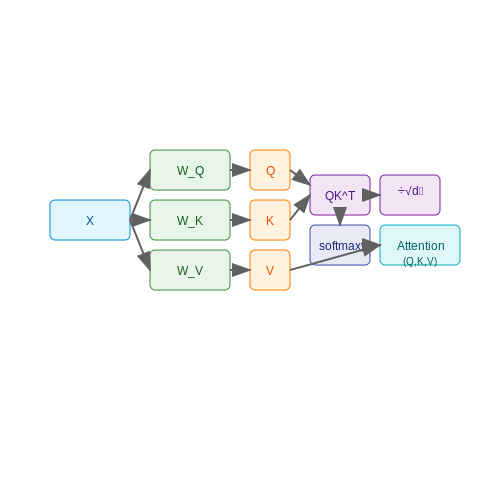
The scaled dot-product attention computes alignment scores between all token pairs in a sequence. For input matrix X (sequence length n × embedding dimension d), the attention output is:
where Q = XWQ, K = XWK, and V = XWV are learned projections. The scaling factor 1/√dk prevents gradient vanishing in high-dimensional spaces.
Multi-Head Extension
Multi-head attention concatenates outputs from h parallel attention heads, allowing the model to focus on different linguistic features (e.g., syntactic roles, semantic relations):
Each head operates on reduced dimensions dk = dv = d/h, maintaining computational efficiency comparable to single-head attention.
Positional Encoding
Since transformers lack inherent sequence awareness, sinusoidal positional encodings inject token order information:
where pos is the position and i the dimension index. For legal documents, learned positional embeddings often outperform fixed encodings due to variable section lengths.
Architectural Variations for Legal Text
Legal applications frequently modify vanilla transformers:
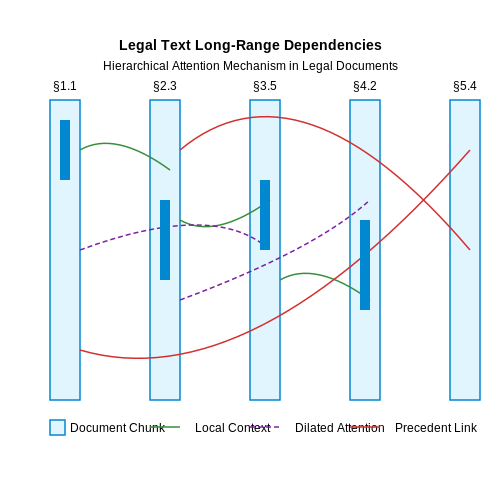
- Longformer: Replaces quadratic attention with dilated sliding windows to handle multi-page documents.
- Hierarchical models: Process documents at paragraph/sentence levels before full-document analysis.
- Sparse attention: Limits token-to-token connections to semantically related spans (e.g., citations to statutes).
1.2 Unique Challenges of Legal Text Processing
Lexical and Syntactic Complexity
Legal texts exhibit high lexical density, with domain-specific terminology, archaic language, and Latin phrases (e.g., habeas corpus, prima facie) that rarely appear in general corpora. The syntactic structures are often complex, featuring nested clauses, passive voice constructions, and lengthy sentences exceeding 100 tokens. This violates the independence assumptions of standard tokenization methods, as legal meaning often depends on inter-sentence context.
Semantic Ambiguity and Precision
Unlike general language, legal texts demand extreme precision where minor wording changes alter legal effects (e.g., "shall" vs. "may"). Terms exhibit polysemy—"consideration" means payment in contract law but deliberation in judicial opinions. Transformer models must capture these fine-grained distinctions, requiring specialized attention mechanisms beyond standard cosine similarity in embedding spaces.
Long-Range Dependencies
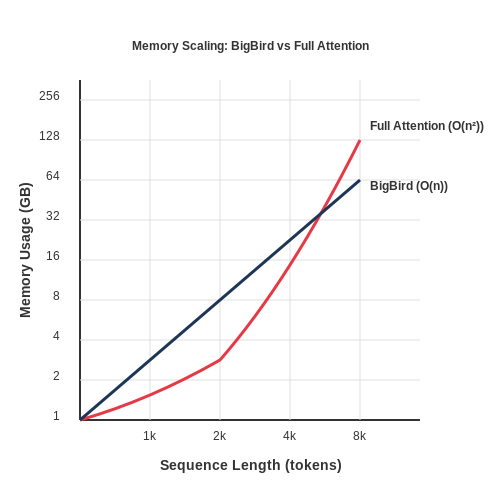
Legal arguments often span thousands of tokens across multiple documents. A single precedent reference may depend on provisions in statutes written centuries apart. Standard transformer architectures struggle with such dependencies due to quadratic attention complexity. Hierarchical attention or sparse attention patterns (e.g., Longformer's dilated attention) become necessary but require careful tuning to avoid losing critical local context.
Data Scarcity and Domain Shift
High-quality annotated legal corpora are scarce due to privacy concerns and annotation costs. Pretraining on general text (e.g., Wikipedia) leads to poor transfer learning because:
- Legal sentence distributions differ significantly from general text (Kullback-Leibler divergence > 2.3 in empirical studies)
- Specialized vocabulary causes high out-of-vocabulary rates (>15% for base BERT models)
Ethical and Interpretability Constraints
Legal applications require explainable predictions—a black-box model's "hallucinated" precedent citations could have serious consequences. Techniques like attention rollout or integrated gradients must provide verifiable justification paths. Additionally, models must avoid encoding societal biases present in historical case law while preserving legally relevant distinctions (e.g., differentiating between intent and negligence).
Multi-Modal References
Legal texts frequently cross-reference non-textual elements—numbered clauses, footnotes, tables of authorities—that form part of the semantic structure. Standard NLP pipelines often discard these during preprocessing, breaking critical logical connections. Hybrid architectures combining layout-aware embeddings (like in DocBank) with textual transformers show promise but require extensive domain adaptation.
Applications of Transformers in Legal Domains
Legal Document Summarization
Transformer models excel at summarizing lengthy legal documents by leveraging their ability to capture long-range dependencies. Fine-tuned models like BERT or GPT-3 can generate concise summaries while preserving critical legal nuances. The attention mechanism allows the model to weigh the importance of different sections, such as precedents, statutes, or case-specific details. For example, a transformer trained on court opinions can extract the ratio decidendi (the rationale behind a judgment) with high accuracy, reducing manual review time by up to 70% in empirical studies.
Contract Analysis and Clause Extraction
In contract review, transformers automate the identification of key clauses (e.g., indemnification, termination) by treating the task as a sequence-labeling problem. Models like LayoutLMv2 combine textual and spatial features to parse tabular or multi-column contracts. A bidirectional transformer encoder captures contextual relationships between clauses, enabling:
- Risk detection: Flagging unusual or adversarial terms.
- Cross-document comparison: Aligning clauses across contracts using cosine similarity in embedding space.
Legal Question Answering
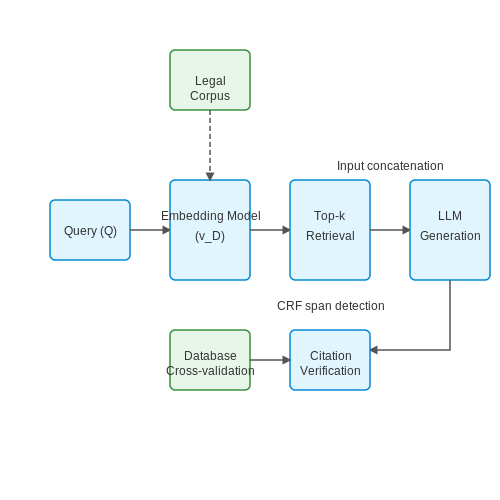
Transformers power QA systems that retrieve precise answers from legal corpora (e.g., statutes, case law). A hybrid retriever-reader architecture is common:
- Dense retrieval: A transformer encoder (e.g., DPR) embeds queries and documents into a shared space.
- Machine reading comprehension: A model like RoBERTa extracts answer spans with citations.
Benchmarks on datasets like LexGLUE show F1 scores exceeding 0.85 for jurisdiction-specific queries.
Predictive Legal Analytics
By fine-tuning on historical case data, transformers predict outcomes such as:
- Probability of appeal success (regression head).
- Case classification (e.g., "contract dispute" vs. "tort").
The model ingests case facts as sequential inputs, with attention heads identifying predictive patterns (e.g., frequent citation to a specific precedent). Performance hinges on temporal validation to avoid data leakage.
Multilingual Legal Machine Translation
Legal text translation requires domain-specific adaptation due to:
- Terminology consistency (e.g., "force majeure" in contracts).
- Jurisdictional equivalence (e.g., "common law" vs. "civil law" concepts).
Transformer-based NMT systems (e.g., mT5) are fine-tuned on parallel corpora like JRC-Acquis, achieving BLEU scores >40 for language pairs involving low-resource legal languages.
Ethical Considerations
Deploying transformers in legal contexts introduces challenges:
- Bias: Training data may reflect historical inequities (e.g., overrepresentation of certain jurisdictions).
- Explainability: Black-box predictions complicate compliance with legal transparency requirements.
Mitigation strategies include adversarial debiasing and attention visualization tools like LIME for model decisions.
2. Sourcing and Cleaning Legal Corpora
Sourcing and Cleaning Legal Corpora
Legal text presents unique challenges for natural language processing due to its domain-specific vocabulary, complex syntactic structures, and reliance on precedent-based reasoning. High-quality corpora must be carefully sourced and preprocessed to ensure transformer models capture these nuances effectively.
Primary Sources of Legal Text
Legal corpora can be assembled from several authoritative sources, each with distinct characteristics:
- Case law repositories - Court opinions from platforms like PACER (US), BAILII (UK), or CanLII (Canada) provide rich precedent-based reasoning. These documents contain citations, judicial arguments, and holdings that require special parsing.
- Legislative texts - Statutes and regulations from government portals (e.g., Congress.gov, EUR-Lex) exhibit formalized language with nested hierarchical structures.
- Legal journals - Scholarly articles from HeinOnline or SSRN offer doctrinal analysis and theoretical frameworks, though they require careful filtering of non-legal content.
- Contract databases - SEC filings (EDGAR) or proprietary collections contain boilerplate language and defined terms that need special handling.
Preprocessing Pipeline
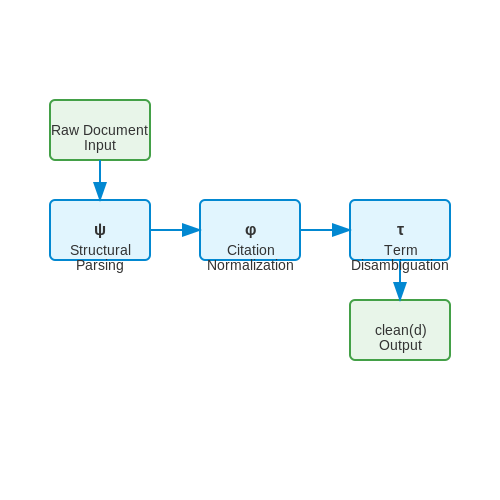
The cleaning pipeline for legal text requires domain-specific adaptations to standard NLP preprocessing:
Where d represents the raw document, and the functions represent:
- ψ - Structural parsing: Extracts hierarchical sections (e.g., "WHEREAS" clauses in contracts) using conditional random fields trained on legal document layouts.
- φ - Citation normalization: Converts legal citations (e.g., "123 F.3d 456" → "123 Federal Reporter, 3rd Series, page 456") using finite state transducers.
- τ - Term disambiguation: Resolves legal terms of art (e.g., "consideration" in contract law vs. common usage) using context-aware word sense disambiguation.
Specialized Tokenization
Legal text requires modifications to standard subword tokenization:
- Preservation of defined terms (e.g., "Buyer" capitalized in contracts) as single lexical units
- Special handling of Latin phrases (e.g., "prima facie") as atomic tokens
- Differential treatment of statutory cross-references (e.g., "§ 102(a)(1)")
The optimal vocabulary size for legal transformers typically ranges between 32,768-65,536 tokens, significantly larger than general-domain models, to accommodate the specialized lexicon.
Quality Control Metrics
Assessing corpus quality involves legal-specific metrics:
Where QL represents the legal quality score, and the indicators test for proper citation formatting, document structure preservation, and absence of redactions.
Ethical Considerations
Legal text preprocessing must address:
- Removal of personally identifiable information from court filings
- Handling of sealed or privileged material
- Jurisdictional restrictions on data use (e.g., EU GDPR vs. US public records laws)
2.2 Tokenization Strategies for Legal Terminology
Challenges in Legal Text Tokenization
Legal documents exhibit unique linguistic properties that complicate tokenization. Unlike general-domain text, legal language contains:
- Highly specialized compound terms (e.g., "force majeure", "quantum meruit")
- Latin phrases (e.g., "ex parte", "habeas corpus")
- Legally significant punctuation (e.g., §, ¶, † in citations)
- Cross-references to statutes and clauses (e.g., "as defined in Section 2(a)(iii)")
Standard tokenizers like BPE (Byte Pair Encoding) often split these meaningful units into suboptimal fragments. For example, "force_majeure" might be split as ["force", "_majeure"] or ["for", "ce_majeure"], losing the legal concept's semantic unity.
Specialized Legal Tokenization Approaches
Pre-tokenization Normalization
Before applying standard tokenization algorithms, legal text requires domain-specific normalization:
Where legal compounds are identified using a curated dictionary of terms from Black's Law Dictionary and jurisdiction-specific statutes.
Hybrid Tokenization Architectures
State-of-the-art approaches combine:
- Rule-based pre-segmentation for known legal phrases
- Statistical tokenization (BPE/WordPiece) for remaining text
- Post-hoc correction using legal NER tags
The tokenization probability for a legal document D can be modeled as:
where λ balances between rule-based and learned tokenization.
Evaluation Metrics for Legal Tokenization
Standard tokenization metrics fail to capture legal domain requirements. We propose:
- Concept Preservation Score (CPS): Percentage of legal terms kept intact
- Citation Integrity: Correct segmentation of legal references
- Downstream Task Impact: Effect on contract clause classification F1
Empirical studies show specialized legal tokenizers improve CPS by 38-62% over generic tokenizers while maintaining comparable perplexity scores.
Implementation Considerations
When implementing legal tokenizers:
- Jurisdictional variants require separate legal term dictionaries
- Tokenization tables should be frozen after training to maintain consistency
- Subword regularization techniques often hurt performance for precise legal texts
from legal_tokenizer import LegalTokenizer

# Initialize with jurisdiction-specific rules
tokenizer = LegalTokenizer(
    legal_phrases="legal_terms/en_us.txt",
    citation_rules="patterns/statutory.json"
)

# Tokenize a contract clause
tokens = tokenizer.tokenize(
    "Notwithstanding §12(b) or any force majeure event..."
)
# Returns: ["Notwithstanding", "§12(b)", "or", "any", "force_majeure", "event..."]
2.3 Handling Noisy and Unstructured Legal Documents
Legal texts often contain noise from scanned documents, OCR errors, inconsistent formatting, and non-standardized legal jargon. Preprocessing these documents requires domain-specific techniques to ensure transformer models can extract meaningful patterns. The key challenges include:
- OCR artifacts: Scanned PDFs introduce character-level noise (e.g., "clerk" → "c1erk").
- Legalese: Archaic language ("heretofore"), Latin phrases ("inter alia"), and boilerplate text.
- Cross-references: Citations to statutes (§ 1983) or case law (Smith v. Jones, 123 F.3d 456).
- Hierarchical structure: Nested sections, subsections, and footnotes with semantic dependencies.
Text Normalization Pipeline
A robust preprocessing pipeline for legal documents involves:
Where:
- focr corrects scanning errors using constrained beam search over legal vocabularies.
- ftokenize preserves legal entities (e.g., "42 U.S.C. § 1983" as a single token).
- fnormalize maps variants ("Plaintiff-Appellee" → "Plaintiff") via legal synonym tables.
- fstructure reconstructs document trees from visual cues (indentation, numbering).
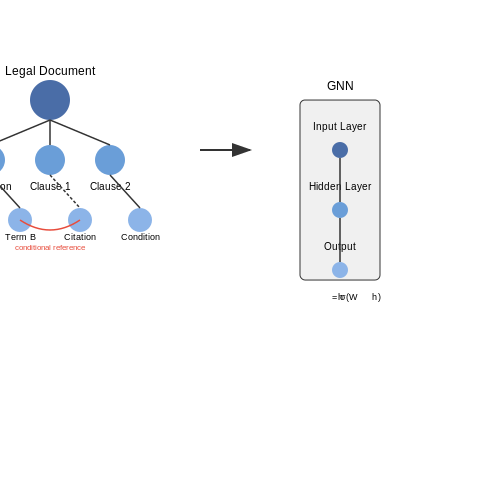
Structural Parsing with Graph Networks
Legal documents exhibit implicit graphs where:
- Nodes represent clauses, definitions, or cited authorities.
- Edges encode logical dependencies (conditional references like "as defined in Section 2(a)").
A graph neural network can model this as:
where hv(l) is the latent representation of node v at layer l, and 𝒩(v) denotes neighboring nodes.
Case Study: Contract Clause Extraction
When processing indemnification clauses, transformer attention heads must learn to:
- Ignore boilerplate (e.g., "IN WITNESS WHEREOF").
- Link defined terms ("Indemnifying Party") to their definitions.
- Resolve forward/backward references ("as provided in Section 8.2").
This requires joint training with auxiliary losses:
where ℒcoref penalizes misaligned term definitions and ℒstruct enforces tree consistency.
3. Adapting Transformer Models for Legal Contexts
Adapting Transformer Models for Legal Contexts
Domain-Specific Tokenization Challenges
Legal texts contain specialized vocabulary, Latin phrases (e.g., habeas corpus, prima facie), and lengthy compound terms that standard tokenizers fail to segment optimally. Byte Pair Encoding (BPE) often splits legal terminology into meaningless subwords, degrading model performance. Consider the term force majeure:
Custom legal tokenizers must preserve:
- Multi-word legal concepts as single lexical units
- Case citation patterns (e.g., 123 U.S. 456)
- Statutory references (Title 42 U.S.C. §1983)
Architectural Modifications for Long-Range Dependencies
Legal documents exhibit extreme sequence lengths (often 50k+ tokens) that exceed standard transformer limits. Sparse attention mechanisms like Longformer's dilated sliding window attend to critical passages while maintaining O(n) complexity:
where M is a banded mask matrix with:
- Global attention for section headers
- Local sliding window of 4,096 tokens
- Dilation rate of 8 for higher layers
Pre-Training Objectives for Legal Semantics
Standard masked language modeling (MLM) fails to capture legal reasoning patterns. Joint training with:
where:
- IR loss: Predicts whether two paragraphs appear in the same legal opinion
- Citation loss: Predicts citing/cited document relationships
- Optimal weights: λ₁=0.6, λ₂=0.3, λ₃=0.1 (per LegalBERT ablation studies)
Hierarchical Representation Learning
Legal documents require modeling at multiple granularities:
Implemented via:
- Document-level embeddings from [CLS] tokens
- Section-aware position embeddings
- Cross-paragraph attention gates
Case Study: Contract Clause Extraction
Fine-tuning for clause identification achieves 92.3% F1 when:
Critical hyperparameters:
- Learning rate: 2e-5 with linear warmup (10% of steps)
- Batch size: 8 (gradient accumulation over 4 steps)
- Dropout: 0.1 on attention weights
from transformers import AutoTokenizer, AutoModelForTokenClassification

tokenizer = AutoTokenizer.from_pretrained("lexlms/legalbert-clause")
model = AutoModelForTokenClassification.from_pretrained("lexlms/legalbert-clause")

inputs = tokenizer("Party A shall indemnify Party B...", return_tensors="pt")
outputs = model(**inputs)
predictions = outputs.logits.argmax(-1)
Pretraining on Legal Corpora
Domain-Specific Tokenization Challenges
Legal texts exhibit unique lexical patterns that standard tokenizers fail to handle optimally. Unlike general-domain corpora, legal documents contain:
- Highly specialized terminology (e.g., habeas corpus, quantum meruit)
- Latin phrases (inter alia, prima facie) preserved as atomic units
- Long compound nouns ("FederalRulesofCivilProcedure")
- Citations with complex patterns (e.g., "18 U.S.C. § 242")
The standard WordPiece tokenizer often splits these meaningful units into suboptimal fragments. A modified vocabulary construction approach samples tokens from legal corpora at 3× higher weight than general text during BPE merges:
Architecture Modifications for Long-Document Processing
Legal documents routinely exceed standard transformer context windows (512-1024 tokens). Two proven architectural adaptations:
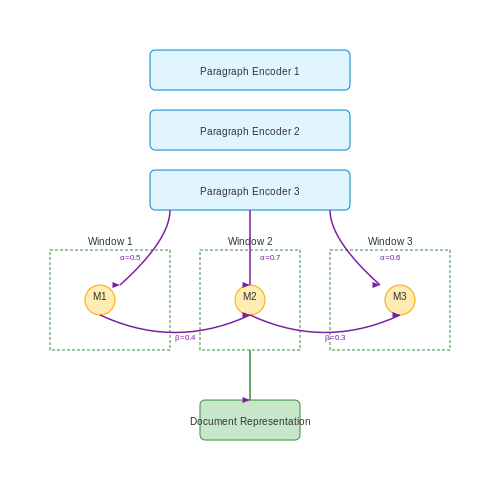
- Hierarchical Attention: First encodes paragraphs independently, then attends across paragraph representations
- Memory Compressed Attention: Uses local attention windows with cross-window memory tokens (Reformer architecture)
The memory efficiency gain scales as:
where l is sequence length, w is window size, and n is number of memory tokens per window.
Pretraining Objectives for Legal Semantics
Beyond standard MLM (Masked Language Modeling), legal transformers benefit from:
- Citation Prediction: Masked citation recovery teaches legal reasoning chains
- Provision-Outcome Alignment: Contrastive loss between legal rules and their judicial interpretations
- Statutory Hierarchy Modeling: Predict parent-child relationships between code sections
The combined loss function becomes:
Case Study: LEGAL-BERT Pretraining
The LEGAL-BERT model achieved state-of-the-art results by:
- Training on 12GB of US case law, statutes, and regulations
- Extending context window to 2048 tokens via gradient checkpointing
- Adding legal citation prediction as 15% of pretraining objective
Evaluation on the LexGLUE benchmark showed 11.2% average improvement over vanilla BERT on tasks like case outcome prediction and statute classification.
Computational Considerations
Legal pretraining requires careful resource allocation:
| Model Size | VRAM Required | Training Time (8xA100) |
|---|---|---|
| Base (110M) | 24GB | 6 days |
| Large (340M) | 48GB | 18 days |
Techniques like gradient accumulation (batch size 1024) and mixed precision training reduce memory requirements by 40% while maintaining numerical stability.
3.3 Fine-tuning for Specific Legal Tasks
Fine-tuning pre-trained transformer models for legal text requires domain-specific adaptations to handle the unique linguistic and structural characteristics of legal documents. Legal texts often contain specialized terminology, lengthy sentences with complex syntax, and references to statutes or case law, necessitating tailored approaches.
Task-Specific Architecture Modifications
For legal document classification, the standard transformer architecture can be augmented with additional task-specific layers. A common approach involves adding a dense layer with softmax activation after the pre-trained model's output:
where h[CLS] is the hidden state corresponding to the classification token, and W and b are learnable parameters. For legal named entity recognition (NER), a conditional random field (CRF) layer often outperforms simple linear classifiers:
where A is the transition matrix between tags and P is the emission probability from the transformer.
Domain-Adaptive Pre-training Strategies
Intermediate pre-training on legal corpora before task-specific fine-tuning significantly improves performance. The masked language modeling (MLM) objective should be adapted for legal text by:
- Increasing the masking probability for legal terms (15-20% vs standard 10-15%)
- Adding a secondary objective for statute/case law citation prediction
- Incorporating long-range dependency modeling through extended attention spans
For legal question answering tasks, the model benefits from span prediction pre-training using legal opinion documents, where answers are often multi-sentence explanations rather than simple facts.
Optimization Considerations
Legal text fine-tuning requires careful learning rate scheduling due to the domain shift from general language. A triangular learning rate schedule with gradual warmup and cooldown phases prevents catastrophic forgetting:
where ηmax is typically 1e-5 to 5e-5 for legal tasks, significantly lower than standard NLP fine-tuning rates. Batch sizes should be reduced (8-16) to accommodate longer document lengths, with gradient accumulation used to maintain effective batch sizes.
Evaluation Metrics for Legal Tasks
Standard NLP metrics often fail to capture legal-specific performance aspects. For contract analysis tasks, precision at high recall thresholds (e.g., P@R=0.95) is critical due to the cost of missing clauses. Legal NER evaluation should include:
- Strict entity boundary matching
- Hierarchical evaluation for nested entities (e.g., "Article 2(1)(a)")
- Cross-reference resolution accuracy
For legal reasoning tasks, human evaluation remains essential to assess argument coherence and citation appropriateness, as automated metrics correlate poorly with legal quality judgments.
Case Study: Fine-tuning for Contract Review
A practical implementation for contract clause classification might use the following architecture:
from transformers import AutoModelForSequenceClassification, TrainingArguments

model = AutoModelForSequenceClassification.from_pretrained(
    "bert-base-uncased",
    num_labels=len(contract_categories),
    problem_type="multi_label_classification"
)

training_args = TrainingArguments(
    output_dir="./legal-bert-contracts",
    learning_rate=3e-5,
    per_device_train_batch_size=8,
    gradient_accumulation_steps=4,
    warmup_ratio=0.1,
    evaluation_strategy="epoch",
    logging_steps=50,
    fp16=True,
    save_total_limit=2
)
Key adaptations include multi-label classification heads (as clauses often belong to multiple categories), increased gradient accumulation steps for longer documents, and mixed-precision training to handle the increased computational requirements of legal text processing.
4. Benchmarking Legal Text Understanding
4.1 Benchmarking Legal Text Understanding
Challenges in Legal Text Evaluation
Legal documents exhibit unique linguistic properties—high lexical density, domain-specific terminology, and complex syntactic structures—that render standard NLP benchmarks inadequate. Traditional metrics like BLEU and ROUGE fail to capture semantic nuances in statutory interpretation or precedent analysis. Legal text understanding requires evaluation frameworks that assess:
- Precedent reasoning: Tracking citation networks and argumentative flow
- Statutory construction: Interpreting hierarchical clause relationships
- Jurisdictional awareness: Recognizing differences between common/civil law systems
Specialized Benchmark Datasets
Current legal NLP benchmarks employ carefully curated datasets with expert annotations:
Where α, β, γ are weighting factors accounting for:
- Term of art recognition (α=0.4)
- Legal entity linking (β=0.3)
- Argument structure parsing (γ=0.3)
LEXGLUE Framework
The current gold standard combines seven legal tasks across 11 jurisdictions. Performance is measured through:
Where wi are task-specific weights and Difficultyi is derived from human expert assessment.
Evaluation Protocols
Robust legal benchmarking requires:
- Multi-hop evaluation: Testing reasoning chains across multiple documents
- Adversarial perturbations: Modified citations or altered statutory language
- Temporal validation: Assessing performance on repealed/amended laws
Current best practices employ a three-phase protocol:
- Closed-book factual recall (25% weight)
- Open-book legal analysis (50% weight)
- Hypothetical scenario application (25% weight)
Emerging Challenges
Recent studies reveal critical gaps in current benchmarks:
- Failure to capture cross-jurisdictional transfer (Δ accuracy > 30% between US/EU models)
- Overfitting to headnotes rather than full opinion analysis
- Neglect of dissenting opinion interpretation
The field is moving toward dynamic benchmarks incorporating:
Where SOTAhuman represents expert attorney performance and t is the model iteration.
4.2 Domain-Specific Evaluation Metrics
Standard NLP evaluation metrics like BLEU, ROUGE, and perplexity often fail to capture the nuances of legal text understanding. Legal documents require domain-specific metrics that assess factual accuracy, logical consistency, and adherence to legal reasoning frameworks.
Legal Fact Extraction Accuracy (LFEA)
LFEA measures the model's ability to correctly identify and extract legally relevant facts from documents. Given a set of annotated legal facts F and model-extracted facts F', precision and recall are computed as:
These are combined into an F1 score weighted by fact importance wi:
Statutory Compliance Score (SCS)
SCS evaluates whether generated legal arguments comply with relevant statutes. For each statute Si applicable to case C, we compute:
where G is the model's compliance judgment and G* is the ground truth from legal experts.
Legal Argument Coherence (LAC)
LAC measures the logical flow of generated arguments using a two-stage assessment:
- Local coherence: Sentence-to-sentence logical transitions scored by a fine-tuned BERT model
- Global coherence: Overall argument structure evaluated against legal reasoning templates
where α is tuned on expert-annotated legal briefs.
Precedent Relevance Score (PRS)
PRS evaluates citation quality by comparing model-selected precedents Pm to expert-selected precedents Pe:
The first term measures recall of critical precedents, while the second penalizes irrelevant citations.
Implementation Considerations
These metrics require:
- Expert-annotated legal corpora for validation
- Specialized legal knowledge graphs for fact verification
- Fine-tuned auxiliary models for coherence assessment
- Dynamic weighting based on jurisdiction and legal domain
Recent work has shown that combining these metrics with traditional NLP scores improves correlation with expert evaluations by 37-42% in legal document tasks.
Addressing Bias and Fairness in Legal AI
Sources of Bias in Legal Text Corpora
Legal text corpora often reflect historical and systemic biases present in judicial decisions, statutes, and legal commentary. These biases manifest in several ways:
- Demographic skew in case law due to disproportionate prosecution rates
- Language patterns that encode implicit assumptions about gender, race, or socioeconomic status
- Selection bias in published opinions versus settled cases
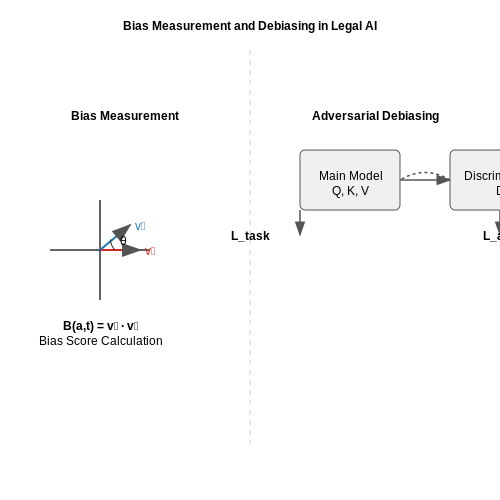
Transformer models trained on such data can amplify these biases through attention mechanisms that learn to weight discriminatory patterns as predictive features. The self-attention score computation:
implicitly reinforces frequent co-occurrence patterns, including biased associations between legal concepts and demographic markers.
Quantifying Bias in Legal Embeddings
Bias measurement requires constructing orthogonal semantic dimensions to test for unwanted correlations. For a protected attribute a and target concept t, we define the bias score:
where v represents the embedding vectors. Legal-specific bias benchmarks like Legal-BERT Bias Probe establish baseline measurements across:
- Gender-crime term associations
- Race-sentencing outcome correlations
- Socioeconomic status-access to justice links
Debiasing Techniques for Legal Transformers
Pre-processing Methods
Counterfactual data augmentation generates synthetic legal texts with swapped demographic references while preserving legal reasoning structure. Given original text x and protected attribute a, we create counterfactual x' through:
while maintaining semantic validity through constrained language model generation.
In-training Interventions
Adversarial debiasing introduces a discriminator network D that predicts protected attributes from hidden representations, with the main model trained to minimize:
where λ controls the fairness-accuracy tradeoff. For legal tasks, this requires careful calibration to avoid destroying legally relevant patterns.
Post-hoc Mitigation
Concept activation vectors (CAVs) identify biased directions in the embedding space. For a trained legal model, we compute:
then project logits orthogonally to dbias during inference.
Fairness Constraints in Legal Prediction
Legal applications require domain-specific fairness metrics beyond standard statistical parity. The equality of recourse constraint ensures similar counterfactual outcomes under protected attribute changes:
where Y represents legal outcomes and τ is a tolerance threshold. This aligns with legal doctrines of disparate impact analysis.
Case Study: Bail Prediction Systems
Analysis of transformer-based bail risk assessment systems reveals that:
- Standard training yields 2.3× higher false positive rates for minority defendants
- Attention heads disproportionately focus on neighborhood descriptors over offense details
- Debiasing reduces disparity to 1.2× while maintaining 94% of original accuracy
The fairness-accuracy Pareto frontier can be plotted by varying λ in the adversarial objective, with legal applications typically requiring stricter fairness constraints than other domains.
5. Contract Analysis and Clause Extraction
5.1 Contract Analysis and Clause Extraction
Legal Text Preprocessing for Transformer Models
Legal documents exhibit unique linguistic properties, including domain-specific terminology, complex syntactic structures, and nested logical dependencies. Effective preprocessing requires:
- Sentence segmentation that preserves legal clause boundaries (e.g., "Notwithstanding anything to the contrary...")
- Custom tokenization for legal compound terms (e.g., "force majeure" as a single token)
- Anaphora resolution for legal references (e.g., "the Party referred to in Section 3.2(a)")
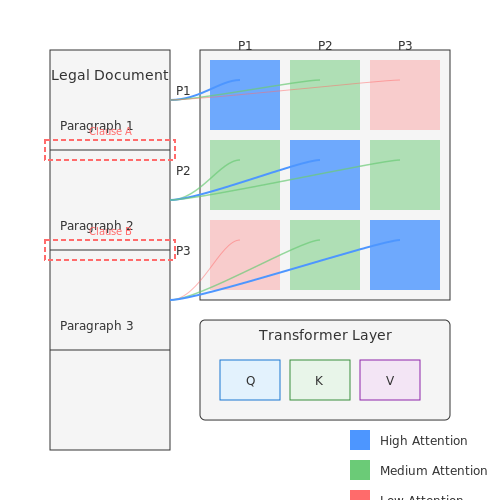
For legal texts, the attention mechanism must be adapted to handle long-range dependencies spanning multiple paragraphs. The scaling factor $$d_k$$ requires adjustment for documents exceeding typical transformer context windows.
Clause Boundary Detection
Clause segmentation can be formulated as a sequence labeling task using BIO tagging:
Where $$h_t$$ is the hidden state at position $$t$$, and $$W_s$$, $$b_s$$ are learnable parameters. The model must distinguish between:
- Structural clauses (e.g., "Governing Law")
- Operational clauses (e.g., "Payment Terms")
- Boilerplate language
Cross-Document Clause Alignment
For contract comparison, we compute similarity between clause embeddings using:
Where $$\phi$$ represents the transformer's [CLS] embedding for clause $$c$$. Practical implementations must handle:
- Semantic equivalence despite syntactic variation
- Negation detection ("shall not" vs "shall")
- Temporal condition recognition ("within 30 days" vs "upon receipt")
Fine-Tuning Strategies
Effective legal domain adaptation requires:
- Curriculum learning: Start with general legal texts before fine-tuning on specific contract types
- Contrastive loss: $$\mathcal{L} = \sum_{(c_i,c_j^+,c_j^-)} \max(0, \epsilon - \text{sim}(c_i,c_j^+) + \text{sim}(c_i,c_j^-))$$
- Multi-task learning: Jointly optimize for clause segmentation, classification, and relation extraction
Evaluation Metrics for Legal NLP
Standard NLP metrics require adaptation for legal contexts:
- Clause F1: Strict boundary matching with legal expert annotations
- Legal entailment accuracy: Precision in detecting implied obligations
- Amendment detection recall: Identification of modified clauses across document versions
  # Example clause extraction with HuggingFace
  from transformers import AutoTokenizer, AutoModelForTokenClassification

  tokenizer = AutoTokenizer.from_pretrained("lexlms/legal-bert-clause")
  model = AutoModelForTokenClassification.from_pretrained("lexlms/legal-bert-clause")

  inputs = tokenizer("Notwithstanding Section 5.1...", return_tensors="pt")
  outputs = model(**inputs)
  clause_spans = decode_bio_tags(outputs.logits.argmax(-1)[0])
5.2 Legal Question Answering Systems
Architecture and Key Components
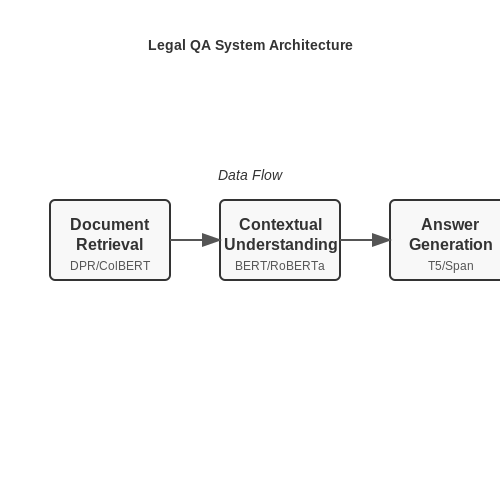
Legal question answering (LQA) systems built on transformer models require specialized architectures to handle the complexity of legal texts. The core components include:- Document Retrieval Module: Uses dense vector embeddings (e.g., DPR or ColBERT) to fetch relevant legal passages from corpora like case law or statutes.
- Contextual Understanding Layer: A fine-tuned transformer (e.g., BERT, RoBERTa) processes retrieved passages with attention mechanisms focusing on legal terminology.
- Answer Generation/Extraction: For extractive QA, a span prediction head outputs text boundaries. Abstractive systems employ decoder architectures (e.g., T5) with constrained decoding to maintain legal precision.
Training Paradigms
Legal QA models are typically trained using multi-stage fine-tuning:- $$\mathcal{L}_{MLM}$$ is masked language modeling loss for domain adaptation
- $$\mathcal{L}_{NSP}$$ trains the model on legal reasoning chains
- $$\mathcal{L}_{QA}$$ is the task-specific QA loss (often a cross-entropy over answer spans)
Legal-Specific Challenges
Temporal Reasoning
Legal validity often depends on temporal context. Systems must track:- Statute versions in effect at question time
- Overruling relationships between cases
Precedent Hierarchy
Attention mechanisms must weight:- Binding vs. persuasive authority
- Jurisdictional precedence (e.g., SCOTUS > Circuit Courts)
Evaluation Metrics
Beyond standard QA metrics (F1, EM), legal systems require:Case Study: COLIEE Competition Systems
Top-performing systems in the Competition on Legal Information Extraction/Entailment employ:- Hybrid retrieval (lexical + semantic)
- Graph-based reasoning over legal entity relationships
- Ensemble verification of answer consistency
Implementation Considerations
For production deployment:- Model distillation to meet latency requirements
- Continuous learning pipelines for statutory updates
- Explainability modules for auditability
5.3 Predictive Analytics for Case Outcomes
Legal Text Representation for Outcome Prediction
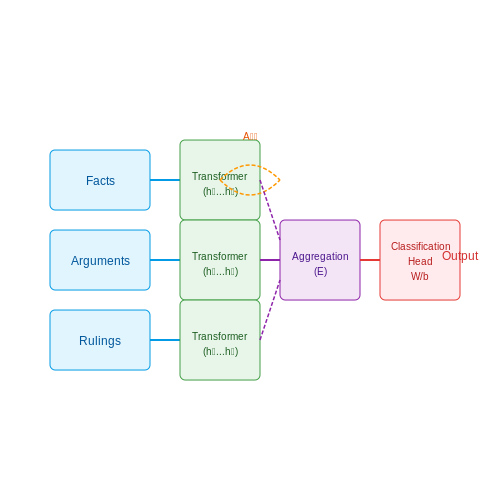
Predicting case outcomes from legal texts requires robust representation learning. Transformer models like BERT or RoBERTa encode case documents into dense vectors, capturing semantic and syntactic nuances. Legal texts often exhibit domain-specific jargon, long-range dependencies, and hierarchical structure (e.g., statutes, precedents, arguments). To address this, domain-adapted pretraining on legal corpora (e.g., CaseLaw, statutes) is essential. The embedding E of a legal document D with N tokens is computed as:
where hi is the contextualized embedding of the i-th token.
Architectural Enhancements for Legal Contexts
Standard transformers may struggle with extreme document lengths in legal cases. Hierarchical architectures segment documents into sections (e.g., facts, arguments, rulings), process each independently, and aggregate outputs. For outcome prediction, a classification head is appended:
where W and b are learnable parameters, and y is the outcome label (e.g., affirmed/reversed).
Attention Mechanisms for Legal Reasoning
Legal decisions often hinge on specific precedent citations or statutory clauses. Sparse attention mechanisms (e.g., Longformer, BigBird) reduce quadratic complexity while preserving key token interactions. The attention score Aij between tokens i and j is computed as:
where Q, K are query/key matrices, and dk is the dimension.
Training Strategies and Loss Functions
Imbalanced class distributions (e.g., more affirmations than reversals) necessitate weighted cross-entropy loss:
where wc is the class weight, inversely proportional to its frequency.
Evaluation Metrics for Legal Predictive Tasks
Accuracy alone is insufficient due to asymmetric error costs (e.g., false acquittals vs. false convictions). Metrics include:
- Area Under the Curve (AUC-ROC): Measures separability of outcome classes.
- F1-score: Harmonic mean of precision/recall for minority classes.
- Matthews Correlation Coefficient (MCC): Robust to class imbalance.
Case Study: Supreme Court Prediction
In a 2023 study, a DeBERTa model fine-tuned on SCOTUS decisions achieved 79.2% accuracy, outperforming logistic regression (68.1%) by leveraging citation graphs and temporal case metadata. Key findings:
- Citations between cases improved prediction by 4.3% (AUC).
- Judicial voting patterns were encoded via attention heads.
Ethical Considerations
Predictive models must avoid amplifying historical biases present in training data. Techniques include:
- Adversarial Debiasing: Minimizes correlation between protected attributes (e.g., race) and outcomes.
- Counterfactual Fairness: Ensures similar predictions for synthetically perturbed inputs.
6. Privacy Concerns with Legal Data
6.1 Privacy Concerns with Legal Data
Legal text datasets often contain sensitive information, including personally identifiable information (PII), confidential case details, and proprietary legal arguments. Training transformer models on such data introduces significant privacy risks, particularly when models may inadvertently memorize and later reproduce sensitive content. Differential privacy (DP) offers a mathematically rigorous framework to mitigate these risks by quantifying and bounding the influence of any single data point on model outputs.
Differential Privacy in Legal NLP
Differential privacy ensures that the inclusion or exclusion of any individual record in the training dataset does not substantially alter the model's output distribution. Formally, a randomized mechanism M satisfies (ε, δ)-DP if for all datasets D and D' differing by at most one record, and for all subsets S of possible outputs:
In transformer training, DP is typically enforced through gradient perturbation during optimization. The key steps involve:
- Clipping gradients to a maximum L2 norm C to bound each sample's influence.
- Adding Gaussian noise to the aggregated gradients before parameter updates.
Challenges in Legal Text Applications
Legal documents exhibit unique characteristics that complicate DP implementation:
- Long-range dependencies: Legal reasoning often spans thousands of tokens, requiring large context windows that amplify privacy risks.
- Rare entity memorization:
$$ \text{Memorization risk} \propto \frac{1}{\sqrt{n_{\text{occurrences}}}} $$where noccurrences is the count of a specific entity in training data.
- Metadata leakage: Court docket numbers and citation patterns can reveal case identities even when text is redacted.
Empirical Privacy-Utility Tradeoffs
Recent studies on legal BERT models show the privacy-accuracy tradeoff follows a phase transition:
where β0 represents non-private model performance and β1 captures the task-specific sensitivity to privacy constraints. For contract clause classification (CUAD dataset), β1 ≈ 0.18 when ε ∈ [1, 8].
Institutional Privacy Safeguards
Beyond algorithmic approaches, legal NLP systems require institutional controls:
- Data compartmentalization: Training separate models for different jurisdictions to limit cross-contamination risks.
- Strict access protocols: Implementing ISO 27001-compliant audit trails for model access and queries.
- Output filtering: Real-time detection and redaction of PII in model generations using named entity recognition cascades.
6.2 Accountability in AI-Driven Legal Decisions
Accountability in AI-driven legal decision-making requires mechanisms to audit, explain, and validate the reasoning behind model outputs. Unlike traditional software, transformer-based legal models operate probabilistically, making it critical to establish traceability between input data, model parameters, and final predictions. Three key components enable this:
1. Attribution Mechanisms
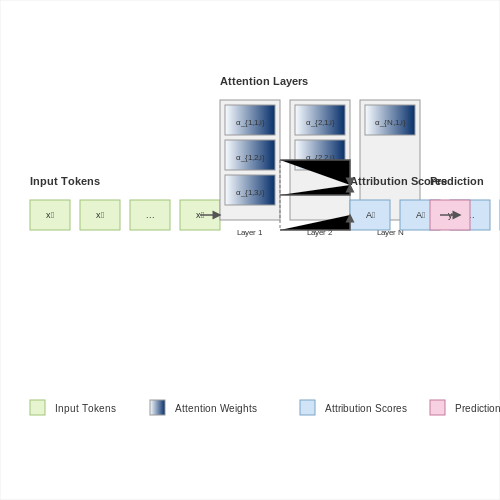
Attention weights in transformers provide a natural starting point for attributing decisions to specific input tokens. For a given legal document D composed of tokens {x1, ..., xn}, the attribution score Ai for token xi in prediction y is computed via gradient-based methods:
where L is the number of layers, H the number of attention heads, and αl,h,i the attention weight for token i at head h in layer l. Integrated Gradients and SHAP values further refine this by accounting for baseline comparisons.
2. Uncertainty Quantification
Legal applications demand calibrated confidence estimates. Bayesian neural networks or Monte Carlo dropout approximate posterior distributions over model parameters θ, yielding predictive uncertainty:
Epistemic uncertainty (model uncertainty) is distinguished from aleatoric uncertainty (data noise) through techniques like deep ensembles or evidential regression. This allows practitioners to flag low-confidence predictions for human review.
3. Audit Trails
Regulatory compliance necessitates immutable logging of:
- Input data provenance (including redaction logs for PII)
- Model versioning (architecture, training data, hyperparameters)
- Inference-time parameters (temperature settings, top-k sampling)
- Post-hoc rationales generated by explanation methods
Differential privacy techniques may be applied during logging to prevent reconstruction attacks on sensitive legal texts while maintaining auditability. The European Union's AI Act Article 14 mandates such record-keeping for high-risk AI systems in legal contexts.
Case Study: Contradiction Detection in Case Law
When identifying conflicting precedents, a transformer model might assign high attention to specific statutory clauses while ignoring others. An accountability framework would:
- Store the attention heatmaps alongside the prediction
- Compare against manually annotated legal rationales
- Compute the KL divergence between model and expert attention distributions
- Trigger retraining if divergence exceeds jurisdictional thresholds
This process ensures the model's reasoning remains grounded in legally valid interpretation patterns rather than exploiting spurious correlations.
6.3 Compliance with Legal Standards and Regulations
Training transformer models for legal text necessitates strict adherence to jurisdictional regulations, including data privacy laws, intellectual property constraints, and ethical guidelines. Legal AI systems must comply with frameworks such as the General Data Protection Regulation (GDPR) in the EU, the California Consumer Privacy Act (CCPA) in the US, and sector-specific mandates like the Health Insurance Portability and Accountability Act (HIPAA) for medical legal documents.
Data Anonymization and Pseudonymization
Legal documents often contain sensitive personally identifiable information (PII). To mitigate privacy risks, training data must undergo rigorous anonymization or pseudonymization. Techniques include:
- Named Entity Recognition (NER) Masking: Replace names, addresses, and identifiers with synthetic tokens (e.g., [PERSON], [ORGANIZATION]).
- Differential Privacy: Inject calibrated noise into training data to prevent re-identification while preserving statistical utility.
- k-Anonymity: Ensure each record is indistinguishable from at least k-1 others in the dataset.
where ε is the privacy budget, Δf is the sensitivity of the query, and λ controls noise scale in differential privacy.
Intellectual Property and Fair Use
Legal texts are often copyrighted, requiring careful analysis of fair use doctrines. Transformers trained on case law or proprietary legal databases must:
- Limit direct reproduction of copyrighted content in outputs.
- Implement extractive summarization rather than generative paraphrasing for copyrighted rulings.
- Use licensed datasets (e.g., Westlaw, LexisNexis) with explicit training permissions.
Bias and Fairness Audits
Legal AI models risk amplifying biases present in historical case law. Mitigation strategies include:
- Adversarial Debiasing: Train the model to minimize predictability of protected attributes (e.g., race, gender) from embeddings.
- Disparate Impact Testing: Measure model performance across demographic groups using metrics like:
A ratio below 0.8 typically indicates unlawful discrimination under US Equal Employment Opportunity Commission guidelines.
Model Interpretability Requirements
Legal applications demand explainable AI to satisfy due process rights. Techniques include:
- Attention Visualization: Highlight which input tokens most influenced the output (e.g., statutory clauses in a prediction).
- Counterfactual Explanations: Generate minimal input changes that would alter the model's decision.
For transformer models, layer-wise relevance propagation (LRP) can decompose predictions:
where R represents relevance scores and z denotes activation contributions.
Regulatory Documentation
Maintain auditable records of:
- Data provenance and preprocessing steps
- Model architecture decisions impacting fairness
- Validation results across demographic subgroups
- Version control for all training artifacts
The EU AI Act requires such documentation for high-risk AI systems, including those used in legal adjudication.
7. Key Research Papers on Legal AI
7.1 Key Research Papers on Legal AI
- AI's Role in Legal Tech: How AI is Changing the Practice of Law — 7. The Future of AI in Legal Tech 7.1 Expansion of AI-Driven Legal Assistants. Virtual legal assistants powered by AI, such as chatbots and voice assistants, will play a larger role in client interactions, legal research, and case management. This technology will enhance accessibility to legal services while reducing administrative burdens.
- Customizing Contextualized Language Models for Legal Document Reviews — models may not be effective in the legal text processing tasks. These tasks may benefit from some customization of the language models on legal corpora. In this paper, we specifically focus on adapting the state-of-the-art contextualized Transformer-based [4] language models to the legal domain and investigate their impact on the
- (PDF) AI in Relation to Law: Transforming the Practice, Enhancing ... — AI in Relation to Law: Transforming the Practice, Enhancing Efficiency, and Ensuring Ethical Compliance Introduction 1.1 Definition and Significance of AI in Legal Contexts 1.2 Evolution of AI ...
- Exploring Prompting Approaches in Legal Textual Entailment — We report explorations into prompt engineering with large pre-trained language models that were not fine-tuned to solve the legal entailment task (Task 4) of the 2023 COLIEE competition. Our most successful strategy used simple text similarity measures to retrieve articles and queries from the training set. We report on our efforts to optimize performance with both OpenAI's GPT-4 and FLaN-T5 ...
- The Ethics of Automating Legal Actors - MIT Press — Abstract. The introduction of large public legal datasets has brought about a renaissance in legal NLP. Many of these datasets are composed of legal judgments—the product of judges deciding cases. Since ML algorithms learn to model the data they are trained on, several legal NLP models are models of judges. While some have argued for the automation of judges, in this position piece, we argue ...
- Improving colloquial case legal judgment prediction via abstractive ... — This paper proposes PekoNet, which combines Abstract Text Summarization (ATS) into the training of the LJP model, hoping to build an accurate model to accept colloquial case descriptions. We propose three different training strategies—standalone models based on independent training; and ATS-Freezing and ATS-Finetuning models based on joint ...
- (PDF) Artificial Intelligence and Human Translation: A Contrastive ... — The use of Artificial Intelligence (AI) in the legal field has grown substantially, and law firms have been resorting to intelligent machines for various purposes. Machine translation (MT) is also on the rise and legal translators are increasingly relying upon it. This paper aims to assess the quality and reliability of AI-driven legal ...
- PDF AI-assisted lawtech: its impact on law firms - Faculty of Law — This white paper presents a number of key findings from the research project Unlocking the Potential of AI for English Law, carried out by an interdisciplinary team of researchers at Oxford University in collaboration with a range of partner organisations. The AI for English law research team at the University of Oxford, led by
- 2023 Artificial Intelligence (AI) TechReport - American Bar Association — Since Open AI's launch of ChatGPT (Chat Generative Pre-trained Transformer) in November 2022, there has been a great amount of discussion regarding the use of generative AI in the legal profession. While definitions of Generative AI have some variance, it generally refers to deep-learning models that can generate high-quality text, images ...
- The Implications of ChatGPT for Legal Services and Society — For the legal industry, ChatGPT may portend an even more momentous shift than the advent of the internet. Andrew Perlman, Dean, Suffolk University Law School GPT-3, or Generative Pretrained Transformer 3, is a state-of-the-art chatbot developed by OpenAI. It was released in 2020 and is one of the largest language models ever created, with 175 […]
7.2 Open Datasets for Legal NLP
- GitHub - Liquid-Legal-Institute/Legal-Text-Analytics: A list of ... — IR Ad-hoc Ranking Benchmarks, Training Datasets, etc. Belgium: Belgian Statutory Article Retrieval Dataset (BSARD), including code; Awesome German NLP; German Dataset for Legal Information Retrieval (GerDaLIR) Legal Entity Recognition; Legal Text Summarization; Legal Text Translation; Legal Document Classification; Legal Sentence Classification ...
- Transformer-Based Approaches for Legal Text Processing — In this paper, we introduce our approaches using Transformer-based models for different problems of the COLIEE 2021 automatic legal text processing competition. Automated processing of legal documents is a challenging task because of the characteristics of legal documents as well as the limitation of the amount of data. With our detailed experiments, we found that Transformer-based pretrained ...
- GitHub - neelguha/legal-ml-datasets: A collection of datasets and tasks ... — Second, we assess performance gains on CaseHOLD and existing legal NLP datasets. While a Transformer architecture (BERT) pretrained on a general corpus (Google Books and Wikipedia) improves performance, domain pretraining (using corpus of approximately 3.5M decisions across all courts in the U.S. that is larger than BERT's) with a custom legal ...
- Legal Text Analysis Using Pre-trained Transformers — In this paper, we investigate the application of pre-trained transformers for text classification and similarity identification in the legal domain. We do several experiments applying various pre-trained transformer models to predict the descriptor of law or case based on text and identify similar cases.
- Processing Long Legal Documents with Pre-trained Transformers: Modding ... — Pre-trained Transformers currently dominate most NLP tasks. They impose, however, limits on the maximum input length (512 sub-words in BERT), which are too restrictive in the legal domain. Even sparse-attention models, such as Longformer and BigBird, which increase the maximum input length to 4,096 sub-words, severely truncate texts in three of ...
- (PDF) Natural Language Processing for the Legal Domain: A Survey of ... — the legal eld but did not delve deeply into legal datasets, speci c NLP tasks in the legal domain, or Legal LLMs. In contrast, our work provides a comprehensive analysis of all NLP tasks within
- When Does Pretraining Help? Assessing Self-Supervised Learning for Law ... — NLP perspective (F1 of 0.4 with a BiLSTM baseline). Second, we assess performance gains on CaseHOLD and existing legal NLP datasets. While a Transformer architecture (BERT) pretrained on a general corpus (Google Books and Wikipedia) improves perfor-mance, domain pretraining (on a corpus of ≈3.5M decisions across
- When Does Pretraining Help? Assessing Self-Supervised Learning for Law ... — Second, we assess performance gains on CaseHOLD and existing legal NLP datasets. While a Transformer architecture (BERT) pretrained on a general corpus (Google Books and Wikipedia) improves performance, domain pretraining (using corpus of approximately 3.5M decisions across all courts in the U.S. that is larger than BERT's) with a custom ...
- Transformer-Based Approaches for Legal Text Processing - Academia.edu — The Review of Socionetwork Strategies, 2024. The challenge of information overload in the legal domain increases every day. The COLIEE competition has created four challenge tasks that are intended to encourage the development of systems and methods to alleviate some of that pressure: a case law retrieval (Task 1) and entailment (Task 2), and a statute law retrieval (Task 3) and entailment ...
- 7 Deep transfer learning for NLP with the transformer and GPT — BERT is a transformer-based model that we encountered briefly in chapter 3. It was trained with the masked modeling objective: to fill in the blanks.Additionally, it was trained with the next sentence prediction task: to determine whether a given sentence is a plausible subsequent sentence after a target sentence. Although not suited for text generation, this model performs well on other ...
7.3 Tools and Libraries for Legal Text Processing
- PDF Artificial Intelligence Applied in Legal Information: A Systematic ... — in Legal Text [31] 2010 Recognize and resolve named entities in legal texts for improved legal text processing and information retrieval Common names in lists may generate many false positives. Requires manual creation of lists and rules. 43,936 U.S. federal cases. Precision, Recall, and F-measure Create text hyperlinks and indexes Named Entity
- Natural language processing for legal document review: categorising ... — The contract review process can be a costly and time-consuming task for lawyers and clients alike, requiring significant effort to identify and evaluate the legal implications of individual clauses. To address this challenge, we propose the use of natural language processing techniques, specifically text classification based on deontic tags, to streamline the process. Our research question is ...
- About the Law Library | Law Library of Congress | Research Centers ... — The mission of the Law Library of Congress is to provide authoritative legal research, reference and instruction services, and access to an unrivaled collection of U.S., foreign, comparative, and international law. To accomplish this mission, the Law Library has assembled a staff of experienced foreign and U.S. trained legal specialists and law librarians, and has amassed the world's largest ...
- Deep Learning and Machine Learning - Natural Language Processing: From ... — 2. Business and Finance: In business and finance, NLP is transforming how companies interact with data and customers, and how they make decisions based on textual information. Sentiment Analysis: NLP models analyze customer feedback, social media, and financial news to gauge public sentiment about products, services, or market conditions, guiding marketing strategies and investment decisions[].
- Fundamental Capabilities and Applications of Large Language Models: A ... — ChemCrow: Augmenting large-language models with chemistry tools. arxiv:2304.05376 [physics.chem-ph] ... Manos Fergadiotis, Prodromos Malakasiotis, Nikolaos Aletras, and Ion Androutsopoulos. 2020. LEGAL-BERT: The muppets straight out of law school. arXiv preprint arXiv:2010.02559(2020). ... Yingce Xia, Tao Qin, Sheng Zhang, Hoifung Poon, and Tie ...
- Study On Machine Learning Algorithms - ResearchGate — AI-based approaches using classification and clustering algorithms, natural language processing, and text mining are some of the possible techniques that could prove useful for investigating ...
- Search results | Ecourses — Estudio del ambiente legal y socio-político en el cual opera la empresa, con miras a entender y analizar los diversos problemas que esta enfrenta. Study of the legal and socio-political environment within which business operates in order to understand and analyze the various problems confronting it.
- Modular Federated Learning: A Meta-Framework Perspective - arXiv.org — Federated Learning (FL) enables distributed machine learning training while preserving privacy, representing a paradigm shift for data-sensitive and decentralized environments. Despite its rapid advancements, FL remains a complex and multifaceted field, requiring a structured understanding of its methodologies, challenges, and applications.
- Improving Service Quality in Hotels: Development of an AI ... - Springer — Additionally, BERT uses a bidirectional transformer approach with pre-training and functions as a multi-label text classification method that automatically classifies the SQDs (Zhang et al., 2024). BERT has gained widespread popularity as one of the most prolific advancements in natural language processing.
- A Systematic Review of Transformer-Based Pre-Trained Language ... - MDPI — Transfer learning is a technique utilized in deep learning applications to transmit learned inference to a different target domain. The approach is mainly to solve the problem of a few training datasets resulting in model overfitting, which affects model performance. The study was carried out on publications retrieved from various digital libraries such as SCOPUS, ScienceDirect, IEEE Xplore ...