


INA321 322 a low-cost medium accuracy ECG machine ECG amplifier
#ECG
#INA321
#INA322
#medical
#signal amplification
#low-cost
#medium accuracy
#biomedical
#patient monitoring
#instrumentation

Description: The INA321/322 forms a low-cost, medium-accuracy ECG amplifier circuit. The INA321 receives input signals from the patient's arm, amplifying them before sending the modified output to the operational amplifier OPA336. The OPA336 generates an output voltage from the inverting amplifier, achieving a gain of 100 times. A common-mode voltage is managed using a 2MΩ resistor. An inverting amplifier configuration with OPA336 is utilized to provide a bias voltage, which adjusts the output voltage for the operating point. Additionally, another OPA336 creates feedback connected to the REF terminal of the INA321/322, serving as a bias voltage. The output voltage from pin 6 of the INA321/322 is a small bias voltage that experiences minimal change. The OPA336 functions as a voltage follower to drive the right leg. For filtering purposes, different capacitance values can be employed to tailor the output to specific applications.
The ECG amplifier circuit utilizing the INA321 and INA322 operational amplifiers is designed for effective signal amplification from electrocardiogram (ECG) electrodes placed on the patient's skin. The INA321 and INA322 are specifically configured for low-noise, low-drift applications, making them suitable for medical instrumentation. The input stage involves capturing weak electrical signals generated by the heart, which are then amplified by the INA321/322 to a level suitable for further processing.
The operational amplifier OPA336 is employed in a non-inverting configuration to achieve a significant voltage gain of 100, which is crucial for enhancing the ECG signal while maintaining fidelity. The use of a 2MΩ resistor for common-mode voltage rejection is essential in minimizing interference from external electrical noise, thereby improving the accuracy of the ECG readings.
The feedback mechanism implemented by the second OPA336 connected to the REF terminal of the INA321/322 ensures that the bias voltage remains stable, allowing for consistent output even with variations in input signals. This feedback loop is vital for maintaining the integrity of the ECG signal, particularly when the patient’s physiological conditions fluctuate.
The circuit design incorporates a voltage follower configuration using the OPA336 to drive the right leg, which is a common practice in ECG systems to reduce common-mode noise. This configuration helps to improve signal integrity by providing a stable reference point and minimizing ground loops.
Furthermore, the ability to adjust capacitance values in the filtering stage allows for customization based on specific application requirements. By selecting appropriate capacitors, the circuit can be optimized for different frequency responses, thus tailoring the output to effectively filter out unwanted noise while preserving the essential characteristics of the ECG signal. This flexibility is advantageous in various clinical settings where ECG monitoring is essential. As shown by INA321/322 constitute a low-cost, medium accuracy ECG machine ECG amplifier circuit shown. INA321 input signal from the patients arm around/322, the INA321/322 ampl ified output to the operational amplifier OPA336, OPA336 produce an output voltage from the inverting amplifier VOUTPUT 100 times. Common-mode voltage is done by 2M resistance. VR inverting amplifier OPA336 to provide a bias voltage, the output voltage as a bias voltage for the operating point changes.
Similarly, by another OPA336 form a feedback added to the REF terminal INA321/322 as a bias voltage, INA321/322 6 pin output voltage as a bias voltage is small for a change. The OPA336 as a voltage follower, for the right leg drive. For filter requires different applications, you can change the output of the capacitance value to meet.
The ECG amplifier circuit utilizing the INA321 and INA322 operational amplifiers is designed for effective signal amplification from electrocardiogram (ECG) electrodes placed on the patient's skin. The INA321 and INA322 are specifically configured for low-noise, low-drift applications, making them suitable for medical instrumentation. The input stage involves capturing weak electrical signals generated by the heart, which are then amplified by the INA321/322 to a level suitable for further processing.
The operational amplifier OPA336 is employed in a non-inverting configuration to achieve a significant voltage gain of 100, which is crucial for enhancing the ECG signal while maintaining fidelity. The use of a 2MΩ resistor for common-mode voltage rejection is essential in minimizing interference from external electrical noise, thereby improving the accuracy of the ECG readings.
The feedback mechanism implemented by the second OPA336 connected to the REF terminal of the INA321/322 ensures that the bias voltage remains stable, allowing for consistent output even with variations in input signals. This feedback loop is vital for maintaining the integrity of the ECG signal, particularly when the patient’s physiological conditions fluctuate.
The circuit design incorporates a voltage follower configuration using the OPA336 to drive the right leg, which is a common practice in ECG systems to reduce common-mode noise. This configuration helps to improve signal integrity by providing a stable reference point and minimizing ground loops.
Furthermore, the ability to adjust capacitance values in the filtering stage allows for customization based on specific application requirements. By selecting appropriate capacitors, the circuit can be optimized for different frequency responses, thus tailoring the output to effectively filter out unwanted noise while preserving the essential characteristics of the ECG signal. This flexibility is advantageous in various clinical settings where ECG monitoring is essential. As shown by INA321/322 constitute a low-cost, medium accuracy ECG machine ECG amplifier circuit shown. INA321 input signal from the patients arm around/322, the INA321/322 ampl ified output to the operational amplifier OPA336, OPA336 produce an output voltage from the inverting amplifier VOUTPUT 100 times. Common-mode voltage is done by 2M resistance. VR inverting amplifier OPA336 to provide a bias voltage, the output voltage as a bias voltage for the operating point changes.
Similarly, by another OPA336 form a feedback added to the REF terminal INA321/322 as a bias voltage, INA321/322 6 pin output voltage as a bias voltage is small for a change. The OPA336 as a voltage follower, for the right leg drive. For filter requires different applications, you can change the output of the capacitance value to meet.

Bob Beck Electrifier
The procedure requires no doctors, drugs, or medical bills. It involves sterilizing the blood of viruses, bacteria, parasites, fungi, microbes, pathogens, mycotoxins, and foreign life forms by passing a small current through the body. The original procedure, invented and patented...

DIY ECG Machine On The Cheap
The purpose of an electrocardiograph (ECG) is to amplify, measure, and record the natural electrical potential generated by the heart. It is important to note that cardiac electrical signals are distinct from heart sounds, which are detected using a stethoscope....
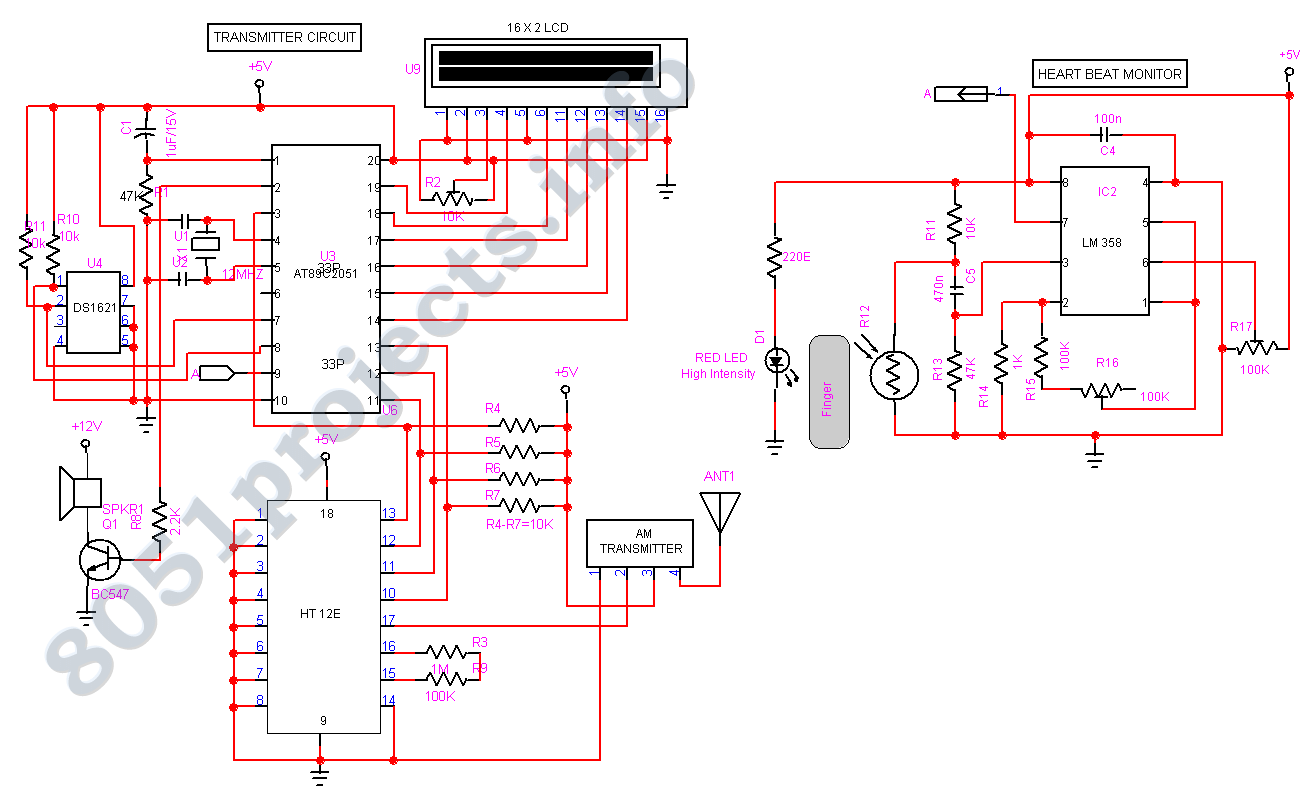
Biomedical Monitoring circuit AT89C2051
In spite of the improvement of communication link and despite all progress in advanced communication technologies, there are still very few functioning commercial wireless monitoring systems, which are most off-line, and there are still a number of issues to deal...

ECG Amplifier By TLC274
This circuit enables the display of an ECG signal on an oscilloscope. Operational amplifiers IC1a, IC1b, and IC1d create an instrumentation amplifier with a gain of 201. IC1c amplifies the common-mode signal by a factor of 31 and supplies this...

Medical call with lighting signal receiver circuit diagram
The receiver, as depicted in the figure, assists patients in avoiding missed audio signals during the daytime. The receiver operates independently, and the lighting will automatically turn off. At night, the lighting signal receiver activates simultaneously with the patient's request....

The medical electric aspirator waterproof controller (2)
The working principle of the circuit pertains to a medical electric aspirator waterproof controller, which includes a power supply circuit, a liquid level detection control circuit, and an alarm circuit, as illustrated in Figure 9-47. The power supply circuit is...

Heart Monitor (ECG Sensor Signal Amplifier/Conditioner)
The circuit illustrated in the schematic diagram below is designed to monitor the heart pulses of a patient. This circuit buffers and amplifies the heart pulses.
The heart pulse monitoring circuit typically consists of several key components that work together to...

INA321 322 a direct drive capacitive input of the A D converter Figure
The INA321/322 is configured to directly drive the capacitive input of an A/D converter. Due to its low output resistance, the INA321/322 can effectively handle high frequency signals and directly drive capacitive loads. The input voltage is amplified by the...

Instrumentation circuit
The mechanical chassis prototype, as illustrated in the accompanying image, was constructed using two materials: foam and aluminum. Foam was selected for its ease of manipulation, while aluminum was chosen for its excellent strength-to-weight ratio. The prototype features a rotary...