


ESP Sound Impairment Monitor
#ESP32
#sound monitoring
#differential amplifier
#high gain amplifier
#rectifier
#indicator circuit
#adjustable circuit
#audio measurement
#sensor

Description: A differential amp used by the SIM, and it is a completely conventional circuit. This is adjustable by using VR1 to null out any normal variations that the amp might show when there is no distortion or other nastiness in evidence. The second stage is a high gain amplifier, and will amplify the residual signal to a level suitable for the rectifier and indicator circuits. More: The opamp shown is adequate for most applications, but the use of a premium device from Analog Devices or Burr-Brown will improve performance, especially at high frequencies. This is not strictly necessary, because the operation of any amplifier protection.
The described circuit is a differential amplifier, which is a fundamental building block in analog electronics, particularly in signal processing applications. The primary function of this circuit is to amplify the difference between two input signals while rejecting any common-mode signals. This characteristic makes it particularly useful in environments where noise and interference are prevalent.
The circuit employs a variable resistor, designated as VR1, which allows for fine-tuning of the amplifier's offset. This adjustment is crucial for nullifying any inherent variations or offsets that may occur in the absence of distortion. By carefully setting VR1, the user can ensure that the output remains stable and accurate, even when the input signals are at their baseline levels.
The first stage of the amplifier is configured to operate as a differential input stage, typically utilizing operational amplifiers (op-amps). These op-amps are selected based on their performance characteristics, with the recommendation to utilize high-quality components from manufacturers such as Analog Devices or Burr-Brown for enhanced performance, particularly at higher frequencies. While standard op-amps may suffice for many applications, premium devices can provide improved bandwidth, lower noise, and better linearity, which are essential for high-fidelity signal processing.
Following the differential input stage, the second stage of the circuit is a high-gain amplifier. This stage is responsible for amplifying the residual signal output from the first stage to a level that is suitable for subsequent processing by rectifier and indicator circuits. The design of this stage must consider the gain requirements and the bandwidth to ensure that the amplified signal retains the integrity of the original input.
The circuit's layout should also incorporate appropriate power supply decoupling and grounding techniques to minimize noise and ensure stable operation. Additionally, the selection of passive components, such as resistors and capacitors, should be made with attention to tolerance and temperature coefficients to maintain performance across varying conditions.
Overall, this differential amplifier circuit is a versatile solution for applications requiring precise signal amplification with minimal distortion and noise, making it an essential component in various electronic systems.A differential amp used by the SIM, and it is a completely conventional circuit. This is adjustable by using VR1 to null out any normal variations that the amp might show when there is no distortion or other nastiness in evidence. The second stage is a high gain amplifier, and will amplify the residual signal to a level suitable for the rectifier and indicator circuits.
The opamp shown is adequate for most applications, but the use of a premium device from Analog Devices or Burr-Brown will improve performance, especially at high frequencies. This is not strictly necessary, because the operation of any amplifier protecti
The described circuit is a differential amplifier, which is a fundamental building block in analog electronics, particularly in signal processing applications. The primary function of this circuit is to amplify the difference between two input signals while rejecting any common-mode signals. This characteristic makes it particularly useful in environments where noise and interference are prevalent.
The circuit employs a variable resistor, designated as VR1, which allows for fine-tuning of the amplifier's offset. This adjustment is crucial for nullifying any inherent variations or offsets that may occur in the absence of distortion. By carefully setting VR1, the user can ensure that the output remains stable and accurate, even when the input signals are at their baseline levels.
The first stage of the amplifier is configured to operate as a differential input stage, typically utilizing operational amplifiers (op-amps). These op-amps are selected based on their performance characteristics, with the recommendation to utilize high-quality components from manufacturers such as Analog Devices or Burr-Brown for enhanced performance, particularly at higher frequencies. While standard op-amps may suffice for many applications, premium devices can provide improved bandwidth, lower noise, and better linearity, which are essential for high-fidelity signal processing.
Following the differential input stage, the second stage of the circuit is a high-gain amplifier. This stage is responsible for amplifying the residual signal output from the first stage to a level that is suitable for subsequent processing by rectifier and indicator circuits. The design of this stage must consider the gain requirements and the bandwidth to ensure that the amplified signal retains the integrity of the original input.
The circuit's layout should also incorporate appropriate power supply decoupling and grounding techniques to minimize noise and ensure stable operation. Additionally, the selection of passive components, such as resistors and capacitors, should be made with attention to tolerance and temperature coefficients to maintain performance across varying conditions.
Overall, this differential amplifier circuit is a versatile solution for applications requiring precise signal amplification with minimal distortion and noise, making it an essential component in various electronic systems.A differential amp used by the SIM, and it is a completely conventional circuit. This is adjustable by using VR1 to null out any normal variations that the amp might show when there is no distortion or other nastiness in evidence. The second stage is a high gain amplifier, and will amplify the residual signal to a level suitable for the rectifier and indicator circuits.
The opamp shown is adequate for most applications, but the use of a premium device from Analog Devices or Burr-Brown will improve performance, especially at high frequencies. This is not strictly necessary, because the operation of any amplifier protecti

Add a sensor to a board and measure something with it
This week's plan is to build a device that warns of the potential for a knockdown, which is the process by which an over-canvassed ship is laid over on her beam-ends. The risk of sinking is high during this event,...

Variable gain differential amplifier circuit diagram A709
The configuration of the variable gain A709 differential amplifier circuit is illustrated. The primary advantage of this circuit is its ability to maintain a constant common-mode rejection ratio (CMRR) while allowing for continuous adjustments to the differential gain. The circuit...

Differential amplifier circuit four connection methods and characteristics of comparison c
Differential amplifier circuit with four connection methods and characteristics for comparison. The circuit exhibits magnification with a single tube when symmetrical. Additionally, CMRR (Common Mode Rejection Ratio) is adapted from single-ended input to a double-ended output.
The differential amplifier is a...

Single-phase rectifier DC welding power load from road circuit
A single-phase rectifier DC welding power load from the road circuit is presented. The contactor KM utilizes a CJ20-40A model rated for 220V. An adjustment potentiometer RP is employed to ensure proper arcing, while the relay KA2 is designed for...

Having a differential amplifier and overcurrent protection for power supply circuit 2
The circuit features a current protection mechanism utilizing transistors VTa, VT4, and a sense resistor Ro. When an overcurrent or short-circuit fault occurs, the power supply cannot resume normal operation because the conduction condition of VT3 remains unchanged, resulting in...

Half-wave rectifier circuit principle
A bridge rectifier capacitor filter serves as a primary power supply for current amplifier circuits. This power supply configuration is straightforward and offers enhanced performance. The bridge rectifier circuit is a full-wave rectifying circuit, meaning it converts both the positive...

Precision full wave rectifier
The circuit facilitates precise full-wave rectification. It exhibits low output impedance for both input polarities, and the error rates remain minimal across all signal levels. It is important to note that the output will not be capable of sinking significant...
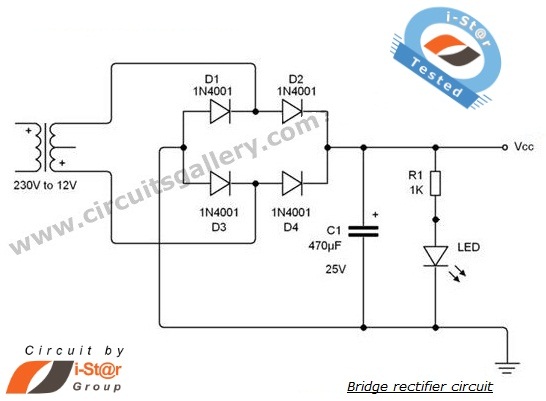
diode bridge rectifier circuits
A rectifier is an electronic circuit that converts AC voltage to DC voltage. It can be implemented using a combination of capacitors and diodes. The unique property of diodes, which allows current to flow in a single direction, is utilized...
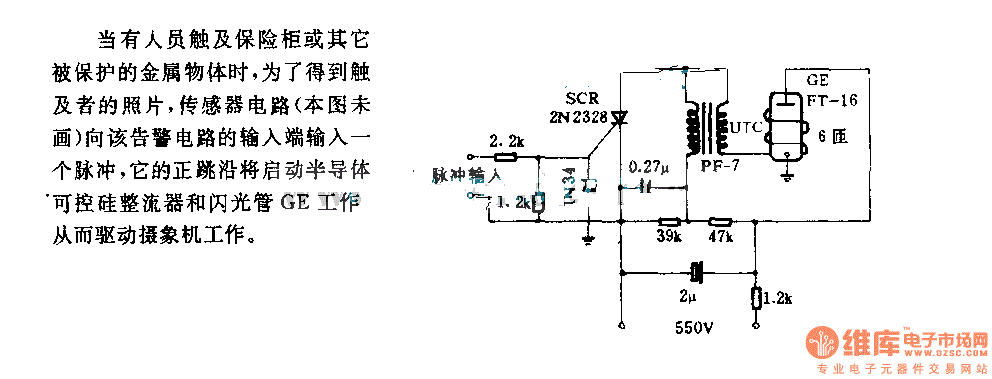
The alarm circuit diagram for safety box and other metal objects
When an individual touches the safety box or other protected metal objects, the sensor circuit generates a pulse to the alarm circuit. The positive edge of this pulse activates the semiconductor and thyristor flash GE, subsequently triggering the camera to...