


audio mixing
#audio mixing
#signal processing
#audio signals
#sound engineering
#mixer circuit
#audio amplifier
#analog circuits
#audio processing
#stereo mixing
#audio electronics
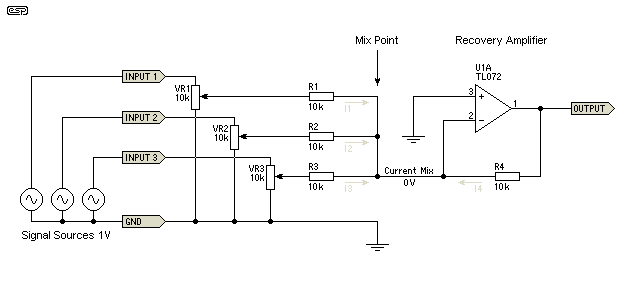
Description: The fundamental principles of mixing audio signals are simple, yet they are often not clearly explained online. This article aims to address those gaps.
Mixing audio signals involves combining multiple sound sources to create a cohesive audio output. The process requires a fundamental understanding of various concepts such as levels, panning, equalization, and effects. Each of these elements plays a crucial role in achieving a balanced and professional-sounding mix.
Levels refer to the amplitude of each audio signal. Proper level management ensures that no single element overwhelms others, allowing for clarity and definition in the mix. It is essential to adjust levels appropriately to maintain a dynamic range that is neither too compressed nor too dynamic.
Panning involves positioning audio signals within the stereo field. By distributing sounds across the left and right channels, a mix can achieve depth and spatial awareness. Careful panning can create a more immersive listening experience, allowing listeners to perceive the arrangement of instruments and vocals.
Equalization (EQ) is a critical tool used to enhance or reduce specific frequency ranges within audio signals. By applying EQ, unwanted frequencies can be attenuated, and desirable characteristics can be emphasized. This process helps in reducing muddiness and harshness, ensuring that each element occupies its own frequency space.
Effects such as reverb, delay, and compression can further enhance the mix. Reverb adds a sense of space and depth, while delay can create rhythmic interest. Compression helps control dynamics by reducing the volume of louder signals and raising the volume of quieter ones, leading to a more consistent sound.
In summary, mixing audio signals requires a comprehensive understanding of levels, panning, equalization, and effects. Mastery of these principles can lead to clearer, more engaging audio productions that resonate with listeners.The essential principles of mixing audio signals are straightforward, but strangely are not explained very well at all on the Net. This article should fill the gaps..
Mixing audio signals involves combining multiple sound sources to create a cohesive audio output. The process requires a fundamental understanding of various concepts such as levels, panning, equalization, and effects. Each of these elements plays a crucial role in achieving a balanced and professional-sounding mix.
Levels refer to the amplitude of each audio signal. Proper level management ensures that no single element overwhelms others, allowing for clarity and definition in the mix. It is essential to adjust levels appropriately to maintain a dynamic range that is neither too compressed nor too dynamic.
Panning involves positioning audio signals within the stereo field. By distributing sounds across the left and right channels, a mix can achieve depth and spatial awareness. Careful panning can create a more immersive listening experience, allowing listeners to perceive the arrangement of instruments and vocals.
Equalization (EQ) is a critical tool used to enhance or reduce specific frequency ranges within audio signals. By applying EQ, unwanted frequencies can be attenuated, and desirable characteristics can be emphasized. This process helps in reducing muddiness and harshness, ensuring that each element occupies its own frequency space.
Effects such as reverb, delay, and compression can further enhance the mix. Reverb adds a sense of space and depth, while delay can create rhythmic interest. Compression helps control dynamics by reducing the volume of louder signals and raising the volume of quieter ones, leading to a more consistent sound.
In summary, mixing audio signals requires a comprehensive understanding of levels, panning, equalization, and effects. Mastery of these principles can lead to clearer, more engaging audio productions that resonate with listeners.The essential principles of mixing audio signals are straightforward, but strangely are not explained very well at all on the Net. This article should fill the gaps..

Circuit of power audio amplifier with circuit integrated tda2030 car amplifier 14 watts rms
The TDA2030 is a monolithic integrated circuit in a Pentawat® package designed to function as a Class AB audio amplifier. It typically delivers up to 14 watts of output power (with a distortion rate of 0.5%) at 14V with a...

4-channel amplifier
The rear channel "ambience" can be incorporated into an existing stereo system to extract a difference signal (R - L or L - R). When this signal is combined with a direct signal (R or L), it enhances the fullness...

5 Watt Class-A Audio Amplifier Circuit diagram
This solid-state push-pull single-ended Class A circuit is designed to deliver sound quality comparable to valve amplifiers, providing an output power of 6.9W measured across an 8 Ohm loudspeaker cabinet load. It features reduced total harmonic distortion (THD), increased input...

stereo power amplifier 4w 8w with tda2005
This circuit is a class AB stereo audio power amplifier designed by Quasar for high-fidelity applications using a TDA2005 module. It is straightforward to construct and requires a minimal number of external components. The module includes output current protection and...

Small class b audio amplifier circuit diagram
When the power supply reaches the circuit and the input signal is applied, the sound signal is processed through capacitor C1 and resistor R1 for signal coupling and noise reduction. The modified signal then reaches pin 3 (non-inverting) of operational...

22 Watt Audio Amplifier
The 22 watt amp is easy to build, and very inexpensive. The circuit can be used as a booster in a car audio system, an amp for satellite speakers in a surround sound or home theater system, or as an...

4 Watt audio Amplifier
The circuit is very simple and incorporates darlington output transistors that will provide more than enough output current than is needed to drive a 3-ohm speaker. The gain may be pre-set for a variety of input levels, making it suitable...

TDA8932B D Audio Amplifier
The following circuit diagram represents a simplified application circuit of the TDA8932B/33(B) device when operated from an asymmetrical (single) supply. To streamline the design for an asymmetrical supply in a single-ended (SE) configuration, the TDA8932B/33(B) incorporates three integrated half-supply voltage...

50 Watt Amplifier
This is a handy, easy to build general purpose 50 watt amp. The amp has an input for a radio, TV, stereo or other line level device. More: It also has a phono input for a record player, guitar, microphone...