


Talk Over Circuit
#talk over
#radio station
#music
#potentiometer
#audio mixing
#voice over
#sound system
#public address
#broadcast
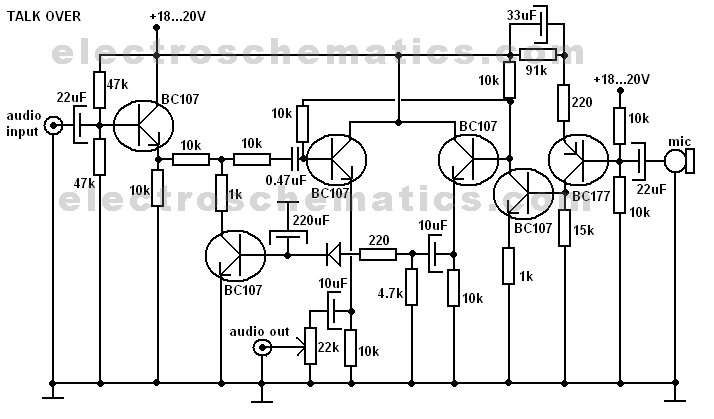
Description: A very useful talk-over circuit that can be utilized in radio stations, clubs, or any location where speaking over music is desired without the need for adjusting a potentiometer.
The talk-over circuit is designed to automatically reduce the volume of background music when a microphone input is detected, allowing for clear communication without manual volume adjustments. This circuit typically employs a compressor or an automatic gain control (AGC) mechanism to achieve the desired effect.
The basic components of a talk-over circuit include a microphone preamplifier, a comparator, and a variable resistor or digital control for the music signal. The microphone preamplifier amplifies the audio signal from the microphone, ensuring that it is strong enough to trigger the subsequent components.
The comparator monitors the amplitude of the microphone signal relative to the music signal. When the microphone signal exceeds a certain threshold, the comparator sends a control signal to reduce the music volume. This can be achieved by using a voltage-controlled amplifier (VCA) or a relay that adjusts the music signal path.
The circuit may also incorporate additional features such as adjustable sensitivity and response time to fine-tune the operation according to the specific application. For instance, a longer response time can create a smoother transition between music and speech, while adjustable sensitivity allows for customization based on the ambient noise levels.
Power supply considerations are also important, as the circuit may require a stable voltage source to function correctly. It is common to use a dual power supply configuration to accommodate both the analog and digital components of the circuit.
In summary, the talk-over circuit is an essential tool for environments where clear audio communication is necessary over background music, providing an automated solution that enhances user experience without manual intervention.A very usefull talk over circuit which you can use in your radio stations, club or anywhere you want to speak over music without any movement of potentiome..
The talk-over circuit is designed to automatically reduce the volume of background music when a microphone input is detected, allowing for clear communication without manual volume adjustments. This circuit typically employs a compressor or an automatic gain control (AGC) mechanism to achieve the desired effect.
The basic components of a talk-over circuit include a microphone preamplifier, a comparator, and a variable resistor or digital control for the music signal. The microphone preamplifier amplifies the audio signal from the microphone, ensuring that it is strong enough to trigger the subsequent components.
The comparator monitors the amplitude of the microphone signal relative to the music signal. When the microphone signal exceeds a certain threshold, the comparator sends a control signal to reduce the music volume. This can be achieved by using a voltage-controlled amplifier (VCA) or a relay that adjusts the music signal path.
The circuit may also incorporate additional features such as adjustable sensitivity and response time to fine-tune the operation according to the specific application. For instance, a longer response time can create a smoother transition between music and speech, while adjustable sensitivity allows for customization based on the ambient noise levels.
Power supply considerations are also important, as the circuit may require a stable voltage source to function correctly. It is common to use a dual power supply configuration to accommodate both the analog and digital components of the circuit.
In summary, the talk-over circuit is an essential tool for environments where clear audio communication is necessary over background music, providing an automated solution that enhances user experience without manual intervention.A very usefull talk over circuit which you can use in your radio stations, club or anywhere you want to speak over music without any movement of potentiome..

Music Light Show
The circuit connects to the speaker outputs of your stereo or to the back of your speaker. The music passes through the transformer and the volume level is adjusted by the 5k ohm pot. Each light bulb is turned on...

potentiometer Making an adjustable resistance
This part of the circuit is isolated from any other component, except for the 5V and ground connections. It includes LEDs and a shift register, which may not interact significantly. The LDR (Light Dependent Resistor) is utilized solely as a...

Music synthesizer
The music synthesizer mode offers three operational modes: playing a note, playing one of four pre-stored tunes, or recording a tune for later playback.
In the music synthesizer mode, the circuit is designed to facilitate three distinct functionalities, enhancing user interaction...

Wet/Dry Mix Knob - will this schematic work
A simple wet/dry knob is desired to be added to a GSSL (Chameleon Labs 7720) for parallel compression. A relevant schematic has been found.
To implement a wet/dry knob for parallel compression on a GSSL (Chameleon Labs 7720), the circuit can...

Bachmann Sound Tips
The Bachmann Big Hauler locomotive has significantly improved in appearance, reliability, and noise level over the past few years. However, the sound system remains basic, providing a poor imitation of exhaust sounds in the form of a chuff synchronized with...
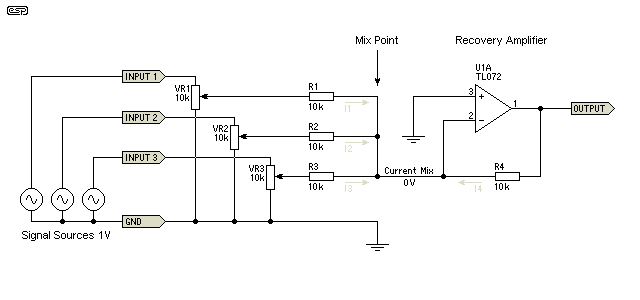
audio mixing
The fundamental principles of mixing audio signals are simple, yet they are often not clearly explained online. This article aims to address those gaps.
Mixing audio signals involves combining multiple sound sources to create a cohesive audio output. The process requires...

Using tap potentiometer loudness circuit
Figure 1.88 illustrates the loudness control circuit utilizing multiple taps on a potentiometer. In Figure (A), the connection is made between the tap and the potentiometer's input, along with the ground. An RC compensation network is employed, where the slide...
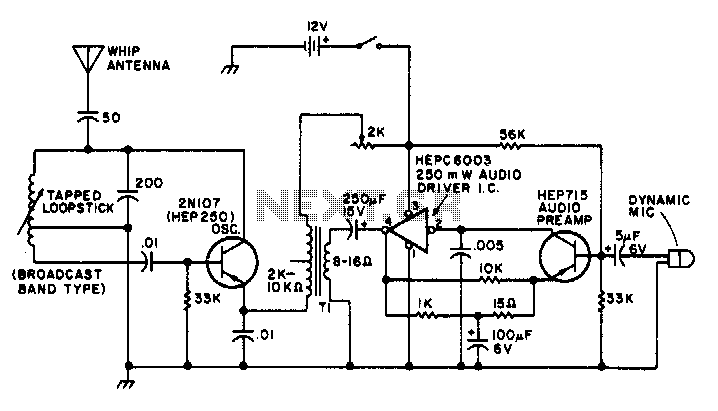
1-2Mhz broadcast transmitter
T1 is a low impedance output transformer with a conversion ratio of 5000 to 8 ohms.
The low impedance output transformer, T1, is designed to match the output of an audio amplifier to the impedance of the speaker load. The specified...

Final Project
The objective was to create an octave that could be played by pressing a crocodile paddle. This device was designed as an entertainment tool, functioning as a giant piano, allowing users to control sound with their feet. The project was...