


Tremolo Circuit
#tremolo
#audio effect
#VLF
#AM modulation
#musical instruments
#phase-shift
#signal processing
#sound modulation

Description: This circuit incorporates a Very Low Frequency (VLF) Amplitude Modulation (AM) component into an audio signal. This effect is commonly utilized in musical instruments. U1C, a phase-shift oscillator functioning at a few Hertz, generates a signal that modulates the gain of U1D. Resistor R11 adjusts the level of the effect, while resistor R12 modifies the frequency.
The circuit operates by leveraging a phase-shift oscillator (U1C) that produces a low-frequency oscillation. This oscillator typically consists of an operational amplifier configured in a feedback loop that introduces phase shifts to create a sine wave output at a frequency in the range of a few Hertz. The output of U1C is fed to transistor Q1, which acts as a modulator. The modulation of the gain of U1D is achieved by varying the control voltage applied to its input, influenced by the oscillating signal from Q1.
Resistor R11 plays a critical role in controlling the depth of the modulation effect. By adjusting R11, the user can increase or decrease the amplitude of the modulation signal, thus altering how pronounced the VLF AM effect is on the audio signal. A higher resistance value will result in a subtler effect, while a lower value will yield a more pronounced modulation.
Resistor R12 is responsible for adjusting the frequency of the modulation effect. Changing the resistance value alters the feedback network of the phase-shift oscillator, which in turn modifies the frequency of the oscillation. This allows for a range of modulation frequencies to be selected, enabling the user to tailor the sound to their preferences.
Overall, this circuit design is beneficial for musicians and sound designers looking to incorporate unique modulation effects into their audio signals, enhancing the sonic characteristics of their instruments or audio production. Proper implementation of the circuit components and careful tuning of R11 and R12 can yield a wide variety of creative sound effects. This circuit adds a VLF AM component to an audio signal. This effect is widely used in musical instruments. U1C, a phase-sh ift oscillator operating at a few Hz applies a signal to Ql, which modulates the gain of U1D. Rll varies the level of the effect, while R12 varies the frequency.
The circuit operates by leveraging a phase-shift oscillator (U1C) that produces a low-frequency oscillation. This oscillator typically consists of an operational amplifier configured in a feedback loop that introduces phase shifts to create a sine wave output at a frequency in the range of a few Hertz. The output of U1C is fed to transistor Q1, which acts as a modulator. The modulation of the gain of U1D is achieved by varying the control voltage applied to its input, influenced by the oscillating signal from Q1.
Resistor R11 plays a critical role in controlling the depth of the modulation effect. By adjusting R11, the user can increase or decrease the amplitude of the modulation signal, thus altering how pronounced the VLF AM effect is on the audio signal. A higher resistance value will result in a subtler effect, while a lower value will yield a more pronounced modulation.
Resistor R12 is responsible for adjusting the frequency of the modulation effect. Changing the resistance value alters the feedback network of the phase-shift oscillator, which in turn modifies the frequency of the oscillation. This allows for a range of modulation frequencies to be selected, enabling the user to tailor the sound to their preferences.
Overall, this circuit design is beneficial for musicians and sound designers looking to incorporate unique modulation effects into their audio signals, enhancing the sonic characteristics of their instruments or audio production. Proper implementation of the circuit components and careful tuning of R11 and R12 can yield a wide variety of creative sound effects. This circuit adds a VLF AM component to an audio signal. This effect is widely used in musical instruments. U1C, a phase-sh ift oscillator operating at a few Hz applies a signal to Ql, which modulates the gain of U1D. Rll varies the level of the effect, while R12 varies the frequency.

Tremolo Effect Circuit for Electric Guitar or Other Musical Instruments
A tremolo circuit is a type of sound effect commonly utilized in guitar effect pedals. This effect is achieved by modulating the amplitude of an audio signal. The shape of the modulating signal can vary and may include square wave,...

35W resistive and capacitive half-wave phase-shift trigger doer control circuit
A 35W resistive and capacitive half-wave phase-shift trigger control circuit is designed for automatic or semi-automatic welding equipment to manage wire feeding and welding carriage travel. This system necessitates a drive control circuit to fulfill the welding process requirements. The...

Vlf Whistler Receiver Circuit
The VLF whistler receiver is designed to detect natural radio noise and signals that occur below 20 kHz. LI is a large loop antenna consisting of 250 to 300 turns of #26 gauge wire wound on a form with a...

Interpolating Scanner Circuit
This design is for an interpolating scanner, a circuit featuring multiple signal inputs, a control voltage input, and a signal output. The output selectively transitions between inputs, smoothly fading from one to the next as the control voltage increases. A...

Tremolo
This simple circuit can color the sound coming from your audio system. Clocking for the circuit is provided by an oscillator built from one quarter of a 4093 quad NAND Schmitt trigger. With the component values shown, it will run...
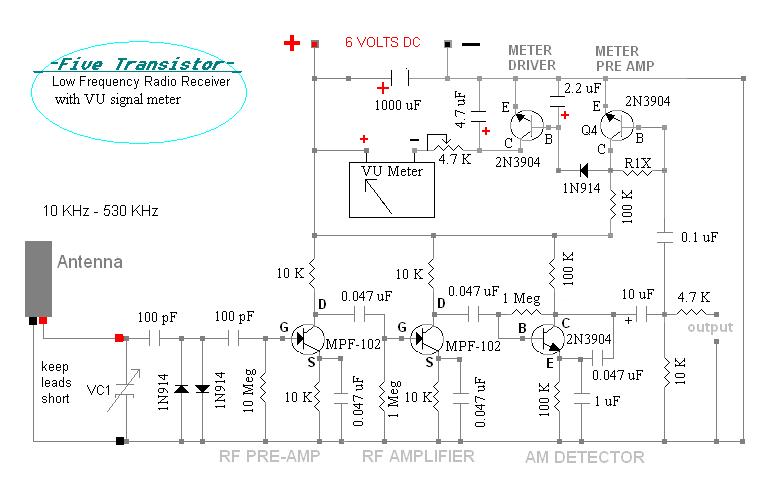
Stormwise VLF Radio Electronic Project
This radio receiver, constructed on a wooden base, utilizes only five transistors to receive longwave beacons and VLF beacons, depending on the connected antenna unit. It incorporates the AMVC-384 capacitor along with one of the "C" antennas. The unit, noted...

AM Modulator
This circuit employs two signal generators to simulate an amplitude-modulated RF carrier wave. The output can be utilized to analyze the response of LC and tank circuits. One signal generator represents a high-frequency RF carrier at 200 kHz (VG2), while...
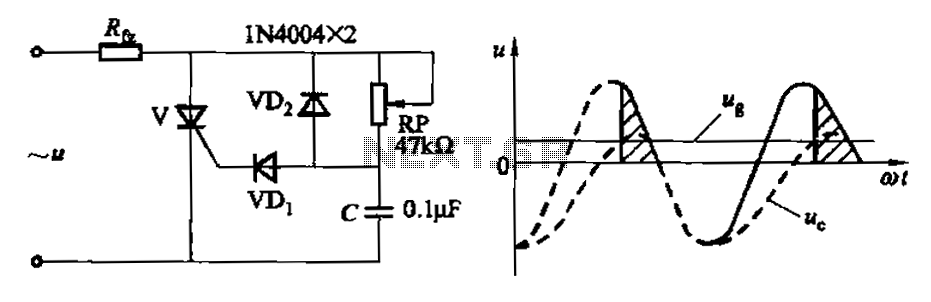
Resistance-capacitance diode-plus phase-shift trigger circuit
Circuit characteristics: A simple phase shift range of 180 degrees, with a practical range of 170 degrees. The circuit is influenced by temperature and is suitable for small power applications in less demanding situations.
The circuit operates by utilizing a basic...

VLF Radio Receiver circuit
This version sports a 2nd audio amplifier stage at Q3. The output level with this version is sufficient to drive a crystal headphone to a comfortable volume. The "crystal" headphone is like those used on ye olde crystal radios. A...