


Vacuum State Electronics FVP5A tube preamp
#tube preamp
#vacuum state
#audio amplifier
#high fidelity
#electronics
#audio equipment
#preamplifier
#hifi
#audiophile
#sound quality

Description: This review highlights a dual-test scenario involving the FVP preamp, with initial contacts made with Vacuum State and insights provided by Geoff during a trip to Brittany. The FVP was sent to France for evaluation. Geoff tested the FVP5A in high-gain mode, contrasting it with his low-gain Audion preamp and a Dynavector current-mode step-up device. The Dynavector DRT-1 cartridge experienced a high 47k impedance with the VSE preamp, while it encountered zero Ohms with the Dyna/Audion combination, indicating a significant difference. After studying Allen's books on preamps and cables, the reviewer received a modified preamp from Allen, which was not in pristine condition but met FVP5 specifications. The preamp, resembling an old integrated unit, was lightweight due to its thin alloy case and a small mains transformer. Despite its appearance, the preamp produced a realistic soundscape, especially evident in the Sheffield Labs recording of "Harry James - King James." The reviewer noted the FVP5's ability to create a vast soundstage, although it fell slightly short in comparison to the Audion in terms of energy and depth. The Dynavector step-up device enhanced the performance of the Audion, which was designed for optimal compatibility with the DRT-1 cartridge.
The FVP5 preamplifier, designed by Vacuum State, represents a significant advancement in audio technology, despite its unassuming exterior. The preamp's performance was evaluated under various conditions, particularly in high-gain mode, which allows for a greater amplification of the audio signal. This mode was contrasted with a low-gain configuration utilizing an Audion preamp coupled with a Dynavector current-mode step-up transformer, emphasizing the importance of impedance matching in high-fidelity audio systems. The Dynavector DRT-1 cartridge experienced markedly different loading conditions, which can significantly affect sound reproduction quality.
The physical design of the FVP5 is noteworthy. While its lightweight construction may suggest a lack of quality, it is an intentional design choice that prioritizes performance. The use of a small mains transformer and fine solid-core copper wiring aligns with modern audio engineering practices that seek to minimize signal degradation. The preamp’s design facilitates low noise and high fidelity, enabling it to produce a soundscape that is both expansive and immersive.
The evaluation of the FVP5 with the Sheffield Labs recording exemplifies its capability to reproduce a realistic soundstage, allowing listeners to perceive spatial characteristics of the recording environment. This ability to convey depth and dimensionality is critical in high-end audio reproduction. While the FVP5 demonstrated impressive performance, it was noted that the Audion preamp, when paired with the Dynavector step-up transformer, provided a more energetic sound. This observation underscores the significance of component synergy in audio systems, where the interaction between different devices can influence overall sound quality.
In conclusion, the FVP5 preamplifier stands out as a capable device within the realm of high-end audio, demonstrating that aesthetic appearance does not always correlate with performance. Its engineering principles reflect a commitment to achieving high fidelity, making it a valuable component for audiophiles seeking to enhance their listening experience.This was one of those reviews where time and circumstances conspired to allow a dual-test. I made the first contacts with Vacuum State, and Allen was eager to oblige. Combine this with a planned trip to Brittany and it was obvious that Geoff too would have a listen to the FVP. Eventually I got tied up rebuilding part of the house we just bought, a nd so the FVP first was sent off to France. These are Geoff`s findings. Note that Geoff used the FVP5A in high-gain mode (I did so in low gain mode), comparing to his own low-gain Audion preamp plus the Dynavector current-mode step-up device. So in case of the VSE pre, Geoff`s resident Dynavector DRT-1 cartridge saw a high 47k impedance, while driving the Dyna/Audion combo it saw the zero Ohms of the current input.
Quite a difference. - Werner After having read Allen`s two books, the first on pre-amps, the second on cables, I was intrigued to see what happened when all this was put into practice. And so a month down the line I was presented with a large cardboard box by the deliveryman. Opening it all up revealed a much loved, modified and abused ( ) pre-amp, indeed the one that Allen uses himself to try out new ideas.
In effect it was up to full FVP5 spec but the disconnected balance controls and jury rigged phono switch showed how it was a "mule". Cosmetically it looked like a 20 year-old integrated, not a state-of-the-art valve pre-amp, and I even had to remove the top cover as the extra valves would generate too much heat for the `old` slots.
BUT I was expecting all this, Allen assured me that under the bonnet it was cutting edge and directly comparable with the production FVP5A. What did surprise me though was the weight. Generally hi-end amps are sold by the pound and here I had something that felt like a budget CD player.
The thin alloy casework provided part of the answer but the main reason was the small mains transformer: not a lot bigger than the "wall wart" freebees. My own Audion Silver Knight pre has an off-board power supply that must weigh two times as much as the complete FVP5.
Looking further the whole thing was wired with very fine solid core copper wire as per the Wright pre-amp book. So what makes this ugly duckling into a swan First comes that most difficult trick, producing a realistic soundscape.
I have a copy of the Sheffield Labs `Harry James - King James`, a disc that is so far ahead of almost any other recording it wants to make you string up every marketing exec, producer and recording engineer by the thumbs until they promise to match it. It`s recorded, direct to disc in a chapel, and boy can you `see` the walls with the Wright pre. It`s not clinical, stripping bare every instrument, rather there`s a big orchestra bound between (and beyond) the speakers, and reaching both way back and slightly in front of them.
The music is not totally to my taste but the intoxicating rasp of brass, the tight drumkit and sheer energy mean it`s a disc that`s almost impossible to take off. This is high-end stuff no matter what the box looks like. My own Audion held up its end well here, producing a slightly more energetic and meaty rendition, albeit lacking some of the FVP5`s depth and precision.
Here I point the finger to the Dynavector step-up I used with the Audions MM stage. This is an amazing device endowing any top MC with a power and weight you`d not believe. Here the FVP5`s MC phono stage missed out, and substituting the Trichord Dino and squirting this direct into the Audion did rather redress the balance. I might add that the Dynavector step-up was designed specifically for the DRT-1 and as such is a stunning match (at a price).
That the FVP5 should fall behind a little in direct comparison is then less of a surprise. Werner did also point out that the FVP5 wasn`t loading the Dynavector to it`s optimum 30ohms so. And these basic characteristics continued through the raft of records I played over the n
The FVP5 preamplifier, designed by Vacuum State, represents a significant advancement in audio technology, despite its unassuming exterior. The preamp's performance was evaluated under various conditions, particularly in high-gain mode, which allows for a greater amplification of the audio signal. This mode was contrasted with a low-gain configuration utilizing an Audion preamp coupled with a Dynavector current-mode step-up transformer, emphasizing the importance of impedance matching in high-fidelity audio systems. The Dynavector DRT-1 cartridge experienced markedly different loading conditions, which can significantly affect sound reproduction quality.
The physical design of the FVP5 is noteworthy. While its lightweight construction may suggest a lack of quality, it is an intentional design choice that prioritizes performance. The use of a small mains transformer and fine solid-core copper wiring aligns with modern audio engineering practices that seek to minimize signal degradation. The preamp’s design facilitates low noise and high fidelity, enabling it to produce a soundscape that is both expansive and immersive.
The evaluation of the FVP5 with the Sheffield Labs recording exemplifies its capability to reproduce a realistic soundstage, allowing listeners to perceive spatial characteristics of the recording environment. This ability to convey depth and dimensionality is critical in high-end audio reproduction. While the FVP5 demonstrated impressive performance, it was noted that the Audion preamp, when paired with the Dynavector step-up transformer, provided a more energetic sound. This observation underscores the significance of component synergy in audio systems, where the interaction between different devices can influence overall sound quality.
In conclusion, the FVP5 preamplifier stands out as a capable device within the realm of high-end audio, demonstrating that aesthetic appearance does not always correlate with performance. Its engineering principles reflect a commitment to achieving high fidelity, making it a valuable component for audiophiles seeking to enhance their listening experience.This was one of those reviews where time and circumstances conspired to allow a dual-test. I made the first contacts with Vacuum State, and Allen was eager to oblige. Combine this with a planned trip to Brittany and it was obvious that Geoff too would have a listen to the FVP. Eventually I got tied up rebuilding part of the house we just bought, a nd so the FVP first was sent off to France. These are Geoff`s findings. Note that Geoff used the FVP5A in high-gain mode (I did so in low gain mode), comparing to his own low-gain Audion preamp plus the Dynavector current-mode step-up device. So in case of the VSE pre, Geoff`s resident Dynavector DRT-1 cartridge saw a high 47k impedance, while driving the Dyna/Audion combo it saw the zero Ohms of the current input.
Quite a difference. - Werner After having read Allen`s two books, the first on pre-amps, the second on cables, I was intrigued to see what happened when all this was put into practice. And so a month down the line I was presented with a large cardboard box by the deliveryman. Opening it all up revealed a much loved, modified and abused ( ) pre-amp, indeed the one that Allen uses himself to try out new ideas.
In effect it was up to full FVP5 spec but the disconnected balance controls and jury rigged phono switch showed how it was a "mule". Cosmetically it looked like a 20 year-old integrated, not a state-of-the-art valve pre-amp, and I even had to remove the top cover as the extra valves would generate too much heat for the `old` slots.
BUT I was expecting all this, Allen assured me that under the bonnet it was cutting edge and directly comparable with the production FVP5A. What did surprise me though was the weight. Generally hi-end amps are sold by the pound and here I had something that felt like a budget CD player.
The thin alloy casework provided part of the answer but the main reason was the small mains transformer: not a lot bigger than the "wall wart" freebees. My own Audion Silver Knight pre has an off-board power supply that must weigh two times as much as the complete FVP5.
Looking further the whole thing was wired with very fine solid core copper wire as per the Wright pre-amp book. So what makes this ugly duckling into a swan First comes that most difficult trick, producing a realistic soundscape.
I have a copy of the Sheffield Labs `Harry James - King James`, a disc that is so far ahead of almost any other recording it wants to make you string up every marketing exec, producer and recording engineer by the thumbs until they promise to match it. It`s recorded, direct to disc in a chapel, and boy can you `see` the walls with the Wright pre. It`s not clinical, stripping bare every instrument, rather there`s a big orchestra bound between (and beyond) the speakers, and reaching both way back and slightly in front of them.
The music is not totally to my taste but the intoxicating rasp of brass, the tight drumkit and sheer energy mean it`s a disc that`s almost impossible to take off. This is high-end stuff no matter what the box looks like. My own Audion held up its end well here, producing a slightly more energetic and meaty rendition, albeit lacking some of the FVP5`s depth and precision.
Here I point the finger to the Dynavector step-up I used with the Audions MM stage. This is an amazing device endowing any top MC with a power and weight you`d not believe. Here the FVP5`s MC phono stage missed out, and substituting the Trichord Dino and squirting this direct into the Audion did rather redress the balance. I might add that the Dynavector step-up was designed specifically for the DRT-1 and as such is a stunning match (at a price).
That the FVP5 should fall behind a little in direct comparison is then less of a surprise. Werner did also point out that the FVP5 wasn`t loading the Dynavector to it`s optimum 30ohms so. And these basic characteristics continued through the raft of records I played over the n

60W audio amplifier
In the circuit exists a simple power amplifier 60W in the 8 ohm and 80W in the 4 ohm, with components that sure exist in big quantities. It can be used in home cinema systems or in other uses. With...

Low cost 20 w audio amplifier
This simple and inexpensive audio amplifier can be constructed using a couple of TO-220 monolithic Darlington transistors for the push-pull output stage. The frequency response is flat within 1 dB from 30 Hz to 200 kHz, with typical harmonic distortion...

General-Purpose 5W Audio Amplifier With Ac Power Supply
This general-purpose low-power (5 W) audio amplifier is designed to drive speakers ranging from 8 to 12 inches. It utilizes a Sanyo LA4460 integrated circuit (IC) as the audio output component. The circuit features a loudness control, a driver amplifier...

RIAA Phono Preamplifier
Modern sound systems often lack inputs for record players, leading to a rise in the popularity of separate MD preamplifiers. These devices are essential not only for vinyl enthusiasts but also for individuals looking to digitize their LP collections onto...

10 vpp audio amplifier circuit
A simple audio amplifier with a 10 Vpp output designed for use with the AD633 ring modulation chip. The datasheet for the chip is available, and the circuit will utilize the XR2206 function generator IC for the modulation input.
The...
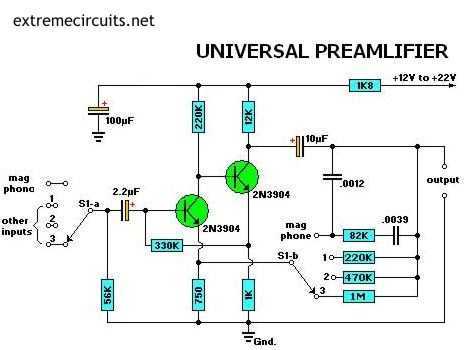
General use Preamplifier with 2N3904
Most audio amplifier systems must have preamplifiers with many different characteristics. These include high-gain linear response for magnetic microphones, low-gain linear response for tuners, and high-gain RIAA equalization for magnetic phone cartridges. To meet this broad requirement, most amplifier designers...

Phono RIAA Preamplifier
In this circuit exists a second designing proposal of preamplifier RIAA. The first stage uses discernible components and in second exist a opamp. [IC1]. In the negative feedback exist the correction RIAA filters. Certain points need certain discriminators: 1] capacitors...

Moduler Preamplifier Circuit
This module utilizes an unconventional topology while retaining the fundamental operational amplifier circuitry of the main module, with some modifications in resistor values. A distinctive feature of this circuit is the incorporation of six-way switches instead of the more typical...

Audio Line High-End Preamplifier with ICs
The original description discusses a modular preamplifier that is simpler in construction yet exceptional in quality. The philosophy behind this circuit is that simplicity can also lead to better results. The circuit only uses a volume potentiometer. The Tape Monitor...