


Analysis schematic Chaolitong Phone Travel Charger
#phone charger
#travel charger
#nickel-cadmium
#nickel hydrogen
#lithium-ion
#Motorola
#battery switch
#mobile phone

Description: Chaolitong Phone Travel Charger for Motorola models 308, 328, 338, and 368 series mobile phone batteries. This charger features a switch for nickel-cadmium, nickel-hydrogen, and lithium-ion batteries, along with a discharge function. It operates with an AC mains input of 150 to 250V at 40mA and provides a DC output of 300mA at 50V. The following information is based on the physical operating principle for reference. At no load, pin IC1 reads 0.08V, indicating V6 cutoff. Diodes VD10 and VD11 illuminate, showing corresponding capacities of 40% and 60%. When the voltage across resistors R40 and R41 rises to 2.63V, pin IC1 also reaches 2.63V, and the output transitions high, causing diode VD9 to light up, indicating an 80% charge capacity. When pin IC1 voltage reaches 2.66V, the output remains high, and VD13 lights up, corresponding to a 100% charge capacity. Even with VD13 illuminated, VD12 continues to blink, indicating that the battery has not yet reached full saturation. Only when the voltage at pin IC1 reaches 6.5V does VD12 gradually turn off, signaling that the battery is fully charged to saturation. Diode VD16 serves as overcurrent protection in the charging circuit, while VD8 provides reverse protection, preventing the charger from discharging back into the battery.
The Chaolitong Phone Travel Charger is designed for specific Motorola mobile phone models, ensuring compatibility with their battery technologies. The integrated switch allows users to select the appropriate battery type, optimizing charging conditions for nickel-cadmium, nickel-hydrogen, or lithium-ion batteries.
The charger operates efficiently within a voltage range of 150 to 250V AC, drawing a current of 40mA from the mains. It converts this input into a stable 300mA DC output, which is suitable for charging the designated mobile phone batteries. The circuit employs a series of diodes and resistors to monitor and indicate the charging status.
The monitoring system utilizes an integrated circuit (IC1) that provides feedback on the charging process. At no load, IC1 pin indicates a low voltage of 0.08V, which corresponds to a cutoff state for the charger. As the charging process begins, the voltage across resistors R40 and R41 is monitored. When this voltage reaches 2.63V, the output from IC1 transitions to a high state, turning on diode VD9, which signals that the battery is at 80% capacity.
As the charging continues and the voltage at IC1 reaches 2.66V, diode VD13 indicates a full charge capacity of 100%. However, the continued blinking of VD12 suggests that the battery has not yet reached its full saturation point. The final indication of a fully charged battery occurs when the voltage at IC1 reaches 6.5V, at which point VD12 turns off, confirming that the battery is fully charged.
In terms of safety features, diode VD16 is included to protect against overcurrent situations during charging, while diode VD8 prevents any reverse discharge from the battery back into the charger, safeguarding both the charger and the battery from potential damage. This comprehensive design ensures reliable performance and safety during the charging process of Motorola mobile phone batteries. Chaolitong Phone Travel Charger for Motorola to 308,328,338 and 368 series mobile phone battery. The charger has a nickel-cadmium, nickel hydrogen, lithium-ion battery switch, and having a discharge function. In 150 ~ 250V, 40mA when AC mains input, output 300 50mA DC current. The following are plotted based on physical operating principle, for your reference. on the contrary at no load, IC1 a pin is 0.08V, V6 cutoff), VD10, VD11 lights, indicating the corresponding capacity of 40%, 60%. When the partial pressure values R40, R41 rises to 2.63V, that IC1 foot equals 2.63V, after which foot via a resistor voltage divider was 2.63V, feet high output, VD9 lights corresponding to the charge capacity of 80%.
Only IC1 ? pin voltage 2.66V, feet only output high, VD13 lights corresponding to the charge capacity of 100%. Even when lit VD13, VD12 still blinks, it indicates that the battery has not yet reached full saturation. Only IC1 pin voltage 6.5V time, VD12 gradually turns off, the battery is fully charged to saturation.
VD16 played in the charge circuit, overcurrent protection role, VD8 play reverse the protective effect, avoid power charger, the battery reverse discharge.
The Chaolitong Phone Travel Charger is designed for specific Motorola mobile phone models, ensuring compatibility with their battery technologies. The integrated switch allows users to select the appropriate battery type, optimizing charging conditions for nickel-cadmium, nickel-hydrogen, or lithium-ion batteries.
The charger operates efficiently within a voltage range of 150 to 250V AC, drawing a current of 40mA from the mains. It converts this input into a stable 300mA DC output, which is suitable for charging the designated mobile phone batteries. The circuit employs a series of diodes and resistors to monitor and indicate the charging status.
The monitoring system utilizes an integrated circuit (IC1) that provides feedback on the charging process. At no load, IC1 pin indicates a low voltage of 0.08V, which corresponds to a cutoff state for the charger. As the charging process begins, the voltage across resistors R40 and R41 is monitored. When this voltage reaches 2.63V, the output from IC1 transitions to a high state, turning on diode VD9, which signals that the battery is at 80% capacity.
As the charging continues and the voltage at IC1 reaches 2.66V, diode VD13 indicates a full charge capacity of 100%. However, the continued blinking of VD12 suggests that the battery has not yet reached its full saturation point. The final indication of a fully charged battery occurs when the voltage at IC1 reaches 6.5V, at which point VD12 turns off, confirming that the battery is fully charged.
In terms of safety features, diode VD16 is included to protect against overcurrent situations during charging, while diode VD8 prevents any reverse discharge from the battery back into the charger, safeguarding both the charger and the battery from potential damage. This comprehensive design ensures reliable performance and safety during the charging process of Motorola mobile phone batteries. Chaolitong Phone Travel Charger for Motorola to 308,328,338 and 368 series mobile phone battery. The charger has a nickel-cadmium, nickel hydrogen, lithium-ion battery switch, and having a discharge function. In 150 ~ 250V, 40mA when AC mains input, output 300 50mA DC current. The following are plotted based on physical operating principle, for your reference. on the contrary at no load, IC1 a pin is 0.08V, V6 cutoff), VD10, VD11 lights, indicating the corresponding capacity of 40%, 60%. When the partial pressure values R40, R41 rises to 2.63V, that IC1 foot equals 2.63V, after which foot via a resistor voltage divider was 2.63V, feet high output, VD9 lights corresponding to the charge capacity of 80%.
Only IC1 ? pin voltage 2.66V, feet only output high, VD13 lights corresponding to the charge capacity of 100%. Even when lit VD13, VD12 still blinks, it indicates that the battery has not yet reached full saturation. Only IC1 pin voltage 6.5V time, VD12 gradually turns off, the battery is fully charged to saturation.
VD16 played in the charge circuit, overcurrent protection role, VD8 play reverse the protective effect, avoid power charger, the battery reverse discharge.

Efficient nickel-cadmium battery charger IC LTC1148 circuit
Efficient nickel-cadmium battery charger IC (LTC1148) circuit
The LTC1148 is an integrated circuit designed for the efficient charging of nickel-cadmium (NiCd) batteries. This charger IC features a constant current/constant voltage (CC/CV) charging method, which is essential for optimizing the charging process...

Nickel-cadmium battery fast charger temperature control circuit
When fast charging a nickel-cadmium battery, the temperature control circuit, as illustrated in the accompanying figure, is designed to monitor the battery temperature to regulate the charging current. The circuit consists of Icl to IC3, which forms the temperature control...
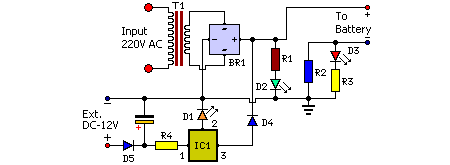
Low Cost Phone Battery Charger Schematic Diagram
Mobile phone battery chargers available in local markets can be quite expensive. The circuit presented here offers a low-cost alternative for charging cellular phone batteries or battery packs with a rating of 7.2 volts.
This low-cost phone battery charger circuit is...

mobile phone battery charger circuit
Mobile phone chargers available in the market are quite expensive. The circuit presented here serves as a low-cost alternative to charge mobile telephones or battery packs with a rating of 7.2 volts.
The proposed circuit design utilizes a straightforward approach to...
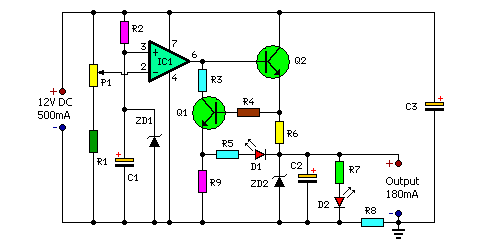
A Friendly Charger Schematic for Mobile Phones
Charges and protects your mobile phone from voltage spikes and short circuits. Most mobile chargers do not have current or voltage regulation, nor do they provide short-circuit protection.
The described circuit functions as a mobile phone charger designed to safeguard the...

Lithium ion battery charging circuit diagram
A lithium-ion battery charging circuit is illustrated above. Initially, when charging begins, if the battery voltage is below 8.4V, the output of IC1 is inactive. As a result, Q2 remains off, and the LM317 operates in constant current mode. When...

Motorola MaxTrac Radius and GM300 Series Introductory Information
This page focuses on radios marketed in the USA, compiled by residents familiar with these products. Contributions regarding non-USA radios are welcome, and a region-specific page could be created. The MaxTrac, Radius, and GM300 series have inspired additional radio designs...

Nickel-cadmium battery charger LM324 constituted
The first circuit is designed for discharging nickel-cadmium batteries before recharging to eliminate the "memory effect." After discharging, the power is automatically converted to the state of charge. The charging process utilizes pulse-width modulation for constant current, along with a...

Remote control by mobile phone
Many individuals may have an old mobile phone that is no longer in use. The circuit presented in this article repurposes the old mobile, allowing it to control an electrical appliance in or around the home by switching it on...