


USB Free Space Communicator
#laser communication
#optical communication
#USB device
#free space communication
#hyper terminal
#PC communication
#B.Tech project
#mini project

Description: During an optical communications course, an idea was conceived to establish a free space communication link between two PCs using a laser. As part of a B.Tech curriculum, a mini project is to be submitted. The project involves developing a USB device that enables two computers to communicate via laser using HyperTerminal.
The proposed project aims to create a free space optical communication link utilizing laser technology for data transmission between two personal computers (PCs). This system will leverage a USB interface for connectivity, allowing each PC to communicate wirelessly over a designated distance without the need for physical cabling.
The core components of the system include a laser diode for transmitting data, a photodiode for receiving the transmitted signal, and microcontroller units (MCUs) to manage data encoding and decoding. The laser diode will convert electrical signals from the transmitting PC into modulated light signals, which will then be directed toward the receiving PC. The photodiode will detect these light signals and convert them back into electrical signals for processing.
The communication protocol can be implemented using HyperTerminal, which allows the PCs to send and receive data in real-time. The use of a USB interface will facilitate easy connection and power supply for the laser and photodiode components. Additionally, the design will incorporate alignment mechanisms to ensure that the laser beam remains focused on the photodiode over the communication distance.
In terms of performance, the system must be calibrated to operate effectively under various lighting conditions and distances, ensuring reliable data transmission. The project will also include safety measures to prevent eye exposure to the laser beam, such as using low-power laser diodes and appropriate housing for the optical components.
Overall, this project represents an innovative approach to optical communication, demonstrating the principles of free space communication and practical applications of laser technology in modern data transmission.During my optical communications course, I had an idea to form a free space communication link between two PCs using LASER. We are supposed to submit a mini project as part of B.Tech curriculum. So I decided to develop a USB device which allows two computers to communicate using LASER via hyper terminal as.
The proposed project aims to create a free space optical communication link utilizing laser technology for data transmission between two personal computers (PCs). This system will leverage a USB interface for connectivity, allowing each PC to communicate wirelessly over a designated distance without the need for physical cabling.
The core components of the system include a laser diode for transmitting data, a photodiode for receiving the transmitted signal, and microcontroller units (MCUs) to manage data encoding and decoding. The laser diode will convert electrical signals from the transmitting PC into modulated light signals, which will then be directed toward the receiving PC. The photodiode will detect these light signals and convert them back into electrical signals for processing.
The communication protocol can be implemented using HyperTerminal, which allows the PCs to send and receive data in real-time. The use of a USB interface will facilitate easy connection and power supply for the laser and photodiode components. Additionally, the design will incorporate alignment mechanisms to ensure that the laser beam remains focused on the photodiode over the communication distance.
In terms of performance, the system must be calibrated to operate effectively under various lighting conditions and distances, ensuring reliable data transmission. The project will also include safety measures to prevent eye exposure to the laser beam, such as using low-power laser diodes and appropriate housing for the optical components.
Overall, this project represents an innovative approach to optical communication, demonstrating the principles of free space communication and practical applications of laser technology in modern data transmission.During my optical communications course, I had an idea to form a free space communication link between two PCs using LASER. We are supposed to submit a mini project as part of B.Tech curriculum. So I decided to develop a USB device which allows two computers to communicate using LASER via hyper terminal as.

Advanced Projects in Laser Communication
The previous section discussed several basic free-air laser light communication projects. It covered the modulation of a He-Ne laser beam using a transformer, transistor, and a piece of Mylar foil stretched in a needlepoint hoop. Various methods for electronically modulating...

1RE30 DATA TRANSMISSION USING LASER
Free-space optical (FSO) communication utilizes light as a medium for data transmission. Communication was established between two computers using a laser, independent of any conventional communication methods. Text messages were sent from one PC to another using a system referred...

Laser Communication (Transmitter-Receiver)
Laser communication system circuit diagram. The circuit module consists of a transmitter and a receiver that utilize the IC LM386. It is powered by a 9V battery.
The laser communication system is designed to facilitate wireless data transmission using modulated laser...

Optical communication system
The simple modulator stage will accommodate most common LEDs. By adjusting the potentiometer, the bias of the transistor is varied until the LED is at its half output point. Then, audio will cause it to vary above and below this...
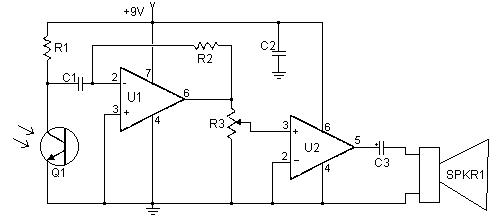
Transmitting Voice Wirelessly Using Laser
Transmitting voice wirelessly using laser technology, along with tips and tweaks to enhance your computer operating system experience.
The concept of transmitting voice wirelessly using laser involves utilizing modulated laser beams to carry audio signals over distances without the need for...

Optical communication system
The circuit modulates the light emitted by an LED using either a crystal microphone or a loudspeaker output. To achieve maximum range, the optical system must operate efficiently. A convex lens or a concave mirror can be utilized to transform...