


CPU number of liquid crystal display driver circuit example tube
#LCD
#display driver
#CPU interface
#digital display
#microcontroller
#data visualization
#circuit example
#embedded systems

Description: Examples of the structure of several liquid crystal display drive circuit CPU tubes.
Liquid crystal display (LCD) drive circuits play a critical role in controlling the operation of LCD panels, which are widely used in various electronic devices. These circuits typically consist of a combination of integrated circuits (ICs), passive components, and sometimes microcontrollers, which work together to manage the voltage and timing necessary for the proper functioning of the LCD.
The primary function of an LCD drive circuit is to generate the necessary waveforms that control the alignment of liquid crystal molecules in the display. This is achieved through a series of voltage levels applied to the electrodes of the LCD. The drive circuit must be capable of producing different waveforms for different pixel states, ensuring that the display can represent various images and text clearly.
In a typical LCD drive circuit, a microcontroller or dedicated LCD controller IC interfaces with the CPU to receive image data. This data is processed and converted into specific control signals that determine the on/off state of individual pixels. The drive circuit may include components such as resistors, capacitors, and transistors to shape the output signals and manage the timing for refreshing the display.
Moreover, the design of the LCD drive circuit can vary depending on the type of LCD technology used, such as twisted nematic (TN), in-plane switching (IPS), or organic light-emitting diode (OLED). Each technology may require different driving voltages and signal timings, which must be accounted for in the circuit design.
In summary, the structure of an LCD drive circuit is essential for the effective operation of liquid crystal displays. It integrates various components to ensure precise control over the display's performance, enabling high-quality visual output in electronic devices.Examples of the structure of a number of liquid crystal display drive circuit CPU tubes.
Liquid crystal display (LCD) drive circuits play a critical role in controlling the operation of LCD panels, which are widely used in various electronic devices. These circuits typically consist of a combination of integrated circuits (ICs), passive components, and sometimes microcontrollers, which work together to manage the voltage and timing necessary for the proper functioning of the LCD.
The primary function of an LCD drive circuit is to generate the necessary waveforms that control the alignment of liquid crystal molecules in the display. This is achieved through a series of voltage levels applied to the electrodes of the LCD. The drive circuit must be capable of producing different waveforms for different pixel states, ensuring that the display can represent various images and text clearly.
In a typical LCD drive circuit, a microcontroller or dedicated LCD controller IC interfaces with the CPU to receive image data. This data is processed and converted into specific control signals that determine the on/off state of individual pixels. The drive circuit may include components such as resistors, capacitors, and transistors to shape the output signals and manage the timing for refreshing the display.
Moreover, the design of the LCD drive circuit can vary depending on the type of LCD technology used, such as twisted nematic (TN), in-plane switching (IPS), or organic light-emitting diode (OLED). Each technology may require different driving voltages and signal timings, which must be accounted for in the circuit design.
In summary, the structure of an LCD drive circuit is essential for the effective operation of liquid crystal displays. It integrates various components to ensure precise control over the display's performance, enabling high-quality visual output in electronic devices.Examples of the structure of a number of liquid crystal display drive circuit CPU tubes.

POWER LINE MODEM FOR COMPUTER CONTROL
This circuit employs an 87C57 microcontroller along with several peripherals to convert X-10 power-line carrier-code formats from a personal computer for use with an X-10 power-line interface in a home-control system. Software details can be found in the reference.
The circuit...

LCD 7 digit HF counter
The resistor between basis and collector (around 47k) is to be individually set according to transistor characteristics. Without PIC in socket at the collector should be 2.5 V.
The circuit described involves a transistor configuration where a resistor, typically valued at...

microcontroller How does this power supply circuit work? (MCU + LM317)
The filter consisting of resistors R1, R2, and capacitor C1 integrates the PWM waveform. The purpose of the operational amplifier appears to be that of a non-inverting amplifier, with the gain determined by resistors R6 and R7. However, the need...

Automatic Switch Project
Model railroad turnouts, often referred to as switches, can be controlled in various ways. The simplest method is manual control, operated by hand. Remote activation is typically achieved through pneumatic (air) or electrical means. The project discussed in these articles...
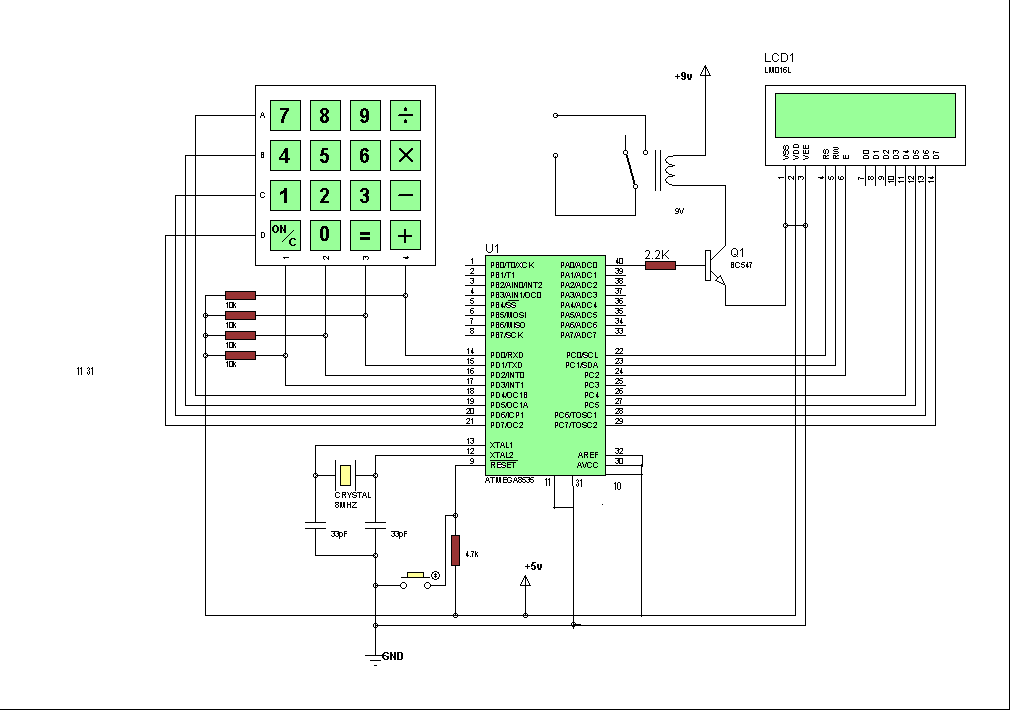
Secured room access system
Security is a primary concern in daily life, and an access control system is a crucial component of a security framework. The microcontroller-based digital lock described here is an access control system that permits only authorized individuals to enter a...
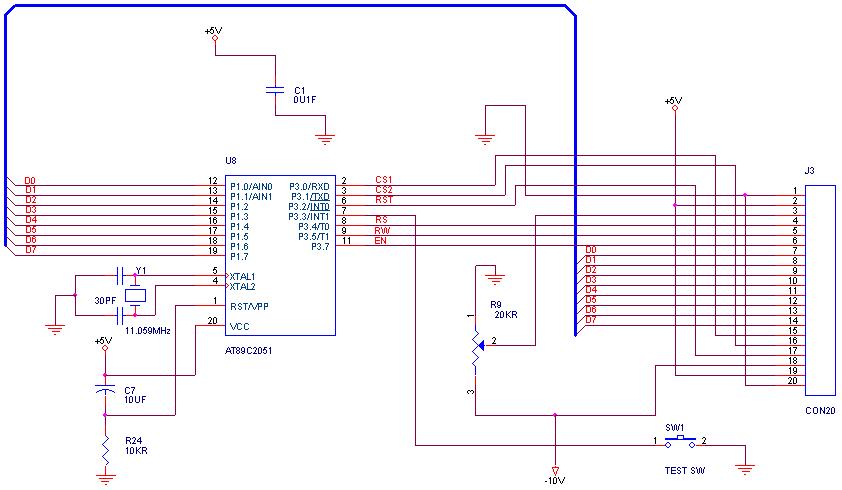
graphical LCDs with a microcontroller
How can graphical LCDs be controlled using a microcontroller? Is there any datasheet available?
Graphical LCDs (Liquid Crystal Displays) are widely used in various electronic applications for displaying complex graphics and text. To control these displays with a microcontroller, several steps...

Build your own LC-Display
For the wiring of the display, the ribbon cable is first taken and soldered according to the circuit diagram on the 25-pin sub-D (parallel port) plug. The small circuit diagram illustrates the rear side, which is the solder side of...

Microcontroller measures heart rate through fingertip
The reflected infrared (IR) signal detected by the photodiode is sent to a signal conditioning circuit, which filters out unwanted signals and amplifies the desired output.
The circuit begins with a photodiode that captures the reflected IR signals. The photodiode operates...

Electronics Engineering Herald - online magazine of electronics -home
Embedded systems serve as the core of most electronics-based systems, enabling data access, processing, storage, and control. While some simple electronic circuits can be designed without a microprocessor or microcontroller, this approach is often economically impractical, except for basic passive...