


stroboscope uses white leds
#stroboscope
#white LEDs
#high-brightness
#frequency counter
#torch housing
#rev counter
#light source
#signal output
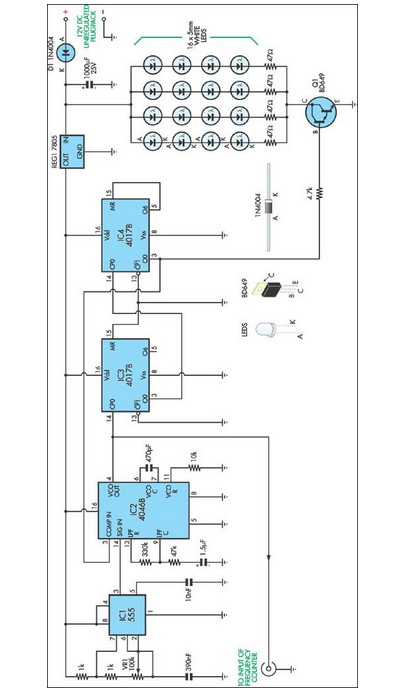
Description: This stroboscope circuit utilizes 16 high-brightness white LEDs housed within a torch structure. It also offers a signal output to a frequency counter to indicate revolutions per minute (RPM).
The stroboscope circuit is designed to provide visual indication of rotating objects through the use of high-intensity white LEDs. The circuit includes a microcontroller or timer IC to generate a pulse-width modulation (PWM) signal that controls the LEDs. The frequency of the PWM signal can be adjusted to match the rotational speed of the object being observed, allowing for effective stroboscopic effects.
The 16 white LEDs are arranged in a manner that maximizes light output and coverage. The LEDs are powered by a suitable power supply, ensuring that they operate at their optimal brightness. A heat sink may be incorporated to dissipate excess heat generated during operation, thus prolonging the lifespan of the LEDs.
The signal output to the frequency counter is typically derived from the same PWM signal driving the LEDs. This output can be connected to a microcontroller or dedicated frequency counter module, allowing for real-time measurement of the RPM of the rotating object. The circuit may include additional components such as resistors, capacitors, and transistors to ensure proper signal conditioning and LED driving capabilities.
Overall, this stroboscope circuit is suitable for various applications, including mechanical diagnostics, motion analysis, and educational demonstrations, where the visualization of fast-moving objects is required.This stroboscope circuit uses 16 high-brightness white LEDs in a torch housing and it provides a signal output to a frequency counter to provide a rev cou..
The stroboscope circuit is designed to provide visual indication of rotating objects through the use of high-intensity white LEDs. The circuit includes a microcontroller or timer IC to generate a pulse-width modulation (PWM) signal that controls the LEDs. The frequency of the PWM signal can be adjusted to match the rotational speed of the object being observed, allowing for effective stroboscopic effects.
The 16 white LEDs are arranged in a manner that maximizes light output and coverage. The LEDs are powered by a suitable power supply, ensuring that they operate at their optimal brightness. A heat sink may be incorporated to dissipate excess heat generated during operation, thus prolonging the lifespan of the LEDs.
The signal output to the frequency counter is typically derived from the same PWM signal driving the LEDs. This output can be connected to a microcontroller or dedicated frequency counter module, allowing for real-time measurement of the RPM of the rotating object. The circuit may include additional components such as resistors, capacitors, and transistors to ensure proper signal conditioning and LED driving capabilities.
Overall, this stroboscope circuit is suitable for various applications, including mechanical diagnostics, motion analysis, and educational demonstrations, where the visualization of fast-moving objects is required.This stroboscope circuit uses 16 high-brightness white LEDs in a torch housing and it provides a signal output to a frequency counter to provide a rev cou..

2Mhz Frequency Counter Circuit
This is a schematic and block diagram of a 2-MHz frequency counter. It utilizes an LSI counter/display driver, an LCD readout, and several logic chips for timebase and timing pulse circuitry. Q2 and Q3 serve as a signal (input) amplifier....

10 Mhz universal counter
The ICM7216A can be utilized as a minimal component complete Universal Counter. This circuit is capable of handling input frequencies of up to 10 MHz at INPUT A and 2 MHz at INPUT B. In cases where the signal at...

Inexpensive frequency counter-tachometer
This circuit utilizes the low-power ICM7555 (CMOS 555) to generate the gating, STORE, and RESET signals. The timer is configured as an astable multivibrator to provide the gating signal. Calibration of the system is achieved using a 5 MΩ potentiometer...

Strobo controller
Most stroboscopes designed for commercial use, such as light effects, theatrical lighting, and DJ lights, are equipped with external trigger connectors on the back. These trigger inputs typically utilize 6.3 mm jacks or XLR connectors. Occasionally, there is one input...

10H2 to 2MH2 frequency counter circuit
The 7208 seven-stage decimal counter can be utilized as a frequency counter. It features latch and multiplexing functions, along with direct digital driving circuitry and display driving circuitry. The output frequency of the 7207 IC 6.5536 MHz crystal oscillator is...
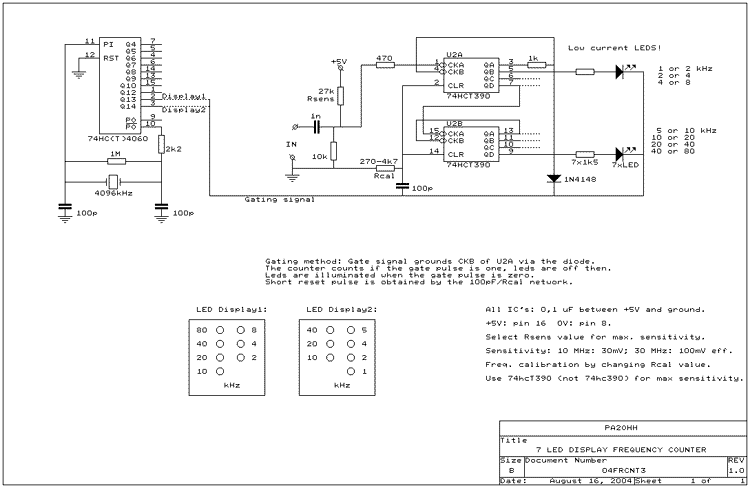
BINARY DECIMAL LED DISPLAY VERSIONS OF THE SIMPLE FREQUENCY COUNTER
Alternative display methods exist beyond the original 8 LED frequency counter, potentially offering improved readability and a more suitable format for QRP equipment. This document presents examples of binary decimal displays. Typically, the counter omits the MHz position, focusing solely...

Frequency counter hardware keys schematic
This circuit consists of four nearly identical debounced switches. Each switch features two resistors and one capacitor at the input of its respective Schmitt trigger, which are utilized for debouncing. The output from the Schmitt triggers is directed into a...

Stroboscope Uses White LEDs
This stroboscope circuit employs 16 high-brightness white LEDs housed in a torch and provides a signal output to a frequency counter for rev counter display. The circuit utilizes IC1, a 555 astable multivibrator, which generates a signal for IC2, a...

50MHz frequency counter V-meter & SWR/PWR indicator
This device is an upgraded version of the PIC16C71 4-digit LED frequency counter and voltmeter. It eliminates several hard-to-find components from the previous model, which have been out of production for some time. The older PIC16C71 has been replaced with...