


ECG Simulator Schematic

Description: Below is the final schematic for the Menta ECG Simulator project. LadyAda's Eagle schematic for the Menta was used as a starting point.
The Menta ECG Simulator project is designed to emulate the electrical signals produced by the heart, providing a valuable tool for testing and calibrating electrocardiogram (ECG) equipment. The schematic incorporates various electronic components that work together to generate realistic ECG waveforms.
The circuit typically includes operational amplifiers configured to create the desired signal shapes, resistors to set gain levels, and capacitors to filter noise and stabilize the output. A microcontroller may also be integrated into the design to allow for programmable waveform generation, enabling the user to simulate different heart conditions by adjusting parameters such as heart rate and rhythm.
Power supply considerations are crucial, with the circuit requiring a stable voltage source to ensure accurate signal generation. Additionally, isolation techniques may be implemented to protect both the simulator and any connected ECG devices from electrical interference or damage.
Output connections are designed to interface seamlessly with standard ECG equipment, often utilizing BNC connectors for ease of use. The final schematic should be thoroughly tested to validate the performance of the simulator under various operating conditions, ensuring it meets the necessary specifications for clinical or educational applications.Below is the final schematic for the Menta ECG Simulator project. LadyAda`s Eagle schematic for the Menta was used as a starting point and I simply ad..
The Menta ECG Simulator project is designed to emulate the electrical signals produced by the heart, providing a valuable tool for testing and calibrating electrocardiogram (ECG) equipment. The schematic incorporates various electronic components that work together to generate realistic ECG waveforms.
The circuit typically includes operational amplifiers configured to create the desired signal shapes, resistors to set gain levels, and capacitors to filter noise and stabilize the output. A microcontroller may also be integrated into the design to allow for programmable waveform generation, enabling the user to simulate different heart conditions by adjusting parameters such as heart rate and rhythm.
Power supply considerations are crucial, with the circuit requiring a stable voltage source to ensure accurate signal generation. Additionally, isolation techniques may be implemented to protect both the simulator and any connected ECG devices from electrical interference or damage.
Output connections are designed to interface seamlessly with standard ECG equipment, often utilizing BNC connectors for ease of use. The final schematic should be thoroughly tested to validate the performance of the simulator under various operating conditions, ensuring it meets the necessary specifications for clinical or educational applications.Below is the final schematic for the Menta ECG Simulator project. LadyAda`s Eagle schematic for the Menta was used as a starting point and I simply ad..

Osteoarthritis treatment circuit
Currently, there is an increasing number of patients suffering from osteoarthritis, which causes significant discomfort. To alleviate this suffering and help patients return to normal life, a therapeutic circuit is utilized. This circuit applies direct current through electrodes coated with...

Micro-Cap 9
Micro-Cap 9 is an integrated schematic editor and mixed analog/digital simulator that provides an interactive sketch and simulate environment for electronics engineers. Since its original release in 1982, Micro-Cap has been steadily expanded and improved. Micro-Cap 9, the eighth generation,...

Medical treat ventilator controller
The medical ventilator controller circuit consists of an astable oscillator, a control circuit, and a power supply circuit. The astable oscillator is constructed using resistors R1, R2, a potentiometer RP, capacitors C1, C2, and a time base integrated circuit IC1....

ECG Amplifier By TLC274
This circuit enables the display of an ECG signal on an oscilloscope. Operational amplifiers IC1a, IC1b, and IC1d create an instrumentation amplifier with a gain of 201. IC1c amplifies the common-mode signal by a factor of 31 and supplies this...

ECG telemetry circuit diagram
The circuit is designed for teaching demonstrations or experiments to hear the electrocardiogram (ECG) signal voltage. The ECG signal voltage is amplified by the LM4250 operational amplifier, which is connected to a voltage-controlled oscillator (NE566) to modulate the oscillator output....

Heart Monitor (ECG Sensor Signal Amplifier/Conditioner)
The circuit illustrated in the schematic diagram below is designed to monitor the heart pulses of a patient. This circuit buffers and amplifies the heart pulses.
The heart pulse monitoring circuit typically consists of several key components that work together to...

Download NL5 Non-Linear Electronic Circuit Simulator
Since then, NL has evolved into the Microsoft Windows®-based NL4, which has been extensively used by world-class engineers in various fields of electronics for almost 10 years. NL5 is the first version to be publicly available. Unlike conventional SPICE-based simulators,...

Electrocardiagram (ECG / EKG) for DrDAQ Data Logger
An electrocardiogram (ECG), also known as EKG (derived from the German term Elektro-Kardiographie), is an electrical recording of the heart utilized in diagnosing heart disease. This application employs a DrDAQ Data Logger to read and store electrocardiograms. British physiologist Augustus...
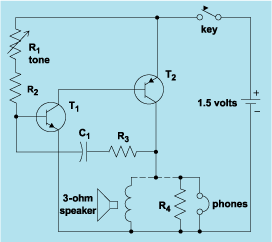
schematic diagram graphic arts
Schematic diagram. A presentation of the element-by-element relationship of all parts of a system.
A schematic diagram serves as a crucial tool in electronic design and engineering, representing the interconnections and relationships between various components within a system. It provides a...