


Sound pressure meter
#sound pressure
#op-amp
#CA3140
#audio measurement
#home theater
#non-inverting amplifier
#sound levels
#testing
#sensor
#audio
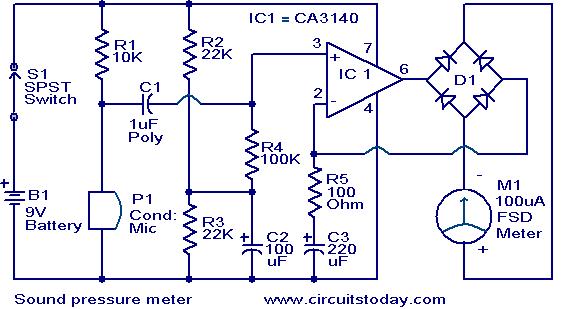
Description: This circuit is a simple sound level checker, useful for setting up home theater systems by testing sound pressure levels across different channels and positions in a room. The design features a non-inverting amplifier utilizing the CA 3140 operational amplifier (IC1). The sound captured by the condenser microphone is amplified by IC1 and subsequently rectified by bridge rectifier D1 to drive meter M1. The meter's deflection corresponds to the sound pressure detected by the microphone. An ON/OFF switch (S1) is included for power control.
The sound level checker circuit is designed to facilitate accurate sound pressure measurements essential for optimizing audio setups. The core component, the CA 3140 operational amplifier, operates in a non-inverting configuration, providing high input impedance and low output impedance, which is ideal for interfacing with the condenser microphone.
The condenser microphone generates an analog voltage signal proportional to the sound pressure it receives. This signal is fed into the non-inverting input of IC1. The gain of the amplifier can be set using external resistors, allowing for flexibility in sensitivity based on the expected sound levels in the environment.
After amplification, the signal is routed to the bridge rectifier (D1), which converts the AC signal produced by the microphone into a DC voltage suitable for driving the meter (M1). The rectification process ensures that the meter provides a readable deflection corresponding to the average sound pressure level, allowing users to assess the audio output effectively.
The inclusion of switch S1 provides a simple means to control the power to the circuit, ensuring that it can be easily turned on or off as required. This feature enhances usability, especially in temporary setups where the circuit may need to be used intermittently.
Overall, this sound level checker circuit is a practical tool for audio enthusiasts and professionals alike, enabling precise adjustments to sound systems to achieve optimal performance in various listening environments.Here is a simple circuit that can be used to check the sound levels. The sound pressure meter is vey useful in setting up home theater systems, if you need to test the sound pressure of each channels on different positions in the room. The circuit is nothing but a non- inverting amplifier based on op-amp CA 3140 9 (IC1). The sound picked by the con denser mic will be amplified by the IC1 and rectified by the bridge D1 to drive the meter M1. The deflection on the meter will be proportional to the pressure of the sound falling on the mic. The switch S1 can be used as an ON/OFF switch.
The sound level checker circuit is designed to facilitate accurate sound pressure measurements essential for optimizing audio setups. The core component, the CA 3140 operational amplifier, operates in a non-inverting configuration, providing high input impedance and low output impedance, which is ideal for interfacing with the condenser microphone.
The condenser microphone generates an analog voltage signal proportional to the sound pressure it receives. This signal is fed into the non-inverting input of IC1. The gain of the amplifier can be set using external resistors, allowing for flexibility in sensitivity based on the expected sound levels in the environment.
After amplification, the signal is routed to the bridge rectifier (D1), which converts the AC signal produced by the microphone into a DC voltage suitable for driving the meter (M1). The rectification process ensures that the meter provides a readable deflection corresponding to the average sound pressure level, allowing users to assess the audio output effectively.
The inclusion of switch S1 provides a simple means to control the power to the circuit, ensuring that it can be easily turned on or off as required. This feature enhances usability, especially in temporary setups where the circuit may need to be used intermittently.
Overall, this sound level checker circuit is a practical tool for audio enthusiasts and professionals alike, enabling precise adjustments to sound systems to achieve optimal performance in various listening environments.Here is a simple circuit that can be used to check the sound levels. The sound pressure meter is vey useful in setting up home theater systems, if you need to test the sound pressure of each channels on different positions in the room. The circuit is nothing but a non- inverting amplifier based on op-amp CA 3140 9 (IC1). The sound picked by the con denser mic will be amplified by the IC1 and rectified by the bridge D1 to drive the meter M1. The deflection on the meter will be proportional to the pressure of the sound falling on the mic. The switch S1 can be used as an ON/OFF switch.
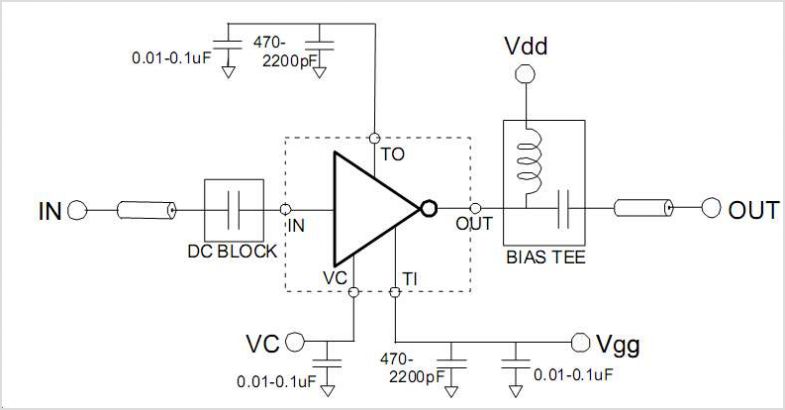
KGA8010 Ultra Broadband Distributed Amplifier
The KIA6924S is designed to mute the popping sound produced when turning ON or OFF receivers, pre-amplifiers, main amplifiers, and other electronic audio equipment, as well as to eliminate noise generated during switch transitions. Manufactured by Korea Electronics (KEC).
The...

2Watt Audio Amplifier circuit
This amplifier is designed to be self-contained within a compact loudspeaker enclosure. It can be powered by devices such as Walkmans, Mini Discs, iPods, CD players, computers, and other devices equipped with line or headphone outputs. Typically, two units are...

Simple audio amplifier LM307 A741
The simple audio amplifier circuit is illustrated in the figure. Utilizing an integrated op-amp configuration, this audio amplifier is stable and allows for easy negative feedback, facilitating the achievement of equalization characteristics. Additionally, the crosstalk between channels is minimal, making...

Guitar Control
The IC1A operational amplifier is configured as an inverting amplifier, with its gain determined by a three-way switch that connects different resistor values in parallel to resistor R4. This input stage is succeeded by an active three-band tone control stage,...

op amp IR Demodulator Design
Designing an infrared (IR) demodulator circuit to replace the one shown in this question. The goal is to demodulate a simple IR signal modulated at 32.678 kHz, with the requirement of detecting the presence of the signal without packet decoding....

Audio oscillator
Almost any transistor will work. R1 and C1 will vary the tone.
The circuit utilizes a transistor as the primary active component, which can be substituted with various types of transistors, including bipolar junction transistors (BJTs) or field-effect transistors (FETs). The...

Audio Millivoltmeter
An AC millivoltmeter - calibrated in dB - with a range of 30V down to 3mV full scale (80dB range) would be extremely useful. Attach a microphone (electret mic capsules are quite good), and you have a relative sound level...

Op-Amp Microphone Preamp
A high-quality microphone preamplifier utilizing a single power supply, suitable for both dynamic and electret microphones. The operational amplifier (op-amp) employed can be any low-noise, high-performance type, such as the NE5534, TL071, or OPA 371. The schematic illustrates the configuration...

Bass and Tremble Controller
It is very useful for 1 -100 watt AUDIO AMPLIFIERS
This description refers to a component or circuit designed to enhance the performance of audio amplifiers in the power range of 1 to 100 watts. Such amplifiers are commonly used in...