


8051 DS1307 example
#8051
#DS1307
#I2C
#PIC
#AVR
#microcontroller
#embedded systems
#real-time clock
#code examples
#library
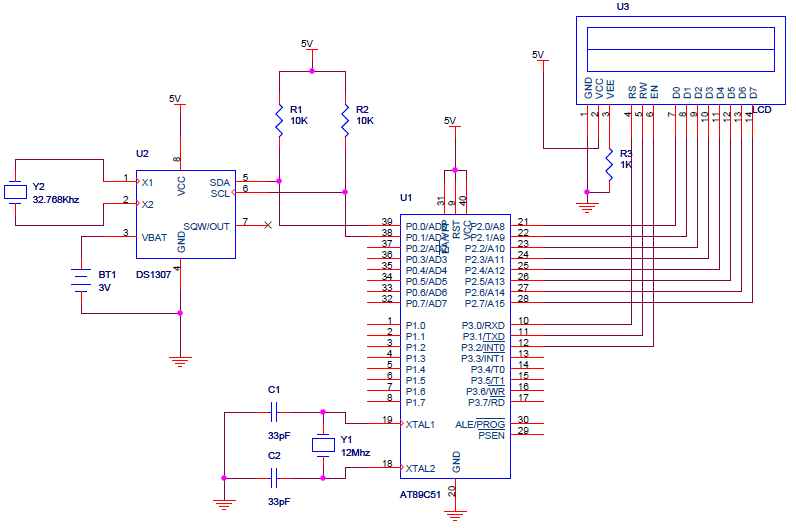
Description: Learn how to implement I2C on 8051, PIC, and AVR microcontrollers. This resource provides code examples and guidance for utilizing the I2C library.
The Inter-Integrated Circuit (I2C) protocol is a widely used communication protocol that allows multiple slave devices to communicate with a master device over a two-wire bus. This protocol is particularly useful in microcontroller applications where multiple peripheral devices need to be interfaced with a central processing unit. The 8051, PIC, and AVR microcontrollers are popular choices in embedded systems, and implementing I2C on these platforms can significantly enhance functionality.
For the 8051 microcontroller, the implementation of I2C typically involves configuring the Serial Control (SCON) register for I2C mode, setting the appropriate clock frequency, and utilizing specific pins for data (SDA) and clock (SCL) lines. The I2C library for the 8051 may include functions for initializing the bus, sending and receiving data, and handling acknowledgments.
In the case of PIC microcontrollers, the implementation can vary depending on the specific model. Many PIC devices come with built-in I2C hardware modules, simplifying the process. The configuration involves setting up the I2C Control Register (I2C1CON) and the Baud Rate Register (I2C1BRG) to ensure correct timing for communication. The library functions will allow for easy management of master and slave operations, including start conditions, stop conditions, and data transmission.
For AVR microcontrollers, the TWI (Two Wire Interface) is the equivalent of I2C. The TWI module must be initialized by setting the appropriate registers, such as TWBR (TWI Bit Rate Register) and TWSR (TWI Status Register). The AVR I2C library provides functions for initiating communication, reading from and writing to slave devices, and handling various TWI states.
In all cases, the provided code examples will demonstrate how to set up the microcontroller, initialize the I2C bus, and communicate with peripheral devices. This resource serves as a practical guide for engineers and hobbyists looking to integrate I2C communication into their projects, providing a solid foundation for developing more complex systems that require efficient data exchange between multiple components.Learn implementing I2C on 8051 PIC and AVR microcontrollers. Here you will find codes and examples for using I2C library..
The Inter-Integrated Circuit (I2C) protocol is a widely used communication protocol that allows multiple slave devices to communicate with a master device over a two-wire bus. This protocol is particularly useful in microcontroller applications where multiple peripheral devices need to be interfaced with a central processing unit. The 8051, PIC, and AVR microcontrollers are popular choices in embedded systems, and implementing I2C on these platforms can significantly enhance functionality.
For the 8051 microcontroller, the implementation of I2C typically involves configuring the Serial Control (SCON) register for I2C mode, setting the appropriate clock frequency, and utilizing specific pins for data (SDA) and clock (SCL) lines. The I2C library for the 8051 may include functions for initializing the bus, sending and receiving data, and handling acknowledgments.
In the case of PIC microcontrollers, the implementation can vary depending on the specific model. Many PIC devices come with built-in I2C hardware modules, simplifying the process. The configuration involves setting up the I2C Control Register (I2C1CON) and the Baud Rate Register (I2C1BRG) to ensure correct timing for communication. The library functions will allow for easy management of master and slave operations, including start conditions, stop conditions, and data transmission.
For AVR microcontrollers, the TWI (Two Wire Interface) is the equivalent of I2C. The TWI module must be initialized by setting the appropriate registers, such as TWBR (TWI Bit Rate Register) and TWSR (TWI Status Register). The AVR I2C library provides functions for initiating communication, reading from and writing to slave devices, and handling various TWI states.
In all cases, the provided code examples will demonstrate how to set up the microcontroller, initialize the I2C bus, and communicate with peripheral devices. This resource serves as a practical guide for engineers and hobbyists looking to integrate I2C communication into their projects, providing a solid foundation for developing more complex systems that require efficient data exchange between multiple components.Learn implementing I2C on 8051 PIC and AVR microcontrollers. Here you will find codes and examples for using I2C library..

Microchip PIC Programmer
This circuit is capable of programming any Microchip processor ranging from 6 pins to 40 pins. The programmer is compatible with the PIC12, PIC16, PIC18, dsPIC24, and dsPIC30 families, utilizing an ICSP header which eliminates the need to remove the...
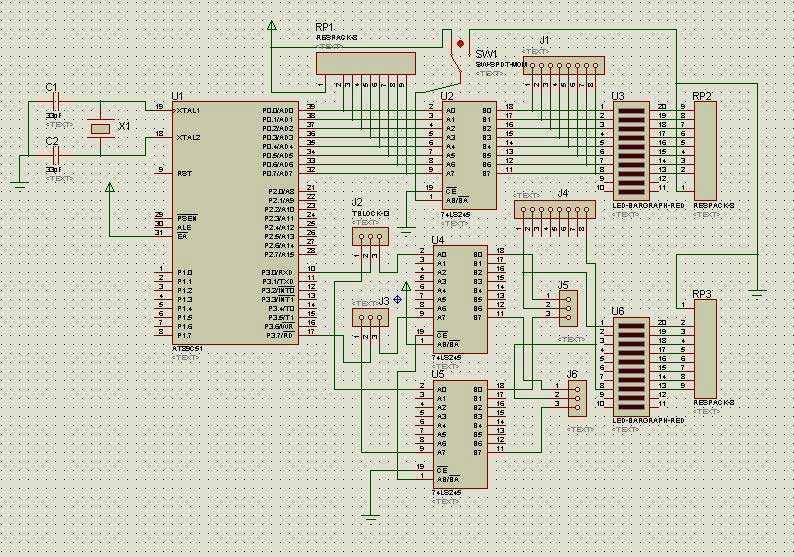
display board to interface it with 8051
74hc573 is used to store data so that the previous content on SS is not vanish when we disable LE pin. T0 select the proper latch 74hc238, 3x8 decoder is used. And to convert BCD into decimal, 74ls48 converter is...

The embedded microcontroller MC68HC912B32 background debugs the mode to design
The widespread application of Flash technology in microprocessors has led to significant advancements in the development and utilization of one-chip computers. Designers have transitioned from traditional in-circuit emulators (ICE) and JTAG interfaces to more cost-effective and user-friendly development methods. While...

AVR Microcontrolled PLL FM Transmitter
An LMX1601 Phase locked loop, a discreet FET VCO, and an AVR microcontroller combine to make a stable, easy to use monophonic FM transmitter that includes an audio activated switch that turns the transmitter on only when it is being...
AVR
The article "Creating a Line Follower Robot with AVR" serves as a continuation of a previous piece on line follower robots, focusing on the AVR ATMega8535 and the associated block diagram. In the first part of this series, titled "Creating...

microcontroller 8051 rftx rx
The issue arises when connecting the 8051 microcontroller to the HT640 encoder; the data sent is not received at the receiver. However, when the connections to the 8051 are removed, the transmission functions perfectly. This indicates that manual RF communication...

avr ntp clock.
The Network Time Protocol (NTP) has transformed global timekeeping, allowing accurate time and date information from anywhere in the world. NTP is a straightforward UDP-based protocol that can be implemented in a microcontroller. While UDP and TCP servers have been...

An AVR microcontroller based Ethernet device
Ethernet has traditionally been a complex interface. All Ethernet chips up until now have had 100 pins or more, making them difficult to find in small quantities and challenging to use with microcontrollers that have limited memory. Microchip has revolutionized...

8 Pin PIC Development Board
Prototype board designed for 8-pin PIC microcontrollers featuring a 4 MHz ceramic resonator, an external 8K EEPROM, a power supply circuit, and an RS232 port. It includes two small holes for soldering DC power lines (Vdd/Gnd), compatible with voltages above...