


Flash programming of AT89 microcontrollers using ISP adapter
#AT89
#ISP
#flash programming
#microcontroller
#parallel programming
#programming voltage
#AT89C
#AT89S
#programmer
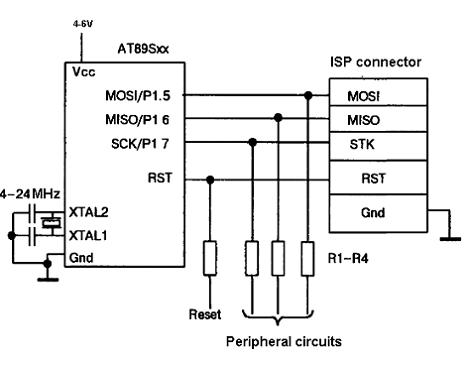
Description: The AT89C family of microcontrollers features a parallel programming interface for flash memory. To write information, a programming voltage of 12V is required, and nearly all pins of the ports are utilized for this purpose. Consequently, parallel programming is conducted using specialized devices known as programmers. In contrast, the AT89S microcontrollers possess the additional capability of in-system programming (ISP). This method eliminates the need for a 12V programming voltage, as it incorporates a voltage converter within the interface. When programming the AT89S microcontroller via the ISP method, only four lines are necessary: RESET, SCK, MOSI, and MISO. ISP allows programming without the need to remove the microcontroller from the circuit, hence the term in-system programmability. The circuit diagram illustrates how the programmer connects to the microcontroller using an ISP header. Resistors R1-R4 are implemented to prevent signal conflicts between the programmer and peripheral circuitry. The ISP programmer can be connected to the LPT port, which manages the programming process and synchronizes the overall operation. The programmer functions similarly to the AVR ISP programmer, and AT89S microcontrollers can be programmed using widely available software such as PonyProg.
The AT89C and AT89S microcontrollers are widely utilized in various applications due to their flexibility and ease of programming. The AT89C series, with its parallel programming requirement, is suitable for scenarios where dedicated programming devices are available. The AT89S series, with ISP capabilities, is particularly advantageous in embedded systems where space and accessibility are constraints. The use of only four lines for ISP not only simplifies the circuit design but also enhances reliability by reducing the number of connections that can introduce errors.
The connection of the ISP programmer to the microcontroller is typically achieved through a dedicated ISP header, which is a small connector that facilitates the necessary communication lines. The resistors R1-R4 serve a critical role in ensuring that the signals from the programmer do not interfere with the signals from other components connected to the microcontroller. This is particularly important in complex circuits where multiple devices may share the same communication lines.
In practical applications, the choice between parallel programming and ISP will depend on the specific requirements of the project, such as the development environment, the available tools, and the final application of the microcontroller. The ability to program the AT89S microcontroller in-circuit allows for easier updates and modifications, which is a significant advantage in product development and prototyping. Additionally, the compatibility with software like PonyProg ensures that users have access to robust tools for programming and debugging.
Overall, the AT89C and AT89S microcontrollers provide versatile solutions for various electronic applications, with their programming methods tailored to meet different needs in the design and development process.Microcontrollers family AT89C has parallel programming interface of flash memory. In order to write information we need to supply programming voltage 12V and for controlling almost all pins of ports are used. This is why parallel programming is done in special devices a‚ programmers. Microcontrollers AT89S besides parallel programming ability ha ve ISP programming ability. Using Serial programming interface doesn`t need 12V of programming voltage, because inside interface is voltage converter included. When programming AT89S microcontroller using ISP method there are only four lines needed a‚ RESET, SCK, MOSI, MISO.
Using ISP programming method it is not necessary to remove microcontroller from circuit ISP is so called in-system programmability. How does it look in circuit shows following illustration: Programmer connects to microcontroller using ISP header.
Resistors R1-R4 are used to avoid conflicts of signals between programmer and peripheral circuitry. ISP programmer can be connected to LPT port which controls all programming process and synchronizes overall process. Programmer is same as AVR ISP programmer and AT89S microcontrollers can be programmed using popular software like PonyProg.
We aim to transmit more information by carrying articles. Please send us an E-mail to wanghuali@hqew. net within 15 days if we are involved in the problems of article content, copyright or other problems. We will delete it soon.
The AT89C and AT89S microcontrollers are widely utilized in various applications due to their flexibility and ease of programming. The AT89C series, with its parallel programming requirement, is suitable for scenarios where dedicated programming devices are available. The AT89S series, with ISP capabilities, is particularly advantageous in embedded systems where space and accessibility are constraints. The use of only four lines for ISP not only simplifies the circuit design but also enhances reliability by reducing the number of connections that can introduce errors.
The connection of the ISP programmer to the microcontroller is typically achieved through a dedicated ISP header, which is a small connector that facilitates the necessary communication lines. The resistors R1-R4 serve a critical role in ensuring that the signals from the programmer do not interfere with the signals from other components connected to the microcontroller. This is particularly important in complex circuits where multiple devices may share the same communication lines.
In practical applications, the choice between parallel programming and ISP will depend on the specific requirements of the project, such as the development environment, the available tools, and the final application of the microcontroller. The ability to program the AT89S microcontroller in-circuit allows for easier updates and modifications, which is a significant advantage in product development and prototyping. Additionally, the compatibility with software like PonyProg ensures that users have access to robust tools for programming and debugging.
Overall, the AT89C and AT89S microcontrollers provide versatile solutions for various electronic applications, with their programming methods tailored to meet different needs in the design and development process.Microcontrollers family AT89C has parallel programming interface of flash memory. In order to write information we need to supply programming voltage 12V and for controlling almost all pins of ports are used. This is why parallel programming is done in special devices a‚ programmers. Microcontrollers AT89S besides parallel programming ability ha ve ISP programming ability. Using Serial programming interface doesn`t need 12V of programming voltage, because inside interface is voltage converter included. When programming AT89S microcontroller using ISP method there are only four lines needed a‚ RESET, SCK, MOSI, MISO.
Using ISP programming method it is not necessary to remove microcontroller from circuit ISP is so called in-system programmability. How does it look in circuit shows following illustration: Programmer connects to microcontroller using ISP header.
Resistors R1-R4 are used to avoid conflicts of signals between programmer and peripheral circuitry. ISP programmer can be connected to LPT port which controls all programming process and synchronizes overall process. Programmer is same as AVR ISP programmer and AT89S microcontrollers can be programmed using popular software like PonyProg.
We aim to transmit more information by carrying articles. Please send us an E-mail to wanghuali@hqew. net within 15 days if we are involved in the problems of article content, copyright or other problems. We will delete it soon.
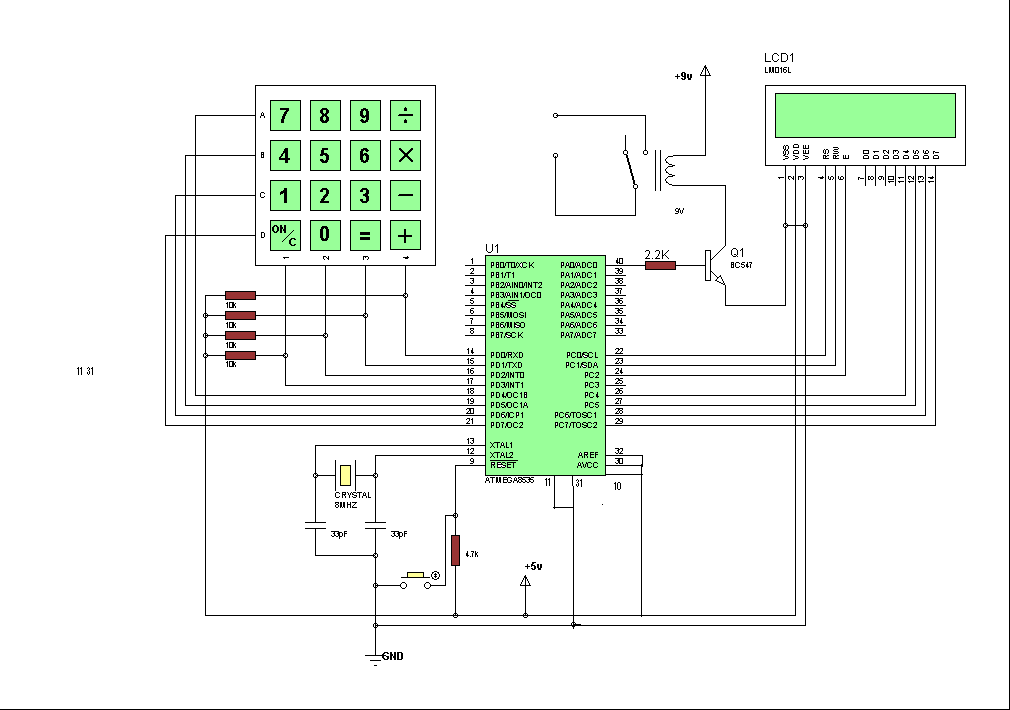
Secured room access system
Security is a primary concern in daily life, and an access control system is a crucial component of a security framework. The microcontroller-based digital lock described here is an access control system that permits only authorized individuals to enter a...

Water Level controller
The microcontroller-based water level controller and motor protector manages the on and off states of the motor based on the water level in the overhead tank (OHT). It regulates the tank's water level through a microcontroller, thereby providing automatic protection...
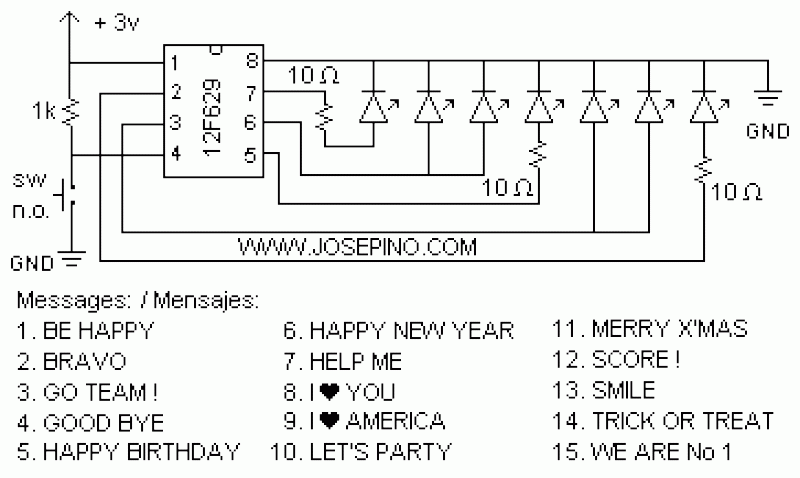
ON/OFF button using Microcontrollers
Using a switch to power up your microcontroller projects may not be a good idea if you need to "wake" the PIC during some events. For example: A metal detector sends a pulse indicating a car is ready to enter...

Microcontroller Relay Driver and Interface
Many microcontroller designs typically integrate various interfacing methods. A microcontroller (µC) system can be viewed as a system that reads from inputs.
Microcontroller systems are versatile platforms that facilitate the integration of multiple interfacing methods to interact with various peripherals and...

home security system
The fundamental design of this project employs an Atmel AT89S8252-24PC Microcontroller, which features 2KB of EEPROM for runtime data storage. An ADC0838CCN analog-to-digital converter will be utilized to process up to eight inputs from sensor devices, including passive infrared sensors...

GSM Remote Control 2 IN and 2 OUT Part 2 Schematic
The control of the system is managed by a Microchip PIC18F46K20-I/PT microcontroller, which is programmed with firmware to oversee the activity of the GSM/GPRS module, monitor the logic conditions of two opto-isolated inputs, and send commands to two relays within...

Microcontroller measures heart rate through fingertip
The reflected infrared (IR) signal detected by the photodiode is sent to a signal conditioning circuit, which filters out unwanted signals and amplifies the desired output.
The circuit begins with a photodiode that captures the reflected IR signals. The photodiode operates...

Fluffy - A Scenix (and PIC) Programmer
Anyway, Fluffy is a SX programmer for people who have already experimented with PIC chips, and want to try out the Scenix SX family. I built Fluffy because I wanted to experiment with the SX's, but didn't want to spend...

ATMEL 89C Series Flash Programmer
This programmer was designed in view of to be flexible, economical and easy to built, the programmer hardware utilizes the standard TTL series parts and no special components are used. The programmer is interfaced with the PC parallel port and...