


A resistor-capacitor circuit protection thyristor
#resistor-capacitor
#circuit protection
#thyristor
#over-current
#over-voltage
#diode
#electronic components
#voltage regulation

Description: Diodes and thyristors have limited tolerance to over-current and over-voltage conditions. Short-term exposure to excessive voltage or current can damage these components and prevent them from achieving their full potential. The parameters of these devices should be determined based on the temporary over-current and over-voltage experienced during operation. It is important to maximize the load capacity of the device, which makes the enhancement of thyristor protection essential for operational reliability. On the secondary side of the transformer, shunt resistors and capacitors may help dissipate electromagnetic energy from the transformer windings into the capacitor, where it is stored as electric field energy. As the voltage across the capacitor cannot change abruptly, this setup effectively suppresses over-voltage conditions. Additionally, series resistance can help dissipate part of the generated over-voltage and mitigate oscillations in LC circuits.
Diodes and thyristors are critical components in electronic circuits, particularly in power electronics applications. Their ability to manage over-current and over-voltage is crucial for the reliability of circuits that operate under variable load conditions. When designing circuits that incorporate these components, careful consideration must be given to their ratings and the transient conditions they may encounter.
In practical applications, the use of protective elements such as shunt resistors and capacitors on the secondary side of transformers plays a vital role in energy management. Shunt resistors are used to divert excess current away from sensitive components, while capacitors store energy and release it when needed, thus smoothing out voltage fluctuations. The energy stored in the capacitor can be critical in maintaining stability in the circuit, especially during sudden load changes or faults.
The capacitor's voltage rating is essential, as it must withstand the maximum voltage conditions without failure. The series resistance can be strategically selected to balance energy dissipation and circuit efficiency. It aids in reducing over-voltage spikes that may occur due to inductive kickback or other transient events, thus protecting downstream components.
In summary, the integration of diodes, thyristors, shunt resistors, and capacitors into electronic circuits is fundamental for ensuring operational reliability and efficiency. Properly designed protection schemes are necessary to enhance the performance and longevity of these components, particularly in environments subject to electrical stress.Diode and thyristor can withstand over-current and over-voltage of poor, short-term over-voltage over-current will damage the components, but can not complete the full potentia l value of the device according to the runtime temporary overcurrent and overvoltage device to determine parameters, but also give full play-off device should load capacity, and therefore, improve the protection thyristor device has become an indispensable part of operational reliability. In the secondary side of the transformer shunt resistors and capacitors, as shown, may be released from the transformer winding electromagnetic energy into the capacitor C is the electric field energy stored.
Since the voltage across the capacitor can not change suddenly, it is possible to effectively suppress overvoltage. Series resistance can be consumed part of the production of green energy over-voltage and suppress LC oscillator circuit.
Diodes and thyristors are critical components in electronic circuits, particularly in power electronics applications. Their ability to manage over-current and over-voltage is crucial for the reliability of circuits that operate under variable load conditions. When designing circuits that incorporate these components, careful consideration must be given to their ratings and the transient conditions they may encounter.
In practical applications, the use of protective elements such as shunt resistors and capacitors on the secondary side of transformers plays a vital role in energy management. Shunt resistors are used to divert excess current away from sensitive components, while capacitors store energy and release it when needed, thus smoothing out voltage fluctuations. The energy stored in the capacitor can be critical in maintaining stability in the circuit, especially during sudden load changes or faults.
The capacitor's voltage rating is essential, as it must withstand the maximum voltage conditions without failure. The series resistance can be strategically selected to balance energy dissipation and circuit efficiency. It aids in reducing over-voltage spikes that may occur due to inductive kickback or other transient events, thus protecting downstream components.
In summary, the integration of diodes, thyristors, shunt resistors, and capacitors into electronic circuits is fundamental for ensuring operational reliability and efficiency. Properly designed protection schemes are necessary to enhance the performance and longevity of these components, particularly in environments subject to electrical stress.Diode and thyristor can withstand over-current and over-voltage of poor, short-term over-voltage over-current will damage the components, but can not complete the full potentia l value of the device according to the runtime temporary overcurrent and overvoltage device to determine parameters, but also give full play-off device should load capacity, and therefore, improve the protection thyristor device has become an indispensable part of operational reliability. In the secondary side of the transformer shunt resistors and capacitors, as shown, may be released from the transformer winding electromagnetic energy into the capacitor C is the electric field energy stored.
Since the voltage across the capacitor can not change suddenly, it is possible to effectively suppress overvoltage. Series resistance can be consumed part of the production of green energy over-voltage and suppress LC oscillator circuit.

Diode Cmos Stabilizer
The simple diode network can stabilize the voltage supplied to CMOS circuitry from a battery. D1 and D2 must have a combined forward-voltage drop of about 1.5 V. D3 is an LED with a forward-voltage drop of about 1.7 V....
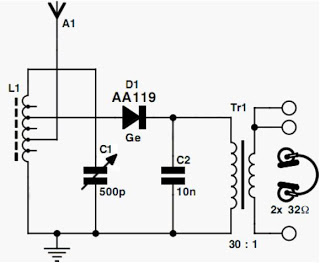
diode radio circuit
Currently, the most commonly available headphones have an impedance ranging from 2 to 32 ohms. This relatively low value renders them unsuitable for certain designs. However, with some clever modifications, these headphones can be effectively utilized in such applications. To...

Diode Rf Switch
D1 and D2 can be IN914B or HP2800-series diodes (for UHF). The loss is over 60 dB in the off state and less than 3 dB at 3.5 to 30 MHz (using common IN914B diodes).
The circuit utilizes D1 and D2...

Thyristor AC automatic voltage regulator circuit diagram
The circuit utilizes a thyristor-based AC automatic voltage regulator to stabilize the brightness of lamp L. A diagonal line connects the thyristor to the T5 bridge. The trigger pulse for the thyristor is generated by a single-junction transistor, VT4. Transistors...

Positive-regulator
In the circuit, Q1 and Q2 are connected in the classic SCR or thyristor configuration. When higher input voltages or a minimal component count are required, the thyristor boost circuit can be utilized. The thyristor operates in a linear mode...

Thyristor drive circuit
The circuit primarily consists of a new pyroelectric infrared sensor device, TDH98072, which features a special composition. This device is integrated with a control circuit characterized by simplicity, ease of adjustment, and high reliability. Additionally, the device can be combined...

Bidirectional thyristor AC contactor interface circuit
Device for an intermediate relay. The circuit utilizes a Triac AC contactor interface, employing the MOC3041 Triac output optical coupler to trigger the Triac. When Pl0 is low, the Triac will be activated, energizing the AC contactor coil.
The described device...

Thyristor controlled forward start circuit
The 331 circuit depicted in the figure utilizes a two-way thyristor for controlling the start and stop functions of a motor. It operates without mechanical contacts, generating no noise or sparks, making it suitable for applications that require frequent operation.
The...

1500A-7V-phase thyristor power regulator circuit a plating
A 1500A-7V phase thyristor power regulator circuit is designed for plating applications. It consists of three major components: the main circuit, the control circuit, and the protection circuit. The control circuit includes a trigger circuit, a synchronous power supply, and...