


Stepper Motor ControllerCircuit Based On The 7404 IC

Description: The following circuit illustrates a Stepper Motor Controller Circuit Diagram. This circuit is based on the 7404 IC. Features include a simple stepper motor.
The stepper motor controller circuit utilizing the 7404 IC is designed to drive a stepper motor with a straightforward and efficient approach. The 7404 IC, a hex inverter, plays a crucial role in generating the necessary control signals for the stepper motor operation.
In this configuration, the circuit typically includes the following components: the 7404 IC, a power supply, the stepper motor, and additional passive components such as resistors and capacitors for signal conditioning. The power supply provides the required voltage and current to both the 7404 IC and the stepper motor, ensuring reliable operation.
The stepper motor is controlled by sending a sequence of pulses to its windings, which are managed by the output of the 7404 IC. The inverters in the IC convert the input control signals into the appropriate logic levels needed to energize the motor phases in the correct order, allowing for precise control of the motor's position and speed.
Additionally, the circuit can be enhanced with features such as speed control through pulse width modulation (PWM) or the inclusion of a microcontroller for more complex control schemes. Implementing such features can significantly improve the performance and versatility of the stepper motor controller, making it suitable for various applications in robotics, automation, and precision positioning systems.
Overall, this stepper motor controller circuit exemplifies a basic yet effective method of controlling stepper motors using the 7404 IC, showcasing simplicity and functionality in electronic design.The following circuit shows about Stepper Motor Controller Circuit Diagram. This circuit based on the 7404 IC. Features: simple stepper motor .
The stepper motor controller circuit utilizing the 7404 IC is designed to drive a stepper motor with a straightforward and efficient approach. The 7404 IC, a hex inverter, plays a crucial role in generating the necessary control signals for the stepper motor operation.
In this configuration, the circuit typically includes the following components: the 7404 IC, a power supply, the stepper motor, and additional passive components such as resistors and capacitors for signal conditioning. The power supply provides the required voltage and current to both the 7404 IC and the stepper motor, ensuring reliable operation.
The stepper motor is controlled by sending a sequence of pulses to its windings, which are managed by the output of the 7404 IC. The inverters in the IC convert the input control signals into the appropriate logic levels needed to energize the motor phases in the correct order, allowing for precise control of the motor's position and speed.
Additionally, the circuit can be enhanced with features such as speed control through pulse width modulation (PWM) or the inclusion of a microcontroller for more complex control schemes. Implementing such features can significantly improve the performance and versatility of the stepper motor controller, making it suitable for various applications in robotics, automation, and precision positioning systems.
Overall, this stepper motor controller circuit exemplifies a basic yet effective method of controlling stepper motors using the 7404 IC, showcasing simplicity and functionality in electronic design.The following circuit shows about Stepper Motor Controller Circuit Diagram. This circuit based on the 7404 IC. Features: simple stepper motor .

Bipolar stepper motor driver circuit diagram
This circuit generates the power required to operate a bipolar stepper motor. It allows for adjustments in both the rotation speed and direction of the motor. The design includes two integrator circuits (A1, A3) and an amplifier (A2) connected in...

DIY Stepper Controller Circuit
The schematic for the board is illustrated below. The three primary components of the board include (1) the power input and voltage regulation, (2) the L297 input and outputs, and (3) the L298 stepper motor control circuit. The motor is...

Bipolar stepper motor driver module circuit
The circuit operates using a dedicated stepping motor controller, the L297. Pin 17 (CW/CCW) is utilized to control the rotation direction of the stepper motor. Pin 18 (CLOCK) regulates the speed of the stepper motor, while pin 19 (HALF/FULL) allows...

Stepper Motor Controller
This circuit is constructed using standard components and can be easily adapted for computer control. By utilizing inexpensive surplus transistors and a stepper motor, the overall cost of the circuit can be maintained at under $10.
The described circuit is a...

Computer Controlled Stepper Motor
This article outlines the process of connecting a stepper motor to a computer's parallel port and writing code to control it using the scroll wheel of a mouse. For those unfamiliar with stepper motors, this project offers an engaging introduction....
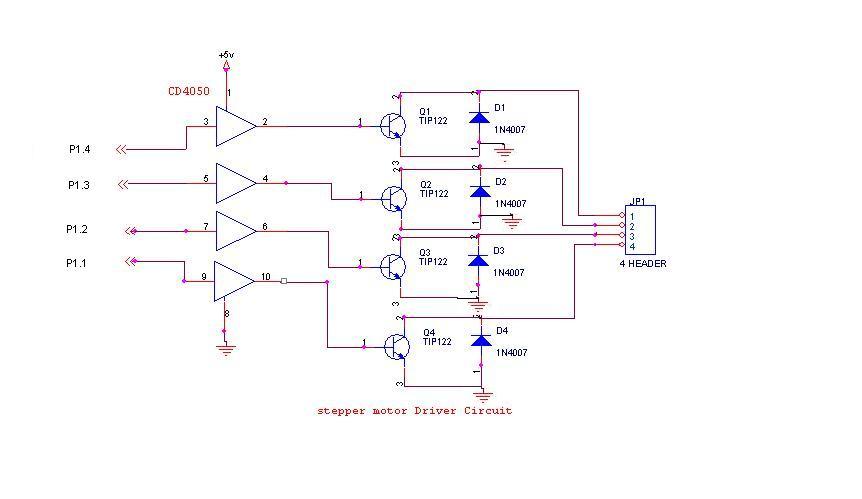
Stepper Motor Controller Schematic
A 6V, 2A stepper motor is utilized in this circuit. The CD4050 hex buffer is employed to connect to the microcontroller. The output of the CD4050 is linked to the base of a TIP122 transistor. The emitter and collector of...

Stepper motor getting very hot wrong driver or power supply
The ULN2003A and Zener diode are components from the driver board within the same device. The motor in question has five wires, while the schematic depicts a six-wire motor. It is assumed that the difference lies in the fact that...

Controlling Stepper Motor with a Parallel Port
This is an easy to build stepper motor driver that will allow you to precisely control a unipolar stepper motor through your computer's parallel port. With a stepper motor you can build a lot of interesting gadgets such as robots,...

TB6560 Stepper Motor Driver Boards
Attached are three captures from a L297/L298 board using the same motor at 500, 750, and 900 steps per second on a 36V supply, wired in bipolar parallel (coil resistance = 3.2 ohms). This shows the A-enable signal (blue) and...