


Wien bridge oscillator II
#Wien bridge
#sine-wave oscillator
#RCA CA3140
#op amps
#harmonic distortion
#frequency range
#10k pot
#waveform adjustment

Description: A Wien bridge sine-wave oscillator utilizing two RCA CA3140 operational amplifiers operates within a frequency range of 30 Hz to 100 kHz, achieving less than 0 percent total harmonic distortion. A 10k potentiometer is used for waveform optimization. Capacitors C1 and C2 comprise a two-gang, 450-pF variable capacitor with its frame electrically isolated from ground. The maximum output into a 600-ohm load is approximately 1 volt RMS.
The Wien bridge oscillator is a well-established circuit design known for generating low-distortion sine waves. The configuration employs two RCA CA3140 operational amplifiers, which are precision devices capable of operating over a wide frequency range while maintaining low distortion levels. This oscillator can be tuned to produce frequencies from 30 Hz to 100 kHz, making it suitable for various applications, including signal generation and testing.
The key components of the circuit include a resistive network and a capacitive network. The resistive network typically consists of resistors that set the gain of the op-amps, while the capacitive network, which includes the variable capacitors C1 and C2, determines the frequency of oscillation. The two-gang, 450-pF variable capacitor allows for fine-tuning of the frequency by adjusting the capacitance, which is critical for achieving the desired output waveform.
The use of a 10k potentiometer in the feedback loop of the operational amplifiers allows for real-time adjustment of the gain, which is essential for stabilizing the oscillation and ensuring that the output waveform is optimal. The circuit's design ensures that the output remains stable and free from distortion, achieving a total harmonic distortion of less than 0 percent.
The output stage of the oscillator is designed to drive a load of 600 ohms, providing a maximum output voltage of approximately 1 volt RMS. This output level is suitable for interfacing with various devices and circuits, making the Wien bridge oscillator a versatile tool in both laboratory and practical applications. The overall design emphasizes stability, low distortion, and ease of frequency adjustment, making it an effective solution for sine wave generation.Wien bridge sine-wave oscillator using two RCA CA3140 op amps cover» 30 Hz to 100 kHz with less than 0 percent total harmonic distortion. The 10k pot is adjusted for the best waveform Capacitor CI and C2 are a two-gang, 450-pF variable with its frame isolated from ground. Maximum output into a 600-ohm load is about 1 volt rms.
The Wien bridge oscillator is a well-established circuit design known for generating low-distortion sine waves. The configuration employs two RCA CA3140 operational amplifiers, which are precision devices capable of operating over a wide frequency range while maintaining low distortion levels. This oscillator can be tuned to produce frequencies from 30 Hz to 100 kHz, making it suitable for various applications, including signal generation and testing.
The key components of the circuit include a resistive network and a capacitive network. The resistive network typically consists of resistors that set the gain of the op-amps, while the capacitive network, which includes the variable capacitors C1 and C2, determines the frequency of oscillation. The two-gang, 450-pF variable capacitor allows for fine-tuning of the frequency by adjusting the capacitance, which is critical for achieving the desired output waveform.
The use of a 10k potentiometer in the feedback loop of the operational amplifiers allows for real-time adjustment of the gain, which is essential for stabilizing the oscillation and ensuring that the output waveform is optimal. The circuit's design ensures that the output remains stable and free from distortion, achieving a total harmonic distortion of less than 0 percent.
The output stage of the oscillator is designed to drive a load of 600 ohms, providing a maximum output voltage of approximately 1 volt RMS. This output level is suitable for interfacing with various devices and circuits, making the Wien bridge oscillator a versatile tool in both laboratory and practical applications. The overall design emphasizes stability, low distortion, and ease of frequency adjustment, making it an effective solution for sine wave generation.Wien bridge sine-wave oscillator using two RCA CA3140 op amps cover» 30 Hz to 100 kHz with less than 0 percent total harmonic distortion. The 10k pot is adjusted for the best waveform Capacitor CI and C2 are a two-gang, 450-pF variable with its frame isolated from ground. Maximum output into a 600-ohm load is about 1 volt rms.

Wien Bridge Oscillator Tutorial and Theory
A tutorial on the Wien Bridge Oscillator circuit, which utilizes an RC phase shift oscillator to generate sine waves.
The Wien Bridge Oscillator is a well-known electronic circuit used to produce sine waves. It operates based on the principle of a...

1 KHz Frequency Wien Bridge Oscillator
The circuit was designed to create an electronic oscillator known as a Wien Bridge Oscillator, which can be used for the creation of low-frequency sine waves.
The Wien Bridge Oscillator is a type of electronic oscillator that generates sine waves. It...

Low Distortion Wien Bridge Oscillator
This Wien bridge oscillator utilizes an incandescent lamp to stabilize its amplitude. The amplitude stabilization results in a low distortion output and supports multiple frequencies.
The Wien bridge oscillator is a type of electronic oscillator that generates sine waves. It is...
Wien Bridge Oscillator
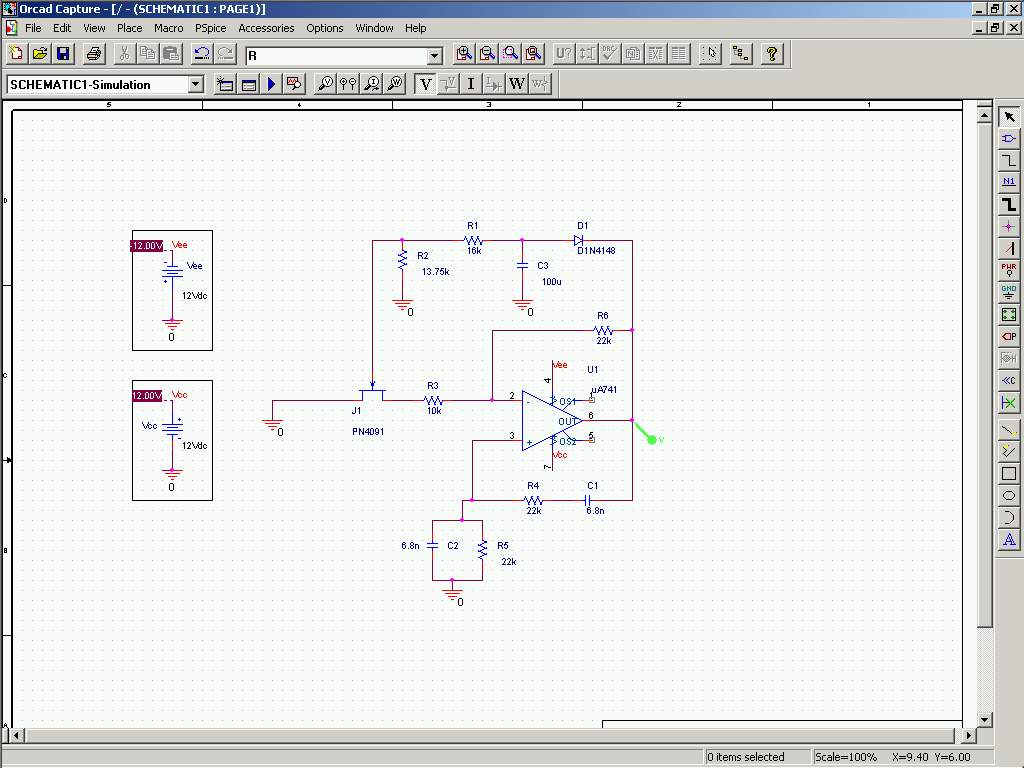
In this experiment, an oscillator is constructed using an operational amplifier along with several passive components. This specific configuration is known as a Wien Bridge oscillator. The frequency of the oscillator is determined by the resistors R4, R5 and the...

Wien bridge oscillator schematic
This is a simple scheme for a bridge oscillator. It provides a nice sinusoidal signal. This type of oscillator uses an op-amp. The weakening of the oscillating member (R1, R2, C1, C2) is 3x. To compensate, the attenuated signal is...

1Khz Harmonic Distortion Meter Circuit
The circuit designed for distortion measurements eliminates the fundamental frequency of 1 kHz, enabling the assessment of the residual harmonic levels. Initially, a true RMS meter is employed to measure the 1-kHz input level (E^) by positioning the switch (SA)...

Wien Bridge Oscillator Design
One of the simplest sine wave oscillators is the Wien Bridge Oscillator. Any circuit requires two conditions to oscillate. Tracing the path from the input, through the feedback network, and back to the input, there must be an overall phase...
Single-supply-wien-bridge-oscillator
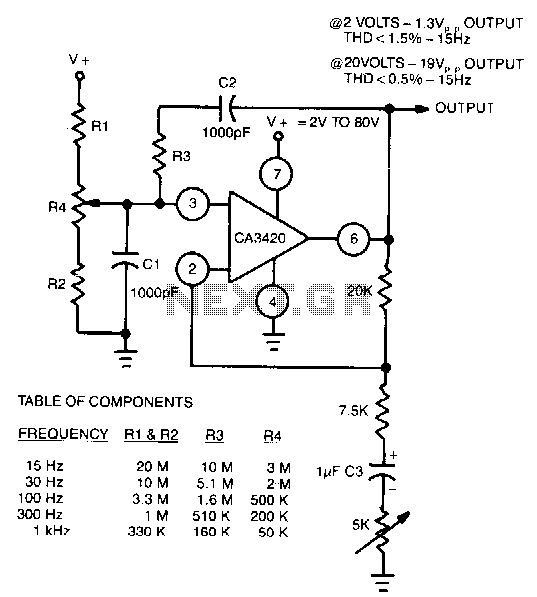
The adjustment of R4 contributes to the comparatively symmetrical output transfer characteristic of the CA3420 BiMOS operational amplifier. To extend the lower operating frequency, remove C3 and use a dual supply.
The CA3420 is a high-performance BiMOS operational amplifier that combines...

wien bridge oscillator circuit
This is a circuit known as a Wien bridge oscillator circuit. The circuit features both positive and negative feedback loops and operates under the control of an operational amplifier (op-amp). The oscillation frequency is determined by the RC time constant,...