


Wien-Bridge Oscillator Using Incandescent lamp Stabilizer
#Wien-Bridge
#incandescent lamp
#sine oscillator
#harmonic distortion
#nonlinear resistance
#filament
#stabilizer
#analog circuits
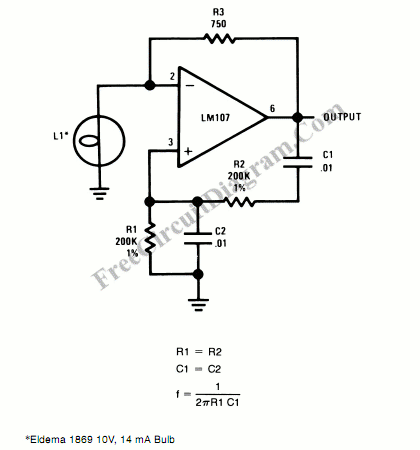
Description: An incandescent lamp has been utilized to reduce harmonic distortion in a sine oscillator circuit. The nonlinear resistance characteristic of the lamp filament assists in this process.
In the context of electronic circuits, the use of an incandescent lamp as a harmonic distortion reducer in a sine oscillator circuit leverages the unique properties of the lamp filament. The filament exhibits a nonlinear resistance that varies with temperature; as the current passing through the filament increases, the temperature rises, leading to an increase in resistance. This characteristic can effectively smooth out voltage fluctuations and reduce the presence of harmonics generated by the oscillator.
In a typical sine oscillator circuit, harmonic distortion may arise from nonlinear components or configurations that do not produce a pure sine wave output. By integrating an incandescent lamp into the circuit, the lamp acts as a passive load that absorbs excess energy and mitigates abrupt changes in current, thereby flattening the waveform and promoting a cleaner sine wave output.
The lamp's nonlinear resistance provides a self-regulating mechanism; as the distortion levels increase, the filament heats up, increasing its resistance and limiting the current flow. This feedback loop helps maintain a more stable operation of the sine oscillator, improving overall performance and reducing the likelihood of signal distortion.
In practical implementation, the incandescent lamp should be selected based on the specific voltage and current requirements of the oscillator circuit. Proper placement within the circuit is essential to ensure effective harmonic reduction without compromising the desired oscillation characteristics. Additionally, consideration should be given to the thermal management of the lamp, as excessive heating can lead to premature failure or changes in its electrical properties.
Overall, the integration of an incandescent lamp in a sine oscillator circuit serves as an innovative approach to managing harmonic distortion, enhancing the quality of the output signal while maintaining circuit stability.Incandescent lamp has been used to reduce harmonic distortion in sine oscillator circuit. The nonlinear resistance characteristic of the lamp filament help the.
In the context of electronic circuits, the use of an incandescent lamp as a harmonic distortion reducer in a sine oscillator circuit leverages the unique properties of the lamp filament. The filament exhibits a nonlinear resistance that varies with temperature; as the current passing through the filament increases, the temperature rises, leading to an increase in resistance. This characteristic can effectively smooth out voltage fluctuations and reduce the presence of harmonics generated by the oscillator.
In a typical sine oscillator circuit, harmonic distortion may arise from nonlinear components or configurations that do not produce a pure sine wave output. By integrating an incandescent lamp into the circuit, the lamp acts as a passive load that absorbs excess energy and mitigates abrupt changes in current, thereby flattening the waveform and promoting a cleaner sine wave output.
The lamp's nonlinear resistance provides a self-regulating mechanism; as the distortion levels increase, the filament heats up, increasing its resistance and limiting the current flow. This feedback loop helps maintain a more stable operation of the sine oscillator, improving overall performance and reducing the likelihood of signal distortion.
In practical implementation, the incandescent lamp should be selected based on the specific voltage and current requirements of the oscillator circuit. Proper placement within the circuit is essential to ensure effective harmonic reduction without compromising the desired oscillation characteristics. Additionally, consideration should be given to the thermal management of the lamp, as excessive heating can lead to premature failure or changes in its electrical properties.
Overall, the integration of an incandescent lamp in a sine oscillator circuit serves as an innovative approach to managing harmonic distortion, enhancing the quality of the output signal while maintaining circuit stability.Incandescent lamp has been used to reduce harmonic distortion in sine oscillator circuit. The nonlinear resistance characteristic of the lamp filament help the.

Simple Wlen-Bridge Oscillator
In this circuit, the Wien bridge network provides phase shift, and the lamp regulates the amplitude of the oscillations. The smooth, limiting nature of the lamp's operation, in combination with its simplicity, yields good results. Harmonic distortion is below 0.3%.
The...

Oscillator keeps THD below 1 ppm
The Wien-bridge sine-wave oscillator utilizes a light bulb for amplitude stabilization. The circuit depicted in Fig 1 omits the light bulb and incorporates several enhancements that reduce distortion and produce a test signal sufficiently pure for evaluating modern operational amplifiers...

Harmonic Distortion Analyzer Circuit
The circuit comprises a low-distortion, 1-kHz oscillator designed to measure Total Harmonic Distortion (THD) at a user-selected voltage level, suitable for voltage amplifiers or for testing amplifiers with power levels up to 600 W. It is capable of detecting THD...

Wien-Bridge Oscillator
The classic Wien-Bridge oscillator, with incandescent lamp nonlinear stabilization, provides a low distortion sine wave source. A thorough and clear discussion of the Wien-Bridge oscillator is provided in Malvino's Electronic Principles. Using an inexpensive op-amp with sufficient bandwidth and slew...

Swept sine oscillator has quadrature output
Signals with a known frequency but an unknown phase can be detected using an in-phase signal and a signal that is shifted by 90 degrees, a method commonly utilized in lock-in amplifiers, synchronous detectors, and frequency-response analyzers. The signal that...

Injection-lock a Wien-bridge oscillator
A low-distortion Meacham-bulb-stabilized Wien-bridge oscillator is utilized to acquire the FFT of a pure sinusoid at approximately 5 kHz.
The Meacham-bulb-stabilized Wien-bridge oscillator is a precision oscillator circuit that generates a sine wave output with low distortion. This type of oscillator...

Wien-Bridge Oscillator Using HA2541 Op-Amp
A Wien-Bridge oscillator circuit can be constructed using the HA2541 operational amplifier along with several basic components. This circuit is capable of generating high-quality sine waves at a frequency of 40 MHz, with a maximum frequency limit of 50 MHz....

in making incandescent lamps
This simple circuit can be used to flash incandescent lamps with a power rating of up to 10W. The circuit is ideal for creating flashing beacons on automobiles and similar applications. It consists of an astable multivibrator based on transistors...

Wien-Bridge Oscillator
The HA2541 is ideal for use as the core component of an oscillator. Despite the basic diode limiting provided by R3 through R7 and D1 and D2, a high-quality sine wave at 40 MHz can be easily achieved, with an...