


Injection-lock a Wien-bridge oscillator
#Wien-bridge
#low-distortion
#Meacham-bulb
#FFT
#sinusoid
#5 kHz
#injection-lock
#frequency stabilization

Description: A low-distortion Meacham-bulb-stabilized Wien-bridge oscillator is utilized to acquire the FFT of a pure sinusoid at approximately 5 kHz.
The Meacham-bulb-stabilized Wien-bridge oscillator is a precision oscillator circuit that generates a sine wave output with low distortion. This type of oscillator is particularly effective for applications requiring a stable frequency output, such as signal processing and testing. The Wien-bridge configuration consists of a bridge circuit with resistors and capacitors arranged to provide positive and negative feedback, allowing for oscillation at a specific frequency determined by the component values.
In this setup, the Meacham bulb serves as a temperature-sensitive resistor, which provides automatic gain control to stabilize the oscillation amplitude. As the output signal increases, the bulb's resistance changes due to heating, reducing the gain and preventing distortion. Conversely, if the output decreases, the bulb cools down, increasing the resistance and allowing the gain to rise again. This feedback mechanism ensures that the oscillator maintains a consistent output level.
The oscillator is tuned to produce a frequency of approximately 5 kHz, which is suitable for acquiring the Fast Fourier Transform (FFT) of the generated pure sinusoidal signal. The FFT analysis allows for the examination of the frequency components within the signal, providing insights into its harmonic content and aiding in various signal processing applications.
Overall, the Meacham-bulb-stabilized Wien-bridge oscillator is an essential tool for generating low-distortion sine waves, making it ideal for testing and analysis in electronic circuits.A low-distortion Meacham-bulb-stabilized Wien-bridge oscillator is used to acquire the FFT of a pure sinusoid of about 5 kHz..
The Meacham-bulb-stabilized Wien-bridge oscillator is a precision oscillator circuit that generates a sine wave output with low distortion. This type of oscillator is particularly effective for applications requiring a stable frequency output, such as signal processing and testing. The Wien-bridge configuration consists of a bridge circuit with resistors and capacitors arranged to provide positive and negative feedback, allowing for oscillation at a specific frequency determined by the component values.
In this setup, the Meacham bulb serves as a temperature-sensitive resistor, which provides automatic gain control to stabilize the oscillation amplitude. As the output signal increases, the bulb's resistance changes due to heating, reducing the gain and preventing distortion. Conversely, if the output decreases, the bulb cools down, increasing the resistance and allowing the gain to rise again. This feedback mechanism ensures that the oscillator maintains a consistent output level.
The oscillator is tuned to produce a frequency of approximately 5 kHz, which is suitable for acquiring the Fast Fourier Transform (FFT) of the generated pure sinusoidal signal. The FFT analysis allows for the examination of the frequency components within the signal, providing insights into its harmonic content and aiding in various signal processing applications.
Overall, the Meacham-bulb-stabilized Wien-bridge oscillator is an essential tool for generating low-distortion sine waves, making it ideal for testing and analysis in electronic circuits.A low-distortion Meacham-bulb-stabilized Wien-bridge oscillator is used to acquire the FFT of a pure sinusoid of about 5 kHz..

Wien-bridge-filter
Most audio tone controls affect midband gain and often create booming or hissing sounds when activated. These problems can be avoided by using a dual Wien-bridge filter to provide independent control of the treble and bass frequencies. Experiments with equalizers...

Wien-Bridge Audio Oscillator Circuit
For variable-frequency operation, Rl and R2 can be replaced by a dual potentiometer.
In electronic circuits that require variable-frequency operation, the use of a dual potentiometer as a replacement for resistors Rl and R2 can provide enhanced functionality and flexibility. A...

Simple Wien-Bridge Oscillator
Incandescent lamp has been used to reduce harmonic distortion in sine oscillator circuit. The nonlinear resistance characteristic of the lamp filament help the circuit to shape the signal to approximate the ideal sine wave. Here is the classic Wien-bridge oscillator...

Oscillator keeps THD below 1 ppm
The Wien-bridge sine-wave oscillator utilizes a light bulb for amplitude stabilization. The circuit depicted in Fig 1 omits the light bulb and incorporates several enhancements that reduce distortion and produce a test signal sufficiently pure for evaluating modern operational amplifiers...

Wien-bridge-oscillator
LEDs function as both pilot lamps and as an AGC (automatic gain control) in this unconventional amplitude-stabilized oscillator.
The circuit utilizes Light Emitting Diodes (LEDs) for dual purposes, acting as pilot lamps to indicate operational status and as components in the...

Low-distortion 1.6-30mhz ssb driver
The amplifier achieves a total power gain of approximately 25 dB, utilizing a construction technique that incorporates low-cost components throughout. The MRF476 is rated as a 3-watt device, while the MRF475 delivers an output power of 12 watts. Both devices...

Wien-Bridge Oscillator
The classic Wien-Bridge oscillator, with incandescent lamp nonlinear stabilization, provides a low distortion sine wave source. A thorough and clear discussion of the Wien-Bridge oscillator is provided in Malvino's Electronic Principles. Using an inexpensive op-amp with sufficient bandwidth and slew...

Low-Distortion Amplifier/Compressor
Designers can construct a 15-dB compressor using a miniature lamp and a current-feedback amplifier. The circuit exhibits extremely low distortion at frequencies above the lamp's thermal time constant, indicating that distortion remains negligible from audio frequencies to over 10 MHz....
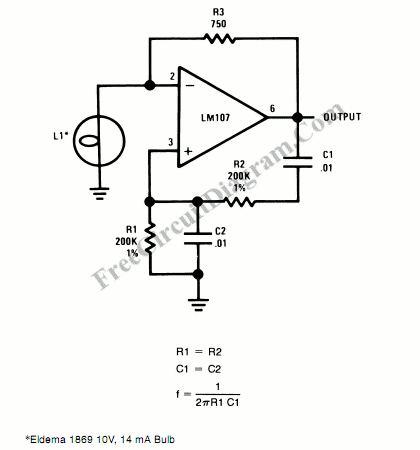
Wien-Bridge Oscillator Using Incandescent lamp Stabilizer
An incandescent lamp has been utilized to reduce harmonic distortion in a sine oscillator circuit. The nonlinear resistance characteristic of the lamp filament assists in this process.
In the context of electronic circuits, the use of an incandescent lamp as a...