


Negative Voltage Hot Swap Controllers in SOT-23
#hot swap controller
#negative voltage
#current limiting
#SOT-23
#LTC4251B
#live backplane
#circuit breaker
#power management

Description: The LTC 4251B, LTC4251B-1, and LTC4251B-2 are negative voltage Hot Swap controllers that facilitate the safe insertion and removal of a board from a live backplane. Output current is regulated through three stages of current limiting: a timed circuit breaker, active current limiting, and a fast feedforward path that restricts peak current during worst-case catastrophic failures. Programmable undervoltage and overvoltage detectors disconnect the load whenever the input supply surpasses the specified operating range. The supply input is shunt regulated, ensuring safe operation with very high supply voltages. A multifunction timer is incorporated to delay initial start-up and manage the circuit breaker's response time. The UV/OV thresholds for the LTC4251B are tailored to align with the standard telecom operating range of 43V to 75V. The LTC4251B-1 expands the operating range to include 36V to 72V, while the LTC4251B-2 features a UV threshold of 43V only. The LTC4251B enhances the robustness of the LTC4251 shunt regulator.
The LTC4251 series of Hot Swap controllers are designed to enable safe board insertion and removal in live systems, minimizing the risk of damage to both the board and the backplane. The three-stage current limiting mechanism is crucial for protecting components from excessive current during fault conditions. The timed circuit breaker provides an initial delay before disconnecting the load, allowing transient conditions to stabilize. Active current limiting continuously monitors the output current, adjusting as necessary to prevent overcurrent situations. The fast feedforward path is particularly beneficial during sudden load changes, as it reacts quickly to limit peak currents that could cause damage.
The shunt regulation feature of the supply input allows the device to handle high supply voltages without compromising safety, making it suitable for applications in environments where voltage levels may fluctuate significantly. The programmable undervoltage and overvoltage detection ensures that the load is disconnected from the supply if the voltage strays outside the designated range, further protecting sensitive components.
The multifunction timer is an integral part of the device, providing flexibility in system design. It can be configured to delay the start-up of the board, allowing other components to stabilize before power is applied. Additionally, it manages the response time of the circuit breaker, ensuring that it operates effectively under varying conditions.
The LTC4251B is specifically optimized for telecom applications, with its UV/OV thresholds set to match industry standards. The LTC4251B-1 variant extends the operational range, accommodating a broader spectrum of input voltages, while the LTC4251B-2 focuses on a fixed undervoltage threshold, catering to specific design requirements. The enhancements in the LTC4251B model further improve the resilience of the shunt regulator, ensuring reliable performance in demanding environments. Overall, the LTC4251 series provides a comprehensive solution for managing power in Hot Swap applications, ensuring both safety and efficiency.The LTC ®4251B/LTC4251B-1/LTC4251B-2 negative voltage Hot Swap controllers allow a board to be safely inserted and removed from a live backplane. Output current is controlled by three stages of current limiting: a timed circuit breaker, active current limiting and a fast feedforward path that limits peak current under worst-case catastrophic fa
ult conditions. Programmable undervoltage and overvoltage detectors disconnect the load whenever the input supply exceeds the desired operating range. The supply input is shunt regulated, allowing safe operation with very high supply voltages. A multifunction timer delays initial start-up and controls the circuit breaker`s response time. The LTC4251B UV/OV thresholds are designed to match the standard telecom operating range of 43V to 75V.
The LTC4251B-1 UV/OV thresholds extend the operating range to encompass 36V to 72V. The LTC4251B-2 implements a UV threshold of 43V only. The LTC4251B improves the ruggedness of the LTC4251 shunt regulator.
The LTC4251 series of Hot Swap controllers are designed to enable safe board insertion and removal in live systems, minimizing the risk of damage to both the board and the backplane. The three-stage current limiting mechanism is crucial for protecting components from excessive current during fault conditions. The timed circuit breaker provides an initial delay before disconnecting the load, allowing transient conditions to stabilize. Active current limiting continuously monitors the output current, adjusting as necessary to prevent overcurrent situations. The fast feedforward path is particularly beneficial during sudden load changes, as it reacts quickly to limit peak currents that could cause damage.
The shunt regulation feature of the supply input allows the device to handle high supply voltages without compromising safety, making it suitable for applications in environments where voltage levels may fluctuate significantly. The programmable undervoltage and overvoltage detection ensures that the load is disconnected from the supply if the voltage strays outside the designated range, further protecting sensitive components.
The multifunction timer is an integral part of the device, providing flexibility in system design. It can be configured to delay the start-up of the board, allowing other components to stabilize before power is applied. Additionally, it manages the response time of the circuit breaker, ensuring that it operates effectively under varying conditions.
The LTC4251B is specifically optimized for telecom applications, with its UV/OV thresholds set to match industry standards. The LTC4251B-1 variant extends the operational range, accommodating a broader spectrum of input voltages, while the LTC4251B-2 focuses on a fixed undervoltage threshold, catering to specific design requirements. The enhancements in the LTC4251B model further improve the resilience of the shunt regulator, ensuring reliable performance in demanding environments. Overall, the LTC4251 series provides a comprehensive solution for managing power in Hot Swap applications, ensuring both safety and efficiency.The LTC ®4251B/LTC4251B-1/LTC4251B-2 negative voltage Hot Swap controllers allow a board to be safely inserted and removed from a live backplane. Output current is controlled by three stages of current limiting: a timed circuit breaker, active current limiting and a fast feedforward path that limits peak current under worst-case catastrophic fa
ult conditions. Programmable undervoltage and overvoltage detectors disconnect the load whenever the input supply exceeds the desired operating range. The supply input is shunt regulated, allowing safe operation with very high supply voltages. A multifunction timer delays initial start-up and controls the circuit breaker`s response time. The LTC4251B UV/OV thresholds are designed to match the standard telecom operating range of 43V to 75V.
The LTC4251B-1 UV/OV thresholds extend the operating range to encompass 36V to 72V. The LTC4251B-2 implements a UV threshold of 43V only. The LTC4251B improves the ruggedness of the LTC4251 shunt regulator.

Current Limiting for Redundant Power Systems
The new TPS2359 hot-plug controller integrates all power management functions for two AdvancedMC (AMC) modules. Its current limiting circuitry enables designers to meet stringent AMC requirements, particularly in applications utilizing redundant supplies. A unique feature called multiswap maintains a fixed...

Negative Voltage Load Swtich
The idea is simply to turn off the negative voltage load. Some examples: - Bias voltages for LCD panels - RF Amplifiers - Audio Amplifiers
The good thing about this design is that I can make use of the system I/O...

Trip Coil Of Circuit Breaker
A trip unit is electrically connected in parallel with a current-limiting polymer element in series with circuit breaker contacts to function as a shunt resistance for the polymer element. It becomes energized when the polymer element transitions to its high...
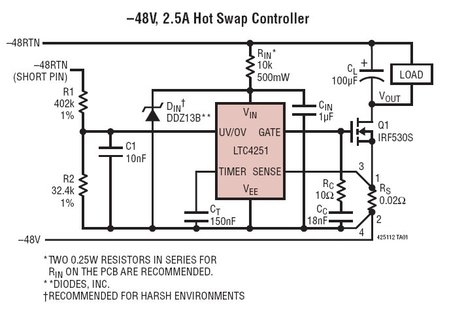
Negative Voltage Hot Swap Controllers in SOT-23
The LTC4251, LTC4251-1, and LTC4251-2 are negative voltage Hot Swap controllers designed to enable the safe insertion and removal of a board from a live backplane. The output current is managed through three stages of current limiting: a timed circuit...

Mains Manager
It is common to forget to turn off peripherals such as monitors, scanners, and printers when shutting down a PC. Typically, these devices are connected to a four-way trailing socket, which is plugged into a wall outlet. If this outlet...

Adjustable Current Limit For Dual Power Supply circuit
This current-limiting circuit, illustrated in this example as part of a small bench power supply, could theoretically be utilized alongside any dual-rail current source. The section of the circuit to the left of the diagram restricts the input current to...

10 Amp 13 8 Volt Power Supply
The circuit includes a current limiting feature that is more reliable than most commercial units. It employs three pass transistors that require heat sinks. Resistor R9 allows for fine-tuning of the output voltage to precisely 13.8 volts, while the resistor...

turn your power supply s power limit current limit
Through simple circuit modifications, designers can use peak current limiting to produce a constant current source.
A constant current source is an essential component in various electronic applications, providing a steady output current regardless of load fluctuations or variations in supply...

Electronic Circuit Breaker
An electronic circuit breaker is designed to detect overload conditions and disconnect power when the load exceeds a predetermined threshold. This circuit is particularly suitable for safeguarding Uninterruptible Power Supply (UPS) devices, such as inverters.
The electronic circuit breaker operates by...