


Transformerless joule thief circuit
#joule thief
#transformerless
#transistors
#inductor
#low voltage
#energy harvesting
#boost converter
#battery
#efficiency
#DIY electronics

Description: This circuit is very similar to a Joule Thief, but it utilizes two transistors, does not include a transformer core, and employs only one inductor.
The described circuit operates on principles akin to those of a Joule Thief, which is a type of boost converter designed to extract energy from low-voltage sources. The use of two transistors instead of one allows for enhanced efficiency and improved performance, particularly in terms of switching speed and output voltage regulation.
In this configuration, the two transistors are typically arranged in a complementary push-pull configuration. This arrangement enables one transistor to conduct while the other is in the off state, effectively alternating between the two to maintain oscillation. The inductor plays a crucial role in energy storage and transfer, charging when one transistor is conducting and releasing energy to the output when the other transistor is active.
The absence of a transformer core simplifies the design, reducing component count and size, which can be advantageous in compact applications. The circuit's reliance on a single inductor means that careful attention must be paid to the inductor's specifications, such as inductance value and saturation current, to ensure optimal performance.
The circuit can be powered by a low-voltage source, such as a single-cell lithium battery or a pair of AA batteries, making it suitable for applications where energy efficiency is paramount. The output voltage can be significantly higher than the input voltage, allowing for the powering of devices that require higher voltage levels.
Overall, this circuit design exemplifies a minimalist approach to energy conversion, leveraging the properties of transistors and inductors to achieve efficient voltage boosting without the complexity of additional components like transformer cores.This is a circuit very similar to a Joule Thief, except that it is using 2 transistors, no transformer core, and only one inductor.
The described circuit operates on principles akin to those of a Joule Thief, which is a type of boost converter designed to extract energy from low-voltage sources. The use of two transistors instead of one allows for enhanced efficiency and improved performance, particularly in terms of switching speed and output voltage regulation.
In this configuration, the two transistors are typically arranged in a complementary push-pull configuration. This arrangement enables one transistor to conduct while the other is in the off state, effectively alternating between the two to maintain oscillation. The inductor plays a crucial role in energy storage and transfer, charging when one transistor is conducting and releasing energy to the output when the other transistor is active.
The absence of a transformer core simplifies the design, reducing component count and size, which can be advantageous in compact applications. The circuit's reliance on a single inductor means that careful attention must be paid to the inductor's specifications, such as inductance value and saturation current, to ensure optimal performance.
The circuit can be powered by a low-voltage source, such as a single-cell lithium battery or a pair of AA batteries, making it suitable for applications where energy efficiency is paramount. The output voltage can be significantly higher than the input voltage, allowing for the powering of devices that require higher voltage levels.
Overall, this circuit design exemplifies a minimalist approach to energy conversion, leveraging the properties of transistors and inductors to achieve efficient voltage boosting without the complexity of additional components like transformer cores.This is a circuit very similar to a Joule Thief, except that it is using 2 transistors, no transformer core, and only one inductor.

Battery state of charge indicator circuit
During the charging process, the green light-emitting diode (LED) VLi indicates that the battery is sufficiently charged, while the red light-emitting diode (LED) VLz illuminates when the battery is low.
The circuit involves two light-emitting diodes (LEDs) serving as indicators for...

joule thief circuit project
The conversion of a circuit from NPN to PNP configuration is in progress, along with a switch in polarity. Parts are being ordered for this modification.
The conversion from an NPN to a PNP transistor involves several key changes in the...

improved vibrating battery
Many blind and deaf-blind individuals utilize portable electronic devices to assist in their daily activities; however, testing the batteries used in such equipment can be challenging. While talking voltmeters are available for the blind, there is no commercially available equivalent...

Joule Thief Circuit Kit
A steam engine powered carousel project that utilizes the Joule Thief circuit.
The project involves the design and construction of a carousel that is powered by a steam engine, showcasing the principles of mechanical motion and energy conversion. The Joule Thief...

power supply Inductive choke with bypass capacitors
An inductor is used in series with a decoupling capacitor, forming a series LC circuit. One of the characteristics of LC circuits is their resonant frequency. A model of this LC circuit was created with a purely resistive load to...
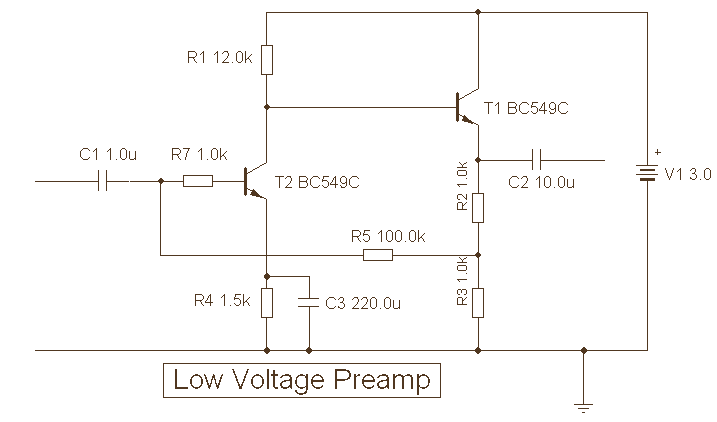
Low Voltage Preamplifier
The provided description pertains to a unique low voltage variant of an audio preamp. The emitter voltage of T1 is biased close to half the supply voltage, which is 1.5V. This biasing allows for the maximum output voltage swing. The...

Joule thief circuit powering a clock
How to create a Joule Thief circuit to power a clock, including circuit details and tips for construction.
The Joule Thief circuit is a simple and efficient boost converter that allows the extraction of usable voltage from low-voltage sources, such as...

Hyper-Simple Battery Capacity Tester
The circuit described is suitable for indicating the capacity of a battery using a low-cost electric clock. By connecting a resistor across the battery terminals, the battery discharges at a faster rate than it would with the clock alone. Selecting...
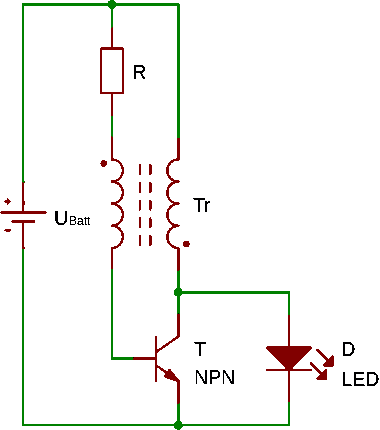
Coin cell battery to 3.3V with Joule Thief circuit
It is a self-oscillating voltage booster. It is relatively simple to build and it will allow you to use almost all the power in the battery, even when its voltage is low.
The self-oscillating voltage booster is a circuit designed to...