


2m VHF FM PMR transceiver to amateur radio converter

Description: The PMR VHF transceiver Motorola Radius M110 (in further text referred as M110) was manufactured by Motorola GmbH therefore being an European radio. Since many professional radio service users has replaced this transceiver with newer gear, a considerable number of M110 has appeared on HAM flea markets. M110 is a simple yet fine transceiver with pretty good receiving performance and it would be a waste to throw it away or to use it just as a source of electronic components instead of giving it a new life in the HAM shack. More: The modification described on this page is not just a reprogramming of the existing 9 channels of the M110 to HAM frequencies. It is a hardware upgrade that will turn the PMR transceiver into a full-featured HAM transceiver. After the modification has been...
The Motorola Radius M110 is a VHF transceiver designed primarily for PMR (Private Mobile Radio) applications. This device operates in the VHF frequency band, making it suitable for various communication needs, particularly in professional and amateur radio environments. The M110 is recognized for its robust build quality and reliable performance, which contributes to its continued popularity among radio enthusiasts, especially as many units become available in the second-hand market.
The transceiver is equipped with a user-friendly interface, allowing operators to navigate through its features with ease. The original configuration provides nine preset channels, which can be utilized for basic communication. However, the potential for modification greatly enhances its functionality. The proposed hardware upgrade transforms the M110 from a simple PMR unit into a versatile HAM transceiver, expanding its operational capabilities significantly.
The modification process typically involves several key steps, including altering the internal circuitry to allow for a broader range of frequencies, adding additional channels, and potentially upgrading the power output capabilities. Specific components that may require replacement or enhancement include the oscillator circuits, filters, and possibly the power amplifier stages.
Furthermore, this upgrade may also involve reprogramming the microcontroller to support the new frequency ranges and functionalities, ensuring compliance with amateur radio regulations. After completing the modifications, the M110 can be reconfigured to operate on various amateur radio bands, thereby providing users with access to a wider range of communication options.
In conclusion, the Motorola Radius M110, with its solid performance and capability for hardware upgrades, represents a valuable asset for both novice and experienced HAM operators. By investing time and resources into its modification, users can revitalize this transceiver and integrate it into their amateur radio setups, enhancing their communication experience.The PMR VHF transceiver Motorola Radius M110 (in further text referred as M110) was manufactured by Motorola GmbH therefore being an European radio. Since many professional radio service users has replaced this transceiver with newer gear, a considerable number of M110 has appeared on HAM flea markets.
M110 is a simple yet fine transceiver with pretty good receiving performance and it would be a waste to throw it away or to use it just as a source of electronic components instead of giving it a new life in the HAM shack. The modification described on this page is not just a reprogramming of the existing 9 channels of the M110 to HAM frequencies. It is a hardware upgrade that will turn the PMR transceiver into a full-featured HAM transceiver. After the modification has bee
The Motorola Radius M110 is a VHF transceiver designed primarily for PMR (Private Mobile Radio) applications. This device operates in the VHF frequency band, making it suitable for various communication needs, particularly in professional and amateur radio environments. The M110 is recognized for its robust build quality and reliable performance, which contributes to its continued popularity among radio enthusiasts, especially as many units become available in the second-hand market.
The transceiver is equipped with a user-friendly interface, allowing operators to navigate through its features with ease. The original configuration provides nine preset channels, which can be utilized for basic communication. However, the potential for modification greatly enhances its functionality. The proposed hardware upgrade transforms the M110 from a simple PMR unit into a versatile HAM transceiver, expanding its operational capabilities significantly.
The modification process typically involves several key steps, including altering the internal circuitry to allow for a broader range of frequencies, adding additional channels, and potentially upgrading the power output capabilities. Specific components that may require replacement or enhancement include the oscillator circuits, filters, and possibly the power amplifier stages.
Furthermore, this upgrade may also involve reprogramming the microcontroller to support the new frequency ranges and functionalities, ensuring compliance with amateur radio regulations. After completing the modifications, the M110 can be reconfigured to operate on various amateur radio bands, thereby providing users with access to a wider range of communication options.
In conclusion, the Motorola Radius M110, with its solid performance and capability for hardware upgrades, represents a valuable asset for both novice and experienced HAM operators. By investing time and resources into its modification, users can revitalize this transceiver and integrate it into their amateur radio setups, enhancing their communication experience.The PMR VHF transceiver Motorola Radius M110 (in further text referred as M110) was manufactured by Motorola GmbH therefore being an European radio. Since many professional radio service users has replaced this transceiver with newer gear, a considerable number of M110 has appeared on HAM flea markets.
M110 is a simple yet fine transceiver with pretty good receiving performance and it would be a waste to throw it away or to use it just as a source of electronic components instead of giving it a new life in the HAM shack. The modification described on this page is not just a reprogramming of the existing 9 channels of the M110 to HAM frequencies. It is a hardware upgrade that will turn the PMR transceiver into a full-featured HAM transceiver. After the modification has bee

VHF/UHF Prescaler
The recommended prescaler is very straightforward. It consists of a single integrated circuit, a TV tuner prescaler, specifically the Philips SAB6456A, which is capable of dividing by 64 or 256. This chip is readily available, both new and in surplus...

GenesisRadio Transceivers
Later, the same pivot table will be utilized to list the parts for each of the eight phases in the build, organizing them into phase-specific bags of parts. The initial observation is that there are slight inconsistencies between the well-illustrated...

VHF MODULATOR circuit
Developed as an interface between the General Instruments AY-3-8500-1 TV game chip and the antenna terminal of a TV set. Adjust capacitor C1 to the frequency of an unused channel to which the receiver is set for playing games. The...

50 kHz FM Optical Receiver
Frequency modulation (FM) can be used to transmit an analog voltage level signal with good noise immunity. The transmission itself might employ different techniques.
Frequency modulation (FM) is a method widely utilized in communication systems to encode information in a carrier...

GE/MACOM MASTR-III VHF Station
This article provides conversion instructions for radio model GE/MACOM MASTR-III Group 2 (150.8-174 MHz) Repeater or Base, Combination Number SXS, to enable it to operate effectively in the 144-148 MHz range. It is important to note that this document is...

Simple VHF FM radio
The RF stage of the receiver utilizes a transistor VT1, functioning as both a mixer and a local oscillator while also serving as a synchronous detector. A headphone cable acts as an antenna, capturing signals that are directed to the...

Switchable Vhf Active Antenna Circuit
The AA-7 active antenna consists of two active components: Q1 (an MFE201 N-channel dual-gate FET) and Q2 (a 2SC2570 VHF silicon transistor), which form the foundation for two independent, switchable RF preamplifiers.
The AA-7 active antenna is designed to enhance the...
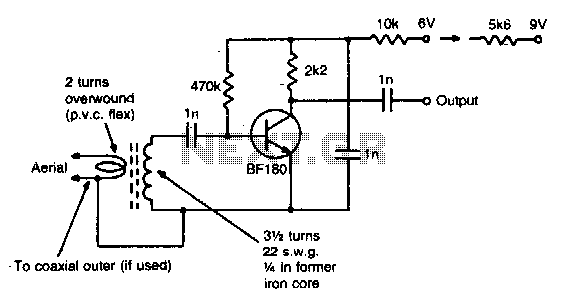
Vhf preamplifier
This simple circuit provides a gain of 15 dB and can be mounted on a 1 inch by 2 inch PCB. Coil specifications are provided for a frequency range of 85 to 95 MHz. For other frequencies, the coil should...

VHF Audio Video Transmitter
The circuit described is a simple audio/video transmitter with a range of 3 to 5 meters. The A/V signal source can be a VCR, satellite receiver, or video game console. A mixer that functions as an oscillator at the VHF...